


When you hear "windshield tint," you probably picture dark, privacy-focused films. But there’s a completely different technology at play that offers powerful protection without changing the look of your glass: clear security film.
Think of it less as a "tint" and more as an invisible shield for your glass. This isn't your standard film designed to darken windows. It's a high-tech, multi-layered polyester film engineered for one primary reason: to make your glass dramatically stronger.
Understanding Windshield Clear Tint: The Invisible Shield
At its core, windshield clear tint, or more accurately, clear security film, is about fortification. It’s a transparent layer that bonds directly to the inside of your glass, reinforcing its weakest points.
The real magic happens when the glass is struck. Instead of shattering into a million dangerous pieces, the film’s powerful adhesive holds the broken shards together. This membrane keeps the glass in the frame, preventing deadly projectiles in a car crash and creating a tough, resilient barrier that seriously frustrates any would-be thief trying to smash their way in.
More Than Just A Tint
While "tint" is in the name, this film's purpose goes far beyond aesthetics. It’s engineered for situations where you need robust protection but can’t sacrifice visibility. That makes it a perfect fit for a wide range of applications, especially here in Southern California.
- Vehicle Windshields: It adds a crucial layer of safety from road debris or accidents without hindering the driver's view of the road.
- Retail Storefronts: This film is a game-changer for protecting high-value merchandise from smash-and-grab robberies while keeping product displays crystal clear.
- Home Windows: You can secure your home against break-ins without altering its appearance or blocking natural light.
- School Buildings: It helps fortify glass in entryways and classrooms, adding precious time and protection for students and staff during an emergency.
This blend of invisible protection and high performance is why the market is booming. The global automotive tinting film sector was valued at $7.12 billion in 2023 and is projected to hit $13.22 billion by 2032. A huge driver of this growth is the demand for clear, high-tech films that block up to 99% of UV rays while adding security. You can dig deeper into the automotive tinting film market and its growth to see the full picture.
One of the biggest myths is that window film has to be dark to be effective. Clear security film shatters that idea, delivering incredible UV and heat rejection plus anti-shatter protection, all while being virtually undetectable.
Clear Security Tint vs. Traditional Dark Tint
So, how does this invisible shield stack up against the dark tint most people are familiar with? It really comes down to their fundamental purpose. Traditional tints are all about privacy, glare control, and changing the look of your car. Clear security films are built from the ground up for safety.
The table below breaks down the key distinctions.
Clear Security Tint vs Traditional Window Tint at a Glance
This quick comparison highlights just how different these two products are, from their construction to their legal standing.
| Feature | Windshield Clear Tint (Security Film) | Traditional Dark Tint |
|---|---|---|
| Primary Purpose | Safety, security, and impact resistance | Privacy, glare reduction, and style |
| Visibility | Optically clear, virtually invisible | Varies from light to very dark (limo) |
| Thickness | Much thicker for strength (4-14 mil) | Very thin (around 1.5 mil) |
| UV Rejection | Excellent, up to 99.9% | Typically 99% |
| Heat Rejection | High, using advanced ceramic technology | Varies based on darkness and material |
| Legal on Windshields | Generally compliant, often above AS-1 line | Heavily restricted or completely illegal |
As you can see, choosing between them isn't about which is "better"—it's about what you need to achieve. For pure, unadulterated protection, clear security film is in a league of its own.
The Science Behind Clear Security Film
How can a thin, transparent film be strong enough to stop a brick in its tracks, yet so clear you barely know it's there? The secret isn’t magic; it’s some pretty incredible material science. Think of it like a high-tech layer cake, where each microscopic layer has a very specific job.
It all starts with a powerful, pressure-sensitive adhesive. This isn't your everyday glue. It’s engineered to create a permanent molecular bond with the glass, effectively making the film an integral part of the window. This bond is what keeps dangerous shards of glass together during an impact.
Next up is the film's muscle: multiple, stacked layers of high-grade polyester.
Unpacking Tensile Strength and Material Science
You know how a single sheet of paper is easy to tear, but a thick phone book is nearly impossible? That’s the same principle at work here. The film’s tensile strength—its ability to resist being pulled apart—comes from stacking these ultra-thin polyester sheets. More layers mean more strength.
This is what allows the film to absorb and spread out the force from a sudden impact, whether it's a thief’s pry bar or a rock kicked up on the freeway.
The thickness of these layers, measured in mils (one-thousandth of an inch), is a direct indicator of its strength. A standard solar tint is usually around 1.5 mils thick. Security films, on the other hand, start at 4 mils and can go all the way up to 14 mils or more for maximum protection. To see how these thicker options are used, check out the applications of car window security film for a deeper dive into vehicle safety.
This simple diagram shows how all the benefits come together in one advanced film.
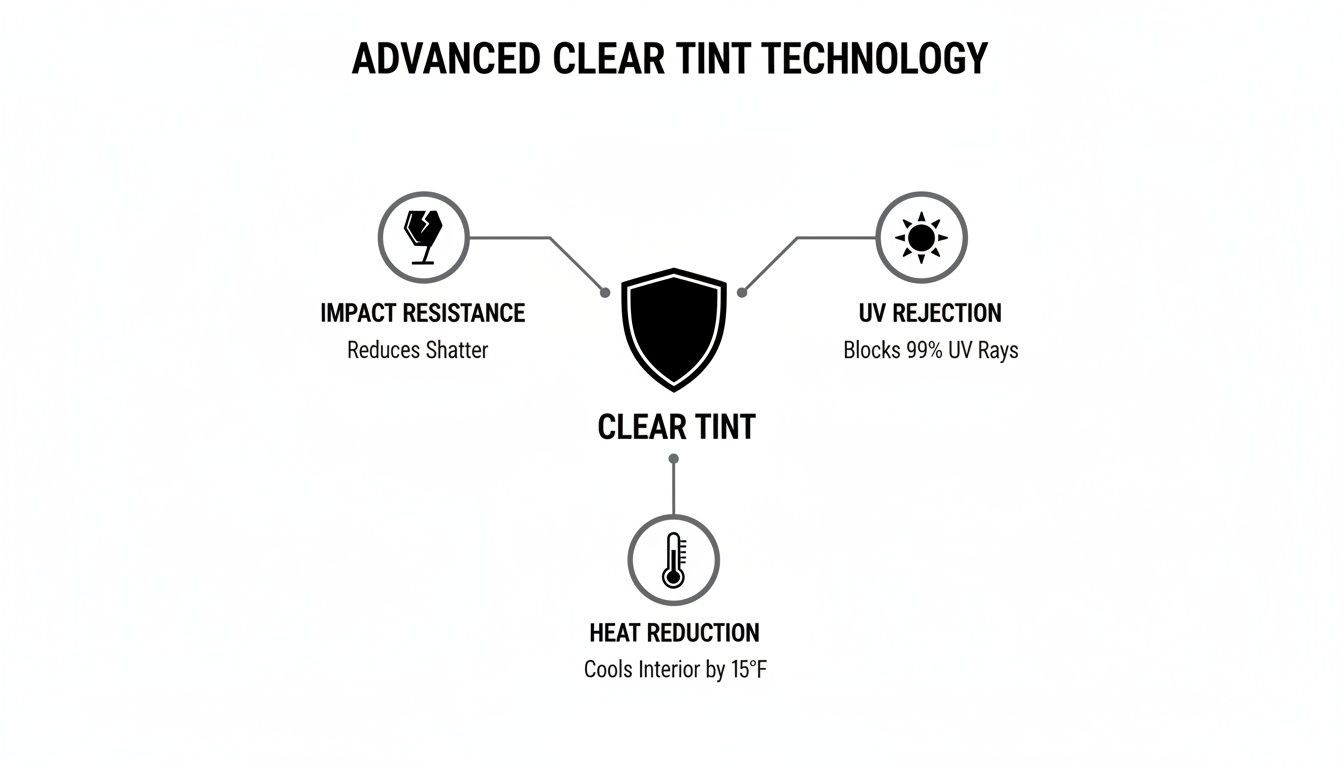
As you can see, a single clear film delivers impact resistance, UV protection, and heat reduction—all thanks to its sophisticated construction.
The Invisible Top Coat Technology
The outermost layer is where the real high-tech work happens. This isn't just a simple scratch coating; it’s embedded with nano-ceramic particles. These microscopic particles are incredibly smart, designed to block specific wavelengths of light.
They target and reject infrared (IR) radiation, which is the part of the sun’s spectrum we feel as heat. At the same time, they block over 99.9% of harmful ultraviolet (UV) rays—the main culprit behind faded dashboards, furniture, and sun damage to your skin.
The real genius of nano-ceramic technology is its ability to be selective. It stops the bad stuff—heat and UV rays—while letting nearly all the visible light pass right through. This preserves your view and the natural look of your windows.
This intelligent filtering is exactly how a windshield clear tint can keep your car dramatically cooler without the dark, limo-tint look. It's the perfect marriage of raw strength and optical science.
When all these layers are combined, you get a product that’s both unbelievably tough and crystal clear. It’s a real feat of modern engineering that turns a simple piece of glass into a protective shield for your vehicle, home, or business.
The Triple Threat: Protection, Clarity, and Savings
When you think about clear film for your windshield, you might wonder what the real payoff is. It's not just one thing—it's a powerful combination of three distinct advantages that work together to completely upgrade your driving experience. You get top-tier protection, perfect visibility, and even some money back in your pocket over time.
This trio of benefits turns a standard piece of glass into a multi-functional shield. Let's break down exactly what that means for you and your vehicle.
Crystal Clear Views, Total UV Defense
The first, and maybe most surprising, benefit is what the film blocks without you ever noticing it's there. A high-quality clear tint is engineered to be optically invisible, yet it manages to block up to 99.9% of the sun's damaging ultraviolet (UV) rays. This invisible barrier is a game-changer for a couple of big reasons.
First, it’s like sunscreen for your car's interior. We’ve all seen the result of constant sun exposure: cracked dashboards, faded seats, and brittle plastic trim. By stopping nearly all UV radiation in its tracks, the film preserves your car's interior, keeping it looking newer for longer and protecting your investment.
Just as importantly, it protects you. Those same UV rays are hitting your skin during every drive, especially on long commutes. A clear tint provides a constant, reliable shield. For those looking to take visibility and protection to the next level, you might also look into specialized windshield ceramic coatings for flawless visibility.
A Major Leap in Safety and Security
This is where clear security films really pull away from the pack. If an object strikes a window treated with this film, the glass doesn't shatter and explode inwards. Instead, the film's powerful adhesive grabs onto every shard, holding the broken pane together in a contained "spiderweb" pattern.
This anti-shatter feature is a critical safety upgrade in a few key scenarios:
- In a Collision: It drastically reduces the risk of injury from flying glass, a major hazard in accidents, and can help prevent occupants from being ejected.
- From Road Debris: A rock flung from a truck on the freeway might crack the glass, but the film is often strong enough to stop it from penetrating the windshield and injuring you.
- Against Break-Ins: The film makes a smash-and-grab attempt incredibly difficult. Thieves rely on speed; when the glass refuses to break, the extra time and noise are usually enough to make them give up and run.
The delay is everything. A thief is working against the clock. When a window holds firm for even a few extra seconds, it completely disrupts their plan and often sends them looking for an easier target.
Real, Long-Term Financial Savings
The final benefit is how the first two come together to save you money. The advanced nano-ceramic technology in these films doesn’t just block UV light—it also rejects a massive amount of infrared (IR) heat. That's the energy you feel as warmth from the sun. On a scorching Southern California day, this means your car's cabin stays remarkably cooler.
A cooler interior means your AC doesn't have to blast on high just to keep up, which can genuinely improve your fuel efficiency. And by preventing your dashboard and upholstery from fading and cracking, you're directly protecting your car's resale value. We have more information on this in our guide to car window tinting benefits.
For vehicle owners in places like Beverly Hills or Palos Verdes, these films can cut interior fading by 60-80% and reduce the load on an HVAC system by 30%. The benefits aren't just for cars, either. Retail storefronts and schools see huge value, with these films proven to slash smash-and-grab incidents by creating that crucial delay during a forced entry. It's clear why these films are seen as essential for protecting both luxury assets and public spaces.
Staying Legal with Windshield Tints in Southern California
Figuring out the window tinting laws in Southern California can feel a little confusing. The rules are pretty specific, and a misunderstanding can easily land you a fix-it ticket. The good news? It's not as complicated as it seems once you understand the one key factor everything hinges on.
California's tint laws are all about Visible Light Transmission, or VLT. Think of it as a simple percentage: it’s the amount of light the film allows to pass through into your car. A lower VLT number means a darker tint, and a higher number means a clearer film.
This is where the difference between a dark, privacy-style tint and a modern windshield clear tint really matters. For obvious safety reasons, California is extremely strict about the front windshield—nothing can obstruct the driver's view.
Understanding California VLT Requirements
The law in California is pretty cut and dry. You're allowed to have a non-reflective tint on the top 4 inches of your windshield. That little strip at the top helps cut down on sun glare, but that's the only place a dark film is legal.
For the rest of the windshield—the main part you look through—any film you apply has to let in at least 70% of the light. This is why you can’t just throw a dark tint on your windshield; its VLT would be way too low, making it illegal and unsafe.
How Clear Security Film Stays Compliant
This is exactly where high-quality clear security films come into play. They're designed from the ground up to meet these legal standards. Instead of using dark dyes or metals to block light, these advanced films rely on nano-ceramic technology.
A common myth is that you need a dark film for real protection. The truth is, a premium windshield clear tint can block 99.9% of UV rays and a huge amount of heat while still letting over 80% of visible light through, keeping it well within California’s legal limits.
This means you get all the benefits—shatter resistance, UV protection, and heat rejection—without any legal headaches. The film is so clear it’s virtually invisible, so your view of the road remains perfect while adding a powerful layer of protection you can't even see.
So, what about the rest of your car?
- Front Side Windows: These also need to let in more than 70% of light.
- Back Side and Rear Windows: Here, the rules relax. You can go as dark as you like on these windows.
By choosing a professional-grade clear tint for your windshield, you’re not just making a smart move for comfort and safety—you're making a fully legal one. You get the anti-shatter security you need without ever having to worry about breaking the California vehicle code. It's just pure peace of mind on the road.
Where Clear Security Film Really Makes a Difference
You can talk about technical specs all day, but the real test of any product is how it holds up in the real world. That’s where clear security film goes from being just a sheet of plastic to a genuine problem-solver for people all over Southern California. Let’s look at a few everyday situations where this invisible layer provides some very tangible protection.
From bustling city streets to quiet suburban driveways, the need for discreet yet effective protection is something we all understand. The film’s versatility truly shines in how it adapts to protect what matters most, whether it's a classic car, a storefront, or your family.
For the Classic Car Owner in Los Angeles
Imagine a car enthusiast in L.A. who has poured their heart and soul into restoring a vintage Porsche. The car’s original, classic look is everything. Slapping a dark, modern tint on those windows would completely ruin the aesthetic. But parking it anywhere, even for a few minutes, is nerve-wracking with the constant threat of break-ins.
This is the perfect job for a high-quality clear security film. When professionally installed, a thick, multi-layered film is optically invisible, so it doesn't change the car's appearance one bit.
Now, the owner can breathe a little easier. That film creates a tough barrier against smash-and-grab thieves, making the car a much less appealing target. Plus, it adds a crucial layer of defense against road debris on the freeway, helping to prevent costly chips and cracks in that original, hard-to-find glass.
For the Retail Manager in Beverly Hills
Think about a manager of a luxury boutique on Rodeo Drive. Their storefront is all about those big, beautiful plate-glass windows showcasing high-end merchandise. While great for business, those windows are also a huge vulnerability for smash-and-grab robberies, which are notoriously fast.
Instead of installing ugly metal grates that scream "fortress," the store opts for a professional-grade clear security film. This film reinforces the glass, making it incredibly difficult for a thief to break through quickly.
A criminal expecting a quick smash-and-run is suddenly met with a window that just won't give way. The glass might crack under the force of the blow, but it holds together in the frame, creating noise and, most importantly, delay—the two things thieves hate most.
The manager gets to protect their inventory and staff without sacrificing the store’s elegant, inviting look. Security is blended seamlessly with style.
For the Safety-Conscious Parent in Arcadia
Finally, picture a parent driving their kids to and from school in a place like Arcadia. Their number one priority is keeping their family safe. They worry about LA's unpredictable traffic, the risk of a collision, and the terrifying thought of glass shattering in an accident.
They decide to have a clear security film applied to every window of their family SUV, not just the windshield. It's a simple upgrade that turns every piece of glass into an active safety feature.
If they're ever in a side-impact collision, the film will hold the broken glass together, preventing a spray of dangerous shards from flying into the cabin and harming their children. It essentially turns standard tempered glass into laminated safety glass. It’s an invisible guardian providing priceless peace of mind on every drive.
These stories show why the broader automotive films market is booming, projected to grow from $11.56 billion in 2023 to $16.56 billion by 2030. For enthusiasts, these films offer impact resistance without violating VLT laws. Beyond cars, schools using security films have reported 30% fewer glass-related incidents, while businesses can cut cooling costs by 20-30%. It’s clear this technology has a wide-ranging impact. You can learn more about these trends in the automotive films market and see where the industry is headed.
How to Choose the Right Clear Security Film
Picking the right clear security film isn't just another item on a checklist; it's a critical decision for your safety and property. With so many options out there, it’s easy to get lost. But it boils down to understanding a few key factors that separate a basic film from a truly protective barrier.
Think of it this way: you wouldn't use a simple padlock to protect a bank vault. The same logic applies here. The level of threat you're trying to mitigate—whether it's a stray baseball, a smash-and-grab burglar, or a more determined intruder—will dictate the kind of film you need. Let’s break down what really matters: thickness, performance specs, and the quality of the installation.
Decoding Film Thickness
The single most important measure of a security film's strength is its thickness. This is measured in mils, where one mil is a thousandth of an inch. It's a simple concept: the thicker the film, the more force it can absorb and the harder it is to tear. A thicker film creates a much tougher barrier.
Here’s a look at what the different thicknesses are really for:
- 4-7 Mil Films: This is your starting point for real safety. A 4-mil film is fantastic for basic shatter resistance, keeping glass shards together if a window breaks accidentally. It’s a great choice for homes with kids and can even delay a smash-and-grab thief for a few valuable seconds.
- 8-11 Mil Films: When you step into this range, you're getting serious protection. An 8-mil film is a workhorse for both homes and businesses, offering a solid defense against a determined burglar. It takes a lot more time and effort to get through, which is often enough to make them give up and move on.
- 12 Mil and Thicker: This is the top tier, reserved for high-stakes security. Films that are 12 mils thick or more are built to handle prolonged, aggressive attacks. You'll find them on jewelry stores, government facilities, and high-end storefronts where delaying entry for as long as possible is the number one priority.
For most cars and homes in Southern California, an 8-mil film hits the sweet spot, delivering robust protection without breaking the bank.
To make it even clearer, here’s a quick guide to help you match the film thickness to your specific needs.
Security Film Thickness Guide
This table breaks down the most common film thicknesses and their ideal applications, helping you choose the right level of protection for your vehicle, home, or business.
| Film Thickness (mil) | Primary Use Case | Protection Level |
|---|---|---|
| 4-7 mil | Basic safety, anti-shatter, smash-and-grab | Good (Holds glass, deters opportunistic thieves) |
| 8-11 mil | Residential & commercial forced entry defense | Excellent (Significant delay against intruders) |
| 12-14+ mil | High-security areas, bomb blast mitigation | Maximum (Withstands prolonged, violent attacks) |
Choosing the right thickness is the first and most important step in securing your glass.
Performance Ratings and Professional Installation
While thickness is king, you can't ignore the film's other specs. Look for its Total Solar Energy Rejection (TSER) rating—a higher number means more heat is blocked, which is a lifesaver for your car or home's AC unit in the SoCal sun. And for any windshield clear tint, make sure it blocks 99% or more of damaging UV rays.
But here’s the thing: you can buy the thickest, most advanced film on the market, and it will be completely useless if it’s installed incorrectly. Professional installation is not just a recommendation; it's a necessity.
A certified installer has the right tools and, more importantly, the experience to ensure a perfect, bubble-free bond to the glass. They know how to handle tricky curves and get that seamless, edge-to-edge coverage that's essential for the film to work properly. A shoddy DIY job leads to peeling, bubbles, and weak spots, defeating the entire purpose of your investment. When you're budgeting, it's also smart to know what goes into the final price, which you can learn about in our guide on the cost of security window film.
Ultimately, paying for a professional install ensures your film performs as promised and protects you for years to come.
Answering Your Top Questions About Windshield Clear Tint
Even after learning about all the benefits, most people still have a few questions before they're ready to commit. We get it. This is an investment in your safety and comfort, and you want to be sure.
Let's walk through the most common questions we hear from customers every day here in Southern California, covering everything from how it looks to how long it lasts.
Will It Make My Windshield Look Bubbly or Distorted?
This is probably the number one concern, and for good reason! The short answer is a firm no, as long as you get it done right.
A high-quality windshield clear tint is designed to be optically perfect. When a certified professional puts it on, it becomes completely invisible. There's no distortion, no haze, no bubbles—nothing but your crystal-clear view. The secret is in both the quality of the film and the skill of the installer, which is why we always stress that a professional job is the only way to go.
How Long Does This Stuff Actually Last?
These films are built to endure. When installed by a pro, a top-tier security film is incredibly durable and meant to last for years and years.
Most of the trusted brands we work with provide a lifetime warranty for automotive applications. For homes and commercial buildings, you're typically looking at a solid 10-15 year warranty.
The film is engineered to handle constant sun and extreme temperature swings without peeling, cracking, or turning that ugly yellow color. And taking care of it is a breeze—just use an ammonia-free cleaner and a soft cloth.
Is This the Same as Bulletproof Glass?
This is a critical distinction to make. Standard clear security film is not bulletproof glass, but it does make your glass significantly safer. Its main purpose is to make the glass shatter-resistant, holding all the pieces together to stop someone from breaking through with brute force.
That said, for those who need a serious step-up in protection, there are specialized multi-layered ballistic films. These are engineered to stop certain projectiles and offer a much higher level of defense. They give you a powerful shield without the crazy cost and weight of replacing your windows with traditional ballistic glass.
Ready to add an invisible layer of protection to your car, home, or business? The experts at Fortress Security Films are here to help with professional consultations and flawless installations using the best materials in the industry. Protect what matters most—learn more by visiting us at https://fortresssecurityfilms.com.
