


Think of window security film as an invisible bodyguard for your glass. It's an incredibly tough, micro-thin layer of polyester that gets bonded directly to your windows. Its main job? To hold shattered glass together when it takes a hit. This one simple feature is what stops a burglar in their tracks and prevents a dangerous shower of glass shards during a storm or accident.
What Is Window Security Film and How Does It Work
Picture a baseball hitting an unprotected window. The glass instantly explodes, sending sharp, dangerous fragments flying and leaving a gaping hole for anyone to climb through. It’s a mess, and it’s a major security breach.
Now, imagine that same baseball hitting a window treated with security film. The glass will still crack, but it won’t shatter and fly apart. Instead, the film holds all the broken pieces together in the frame, creating a tough, spiderweb-like barrier that remains in place.
That’s the core principle behind how security film works. It’s not about making glass unbreakable—it’s about making it shatter-resistant. A professional installer applies the film to the interior side of your glass using a powerful adhesive, forming a permanent bond that’s ready to perform when you need it most.
The Science of Holding It Together
The real strength is in the film's multi-layered polyester construction. When something—a crowbar, a piece of flying storm debris, even an errant golf ball—strikes the glass with force, the glass itself takes the initial shock and breaks. But that's where the film takes over, absorbing and dispersing the impact energy across its surface.
The film stretches and absorbs the force, preventing the glass from collapsing. This action is what transforms a fragile pane into a robust shield, holding the broken pieces tightly in the window frame.
This simple but powerful mechanism delivers two huge benefits right away:
- Deters Forced Entry: Burglars depend on being fast and quiet. When a window refuses to give way after the first or second strike, they lose the element of surprise. That delay is often all it takes for them to give up and look for an easier target.
- Enhances Personal Safety: During a violent storm, an earthquake, or even an explosion, the biggest threat from windows is flying glass. The film contains these razor-sharp shards, protecting everyone inside from serious injury.
Before we dive deeper, here's a quick overview of what window security film brings to the table.
Window Security Film at a Glance
| Core Function | Primary Benefit | Result |
|---|---|---|
| Shatter Resistance | Holds broken glass in place within the frame. | Prevents dangerous flying glass shards and denies quick entry. |
| Impact Absorption | Disperses the energy from blows or projectiles. | Delays and deters forced entry attempts significantly. |
| Invisible Protection | Optically clear film doesn't alter the view. | Maintains aesthetics while adding a powerful layer of security. |
This table neatly sums up how a simple, invisible layer can make such a dramatic difference in safety and security.
A Growing Market Driven by Need
The real-world effectiveness of this technology hasn't gone unnoticed. The global demand for security window film is surging as more people recognize its protective power. Valued at USD 1.5 billion in 2024, the market is projected to more than double, reaching USD 3.2 billion by 2034.
This boom is a direct response to rising security concerns, especially in cities where smash-and-grab burglaries and vandalism are common. Security films are proven to hold glass together against repeated impacts, buying a critical 2-5 minutes for law enforcement to respond. You can discover more insights about this growing market on Precedence Research.
At the end of the day, security film is all about managing how glass fails. By controlling the break, it turns a building's weakest points into sources of strength, safety, and real peace of mind.
Choosing the Right Film Thickness and Type
Picking the right window security film isn't a one-size-fits-all deal. It’s really about matching the film’s strength to your specific situation and what you're trying to protect against. The main way we measure a film's toughness is by its thickness in mils—with one mil being just one-thousandth of an inch. It sounds incredibly thin, but those few extra mils make a world of difference in how much abuse your glass can take.
Think of it like buying a new jacket. You wouldn't wear a light windbreaker in a blizzard, and you don't need a heavy-duty parka on a breezy day. It's the same idea here. The level of protection you need, whether it's stopping a quick smash-and-grab or defending against a more determined threat, will guide you to the right thickness.
This thought process is similar in other industries, too. In the automotive world, for example, car owners often debate the merits of paint protection film vs ceramic coating to shield their vehicle's finish. Each offers a different type of defense, just like the various levels of window film.
Baseline Protection For Safety And Deterrence
For most homes and small businesses, the main goals are to make the easiest entry points more difficult and to improve overall safety. This is where the thinner films really excel.
- 4-7 Mil Films: This is your foundational security layer. It’s more than enough to hold glass together if a baseball hits it or someone accidentally falls against a sliding door. Even better, it's a fantastic deterrent for opportunistic thieves. A burglar who expects the glass to shatter and fall away will be met with a frustratingly strong barrier that holds together, forcing them to waste time and make a lot of noise.
These films are a perfect fit for most residential windows, ground-floor offices, and even interior glass partitions where the biggest risk is accidental breakage or a simple smash-and-grab.
This diagram shows you exactly how the film changes the game, holding shattered glass in place.
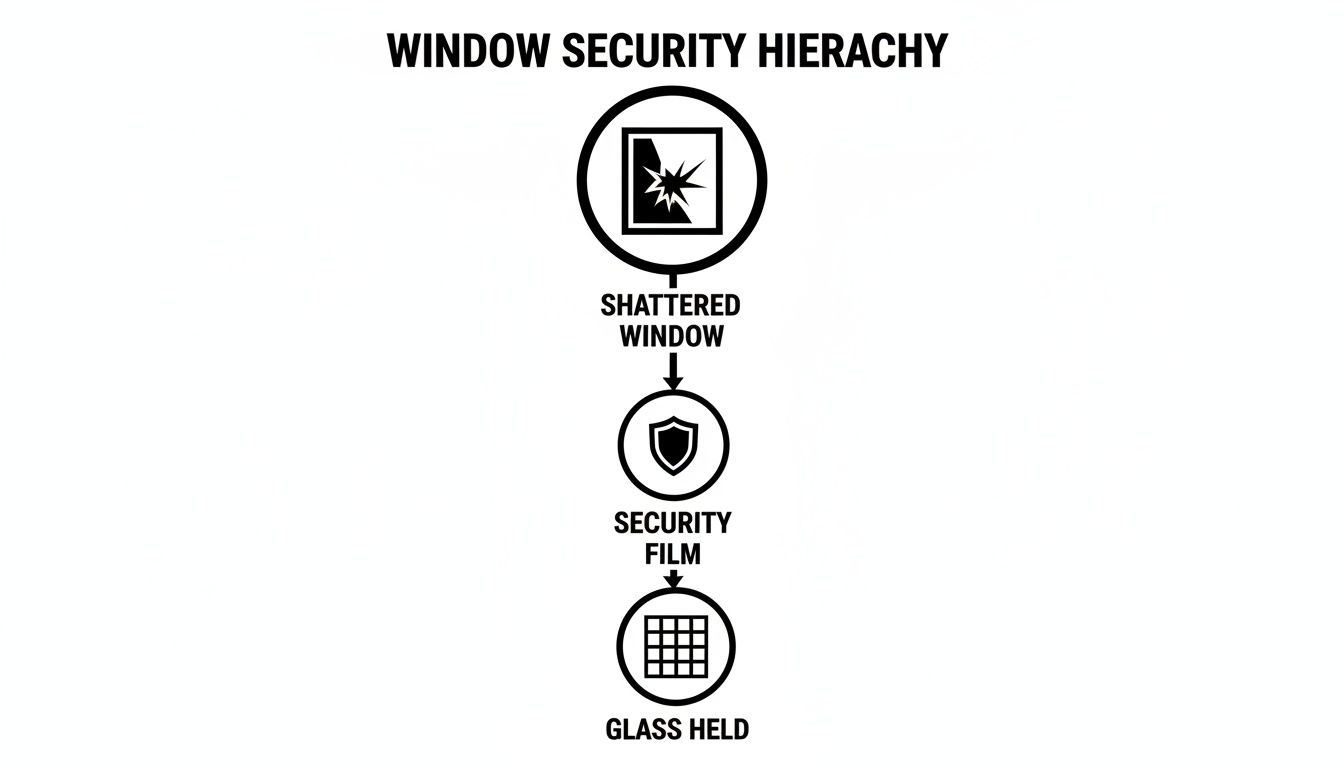
As you can see, the film’s job is to act like a super-strong web, containing the dangerous shards and turning a weak point into a resilient shield.
Mid-Range Security For Determined Threats
When you're dealing with the possibility of more persistent attackers or even the violent forces of Mother Nature, it’s time to step up to a thicker film.
- 8-14 Mil Films: Moving into this mid-range gives you a serious boost in tear and puncture resistance. An 8-mil film can be up to 40 times stronger than a basic 4-mil one, meaning it takes a lot more time and effort to get through. These films are specifically engineered to withstand repeated hits from tools like hammers, bats, or crowbars, making them a smart choice for higher-value targets.
We often see this level of protection on retail storefronts protecting valuable inventory, on government buildings, and on homes in areas that get hit by severe storms or hurricanes. The extra thickness is critical for stopping flying debris and preventing a total window blowout.
If you want to dig deeper into what makes a quality product, check out our guide on finding the best window security film for your property.
Advanced Protection and Ballistic Resistance
For locations facing the highest risks, standard films just won't cut it. This is where advanced, multi-layered systems enter the picture, designed to handle extreme threats.
- 15+ Mil and Multi-Layered Films: These are the real heavyweights. They're often made of multiple layers of film laminated together for exceptional toughness. But the film itself is only half the story. To unlock its full potential, it has to be paired with an anchoring system (sometimes called an attachment system) that mechanically fastens the film directly to the window frame with a special structural silicone or a physical clamp.
This combination creates a single, unified shield. When the window is hit with extreme force—like from a bomb blast or a projectile—the entire system of glass, film, and frame flexes together to absorb and spread out the energy. This is what keeps the whole pane from being blown out of the frame, which is how windows typically fail under extreme stress. Some of these top-tier systems can even achieve an NIJ rating for ballistic resistance, meaning they can stop bullets from certain firearms when installed on the right type of glass. It’s the highest level of window fortification available.
More Than Just Security: The Hidden Perks of Window Film
While stopping a break-in is the main reason people look into security film, the story doesn't end there. Think of it less as a single-purpose security feature and more as a complete upgrade for your windows. Once installed, the film quietly delivers a whole host of other benefits that make your space more comfortable, protect your belongings, and can even trim your monthly bills.
These extra advantages are what really make security film a smart investment for any property owner. It’s one of those rare products that solves multiple common headaches at once, often in ways you wouldn't expect.
A Powerful Sunscreen For Your Interiors
One of the biggest, and often surprising, benefits is the film's incredible ability to block ultraviolet (UV) radiation. A quality security film will stop up to 99% of damaging UV rays from ever entering your windows. It’s like applying a powerful, invisible layer of sunscreen to everything you own.
This isn't just a small bonus; it's a critical defense against the slow, silent damage the sun inflicts on your interiors day after day.
This UV-blocking power works around the clock to preserve:
- Hardwood Floors and Carpets: No more worrying about that bleached-out spot on the rug or the faded patch of flooring where the sun hits just right.
- Furniture and Upholstery: The rich colors of your couches, chairs, and curtains are safe from fading into a washed-out, tired version of their former selves.
- Artwork and Photographs: Your precious paintings, prints, and family photos are shielded from the kind of sun damage that can't be undone.
By getting ahead of this damage, the film helps keep your interiors looking their best and maintains their value for years.
Better Comfort, Lower Energy Bills
On top of UV protection, many security films are also engineered to control solar heat. They’re designed to reject a huge chunk of the sun's infrared rays—the ones that make a room feel uncomfortably hot and stuffy. This immediately creates a more pleasant indoor environment, but the real magic is what it does for your energy costs.
When you block that solar heat, your air conditioning system doesn't have to fight nearly as hard to keep the place cool, especially during those scorching summer months. A lighter workload for your AC means it runs less, which translates directly into lower electricity bills. It's a security investment that can actually start paying for itself.
Plus, that same solar control technology puts an end to frustrating glare. If you've ever had to squint to see your computer screen or angle the TV just to avoid a blinding reflection, you'll love how the film diffuses that harsh light. It makes your space more usable and comfortable without making it feel dark.
This combination of benefits is why the global window film market, valued at USD 2.40 billion in 2024, is expected to grow to USD 3.99 billion by 2032. Here in the U.S., where FEMA data shows hurricanes can destroy up to 70% of a home's windows, these advanced films also provide a crucial shield against extreme weather. In fact, some have been shown to reduce insurance claims by as much as 50% following major storms. You can dig deeper into these trends and the technology driving them with market analysis from Fortune Business Insights.
At the end of the day, window security film is far more than just a barrier. It’s a total upgrade that makes your property safer, more efficient, and a lot more comfortable to live or work in.
Real-World Scenarios Where Security Film Excels
This is where the rubber meets the road. All the technical specs in the world don't mean much until you see how security film actually performs in real life. It's not just about making glass stronger; it's about providing smart, targeted protection for the places we live, work, and learn.
From a quiet home on a suburban street to a busy downtown storefront, every building has its own weak points. The beauty of security film is how it adapts to the specific threats each location might face, acting as an invisible, silent guardian.
Protecting Your Home and Family
Let’s be honest, for any homeowner, peace of mind is everything. Those beautiful, big glass doors and ground-floor windows are also the most tempting targets for burglars looking for a quick, quiet way in. A standard window can be shattered and cleared in seconds.
This is where security film completely changes the game. It turns that vulnerable entry point into a real obstacle. A would-be intruder expecting an easy smash-and-grab suddenly finds themselves faced with a window that just won't give way. The noise and delay are usually more than enough to send them packing.
It's not just about break-ins, either. Think about everyday safety. A child accidentally stumbling into a sliding glass door or a stray baseball from the yard will still crack the glass, but the film holds the dangerous shards together, preventing a trip to the emergency room.
Fortifying Retail and Commercial Spaces
Storefronts are a magnet for smash-and-grab thieves. These criminals can shatter a window, snatch thousands of dollars in merchandise, and be gone in under a minute. The damage isn't just the lost inventory—it's the expensive window replacement and the business you lose while you're shut down for repairs.
Security window film is one of the single most effective ways to stop this kind of crime. By holding the glass firmly in place, it denies criminals the instant access they're counting on. Your valuable assets stay protected, and the financial hit from an attempted break-in is drastically reduced.
This invisible shield works around the clock without altering your storefront's appearance. Your displays stay bright and inviting to customers while being powerfully resistant to criminals. While window security film serves as a formidable physical barrier against forced entry, a truly comprehensive security setup often integrates multiple layers of protection, including advanced surveillance like Homeboy Security Camera systems.
Safeguarding Schools and Government Buildings
In today's world, securing vulnerable spots at schools and public buildings has become a critical priority. Large glass entrances and classroom windows can be seen as soft targets.
Applying a robust security film, especially when anchored to the frame with an attachment system, dramatically hardens these locations. If an attacker tries to force their way through the glass, the film creates a critical delay. Those few extra seconds are invaluable, giving students and staff time to initiate lockdown procedures and allowing law enforcement the time they need to arrive and respond.
This is why the market for these films has grown so much. Safety and security films are a key segment, valued at USD 639.5 million in 2025. This growth is a direct response to some sobering global trends: over 10 million burglaries occur each year, and glass entry points are used in 23% of residential forced entries. After the tragic Parkland shooting in 2018, over 40% of U.S. school districts invested in window films to bolster security. You can find more details on this important market segment by exploring the full safety and security window film report.
Enhancing Automotive Safety and Security
Your car's side windows are made of tempered glass. It’s designed to shatter into thousands of small, relatively blunt pieces in an accident to prevent serious cuts. The downside? This also makes them incredibly easy for thieves to break.
Automotive window security film tackles both safety and security issues head-on:
- Theft Deterrence: The film holds the shattered glass together, creating a tough web that makes a quick "smash and grab" far more difficult and time-consuming for a thief.
- Collision Safety: In a side-impact crash, the film keeps those glass fragments from flying into the cabin and injuring you or your passengers.
It’s a simple addition that provides a crucial layer of protection for you, your family, and your valuables, turning your vehicle's most fragile points into a real source of strength.
What Does a Professional Installation Actually Involve?
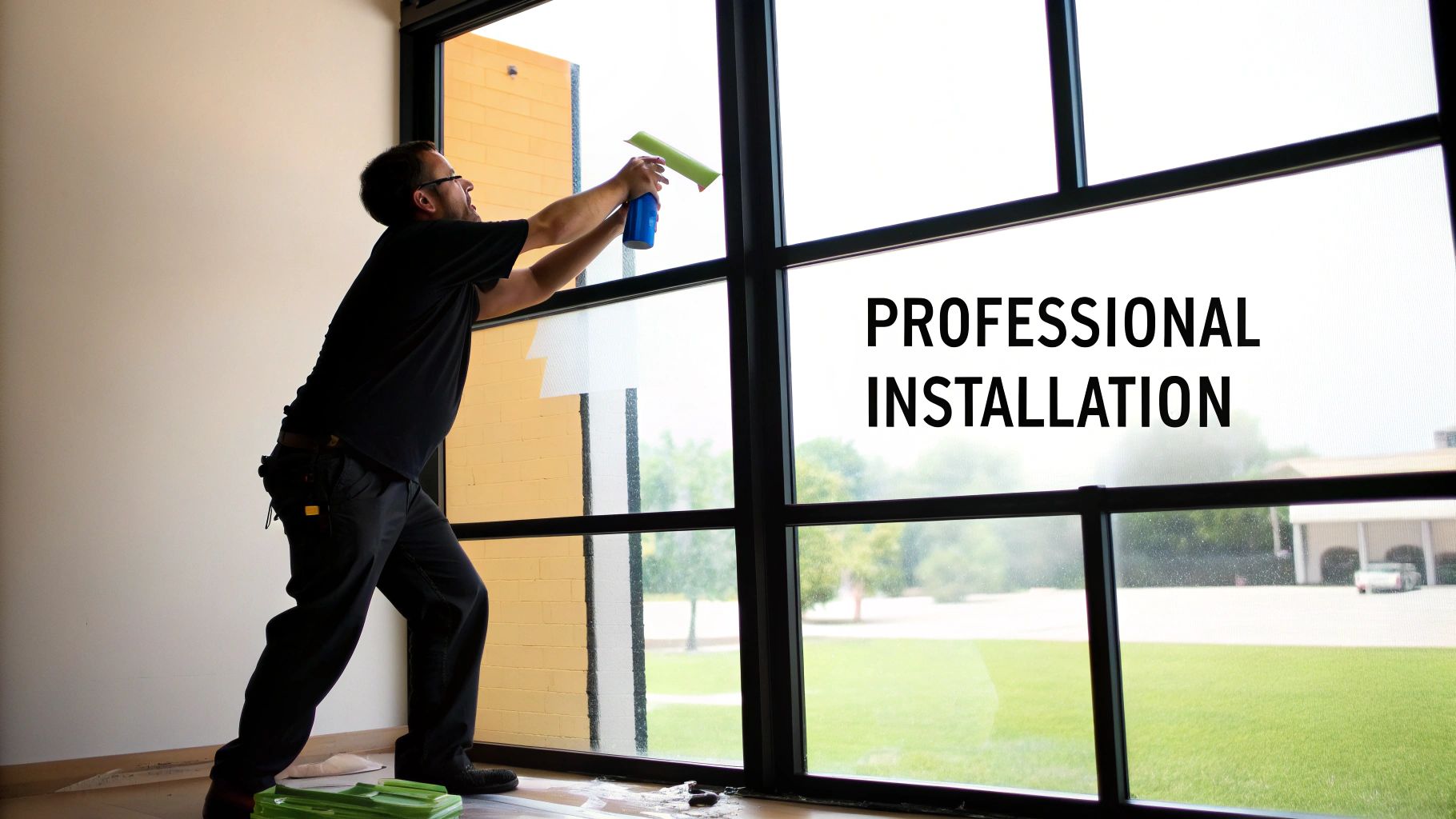
Here's a hard truth: even the best security film on the market is useless if it's not installed correctly. This isn't a weekend DIY project. It’s a craft that requires a surgeon's precision to get that flawless, permanent bond between film and glass. Knowing what the pros do helps you understand why their expertise is non-negotiable for a system that has to work when it matters most.
From the first measurement to the final squeegee stroke, every step is about precision. A certified installer’s job is to make the film a seamless part of your window, creating the invisible, shatter-resistant shield you're paying for.
The Initial Consultation and Measurement
It all starts with a conversation. An expert will come to your property to get a feel for the layout, identify weak points, and talk through what you’re trying to achieve. Based on that, they’ll recommend the right film thickness and type for your specific situation.
Then comes the measuring tape. They will measure every single pane of glass that's getting treated, and these measurements have to be exact. The film needs to be cut for a perfect fit, leaving just a tiny, consistent gap around the edge. This small detail is critical; it allows the glass to expand and contract with temperature changes without stressing the film.
Meticulous Glass Preparation
Before a single piece of film touches the glass, that surface has to be surgically clean. Honestly, this is probably the most critical part of the whole job. A single speck of dust, a fingerprint, or a bit of residue can ruin the adhesive bond and leave an ugly blemish you'll see forever.
Installers don’t just use Windex. They use special cleaning agents, razor scrapers, and professional-grade squeegees to get every last contaminant off the glass. The goal is a pristine surface so the film's adhesive can grab on and form a true molecular bond.
A perfectly prepared surface is the foundation of a successful installation. It guarantees the film will be optically clear and that its adhesive will cure properly, delivering the full strength and protective benefits engineered into the product.
Skilled Application and Finishing
With the glass prepped, the real artistry begins. The installer sprays a special mounting solution—basically, water with a slip agent—onto both the glass and the adhesive side of the film. This lets them literally float the film into the perfect position without it sticking prematurely.
Next, they grab their squeegees and start working from the center out, methodically pushing all the mounting solution to the edges. This does two crucial things at once:
- Activates the Adhesive: It kicks off the bonding process, creating a powerful, even connection across the whole window.
- Eliminates Bubbles: It forces out every pocket of air and water, leaving a finish that's completely smooth and free of distortion.
This step takes a steady hand and a feel that only comes with experience. To see what a professional crew can do, you can learn more about the complete security window film installation process from certified experts.
The Curing Period
Once the installer packs up, the film starts its "curing" phase. It might look finished, but there's still a tiny bit of moisture trapped between the film and the glass. Over the next 30 to 60 days, this moisture will slowly evaporate right through the film’s microscopic pores.
During this time, you may see a slightly hazy or milky look to your windows—don't panic, this is totally normal. The most important thing is to leave the windows alone. Don't clean them or poke at them. This gives the adhesive time to fully harden and reach its maximum strength. Once it's fully cured, the film will be crystal clear and practically invisible.
Breaking Down the Cost, Care, and Long-Term Payoff
When you're considering security film, the initial price tag is obviously a big part of the conversation. But to really understand the value, you have to look beyond that first number. It’s an investment, and like any good investment, it pays you back over time in ways you might not expect.
So, what goes into the upfront cost? A few things. The film's thickness is a major factor—a heavy-duty 14-mil film built to stop a determined intruder is naturally going to be more of an investment than a basic 4-mil film for everyday safety. The size of the job (how many windows and how tricky they are to get to) also shapes the final price.
For places needing maximum protection, we’ll often add a frame attachment system. This mechanically fastens the film directly to the window frame, turning the entire window into a single, unified barrier that can stand up to incredible force. This extra step does add to the cost, but for high-risk areas, it's non-negotiable.
Calculating the True Return on Your Investment
While you can't put a price on peace of mind, you can absolutely measure the financial returns. The ROI for security film goes way beyond just stopping a break-in.
The real value of window security film is found in its continuous, long-term benefits. It's an investment that protects your assets, reduces operational costs, and preserves the value of your property day after day.
Here’s how the investment starts paying for itself:
- Insurance Premium Discounts: Many insurance companies love to see this kind of proactive security. They often offer real, meaningful discounts on premiums for both homes and businesses that have it installed.
- Energy Savings: If you opt for a film with solar control properties, it can bounce a surprising amount of heat away from your windows. Your AC won't have to work nearly as hard, and you'll see the difference on your monthly energy bills.
- UV Damage Prevention: The film acts like a powerful sunscreen for your interior, blocking up to 99% of the UV rays that cause fading. Over the years, that adds up to thousands of dollars saved by protecting your floors, furniture, merchandise, and artwork from sun damage.
When you add it all up, the financial argument becomes pretty clear. For a deeper dive into the numbers, check out our complete guide on security window film cost and what to expect.
Simple Care and Solid Warranties
One of the best things about modern security film is that it’s incredibly low-maintenance. There are no special routines or expensive products needed to keep it in top shape.
Just let the film fully cure, which usually takes about 30-60 days. After that, you can clean your windows pretty much like you always have. The key is to use soft materials like a microfiber cloth or a rubber squeegee and avoid anything abrasive. Skip the ammonia-based cleaners—they can be harsh on the film. A simple mix of mild soap and water is perfect.
This easy-care approach is backed by some serious manufacturer warranties. These policies are comprehensive, covering things like peeling, bubbling, cracking, and discoloration. It’s your guarantee that the film will stay optically clear and perform as promised for years, giving you confidence that you’ve made a lasting security upgrade.
Frequently Asked Questions About Security Film
It's completely normal to have a few more questions, even after digging into the details. When it comes to securing your property, you want to be 100% certain. So, let's tackle some of the most common things people ask us, clearing up any final doubts so you can feel confident in your decision.
Will Security Film Make My Glass Unbreakable?
This is a great question, and the answer is a crucial one: no. It's more accurate to say that security film makes glass shatter-resistant, not unbreakable or shatterproof. The real magic of the film is its ability to hold all the dangerous glass shards together after the window breaks.
Think of it this way: without film, a blow shatters the glass and it flies everywhere. With film, that same blow will crack the glass, but the film and its adhesive grip onto every piece, holding the broken pane in the frame. That’s what buys you precious time against an intruder and stops deadly flying glass in its tracks. Even bullet-resistant systems operate on this principle—the glass breaks to absorb the energy, but the film layers stop the bullet from getting through.
Can I Install Window Security Film Myself?
Technically, you could try, but for genuine security film, it’s a job best left to the pros. You might see DIY kits online, but those are typically for thin, decorative films that offer zero real protection. Installing thick security film is an art and a science; it takes specialized tools and a practiced hand to get that perfect, edge-to-edge bond that can actually withstand a serious impact.
Even more importantly, a DIY job will instantly void the manufacturer’s warranty. If the film isn't applied correctly, it simply won't perform as advertised, leaving you with a false sense of security. A certified installer guarantees the film is applied to spec, ensuring it will work when you need it most.
"A professional installation isn't just about making the film look good—it's about ensuring the adhesive cures perfectly to provide the full, life-saving strength the film was designed to deliver. It is the most critical step in the entire process."
Honestly, a flawless installation is what turns a sheet of film into a true security barrier.
Will The Film Change The Appearance Of My Windows?
Not at all. High-quality security film is optically clear, meaning it’s designed to be virtually invisible once it's installed and cured. It won’t cause any distortion, cloudiness, or that dreaded yellowing effect over time. Your view to the outside remains crystal clear.
Of course, you can opt for films that blend security with other features like solar tinting or privacy frost. But if you’re just looking for protection, the standard clear films add a powerful layer of security that no one will ever know is there. You get to keep your home’s curb appeal and all that beautiful natural light, just with a whole lot more peace of mind.
Ready to transform your most vulnerable entry points into a source of strength? The experts at Fortress Security Films are here to design a security solution that protects your property without compromising its appearance. Secure your home, business, or vehicle by visiting us at https://fortresssecurityfilms.com to schedule your professional consultation today.
