


Let's cut right to the chase. When you're looking at having window security film professionally installed, you can expect the cost to land somewhere between $7 to $20 per square foot. Where you fall in that range really boils down to the specific film you choose—its thickness, its features, and the complexity of the job.
Understanding the Real Cost of Window Security Film
Figuring out the true cost of window security film is about more than just the price of the material. You're really investing in peace of mind, and that final price tag is a mix of the film's protective power, the quality of the brand, and the expertise needed for a perfect, bubble-free application.
Think of it as a spectrum of protection.
A standard, clear 4-mil film offers a fantastic baseline of shatter resistance and will be on the lower end of that cost range. It's a great, practical choice for everyday home safety. But if you step up to a much thicker 8-mil or even 14-mil film that also blocks solar heat and UV rays, you’re looking at a significant upgrade in both security and price. This kind of film does double duty—it makes breaking in much harder and helps lower your energy bills.
It's no surprise that demand for these films is on the rise. The global market was recently valued at around USD 1.5 billion and is projected to nearly double. That tells you just how many home and business owners see this as an essential upgrade. For a deeper dive into market trends, you can explore the growth projections outlined by industry analysts at Verified Market Reports.
Estimated Window Security Film Cost at a Glance
To give you a clearer picture of what to budget for, we've put together a quick summary of typical costs. This table breaks down the average installed price per square foot for the most common types of security film.
| Film Type / Thickness | Average Cost Per Square Foot (Installed) | Best For |
|---|---|---|
| Clear Safety Film (4-mil) | $7 – $11 | General shatter resistance and accident prevention. |
| Clear Security Film (8-mil+) | $12 – $18 | Enhanced protection against forced entry and smash-and-grabs. |
| Solar Security Film (4-8 mil) | $10 – $20 | Combining shatter resistance with UV and heat rejection for energy savings. |
| Anti-Graffiti Film (6-mil) | $9 – $14 | Sacrificial layer to protect glass from vandalism in commercial settings. |
Keep in mind, this is a great starting point, but other things can nudge the final quote up or down. Factors like hard-to-reach windows, intricate window shapes, or the need to remove old film can all add to the labor costs. We’ll get into all those details next.
How Film Thickness and Quality Affect Your Price

When you start looking at quotes for window security film, you'll quickly notice that the biggest factor driving the price is the material itself. It's simple, really: not all films are made the same. The differences in thickness and overall quality are what directly determine how much you'll end up paying per square foot.
Think of it like buying body armor for your windows. A thin vest offers a basic level of protection, but a heavy-duty, multi-layered one provides serious, fortress-like defense. In our world, that strength is measured in mils—with one mil being just one-thousandth of an inch.
A standard 4-mil film is a fantastic starting point. It's designed for shatter resistance, keeping glass from exploding into dangerous shards after an accidental impact. But if you're looking to deter a break-in, stepping up to an 8-mil film gives you a significant boost in strength against deliberate force. For high-security situations, you can even get films that are 14 mils thick or more, creating a truly formidable barrier.
The Role of Film Thickness in Cost
It’s a pretty straightforward relationship: thicker films mean a higher price. They simply require more raw material and involve a more complex manufacturing process.
A thicker film is much better at absorbing and spreading out the energy from an impact. It's like trying to punch through a single piece of paper versus a thick phone book. The phone book’s hundreds of pages work together to dissipate the force, and that’s exactly how security film works on your glass.
This added thickness is directly reflected in your window security film cost:
- 4 to 7-mil Films: We usually call these "safety" films. They’re perfect for preventing injury from accidental breakage and are the most budget-friendly choice.
- 8 to 14-mil Films: This is the sweet spot for true "security" films. They are engineered to handle repeated hits, buying you precious time to react during a break-in attempt.
- 15-mil+ Films: You’ll typically see these films in high-risk commercial or government buildings. They offer the absolute highest level of protection and, as you'd expect, come with a premium price tag.
Beyond Thickness: What Else Influences Price?
While thickness is a huge part of the equation, it's not the whole story. Several other quality factors separate the premium products from the basic ones, and they all contribute to the film’s performance, longevity, and final cost.
The adhesive technology, for example, is absolutely critical. A high-quality adhesive ensures the film bonds perfectly to the glass without bubbling, peeling, or failing over time, especially under stress. This bond is what holds shattered glass together, so a weak adhesive means the whole system is compromised.
The best security films use advanced, pressure-sensitive adhesives that cure over time to form an incredibly strong molecular bond with the glass. This is the "secret sauce" that makes professional-grade films so effective at resisting forced entry.
Other details matter, too. Top-tier brands invest a ton in R&D to achieve exceptional optical clarity, so your view remains crystal clear. Many premium films also use a multi-layer construction that adds benefits like UV protection without distorting the light coming through your windows. All that innovation and quality control is naturally reflected in the price. If you want to see how these features play out in the real world, exploring a variety of security film applications in our blog can give you some great examples.
Choosing the Right Type of Security Film
Let's be clear: not all security films are the same. Thinking they are is a common mistake that can cost you, either by overspending on features you don't need or, far worse, under-protecting your home or business. The final window security film cost hinges directly on the type of film you choose.
Think of it like buying tires. You wouldn't put off-road mud tires on a sports car, right? The same logic applies here. The right film depends entirely on your specific security goals.
H3: Standard Clear Security Films
The most common and budget-friendly option is a standard clear security film. Its one and only job is to make your glass tougher to break. By holding the shattered pieces together, it stops intruders from getting in quickly and prevents dangerous shards of glass from flying everywhere.
Since these films don't have extra features like heat rejection or tinting, they're the most affordable entry point into window security. They're a fantastic choice if your main goal is simply to reinforce the glass and deter break-ins without changing how your windows look.
H3: Hybrid and Specialty Films
If you're looking for more than just a basic shield, hybrid films are where you get multiple benefits rolled into one. These are incredibly popular because they blend security with other practical features.
- Solar Security Films: This is often the smartest investment. Not only do you get the shatter resistance, but these films also block up to 99% of damaging UV rays and cut down on solar heat. This means your furniture and floors won't fade, and you'll actually see a difference in your cooling costs during the summer.
- Anti-Graffiti Films: You'll see these mostly on storefronts and public buildings. They act as a sacrificial, invisible layer on the outside of the glass. If a vandal strikes with spray paint or even etches the glass, you just peel off the damaged film. It's a whole lot cheaper than replacing the entire window.
Naturally, the extra technology in these films means they cost more upfront. But for many people, the long-term energy savings and added protection easily justify the initial expense.
Security Film Type Comparison Guide
To make this even clearer, I've put together a table breaking down the most common film types. This should give you a good sense of what's out there and help you match a film to your specific needs and budget.
| Film Type | Primary Benefit | Typical Thickness (mils) | Relative Cost | Ideal Application |
|---|---|---|---|---|
| Standard Clear | Basic shatter resistance | 4-7 mil | $ | Residential homes, low-risk areas |
| Solar Security | Shatter resistance + heat/UV rejection | 4-8 mil | $$ | Homes/offices in sunny climates |
| Anti-Graffiti | Sacrificial layer against vandalism | 4-6 mil | $$ | Retail storefronts, public transit |
| Thick Security | High-impact and blast mitigation | 8-14+ mil | $$$ | High-risk commercial, government buildings |
The takeaway here is simple: more features and greater thickness will increase the price, but they also provide a higher level of protection and additional benefits.
Choosing the right film thickness is just as critical as selecting the type. The market often segments films based on this metric, as it directly correlates with both the level of protection and the price.
This hierarchy shows how the film's material creates a baseline cost before you even factor in labor.
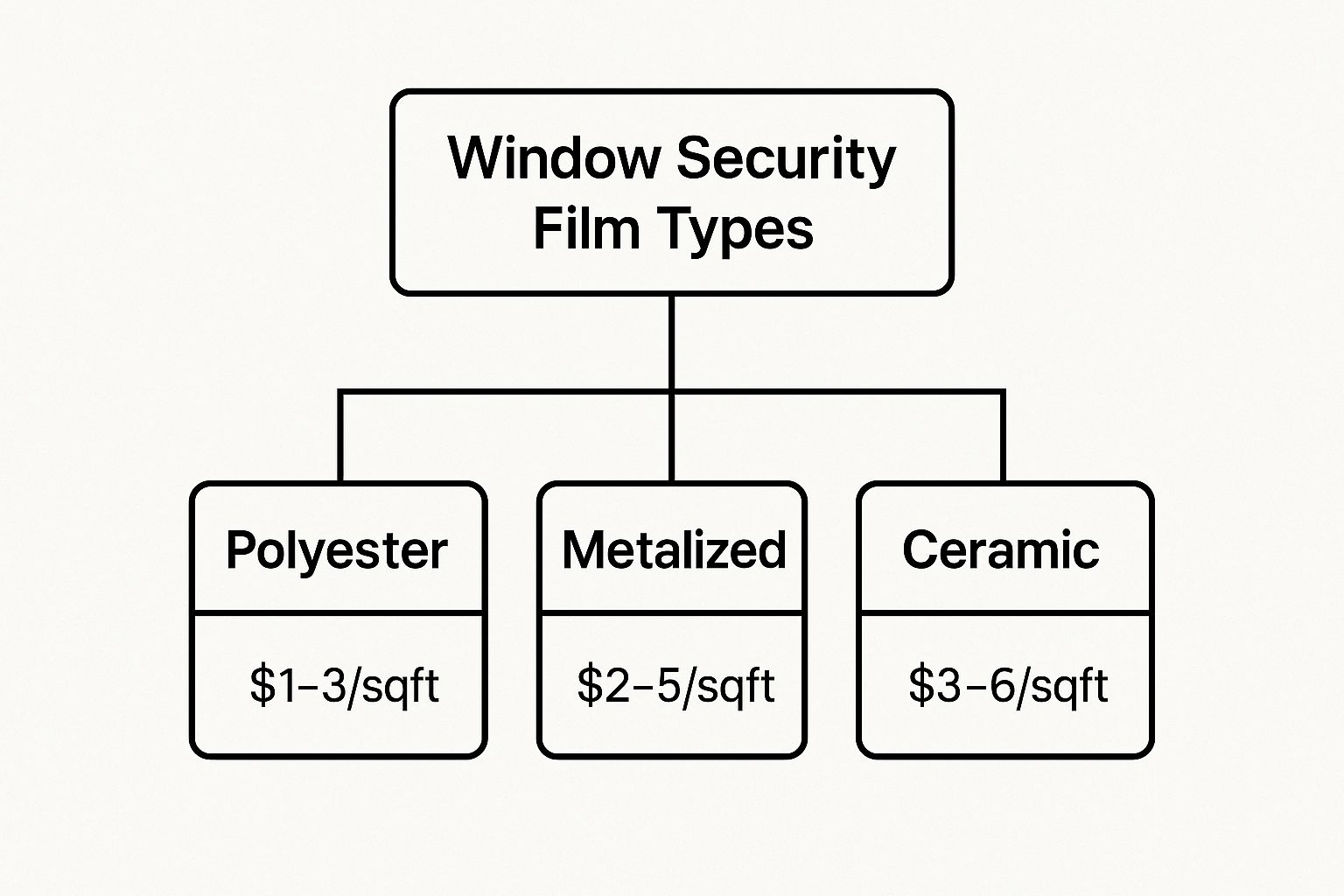
As you can see, the more advanced the material, the higher the cost per square foot. Film thickness is usually categorized like this: anything under 8 mil is great for most homes, 8 to 14 mil is common for higher-risk commercial or government buildings, and films over 14 mil are used for maximum security where you might even be concerned about blast mitigation. If you want to dive deeper into the technical specs, you can check out the latest market analysis on performance levels.
Factoring in Professional Installation Costs
The security film itself is a big part of the equation, but its real power is only unlocked when it's applied perfectly. Think of it like a high-performance engine; you could have the best one in the world, but without a skilled mechanic to install it, you’ll never get the horsepower you paid for. This is why professional installation isn’t just another line item on the invoice—it’s an investment in making sure the whole system actually works.
It can be tempting to go the DIY route to save a few bucks, but a professional install guarantees the film performs exactly as it was engineered to. Getting that flawless, bubble-free finish takes specialized tools, a dust-free environment, and an incredibly steady hand. Even a tiny speck of dust or a small air pocket trapped underneath can create a weak spot, compromising the film's integrity right where it matters most.
What Determines Labor Costs
Installers don't just charge by the square foot. They price the job based on its complexity, which means every project is a little different.
Here are a few things that can move the needle on your final labor quote:
- Window Accessibility: Easy-to-reach, ground-floor windows are one thing. But if the job involves second-story windows, skylights, or anything requiring ladders and scaffolding, the labor time and cost will go up.
- Window Size and Shape: You might think a huge pane of glass is harder, but it's often quicker to cover than a bunch of small, intricate panes, like you’d find on a French door. Arched or circular windows also require precise, custom cuts, which adds to the installation fee.
- Prep Work: Is there old, peeling film that needs to be taken off first? That removal process is a delicate and time-consuming job. Installers have to carefully scrape off the old film and all its adhesive without scratching the glass, and that necessary prep work will be added to your bill.
A professional installation is about more than just sticking film to glass. It’s about ensuring the edges are perfectly sealed and the surface is free of any flaws. This is what activates the manufacturer’s warranty—something a botched DIY job will almost always void.
The Critical Role of Attachment Systems
For the highest level of protection against forced entry, your installer will likely recommend an attachment system. This is essentially a bead of structural silicone or a special gasket that physically anchors the film to the window frame.
Think of the film as a strong net and the frame as the side of a boat. If the net isn't tied down, a big wave will just wash it away. The attachment system is the rope that bonds the film and glass directly to the frame, creating a single, powerful barrier that can absorb far more force. It adds to the upfront cost, but for anyone serious about security, it’s a non-negotiable upgrade. You can see exactly how these systems are integrated by checking out a professional guide on window security film installation.
When you're getting quotes, always ask installers about their experience, if they're certified, and if their estimate includes a full cleanup after the job is done. This helps ensure you're hiring a true expert.
Calculating Your Long-Term Return on Investment
It’s easy to look at the window security film cost and see it as just another expense. But that's missing the bigger picture. Think of it more like a multi-purpose investment in your property, one that keeps paying you back long after the installation crew has packed up.
The upfront cost is just the beginning; the real story is in the return on investment (ROI). Beyond the obvious peace of mind that comes from deterring a break-in, these films have some hidden financial perks that quietly add up over time. They're a silent, hardworking upgrade for your home.
Uncovering Hidden Financial Benefits
What surprises most people is how much a high-quality security film can actually lower their monthly bills. This is especially true for solar security films, which are engineered to do a lot more than just make your glass stronger.
These hybrid films are fantastic at blocking the sun's heat-producing infrared light. What does that mean for you? Your air conditioner doesn't have to work nearly as hard to keep your home cool and comfortable during those brutal summer months, which translates directly into real energy savings.
On top of that, these films act as a powerful shield against damaging ultraviolet rays. They block up to 99% of UV radiation—the main culprit behind fading.
This invisible layer preserves everything inside your home, from your hardwood floors and expensive furniture to custom draperies and cherished artwork. Over the years, that protection can save you thousands in what you would have spent on replacements or restoration.
Insurance Discounts and Property Value
There’s another financial angle to consider: your homeowner's insurance. Many providers see professionally installed security film as a serious safety upgrade, and they reward homeowners for it.
- Potential Premium Discounts: It's absolutely worth a call to your insurance agent. You may qualify for a discount on your premium for adding a protective layer that reduces the risk of break-ins and storm damage.
- Increased Property Appeal: While it’s not cash in your pocket today, a home with enhanced security features is a big plus for potential buyers, which can add to its overall market value when it's time to sell.
This single upgrade contributes to a whole ecosystem of property protection. The global window film market, valued at around USD 11.53 billion, is built on products that deliver safety, energy efficiency, and UV control. This broader context, along with its use in public buildings as discussed in our guide on security window film for schools, really underscores the recognized value of this technology.
Let's get one thing straight about the cost of security film: a lot of myths and bad information are floating around. It's easy to get confused, and that confusion can lead you to either overspend or, worse, make a choice that doesn't actually protect your property.
Time to bust a few of the most common myths I hear all the time.
Myth #1: Security Film Makes Windows Bulletproof
This is probably the biggest and most dangerous misconception out there. Standard security film is not bulletproof. I can't stress that enough. While you can find highly specialized (and very expensive) ballistic-rated films for places like government buildings or banks, the security film we're talking about for homes and businesses is designed to be bullet-resistant.
What's the difference? Its job is to absorb impact and hold the glass together when it shatters. This creates a tough, flexible membrane that makes it incredibly difficult for someone to get through.
Think of it like this: a normal window is like a single sheet of paper—easy to punch through. Security film turns that paper into a sheet of laminated fabric. It won't stop a bullet, but it will prevent an intruder from quickly smashing their way inside, giving you precious seconds to react.
Myth #2: DIY Kits Are Just as Good as Professional Installation
I see this one a lot. People see a DIY kit at the hardware store and think they can get the same level of protection for a fraction of the price. The reality is, you're not just paying for labor when you hire a pro; you're paying for two things you can't get in a box: superior film and a flawless installation.
Professional-grade films are made with stronger materials and much more advanced adhesives. That bond to the glass is everything. On top of that, applying the film perfectly is an art. The smallest air bubble or a poorly trimmed edge becomes an immediate weak spot, completely undermining the film's purpose.
A professional installer also has access to attachment systems, which bond the film directly to the window frame itself. This turns the window, film, and frame into one solid unit, spreading the force of an impact across the entire structure. You simply can't achieve that level of security with a DIY kit. Going the cheap route here often just gives you a false sense of security and a worthless warranty.
Got Questions? We've Got Answers
When you start looking into security film, a few questions always pop up. It's totally normal. Getting these details sorted out helps you see not just the price tag, but the real-world value and what it's actually like to live with this upgrade day in and day out.
How Long Does Security Film Last?
Think of high-quality, professionally installed security film as a permanent upgrade to your windows. For your home, most top-tier films come with a lifetime warranty. That covers things you'd worry about, like peeling, bubbling, cracking, or the film changing color.
For commercial buildings, you’re typically looking at a solid 10 to 15-year warranty. The bottom line is that your initial window security film cost is an investment that's built to last for decades, with a manufacturer's guarantee to back it up.
Of course, things like the quality of the film itself, the skill of the installer, and even your local climate play a role. But with proper care, you can count on it doing its job for a very long time.
Will It Make My Rooms Darker?
This is probably the most common question we get, and it's a great one. The answer is no. Standard clear security films are designed to be optically invisible once they're on the glass. They let the sunlight stream in just like before.
The whole point of security film is to make your glass tougher without changing how it looks. The technology has come a long way, ensuring your views stay perfectly clear. You won't even notice it's there—until it needs to be.
Even if you opt for a solar security film that also blocks heat and UV rays, they come in incredibly light shades that barely affect the brightness inside. You get the protection without feeling like you're living in a cave.
Can It Be Installed on Any Window?
Pretty much! Security film works beautifully on the vast majority of windows you'll find in homes and businesses—single-pane, double-pane, even tempered glass. As long as it's a flat glass surface, installation is usually straightforward.
The only exceptions might be windows with very deep textures or certain pre-existing factory coatings. In those rare cases, it’s best to have an expert take a look first to make sure the film can get a perfect bond. A professional will always assess your specific windows to confirm everything before they start.
Ready to secure your property without sacrificing your view? The experts at Fortress Security Films can walk you through a professional consultation and handle the entire installation, giving you true peace of mind. Learn more about our advanced security film solutions.
