


Think of a window impact rating as a certified measure of toughness. It’s the window’s report card, telling you exactly how it will perform when things get serious—whether that’s a hurricane hurling debris at your home or an intruder trying to force their way in.
Simply put, a higher rating means you're getting stronger, more resilient glass and a frame built to hold its ground. It’s a lot like the safety rating on a car; it’s a standardized, proven benchmark of how well the product stands up to stress.
What Window Impact Ratings Really Mean for You
When a manufacturer labels a window as "impact-rated," they're saying that the entire window system—the glass, the sealant, and the frame—has survived a battery of brutal, standardized tests. These aren’t just marketing buzzwords; they signify a documented ability to resist specific, measured forces.
And this isn't just a concern for people in coastal regions. While a homeowner in Miami is obviously thinking about hurricane winds, that same impact-rated technology gives a store owner in Chicago a powerful defense against break-ins. The goal is the same: to create a barrier that’s incredibly tough to get through.
It's a System, Not Just Stronger Glass
One of the biggest mistakes people make is thinking that an impact rating is all about the glass. But in reality, a truly impact-rated window is a complete, engineered system. Every single part has to work in concert, which is why understanding the full scope of window impact ratings is so critical. Even the strongest pane of glass is useless if its frame buckles under pressure.
The rating depends on several key components working together:
- Laminated Glass: This is the core of the system. It’s usually two panes of glass bonded with a tough, clear interlayer (like PVB or SGP). When the glass shatters, that interlayer grabs onto all the broken shards, keeping the window sealed and the danger outside.
- Reinforced Frames: The frames are built to be rigid, often using heavy-duty vinyl or aluminum that won't twist or fail when hit with massive force.
- Secure Installation: How the window is actually attached to the wall is just as important as the window itself. A proper installation transfers the force of an impact into the building’s structure, preventing the entire unit from being blown in.
At its heart, an impact rating isn't about making a window unbreakable. It’s about ensuring the window maintains its integrity and keeps the building's envelope secure, even after sustaining a significant impact.
This guide will walk you through the specific tests, codes, and ratings you’ll come across. We’ll cut through the technical jargon so you can confidently compare different products and choose the right level of protection for your home, business, or school.
Decoding the Language of Window Safety Standards
When you start looking at impact-rated windows, you’ll quickly run into a sea of acronyms and numbers: ASTM, TAS, FBC, DP ratings. It can feel like alphabet soup. But these aren't just technical jargon; they're the language of safety, and understanding them is the key to knowing what you're actually buying.
Think of these standards as a universal rulebook. They ensure that an "impact-rated" window in Miami has passed the same kind of brutal testing as one in Houston. Without them, every manufacturer would have a different definition of "strong," and you'd be left guessing.
ASTM E1886 and E1996: The Foundation of All Impact Tests
Almost every impact-rated window in the U.S. starts its journey with two tests from the American Society for Testing and Materials, or ASTM. These aren't ratings themselves—they're the playbook for how the tests are run.
ASTM E1996 is the missile test. This is where a 2×4 piece of lumber is fired from an air cannon directly at the window to simulate flying debris in a major storm. It’s a violent, direct impact.
ASTM E1886 is the follow-up. After taking the hit, the window is put on a pressure wall and blasted with thousands of cycles of positive and negative wind pressure. This mimics the punishing push-and-pull forces of hurricane winds trying to tear the weakened window from its frame.
To earn an impact rating, a window has to survive both parts. It can’t just stop the "missile"; it has to stay in one piece and hold firm against the wind that follows.
Miami-Dade TAS 201, 202, and 203: The Hurricane Gold Standard
After Hurricane Andrew flattened parts of South Florida in 1992, officials realized the existing standards weren't enough. They created their own set of even tougher tests, known as the Test Application Standards (TAS).
If the ASTM tests are the standard qualifying exam, the TAS protocols are the Olympic trials. They are designed specifically for High-Velocity Hurricane Zones (HVHZ), the areas most at risk.
- TAS 201: A large missile impact test, similar to ASTM E1996 but often considered more demanding.
- TAS 202: A brutal test for air and water leakage, ensuring the window seals don't fail under pressure.
- TAS 203: The cyclic wind pressure test, like ASTM E1886, but again, pushing the window to its absolute limits.
When you see a window with a "Miami-Dade Approved" certification, you're looking at one of the toughest products on the market.
A window that meets the strict Miami-Dade standards has proven it can stand up to some of the most destructive weather on the planet. It’s the benchmark for serious storm protection.
Florida Building Code: Where the Rules Become Law
So, we have the testing methods from ASTM and the gold-standard protocols from Miami-Dade. But who makes you follow them? That's the Florida Building Code (FBC).
The FBC is the enforcer. It takes those testing standards and turns them into legal requirements for buildings in different parts of the state. If you live in a coastal High-Velocity Hurricane Zone, the FBC says you must have windows that meet these impact codes. It’s not just a good idea; it’s the law.
To help make sense of it all, here's a quick breakdown of the main standards.
A Quick Guide to Window Impact Testing Standards
This table summarizes the most common testing standards, what they measure, and why they matter for your property's protection.
| Standard or Code | What It Measures | Primary Application | What It Means for You |
|---|---|---|---|
| ASTM E1886/E1996 | A window's resistance to debris impact followed by intense pressure cycling. | A nationwide baseline for certifying all impact-rated windows and doors. | This is the fundamental test. A window must pass this to be called "impact-rated." |
| TAS 201, 202, 203 | An even more rigorous set of impact, pressure, and water infiltration tests. | Certification for use in High-Velocity Hurricane Zones (HVHZ), primarily in South Florida. | This certification signals the highest level of hurricane protection available on the market. |
| Florida Building Code | The specific requirements for window strength and impact resistance in a given region. | Legal enforcement of building safety, especially in hurricane-prone areas of Florida. | Tells you the minimum legal rating your windows must have based on your location. |
Understanding these codes helps you see past the marketing and focus on what really matters: verified performance in a real-world storm.
Design Pressure (DP): Measuring Sheer Wind Strength
There's one more crucial rating to know: the Design Pressure (DP) rating. This one isn't about flying 2x4s. It’s all about a window's ability to resist pure, raw wind force.
A DP rating tells you how much wind pressure a window can take before its frame bends, the glass shatters, or the seals fail. It's calculated by testing three things:
- Structural Load: How much wind force the window can handle without breaking.
- Water Penetration: The wind speed at which water is forced through the seals.
- Air Infiltration: How much air leaks through the closed window.
The higher the DP rating, the stronger the window. A window with a DP50 rating, for example, is much more resilient against wind and wind-driven rain than one with a DP30 rating. For coastal regions, a minimum DP50 rating is often the required standard.
When you put it all together—the impact tests, the code requirements, and the DP rating—you can finally look at a window's label and know exactly what kind of protection you're really getting.
How Windows Earn Their Impact Ratings: A Trial by Fire (and Wood)
Getting a high window impact rating isn't just about filling out paperwork. It's a brutal, hands-on process where a window system has to prove it can withstand the kind of raw power you'd see in a major hurricane. To really grasp what these ratings mean, you have to look at the science behind the tests—tests designed to push these products to their absolute breaking point.
It all starts with the most dramatic part of the process: the missile impact tests. These are designed to mimic the number one threat in a big storm—flying debris—which is what causes most standard windows to fail in the first place.
This chart breaks down the typical certification path, showing how different standards build on each other.
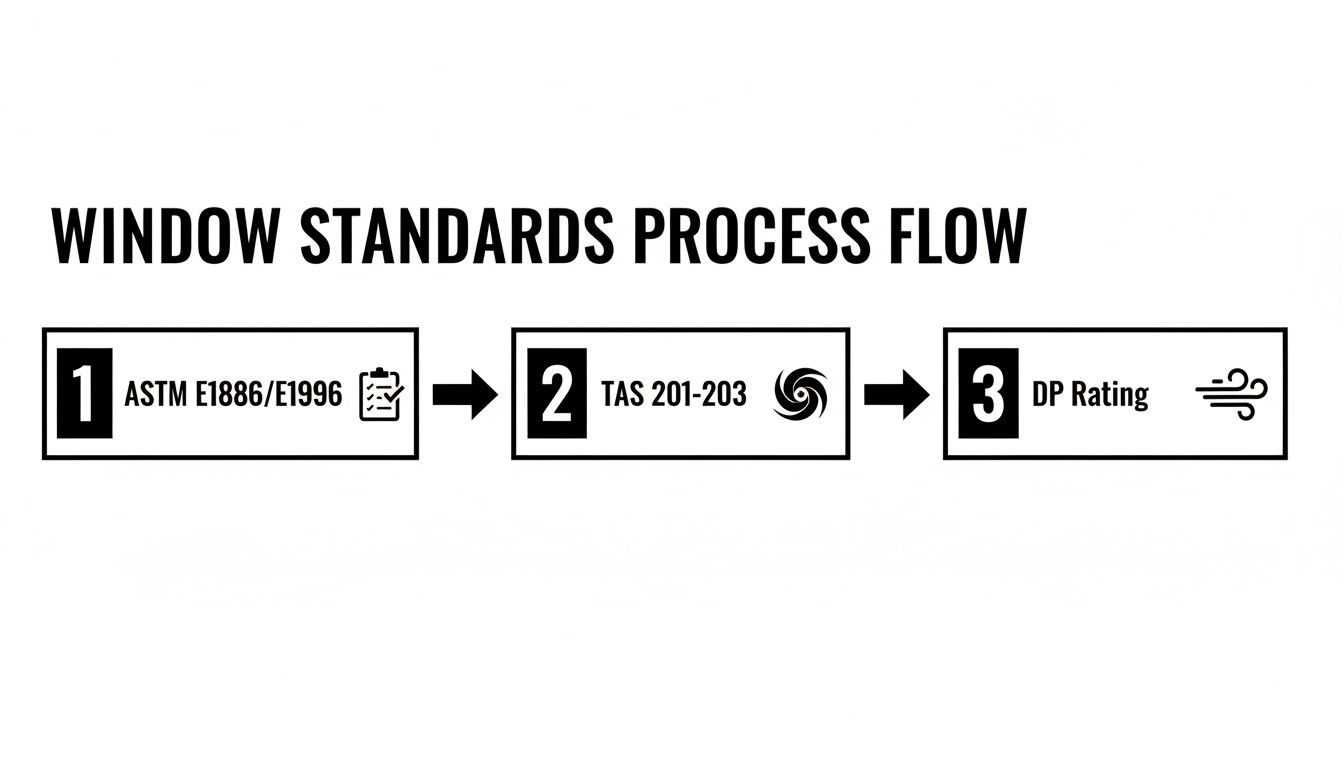
As you can see, a window has to pass the foundational ASTM impact and pressure tests first. Only then can it be considered for the tougher, region-specific approvals like Miami-Dade's TAS standards or earn a high Design Pressure (DP) rating.
The Large Missile Impact Test
Think of this as the heavyweight championship of window testing. Lab technicians take a nine-pound 2×4 timber, about eight feet long, and fire it from an air cannon at speeds hitting 35 miles per hour (or 50 feet per second). The idea is to simulate what happens when a heavy tree branch or a chunk of your neighbor's roof gets ripped off and hurtles toward your house.
The 2×4 is aimed at several key spots on the window, like the center and near the corners, to probe for any weak points. To pass, the glass can crack—and it usually does, quite dramatically—but the protective inner layer has to keep it all together. The key is that the timber can't punch a hole through the window.
The Small Missile Impact Test
While the large missile test is about brute force, the small missile test is all about high-speed punctures. For this test, a handful of small steel ball bearings are shot at the window at a blistering 90 miles per hour (130 feet per second). This is meant to replicate the effect of gravel from a rooftop or other small, sharp bits of debris that essentially become bullets in a hurricane.
Just like before, the goal is to maintain the building's protective shell. The glass must stop these projectiles from getting through, even if it looks like a spiderweb of cracks afterward.
The real goal of these impact tests isn't to keep the glass from breaking. It’s to make sure that even when it breaks, the window remains a sealed barrier. This prevents wind and water from rushing inside, which is what leads to catastrophic pressure changes and structural failure.
Surviving the impacts is only round one. In many ways, the toughest part of the ordeal is still ahead. The window, now damaged and weakened, has to prove it can still handle the relentless push-and-pull pressures of a real hurricane.
The Grueling Pressure Cycling Test
This is where the entire window assembly—the frame, the seals, and the now-shattered glass—is put to the ultimate endurance test. The window is mounted in a special chamber where the air pressure is rapidly increased and decreased, over and over, to simulate the violent gusts of wind that batter a building during a storm.
We're not talking about a few gentle puffs of air. The window is subjected to thousands of these pressure cycles—often more than 9,000 of them—that flex the entire unit inward and outward. The test is designed to see if the cracked-but-intact glass will stay put in its frame or if the pressure will eventually rip it out. If the window gives way at any point during this cycling, the entire product fails its certification.
Passing this full gauntlet of tests is what truly separates a standard piece of glass from a window that has earned its impact rating. It’s a testament to engineering designed for the absolute worst-case scenario. This is especially true for advanced protection; for those exploring the highest levels of security, you can dive deeper into how specialized materials provide ballistic and blast resistance in our article on the topic.
Matching the Right Rating to Your Specific Threat
Choosing the right window protection isn't a one-size-fits-all deal. It's really about looking at your unique situation and figuring out what you're up against. The needs of a quiet suburban home are worlds away from a coastal storefront bracing for hurricane season or a high-security government building. When you match the rating to your actual risks, you get effective protection without paying for overkill.
Think of it like buying tires for your car. You wouldn't put racing slicks on a family SUV that just runs errands around town, right? In the same way, the window system designed to stop a burglar isn't necessarily the one you’d trust to stand up to a Category 4 hurricane.
For Hurricane-Prone Regions
If you live somewhere that hurricanes are a fact of life, you need to zero in on two critical factors: missile impact resistance and a high Design Pressure (DP) rating. These two work in tandem to shield your property from a storm's one-two punch of flying debris and crushing, sustained winds.
First, a window needs to pass a Large Missile Impact test (Level D). This proves it can stop heavy projectiles—like a 9-pound 2×4—blasted at high speeds. This is your absolute first line of defense. Once a window is breached by debris, hurricane-force winds can rush inside and literally tear a building apart from the inside out.
But stopping that initial hit is only half the battle. The window then has to withstand thousands of cycles of intense, fluctuating pressure. That's where a high DP rating comes in. A window with a DP50 rating or higher is built to handle wind forces that can top 170 mph, making sure the entire system—glass, frame, and seals—holds together even after getting smacked by debris. You can get a deeper dive into what makes a window system truly storm-ready in our guide on comprehensive hurricane window protection options.
For anyone on the coast, a Miami-Dade or HVHZ (High-Velocity Hurricane Zone) certification is the gold standard. It’s more than just a label; it’s a guarantee that the window has passed the most brutal tests out there, designed for the absolute worst weather conditions imaginable.
For Everyday Security Against Forced Entry
Move away from the coast, and the main threat shifts from mother nature to people—specifically, burglaries and break-ins. The great thing about impact-rated glass is that its strength against storms also makes it incredibly resistant to blunt force. A standard window shatters with one good hit. An impact-rated window, however, is a whole different story.
An intruder wants to be in and out, fast and quiet. An impact-rated window or one retrofitted with security film completely upends that plan.
- It Absorbs Energy: The tough, flexible interlayer inside the glass absorbs the shock from a hammer, rock, or pry bar, keeping the pane from collapsing.
- It Delays Entry: Instead of shattering, the glass just cracks into a spiderweb pattern while staying locked in the frame. This forces an intruder to waste precious minutes—and make a ton of noise—just to create a small opening.
- It Creates a Deterrent: That delay is usually enough to send them packing. The more time they spend, the higher their risk of getting caught. In fact, law enforcement data shows most home burglaries are over and done in less than 10 minutes.
This added layer of security is a big reason the market is growing so fast. The global demand for impact-resistant glass was valued at around USD 31.1 billion, and it's projected to soar to USD 64.07 billion by 2034. You can see the full trend analysis and research over at Precedence Research.
For High-Risk Blast and Ballistic Threats
For buildings facing more extreme threats—think government facilities, prominent corporate headquarters, or schools—standard impact ratings are just the beginning. The same technology that stops a hurricane-tossed 2×4 provides a solid foundation, but it was never designed to stop a bullet or contain a bomb blast.
These high-risk scenarios demand specialized, purpose-built solutions:
- Ballistic-Rated Glass/Film: These products are tested and certified to very specific standards from the National Institute of Justice (NIJ). An NIJ Level IIIA system, for instance, can stop most handgun rounds, while higher levels are engineered to defeat rifle fire.
- Blast Mitigation Systems: These systems pair thick, multi-layered films with advanced anchoring mechanisms (often called "attachment systems") that physically bond the filmed glass to the window frame. If an explosion occurs, the film holds the deadly glass shards together, preventing them from becoming lethal projectiles.
It's absolutely critical to remember that a "hurricane-proof" window is not "bulletproof." Each type of threat requires a solution that was specifically engineered and tested to defeat it. By matching the right protection to your environment, you can ensure you’re getting real security and genuine peace of mind.
A Practical Checklist for Evaluating Window Security
Knowing the technical specs of window ratings is one thing, but putting that knowledge to work on your own property is where real security begins. Let’s move from theory to action. This checklist will give you a clear framework for spotting your current vulnerabilities and figuring out the best way to fix them.
It all starts with a simple visual inspection of what you already have. This quick assessment creates a baseline, helping you understand where you stand before making any decisions.
Step 1: Assess Your Existing Windows
Before you can think about upgrades, you need to know your starting point. Take a walk around your property and give your windows a close look. You're looking for clues about their strength and construction.
You can often find key details etched right into the corner of the glass or printed on a label tucked inside the window frame.
- Look for Markings: Check for any text that says "tempered" or lists a code like ANSI Z97.1. While this isn't a formal impact rating, it tells you the glass is stronger than standard annealed glass.
- Inspect the Frames: Are the frames flimsy vinyl, or something more substantial like reinforced vinyl or aluminum? Look for any signs of warping, cracking, or rot—a weak frame will fail no matter how strong the glass is.
- Check the Locks: What kind of locking mechanisms are you working with? Simple latches, or something with multiple locking points? Weak locks are often the first thing to give way in a forced entry.
Remember, truly securing your property goes beyond just the glass. This practical guide to securing windows offers great advice on reinforcing locks and frames to create a complete defense.
Step 2: Define Your Primary Security Goals
Next, you need to get crystal clear on what you’re trying to protect against. The specific threats you face will point you directly to the right solution, so you don't waste money on protection you don't need. Ask yourself a few honest questions:
- Is my main worry a quick smash-and-grab burglary?
- Am I in a region that gets hit with hurricanes or severe windstorms?
- Do I need to think about risks from potential blasts or civil unrest?
- Would reducing outside noise be a valuable bonus?
Your answers are your road map. For example, basic forced-entry protection might just call for a quality security film, whereas preparing for a hurricane demands a fully certified impact window system with a high DP rating.
Defining your threat is the most critical step. It’s the difference between buying a security product and implementing a true security solution tailored to your environment.
Step 3: Evaluate Retrofit Solutions Like Security Film
A full window replacement is a massive project and a huge investment. The good news is, it’s not always necessary. Modern retrofit solutions—especially high-performance security films—can deliver a powerful upgrade and significant impact resistance for your existing windows.
So what is it? Security film is a thick, optically clear polyester sheet that a professional applies to the inside of your glass. Its job is to create an incredibly strong membrane that holds shattered glass together.
This turns a standard window into a serious barrier. Instead of exploding inward after an impact, the glass cracks but stays locked in the frame, held tight by the film. This buys precious time against an intruder and stops dangerous debris from flying through your home during a storm, often at a fraction of the cost of new windows. By using this checklist, you can move confidently from assessing your risks to taking effective action, creating a safer, more secure property.
What's Next? Putting Your Knowledge Into Action
You've made it through the technical details of window impact ratings. That's the hard part. Now, it's time to use that knowledge to make your property safer. Moving from understanding to action is what creates real security and peace of mind.
Of course, the right next step depends on who you are. A homeowner's needs are different from a retailer's, and an architect's role is different from them all.
For Homeowners
Your job is to figure out where your home is most vulnerable. Don't just guess.
- Get a Professional Risk Assessment: Have an expert walk your property. They'll spot the weak points you might miss—like that easy-to-access ground-floor window or the aging sliding glass door—and suggest the right fixes.
- Explore Security Film First: Before you jump to expensive window replacements, get a quote for a professional security film retrofit. It's often a highly effective and more affordable solution. You can learn more about the process in our guide to professional security window film installation.
- Think Beyond the Glass: Remember that strong glass isn't the whole story. It's just as important to secure your windows by ensuring the frames and locks are just as tough.
For Commercial Property Managers and Retailers
If you're managing a commercial space, your decisions come down to a practical cost-benefit analysis.
The core question for any property manager is this: What's the better investment—the upfront cost of a security film retrofit, or the much higher cost and disruption of a full window replacement? Don't forget to factor in the potential losses from a break-in, vandalism, or the downtime that follows.
The best way to start is by getting detailed proposals for both options. Pay close attention to the installation timeline. A retrofit can often be done quickly with minimal disruption, which is a huge advantage for any business.
For Architects and Builders
For those on the design and construction side, safety can't be an afterthought. It has to be baked in from the blueprint stage. Specifying the right impact-rated windows from the get-go is non-negotiable, especially in any area prone to severe weather or other threats.
Meeting or, even better, exceeding local building codes like the rigorous Florida Building Code is your baseline responsibility. This focus on building stronger is a clear trend. The global market for hurricane impact windows, valued at around USD 14.2 billion, is expected to climb to USD 23.5 billion by 2032. You can discover more insights about these market projections to see where the industry is heading.
At the end of the day, putting money into the right window protection is an investment in safety, security, and the simple comfort of knowing you're prepared.
Your Impact Rating Questions, Answered
Let's clear up some of the most common questions people have when they start digging into impact ratings. Getting these details straight is key to making a smart decision about protecting your building.
Can Security Film Make My Windows Hurricane Proof?
This is a great question, and the honest answer is no, not in the official sense. While a high-quality security film makes your glass incredibly resistant to shattering and impact, it doesn't earn the official "hurricane-proof" label on its own.
A true hurricane-rated window is an entire system—the glass, the extra-strong frame, and the way it's anchored to the building are all engineered to work together against extreme, sustained wind pressure. Security film is a fantastic upgrade that holds shattered glass in place against flying debris and is a top-tier solution for preventing break-ins. It just doesn't address the frame's ability to resist being blown in or out.
How Is a DP Rating Different from a Missile Impact Rating?
It's easy to get these two mixed up, but they test for two different, equally critical threats during a storm.
A missile impact rating (from tests like ASTM E1996) is exactly what it sounds like. It tests whether the window can take a direct hit from flying debris—like a piece of lumber—without being punctured. Think of this as the brute force test.
A Design Pressure (DP) rating, on the other hand, measures how well the entire window unit holds up against the relentless push-and-pull of powerful wind gusts. A true hurricane window needs to pass both tests with flying colors, because a major impact from debris is almost always followed by intense wind trying to tear its way inside.
Here's a simple way to think about it: The missile rating stops the flying object, and the DP rating stops the wind trying to get through the opening. You need both for real storm protection.
Are Impact Rated Windows a Good Investment Outside Hurricane Zones?
Absolutely. The same features that make a window tough enough for a hurricane make it a serious obstacle for a potential intruder. After all, a window that can withstand a 9-pound 2×4 flying at it is more than a match for a hammer, a crowbar, or a kick. It creates a powerful deterrent that can buy precious time.
Beyond security, these windows often provide much better sound insulation and UV filtering than standard glass. That means a quieter, more comfortable interior and less fading for your furniture and flooring—benefits you'll appreciate every single day, no matter the weather.
At Fortress Security Films, we specialize in upgrading your existing glass into a powerful protective barrier. Explore our advanced residential and commercial window security solutions to find the perfect fit for your property. Learn more at https://fortresssecurityfilms.com.
