


The short answer is yes, you can absolutely put window film on skylights. It's not just possible; it's a popular and highly effective way to manage intense heat, slash annoying glare, and block up to 99% of damaging UV rays, all without sacrificing the natural light you love.
Your Quick Start Guide to Skylight Films
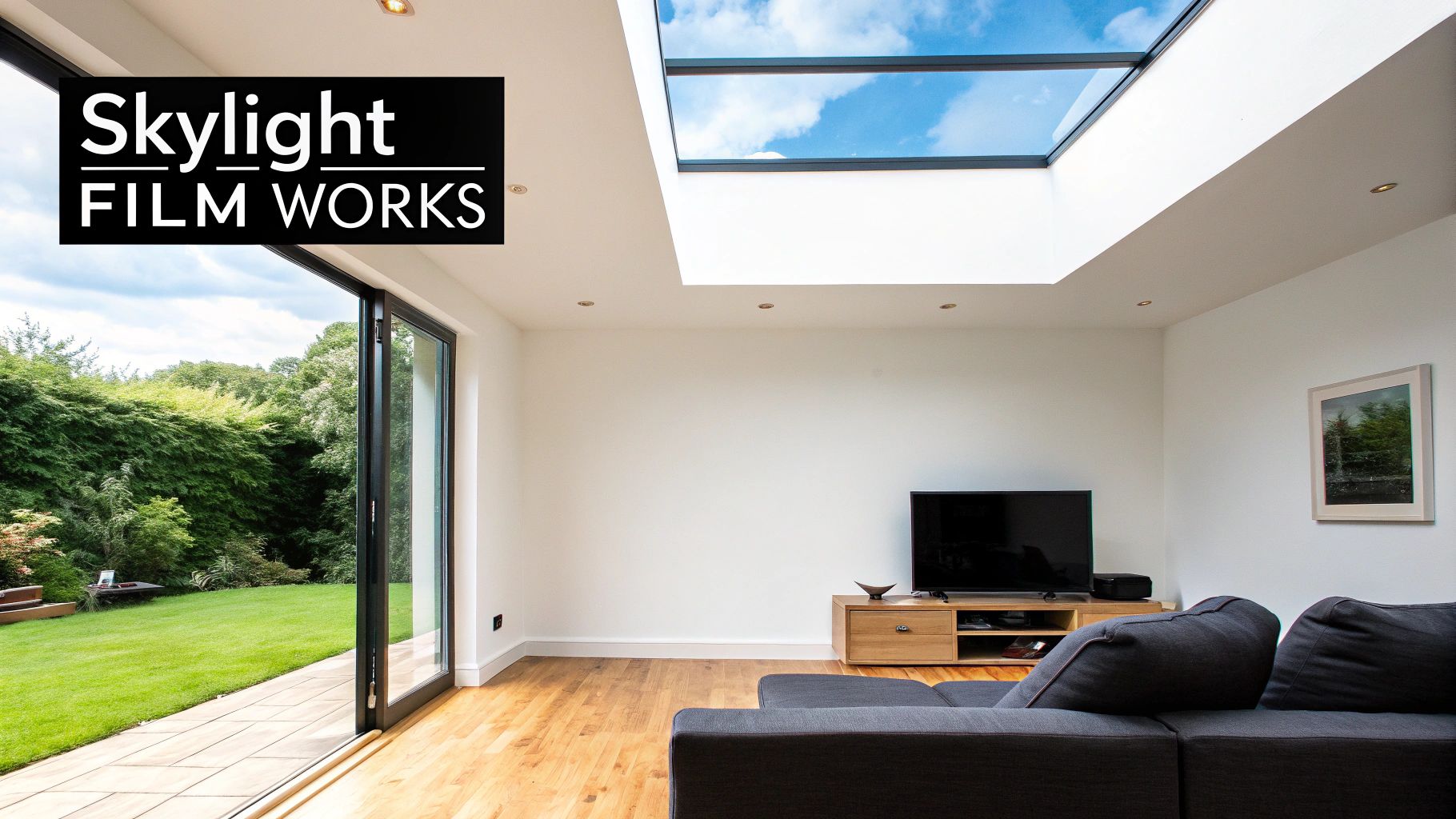
We all love skylights. They’re a brilliant architectural feature, flooding our homes and offices with beautiful, mood-lifting sunlight. But that direct exposure often brings a few unwelcome guests to the party: rooms that feel like greenhouses, faded furniture and flooring, and harsh glare that makes screens impossible to see.
That's where specialized window film comes in. Think of it as a pair of high-tech sunglasses for your home. This thin, durable layer is applied directly to the glass, engineered to filter the sun's rays selectively. It stops the infrared rays that crank up the heat and the UV rays that cause fading, while letting the pleasant visible light stream in.
The Immediate Benefits of Film
Let's break down the tangible benefits you'll notice almost right away. This simple upgrade provides a powerful solution to the most common problems that come with owning skylights.
Immediate Benefits of Skylight Window Film
| Benefit | What It Means for You | Real-World Impact |
|---|---|---|
| Drastic Heat Reduction | Blocks up to 80% of solar heat. | Lower A/C bills and a more comfortable room, even on the sunniest days. |
| Superior UV Protection | Stops nearly all harmful UV radiation. | Protects your furniture, artwork, and floors from fading and sun damage. |
| Serious Glare Control | Softens and diffuses harsh sunlight. | No more squinting to watch TV or work on your laptop. |
| Preserved Aesthetics | The film is virtually invisible. | You keep your clear view and the clean look of the skylight—no bulky blinds needed. |
The best part? These advantages start working the moment the installation is complete, making your home's climate more stable and comfortable.
Material and Installation Considerations
Getting great results with window film on skylights boils down to two things: picking the right film and getting a perfect installation. The material of your skylight itself—whether it's glass, acrylic, or polycarbonate—is the first thing to consider, as it dictates which films are compatible.
For example, trying to use a film designed for glass on a plastic surface is a recipe for disaster. The plastic can "outgas," causing bubbles and ultimately damaging both the film and the skylight. It pays to get this right from the start.
This guide focuses on the film itself, but for those interested in understanding more about skylights in general, learning about their construction and types can provide excellent background knowledge. With a solid foundation, you can make smarter decisions about enhancing your skylights for maximum comfort, protection, and efficiency.
How Skylight Films Actually Work
Think of your skylight as a giant lens aimed straight at the sun, pouring light and energy into your home. It’s fantastic for natural brightness, but that lens also channels in a ton of invisible heat and damaging radiation. This is where a high-performance window film on skylights comes in, acting like an intelligent gatekeeper to turn that lens into a smart, protective barrier.
It's a lot like putting a high-tech pair of sunglasses on your house. Just as polarized sunglasses cut through harsh glare so you can see clearly, skylight film is engineered to block specific parts of the sun's spectrum. It’s smart enough to stop most of the invisible, heat-carrying infrared (IR) light and the fabric-fading ultraviolet (UV) rays, all while letting the pleasant, visible light pour through.
This selective filtering is what makes the technology so brilliant. You get to keep your bright, sunlit rooms without baking in them.
The Science Behind the Filter
So, how can a nearly invisible sheet of material be so effective? The secret is in the microscopic layers and particles baked into the film itself. Different types of film use different methods to wrangle solar energy.
- Ceramic Films: These films are embedded with non-metallic, nano-ceramic particles. They're fantastic at absorbing and reflecting solar heat without creating a mirror-like shine or messing with your Wi-Fi signal. Their sheer durability makes them a go-to choice for skylights, which take a beating from the sun day in and day out.
- Carbon Films: Infused with tiny carbon particles, these films offer a more subdued, matte look. They do a solid job of blocking infrared heat and strike a great balance between performance and aesthetics, avoiding the metallic sheen you see on older films.
- Spectrally Selective Films: This is the top-shelf stuff. These advanced films are engineered to target and reject very specific wavelengths of light—primarily the heat-producing infrared rays—while being virtually invisible to the naked eye. They can block up to 60% of the total solar energy coming through the glass without making your room noticeably darker.
The real job of skylight window film isn't just about blocking light. It's about intelligently managing the entire solar spectrum—separating the good light from the bad heat and UV—to make your home more comfortable and protect what's inside.
A Market Driven by Performance
It's no surprise that the demand for these smart filtering solutions is on the rise. In 2022, the solar control window film market—the category most relevant to skylights—was valued at USD 763.81 million globally. Experts project it will soar to nearly USD 1.27 billion by 2030, all because people are looking for simple ways to cut down on solar heat and protect their homes.
Vacuum-coated films, prized for their ability to reflect radiation and slash cooling costs, owned over 47% of the market in 2022. This just goes to show that the industry is laser-focused on high-performance options that deliver real results. You can read more about these trends over at Grandview Research.
This growth points to a bigger shift: making our buildings more energy-efficient without knocking down walls. To get a better sense of how different materials play a role, you can explore various window insulation solutions, including films, which are key to slowing down heat transfer. At the end of the day, adding a specialized film is one of the quickest and most effective ways to upgrade a skylight, turning it from a potential heat problem into an asset for beautiful, comfortable light.
Choosing the Right Film for Your Skylight
Picking the right film for your skylight isn't like picking one for a regular window. Think of it like this: a vertical window gets hit with sunlight at an angle, but a skylight takes a direct, top-down beating from the sun all day long. It's constantly exposed to the most intense solar energy, heat, and UV radiation.
Because of that constant, direct exposure, your choice of window film on skylights is absolutely critical. The wrong product might simply not work, could break down way too soon, or, in a worst-case scenario, might even damage the skylight itself. To get it right, you have to match the film’s technology to what you want to achieve and what your skylight is made of.
This diagram shows you the core problem and solution at a glance—turning a skylight from a heat cannon into a source of comfortable, cool natural light.
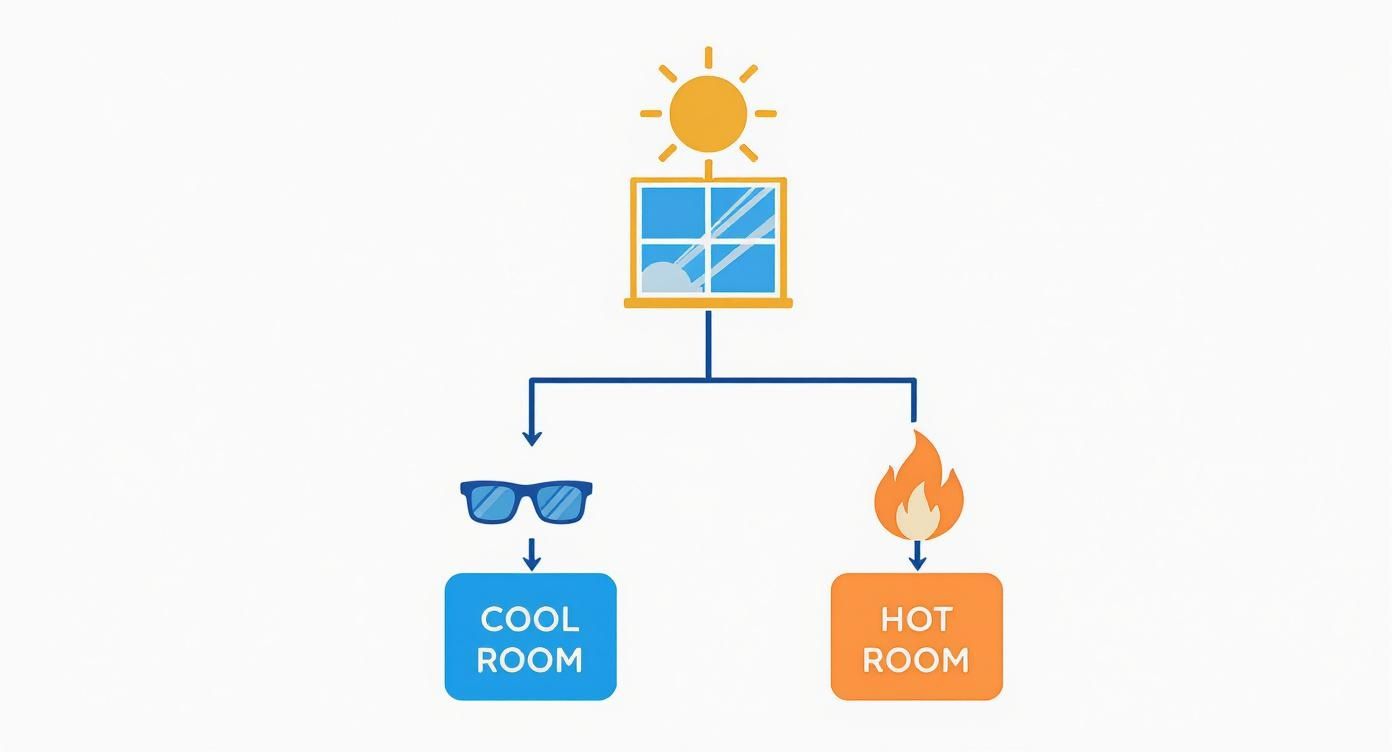
It’s clear that the right film acts as a gatekeeper, completely changing how your home deals with direct sun.
Matching the Film to Your Goal
First things first, what problem are you trying to solve? Are you looking to cool down a room that feels like a greenhouse, or are you more worried about your new hardwood floors fading? Different films are engineered to tackle different challenges.
-
For Maximum Heat Rejection: If your skylight is making your living room unbearably hot, you need a serious solar control film. Look for films with a high Total Solar Energy Rejected (TSER) value. Ceramic and spectrally selective films are the heavy hitters here, often blocking up to 80% of solar heat without making the room noticeably darker.
-
For Fading and UV Protection: To protect your furniture, rugs, and artwork from sun damage, a UV blocking film is non-negotiable. The great news is that almost any quality solar film on the market blocks 99% or more of those damaging UV rays. It's pretty much a standard feature, but it never hurts to double-check the specs.
-
For Glare Reduction: Is the harsh light from your skylight making it impossible to watch TV or work on a laptop? A lightly tinted film can be a game-changer. These films soften and diffuse that intense light, making the entire space more comfortable and usable all day long.
The Critical Material Difference: Glass vs. Plastic
This is, without a doubt, the most important piece of the puzzle. Skylights are made from either glass (usually tempered or laminated) or plastic (like acrylic or polycarbonate). Putting a film made for glass onto a plastic skylight is a recipe for disaster.
Plastic skylights have a natural tendency to expand, contract, and slowly release gases over their lifespan—a process called outgassing. If you apply a standard window film, it traps these gases, creating huge, ugly bubbles between the film and the skylight surface. It looks terrible, the film stops working, and you can kiss your warranty goodbye.
You must use a film specifically made for polycarbonate or acrylic if your skylight is plastic. These specialized films are built with adhesives that let the outgassing happen without causing any bubbling or damage.
Comparing Common Skylight Film Options
To help you narrow down the choices, here's a side-by-side look at the most common film technologies. Each one brings something different to the table, suited for different needs and skylight materials.
| Film Technology | Primary Purpose | Ideal Application | Material Safe |
|---|---|---|---|
| Ceramic Film | High heat rejection with clarity | Homes where you want to keep the natural light bright and clear. Perfect for south-facing skylights. | Glass only |
| Spectrally Selective | Maximum performance, invisible look | Museums, high-end homes, or anywhere you need elite heat/UV control without a visible tint. | Glass only |
| Polycarbonate-Safe | Heat and UV control for plastic | Warehouses, workshops, and homes with dome or bubble-style acrylic or polycarbonate skylights. | Plastic only |
| Low-Emissivity (Low-E) | Year-round insulation | Colder climates where keeping heat in during the winter is just as crucial as keeping it out in the summer. | Glass only |
Ultimately, choosing the right window film on skylights is really a process of elimination. Start with the material—glass or plastic—and you’ll immediately cut your options in half. From there, pick the film that best tackles your main goal, whether that’s heat, UV rays, or glare. This approach ensures you'll get a solution that works perfectly and lasts for years to come.
Understanding Installation and Safety
Let's be clear: applying film to a skylight is a completely different ballgame than tackling a standard window. The whole process is complicated by working at height, wrestling with awkward angles, and the pressure to get a perfect finish. It's a job where both the technique and the safety precautions have to be on point.
A great application isn't just about aesthetics; it's what makes the film actually work and last for years to come.
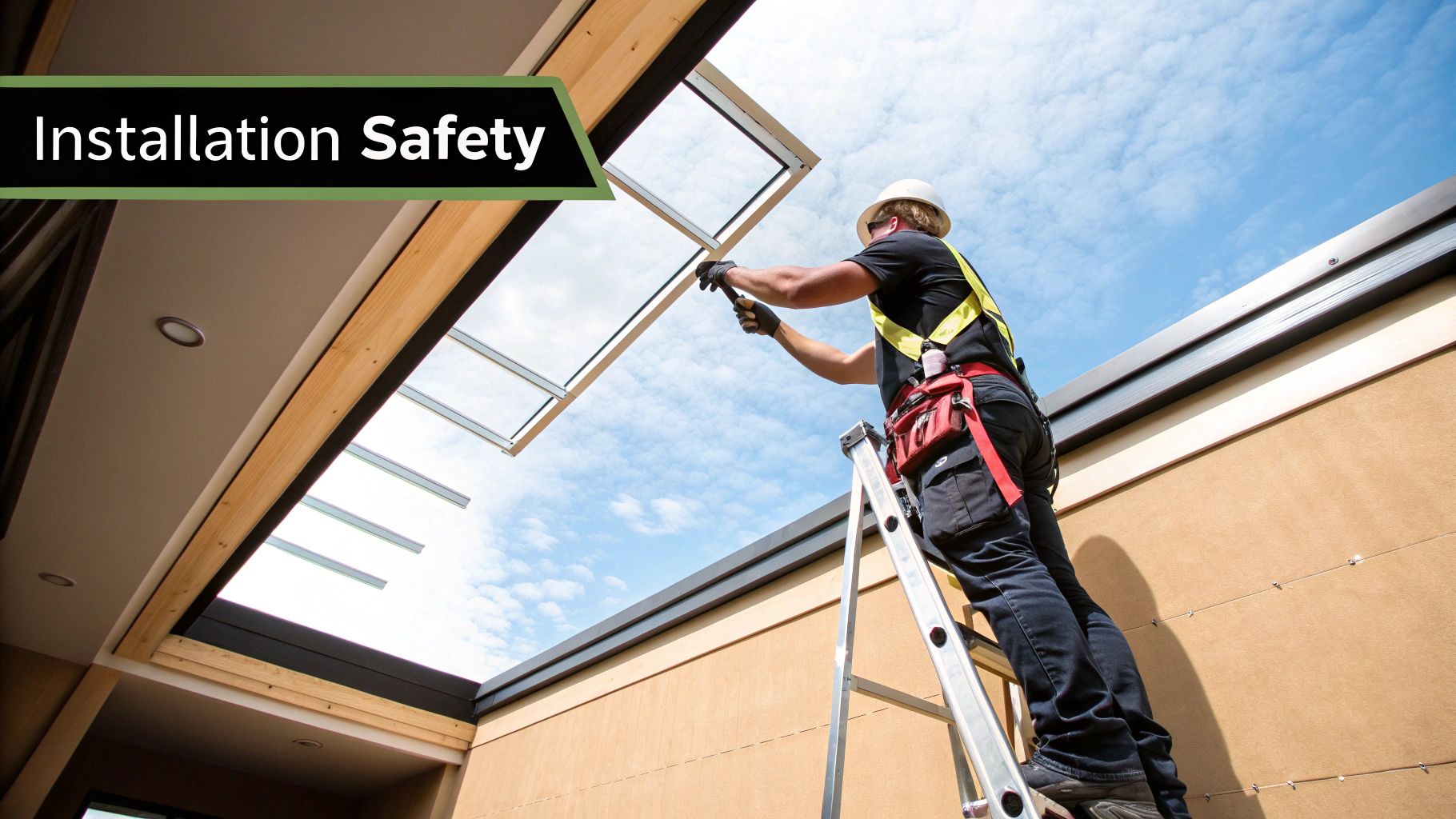
Unlike a vertical window you can comfortably stand in front of, a skylight installation almost always means you're up on a ladder, scaffolding, or even a lift. This immediately brings a level of risk into the picture that demands serious planning and the right gear. The goal is always a pristine, bubble-free application, and cutting corners on safety or technique will almost certainly lead to a mess.
And a botched job is more than just an eyesore. It can trap dirt under the film, create air pockets that kill the film's heat-blocking ability, and even cause it to peel off way too soon. Worse yet, most manufacturers will void the product warranty if the film isn't installed exactly to their specifications, turning your investment into a total loss.
The Unique Challenges of Skylight Installations
Applying window film on skylights throws a few curveballs that can stump even the most confident DIYer. This is not a simple peel-and-stick operation; it's a precision job performed under some pretty tough conditions.
-
Working at Dangerous Heights: The first and most obvious hurdle is just getting to the skylight. Reaching one on a vaulted ceiling or a high roof safely takes more than a wobbly step-stool. You're often looking at sturdy A-frame ladders, full-on scaffolding, or mechanical lifts to create a stable platform to work from.
-
Managing Tricky Angles and Domes: Skylights aren't always nice, flat pieces of glass. Many are domed, curved, or pitched at a steep angle, which makes laying film flat without creases or bubbles incredibly difficult. Pros use special techniques to heat-shrink and mold the film perfectly to these odd shapes.
-
Achieving a Flawless Finish: When you're working overhead, gravity is not your ally. Every tiny speck of dust, stray hair, or air bubble stands out like a sore thumb. Professionals have mastered specific squeegee patterns and use special solutions to get a contamination-free bond—something that’s really hard to pull off without years of practice.
Put all these factors together, and it's clear that skylight film installation is a high-stakes task with a razor-thin margin for error.
Why Safety Must Be Your Top Priority
Beyond the technical skills, you absolutely cannot ignore the safety risks. Working at height is inherently dangerous, and a fall can lead to devastating injuries. This is precisely why a professional installer spends so much time setting up a secure work environment before a single piece of film is even cut.
The success of a skylight film installation is measured equally by its flawless appearance and the safety of the process. A beautiful result is meaningless if it comes at the cost of an accident.
A few safety precautions are simply non-negotiable:
- Use the Right Equipment: Any ladder or scaffold must be rated for the job's height and weight. It needs to be on a level, stable surface and used exactly as the manufacturer intended.
- Have a Spotter: Never work alone. A second person is crucial for stabilizing a ladder, passing up tools, and being there to call for help if something goes wrong.
- Secure the Area: Clear everything out from under the skylight. Move furniture and protect flooring to prevent damage from a dropped tool or an accidental slip.
Ultimately, getting a handle on these installation complexities and safety needs is the first step. It helps you make a realistic call on whether this is a project you can safely take on yourself, or if it’s time to bring in a professional who has the right tools, training, and experience to do it right.
DIY vs. Professional Skylight Film Installation
So, you're sold on the idea of adding film to your skylights, but now comes the big question: should you tackle this yourself or call in the pros? This isn't just a simple choice—it's a decision that directly affects the look, performance, and lifespan of the film.
Let's be honest, the DIY route has its appeal. Who doesn't love saving some cash on labor costs and getting that sense of accomplishment from a home project? If you're dealing with a small, flat, and easily reachable skylight, you might be tempted to give it a shot.
But this is one of those projects where what looks easy on video can get complicated fast. Skylights are a tough canvas. One wrong cut, one tiny speck of trapped dust, or a single air bubble can ruin the whole look, forcing you to start over with a fresh (and expensive) piece of film. Plus, you’re often working on a ladder, which adds a whole layer of safety risk that you just can't ignore.
Why You Should Seriously Consider a Professional
Hiring a professional installer isn't just about paying someone to do the work; it's about investing in a perfect result. These folks have the right tools, the muscle memory from thousands of hours of practice, and a real understanding of how different films react to different skylight materials, especially on tricky domed or angled glass.
Here's what a professional brings to the table:
- A Flawless Finish: They have the technique down to a science. They know exactly how to prep the glass and apply the film to get that smooth, "like it's not even there" finish without any bubbles, creases, or debris underneath.
- Better Film Options: Many of the best-performing, most durable films on the market are sold exclusively through professional dealer networks. Going with a pro opens up access to premium products you simply can't buy at a big-box store.
- It's Just Faster: A seasoned installer can knock out the job in a fraction of the time it would take a DIYer, getting your home back to normal with minimal fuss.
- The All-Important Warranty: This is huge. Professional jobs are almost always backed by a manufacturer's warranty that covers things like peeling, bubbling, or fading. If the film fails, you're covered. That peace of mind is priceless.
Weighing Your Options
Ultimately, the right call depends on your budget, your own skills, and the complexity of your skylights. Here's a quick breakdown to help you decide.
| Factor | DIY Approach | Professional Service |
|---|---|---|
| Upfront Cost | Lower (materials only) | Higher (materials + labor) |
| Final Quality | Risky; high chance of imperfections like bubbles or dirt | Consistently flawless, clean finish |
| Safety | High risk, especially when working on ladders or roofs | Trained, insured, and equipped for working at height |
| Warranty | None. If you mess up, you eat the cost. | Includes both manufacturer and installer warranties. |
The demand for high-quality window film solutions is growing for a reason. The global market, which includes window film on skylights, was valued at roughly USD 2.40 billion in 2024 and is projected to hit nearly USD 3.99 billion by 2032. As more people realize the benefits, they also understand that a professional installation is key to unlocking the film's true performance. You can discover more insights about this expanding market on Fortune Business Insights.
For a permanent installation like this, any money you think you're saving with a DIY job can vanish in an instant with one ruined sheet of film or a voided product warranty. A professional installation is really an investment in getting it done right the first time.
Cost, Care, and Long-Term Value
When you're thinking about adding window film to your skylights, it's natural to focus on the upfront cost. But the real story is about the long-term value. This isn't just an expense; it's a smart investment in your property's comfort, efficiency, and preservation that pays for itself over time.
The initial price tag can swing quite a bit depending on a few things. The type of film you select is the biggest variable—a high-performance ceramic or spectrally selective film will cost more than a standard solar film. Then there's the skylight's location. A hard-to-reach skylight on a vaulted ceiling will naturally require more labor and specialized equipment, like scaffolding, compared to one on a lower, flat ceiling.
Breaking Down the Investment
To get a clear picture of the value, you have to look past the initial invoice. You're not just buying a roll of film; you're paying for a lasting solution that actively puts money back in your pocket.
- Professional Installation: You can generally expect to pay somewhere between $15 to $30+ per square foot. This price covers both the film itself and the skilled labor required for a perfect, bubble-free application, often at a challenging height.
- Film Quality: Premium films are engineered to handle the intense, direct sun that skylights face. They offer superior heat rejection and durability, which more than justifies their higher cost with better performance and a much longer lifespan.
- Warranty: A professional installation almost always comes with a solid manufacturer's warranty, often for 10-15 years. This protects your investment against issues like bubbling, peeling, or other defects.
Calculating Your Return on Investment
The real financial magic of skylight film becomes clear over the long haul. By drastically cutting down on solar heat gain, the film gives your air conditioning system a much-needed break. Most homeowners report a very real drop in their summer cooling bills, and these energy savings can often cover the cost of the installation within a few years.
But the savings don't end with your utility bills. The film’s ability to block 99% of UV rays acts like a powerful insurance policy for everything inside your home. It prevents thousands of dollars in potential sun damage, shielding your hardwood floors, furniture, and artwork from fading and breaking down. This preserves not just your belongings, but the value of your home itself.
Your return on investment comes from two places: the immediate reduction in your monthly energy bills and the long-term prevention of costly sun damage to your home's interior.
As energy efficiency becomes a bigger priority in construction, solutions like window film are gaining serious traction. The global window film market is projected to top USD 22 billion by 2035, and North America is on track to hold a 40% market share. This boom is driven by new building codes and a growing demand for comfortable, energy-smart homes, making window film on skylights a standard upgrade for modern living. You can learn more about these market findings on Research Nester.
Simple Care for Long-Lasting Performance
Keeping your skylight film in top shape is surprisingly easy. After the film has had time to fully cure—usually about 30 days—you can clean it just like a regular window.
All you need is a soft cloth or a rubber squeegee and a simple mix of water with a few drops of mild dish soap. The only thing to remember is to avoid abrasive scrubbers or ammonia-based cleaners, as they can scratch or damage the film’s protective layer. With just that tiny bit of care, your film will keep working hard for you for years to come.
Answering Your Skylight Film Questions
Even when you see the clear benefits, it's natural to have a few lingering questions before you commit to putting film on your skylights. We get these all the time, so let's walk through the most common ones to help you feel confident about your decision.
Will Film Make My Skylight Room Too Dark?
This is probably the number one concern we hear, and the answer is a resounding no. Think of modern window films less like sunglasses and more like a smart filter.
High-quality films are engineered to be incredibly selective. They block the invisible, damaging UV rays and the infrared heat you can feel, but they let the visible light stream right through. You can even choose a film with a high Visible Light Transmission (VLT) to ensure your room stays just as bright and welcoming as before.
How Long Will the Film Actually Last Up There?
You can expect a professionally installed, top-tier window film to last anywhere from 10 to 20 years on a skylight.
A few things factor into its exact lifespan, like the quality of the film itself, your climate, and just how much direct sun it gets slammed with day after day. Any reputable installer will back their work with a solid manufacturer's warranty, giving you peace of mind that it won’t bubble, crack, or peel.
The life of your skylight film really comes down to two things: the quality of the material and the quality of the installation. A pro ensures you get every last year of performance out of it.
Can I Put Film on a Plastic or Polycarbonate Skylight?
Yes, you absolutely can—but you have to use the right product. This is a critical detail.
Standard window film is made for glass. If you put it on a plastic-based material like acrylic or polycarbonate, it can cause a chemical reaction called "outgassing." This leads to a mess of bubbles and can even damage the skylight itself. Always, always confirm with your installer that they are using a film specifically made for plastic surfaces.
Is This Film Any Good in the Winter?
Most people think of window film as a summer solution for beating the heat, but certain types offer a fantastic winter benefit, too.
Low-emissivity (or Low-E) films are designed for year-round performance. In the colder months, they act like a thermal blanket for your skylight, reflecting the heat from your furnace back into the room instead of letting it escape. This reduces heat loss and can make a real difference in your heating bills, making it a smart investment that pays off all year.
At Fortress Security Films, we specialize in professional installations of premium window films that make your home safer, more comfortable, and more efficient. If you want to see how our solutions can upgrade your skylights and windows, come visit us at https://fortresssecurityfilms.com.
