


When you live in a storm-prone area, your windows are your home's most vulnerable points. Hurricane protection window film is a game-changing upgrade designed to hold glass together when it matters most, keeping dangerous shards from flying and maintaining the protective shell of your home. This nearly invisible layer reinforces your windows against violent winds and flying debris.
Your First Line of Defense Against Violent Storms
As a hurricane barrels toward the coast, the integrity of your windows is one of the first things on your mind. A single shattered window is all it takes for a storm to breach your defenses. Once inside, high-velocity winds can create enormous upward pressure, threatening to lift the roof right off your house.
This is exactly where hurricane protection window film proves its worth, acting as a silent, ever-present guardian.
The film's main job isn't to make your glass unbreakable—that's not realistic. Instead, its purpose is to ensure that when the glass does break, it fails safely. Imagine it as a super-strong, transparent net laminated directly onto your window. If a piece of storm debris hits and shatters the glass, that net catches every last fragment.
Instead of a dangerous explosion of glass shards, the broken pane stays locked in the frame. This simple but critical function keeps the wind, rain, and debris outside, right where they belong. By maintaining your home's protective envelope, the film prevents those sudden, catastrophic pressure changes that can lead to structural collapse.
Grasping the Core Advantages
The real-world value of this technology becomes crystal clear when you look at the data. Homes equipped with hurricane safety window film see 60-80% fewer instances of catastrophic glass failure during major storms. This directly translates to less risk of injury and lower repair bills.
Consider the cost: replacing storm-damaged windows can easily run over $10,000, but a professional film installation typically costs between $8-$12 per square foot. You can explore more about the window film market to get a fuller financial picture.
To put its value into perspective before we dive deeper, here’s a quick summary of what you get.
Key Benefits of Hurricane Protection Window Film at a Glance
This table breaks down the primary advantages of installing hurricane safety film, giving you a quick reference for why it's such a smart investment for any homeowner in a storm-prone region.
| Benefit | Description | Impact |
|---|---|---|
| Enhanced Safety | Holds shattered glass in place, preventing flying shards that can cause severe injury to occupants. | Dramatically reduces the primary danger associated with broken windows during a storm. |
| 24/7 Security | The film reinforces glass against forced entry, providing continuous protection from intruders. | Acts as a passive security system that is always active, unlike shutters that must be deployed. |
| Cost-Effectiveness | A more affordable solution compared to installing full impact-resistant windows. | Delivers a high level of protection for a fraction of the cost of total window replacement. |
As you can see, the benefits go beyond just storm protection, adding layers of security and value that work for you year-round.
How Hurricane Window Film Actually Works
On the surface, hurricane window film looks like a simple sheet of plastic. But that simple appearance hides some seriously clever engineering. It’s not just one layer; it’s a sophisticated, multi-layered product designed for incredible tear resistance and strength.
Think about the windshield on your car. When a rock hits it, the glass might spiderweb, but it doesn't usually explode into a thousand dangerous pieces. That's because a layer of vinyl is sandwiched between the glass, holding it all together. Hurricane film operates on a very similar principle, but it’s applied directly to your existing windows.
The film itself is made from layers of exceptionally strong, clear polyester. These are meticulously bonded together to create a formidable membrane. The real secret, though, is the specialized, aggressive adhesive used to apply it. This isn't just glue—it's an advanced bonding agent that forms a powerful, molecular connection with the glass.
The Anatomy of an Impact
So, what actually happens when a piece of wind-borne debris—say, a tree branch or a loose roof shingle—slams into a window protected by this film? The entire event unfolds in a split second, providing a critical shield for your home.
- Initial Impact: The object hits the glass, and the glass breaks. For an unprotected window, this is where the disaster begins.
- Energy Absorption: But with the film, the impact's shockwave is immediately absorbed and spread across the entire pane. This prevents the force from focusing on one spot, which is what causes glass to shatter inward.
- Containing the Shards: Because the film is so strongly bonded to the glass, all the broken pieces—from large chunks to tiny slivers—are held firmly in place. The window is broken, but it hasn't failed.
- Maintaining the Seal: Most importantly, the shattered glass remains in the frame. This keeps your home's protective envelope intact, stopping destructive winds and torrential rain from getting inside and causing even more damage.
This is a great illustration of how the film's main job is to keep your home sealed, even after the glass gives way.
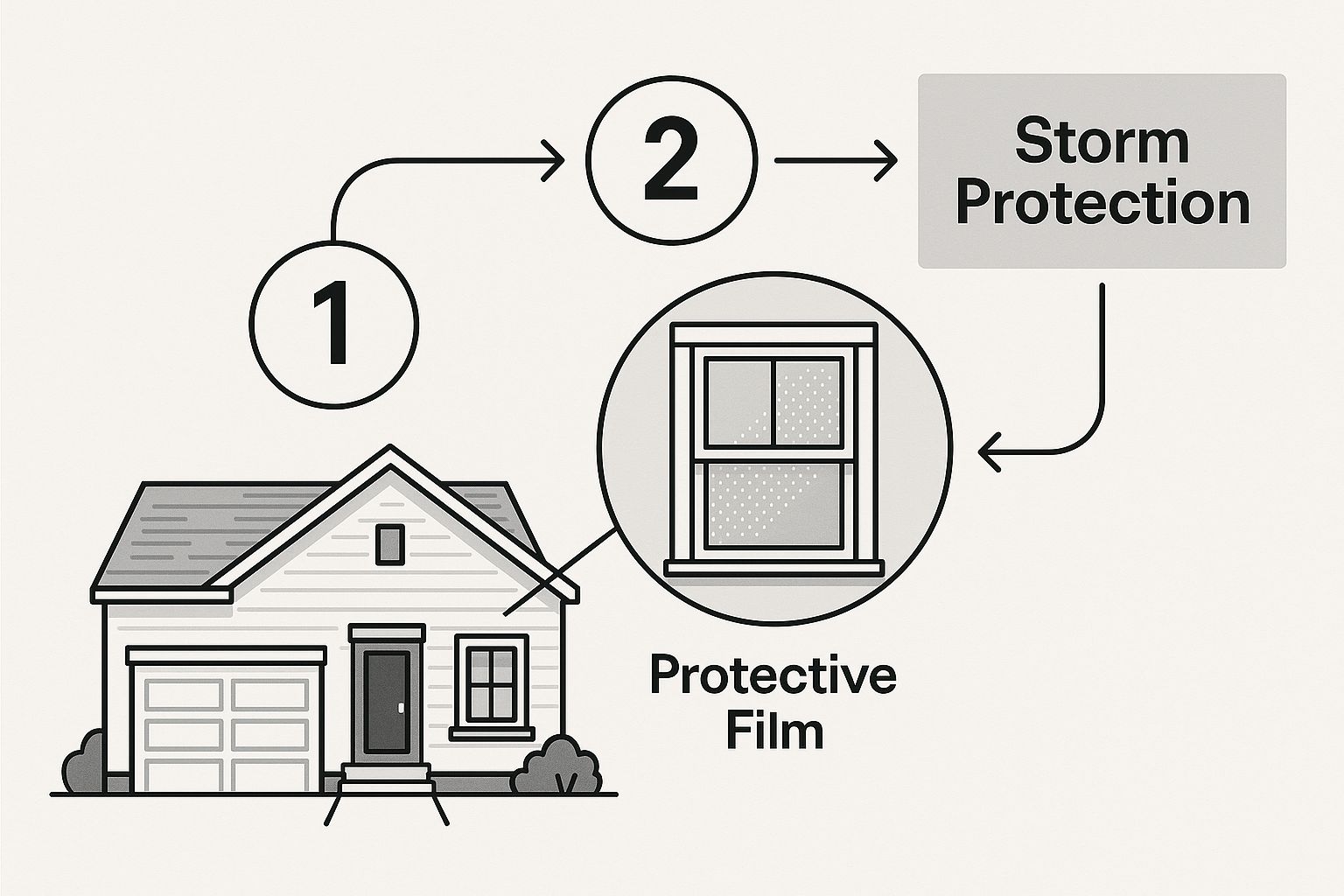
As you can see, the film’s purpose isn’t just to stop the glass from breaking—it’s to ensure that even a broken window doesn’t become an open door for the storm.
Thickness Matters: Film Strength Measured in Mils
It's crucial to understand that not all safety and security films are the same. Their protective strength is directly tied to their thickness, which we measure in mils. A mil is tiny—just one-thousandth of an inch (0.001 inches). But when it comes to film, small increases in thickness make a huge difference in performance.
For perspective, a standard decorative window film might be only 2 mils thick. A true window film for hurricane protection, on the other hand, usually starts at a minimum of 8 mils and can go up to 21 mils or more for high-security situations.
Put simply, the thicker the film, the better it resists tearing and the more impact energy it can handle. An 8-mil film is a popular choice for residential homes, offering solid protection against common storm debris. For an even higher level of security against more severe impacts, films that are 12 mils or greater are the way to go. Picking the right thickness is a critical part of making sure your windows are ready for the types of weather threats you face in your area.
Decoding Hurricane Film Ratings and Certifications
When you start looking into window film for hurricane protection, it can feel like a maze. With so many products out there, how can you tell the difference between a simple decorative film and a legitimate storm shield? The secret is in the official ratings and certifications. These are your guarantee of tested, proven performance when it matters most.
Think of it like a crash-test rating for a car. You wouldn't buy a vehicle without knowing how it holds up in an accident, and the same thinking applies here. For something as serious as hurricane protection, slick marketing slogans just don't cut it. You need hard proof that a film can handle the incredible forces of a major storm.
This proof comes from independent, third-party organizations that run products through a gauntlet of standardized tests. Because these groups aren't tied to any manufacturers, their ratings are unbiased and trustworthy. This system ensures that when you see a certification label, the product behind it has met demanding criteria designed to keep you and your home safe.
The Gold Standard: ASTM E1886 and E1996
When it comes to hurricane film, two specific standards from ASTM International are the ones that truly matter. These are the benchmarks that separate real storm protection from everything else on the shelf.
- ASTM E1886: This is the foundational standard. It lays out the exact testing procedure for how building components, including windows and doors, must be tested against impacts from windborne debris.
- ASTM E1996: This standard gets more specific, defining the performance requirements during the E1886 test. It dictates the size and speed of the projectiles used and the brutal wind pressure cycles the window must withstand afterward.
Taken together, these standards create a two-part trial by fire. First, the filmed window gets hit with high-speed projectiles. Then, it's immediately subjected to thousands of cycles of positive and negative wind pressure, simulating the violent, shifting forces of a hurricane. A window only "passes" if the film successfully holds the glass together in the frame, preventing a breach of the building's envelope.
This rigorous testing is absolutely non-negotiable for any product calling itself window film for hurricane protection.
Understanding the "Cannon Test"
The most dramatic part of this whole certification process is what we in the industry call the "cannon test"—a key piece of the ASTM E1886/E1996 protocol. It’s designed to replicate the terrifying reality of flying debris in a major hurricane.
In a controlled lab, a large air cannon fires a standard projectile—typically a 9-pound 2×4 wooden stud—directly at a window treated with the film. The projectile slams into the glass at about 34 miles per hour (50 feet per second), mimicking the impact of debris caught in hurricane-force winds.
To pass this critical test, the film's job is to hold the shattered glass together. Even though the glass is completely broken, the film must maintain a solid barrier, stopping the projectile from passing through and preventing wind and rain from getting inside.
After surviving this impact, the very same window unit is moved to another rig and blasted with cyclical air pressure. This simulates the violent push-and-pull forces a building endures as a hurricane rages. It's a brutal, comprehensive test that proves a film can hold up not just for a single moment, but through the entire duration of a storm.
Why Certified Film Is a Must-Have
Choosing a certified film isn’t just about checking a technical box; it's about protecting your family and your property. Products that pass these demanding tests have proven they can perform under the most extreme conditions imaginable.
This is the level of performance insurance companies look for. In fact, many carriers recognize how much risk these certified films mitigate. To be compliant, films must demonstrate they can handle debris impacts from objects up to 9 kg traveling at 45-50 mph, ensuring the film keeps glass shards bonded together. The insurance industry has taken notice, with some providers offering premium reductions of up to 20% for homes with this certified protection. You can read more about how these films are influencing the market on Straits Research.
When you talk to an installer, always ask to see the documentation proving their products meet ASTM E1886/E1996 standards. Any reputable professional will have this information ready and will be happy to show you. It's the only way to be sure you're investing in genuine hurricane protection, not just a thin layer of plastic.
More Than Just Storm Protection: The Year-Round Perks of Security Film
When you live in a hurricane-prone region, installing window film for hurricane protection feels like a no-brainer. But what most people don't realize is that its job isn't over when the skies clear up. This film is a silent workhorse, protecting your home 365 days a year in ways that go far beyond storm season.
Think about it. The same features that make the film tough enough to stop flying debris also make it a powerful deterrent against break-ins. Your standard glass window is a weak point, easily shattered by a would-be burglar looking for a quick smash-and-grab.
Now, picture that same window reinforced with security film. An intruder might strike the glass, and it will certainly crack, but it won't collapse. The incredibly strong, tear-resistant film keeps the broken pieces locked tightly in the frame. That immediate, easy entry is gone. This delay is often more than enough to send a thief running.
It's Like Sunscreen for Your Furniture
Beyond keeping things out, security film also protects what's inside from a much quieter threat: the sun. Those beautiful sunbeams streaming into your living room carry damaging ultraviolet (UV) radiation that slowly but surely bleaches everything it touches.
It’s the reason your rich hardwood floors start looking dull, your vibrant sofa fades to a pastel shadow of its former self, and your favorite artwork loses its pop. Hurricane-rated window film is a powerful shield against this daily assault.
Most high-quality security films block up to 99% of harmful UV radiation. This isn't just a seasonal benefit; it's a constant defense that preserves the color and value of your home’s interior, day in and day out.
A Cooler Home and Lower Energy Bills
Here’s a benefit that pleasantly surprises many homeowners: storm film can actually put a dent in your energy bills. A huge amount of the heat that makes your house feel like an oven in the summer comes right through the glass in your windows. This sends your AC unit into overdrive, and your electricity costs soar.
Many modern films are engineered with solar control properties that do more than just block UV light. They also reject a substantial amount of solar heat, keeping your home cooler and more comfortable during the hottest months of the year.
This dual-action performance is a game-changer. In fact, some solar control films can block up to 96% of infrared light and are proven to cut cooling costs by at least 10-15%. This turns a safety upgrade into a smart, energy-saving investment. You can see more data on how these films contribute to green building trends on Research Nester.
Ultimately, choosing window film for hurricane protection is an investment that pays you back in multiple ways. It stops being just a seasonal precaution and becomes a permanent upgrade that makes your home safer, preserves your belongings, and lowers your monthly expenses. To learn more about securing your property, check out other helpful articles on our blog.
Choosing the Right Film and a Professional Installer
Picking the right window film for hurricane protection is a huge decision, but it's really only half the battle. The quality of the installation is every bit as important as the quality of the product itself. A premium, certified film that’s installed poorly will fail you when you need it most, making the whole investment worthless.
Think of it this way: you could buy the best, most expensive engine for a race car, but if a rookie mechanic botches the install, that car won't even finish the first lap. The same principle applies here. The film, the adhesive, and the careful application process all have to work together as a single, unified system to protect your home.
This guide will walk you through what to look for when choosing materials and, just as crucially, how to find a qualified pro to ensure a perfect installation. Getting these choices right is what gives you genuine peace of mind when the storm warnings start rolling in.
Distinguishing Between Film Options
Your first decision is about the film itself. While the main goal is storm safety, you have options that can bring other great benefits to your home. You'll generally run into two main categories: clear films and tinted films.
-
Clear Safety & Security Films: These are the workhorses of storm protection. They’re designed to be virtually invisible once installed, so they won't change your home's appearance or obstruct your views. Their one and only job is to provide maximum impact and tear resistance.
-
Tinted or Solar Control Security Films: These films do double duty. On top of providing the same tough impact protection as clear films, they also reject a good amount of solar heat and block damaging UV rays. This can make your home more comfortable, lower your energy bills, and add a layer of year-round value.
The right choice really comes down to your priorities. If your only concern is hurricane readiness and you love your home’s current look, a clear film is the perfect fit. But if you’d also like to cut down on glare, stop your furniture from fading, and lower your cooling costs, a solar control version is a very smart upgrade.
Why Professional Installation Is Non-Negotiable
It can be tempting to think about a DIY approach to save some money, but when it comes to true hurricane protection, professional installation isn't just a good idea—it's absolutely essential. The performance of these advanced films depends entirely on a perfect application, and that’s a job that demands special tools, training, and a lot of experience.
A professional installer does far more than just stick film to glass. They follow a precise, multi-step process to make sure the film performs exactly how it was designed and tested to, creating a seamless bond between the film and the window pane.
Trying this yourself often leads to problems like dust contamination under the film, ugly air bubbles, or edges that aren't sealed properly. Any one of those mistakes creates a weak point that will compromise the entire window during a high-wind event. On top of that, most manufacturer warranties for impact-rated films are only valid if the product is installed by a certified professional.
Finding and Vetting a Qualified Installer
Finding the right installation company is probably the most important step in this whole process. A reputable installer is your guarantee that the product you paid for will actually perform as certified. You can get a good feel for what a top-notch installation looks like by reviewing a professional window security film installation service page, which often breaks down the meticulous steps involved.
When you're checking out potential companies, here are the key questions you absolutely have to ask:
- Are you licensed and insured? This is the bare minimum. Never even consider working with a company that can't show you proof of both.
- Can you provide proof of certification for your films? Ask to see the actual documents showing their products meet ASTM E1886/E1996 or Miami-Dade standards.
- Are your installers certified by the film manufacturer? The best manufacturers have specific training programs for their products. You want installers who have completed them.
- What does your warranty cover? A quality job should come with a warranty that covers both the film material (against bubbling or peeling) and the installation labor.
- Can you provide references from recent projects? Talking to past customers is one of the best ways to figure out if a company is reliable and does quality work.
Be very wary of any installer who gets cagey about answering these questions or can't provide clear documentation. High-pressure sales tactics or quotes that seem too good to be true are also major red flags—they often point to cheap materials or a rushed, sloppy installation. Taking your time to find a proven, professional partner is the best investment you can make in your home's safety.
Keeping Your Hurricane Film in Fighting Shape
You've made a smart investment in protecting your home with hurricane window film. Now, to make sure that investment pays off for years to come, a little bit of ongoing care is all it takes. Think of it like maintaining any other crucial piece of safety equipment—a few simple habits will ensure it’s ready when you need it most.
Once the film is on, you can't just treat your windows the same old way. The film has a tough, scratch-resistant coating, but it's not invincible. Harsh chemicals and abrasive cleaning tools are its enemies, so the new rule is to clean gently.
How to Clean Your Filmed Windows Safely
Keeping your windows sparkling is straightforward. You don’t need any fancy, expensive cleaners. In fact, simpler is better.
- Give It Time to Set: This is the most important step. Don't touch or clean the windows for at least 30 days after installation. This "curing" period is critical for the adhesive to fully bond with the glass, creating the powerful seal you're counting on.
- Mix a Gentle Cleaner: A few drops of mild dish soap in a spray bottle of water is perfect. Steer clear of any ammonia-based cleaners (like many popular window sprays), as they can break down the film's materials over time.
- Use Soft Tools Only: A soft microfiber cloth or a good-quality rubber squeegee are your best friends here. Never, ever use razor blades, scouring pads, or anything abrasive. Scratches are permanent and can compromise the film's strength.
Lifespan and What to Expect from Your Warranty
When professionally installed and properly cared for, high-quality hurricane film is incredibly durable. You can realistically expect it to last 10 to 15 years, sometimes even longer. This isn't a temporary fix; it's a long-term upgrade to your home's defense system.
A solid manufacturer's warranty is your peace of mind in a piece of paper. It’s the manufacturer's promise that their product will perform as advertised. Look for warranties that cover defects like bubbling, peeling, cracking, or color changes.
When you're shopping around, don't just glance at the warranty—read it. A strong warranty isn't just about covering your financial investment; it's a direct indicator of the manufacturer's confidence in their window film for hurricane protection. It's your assurance that your home will stay protected, storm after storm.
Frequently Asked Questions About Hurricane Film
When you're thinking about a big upgrade like this, it's totally normal to have questions. Let's walk through some of the most common ones we hear from homeowners about window film for hurricane protection. The goal is to give you clear, straightforward answers so you can make a decision you feel good about.
Will This Film Make My Windows Unbreakable?
No, and it's really important to understand why. Hurricane protection film isn't designed to make your glass "hurricane-proof" or impossible to break. Its real job—and it's a critical one—is to hold all the pieces together if the glass shatters from high winds or flying debris.
Think of it like a powerful, invisible safety net for your windows. By keeping the broken glass in the frame, it stops dangerous shards from flying into your home. Just as crucial, it maintains your home's "envelope," preventing destructive wind and rain from getting inside.
Can I Install Hurricane Film Myself?
While you might see DIY kits for thinner films at the hardware store, installing true hurricane protection film is a job for certified professionals. The film's ability to perform under pressure depends entirely on a perfect installation, which takes special training and tools.
A pro ensures the glass is surgically clean and applies the film without any bubbles or trapped dust that could weaken its grip. What's more, professional installation is usually necessary to meet local building codes and to make sure the manufacturer's warranty for impact resistance is valid.
The effectiveness of security film relies heavily on a meticulous installation. For this reason, many educational facilities looking to enhance safety also turn to experts. You can learn more about how security window film for schools is professionally applied to protect students and staff.
How Does Film Compare to Shutters or Impact Glass?
Every window protection system has its pros and cons. It really helps to see how they compare side-by-side.
- Hurricane Film: This is your invisible, always-on guard. It provides 24/7 protection with zero effort needed before a storm. Plus, you get extra perks like UV filtering and a great deterrent against break-ins.
- Storm Shutters: Shutters typically offer fantastic impact resistance, but you have to deploy them, either by hand or with a motor. They can be bulky, they plunge your home into darkness when closed, and they definitely change your home's curb appeal.
- Impact Glass: This is the top-tier option, with a protective laminate built right into the glass. However, it's also the most expensive solution by a long shot, often requiring a complete—and costly—window replacement project.
Will My Insurance Company Offer a Discount?
It's very likely! Many insurance companies in hurricane-prone areas give homeowners credits or discounts on their premiums for having certified windstorm protection. Professionally installed, impact-rated window film often qualifies.
The key is to call your insurance agent directly and ask about their specific rules. They'll almost certainly want to see proof of the film's certification (like its ASTM or Miami-Dade rating) and a receipt from the professional installer before they'll lower your rate.
Ready to add a powerful, invisible layer of defense to your home? The experts at Fortress Security Films are here to help you choose and install the right protection for your windows. Contact us today for a free estimate and gain peace of mind before the next storm season arrives.
