


At its core, bulletproof glass isn't a single piece of glass at all. It's a highly engineered composite, built from alternating layers of a hard material (like glass) and a soft, energy-absorbing material (like polycarbonate). This layered construction is the secret to its incredible stopping power.
The Secret Sandwich That Stops a Bullet
To really grasp what bullet proof glass is made of, stop thinking of a window pane and start thinking of a high-tech club sandwich. You don't just use one ingredient; you stack different components, each with a unique job, to create something far stronger than any single layer on its own. Ballistic glass works on the exact same principle.
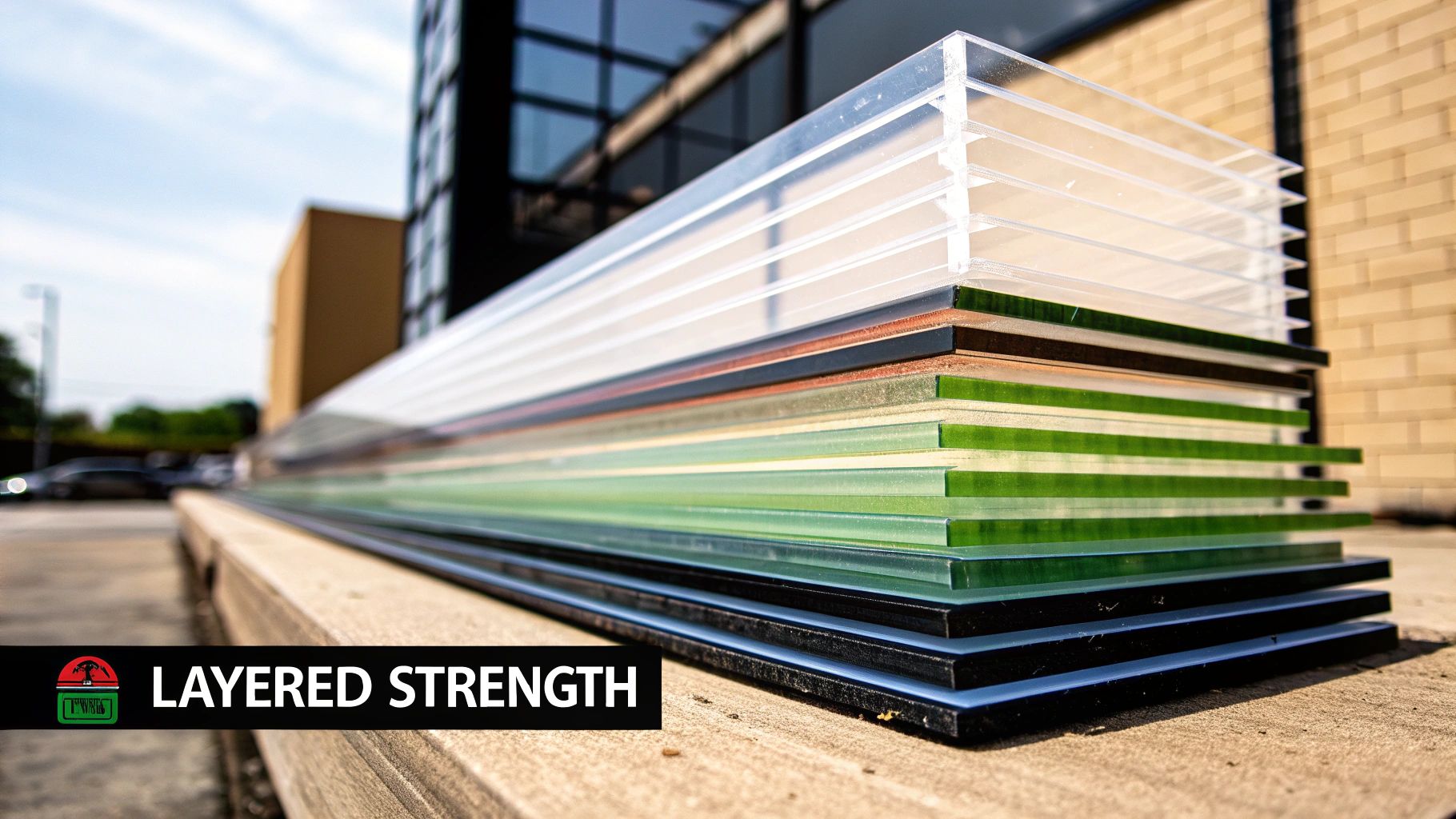
This "sandwich" is a lamination of multiple materials, and their synergy is what makes it work. The outer layers are typically made of a hard material like glass or acrylic. Their job is to be the first line of defense—they flatten the incoming bullet on impact, which immediately starts slowing it down and spreads its force across a wider area.
But the real magic happens in the middle.
The Energy-Absorbing Core
Sandwiched between those rigid outer layers are flexible interlayers made from special transparent polymers. These are the soft, energy-absorbing "fillings" in our sandwich. The two most common workhorses for this job are Polycarbonate and Polyvinyl Butyral (PVB).
- Glass Layers: This is the hard shell. It shatters on impact to deform the bullet and absorb that initial, violent burst of energy.
- Polymer Interlayers: This is the soft core. It acts like a catcher's mitt, flexing and stretching to absorb and dissipate the rest of the kinetic force, stopping the bullet from getting through.
This composite structure is everything. As detailed in market deep-dives from places like Stratview Research, the strength of ballistic glass comes directly from this multi-layer lamination. Each layer plays a part in absorbing and spreading out the energy from a projectile, with the plastic interlayer catching the impact and preventing penetration.
To better understand how these materials work together, here’s a quick breakdown:
Key Materials in Bullet Resistant Glass and Their Roles
This table shows the main components and the specific role each one plays in stopping a projectile.
| Material | Type | Primary Function |
|---|---|---|
| Glass / Acrylic | Hard Layer | Provides initial impact resistance, shatters to deform the bullet and absorb the first wave of energy. |
| Polycarbonate | Soft Layer | A strong, flexible polymer that absorbs and dissipates massive amounts of kinetic energy without breaking. |
| Polyvinyl Butyral (PVB) | Soft Layer | An elastic polymer interlayer that bonds the glass layers together and absorbs impact, preventing spalling (glass fragments flying inward). |
This teamwork between materials is what transforms simple glass and plastic into a formidable protective barrier.
The combination of hard and soft layers is what gives ballistic glass its power. The glass shatters to slow the bullet down, and the plastic stretches to catch it. Without this partnership, the panel would fail.
The precise number of layers and how thick they are determines the level of protection the glass offers—a topic we'll get into next.
How the Layers Catch a Speeding Bullet
Knowing what goes into bullet-resistant glass is one thing, but the real magic is in the physics—how those layers work together in a fraction of a second to stop a projectile cold. It’s not about being an unbreakable wall. It's a highly engineered, multi-stage system designed to absorb and dissipate an incredible amount of energy.
The first line of defense is the outermost layer of glass. This hard, brittle sheet is designed to be a sacrificial hero. Its whole job is to shatter on impact. That sounds like a failure, but it’s actually the critical first step. By shattering, it accomplishes two things instantly: it flattens the bullet's tip, ruining its aerodynamic shape, and it spreads the initial kinetic force out over a much wider area.
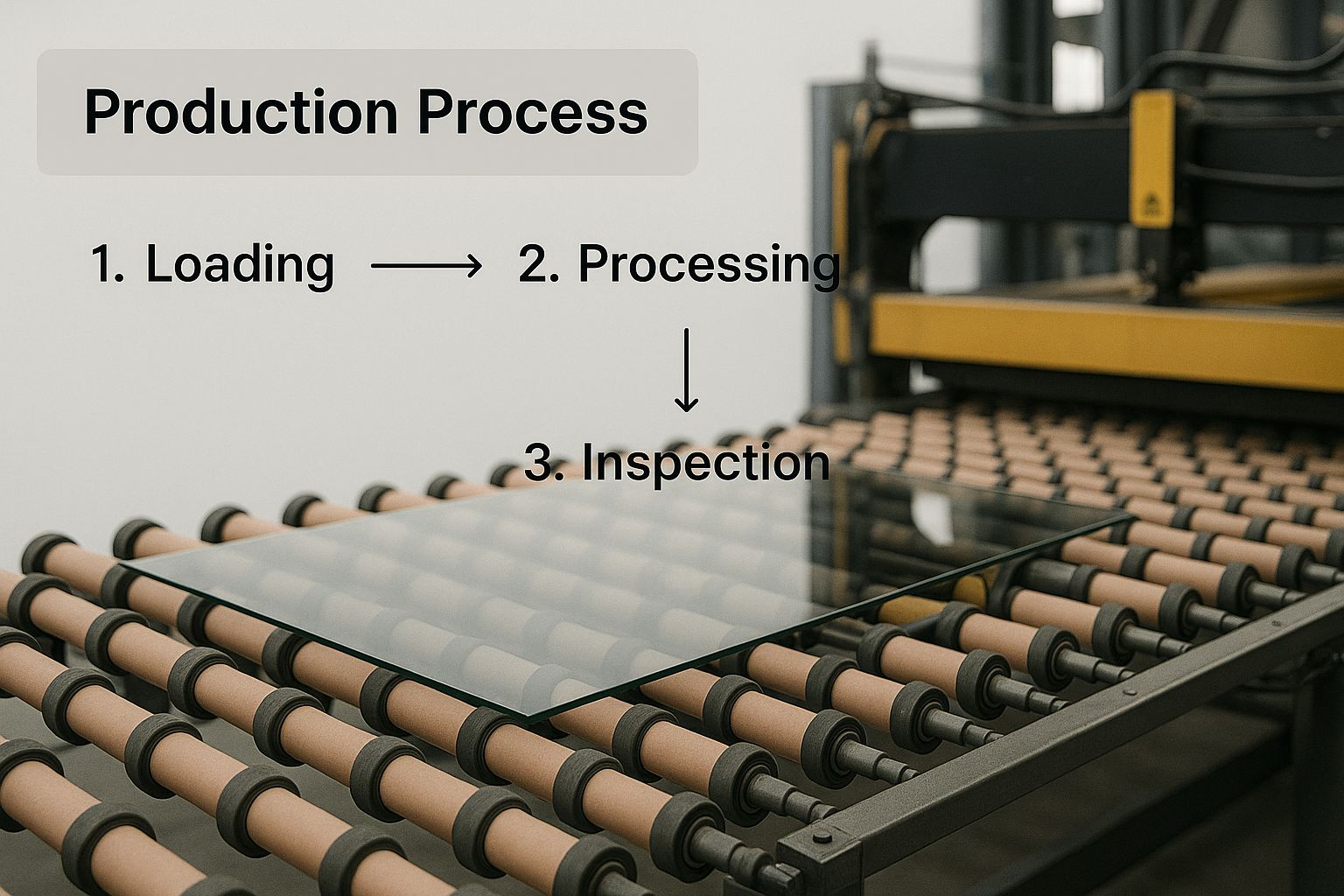
This image shows the lamination process where these different layers are fused into a single, optically clear panel.
With the bullet blunted and the initial shock absorbed, the softer, flexible inner layers are ready to do their job.
The Catcher's Mitt Effect
Once the force punches through that first broken layer of glass, it hits the polymer interlayer—usually polycarbonate or PVB. Think of this layer as a high-tech catcher's mitt. Instead of breaking, it’s designed to flex, stretch, and soak up the rest of the bullet’s momentum.
This elasticity is the secret sauce. The polymer "gives" as the deformed bullet hits it, effectively catching the projectile and spreading its remaining energy across the entire panel. For higher-level threats, this process simply repeats through more layers.
- Layer 1 (Glass): Shatters to deform the bullet and spread the initial impact.
- Layer 2 (Polymer): Stretches like a trampoline to absorb a huge chunk of energy.
- Layer 3 (Glass): Adds more rigidity, slowing the projectile even further.
- Layer 4 (Polymer): Acts as the final backstop, absorbing whatever energy is left.
Each layer systematically strips the bullet of its power until it comes to a complete halt, all while preventing penetration. The goal is also to stop "spalling," which is when fragments break off the back side of the glass, creating a secondary hazard.
The core principle of ballistic glass is this beautiful partnership between a brittle outer layer and a flexible inner layer. One breaks to blunt the attack, and the other stretches to catch the force.
This perfectly coordinated dance of energy transfer is how a clear pane of glass can defeat something moving at over 1,000 feet per second. It's a brilliant example of material science, where combining different materials creates a whole that is profoundly stronger than the sum of its parts.
Choosing the Right Ingredients: Polycarbonate vs. PVB
When you're building a ballistic panel, the materials you choose are everything. Think of it less like a chef picking ingredients and more like an engineer selecting components for a high-performance machine. The choice of the polymer interlayer—the "meat" in the glass sandwich—is what ultimately determines how well the panel will perform under fire. The two heavy hitters in this space are Polycarbonate and Polyvinyl Butyral (PVB).
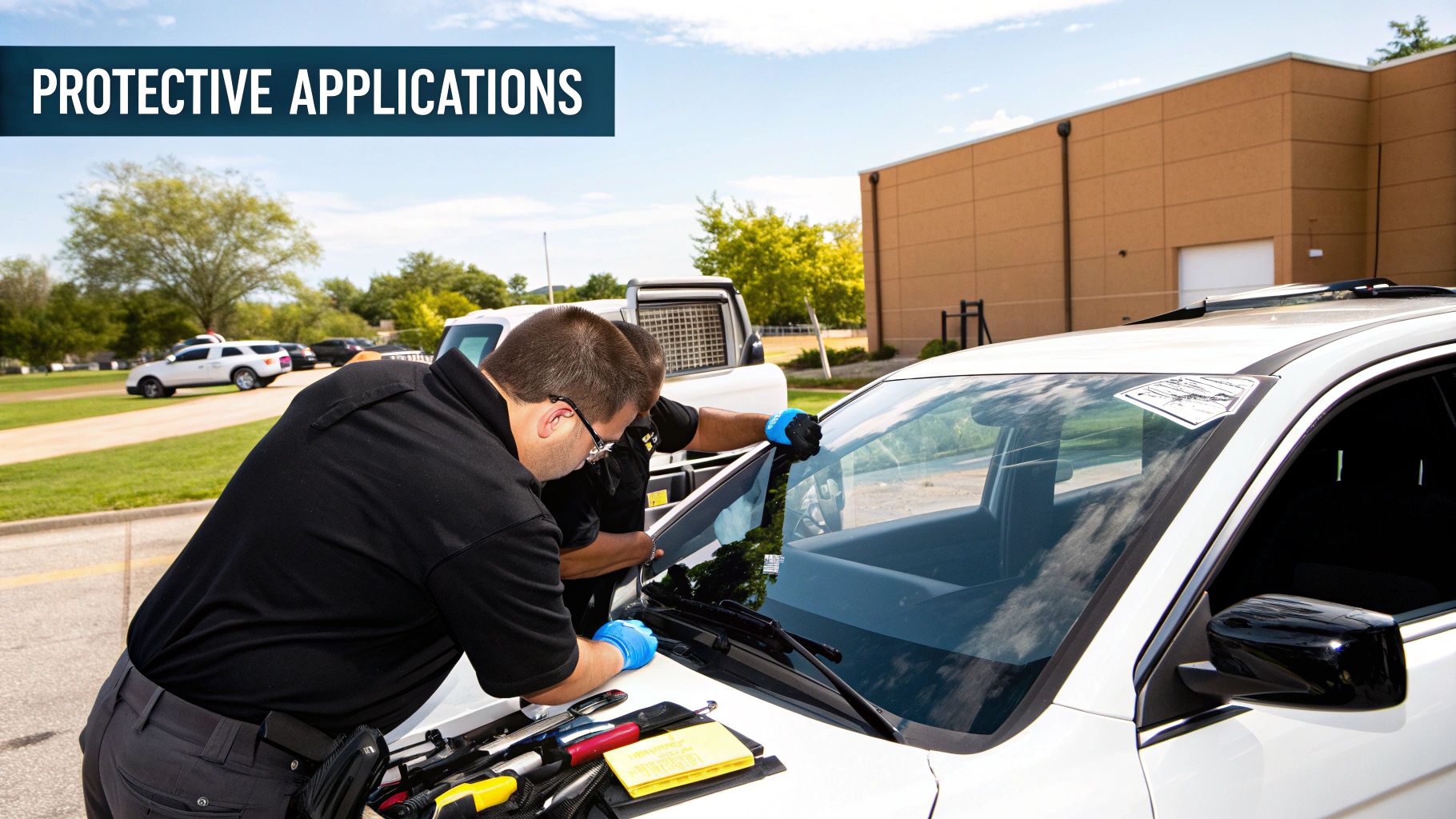
While they both do the job of absorbing a bullet's energy, they play very different roles. Polycarbonate is the modern, high-performance champion, while PVB is the tried-and-true workhorse of the industry. The right one for the job really depends on the security threat and the budget.
The Powerhouse Performer: Polycarbonate
Polycarbonate is a true beast. This thermoplastic is famous for its almost unbelievable impact resistance—we're talking about 250 times stronger than glass of the same thickness. It's an absolute game-changer.
This incredible strength means manufacturers can create ballistic panels that are much thinner and lighter without sacrificing protection. In fact, they often offer higher levels of protection. Its knack for soaking up and spreading out immense kinetic energy makes it the go-to material for situations where you need to stop serious threats but can't afford to add a ton of weight.
Of course, this level of performance doesn't come cheap. Polycarbonate is more complex to manufacture, which positions it as a premium material for serious, high-threat environments.
- Key Advantage: Unmatched strength-to-weight ratio.
- Best For: High-level security applications like military vehicles, government facilities, and armored cars.
- Trade-off: A significantly higher price point.
The Trusted Standard: Polyvinyl Butyral (PVB)
If you've ever seen a car windshield that's cracked but hasn't fallen apart, you've seen PVB in action. It's the vinyl interlayer that holds the glass together, prized for its strong bond and excellent optical clarity.
While it can't go toe-to-toe with polycarbonate on raw strength, PVB is fantastic at absorbing impact from smaller caliber rounds and, crucially, preventing spalling—where sharp glass fragments fly off the back of the panel.
PVB essentially acts like a super-strong, perfectly clear glue. When the glass shatters, it holds all the pieces together, absorbing the impact energy and containing the dangerous fragments. This is its core job in both safety glass and ballistic glass.
Because PVB has been the industry standard for decades, it's much more affordable and readily available. This makes it the perfect solution for lower-level security needs, like protecting a bank or retail store from smash-and-grab robberies or handgun threats. It delivers solid, reliable protection without the premium cost of polycarbonate.
In the end, deciding between polycarbonate and PVB when figuring out what bullet proof glass is made of is a classic engineering trade-off. It’s all about finding the right balance of performance, weight, and cost for the specific threat you need to stop.
Forging Strength From Glass and Plastic
Knowing the raw materials is just part of the story. The real magic happens on the factory floor, where individual sheets of glass and polymer are melded into a single, optically transparent panel. This manufacturing process is an exact science, turning a simple stack of materials into a barrier that can save lives. It's a delicate dance of precision, heat, and immense pressure.
It all starts in a cleanroom, an environment where even the air is meticulously filtered. Any speck of dust, a stray fiber, or a single fingerprint could ruin the panel's integrity and visual clarity. In this sterile space, trained technicians carefully assemble the layers in their precise sequence—glass, polymer, glass, and so on—creating the raw "sandwich" that will soon become bullet-resistant glass.
The Industrial Pressure Cooker
With the stack assembled, it's moved into an autoclave. The easiest way to think of it is as a giant, high-tech pressure cooker. The autoclave is where the lamination process truly comes to life.
Inside this sealed chamber, the glass and polymer sandwich gets hit with two critical forces at the same time:
- Intense Heat: The temperature is cranked way up, softening the polymer interlayers (like PVB or polycarbonate) until they become tacky and adhesive.
- Extreme Pressure: At the same time, the pressure inside the chamber skyrockets, squeezing the layers together with incredible force. This compression eliminates any air bubbles trapped between the layers.
This one-two punch of heat and pressure forces the softened polymer to flow into every microscopic pore and imperfection on the glass surfaces, creating a powerful and permanent bond. What comes out isn't just a stack of layers glued together; it's a single, unified panel. A similar adhesion principle is used when applying specialized security film for home windows to bolster existing glass without a full replacement.
The autoclave process does more than just stick the layers together; it forges a completely new composite material. This process is what guarantees there are no weak spots or air gaps, which is absolutely critical for both stopping a bullet and maintaining perfect visual clarity.
Once the autoclave cycle finishes, the panel is cooled down slowly and carefully. This controlled cooling prevents internal stresses from forming in the glass, which could compromise its strength. This final step locks the molecular bonds in place, solidifying the panel into the incredibly resilient shield it was designed to be.
How Protection Levels Are Rated and What They Mean
So, what is bulletproof glass really made of? The honest answer is, it depends. There’s no single recipe. Instead, manufacturers adjust the materials and thickness based on the specific threat the glass needs to stop. This has led to a standardized system of protection levels, so everyone knows exactly what a product is designed to do.
Think of it like weight classes in boxing. A heavyweight fighter is built completely differently from a lightweight because they're up against different opponents. In the same way, glass made to stop a handgun round is worlds apart from glass engineered to defeat a high-powered rifle.
Understanding the NIJ Standard
In the United States, the most trusted rating system comes from the National Institute of Justice (NIJ). The NIJ standard classifies ballistic-resistant materials into specific levels, each one corresponding to the type of ammunition it can reliably stop. It's a system that cuts through the noise and provides a clear benchmark for performance.
The scale starts with lower levels designed for small arms and gets progressively tougher. For example, a panel rated NIJ Level I is tested to stop rounds from smaller handguns, making it a solid choice for lower-risk settings. As you climb the ladder to Level II and IIIA, the glass gets thicker and stronger to handle more powerful handgun ammunition, like a .357 Magnum or a .44 Magnum.
The whole point of these levels is simple: match the protection to the threat. You wouldn't build a fortress wall to stop a baseball, and you wouldn't use a simple window pane to stop a bullet. The NIJ levels give us the framework to make that call correctly.
This classification system directly dictates how the glass is made. For instance, a panel rated for handgun fire (like NIJ Level IIA, which stops a 9mm) might be less than an inch thick. But a panel rated up to Level IV (designed to stop armor-piercing rifle rounds) can be several inches thick, with a much more complex material composition. You can get a deeper look at these classifications in this U.S. bulletproof glass market report.
From Handguns to High-Powered Rifles
The jump to higher NIJ levels, like Level III and IV, is a big one. These ratings mean the glass can stand up to high-velocity rifle rounds, and in some cases, even armor-piercing ammunition.
To get that kind of stopping power, the laminated "sandwich" has to be much thicker, with more layers of both glass and tough polymers like polycarbonate. You'll find these heavy-duty systems protecting high-security government buildings, military vehicles, and other critical facilities.
For less severe threats, some people opt to reinforce existing glass by applying a specialized ballistic film for windows. In the end, the specific threat you need to stop is what truly determines what your "bulletproof" glass is made of.
Where You'll Find Bullet Proof Glass in the Real World
Now that we’ve pulled back the curtain on the materials and ratings, you can start to see how this technology is anything but one-size-fits-all. You probably walk past different kinds of ballistic glass every day without a second thought. Each application is a direct answer to the risk it's designed to stop, with a composition to match.
Think about the protective barrier at a 24-hour gas station or your local bank. That glass is typically rated NIJ Level I to IIIA. It’s built to stop rounds from the most common handguns—the kind of threat that's statistically most likely in those places. It's just thick enough to be a reliable shield while still allowing for clear visibility and communication.
Applications for High-Threat Environments
But what about an armored truck or a government embassy? The security calculus there is completely different. These situations demand a far more formidable solution, one that can stand up to high-powered rifle rounds.
This is where you'll see NIJ Level III or IV glass. These panels are a whole different beast—significantly thicker, heavier, and often built with a tough polycarbonate core sandwiched between multiple glass layers to defeat military-grade ammunition.
The glass protecting a presidential limousine isn't the same as the glass at a local bank. The first is a multi-inch thick fortress against rifle fire; the second is a practical shield against handguns. The threat dictates the materials.
These real-world examples make it clear: the way bullet-resistant glass is constructed is always a custom job. While a professional security window film installation can be a fantastic upgrade for reinforcing existing glass against forced entry, it's not a substitute for true ballistic protection.
From protecting cashiers to safeguarding world leaders, that layered "sandwich" of glass and polymer is a cornerstone of modern security, carefully engineered for every scenario.
Common Questions About Bullet Proof Glass
After getting into the nitty-gritty of materials and how this glass is made, a few practical questions always seem to pop up. It's one thing to understand the science, but it's another to know how it holds up in the real world. Let's tackle some of the most common curiosities people have.
Is Bullet Proof Glass Actually 'Proof' Against Bullets?
It’s a great question, and the short answer is no. The term “bullet proof” is really a misnomer that stuck. In the industry, we call it bullet-resistant. Think of it less like an impenetrable wall and more like a highly specialized shock absorber.
No transparent material can stop every single type of projectile indefinitely. Instead, each panel is carefully engineered to stop a specific caliber of bullet for a set number of shots. A panel rated for a handgun just isn't built to handle the force of a high-powered rifle. It all comes down to matching the glass to the threat.
The key takeaway is that ballistic glass is not a magic shield. It's a precisely engineered tool designed to defeat a specific, anticipated threat level, which is why matching the rating to the risk is so critical.
How Heavy Is It Compared to Regular Glass?
It's heavy. A lot heavier. All those layers of glass and dense polymer add up quickly. To give you a concrete idea, a standard one-inch-thick panel of ballistic glass can weigh over 12 pounds for just a single square foot.
This extra weight is a huge factor for engineers, especially when designing things like armored vehicles. You have to account for how that weight will affect the vehicle's handling, fuel economy, and overall performance.
Does Bullet Proof Glass Expire or Degrade?
Absolutely. Over time, the environment takes its toll. The constant barrage of UV rays from the sun and big swings in temperature can cause the layers to break down in a process called delamination. This is where the polymer interlayer starts to peel away from the glass.
You might see the panel turn yellow or cloudy, which obviously hurts visibility, but more importantly, it weakens the panel's ability to stop a bullet. That’s why most manufacturers offer a warranty, usually for 5 to 10 years. After that, it’s a good idea to get it replaced to ensure it can still do its job.
Can You Have One-Way Bullet Proof Glass?
Yes, and the technology behind it is pretty clever. You’ll often see one-way ballistic glass used in places like armored trucks or secure facilities where people inside might need to return fire.
It works because the layers are assembled asymmetrically—a brittle layer of glass on the outside (the "threat" side) and a more flexible polycarbonate layer on the inside (the "safe" side).
Here’s the breakdown:
- A shot from the outside: The bullet hits the brittle glass, which shatters and spreads the impact energy. The strong inner layers then absorb that energy and stop the bullet cold.
- A shot from the inside: The bullet first strikes the flexible polycarbonate. This concentrates all the force into a tiny point, allowing it to punch through and shatter the brittle outer glass layer on its way out.
This design is a game-changer, giving occupants a way to defend themselves while staying protected from incoming fire.
At Fortress Security Films, we specialize in advanced window protection solutions that enhance safety without compromising aesthetics. Whether for your home, business, or vehicle, our expert installations provide a powerful layer of defense. Explore our security film options to learn more.
