


It's a common misconception, but a "bulletproof" window isn't just a single, super-thick pane of glass. The reality is far more clever. It’s actually a multi-layered sandwich, meticulously engineered with alternating sheets of hard glass and soft, energy-absorbing plastic. This lamination is the real secret behind its incredible stopping power.
The Secret Sandwich That Stops a Bullet
So, how can a perfectly clear window stop a projectile moving at hundreds of miles per hour? It's not magic; it's a brilliant feat of materials science. Instead of thinking of it as a solid wall, picture a highly advanced catcher's mitt designed to absorb a massive amount of force without breaking.
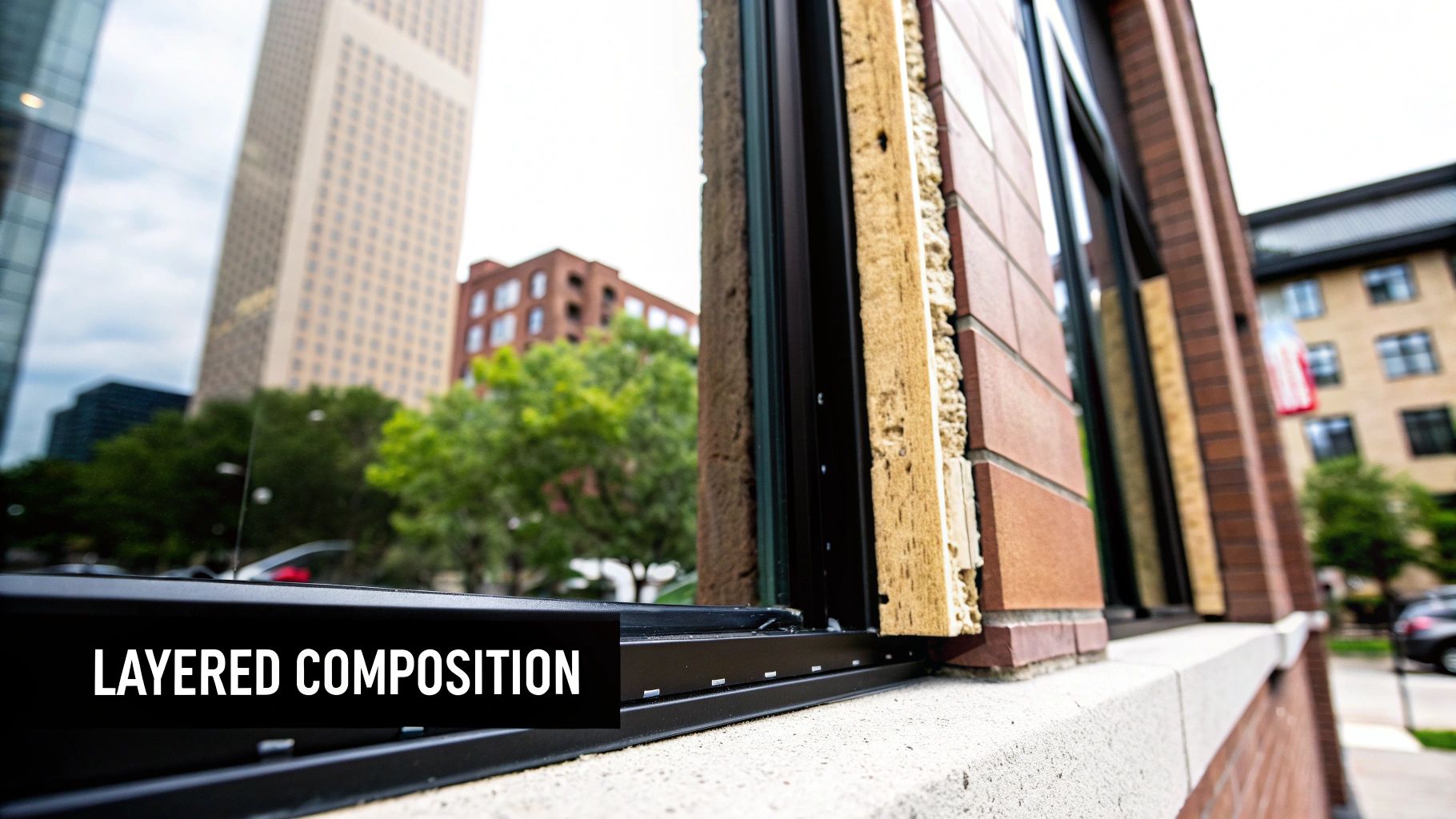
The core idea is simple but powerful: combine materials with opposite properties to create something far stronger than the sum of its parts. The outermost layer is usually a hard, brittle material like tempered glass. Its job is to be the first line of defense. On impact, it shatters, but in doing so, it accomplishes two critical things: it flattens the bullet, stripping it of its sharp, penetrating shape, and it drains a huge chunk of its initial momentum.
Behind the Glass Shield
Once the bullet has been blunted and slowed, the softer inner layers spring into action. These are typically made of a tough, flexible plastic like polycarbonate. Unlike the brittle glass, this material is designed to flex and "catch" the projectile's remaining energy, safely absorbing the impact and spreading it across the entire panel.
This teamwork between different materials is what makes the whole system work. Underneath that first pane of glass, you'll find multiple layers of plastics—often polyvinyl butyral (PVB) or polycarbonate—that soak up and distribute the bullet's kinetic energy. You can get a deeper dive into how these materials provide ballistic protection on omnilert.com.
The fundamental principle is energy dissipation. The hard glass layer breaks up the threat, and the soft plastic layers absorb the impact, preventing penetration without catastrophic failure.
To make this crystal clear, let's break down the role each material plays.
Key Materials in Bullet-Resistant Windows and Their Roles
This table shows how each component in a bullet-resistant window contributes to its overall strength.
| Material Component | Primary Function | Analogy |
|---|---|---|
| Tempered Glass (Outer Layer) | To shatter on impact, blunting and slowing the bullet. | A ceramic plate in body armor; it sacrifices itself to deform the projectile. |
| Polycarbonate (Inner Layer) | To flex and absorb the remaining kinetic energy of the bullet. | A catcher's mitt; it catches the force and stops the ball without breaking. |
| Polyvinyl Butyral (PVB) Interlayer | An adhesive that bonds the layers and helps absorb shock. | The "glue" in a plywood sheet; it holds everything together and adds flexibility. |
Ultimately, it’s this strategic layering—this secret sandwich of hard and soft materials working in concert—that defines what bulletproof windows are made of. This fundamental design is the foundation for all levels of ballistic protection.
What Are Bulletproof Windows Made Of? Deconstructing the Layers
Think of a bullet-resistant window not as a single sheet of super-strong glass, but as a sophisticated sandwich. It's a carefully engineered assembly of different materials, each with a specific job to do. The magic isn't in any single component, but in how they work together to absorb and defeat a projectile that would shatter any one of them alone.
The first line of defense, the layer facing the threat, is usually a sheet of tempered or chemically strengthened glass. This isn't your average window pane. It's designed to be incredibly hard and brittle. Its job isn't to stop the bullet cold, but to act as a sacrificial barrier.
When a bullet strikes this outer glass, the layer shatters instantly. This violent reaction is crucial—it flattens and deforms the projectile, effectively stripping it of its pointed, aerodynamic shape. This process alone absorbs a huge amount of the bullet's initial energy, turning a piercing threat into a much less effective blunt object.
The Power Duo: Polycarbonate and PVB
Once the bullet is blunted and slowed, the workhorse layers in the middle take over. This is where the real "bulletproof" part of the system kicks in, thanks primarily to polycarbonate. This is a type of thermoplastic known for its absolutely incredible strength and flexibility.
While the outer glass is meant to break, polycarbonate is engineered to bend and give, kind of like a catcher's mitt for a fastball. It "catches" what's left of the projectile and spreads the remaining force safely across the entire panel. To put it in perspective, a sheet of polycarbonate is a staggering 250 times more impact-resistant than a piece of glass of the same thickness.
But what keeps this whole sandwich from flying apart? That's the job of Polyvinyl Butyral (PVB). PVB is a tough, clear polymer interlayer that acts like a super-strong glue. When the outer glass shatters, the PVB layer clings to all the broken shards, holding them firmly in place. This prevents dangerous glass fragments (known as spall) from flying inward and helps the whole unit maintain its structure.
This is a great visual of how these layers come together during the manufacturing process to form a single, protective panel.
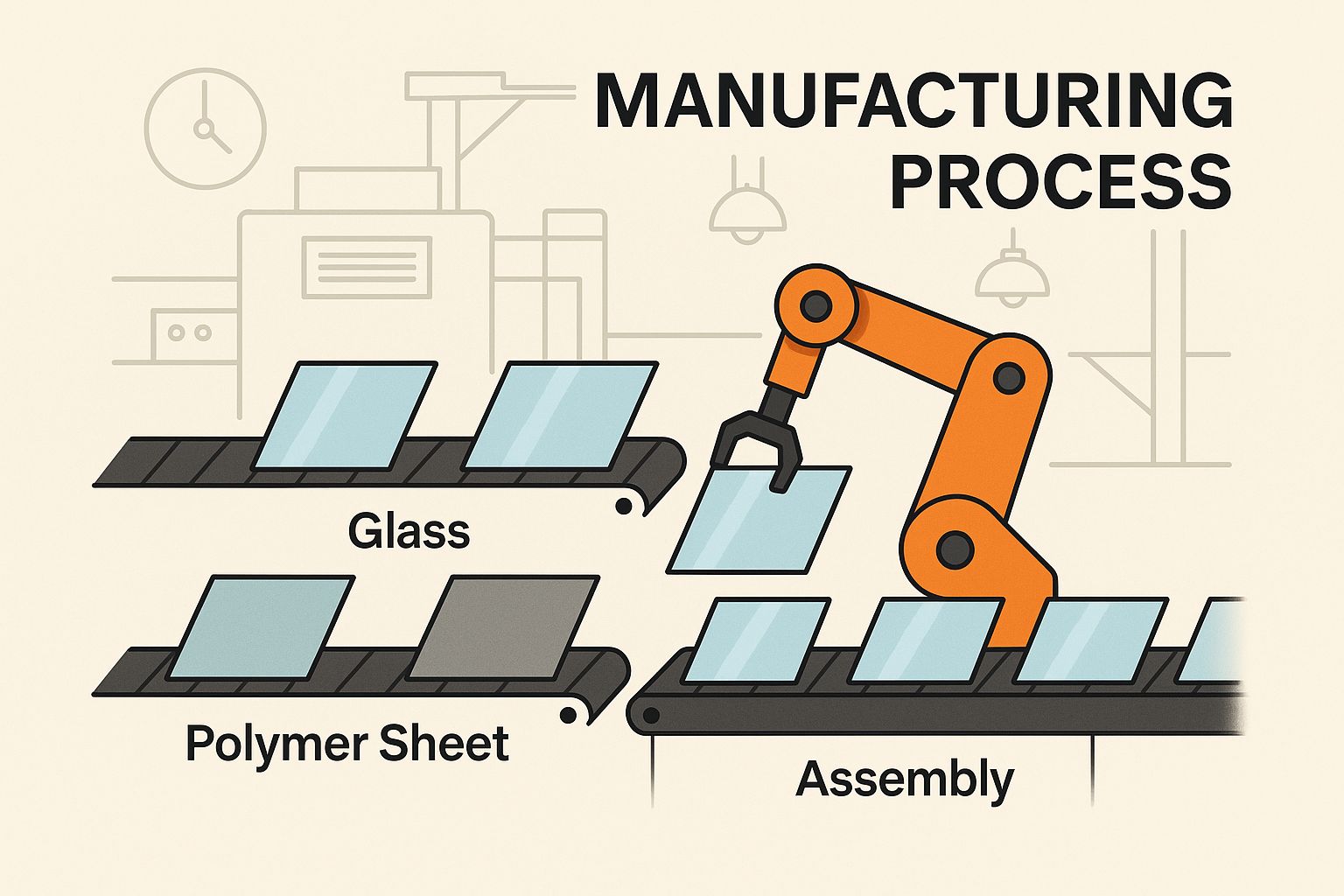
As you can see, it takes real precision to stack these sheets of glass, PVB, and polycarbonate before they are fused together into one solid piece.
Customizing the Layers for the Threat
The specific recipe—the number and thickness of these layers—is what determines the window's protection level. A basic panel might just alternate between glass and PVB, but windows designed to stop more powerful rounds will integrate thick layers of polycarbonate into the mix.
It's this teamwork that makes the system so effective. The hard glass shatters the bullet, the sticky PVB holds the broken pieces together, and the tough polycarbonate absorbs the final punch.
This multi-layer approach is the gold standard for permanent installations. But for situations where you need to upgrade existing glass, other options are available. You can find out how specialized films provide an added layer of defense in our guide on ballistic window film. Understanding this layered construction is the key to knowing what bulletproof windows are made of and why they work so well.
How Thickness Determines Strength
When you're looking at what bulletproof windows are made of, one thing becomes obvious very quickly: they aren't all the same. The real measure of a window's protective power comes down to its thickness and the specific recipe of materials used in its layers.
Think of it like a football helmet versus a bicycle helmet. One is built for casual bumps, while the other is engineered to take repeated, high-force impacts. Bullet-resistant glass operates on the same principle. More layers and more thickness mean more strength.
A relatively thin panel might be enough to stop a slug from a small handgun. But stopping a round from a high-powered rifle? That calls for a much heavier-duty assembly. This is precisely why we have standardized ratings to make sense of it all. The gold standard in the industry is UL 752, which sorts ballistic glazing into 10 different levels of protection.
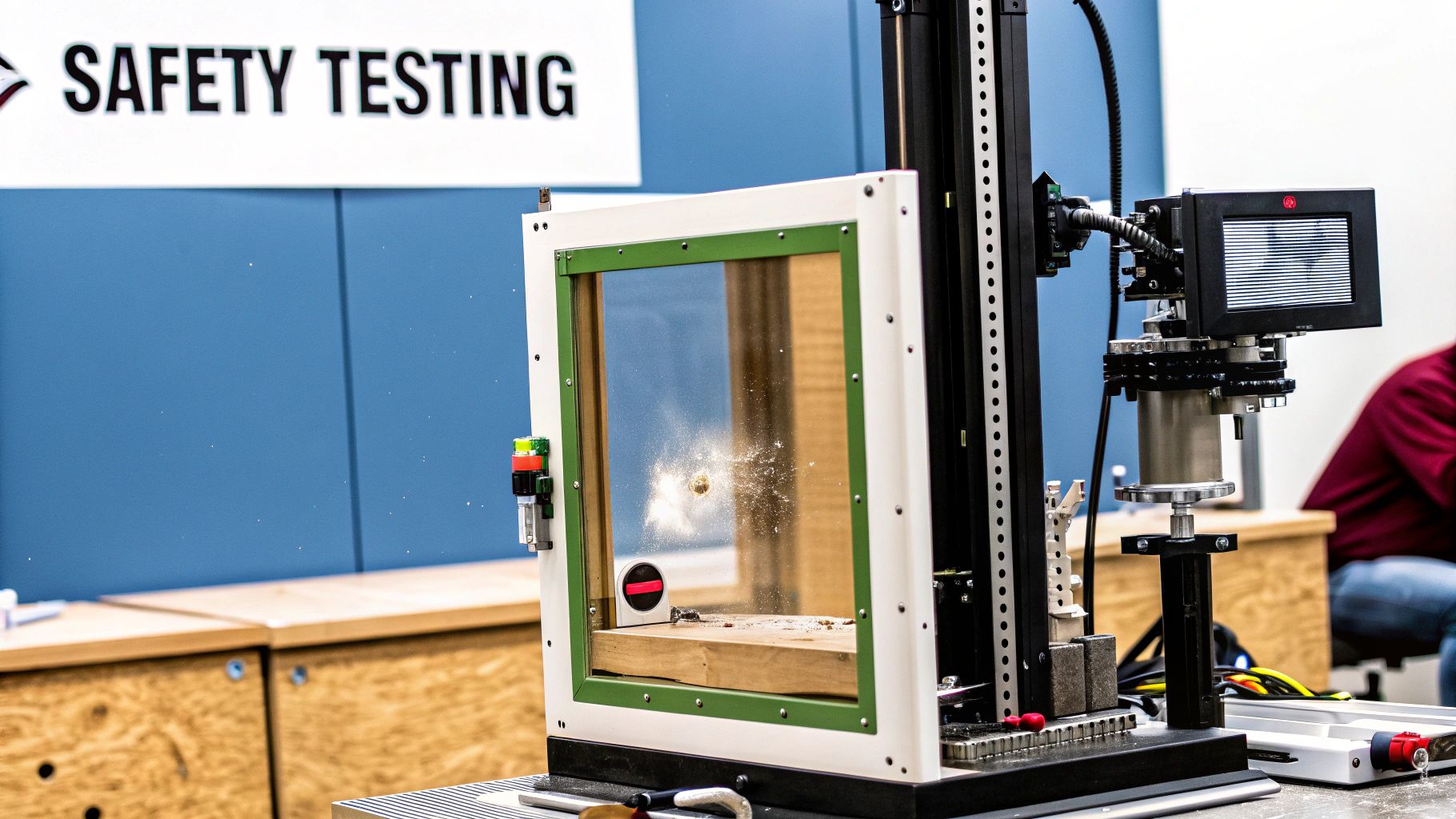
These levels give us a clear, practical way to match a window's capabilities to the specific threats it might face in the real world.
Matching Protection to the Threat
Each UL 752 level isn't just a technical spec on a sheet; it corresponds directly to the type of firearm it can defeat. This lets security professionals choose the right tool for the job, tailoring protection to the actual risks involved.
A gas station, for instance, might only need Level 1 or 2 windows, which are designed to handle common handgun rounds. On the other hand, a federal courthouse or an embassy would demand a much higher rating, like Level 8, which can stop multiple shots from a military-style assault rifle. It all comes down to the thickness and material makeup.
The core idea is simple: the more energy a bullet carries, the thicker and more complex the window assembly needs to be to safely absorb and dissipate that force.
To give you an idea of the range, typical commercial bullet-resistant glazing can go from about three-quarters of an inch to over three and a half inches thick. This thickness directly dictates the level of protection. For example, a 1-inch thick sheet of glass-clad polycarbonate can earn a UL 752 Level 2 rating, meaning it can reliably stop at least three rounds from a .357 Magnum.
The table below breaks down some of the most common UL 752 levels and the threats they're designed to stop.
UL 752 Protection Levels and Common Threats
| UL 752 Level | Typical Thickness Range | Rated to Stop Ammunition From |
|---|---|---|
| Level 1 | 0.75” – 0.94” | 9mm Full Metal Jacket (FMJ) Handgun |
| Level 2 | 1.00” – 1.12” | .357 Magnum Jacketed Soft Point (JSP) Handgun |
| Level 3 | 1.18” – 1.37” | .44 Magnum Lead Semi-Wadcutter (LSWC) Handgun |
| Level 4 | 1.50” – 1.62” | .30 Caliber Rifle Lead Core Soft Point (LCSP) |
| Level 8 | 2.37” – 2.50” | 7.62mm Rifle Full Metal Jacket (FMJ) |
This shows how protection scales up significantly with each level, requiring more advanced materials and greater thickness to handle more powerful firearms.
This principle of scalable protection is what makes modern security so effective and efficient. Of course, the security window film cost can vary dramatically based on the protection level needed. A school, a bank, and a private home all have very different threat profiles, and their window specifications will reflect that—a perfect example of how security today is a calculated balance of material science and practical risk assessment.
The Science of Fusing Glass and Plastic
Making a bullet-resistant window isn't as simple as slapping a few sheets of glass and plastic together. It's a highly controlled manufacturing process, one that takes those separate layers and turns them into a single, optically perfect panel with incredible strength. Think of it less like assembly and more like high-tech baking—the final product is a completely unified whole, bonded under immense heat and pressure.
It all starts with picking the right ingredients. Manufacturers begin with high-quality float glass, which is then supercharged through thermal or chemical tempering to boost its strength. At the same time, sheets of polycarbonate and sticky interlayers like PVB are prepped and ready to go. Getting this first step right is absolutely critical to the integrity of the final window.
From Raw Sheets to a Laminated Stack
Next, we move into an environment that’s cleaner than a hospital operating room. The sheets of glass and plastic are cut to size with extreme precision using lasers or waterjets. This happens in a dedicated cleanroom because even a single speck of dust can create a weak spot or a visual flaw. It's a meticulous process where contamination is the enemy. You can dive deeper into how these materials save lives over at ceramics.org.
Once every layer is perfectly cut, they are carefully stacked in a specific sequence: glass, interlayer, polycarbonate, and so on. This creates that "sandwich" we talked about.
The real magic happens inside an autoclave. This is basically a giant industrial pressure cooker. It uses a combination of intense heat and crushing pressure to force every layer to fuse together, squeezing out any trapped air and forming a permanent, monolithic bond.
This lamination is where the window gets its superpowers. It’s a similar kind of material science that goes into other advanced glass products. For example, innovations like smart glass films also rely on sophisticated layering to create their unique properties.
Final Touches for Long-Term Durability
After the panel comes out of the autoclave and is allowed to cool down slowly, there’s one last crucial step: edge sealing. The edges of the now-fused panel are sealed to protect the sensitive inner layers from moisture and air. This prevents delamination—that ugly, foggy separation you sometimes see in old laminated glass—and ensures the window stays strong and clear for decades.
This whole process is what makes these windows a permanent, reliable security feature. Of course, for upgrading existing windows, the approach is different. Understanding the fundamentals of a professional window security film installation provides a great comparison for how security can be retrofitted.
From the first cut to the final seal, every step is designed to create a product that can take a punch while looking like it isn't even there.
Where You Find Bullet-Resistant Windows
Once you understand the science behind how bulletproof windows are made, you start seeing them everywhere. Seriously—they're often hiding in plain sight. This isn't just technology for spy movies or government motorcades; it's a critical safety feature woven into many of our everyday surroundings.
The most common places are exactly where you'd expect: locations that handle cash or need to protect employees from immediate threats. Think about bank teller windows, the cashier's booth at a 24-hour gas station, or a late-night convenience store. These spots typically face handgun threats, so they'll install windows with a UL Level 1 to 3 rating. It’s a smart balance between solid protection and practical cost.
Protecting Public and Private Spaces
Beyond retail, this specialized glazing is a silent guardian in our public institutions. Courthouses, police stations, and government buildings rely on higher-rated glass at entrances and reception areas to keep staff and citizens safe. You'll even find them in places you might not have noticed before, like the main office of a school, which acts as the first line of defense.
The level of protection is always matched to the potential risk. It’s never a one-size-fits-all approach.
- Embassies and military bases are on another level. They require the highest protection, often UL Level 8 or even higher, designed to stop rounds from high-powered rifles.
- Luxury armored vehicles are a great example of custom work. They use curved ballistic glass to give occupants 360-degree protection without sacrificing the ability to see clearly.
- Residential safe rooms are also becoming more common. People are using bullet-resistant windows to turn a regular room into a secure sanctuary right inside their own home.
Seeing where these windows are used shows how they fit into a bigger picture of security. In fact, many people now see bullet-resistant windows as a vital part of their overall home protection strategies, which marks a real shift in bringing commercial-grade security into our personal lives.
The real takeaway here is that ballistic protection is always tailored. The environment determines the threat, and that threat dictates exactly what materials and thickness the window needs.
From keeping a cashier safe on the night shift to protecting a diplomat in a high-risk country, the layered sandwich of glass and polycarbonate is adapted to meet the challenge head-on. It's a perfect example of how materials science delivers practical, life-saving solutions that make our communities safer, one window at a time.
What Else Can Bulletproof Windows Do?
It turns out, the materials that make bulletproof windows so tough are good for a lot more than just stopping a projectile. The technology has come a long way, transforming ballistic glazing from a simple defensive barrier into a seriously multifunctional piece of building security.
One of the most impressive developments has to be one-way bullet resistance. Think about what that means for a moment. This specialized construction allows someone inside a secure room to shoot out, while the exterior side remains completely resistant to incoming fire. It's a true game-changer for police stations, government buildings, and high-stakes security, turning a static defensive position into an active, defensible one.
Beyond Ballistic Protection
Today’s advanced windows are also engineered to solve some pretty common problems. By adding low-emissivity (low-e) coatings into the mix, these windows become incredible insulators. They reflect heat, helping to keep buildings cooler in the summer and trapping warmth inside during the winter. Over the long run, this adds up to significant savings on energy bills.
But the benefits don't stop there. The unique multi-layered design offers a few other powerful perks:
- Serious UV Protection: Those same polymer interlayers that absorb a bullet’s impact are also fantastic at blocking up to 99% of harmful ultraviolet rays. This helps prevent expensive furniture, priceless artwork, and hardwood floors from fading over time.
- Impressive Soundproofing: The sheer mass and layered makeup of ballistic glass make it an exceptional sound barrier. It can drastically cut down on outside noise, creating a much quieter and more focused environment inside.
The modern bullet-resistant window is a complete building envelope solution. It delivers best-in-class security while simultaneously improving the building's energy performance and the comfort of its occupants.
The Future of Transparent Armor
The push for better, lighter, and stronger materials is relentless. Researchers are deep in the process of developing next-generation transparent armor that promises even greater strength without the traditional weight and thickness.
Cutting-edge materials like transparent aluminum (ALON) and sophisticated ceramics are leading the charge. These materials could potentially offer superior ballistic protection at a fraction of the weight of today's glass-clad polycarbonate. This would open up a whole new world of possibilities for military vehicles, aerospace applications, and architecture where every pound counts. This constant innovation is a clear sign that the field is adapting to meet ever-evolving security threats.
Frequently Asked Questions About Bullet-Resistant Windows
Even after breaking down the science, a few questions always seem to come up. Let's tackle some of the most common curiosities and misconceptions about this kind of high-level security glass.
Are They Really "Bulletproof"?
This is the most important myth to bust right away: no, they aren't. The term "bulletproof" is a popular one, but the industry standard and more accurate term is "bullet-resistant."
Think of it like this: a life vest helps you float, but it won't save you in a hurricane. Similarly, these windows are engineered to stop specific threats under specific conditions. A window rated to stop a 9mm handgun round won't stand a chance against a high-velocity rifle. That's why the UL 752 rating system is so critical—it tells you exactly what kind of threat a window is built to handle.
Just How Heavy Are These Windows?
They are heavy. Way heavier than the standard glass pane you have at home. This is a direct result of their multi-layered construction—all that glass, polycarbonate, and interlayer material adds up fast.
The exact weight really depends on its protection level.
- A basic handgun-rated window might weigh around 10 pounds per square foot.
- A high-level window designed to stop powerful rifle rounds can easily exceed 40 pounds per square foot.
This weight isn't just a fun fact; it's a major engineering consideration. The window frame and the building's structure itself have to be strong enough to support all that extra mass.
The added mass is the whole point—it's what absorbs and dissipates a bullet's incredible energy. More protection always means more weight.
Is the View Distorted?
Thankfully, no. High-quality bullet-resistant glass is manufactured to be optically clear, looking almost identical to a regular window. The lamination process is incredibly precise to prevent air bubbles, cloudiness, or any other visual defects from getting in the way.
You might notice a very subtle green or blue tint on extremely thick panels, but modern manufacturing has made light transmission a top priority. This clarity makes them perfect for everyday environments like banks, government buildings, and even homes where you need security without feeling like you're in a bunker.
At Fortress Security Films, we specialize in reinforcing your existing glass to provide an invisible shield against modern threats. Discover our advanced security film solutions at https://fortresssecurityfilms.com and secure your peace of mind.
