


The term "bulletproof" is a bit of a misnomer. These windows aren't made from a single, magical sheet of glass that's impossible to break. The reality is far more interesting—it’s a sophisticated, multi-layered composite designed to absorb and diffuse a bullet's tremendous energy.
Think of it as a high-tech sandwich, meticulously engineered with alternating layers of hard glass and flexible polycarbonate plastic. When these materials are bonded together, they create a barrier that can effectively stop a projectile cold.
The Secret Recipe for Bullet Resistant Glass
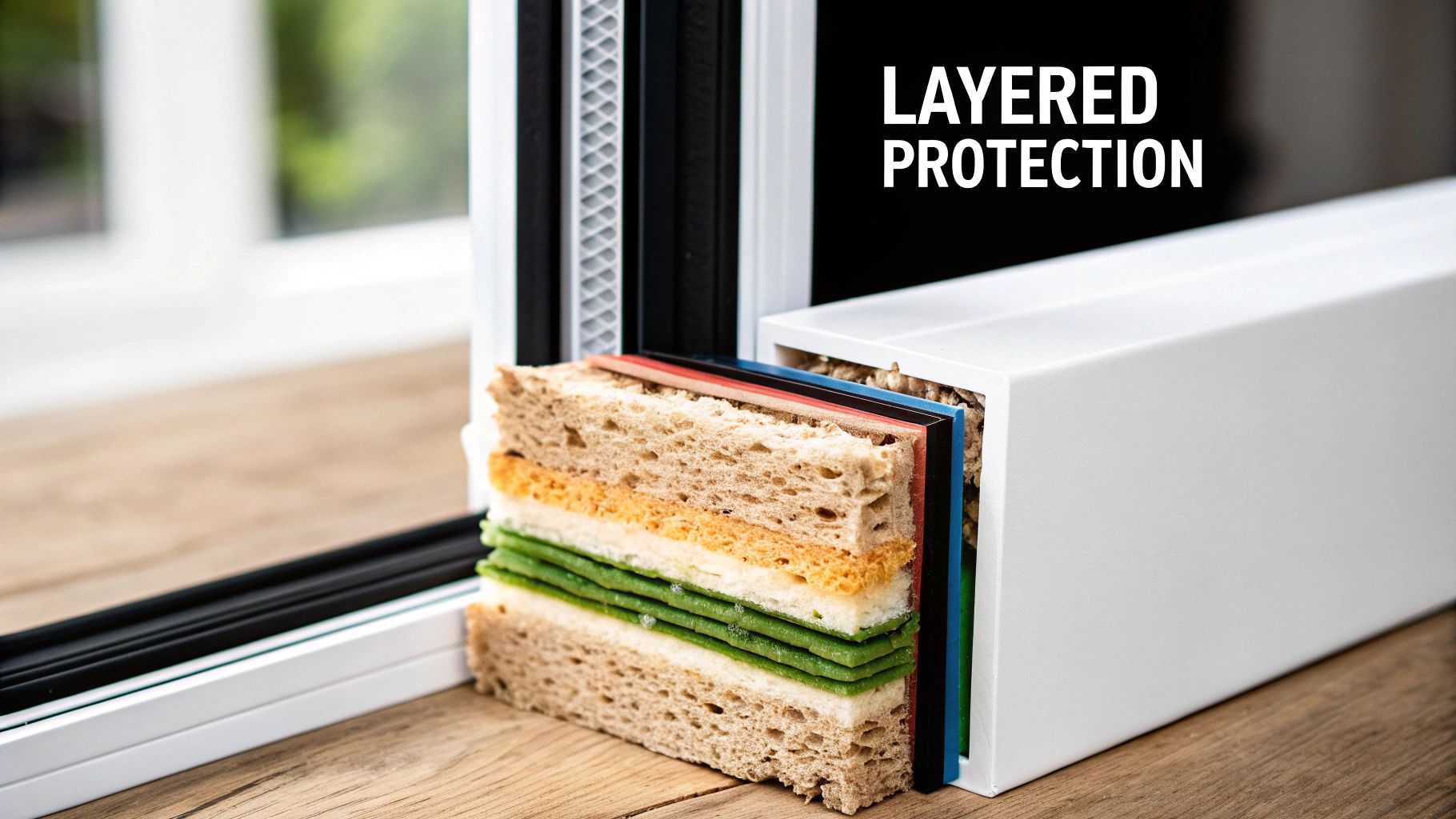
To really get what makes these windows work, don't picture a solid wall. A better analogy is a highly advanced catcher's mitt. A single, thick pane of regular glass would just shatter into a million pieces on impact. The true strength of bullet resistant glass comes from the clever combination of different materials, each with a specific job in managing a bullet's kinetic force.
This layered construction is the fundamental principle behind all ballistic security glass. The outermost layers are typically glass because it's incredibly hard and brittle. Their job isn't to stop the bullet on their own, but to take the initial hit, deforming and flattening the projectile to spread its force over a much wider surface area.
The Key Ingredients
Once the outer glass layers do their job, the softer inner layers take over. These are almost always made from polycarbonate, a remarkably tough and transparent thermoplastic celebrated for its impact resistance. Unlike glass, polycarbonate is flexible. It’s designed to bend and "catch" the slowed-down, mushroomed bullet, absorbing the rest of its energy and preventing it from passing through.
The unsung hero holding this entire assembly together is a special adhesive interlayer, like polyvinyl butyral (PVB). This clear film is laminated between each sheet of glass and polycarbonate, fusing them into a single, cohesive panel. It’s this interlayer that keeps the window from dangerously shattering, even under extreme duress.
This combined structure is what gives the window its strength. The glass provides the initial resistance, the polycarbonate provides the flexibility to absorb the impact, and the interlayer holds everything together under extreme force.
To help visualize how each material contributes, let's break it down.
Key Materials in Bullet Resistant Windows
| Material | Primary Role | Key Characteristic |
|---|---|---|
| Glass | Initial Impact Resistance | Hard, brittle; shatters to deform the bullet and disperse energy. |
| Polycarbonate | Energy Absorption | Flexible, high-impact strength; "catches" the projectile. |
| PVB Interlayer | Adhesion & Safety | Clear adhesive; bonds layers and prevents dangerous spalling. |
As you can see, it's the teamwork between these distinct materials that provides such incredible protection.
The final product consists of these laminated glass and polycarbonate sheets, with the exact number of layers and thickness depending on the desired level of protection. While these specialized windows offer serious ballistic defense, homeowners looking for an added layer of defense against forced entry might also want to learn about the best window film for security as a complementary solution.
How the Layers Work Together to Stop a Bullet
Knowing what goes into a bullet-resistant window is only half the story. The real genius is in how those different layers of glass and polycarbonate work together to absorb a bullet's incredible force. It’s a dynamic, split-second process that turns a fragile material like glass into a serious protective shield.
Think about a fastball hitting a brick wall versus a catcher's mitt. The wall is rigid, so it just shatters on impact. But the mitt is designed with layers that give, flex, and safely absorb the ball's energy. A bullet-resistant window works a lot more like the catcher's mitt.
The Initial Impact
When a bullet first hits the window, the outermost layer of hard glass does its one and only job: it shatters. This isn’t a failure—it's a critical part of the design.
As the glass breaks, it immediately flattens the bullet's sharp tip, forcing it into a "mushroom" shape. This simple change dramatically increases the bullet's surface area, spreading its force out over a much wider section of the window instead of concentrating it on a single point. This initial collision soaks up a huge chunk of the bullet's momentum, leaving it slower and far less able to pierce through.
The Energy Absorption Phase
Now that the bullet is blunted and slowed, the softer inner layers of polycarbonate and adhesive take over. This is where the real "catching" happens. Polycarbonate isn't brittle like glass; it's flexible and incredibly tough. It bows inward on impact, acting almost like a trampoline to soak up the rest of the bullet's energy.
The force ripples through the polycarbonate and the bonding layers, spreading across the entire panel. Each layer helps slow the bullet down a little more, until it finally comes to a dead stop, trapped within the window itself.
This process of transferring and absorbing energy is called delamination. It’s the controlled separation of the layers that allows the window to handle such a violent impact without completely failing, keeping the bullet from ever getting to the "safe" side.
Why a Sandwich Is Better Than a Slab
So, why not just use one super-thick piece of glass? Because no matter how thick you make it, a single pane of glass is still fundamentally brittle. It just can't flex and absorb energy the right way, so it would shatter under the focused pressure of a bullet.
The multi-layer "sandwich" approach provides the perfect combination of hardness (from the glass) and elasticity (from the polycarbonate) that a single material just can't match.
This layering principle is a core concept in protective gear. Even looking beyond ballistic protection, understanding different window privacy film installation techniques shows how combining different materials onto glass achieves a better result. It's this idea of synergy—making materials work together—that makes the technology so effective.
Understanding Ballistic Ratings and Thickness
First things first, let's clear up a common misconception. The term 'bulletproof' is a bit of a misnomer; in the real world, no glass is completely impenetrable to every possible threat. That’s why we in the industry prefer the term 'bullet-resistant.' This isn't just semantics—it reflects a spectrum of protection levels, each one tied to rigorous testing that measures a window’s ability to stand up to specific dangers.
The gold standard for this testing is UL 752. Think of it as a classification system for ballistic glass, with ratings from Level 1 all the way up to Level 8 and beyond for specialized military or government needs. Each level tells you exactly what a window can handle: the type of firearm, the caliber of the bullet, and how many shots it can stop. For instance, a Level 1 window is designed to stop a few rounds from a 9mm handgun, while a Level 8 window is engineered to defeat multiple shots from a high-powered rifle.
This system makes one thing crystal clear: what bulletproof windows are made of directly dictates their performance. Picking the right window isn't about finding something "unbreakable." It's about matching the level of protection to the specific threat you need to guard against.
The Link Between Thickness and Protection
It’s a simple rule of thumb: the thicker the window and the more layers it has, the higher its UL 752 rating. A higher rating means a thicker, heavier panel with more alternating layers of glass and polycarbonate. All that extra mass and complexity are necessary to absorb and dissipate the immense kinetic energy from more powerful ammunition.
The infographic below gives a great visual breakdown of how these layers work in concert to stop a bullet.
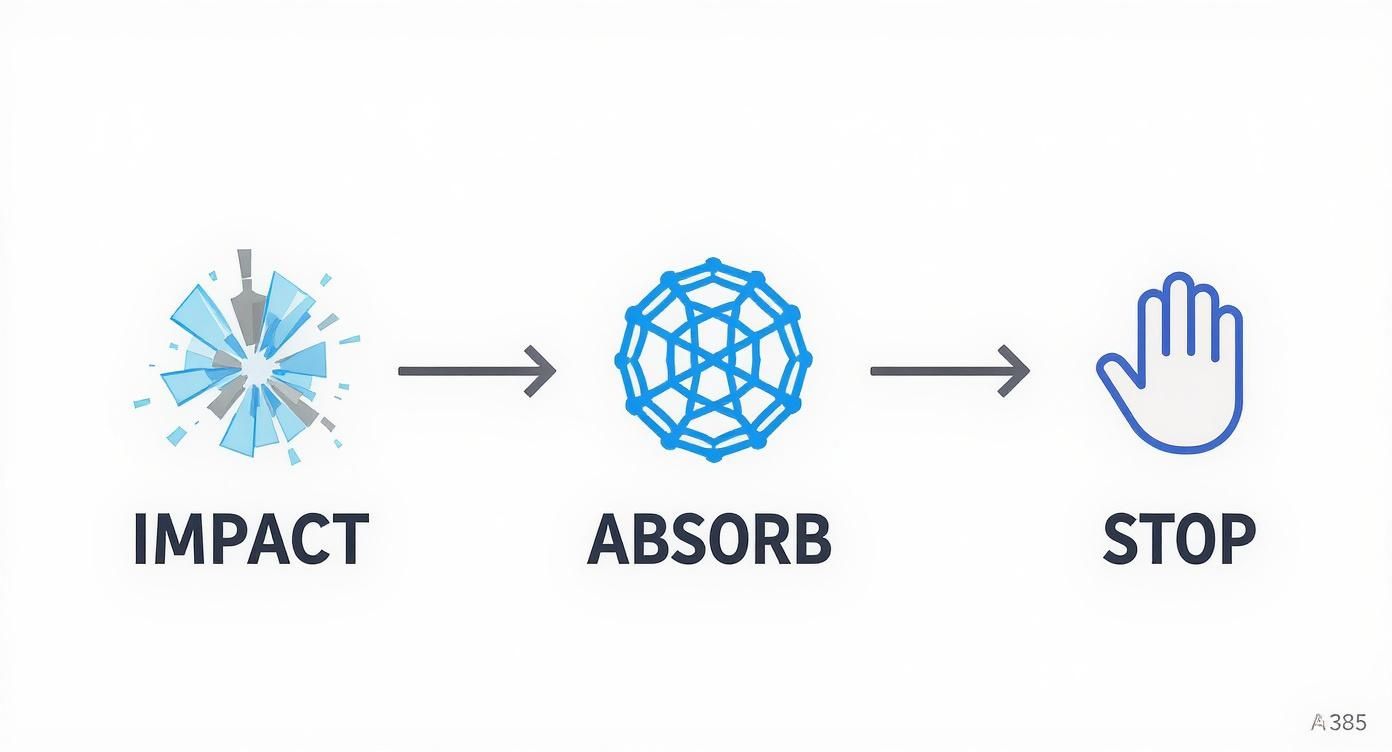
As you can see, stopping a bullet is a team effort. The initial impact is just the beginning; the real work happens as each subsequent layer slows the projectile down until it’s brought to a complete halt.
The thickness of bullet-resistant glazing varies wildly, from panels as slim as a quarter-inch to hefty laminates over three inches thick. To put it in perspective, a 1-inch-thick sheet of glass-clad polycarbonate can earn a UL 752 Level 2 rating, meaning it can stop multiple shots from a .357 Magnum. A slightly thinner ¾-inch panel might meet Level 1 standards, designed for 9mm rounds.
Key Takeaway: A Level 3 window, typically around 1.25 inches thick, is built to stop multiple shots from a powerful .44 Magnum. But if you need to defend against rifle rounds, you’d have to jump up to a much thicker and more complex Level 4 window or higher.
Getting these ratings right is crucial. While a full ballistic window replacement provides the ultimate protection, it’s not the only option. In some cases, existing glass can be significantly reinforced. You can learn more about how ballistic window film can add a crucial layer of defense, proving that effective security is all about choosing the right tool for the job.
Why the Window Frame Is Just as Important
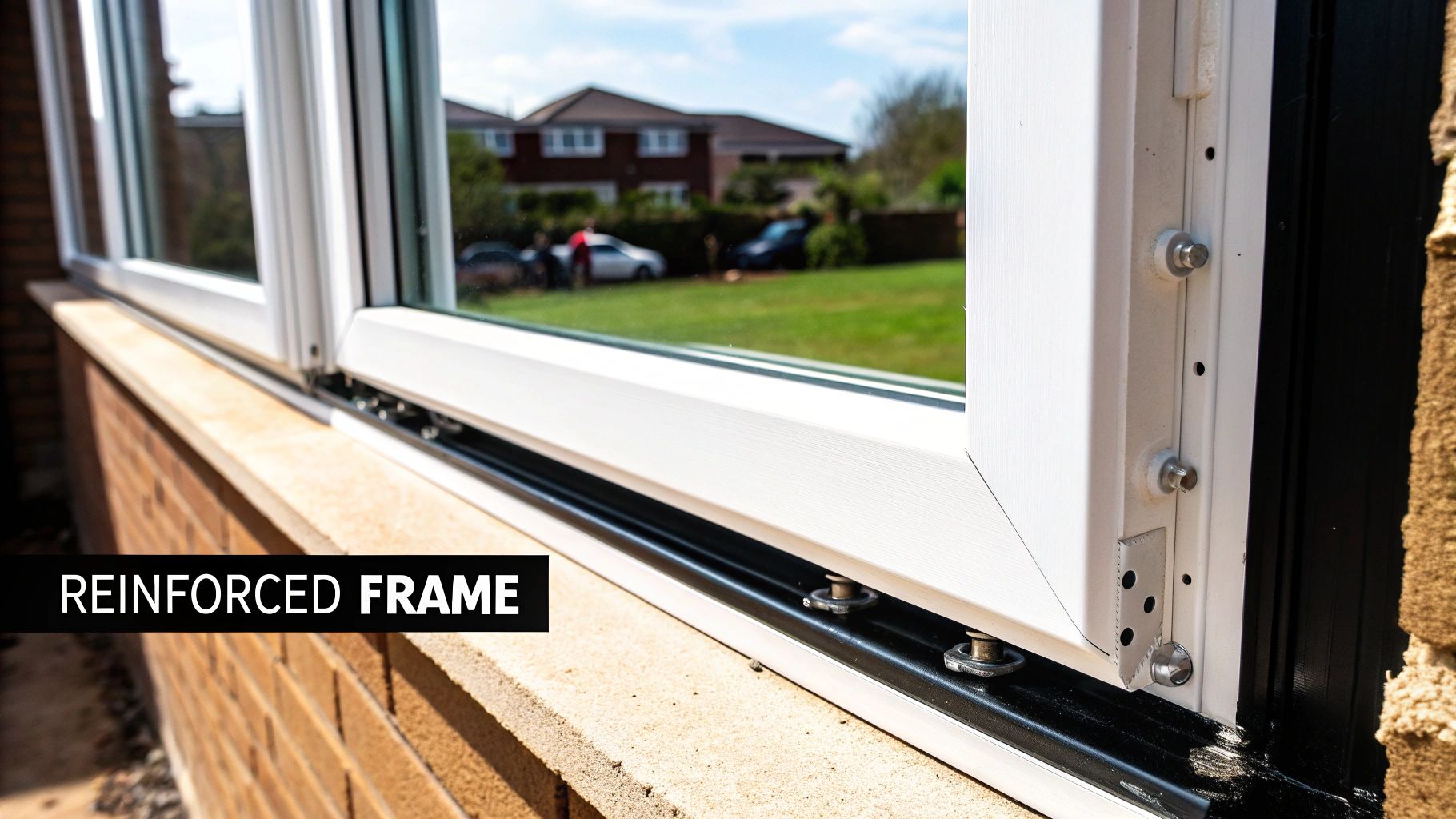
Think of a bullet-resistant window as a complete security system, not just a high-tech pane of glass. The entire assembly is only ever as strong as its weakest link. More often than not, that weak point is the frame.
Dropping a heavy, multi-layered ballistic panel into a standard wood or vinyl frame is setting yourself up for failure. These everyday frames just aren't built to handle the sheer force of a ballistic impact.
When a bullet strikes, its energy has to go somewhere. It radiates from the glazing straight into the structure holding it. A normal frame will splinter, buckle, or even rip out of the wall, taking the glass with it and leaving you completely exposed.
Materials That Make a Frame Bullet Resistant
For a window system to be genuinely secure, the frame has to be engineered to match the protective power of the glass. This means using specialized materials that can absorb incredible force and bear the significant weight of ballistic glazing.
Common choices include:
- Reinforced Steel: This is the industry standard for high-security places like government facilities or banks. Steel delivers maximum strength and durability, offering the highest level of protection, though it's heavy and often has an industrial look.
- Ballistic Aluminum: As a lighter and more versatile option, ballistic aluminum is a great fit for schools, storefronts, and public buildings. It can be engineered to meet various UL ratings while providing a much cleaner architectural appearance than steel.
- Durable Composites: Advanced composite materials are also an option, offering a unique blend of strength and reduced weight. While less common, they can be the perfect solution for specific design challenges.
The performance of bullet-resistant windows isn't just about the glass. The frame's strength and how it's integrated into the building are just as vital, often demanding detailed planning in architectural details drawings.
A key takeaway is that ballistic window systems are certified by UL as a complete unit—the glazing and the frame together. If you mix and match unrated parts, you forfeit any guarantee of performance and introduce a dangerous vulnerability.
Ultimately, real protection comes from a system designed to work as one. While the glazing is obviously a critical component, even understanding the details of a professional window security film installation shows how different elements must cooperate to achieve true security. Selecting the right frame ensures your investment in ballistic glass actually does its job when it counts.
Where You Will Find Bullet Resistant Windows
Think of bulletproof windows, and you might picture a bank teller or an armored truck. While that’s not wrong, it's an outdated picture. Today, this kind of advanced protection is quietly showing up in all sorts of places you might visit every day.
It’s a direct response to a world where security is no longer just for high-stakes environments. The need to protect people and property has expanded into public and private spaces like never before, and the technology has evolved to meet that demand.
Who Uses Ballistic Glass?
You'll now find ballistic glass in schools, high-end retail stores, government buildings, and even private homes. The specific reasons for installing it might differ, but the core goal is always the same: creating a reliable, invisible shield that buys precious time when the unthinkable happens. Seeing where these windows are used tells you a lot about how they're tailored to fit different needs.
The market for these systems is surprisingly diverse. For example, aluminum-framed windows are a popular choice, making up about 40% of the global market because they hit a sweet spot between cost and strength. Stainless steel frames follow at 30%, with tough polycarbonate options holding 20% of the share.
The applications themselves paint an even clearer picture. Residential properties now account for a significant 25% of all installations. Banks make up 15%, while embassies and prisons each represent another 10%. You can explore more data on these market trends to get the full scope.
To put this in perspective, here's a quick look at how the market breaks down.
Bulletproof Window Usage by Sector
| Sector | Market Share Percentage | Primary Security Need |
|---|---|---|
| Residential | 25% | Protection against home invasions and burglaries |
| Banks & Financial | 15% | Securing tellers, assets, and customer areas |
| Embassies | 10% | High-level government and diplomatic protection |
| Prisons & Corrections | 10% | Containment and control within secure facilities |
| Other (Retail, Schools, etc.) | 40% | Active threat prevention, smash-and-grab |
What this data shows is a major shift in thinking.
What was once a niche security product for high-risk government or financial institutions is now becoming a practical safety feature for communities and families.
Adapting to Different Threat Levels
A bulletproof window isn't a one-size-fits-all product. The final design is always a direct reflection of its environment and the potential threats it needs to stop.
-
Schools and Universities: The goal here is to create safe zones in classrooms and at main entrances without turning the school into a fortress. Ballistic aluminum frames that blend in with the existing architecture are a common choice.
-
Retail and Commercial Buildings: High-end storefronts use this glass as a powerful deterrent against smash-and-grab robberies. The key is maintaining perfect optical clarity so the products on display still look their best.
-
Government and Law Enforcement: These are high-security locations that demand the absolute highest level of protection. You'll find heavy-duty steel frames and glass-clad polycarbonate rated to stop high-powered rifle rounds.
-
Private Residences: More and more homeowners are choosing ballistic windows for peace of mind against home invasions. The systems designed for homes prioritize a discreet appearance, offering serious protection that doesn't scream "bunker."
Debunking Common Myths About Bulletproof Glass
Thanks to Hollywood, we have a pretty wild idea of how bulletproof windows work. The reality is far more interesting than the fiction. To really get a handle on this technology, we need to clear up a few things the action movies get wrong.
First off, let's talk about the term "bulletproof." In the real world, nothing is truly bulletproof. The more accurate term we use in the industry is bullet-resistant. This distinction is critical because it tells you the glass is rated to stop a specific caliber from a specific weapon for a specific number of hits—not an endless onslaught from a high-powered rifle.
Are They All Thick and Distorted?
Another myth is that all bullet-resistant windows are ridiculously thick, heavy, and warp your view like an old bottle. While that might have been true decades ago, materials and manufacturing have come a long, long way.
Modern systems, especially those using glass-clad polycarbonate, are engineered for incredible optical clarity. You can find high-level protection that looks virtually identical to a standard pane of glass. This is a game-changer, allowing these windows to blend right into office buildings, schools, and homes without looking like a fortress.
The Truth About Spalling
Stopping the bullet is only half the battle. What happens on the inside of the window when it's hit is just as important. This is where we need to talk about a concept called spalling.
Spalling is what happens when a bullet's impact causes tiny fragments of glass or polycarbonate to break off the back (the "safe" side) of the window. Even if the bullet doesn't get through, these flying shards can be just as deadly.
This is precisely why a well-designed window includes a final inner layer with a spall shield. This thin, specialized coating acts like a net, catching any fragments that might break loose upon impact. It’s a crucial feature that ensures the people on the protected side remain completely unharmed, and it’s one of the key differences between a good system and a great one.
Getting these facts straight gives you a much better picture of how this technology actually performs. These windows aren't magic. They are sophisticated, meticulously engineered safety systems designed to defeat specific, calculated threats.
Frequently Asked Questions
Even after diving into the technical details, you probably have a few practical questions about how these windows work in the real world. Let's tackle some of the most common ones to clear things up.
Are Bullet-Resistant Windows Truly "Bulletproof"?
That’s a great question, and the short answer is no. The term "bulletproof" is really a misnomer that stuck. In the industry, we always refer to them as "bullet-resistant" because no material is absolutely impenetrable to every possible threat.
Think of it like this: a window is engineered to defeat a specific type of attack. It's tested and certified to stop a certain number of rounds from a particular caliber of firearm, based on official standards like UL 752. A window rated for a 9mm handgun simply isn't built to stop a round from a high-powered hunting rifle. The key is matching the protection level to the threats you realistically face.
How Much More Do Bullet-Resistant Windows Cost?
You can expect the cost to be significantly higher than standard windows, and for good reason. The price jump comes down to a few core factors:
- Specialized Materials: High-end materials like polycarbonate and proprietary interlayers don't come cheap.
- Intensive Manufacturing: The lamination process is a precise, multi-stage craft that requires specialized equipment and skill.
- Ballistic Frames: The glass is only half the system. The required reinforced steel or aluminum frames are a major component of the cost.
Depending on the UL rating, size, and frame, the price can run anywhere from several hundred to even thousands of dollars per square foot.
Remember, you aren't just buying a pane of glass. You're investing in a complete security system that has been meticulously engineered and tested to perform under fire.
Can I Just Put Bullet-Resistant Glass in My Existing Window Frames?
I get this question all the time, but in almost every single case, the answer is a hard no. Your standard residential frames, whether they're wood, vinyl, or basic aluminum, just aren't built for this job. They can't handle the sheer weight of ballistic glazing, and more importantly, they would completely fail from the violent shockwave of a bullet impact.
A certified bullet-resistant window is an integrated system. The glazing and the specially designed ballistic frame are tested together to ensure the entire opening holds up. Trying to retrofit just the glass would create a critical weak point.
Do Bullet-Resistant Windows Need Special Cleaning?
Yes, they absolutely do, and this is crucial for maintaining their longevity and clarity. The inner layer of polycarbonate is a fantastic impact absorber, but it's also much softer than glass and can be damaged by the wrong chemicals.
You should never use ammonia-based cleaners like Windex or any abrasive scrubbers. These can cause the polycarbonate to get cloudy or develop fine cracks—a phenomenon called "crazing"—which ruins your visibility. Always stick to the manufacturer's care guide, which almost always recommends a simple solution of mild soap and water with a soft, clean cloth.
At Fortress Security Films, we know that real security is about a combination of advanced materials and professional installation. Our high-performance window films and ballistic systems offer an invisible shield for your property. Discover how we can reinforce your windows against today's threats at https://fortresssecurityfilms.com.
