


A formal threat assessment isn't just another safety protocol; it's a proactive strategy for identifying, evaluating, and ultimately managing students who might pose a risk of violence. This approach digs deeper than simple disciplinary action, aiming to uncover the root causes of troubling behavior. It’s all about early intervention and providing support long before a situation escalates into a crisis.
Why Proactive Threat Assessment Is Now Essential

Let's be honest: keeping a school safe has become incredibly complex. The challenges we face today go far beyond the occasional hallway scuffle. We're dealing with digital harassment, escalating mental health crises, and the very real potential for targeted violence. Simply waiting for something to happen before taking action is a gamble we can't afford to take.
This is why a structured, proactive threat assessment plan is no longer a "nice-to-have"—it's a fundamental pillar of any genuinely safe learning environment.
This isn't about profiling students or jumping straight to punishment. It's about building a system where people feel comfortable reporting concerns, where risks are carefully and professionally evaluated, and where supportive interventions are the primary goal. The entire focus is on de-escalation and prevention, not just reaction.
A proactive threat assessment model shifts the focus from punishment to prevention. It empowers a school to connect a student with necessary resources—counseling, academic support, or family services—addressing the underlying issues that lead to concerning behaviors.
When you look at the true cost of reactive investigations, the need for a proactive model becomes crystal clear. The emotional, financial, and community-wide damage that follows an incident is immense. A preventative framework doesn't just save resources; it protects the well-being of everyone in the school community.
From Theory to Reality: A Real-World Scenario
Picture this: a high school teacher overhears a student making vague but unsettling comments about "making people pay." In a school with a purely reactive system, that student might get sent to the principal's office for a stern lecture and maybe a suspension. The immediate problem is handled, but the underlying anger and distress are never addressed.
Now, let's see how this plays out in a school with a threat assessment plan.
The teacher knows exactly what to do and immediately reports the comment through a clear, confidential channel. This report triggers the school's multidisciplinary Threat Assessment Team (TAT), which might include an administrator, a school psychologist, and a law enforcement liaison. The team gets to work, quietly gathering information from different angles.
- Academics: They quickly discover the student's grades have taken a nosedive recently.
- Social Life: The school counselor learns the student has been the target of relentless online bullying.
- Home Situation: A conversation with a social worker reveals significant turmoil at home.
Instead of punishment, the team develops a supportive management plan. The student is connected with the school psychologist for regular counseling, a peer mediation session is set up to address the bullying, and the parents are brought in to discuss family support resources available in the community.
The threat is neutralized, not just by stopping a potential act, but by helping a student who was clearly in crisis. That's the power of a modern threat assessment framework in action.
Building Your Multidisciplinary Threat Assessment Team
https://www.youtube.com/embed/OWqnXxiGjJo
When it comes to threat assessments, one person can't do it all. The entire process hinges on collaboration and bringing different viewpoints into the same room. The cornerstone of any solid school safety program is the Threat Assessment Team (TAT)—a dedicated, multidisciplinary group that acts as the nerve center for your strategy.
Simply handing this responsibility to a single administrator and hoping for the best isn't just inefficient; it's a recipe for disaster. A lone individual can't possibly see a situation from every critical angle. A well-rounded team, on the other hand, can connect the dots between a student's dipping grades, a sudden change in behavior, and outside pressures that one person might easily miss.
Assembling Your Core Team Members
The real strength of a threat assessment team comes from its makeup. Every member brings a unique lens to the table, which gives you a much fuller, more nuanced picture of what’s really going on. Your core team needs to be small enough to stay agile but diverse enough to be truly effective.
At a minimum, these roles are non-negotiable for your TAT:
-
School Administrator: This is usually a principal or assistant principal who leads the team. They have the authority to make key decisions, free up resources, and actually put the team's recommendations into action. Their buy-in is critical.
-
Mental Health Professional: You absolutely need a school psychologist, social worker, or counselor on board. They bring a deep understanding of student behavior, mental health, and developmental psychology, helping the team get to the "why" behind a potential threat.
-
Law Enforcement Liaison: This is typically your School Resource Officer (SRO) or a specific contact from the local police department. They provide a direct line to law enforcement, offer a public safety perspective, and can guide the team on legal thresholds and official procedures.
This infographic gives a great visual breakdown of the essential steps for getting your team started.
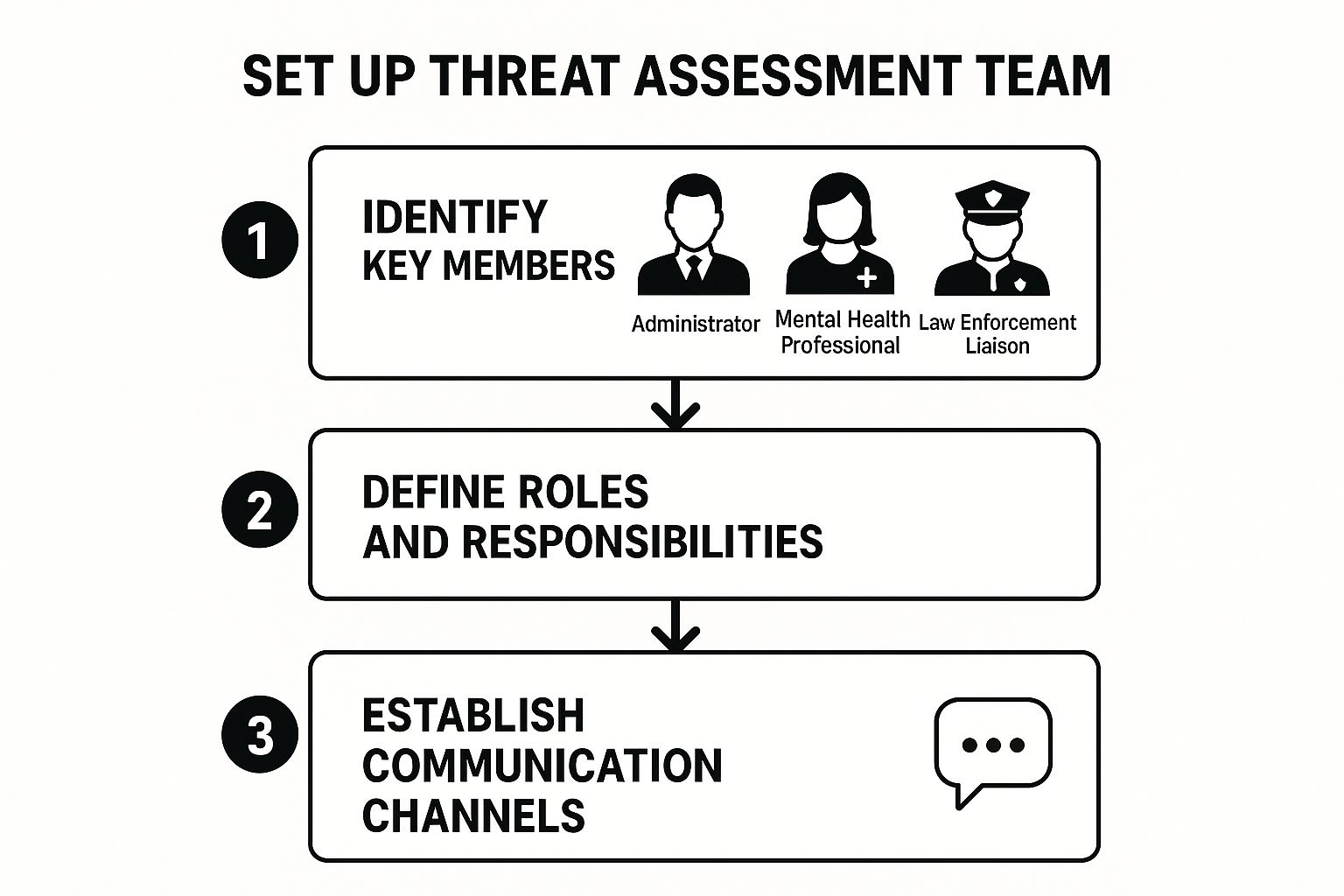
As you can see, a strong team isn't just about who's on it. It’s about how they're organized, with everyone knowing their role and keeping the lines of communication wide open.
Defining Roles for a Cohesive Process
Once you have your people, the next critical step is defining their roles with absolute clarity. When a crisis hits, ambiguity is your enemy—it leads to hesitation and inaction. Everyone must know exactly what they’re responsible for before, during, and after an assessment.
A common mistake I see is schools assuming these roles are self-evident. You have to take the time to actually document responsibilities in writing. It prevents confusion under pressure and ensures your process is consistent and defensible every single time.
For instance, the administrator's job is to steer the process and have the final say on interventions. The mental health professional is tasked with conducting clinical interviews and making sense of behavioral data. And the law enforcement liaison focuses on gathering information tied to any potential criminal activity while advising on safety planning.
This table provides a clearer picture of how these roles function in practice.
Core Roles and Responsibilities in a School Threat Assessment Team
Here is a breakdown of the essential members of a Threat Assessment Team (TAT) and their specific contributions to the process.
| Role | Primary Responsibility | Key Contribution |
|---|---|---|
| School Administrator | Lead the TAT, coordinate meetings, and ensure intervention plans are implemented. | Provides institutional authority and access to school resources, ensuring the team's decisions are acted upon. |
| Mental Health Professional | Assess the student's psychological state, motivations, and underlying issues. | Offers clinical insights into behavior, helping differentiate between making a threat and posing a threat. |
| Law Enforcement Liaison | Investigate potential criminal violations and advise on public safety concerns. | Provides a direct link to law enforcement databases and expertise in safety planning and threat neutralization. |
| Teacher/Staff Member | Report initial concerns and provide firsthand observations of student behavior. | Offers invaluable day-to-day context on the student's interactions, academic performance, and peer relationships. |
Having these roles clearly defined ensures a smooth, coordinated effort when you need it most.
Expanding the Team as Needed
While your core team is the constant, you have to stay flexible. For certain cases, you’ll need to pull in other experts on an ad-hoc basis. Bringing in the right people at the right time is key to making sure you have all the pieces of the puzzle.
Think about looping in these individuals when the situation calls for it:
- Teachers: A student's teacher sees them every day. They're often the first to notice subtle shifts in behavior or attitude that no one else would catch.
- Special Education Staff: If the student has an Individualized Education Program (IEP), this expert provides crucial context about disabilities and what appropriate interventions look like.
- School Nurse: They might have information about medical conditions or medications that could be influencing a student's behavior.
- IT Staff: In cases involving cyberbullying or online threats, your IT department can be instrumental in tracking down and preserving digital evidence.
Building this team is the first, most important step in setting up a threat assessment in schools that actually works. It creates a collaborative structure where shared expertise leads to better, safer outcomes for everyone.
The Five Phases of a Comprehensive Threat Assessment Process
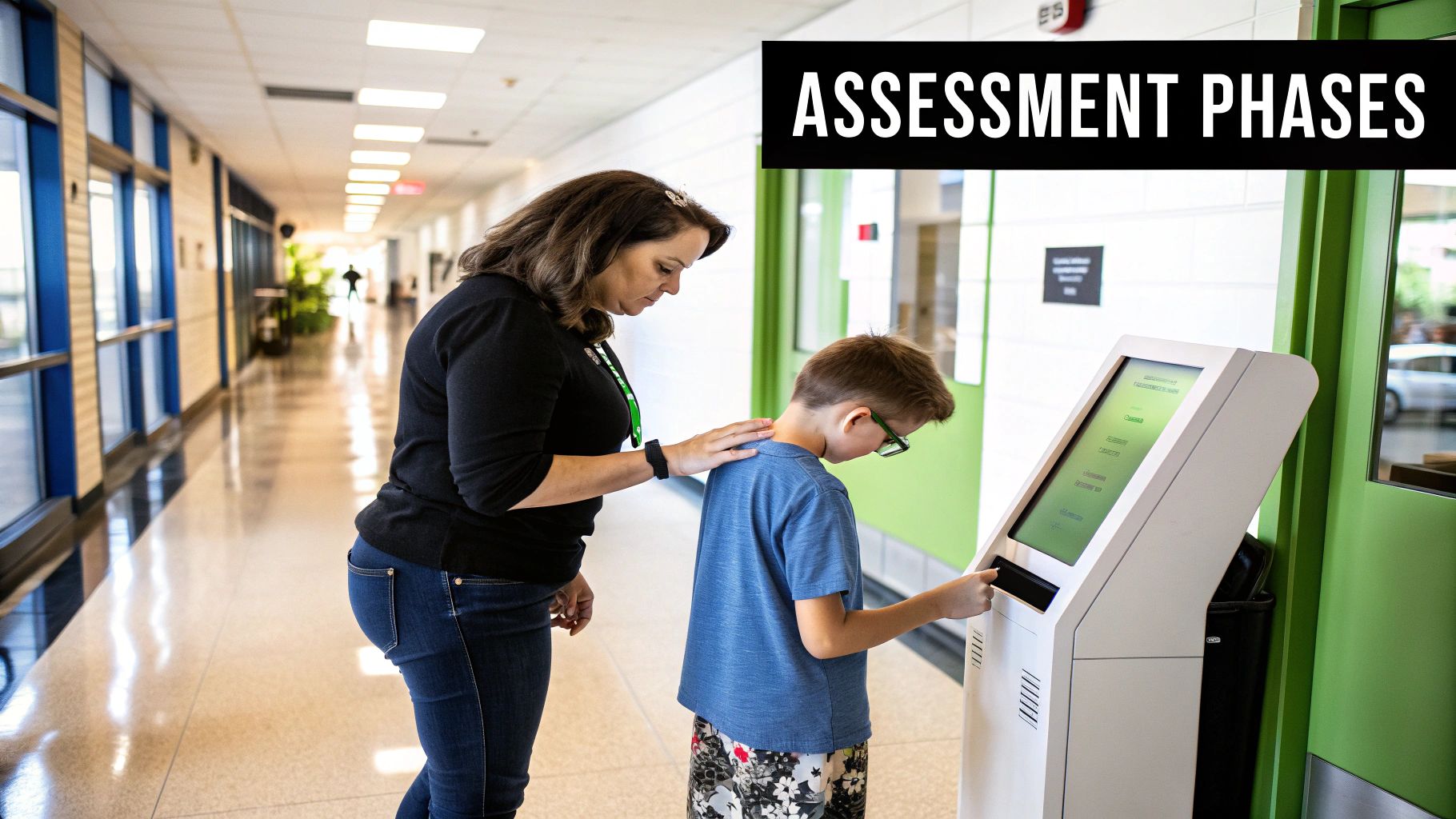
When a potential crisis is unfolding, the last thing you want is guesswork. A structured threat assessment process is what separates a measured, effective response from a reactive scramble fueled by panic. Think of it not as a rigid checklist, but as a systematic framework that ensures every concern is handled with consistency, fairness, and a sharp focus on prevention.
The entire threat assessment in schools model really boils down to five interconnected phases. Each one builds on the last, guiding your team from the first report all the way to a final resolution. Let's walk through how this works on the ground.
Phase 1: Identification and Reporting
It all begins with a report. You can't assess a threat you don't know about, which is why this first phase is about fostering a culture where students, staff, and parents feel empowered to speak up. The goal is to make reporting a concern feel as normal as asking a teacher for help.
This requires much more than a "see something, say something" poster in the hallway. You need clear, accessible, and confidential channels for people to use.
- Anonymous Reporting Tools: You absolutely need a system—whether it’s a dedicated app, a web form, or a text-a-tip line—that lets students share what they know without fearing backlash. Kids are often the first to see when a peer is struggling or heading down a dangerous path.
- Staff Training: Every single adult on your campus, from the principal to the custodians, has to be trained to spot the warning signs and know the exact protocol for reporting them. There should be zero ambiguity about who to tell and how.
- Community Awareness: Keep the conversation going. Regularly remind parents and students why the reporting system exists, framing it as a tool for getting help for those who need it, not just a way to get people in trouble.
A common pitfall I see is creating a reporting system nobody trusts. If students think it’s just a pipeline to the principal’s office for punishment, they’ll never use it. The messaging has to consistently be about support and intervention.
Phase 2: Initial Triage and Information Gathering
Once a report comes in, the Threat Assessment Team (TAT) needs to act fast. This isn't the deep-dive investigation just yet—this is triage. Your immediate goal is to figure out if you're dealing with a transient threat (a fleeting expression of anger) or a substantive threat (a plausible intent to cause harm).
The team quickly pulls together preliminary information to make that call. It's a rapid fact-finding mission to answer a few critical questions:
- What was the specific behavior or statement?
- Who was the target?
- Are there immediate safety concerns that demand an urgent response, like involving law enforcement?
For instance, a student shouting "I'm going to get you!" after losing a basketball game is almost certainly a transient threat. But a student who writes a detailed plan to hurt a classmate and has been researching weapons? That's a substantive threat, and it requires an immediate, full-scale assessment. This information-gathering stage is the bedrock of the whole process; our guide on security threat assessments offers a deeper look into getting it right.
Phase 3: In-depth Assessment and Analysis
If the initial triage points to a substantive threat, the process kicks into high gear. Now, the TAT begins a careful, thorough investigation to understand the full context. This is where having a multidisciplinary team really pays off.
Your team will start pulling information from multiple sources to build a complete picture of the student and the situation.
- Interviews: Talk to everyone involved—the student of concern, the target (if there is one), and key witnesses like friends, teachers, and parents.
- Record Reviews: Dig into academic records, attendance patterns, and past disciplinary files to spot any troubling changes or trends.
- Digital Footprints: Where relevant and accessible, look at social media posts or other online activity for more clues about the student's state of mind, intent, or planning.
This phase is all about connecting the dots. Is the student showing signs of depression? Did they recently suffer a major loss? Are they being bullied? The analysis helps the team distinguish between a student who is making a threat versus one who actually poses a threat.
Phase 4: Case Management and Intervention
With a clear picture of the risk, the team develops a tailored management and intervention plan. The number one priority is always to reduce the risk of violence while getting the student the help they need. This is fundamentally different from a purely disciplinary process.
A good intervention plan is supportive and corrective, not just punitive.
- Supportive Measures: This could mean connecting the student with counseling, academic tutoring, mentoring programs, or family support services.
- Increased Monitoring: The plan might involve more frequent check-ins with a trusted adult, like a counselor or administrator, to monitor progress.
- Safety Planning: This involves creating concrete steps to protect any potential targets and the wider school community, such as adjusting class schedules or establishing no-contact agreements.
Disciplinary action like suspension might be part of the plan, but it should never be the only response to a substantive threat. The real goal is to get to the root of the behavior.
Phase 5: Monitoring and Follow-Up
The work isn't done once an intervention plan is launched. The final, crucial phase is ongoing monitoring to make sure the plan is actually working and the risk is diminishing. The TAT should schedule regular check-ins to review the student's progress and tweak the plan as needed.
This long-term view is essential for creating lasting safety. After all, the landscape of school threats has become incredibly complex, now spanning everything from bullying to social media dangers. One study showed school threats surged by 158%, and more recently, about 40% of schools have been targeted by threats made online or over the phone. These numbers drive home why diligent follow-up is so vital for preventing repeat issues and ensuring your interventions are truly making a difference.
Tying Behavioral Insights to Your Physical Defenses
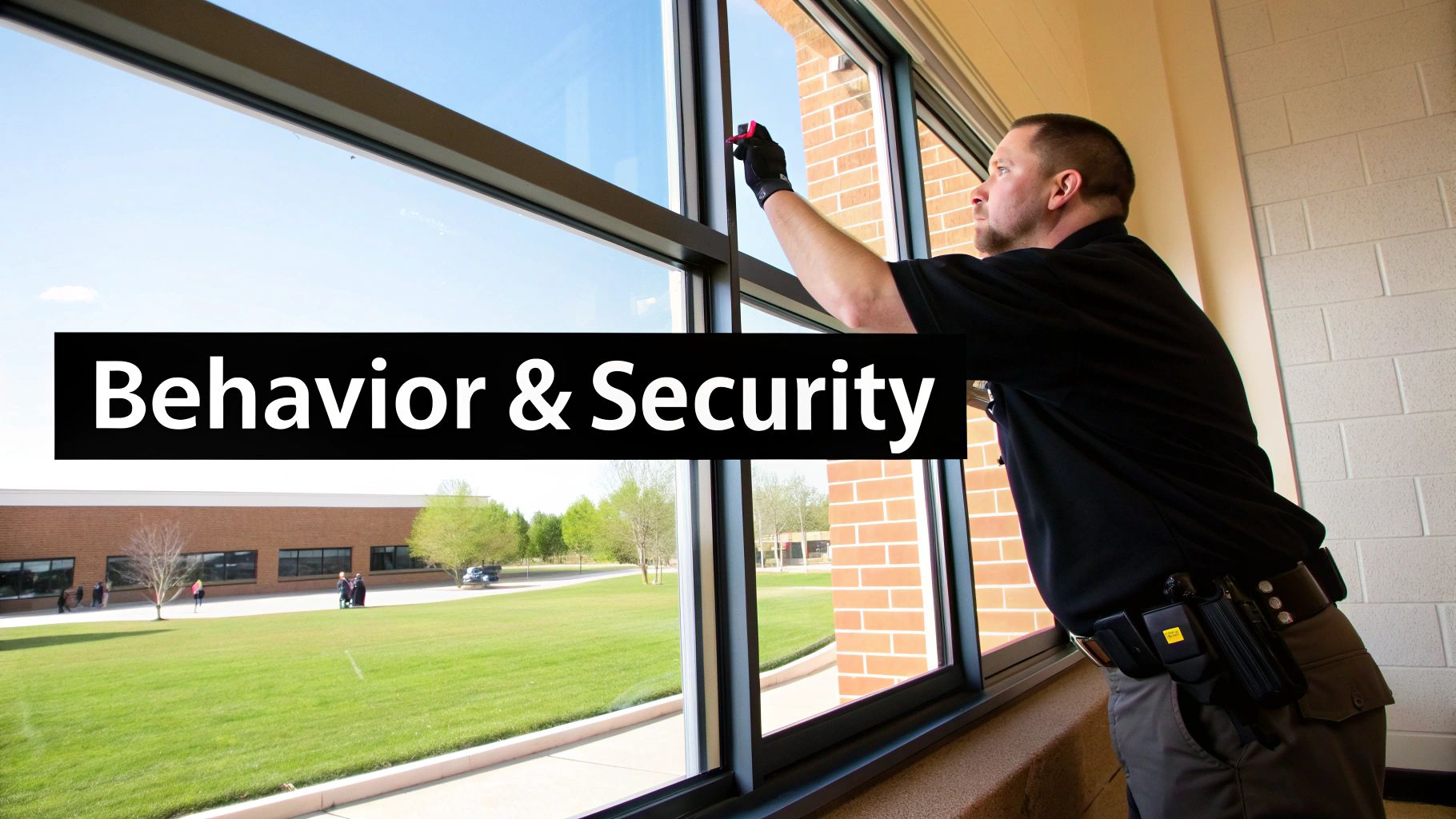
A campus isn't truly secure unless its physical defenses and its understanding of human behavior are working together. An effective threat assessment in schools can't just be an administrative exercise—its findings have to drive real-world changes to your security posture. What you learn about a potential threat should trigger immediate, tangible upgrades to your buildings and protocols.
This is where the insights from your Threat Assessment Team become a practical roadmap for your security staff. The two groups need to be in constant contact, turning behavioral data into concrete action. This ensures your security measures are smart and responsive, not just a static checklist.
For example, if an assessment flags a concern about an unauthorized person trying to get onto campus, that information should immediately trigger a review of your access control. Are visitor check-ins being enforced? Are all exterior doors actually locked and monitored? The behavioral red flag must lead to a specific physical security response.
From Abstract Risk to Real-World Action
The goal is to move from a vague concern to a specific, actionable security adjustment. Every piece of intelligence gathered during an assessment can be mapped directly to a physical vulnerability that needs shoring up.
-
If the concern is… A student has been vocalizing anger toward a specific first-floor classroom or teacher.
-
The action is… This immediately bumps that specific classroom to the top of the list for security upgrades, like reinforcing its windows and doors.
-
If the concern is… The threat involves a former student who knows the campus layout inside and out but is no longer allowed on the property.
-
The action is… Your team should review and maybe even re-route student traffic or change entry procedures to disrupt that person’s familiarity with the school’s daily flow.
When you're trying to interpret these behavioral insights, it helps to view them through a wider lens. Considering frameworks like the principles of trauma-informed practice can offer a much deeper understanding of what might be driving the behavior. This approach ensures your security responses are not only effective but also sensitive to the underlying issues at play.
A Practical Example: Security Window Film
One of the most direct ways to bridge the gap between a behavioral threat and a physical defense is by strategically installing security window film. Let’s be honest: glass doors and ground-floor windows are almost always the weakest points in a school building. Reinforcing them is a direct answer to the risk of forced entry.
It's critical to understand what security film does—and what it doesn't. It's not "bulletproof" or unbreakable. Its real job is much more important: to delay entry.
The film holds shattered glass together, creating an incredibly tough barrier that can absorb repeated hits from a brick, a bat, or a hammer. This delay isn't about stopping an intruder forever. It's about buying you time.
In a crisis, time is everything. Every single second of delay that security film provides is another second for lockdown procedures to work and for law enforcement to get on site. It turns a weak point into a life-saving time buffer.
This delay is what makes your lockdown and evacuation plans viable. Without it, a determined attacker could smash through a standard window in seconds, making those protocols almost useless. If you're looking into this layer of protection, it’s worth understanding the specific benefits of security window film for schools and how it fits into a comprehensive safety plan.
Putting It in Place and Communicating Clearly
Where you install security film is just as important as the film itself. Your threat assessment should guide this decision, helping you prioritize the most critical locations. You want to focus on areas that are easily accessible or have been identified as potential targets.
Key areas for installation typically include:
- All ground-floor windows and doors in classrooms.
- The main entrance, vestibule, and any adjacent glass panels (sidelites).
- Large glass areas like in libraries, cafeterias, and gymnasiums.
- Administrative office windows, especially those facing public areas.
Finally, think about how you talk about this with your community. It’s vital. Frame the installation not as a reaction to fear, but as a proactive, smart enhancement to the building. You can explain that, just like fire sprinklers, it’s a modern safety feature designed to protect everyone inside. This approach builds trust and shows that student well-being is truly your number one priority.
Planning for Broader Systemic and Environmental Risks
A truly effective threat assessment has to look beyond individual behaviors. Real preparedness means adopting an "all-hazards" approach, planning not just for human-caused threats but for the kind of systemic and environmental risks that can hit a campus with little or no warning.
Think about it: school safety is about creating a secure haven, and that means being ready for anything.
This wider view covers everything from natural disasters like earthquakes and tornadoes to newer climate-related events like flash floods or extreme heatwaves. It also includes regional problems, such as a chemical spill from a nearby factory or a widespread power grid failure. If we ignore these external factors, we're leaving a massive blind spot in our safety plan—one that could easily overwhelm a school's resources and put everyone in danger.
Expanding Your Emergency Operations Plan
To get a handle on these bigger risks, you need to bake them right into your Emergency Operations Plan (EOP). This is about moving past a narrow focus on active assailant drills and diversifying your preparedness exercises.
Take a look at your specific location and consider running drills for non-shooter events that actually make sense for your area:
- Tornado or Hurricane Drills: Practice "shelter-in-place" in designated safe zones. Do students and staff know the fastest and safest routes to get there from anywhere on campus?
- Earthquake Drills: Everyone should instinctively know to "Drop, Cover, and Hold On." What about the next step? Practice safe evacuation procedures for after the shaking stops.
- Wildfire or Flood Evacuation Drills: You need multiple evacuation routes off campus, not just one. Map them out, practice them, and make sure you have a rock-solid communication plan for reuniting students with parents at an off-site location.
Drills like these build muscle memory, which is what cuts through panic and allows for a coordinated response when it counts. They also have a funny way of revealing logistical gaps you never would have seen on paper.
The Disconnect in Climate Risk Planning
One of the most frequently overlooked systemic risks is the impact of a changing climate. While governments might be developing high-level strategies, that planning rarely trickles down to the individual school level.
A recent global policy brief uncovered a pretty startling gap: while 79% of governments have national plans for climate risks, a mere 21% actually conduct specific climate risk assessments for their schools. This oversight leaves millions of students vulnerable. You can learn more about these critical findings at unesco.org.
This data brings home a key point for school leaders: you can't assume that national or state-level disaster planning automatically addresses your campus's specific vulnerabilities. Proactive, local risk assessments are absolutely essential.
This is a perfect opportunity for your threat assessment team to step up. By working with local emergency management agencies, you can get a much clearer picture of regional climate projections and environmental hazards. This partnership helps you understand what specific threats—whether it's flooding from severe storms or poor air quality from distant wildfires—your campus is most likely to face in the years ahead.
Building Resilience Through Partnerships and Protection
No school is an island. You can't face these large-scale threats alone. One of the most powerful things you can do is build strong relationships with your local first responders before you need them.
Don't wait for an emergency to introduce yourselves.
Invite the local fire department, EMS, and police to your campus for tours. Let them get familiar with your building's layout, your access points, and your emergency plans. When they already know the turf, their response will be faster, more effective, and better coordinated. This kind of collaborative work is a central part of comprehensive educational facility protection.
Ultimately, a forward-thinking threat assessment process understands that the definition of "safety" is always evolving. When you plan for systemic and environmental risks with the same seriousness you give to individual threats, you create a genuinely resilient campus—one that's prepared to protect its students and staff, no matter what comes its way.
Answering Common Questions About School Threat Assessments
When a school decides to formalize its threat assessment process, it’s only natural for questions to pop up. Administrators, teachers, and especially parents want to understand how it all works in practice. Getting these answers right is fundamental to building trust and making sure the entire school community is on board.
Let's walk through some of the most common questions we hear.
How Is a Threat Assessment Different From Disciplinary Action?
This is probably the most critical distinction to get right. A threat assessment is a supportive, forward-looking process. The entire point is to figure out why a student is struggling or exhibiting concerning behavior and then connect them with the right interventions to get them back on track. It’s about prevention and support.
Disciplinary action, on the other hand, is a reactive consequence for a specific rule violation. It's about accountability for an action that's already happened. While a disciplinary measure might be part of an overall support plan, the threat assessment itself is focused on preventing future harm, not just punishing past behavior.
Think of it this way: discipline addresses the what—the broken rule. A threat assessment digs into the why—the underlying crisis or need.
Can We Really Do This on a Tight Budget?
Yes, absolutely. A strong threat assessment program is built on people and processes, not expensive technology. The core of the system relies on collaboration and clear protocols, which you can establish with the staff you already have.
Your biggest investment here is time and commitment, not a line item in the budget. You can get started by formally designating a team using existing personnel like administrators, counselors, psychologists, and trusted teachers. From there, focus on creating a simple, clear reporting process.
Here are a few ways to keep it budget-friendly:
- Use free resources: Federal and state agencies, like the Secret Service's National Threat Assessment Center, offer incredible training models and guides at no cost.
- Start lean: Don't try to boil the ocean. Begin with a solid core team and a well-defined reporting and triage process. You can expand from there.
- Focus on training: The most important thing is that your staff understands the goals of the program and their specific roles within it.
A dedicated, well-trained team will always outperform a pricey software solution that no one knows how to use properly.
How Is Student Privacy Protected During This Process?
Balancing student safety with the right to privacy isn't just a good idea—it's a legal and ethical requirement. Your threat assessment team has to operate under a strict code of confidentiality. Sensitive information is shared only on a need-to-know basis and always in compliance with privacy laws like the Family Educational Rights and Privacy Act (FERPA).
The entire process should center on observable behaviors, not on rumors, gossip, or labels. The team's investigation is narrowly focused on gathering only the information necessary to understand the context and assess the level of risk.
Parental involvement and consent are also built into the process, especially when creating intervention plans. This keeps things transparent and collaborative. The goal is to conduct a professional assessment that helps a student in crisis while respecting their dignity and privacy.
A comprehensive threat assessment plan is the cornerstone of a safe school. At Fortress Security Films, we add the critical layer of physical security that complements your behavioral safety protocols. Our solutions turn your most vulnerable entry points—your glass doors and windows—into a resilient barrier that buys precious time when it matters most.
Ready to harden your school's defenses? Visit Fortress Security Films to see how our advanced security film can better protect your students and staff.
