


When your storefront glass shatters, the first question is always the same: "How much is this going to cost?" The short answer is that a typical storefront glass replacement cost can run anywhere from $500 for a small, standard panel to over $5,000 for large or specialty installations.
Of course, that price isn't just for the pane of glass. It’s a bundle that includes labor, materials, and often, emergency service fees if you need a fix right away.
Understanding the True Cost of Storefront Glass Replacement
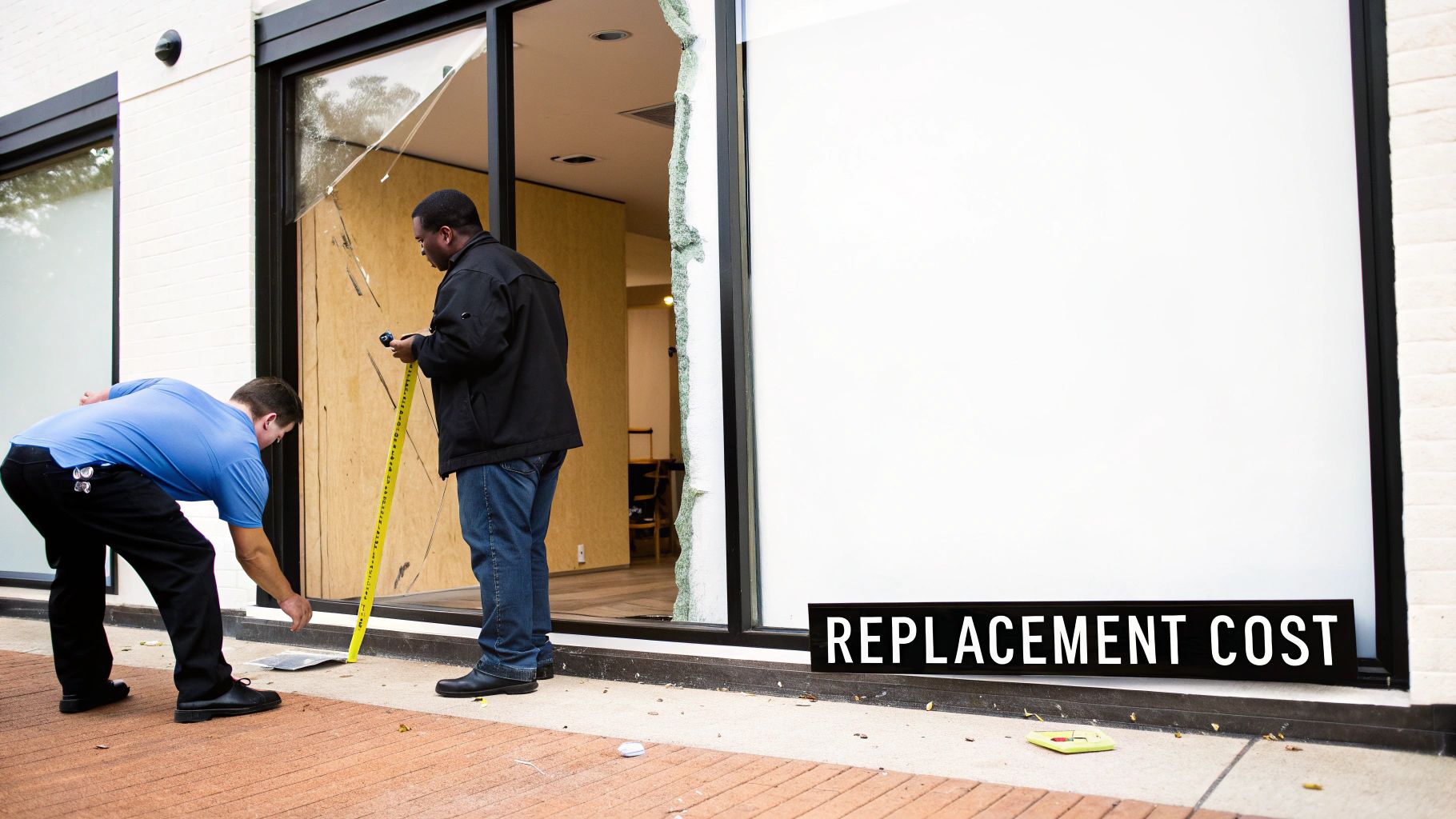
It’s easy to focus on the immediate repair bill, but the real cost goes much deeper than one invoice. I like to compare it to a car repair. The final price isn't just the new alternator; it's the mechanic's time and expertise, the urgency of the job, and the hassle of being without your car. A broken storefront window is no different.
To budget accurately and understand what you're truly investing in, you need to break down the total expense into its core parts.
Core Components of a Replacement Quote
So, what are you actually paying for when you get that quote? It's a combination of several critical things.
- Materials: This is the glass panel itself. The price tag here swings wildly depending on the type (tempered, laminated, etc.), its size, and its thickness.
- Labor: You're not just buying glass; you're paying for the skill of certified technicians who can safely remove shards of broken glass and correctly install the new panel. This isn't a DIY job.
- Emergency Fees: Need someone out at 2 AM on a Saturday? You can get it, but expect to pay a premium for that urgent, after-hours response.
- Business Disruption: This won't appear on the invoice, but it's often the biggest cost. Every hour your storefront is boarded up can mean lost sales, a tarnished reputation, and customer uncertainty.
Your storefront is your business's handshake with the world. A damaged window doesn't just threaten security; it sends a clear message to potential customers that something is wrong, and that can hurt foot traffic long after the glass is fixed.
Estimated Storefront Glass Replacement Cost By Panel Size
To give you a clearer idea, let's look at some typical price brackets. This table breaks down what you might expect to pay based on the size of the glass panel.
| Panel Size | Typical Cost Range (Standard Glass) | Potential Cost with Specialty Glass |
|---|---|---|
| Small (up to 25 sq. ft.) | $500 – $1,500 | $1,200 – $2,500+ |
| Medium (25-50 sq. ft.) | $1,500 – $3,000 | $2,500 – $4,500+ |
| Large (50+ sq. ft.) | $3,000 – $5,000+ | $4,500 – $7,000+ |
Keep in mind these are just ballpark figures. Prices for standard annealed or tempered glass will be on the lower end, while high-performance options like insulated, laminated, or low-E glass will push the cost toward the higher end of the range.
The final invoice will always depend on the specifics of your situation. Don't forget that long-term upkeep is also part of the picture; for a full view of property expenses, it's worth considering things like the Phoenix window cleaning cost per window for ongoing maintenance.
What Really Drives the Cost of Your Replacement Glass?
Ever wonder why one business pays a few hundred dollars for a new glass panel while a seemingly identical job down the street costs thousands? The price on your quote isn't pulled out of a hat. It’s a direct result of specific choices about materials, labor, and the complexity of the job itself. Once you understand these moving parts, you can look at any estimate and know exactly what you're paying for.
Think of it less like buying a simple pane of glass and more like choosing tires for a delivery van. You could get the cheap, standard option, but you could also invest in reinforced, all-weather tires designed for heavy loads and long-term durability. The same goes for your storefront—you're not just buying a window, you're investing in a specific level of security, energy efficiency, and curb appeal.
It All Starts with the Glass Itself
By far, the biggest factor in your storefront glass replacement cost is the type of glass you select. Each one comes with a different price tag because they all offer a unique mix of safety, strength, and performance.
- Tempered Glass: This is your workhorse safety glass. It’s heat-treated to be roughly four times stronger than standard glass. The real magic happens when it breaks—it shatters into small, dull-edged pebbles instead of dangerous shards, which is why it's a go-to for doors and high-traffic areas.
- Laminated Glass: Think of this as a security sandwich. It’s made of two glass panes fused together with a tough, clear vinyl layer in the middle. If it gets hit, the glass might crack, but the fragments stay glued to that inner film. This makes it incredibly difficult to break through, holding everything in place against intruders.
- Insulated Glass Units (IGUs): You’ll hear these called double- or triple-pane glass. They feature two or more panes separated by a sealed space filled with air or an inert gas (like argon). This design is a game-changer for energy efficiency, acting like a thermal buffer to keep the heat or A/C inside your store. It costs more upfront but can trim down your utility bills.
- Low-E Coated Glass: This is a high-tech option with an invisible metallic coating that reflects heat. Here in sunny Southern California, a Low-E coating is fantastic for blocking solar heat from baking your store in the afternoon, which keeps things cooler and cuts down on annoying glare.
The choice between tempered and laminated glass is a classic trade-off. Tempered glass is great for preventing injuries from accidental breakage. Laminated glass, on the other hand, is your best defense against a deliberate smash-and-grab, often stopping a burglar in their tracks.
Size, Thickness, and Custom Touches
It’s simple physics: bigger and thicker pieces of glass cost more. A massive floor-to-ceiling panel requires more raw material, is harder to handle, and takes more crew members to install safely compared to a small transom window.
The glass thickness is just as important. A standard 1/4-inch panel is worlds apart in price from a heavy-duty 1/2-inch or 3/4-inch panel designed for maximum security or to meet specific structural codes.
Then you have the custom features, which can quickly add up.
- Fancy Shapes: Anything that isn't a perfect rectangle—like an arched top or a circular window—has to be custom-cut and finished, which takes more time and skill.
- Tints and Frosting: Adding a film or frost for privacy, branding, or just to cut down on sunlight will increase the material cost.
- Holes and Cutouts: If your glass door needs holes drilled for handles, locks, or a mail slot, that custom fabrication work adds to the final bill.
This trend toward more robust and specialized glass is why the market is booming. The global storefront glass industry was valued at around $5.6 billion in 2020 and has rocketed to an estimated $15.6 billion by 2024. That staggering 180% increase shows just how seriously businesses are taking their storefronts as a critical asset. You can explore more data on this significant market growth to see how these trends are reshaping the industry.
The On-Site Realities: Installation and Framing
Finally, the job site itself plays a huge role in the labor costs. Replacing a simple, ground-level window is a straightforward affair. But if we’re talking about a second-story panel that requires a boom lift or scaffolding to access, the complexity—and the price—goes way up.
Is the window easy to get to, or is it tucked away in a tight corner? That kind of accessibility determines how much time the technicians will need. The condition of your existing window frame is another huge variable. If the metal is bent, rusted, or the wood is rotted, it absolutely must be repaired or replaced. Putting brand new glass into a faulty frame is a recipe for leaks, drafts, and even a failed installation. Any good installer will inspect the frame first to make sure the new glass will have a secure, weatherproof home for years to come.
Replacement vs. Security Film: A Cost-Benefit Analysis
When your storefront glass is damaged, your first thought is to get it fixed—fast. But this moment is also a fork in the road. Do you just replace what was broken, or do you take the opportunity to seriously upgrade your building's defense? This isn't just about appearances; it’s a crucial decision that pits upfront cost and business downtime against long-term security.
A full glass replacement gives you a fresh start. It's the perfect chance to install modern, energy-efficient glass that can give your whole building a facelift. On the other hand, applying a high-tech security film over existing or new glass creates a powerful, nearly invisible barrier against break-ins. This route is often easier on the wallet and causes far less disruption to your business.
To make the right call for your property, you've got to weigh the real-world costs and benefits. Your budget, local crime rates, and long-term goals will all play a part.
Upfront Costs and Installation Time
The first and most obvious difference is what comes out of your pocket right now. A full storefront glass replacement isn't just the cost of the glass itself. It involves the labor-intensive job of tearing out the old, damaged glass and frame, then fitting the new unit. For large or custom panels, this can easily stretch over several days, meaning your storefront is boarded up and you're losing customers.
Security film, by comparison, is a much quicker fix. Certified technicians can apply the film directly to your existing glass with very little interruption, often getting the job done in a few hours. That means less downtime and a much faster return to business as usual. The cost for materials and labor is generally lower, making it a more budget-friendly upgrade for many businesses.
For a deeper dive into the numbers, you can explore the typical security window film cost in our detailed guide.
This chart illustrates the main factors that a glazier will consider when putting together your initial quote.
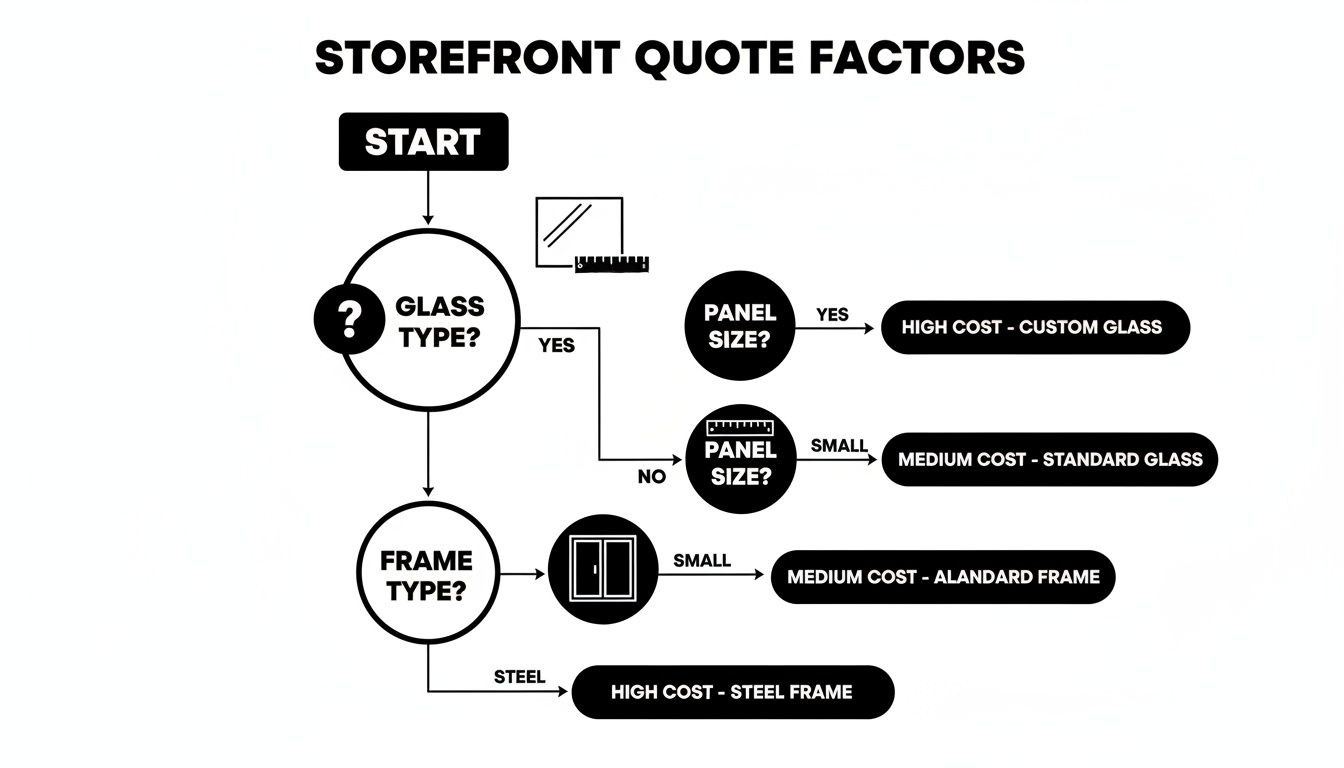
As you can see, the type of glass you choose, its size, and the condition of the frame are the three biggest drivers of the final price tag for any storefront project.
Comparing Long-Term Value and Security
While the initial cost is a big deal, the true value of your choice becomes clear over time. A standard glass replacement just brings your storefront back to square one. It doesn’t do anything to make it stronger against the next break-in attempt or act of vandalism.
Security film, however, fundamentally changes the strength of your glass. It’s a powerful deterrent.
- Forced Entry Delay: Top-tier films can hold shattered glass together, even after being hit repeatedly. This can slow an intruder down for several crucial minutes—often more than enough time for alarms to go off and police to arrive.
- Reduced Injury Risk: If the glass is broken by severe weather or an accident, the film keeps dangerous shards from flying into your store, protecting both your staff and your customers.
- UV Protection: Quality security films block up to 99% of damaging UV rays. This is huge for protecting valuable merchandise from fading and preventing sun damage to your interior floors and fixtures.
A full glass replacement solves the immediate problem of a broken window. Installing security film solves the underlying vulnerability that led to the break-in in the first place, turning your glass from a weak point into a line of defense.
To help you see the differences at a glance, we've put together a side-by-side comparison.
Full Glass Replacement vs. Security Film Installation
Here’s a direct comparison of the two approaches across the factors that matter most to property managers and business owners.
| Factor | Full Glass Replacement | Security Film (e.g., Fortress Security Films) |
|---|---|---|
| Initial Cost | Higher (materials + intensive labor) | Lower (film + application labor) |
| Installation Time | Hours to Days (potential business closure) | Hours (minimal disruption) |
| Security Level | Standard (same as original glass) | Significantly Enhanced (forced entry delay) |
| UV Protection | Minimal to Moderate (unless using Low-E) | Excellent (up to 99% block) |
| Aesthetic Impact | Can update the look with new glass types | Virtually invisible, preserves original look |
| Long-Term ROI | Primarily restores property value | Adds security, prevents future damage costs |
Ultimately, the best choice really depends on your specific situation. If your glass is old, foggy, and inefficient, a full replacement with a modern insulated or Low-E unit is probably the smartest long-term investment. But if your glass is in good shape and your main goal is to stop break-ins and improve safety, security film offers a highly effective and affordable solution that delivers an immediate and substantial security boost.
Dealing with the Paperwork: Insurance Claims and Building Permits
A broken storefront window is stressful enough. But once the immediate crisis is over, you’re left with the paperwork. Navigating insurance claims and, sometimes, local building permits is the next hurdle. Getting this part right is the key to a smooth and affordable recovery.
Think of it like a minor fender bender. You wouldn't just pay a mechanic to fix the dent without calling your insurance agent first. It’s the same principle here—you need to follow the right steps to get reimbursed and stay compliant with city rules.
Making Your Insurance Claim Count
Your commercial property insurance is your financial safety net. But to get the most out of it, you need to give your adjuster solid, clear evidence right from the start. A disorganized claim can lead to frustrating delays or even a flat-out denial.
As soon as your property is secure, here’s what you need to do:
- Document Everything: Before anyone touches a thing, take a ton of photos and videos. Get shots from every angle—the broken glass, how the person got in (if it was a break-in), any damaged merchandise, and the whole scene.
- File a Police Report: If it was vandalism or a burglary, this is a must. Your insurance provider will absolutely ask for the police report number as official proof.
- Hold Onto the Evidence: Don't throw away any damaged goods or whatever was used to break the glass. Wait for your adjuster to give you the green light.
- Get a Pro on the Phone: Call a trusted glass company for a detailed, line-by-line quote for the replacement. This professional estimate is crucial evidence for your claim.
One of the biggest mistakes we see is business owners cleaning up too fast. Securing your store is the top priority, of course, but capturing the initial state of the damage gives your insurance adjuster undeniable proof. It strengthens your claim and gets you paid faster.
Do I Really Need a Building Permit for a Window?
It surprises a lot of business owners, but yes, sometimes a simple glass replacement can require a building permit. Here in Southern California, cities like Los Angeles often require one if the work involves changing the structure or the look of the building's exterior.
So, when does a permit usually come into play?
- You're replacing the frame: If it’s not just the glass but the whole window framing system that’s being swapped out.
- You're changing the size: If you decide to make the window opening bigger or smaller.
- You're upgrading: If you’re moving from a standard window to a heavy-duty security or ballistic glass system, which has different structural needs.
Now, if you're just doing a "like-for-like" replacement—swapping a broken pane for an identical new one—you typically don't need a permit. But it's always smart to double-check. Getting caught without a required permit can lead to fines, orders to tear out the new window, and serious problems if you ever try to sell the building.
A good professional glass installer will know the local codes inside and out. They can tell you if your job needs a permit and will usually handle all that paperwork for you as part of their service.
Smart Ways to Lower Your Storefront Expenses
Dealing with the storefront glass replacement cost shouldn't just be about damage control after a break-in. It’s about being smart and proactive. If you can shift your approach from reactive repair to preventative care, you can slash your long-term expenses and avoid the gut-punch of emergency call-out fees and lost business.
Think of your storefront glass like the tires on a delivery truck. A slow leak is a simple, cheap patch job. But if you ignore it, you’re setting yourself up for a blowout on the freeway—a problem that's far more dangerous and expensive. In the same way, a tiny chip in your glass can easily spread from temperature shifts or vibrations, leading to a full-blown shatter.
Adopt a Proactive Maintenance Routine
The absolute best way to keep costs in check is to spot trouble before it gets out of hand. A simple but consistent inspection routine can honestly save you thousands down the line.
- Monthly Visual Checks: Once a month, take a walk around your property and get up close with your glass. Look for any new chips, scratches, or cracks. Pay extra attention to the corners and edges, as that's where stress concentrates.
- Frame and Seal Inspection: Check the seals and caulking around the glass. Are they brittle, peeling, or pulling away from the frame? A bad seal lets moisture in, which can compromise the entire window assembly over time.
- Immediate Action on Minor Damage: If you spot a small chip, don't wait. Call a glass professional right away. A quick resin repair is a tiny fraction of the cost of replacing an entire pane that finally gave way.
This kind of proactive thinking isn't just a local tip; it's a global best practice. It’s interesting to note that the Asia-Pacific region leads the worldwide market for storefront glass, thanks to a boom in commercial construction. This shows a clear trend: businesses everywhere are realizing the value of investing in the maintenance and security of their physical storefronts. You can discover more insights about the storefront glass market to see how these global dynamics play out.
Smart Shopping When Replacement Is Unavoidable
Even with meticulous care, you'll eventually need a replacement. When that day comes, don't just jump on the first quote you get. Being an informed buyer is your best tool for avoiding inflated costs.
The most expensive repair is the one you have to do twice. Investing a little extra time in vetting your options upfront ensures you get a quality installation that lasts, providing better long-term value than the cheapest bid.
Make it a rule to get at least three detailed, itemized quotes from reputable local installers. This lets you compare more than just the bottom-line price; you can see the differences in material quality, warranty coverage, and how long the job will take.
Also, have a real conversation with each vendor about your options. Sometimes, paying a bit more for laminated glass or a security film application gives you a much better return on investment by stopping future break-ins in their tracks. This is a critical part of how to prevent retail theft before it even happens.
Finally, don't forget the hidden ROI. Upgrading to modern Low-E glass or installing UV-blocking films can directly lower your energy bills, especially here in sunny Southern California. Your HVAC system won't have to work as hard, turning a necessary repair into a smart investment that pays you back month after month.
Choosing the Right Solution for Your Business
Figuring out the true storefront glass replacement cost isn't just about the price of a new pane of glass. It’s really an investment decision—one that impacts your business's security, its curb appeal, and its ability to bounce back from trouble. The final quote will always depend on things like glass type, size, and how tricky the installation is, but the bigger question is about your overall strategy.
Are you just going to replace what was broken, or is this an opportunity to upgrade your defense? For a lot of businesses here in Southern California, dealing with today's security threats, the answer is becoming pretty clear. A simple replacement gets your storefront back to normal, but it leaves you with the exact same weak spot that got you into this mess. This is where a strategic upgrade can make all the difference.
Making the Smartest Investment
The smartest approach is always proactive defense, not reactive repair. Instead of just fixing a window, you can actually fortify it. This is where advanced security films come in, offering a compelling and much more cost-effective alternative to a cycle of expensive glass replacements.
Your storefront glass can either be your most vulnerable entry point or your first line of defense. The choice you make after an incident determines which one it will be.
For a fraction of what a full replacement costs, you can turn the glass you already have into a tough-as-nails barrier. And as you explore different ways to protect your business, remember that physical deterrents work best with surveillance; choosing a comprehensive security camera system is another critical piece of the puzzle.
For Southern California retailers, upgrading with security film isn't just another expense—it's a solid investment in keeping the doors open. By stopping smash-and-grab attempts before they succeed, you're not just saving on emergency repairs; you're preventing product loss and the crippling cost of business downtime. To see how this protective layer can be applied to your property, you can learn more about our specialized commercial and retail security film solutions.
At the end of the day, the best solution is one that protects your assets and gives you peace of mind. If you’re ready to stop just repairing damage and start actively preventing it, our team at Fortress Security Films is here to help. Get in touch for a professional security evaluation and find out how you can protect your investment with a solution built for today’s challenges.
Frequently Asked Questions
When your storefront is damaged, you need straight answers, fast. Let's tackle some of the most common questions we hear from business owners dealing with broken glass and looking for smarter security solutions.
How Long Does Storefront Glass Replacement Take?
This is often the first question people ask, and the honest answer is: it's probably longer than you think. A complete replacement, from the initial call to the finished job, can take anywhere from 24 hours to several days. If you have custom or oversized glass, it could even stretch into weeks.
Here’s a quick look at the typical play-by-play:
- Emergency Board-Up: The first step is always securing the opening. A technician should be on-site to board up the window within a few hours.
- Measure and Quote: The team then takes exact measurements to order the new glass. Precision is key here.
- Fabrication Time: This is the biggest variable. While standard tempered glass might be in stock, any custom sizes, special tints, or laminated security glass has to be made to order. That fabrication process is what can take several days.
- Installation Day: Once the new glass panel arrives, the actual installation is pretty quick—usually just a few hours.
On the flip side, installing security film is a much faster process. Since we're applying it directly to your existing glass, an entire storefront can often be completed in a few hours, causing almost no disruption to your business day.
Will My Insurance Premium Go Down If I Install Security Film?
It’s a great question, and while there's no blanket "yes," the outlook is often positive. Insurance companies love to see property owners taking proactive steps to reduce risk. By installing a professional-grade security film, you're showing them you're serious about preventing theft and vandalism, which can definitely work in your favor.
A quick tip: Call your insurance agent before you have the film installed. Ask them directly if they offer discounts or premium reductions for anti-intrusion window films. That one phone call could translate into significant long-term savings on top of the protection you're getting.
Can Security Film Actually Stop A Bullet?
This is a really important point of clarification. Standard security films are designed for anti-intrusion and forced-entry resistance. They work wonders against smash-and-grab attempts, riots, or vandalism by holding the glass together even after it shatters. But they are not designed to stop a bullet.
That said, specialized ballistic-rated film systems are available. These are a completely different animal—much thicker, multi-layered products that are rigorously tested and certified to meet specific threat levels (like those from the National Institute of Justice). If you're concerned about that level of threat, you need to speak with a specialist who can guide you to the right certified product.
Should I Repair A Small Crack Or Replace The Entire Panel?
This one comes down to the type of glass you have. For older, standard annealed or laminated glass, a small chip or a short crack can sometimes be repaired using a clear resin injection. It's a solid, cost-effective fix for minor damage.
However, this is a non-starter for tempered glass, which is what most modern storefronts use. Tempered glass is manufactured under intense pressure, which is what gives it its strength. The moment its surface is compromised by a crack—no matter how tiny—the tension is released, and the entire pane will break into thousands of small, pebble-like pieces. For tempered glass, there’s no such thing as a small repair; a full replacement is the only option.
Ready to move from reactive repairs to proactive protection? The team at Fortress Security Films can provide a comprehensive security assessment to help you find the right solution for your business. Protect your property, prevent downtime, and gain peace of mind by visiting the Fortress Security Films website to learn more.
