


Sliding glass doors are a fantastic feature in any home, letting in tons of natural light and offering great views. But let's be honest—they're often the weakest link in your home's security. That beautiful pane of glass and the standard, flimsy lock can look like an open invitation to a burglar.
To truly secure them, you need to think in layers. A single fix isn't enough. The goal is to turn this vulnerable entry point into a seriously tough barrier.
Why Burglars Love Sliding Glass Doors
It's a classic scenario for a reason. Intruders often head straight for the sliding glass door at the back of a house. Why? Because they know the design itself is full of security holes.
Unlike a solid front door with a deadbolt, a sliding door's security usually comes down to a single, often weak, latch. These factory-installed locks are notoriously easy to force open. Statistics from researchers at Allied Market Research show that about 30% of home burglaries happen through a forced door, and sliders are a common victim because of these exact issues.
Built-in Weaknesses You Need to Know
I've seen the same design flaws trip people up time and time again. Here are the three main vulnerabilities burglars know how to exploit:
- Flimsy Factory Locks: That little latch that comes with the door? It’s more of a suggestion than a real lock. It can often be jiggled or pried open with very little effort, sometimes without even making a sound.
- The "Lift and Shift" Trick: This one is especially common with older or poorly installed doors. A burglar can use a simple pry bar to lift the entire door panel up and out of its track from the outside. The lock is completely bypassed.
- The Glass Itself: The most obvious weakness is the huge pane of glass. One hard, sharp impact is all it takes to shatter it. From there, an intruder can just reach in, unlock the door, and walk right through. This is a core concept we cover when people ask how to protect windows from a break-in.
Knowing exactly where the weaknesses are is the first step. It lets you stop thinking about generic security and start focusing on specific, targeted upgrades that actually solve the problem.
To give you a clearer picture, here’s a quick breakdown of these common issues and the types of solutions we’ll be walking through.
Sliding Door Vulnerabilities and Solutions
This table maps out the most common weak points against both simple, immediate fixes and more robust, long-term hardware solutions.
| Vulnerability | DIY Solution | Hardware Upgrade |
|---|---|---|
| Weak Factory Latch | Security Bar / Dowel Rod | Multi-Point Locking System |
| Door Can Be Lifted Out | Screws in Upper Track | Anti-Lift Devices |
| Easily Shattered Glass | Curtains for Obscurity | Security Window Film |
Think of this as your roadmap. You can start with the DIY fixes today and plan for the hardware upgrades to build a truly layered defense for your sliding glass doors.
Simple Security Fixes You Can Do Right Now
You don't need a huge budget or a weekend project to seriously beef up the security on your sliding glass door. In fact, some of the most effective deterrents are things you can do in the next 15 minutes, using items you might already have around the house. These quick fixes are all about making a forced entry noisy, difficult, and time-consuming for any would-be intruder.
The classic trick is still one of the best: stick a physical block in the door's track. A sturdy wooden dowel or even a piece of PVC pipe, cut to fit snugly in the bottom track, makes it impossible to slide the door open from the outside. It’s a low-tech solution that works surprisingly well against brute-force prying.
If you want something a bit more permanent and convenient than a loose rod, look into a Charley bar. This is simply a hinged metal bar that mounts onto the door frame. You just swing it down, and it braces against the sliding part of the door, creating a solid physical stop.
Stop the "Lift and Shift" Trick
One of the scariest vulnerabilities of older sliding doors is how easily they can be lifted right out of their tracks. A burglar can simply lift the panel up and pull it out. Thankfully, stopping this is a simple DIY job.
Grab a drill and drive a few screws into the upper track. You want to leave the heads sticking down just enough so the door can slide underneath them without scraping. This simple fix closes the gap an intruder would need to lift the panel out.
While you're at it, check the door's rollers. Most sliding doors have adjustment screws located on the bottom edge of the panel. Over time, the door can settle and create a larger gap at the top. A few turns of these screws will raise the door, tighten that gap, and make it that much harder to lift.
Key Takeaway: When you combine a track blocker (like a security bar) with these anti-lift adjustments, you're creating two distinct layers of defense. A criminal now has to defeat two separate mechanisms, which dramatically increases the effort and noise involved in a break-in.
Add a Better Lock
Let's be honest: the standard latch on most sliding glass doors is flimsy and unreliable. Adding a secondary lock is one of the smartest and most affordable upgrades you can make.
Here are a couple of great options you can install yourself in minutes:
- Pin Locks: These are incredibly simple. You drill a single hole through the sliding door's frame and into the stationary frame. A thick metal pin slides through both, physically bolting the door shut.
- Track Locks: Even easier to install, these little devices clamp right onto the door track with a thumbscrew. They act as a solid metal stop, preventing the door from moving. No drilling required.
These small additions give you a much-needed second locking point that resists the common jimmying and prying attacks that defeat standard latches.
While these steps secure the door's frame and operation, the glass itself is another story. Understanding the principles of window burglar proofing will give you a complete strategy for securing all your home's glass entry points. But for now, implementing these simple fixes will make your home a much harder target.
Choosing the Right Hardware for Real Protection
Once you're ready to move past the quick fixes, upgrading your sliding door's hardware is where you'll get the biggest bang for your buck in terms of security. Investing in some purpose-built locks and reinforcement gear can turn that vulnerable glass panel into a seriously tough barrier. These permanent solutions are engineered to stand up to a real attack, something a simple wooden dowel just can't do.
The idea is to make a burglar's job as difficult as possible. Instead of one flimsy latch, you create a layered defense. This forces them to defeat multiple strong mechanisms, which makes noise, takes time, and dramatically increases the odds they'll just move on.
Upgrading Your Locking Mechanisms
Let's be honest: the standard latch that comes with most sliding doors is usually the first thing to fail. Swapping it out or adding to it is a must for any real sliding glass doors security. You’ve got a few great options to consider, each with its own benefits.
- Dual-Bolt Locks: These are a fantastic upgrade. They operate by throwing two separate bolts into the door frame, usually one up and one down. This gives you a much stronger hold than a single latch and makes it incredibly difficult to pry the door open.
- Keyed Locks: Adding a lock that requires a key adds a whole different level of security. This is huge because it means even if someone shatters the glass, they can't just reach in and flip a latch to get inside.
- Foot-Operated Locks: I'm a big fan of these. They install right at the base of the door, and with a simple tap of your foot, a hardened steel bolt shoots into the track or frame. This secures the door right at its weakest point—the bottom.
I see it all the time: people will install one high-end lock and call it a day. The truly secure setups, though, combine a strong primary lock with a secondary one, like a foot lock or a security bar. It's all about creating redundancy.
This decision tree gives you a good starting point for figuring out which vulnerabilities to tackle first.
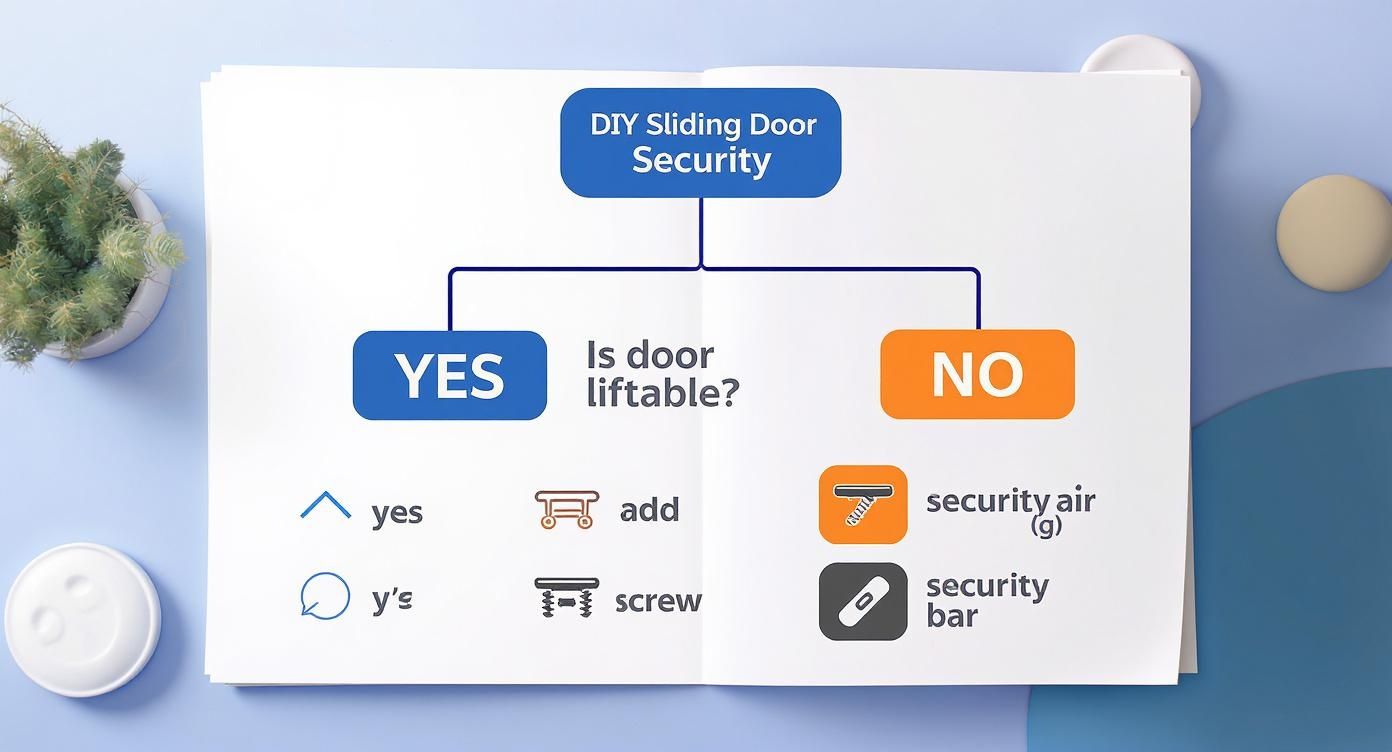
As the flowchart shows, the first order of business is stopping the door from being lifted out or forced open. Get those two things handled, and you've built a solid foundation.
Defeating the Lift-Out Threat
One of the most effective and surprisingly simple hardware additions is an anti-lift device. These are small, cheap pieces of hardware you install in the upper track. Their only job is to physically stop the door panel from being lifted up and out of its frame.
While putting screws in the track works in a pinch, these professionally made anti-lift blocks are engineered specifically for this and provide much better protection. Honestly, they're a critical piece of any serious security overhaul.
If you're considering a full replacement, knowing how to properly install a patio door from the start ensures it’s seated correctly and securely. By choosing the right hardware, you aren't just adding a few locks—you're fundamentally changing how well your door can protect your property.
Don't Forget the Glass: Your Door's Biggest Weak Point
You can install the best locks and bars money can buy, but if you ignore the giant pane of glass they're attached to, you've missed the point. An intruder with a heavy tool or even a well-aimed rock can bypass all your fancy hardware in an instant.
That’s why reinforcing the glass is a critical step in securing your sliding doors. The idea isn't to make the glass bulletproof, but to make breaking through it so loud, difficult, and time-consuming that a would-be thief gives up and moves on.
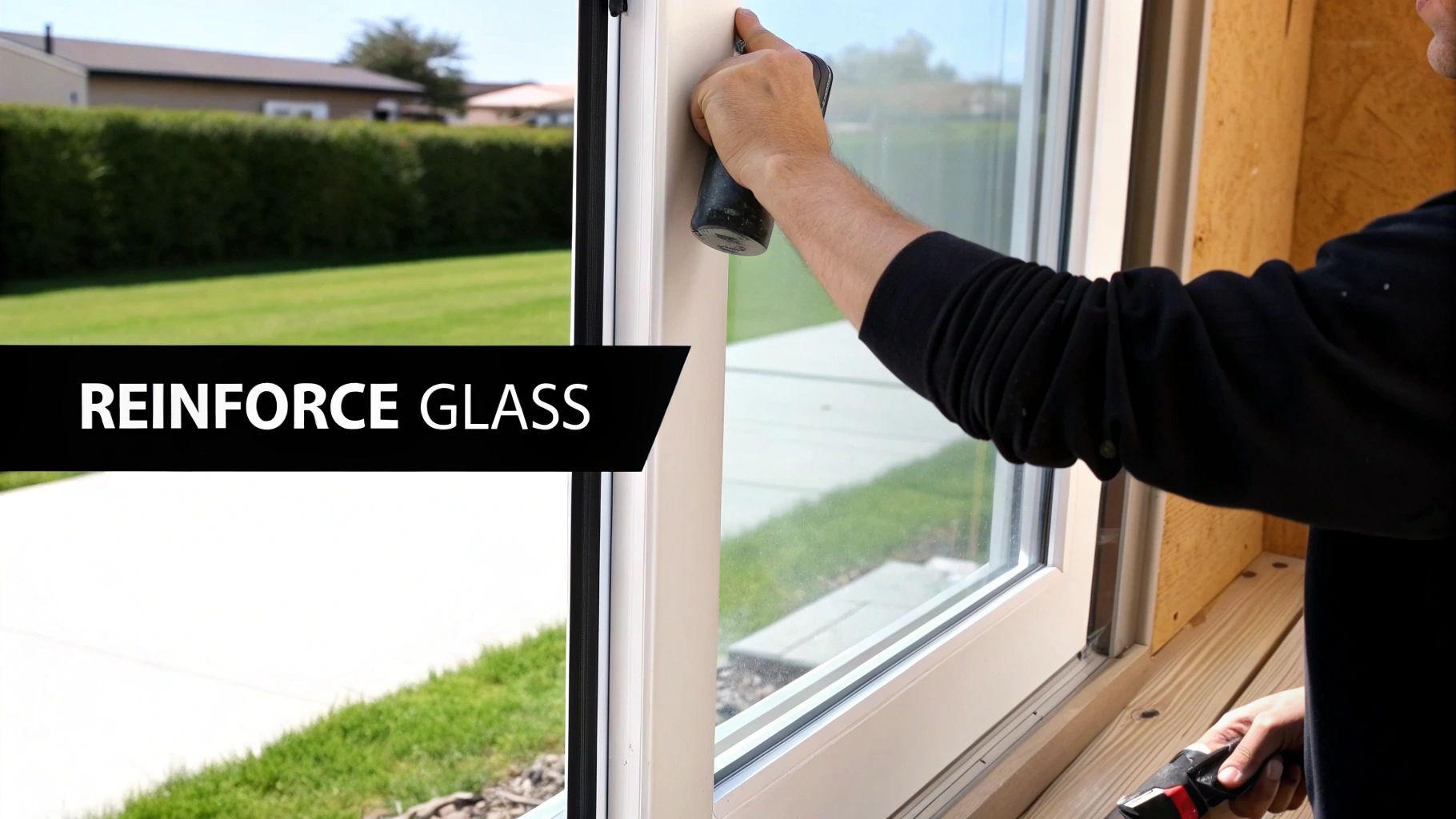
For most people, the best and most practical solution is security window film. This isn't the flimsy decorative or privacy film you might be thinking of. We're talking about a thick, heavy-duty polyester membrane that bonds directly to your glass with an incredibly strong adhesive.
When an intruder hits glass treated with this film, the glass will shatter. But here's the key difference: the film holds all those dangerous, broken shards together in the frame. Instead of the glass caving in, it forms a tough, spiderwebbed barrier that is a nightmare to get through.
How Security Film Buys You Precious Time
Think about it from the burglar's perspective. They're counting on a quick, quiet entry—a simple smash-and-grab. Instead, they hit the glass and it just… stays there. Now they're forced to repeatedly bash the same spot, making a ton of noise and drawing unwanted attention, all just to maybe create a small, jagged hole. That delay is often all you need to deter them completely.
There are a couple of main options when it comes to security films:
- Clear Security Film: This is the go-to for most homeowners. It's virtually invisible after installation, so you get a massive security boost without changing the look of your home one bit.
- Tinted or Solar Security Film: This type pulls double duty. It provides the same robust protection while also blocking harmful UV rays, reducing glare, and increasing daytime privacy.
If you want to get into the nitty-gritty of thicknesses and features, you can learn more about how to choose the right security film for glass doors to fit what you're looking for. I always recommend professional installation for this—a perfect, bubble-free bond is essential for the film to do its job properly.
The real power of security film is buying time. Every extra second a criminal is stuck outside your home, making a racket, is another second they risk getting caught. Film turns an easy smash into a loud, frustrating struggle.
For a More Permanent Solution: Upgrade the Glass Itself
If you're building a new home or in the middle of a major renovation, this is the perfect time to consider upgrading the glass itself. This is a fantastic long-term investment. Your two main choices here are tempered and laminated glass.
Tempered glass is heat-treated to make it about four times stronger than regular glass. From a safety standpoint, it's great because when it does break, it crumbles into thousands of small, dull-edged pebbles instead of sharp shards.
Laminated glass, however, is the real champion of security. It’s made by sandwiching a tough vinyl interlayer between two panes of glass—the same technology used in your car's windshield. When laminated glass is hit, it will crack, but that vinyl layer holds everything firmly in place, making it incredibly difficult to actually break through.
Using Smart Technology to Monitor Your Sliding Door
Physical barriers are your first line of defense, but modern tech brings a whole new level of awareness to your sliding glass door security. By integrating a few smart devices, you can turn a passive entry point into an active part of your home’s security network. It’s a game-changer for your peace of mind.
https://www.youtube.com/embed/m_7lUFt6YOI
Instead of discovering a break-in hours later, these tools can alert you the second something is wrong. This is about switching from a reactive mindset to a proactive one, giving you the power to act immediately, whether that means calling the police or just checking a live camera feed from your phone.
Essential Sensors for Every Sliding Door
The core of any smart setup for a sliding door comes down to a few key sensors. Each one watches for a specific threat, and together they create a pretty solid digital safety net.
- Entry Sensors: You've probably seen these. They're simple, two-piece magnetic sensors that are your frontline alert system. One piece goes on the door frame, the other on the moving panel. The moment that door slides open, the magnetic connection breaks, and you get an instant alert on your phone or your alarm sounds.
- Glass Break Sensors: These are clever little devices. They use a special microphone tuned to listen for the exact sound frequency of shattering glass. Stick one of these near your sliding door, and it’ll catch a forced entry attempt before the intruder even has a chance to step inside.
- Motion Sensors: Think of a motion sensor as your backup. If someone somehow gets past the other sensors—maybe they pry the door without fully opening it or find another way in—a motion sensor placed inside the room and facing the door will catch their movement as soon as they enter the space.
Your goal is to create overlapping fields of detection. If an intruder manages to defeat one sensor—for example, by breaking the glass without opening the door—another sensor is there to catch them.
While upgrading your door's security is a fantastic step, looking into a professional home security system installation can tie everything together for your entire property, not just the vulnerable spots like sliding doors.
The Power of Visual Verification
Alerts from sensors are great, but there’s nothing quite like being able to see what’s actually happening. A motion-activated security camera pointed at your sliding glass door is an absolute must-have. Today’s cameras aren't just for recording; they're active security tools.
The second the camera detects movement, it can send a push notification straight to your smartphone with a live video feed. This lets you immediately check out the situation. Is it just the neighbor's cat, or is someone trying to get in? That visual confirmation is crucial for making the right call, fast.
When you're shopping for a camera, make sure it has these features:
- Night Vision: This is non-negotiable for 24/7 monitoring.
- Two-Way Audio: Being able to speak through the camera can be a powerful deterrent. A simple "Can I help you?" from a speaker can send a would-be burglar running.
- Customizable Motion Zones: This feature is a lifesaver. You can draw a box around the door itself, telling the camera to only alert you when there's motion in that specific area. No more false alarms every time a car drives by.
By layering these smart technologies, you build a seriously robust system. You’re not just making the door physically tougher to break through; you’re also ensuring you’re the first to know if anyone even tries.
Answering Your Top Sliding Door Security Questions
When you start looking into securing your sliding glass doors, a lot of questions pop up. You're trying to figure out what works, what doesn't, and where your money is best spent. Let's cut through the noise and tackle the questions I hear most often from homeowners.
Getting a handle on these key points will help you build a layered defense that actually works, giving you real peace of mind.
Is Security Film Really Effective Against Burglars?
You bet it is. Security film won't make your glass bulletproof, but that's not its job. Its real strength is making the glass a nightmare to get through. The film is engineered to hold all the shattered pieces of glass together in the frame, completely changing the dynamic of a break-in.
Think about it from the burglar's perspective. They expect to smash the glass, reach in, and unlock the door in a few seconds. Instead, they're met with a loud, stubborn barrier that just won't give way. They have to keep hitting it, making a racket and wasting precious time. Most intruders rely on being quick and quiet, so that kind of frustrating, noisy delay is usually enough to send them running for an easier house.
The goal of security film is to create a formidable delay. It transforms your most vulnerable point—the glass—into a barrier that foils a burglar's primary advantages of speed and silence.
What Is the Single Best Upgrade for a Sliding Glass Door?
If you're looking for the most bang for your buck, the single most effective upgrade is a high-quality secondary lock combined with a security bar. The factory-installed latch on virtually every sliding door is its weakest link, so targeting that flaw first gives you the biggest immediate boost in security.
Why does this combo work so well?
- A solid dual-bolt lock or a heavy-duty Charley bar creates a serious physical roadblock.
- It specifically stops the common prying and lifting techniques burglars love to use on these doors.
- Just this one upgrade instantly turns your door from a weak point into a much tougher target.
Can I Make an Old Sliding Glass Door Truly Secure?
Absolutely. You can take an older door and make it just as secure, if not more so, than a brand-new one. The trick is to layer several different upgrades to systematically eliminate the weak points common in older designs.
By combining solutions—like adding a new secondary lock, installing a security bar, applying security film, and dropping anti-lift devices into the track—you build a really robust defense. A new door might have a fancy multi-point lock, but a well-fortified older door can become a serious obstacle without the high cost of a full replacement.
Are Smart Locks a Good Idea for Sliding Doors?
Smart locks can be a fantastic convenience, but for real security, their physical strength is what counts. It’s easy to get wowed by the tech features, but you need to look for a smart lock with a beefy, physical bolt that can actually stand up to force.
For most people, the best solution is a hybrid approach. I recommend using a strong, traditional secondary lock for the heavy lifting and then adding smart sensors—like contact and glass break sensors—for alerts and monitoring. This way, you get powerful physical protection and the awareness of modern technology.
At Fortress Security Films, we believe the best security is invisible. Our advanced films reinforce your glass against forced entry without changing the look of your home. Secure your peace of mind by exploring our residential solutions at https://fortresssecurityfilms.com.
