


You've probably seen it on office buildings or even limousines—that sleek, mirrored glass where you can't see in, but the people inside can see out perfectly. That's the magic of one-way privacy window film, a clever technology that essentially turns your windows into a one-way mirror during the day.
The effect all comes down to a simple principle: a light imbalance. For the film to work, the outside needs to be significantly brighter than the inside. Think of it like a pair of mirrored sunglasses; you can see out just fine, but all anyone else sees is their own reflection.
How Does One-Way Window Film Actually Work?
Ever wish you could flood your rooms with natural light without feeling like you're in a fishbowl? That's the exact problem this film solves. It gives you an unobstructed view of the outdoors while showing the outside world a reflective, mirrored surface.
So, how does it pull this off? It’s not some high-tech sorcery, but rather smart physics. The film is coated with a super-thin, almost invisible layer of microscopic metallic particles. These particles are semi-reflective, meaning they bounce a good portion of light back toward where it came from.
During the day, the bright sunlight outside hits the film and is reflected away, creating that mirror effect that stops people from peering in. But from inside your darker room, your eyes can easily see through the lightly tinted film to the bright world beyond.
Key Advantages at a Glance
This technology is more than just a one-trick pony for privacy. It packs a surprising number of benefits into a single, nearly invisible layer on your glass.
- Total Daytime Privacy: Keeps prying eyes out of your home or office without you having to pull the shades.
- Keeps Natural Light: Lets you enjoy the benefits of sunlight without compromising on privacy, unlike heavy curtains or blinds.
- Blocks Harmful UV Rays: Filters out up to 99% of damaging UV radiation, which helps protect your skin and prevents your furniture, floors, and artwork from fading.
- Cuts Down Energy Bills: By reflecting a significant amount of solar heat, it keeps your space cooler in the summer and can lead to real savings on your air conditioning costs.
The concept is really simple when you boil it down: the film reflects light back to the brightest side. During the daytime, the sunlit exterior is the bright side, so you get privacy. At night, the roles flip if you have lights on inside.
Grasping this core idea is the key to getting the most out of one-way window film. Now, let’s dive deeper into the science, different applications, and what options are out there to help you pick the right one for your space.
How Light Creates Your Private View
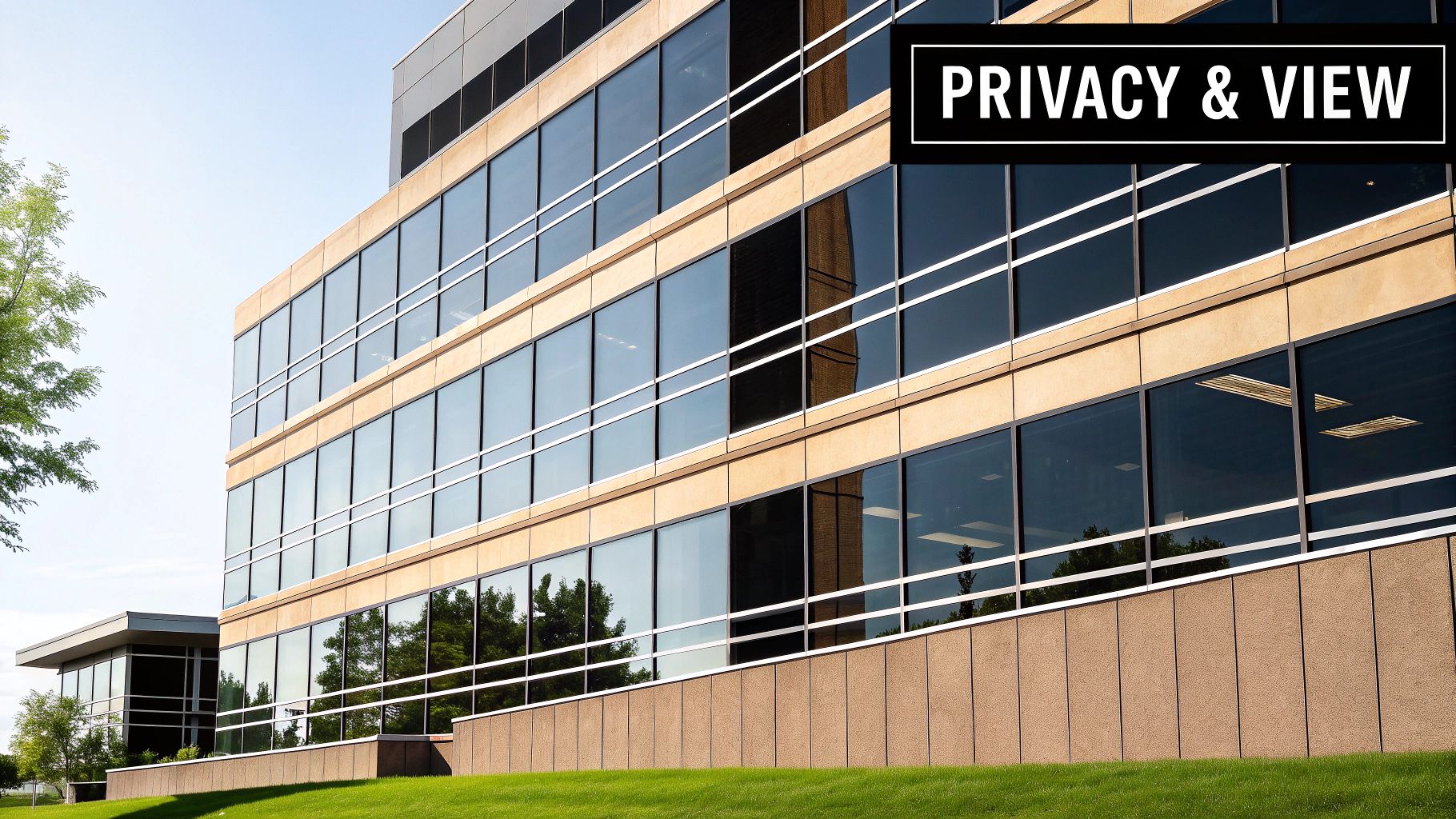
The secret behind a see-out-but-not-in window film isn't some kind of high-tech magic. It’s actually a brilliant, yet simple, manipulation of light. The film doesn't have a mind of its own; it just follows one basic rule: it reflects light back toward whichever side is brighter. This is what creates that coveted one-way mirror effect.
Ever been in a dark theater watching a brightly lit stage? You can see the performers perfectly, but they can't see you at all. They're blinded by their own stage lights. That’s the exact same principle at work on your windows.
These films are coated with an incredibly thin, semi-reflective layer of metallic particles. During the daytime, the sun makes the outside world intensely bright. When that sunlight hits your window, the film bounces a huge portion of it right back, turning your window into a mirror for anyone trying to peek in. Meanwhile, from inside your relatively darker room, you can see right through the light tint to the world outside.
The Science of Light Imbalance
This entire effect hinges on what we call light imbalance. The side of the glass with more light becomes a mirror, while the side with less light stays transparent. It's the most important concept to understand before you decide if one-way film is right for you.
Think of it like a see-saw. For that mirror to appear, the light level outside needs to be much higher than the light level inside. This is why the film performs so incredibly well during the day.
The film simply reflects the brighter side, creating privacy where the light is strongest. It’s not about blocking a view, but about redirecting the most powerful light source.
Of course, this dependence on light is also the film’s biggest weakness. At night, the see-saw tips. When you flip on the lights in your home, your interior becomes the "brightly lit stage." The reflective effect reverses, meaning people outside can now see in, and you're left looking at a reflection of your own living room.
A Growing Market for Smart Solutions
The demand for products that offer both privacy and energy savings is booming. The global window film market, which includes these privacy films, was valued at around USD 17.57 billion in 2025 and is expected to climb to USD 24.09 billion by 2029.
This growth is fueled by rising energy costs and a desire for more comfortable, private spaces. By blocking solar heat, these films cut down on air conditioning costs, which is a huge plus for homeowners and businesses alike. The technology is popular everywhere from homes and offices to cars, where the same principles apply. In fact, you can learn more about the numerous https://fortresssecurityfilms.com/car-window-tinting-benefits/ in our other guide.
Choosing the Right Type of Privacy Window Film
Picking the perfect see out but not in window film isn't a one-size-fits-all situation. It's really about matching the right technology to what you need most. The two main players you'll come across are the old-school metalized films and the more modern nano-ceramic options, and each has its own strengths.
Metalized vs. Nano-Ceramic Films
For a long time, metalized films were the go-to for that classic one-way mirror look. They work by embedding a super-thin layer of metallic particles into the film, which does a fantastic job of reflecting sunlight and giving you excellent privacy during the day. The only real catch? That metal content can sometimes play havoc with your cell phone reception or Wi-Fi signal, a significant downside in today's connected homes and offices.
This is where nano-ceramic films come in. Think of them as the next generation of window film technology. Instead of metal, they use incredibly tiny ceramic particles that are completely non-metallic and non-conductive. This clever engineering means you get all the privacy and heat-blocking benefits without any risk of signal interference.
These high-tech films are also masters at rejecting heat without needing that highly reflective, mirror-like finish. While they do come with a higher price tag, nano-ceramic films deliver unbeatable optical clarity, are more durable over the long haul, and generally perform better across the board. It's why they've become the top choice for premium homes and commercial buildings.
Ultimately, your choice boils down to a trade-off between budget and performance. Metalized films are a solid, cost-effective way to get privacy. Nano-ceramic films, on the other hand, are the premium, no-compromise solution that also offers superior heat control and won't mess with your electronics.
To help you see how these films stack up, the visual below breaks down some key performance metrics and how they can change a window's behavior.
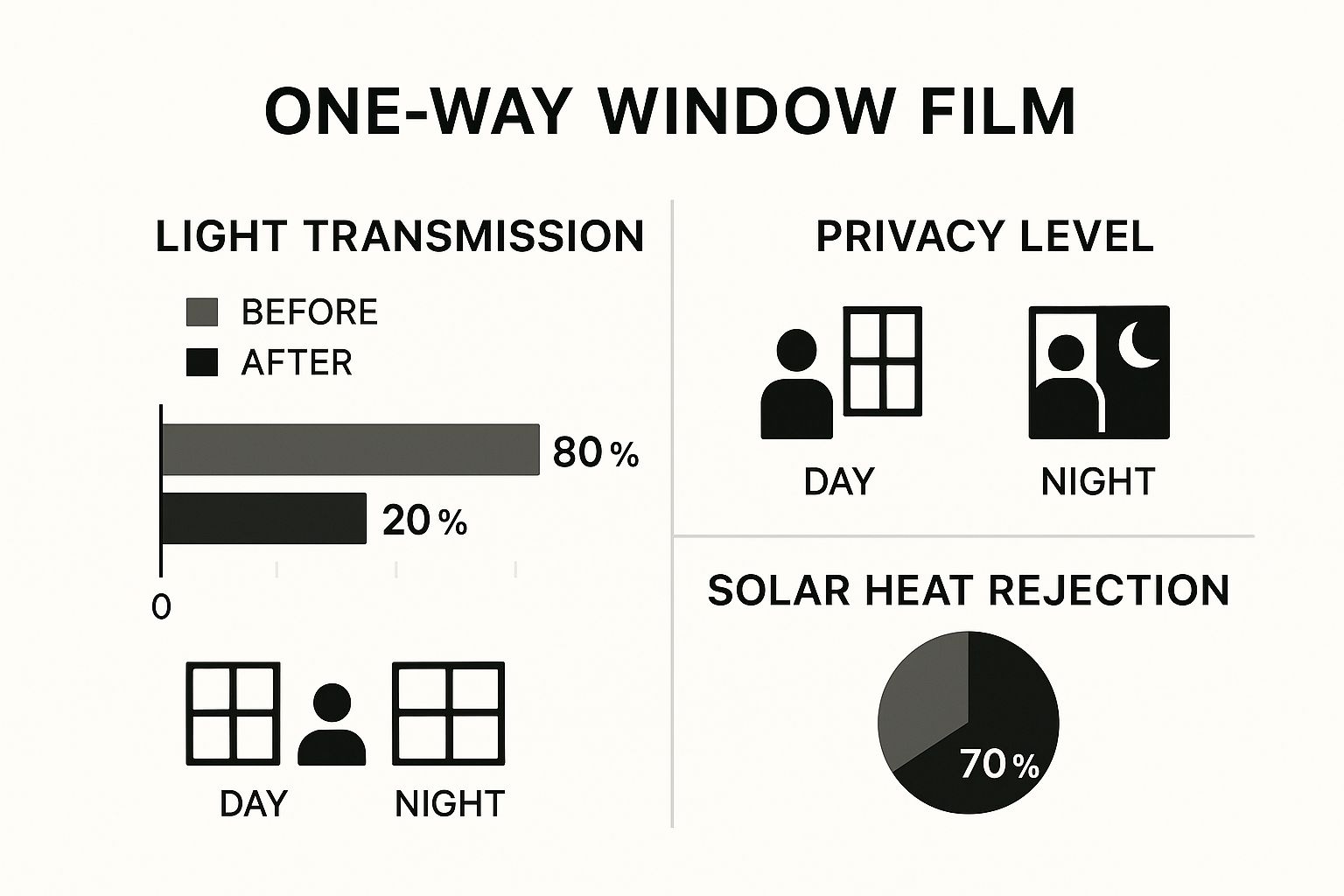
As you can see, there's a delicate balance between how much light gets through, the level of privacy you get at different times of day, and how much solar heat is kept out.
To simplify the decision-making process, here's a table comparing the most common types of one-way privacy films.
Comparing Privacy Window Film Types
| Film Type | Primary Benefit | Potential Drawback | Average Cost |
|---|---|---|---|
| Metalized (Reflective) | Excellent daytime privacy and heat reflection. | Can interfere with electronic signals (Wi-Fi, cell). | $$ |
| Nano-Ceramic | High heat rejection with great clarity; no signal interference. | Higher initial investment. | $$$ |
| Dual-Reflective | High exterior reflection for privacy, low interior reflection for clearer night views. | Still reflective from the outside, which may not suit all aesthetics. | $$$ |
| Frosted/Decorative | Total two-way privacy day and night; highly customizable. | Obscures the view looking out. | $ |
Choosing the right film depends entirely on your priorities and the specific challenges of your space.
Making the Right Choice for Your Space
So, how do you decide? Start by defining your main goal. Are you trying to stop nosy neighbors from peering into a street-level living room? Or is your main concern cutting down the afternoon glare and heat in a sun-drenched office while keeping the view pristine?
The demand for these films is huge for a reason. With the market valued at around USD 12.86 billion in 2025, the push for energy efficiency in green buildings is a major driver. These films are capable of blocking up to 99% of damaging UV rays, which protects your furniture, floors, and artwork from fading—all without you having to pull the blinds. If security is also on your mind, it's worth learning about the best window film for security to see how you can add an extra layer of protection.
By weighing the pros and cons of each film type against what you need for your own property, you'll be able to confidently choose the solution that’s just right.
More Than Just a Pretty (and Private) Face
While that one-way mirror effect is definitely the main event, a high-quality see out but not in window film brings a whole crew of other powerful benefits to your home or business. These perks work quietly in the background, making your space more comfortable, protecting your valuables, and even adding a surprising layer of security.
Think of it this way: privacy is the headliner, but these other advantages are the incredible opening acts that make the whole show worthwhile.
One of the biggest unsung heroes here is energy efficiency. The same reflective science that delivers your privacy also doubles as a formidable shield against solar heat.
In the summer, the film bounces a huge chunk of solar energy right off your windows, keeping your rooms from turning into a greenhouse. This means your air conditioner gets a much-needed break, and you get to see some real savings on your utility bills. Come winter, that same film helps trap your indoor heat, adding a welcome layer of insulation.
A Powerful Shield Against Fading and Damage
Beyond keeping things cool, this film is also an excellent bodyguard against the sun's invisible attacks. We all know ultraviolet (UV) radiation can cause serious damage over time, and your standard glass windows don't do much to stop it.
Most modern privacy films are designed to block up to 99% of harmful UV rays. This simple addition makes your home safer for your family and provides a powerful defense for everything inside it.
It’s like having a permanent, invisible coat of sunscreen on your windows. It protects your hardwood floors, that new sofa, and your favorite artwork from the fading and deterioration that years of sun exposure can cause.
This feature is a game-changer for preserving the color and condition of your belongings, keeping them looking great for years longer than they would otherwise.
Boosting Comfort and Security
Annoying glare can ruin a room, making it tough to watch TV, work on a laptop, or just enjoy the view without squinting. The film knocks down that harsh light, reducing eye strain and making your living and working spaces far more pleasant all day long.
Finally, the film provides an unexpected boost to safety and security. Because it bonds directly to the glass, it helps hold the pane together if it ever shatters.
Whether from a stray baseball, a nasty storm, or an attempted break-in, this feature can be a real lifesaver by preventing dangerous shards of glass from flying everywhere. While privacy is a great first step, you can learn more about other ways to how to secure your windows by exploring more in-depth guides. For those living in areas prone to severe weather, specialized window film for hurricane protection offers even more robust defense.
Where This Film Really Shines: Homes, Offices, and Beyond
So, the science is cool, but what does this mean for you in the real world? Let's talk about where see out but not in window film solves everyday privacy headaches. This isn't just a niche product; its applications are incredibly broad, covering everything from homes and businesses to your car.
Think about a ground-floor apartment or a living room window that looks right out onto a busy sidewalk. You want all that natural light, but keeping the blinds drawn all day makes you feel like you're living in a cave. This is where one-way film completely changes the game.
You can sit back, watch the world go by, and let the sun pour in, all without feeling like you're on display for every person who walks past. It’s freedom and light without sacrificing your privacy.
A Game-Changer for Businesses and Storefronts
Now, let's step into an office. Picture those sleek, modern conference rooms with floor-to-ceiling glass walls. They look great and promote an open feel, but they’re terrible for confidential meetings or private interviews.
Applying a reflective film to those interior partitions keeps the open-concept vibe but shields sensitive discussions from view. The room still feels bright and connected, but the conversation inside is for your team’s ears only. It's the perfect balance.
The same idea works wonders for retail storefronts. You can create brilliant, enticing product displays that draw customers in, while at the same time, the film can cleverly obscure the view into less-than-glamorous storage areas or back offices.
Privacy and Protection on the Road
The benefits don't stop there—they roll right into your vehicle. If you regularly carry tools, expensive equipment, or even just shopping bags in your car, one-way film is a major security boost. It prevents opportunistic thieves from easily seeing what's inside, making your vehicle a much less tempting target for a smash-and-grab.
But it’s not just about security. The film makes every drive more comfortable. By blocking a significant amount of solar heat and cutting down on that blinding glare, it keeps your car's interior cooler and makes driving on a sunny day far more pleasant for everyone inside.
The real magic of this film is that it’s a two-for-one deal. You install it for one main reason—like privacy or security—and you automatically get a whole host of other benefits, from UV protection to better energy efficiency.
It's no surprise this technology is catching on everywhere. In the United States, the window film market is expected to grow by about 5.2% each year through 2035, largely because people want solutions that tackle both privacy and energy costs. The automotive world alone accounted for nearly 36% of the global market in 2023, which tells you just how popular these films have become for our cars. You can dive deeper into these numbers with the full research from Grand View Research.
Common Questions About One-Way Window Film

So, you understand the science behind see out but not in window film, but you probably still have some real-world questions about what it's like to live with every day. It’s a brilliant fix for daytime privacy, but knowing its limits and how to care for it is crucial for getting the most out of your investment. Let's dig into the questions we hear all the time.
The big one, without a doubt, is about what happens at night. As we've discussed, that one-way mirror magic flips once the sun goes down and your indoor lights are brighter than the outside. This means that by itself, a reflective film does not keep prying eyes out after dark.
The simple solution? Pair the film with your existing curtains or blinds. This combo gives you the absolute best of both worlds: a bright, private home with an unobstructed view all day, and total, guaranteed privacy when you need it at night.
Does One-Way Film Make a Room Dark?
It’s a valid concern—no one wants to turn a cheerful, sunny room into a gloomy cave. While it's true that any film will reduce the amount of light coming through, modern films are engineered to be surprisingly subtle.
You can actually pick a film that strikes the perfect balance for your needs. High-quality reflective films are fantastic at cutting annoying glare and harmful UV rays, but they still let in plenty of soft, natural light.
The point isn't to make your room dark; it's to make it more comfortable. These films are designed to take the edge off harsh sunlight and block heat, which often makes a space feel more welcoming, not dimmer.
Now, if you're looking at frosted or decorative films, that's a different story. They're built to diffuse light, which can scatter it more evenly and sometimes even make a room feel brighter. It all comes down to whether you prioritize a clear view or just want privacy around the clock.
Installation and Maintenance Queries
People often wonder if they can install window film themselves or if it’s a job for the pros. DIY kits are out there, but getting that perfectly smooth, bubble-free finish is a true skill that takes a lot of practice to master.
Honestly, we almost always recommend professional installation. Here’s why:
- A Flawless Finish: Experts have the right tools and a practiced hand to get a clean look without any frustrating creases, bubbles, or peeling edges.
- Built to Last: A proper installation ensures the film bonds perfectly to the glass, helping it last for its full lifespan, which can be 10-15 years or even longer.
- Peace of Mind: Most professional jobs are backed by a warranty, so you know your investment is covered.
Once the film is on, taking care of it is a breeze. Forget about special cleaners. All you need is a soft cloth and a simple solution of mild soap and water. The most important thing is to avoid ammonia-based cleaners (like Windex and other common glass sprays) and anything abrasive, as they can wear down the film’s protective layer. Just a gentle wipe and a squeegee to dry is all it takes to keep your film looking great for years.
Ready to enhance your property’s privacy and security with a solution that’s both effective and elegant? The experts at Fortress Security Films provide professional assessments and installations to ensure you get the perfect film for your needs. Explore our advanced window film solutions and secure your peace of mind today.
