


When you think about securing a property, what comes to mind? Alarms, cameras, heavy-duty locks? Those are all great, but they often overlook the most fragile entry points: your windows. That's where security window film comes in.
In simple terms, security window film is a specialized polyester membrane applied directly to glass. It’s optically clear, so you won't even know it's there. But its job is to act like an invisible shield, holding shattered glass together upon impact. This simple addition strengthens your windows, buys you precious time in an emergency, and protects people from dangerous flying glass shards.
What Is Security Window Film and Why It Matters
Let's use an analogy. Think of a standard window pane as a single, brittle sheet of ice. One good hit, and it shatters into a thousand pieces, leaving a gaping hole. Now, imagine laminating that ice with a strong, flexible material. When you hit it, the ice will still crack, but the laminate holds all those dangerous fragments together, maintaining the barrier.
That’s exactly what security film does for your glass. It doesn't make the glass unbreakable—that's a common misconception. What it does is make the glass incredibly difficult to get through. Instead of a quick, quiet smash-and-grab, a would-be intruder is met with a window that cracks, flexes, and stubbornly stays in its frame.
That delay is everything. For a homeowner, those extra minutes are a critical window to call for help and get to safety. For a storefront, it often means the thief gives up and moves on, saving you thousands in stolen merchandise and damages.
The Problems Solved by Security Film
Standard glass is a point of failure in many situations, but security film offers a surprisingly versatile solution to a wide range of problems.
- Forced Entry Deterrence: This is the big one. The film makes breaking a window a loud, frustrating, and time-consuming ordeal. Most criminals rely on speed and stealth, so they'll often abandon the attempt.
- Storm and Seismic Protection: In a hurricane, tornado, or earthquake, flying debris can turn windows into deadly projectiles. The film keeps the glass contained, protecting your home's interior from wind, rain, and further damage.
- Accident Prevention: It's a lifesaver in homes with kids or in public spaces. A stray ball or an accidental fall against a glass door won't result in a shower of sharp, dangerous glass.
- Blast Mitigation: For high-risk facilities like government buildings or airports, specialized films are designed to absorb the shockwave from an explosion and hold glass together, drastically reducing injuries.
This infographic does a great job of showing how the film tackles these different threats.
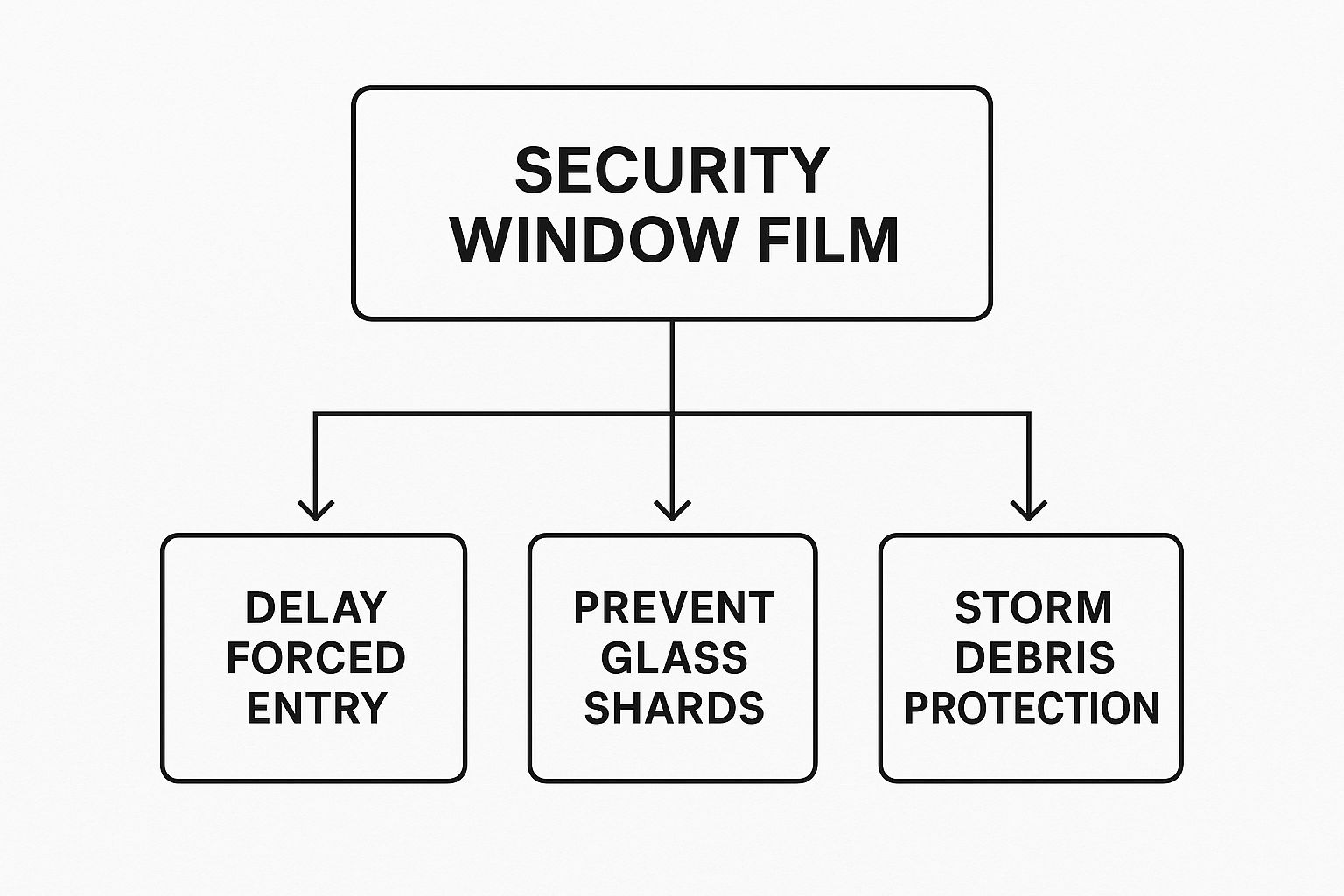
As you can see, it's about so much more than just stopping break-ins. It’s a comprehensive safety upgrade for any property.
A Growing Market Driven by Need
It’s no surprise that the demand for this kind of protection is on the rise. With growing concerns about urban crime and the increasing frequency of severe weather, more people are looking for practical ways to secure their properties. The market reflects this, valued at about USD 1.5 billion in 2025 and projected to hit nearly USD 2.8 billion by 2033. This isn't just a niche product anymore; it's becoming a standard safety feature.
By reinforcing the weakest points of a building's envelope, security film transforms a passive feature into an active layer of defense. It's a fundamental upgrade for modern property protection.
Beyond just the peace of mind it offers, security window film is also one of the smart upgrades that can increase property value. It's a permanent, invisible, and highly effective solution that adds a serious layer of security without changing the look of your home or business.
Comparing the Different Types of Security Film
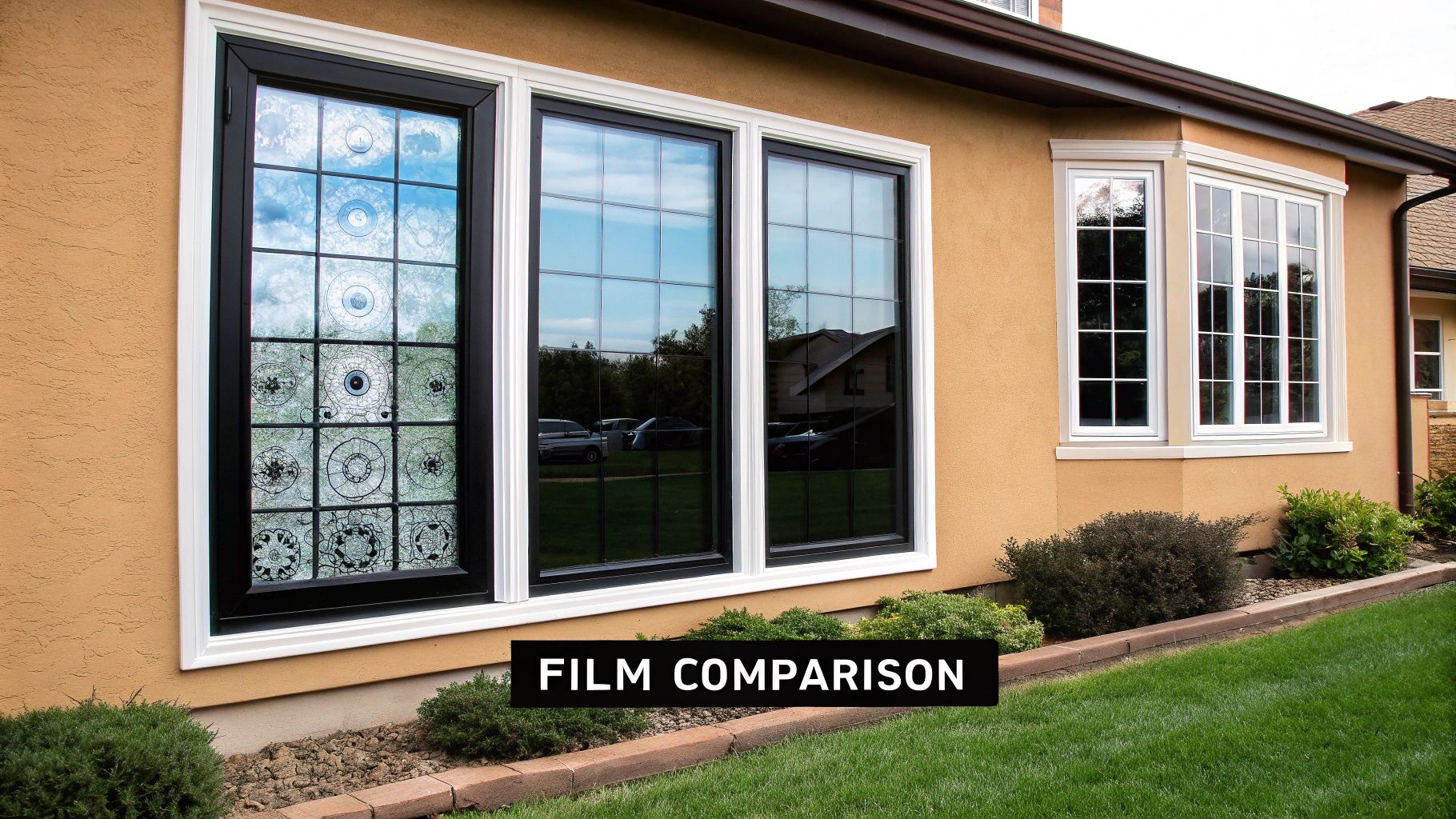
It's a common misconception that all security window film is the same. In reality, choosing the right one is a lot like picking tires for a vehicle—you wouldn't put racing slicks on a 4×4 destined for the mountains. The best film for your needs comes down to your primary goal, whether that’s stopping a smash-and-grab at your store or protecting your family from storm-blown debris.
Each type of film is engineered for a specific job, carefully balancing strength, visibility, and other features. Let's walk through the main categories so you can see which one makes the most sense for you.
Clear Shatter-Resistant Films
Think of this as the foundation of window security. The one and only job of a clear security film is to hold shattered glass together when it breaks. It’s completely transparent, so it adds a serious layer of defense without changing how your windows look one bit.
These films are essentially a single, thick sheet of heavy-duty polyester. Their effectiveness is directly tied to their thickness, which typically ranges from 4 to 15 mils (a mil is just one-thousandth of an inch). A 4-mil film is often enough for basic home safety, but a high-risk commercial building might step up to a much beefier 14-mil film for real peace of mind.
If your only concern is making your glass stronger against forced entry, accidents, or extreme weather, this is your go-to option.
Solar Control Security Films
What if you want security plus some everyday benefits? That's where solar control security films come in. These are true multi-taskers, blending the impact resistance of standard security film with the energy-saving perks of a solar tint.
This two-in-one film not only holds glass together but also cuts down on UV rays and solar heat. Here’s what that looks like in the real world:
- UV Protection: It blocks up to 99% of damaging UV rays, which is what causes your furniture, hardwood floors, and artwork to fade over time.
- Heat Rejection: By blocking a good portion of the sun's heat, it can actually help lower your A/C bills in the summer.
- Glare Reduction: It dials down that harsh afternoon sun, making it much more comfortable to see your computer screen or TV.
This type is a fantastic choice for homeowners and business owners who want to upgrade security while also making their space more comfortable and energy-efficient.
Anti-Graffiti and Specialty Films
Sometimes the threat isn't about breaking the glass—it's about defacing it. Anti-graffiti films are a clever solution designed to be a sacrificial layer. These clear films are applied to the exterior of glass, mirrors, or other smooth surfaces that are easy targets for vandals.
When someone hits the surface with spray paint or even tries to etch it with a sharp object, they're only damaging the film. The film can then be peeled off and replaced quickly and affordably, leaving the expensive glass underneath completely unharmed.
Think of anti-graffiti film as a screen protector for your building. It takes the hit, so your valuable glass doesn't have to, saving thousands in replacement costs.
Beyond these main types, the technology gets even more advanced. For facilities requiring the highest level of protection, learning about the capabilities of ballistic film for windows is a must. These are not just films but entire systems, often involving much thicker materials and specialized anchoring to handle extreme threats.
Security Window Film Feature Comparison
To make it easier to see the differences at a glance, here’s a breakdown of how the main film types stack up against each other.
| Film Type | Primary Benefit | Typical Thickness (mils) | Added Features | Ideal Application |
|---|---|---|---|---|
| Clear Shatter-Resistant | Holds glass together upon impact | 4 – 15 mil | Optically clear, maximum visibility | Basic residential safety, commercial forced entry deterrence |
| Solar Control Security | Impact resistance + energy savings | 4 – 10 mil | UV blocking, heat & glare reduction | Homes and offices seeking comfort and security |
| Anti-Graffiti | Sacrificial barrier against vandalism | 4 – 7 mil | Optically clear, removable | Retail storefronts, public transit, schools, mirrors |
| Ballistic-Resistant | Extreme threat mitigation | 15+ mil (often layered) | Requires specialized anchoring systems | Government buildings, high-risk facilities, embassies |
Ultimately, the right security film is the one that directly addresses your specific vulnerabilities and goals, ensuring your property is protected in the way that matters most to you.
How to Measure the Strength of Security Film
Not all security window film is created equal. When you start comparing products, it’s easy to get lost in a sea of technical jargon. But understanding these key metrics is the difference between buying a real deterrent and just a flimsy layer of plastic.
Let's cut through the noise and talk about what really matters.
The first and most common spec you'll see is film thickness, which is measured in mils. A mil isn't a millimeter; it's one-thousandth of an inch (0.001"). It sounds incredibly small, but in the world of security film, the gap between a 4-mil film and a 14-mil one is massive.
Think of it like the difference between a single sheet of paper and a thick piece of cardstock. You can tear the paper without thinking, but the cardstock puts up a real fight. It's the same principle at work on your windows.
Understanding Film Thickness in Mils
A film’s thickness is directly tied to how well it can handle brute force, whether from a burglar’s hammer or a wind-flung tree branch. The right thickness for you depends entirely on what you're trying to protect against.
Here’s a practical breakdown of how these thicknesses stack up in the real world:
-
4-7 Mils: This is your go-to range for most homes. A 4-mil film is perfect for basic safety—it'll keep a window from shattering if a baseball hits it or a child accidentally runs into a glass door. Bumping up to a 7-mil film gives you a solid first line of defense against a quick smash-and-grab.
-
8-14 Mils: We're now in the sweet spot for most commercial properties like storefronts and office buildings. An 8-mil film can take repeated blows from a heavy object, buying precious time. Films in the 12-14 mil range offer serious protection that often forces an intruder to bring specialized tools to even attempt a breach.
-
15+ Mils: This is the heavy-duty stuff, reserved for high-risk environments. You'll find these ultra-thick films on government buildings, jewelry stores, and facilities that require blast mitigation. At this level, they are almost always installed with an anchoring system to bond the film to the window frame.
The goal isn't just to make the glass stronger; it's to buy time. A determined intruder might eventually get through, but the loud, difficult, and time-consuming process created by a thick security film is often enough to make them give up and move on.
Beyond Thickness: Key Performance Metrics
While thickness is a great starting point, it doesn’t tell the whole story. To truly understand how a film performs under pressure, you have to dig into the product’s data sheet and look at its material science specs. These numbers reveal the film's inherent toughness.
Two of the most critical specs are tensile strength and break strength.
-
Tensile Strength: This tells you how much pulling force the film can handle before it starts to permanently stretch and weaken. A higher number means the film is more rigid and holds its shape under stress.
-
Break Strength: This is the knockout punch. It measures the absolute maximum force the film can take before it tears. For resisting impact, this is arguably the most important number because it defines the film's ultimate failure point.
These metrics are precisely why two films of the same thickness can perform very differently. A well-engineered 8-mil film with superior tensile and break strength will easily outperform a cheaply made 10-mil film.
The Importance of Industry Certifications
Finally, the most reliable way to know you're getting what you pay for is to look for independent, third-party testing and certifications. These aren't marketing claims; they are proof that a product has met specific, rigorous standards for safety and security.
Keep an eye out for these respected ratings:
-
ANSI (American National Standards Institute): The ANSI Z97.1 standard is a critical safety glazing test that ensures glass, when broken, doesn't create dangerous, sharp shards upon human impact.
-
GSA (General Services Administration): The GSA sets performance levels for blast mitigation, a non-negotiable standard for government buildings and other high-security facilities.
-
Miami-Dade County Notice of Acceptance (NOA): This is the gold standard for hurricane protection. Films with this certification have survived brutal testing that simulates the impact of debris in hurricane-force winds.
As building codes get tougher and safety becomes a bigger priority, the demand for certified products is only growing. In fact, the U.S. security window film market is projected to expand at a compound annual growth rate of about 5.2% through 2035, a trend driven by these very needs. You can dig into more insights about this market growth on Fact.MR.
Real-World Examples of Security Film in Action
The specs and technical data for security film are impressive, sure. But where this technology really proves its worth is out in the real world, when things go sideways. It’s one thing to read about tensile strength; it’s another to see how a paper-thin, invisible layer of film can stop a brick.
From a suburban home to a downtown storefront, security film is the unsung hero in all sorts of situations. Let's look at a few practical scenarios that show just how big of a difference it can make.
Protecting Your Home and Family
At home, it all comes down to peace of mind. Security film acts as a silent, 24/7 guardian for the weakest points of your house—the glass.
Picture a burglar trying for a quick smash-and-grab on your back patio door. They expect the glass to explode inward, giving them instant access. Instead, the glass cracks loudly but stays locked in the frame, held together by the film. The thief is left hammering away, making a ton of noise and wasting precious time. That delay and commotion are often all it takes to send them packing, protecting not just your stuff, but your family.
And it’s not just about break-ins. Think about these common household risks:
- Child Safety: An accidental trip into a sliding glass door or a stray baseball from the yard is no longer a catastrophic event. Instead of a dangerous spray of glass shards, the film holds the broken pieces together, preventing a trip to the emergency room.
- Storm Damage: For those in areas prone to hurricanes or high winds, flying debris can easily shatter a window. This breaches your home's "envelope," letting wind and rain pour in to cause massive damage. Security film keeps that opening sealed, minimizing the mess and protecting everyone inside.
Securing Commercial and Retail Spaces
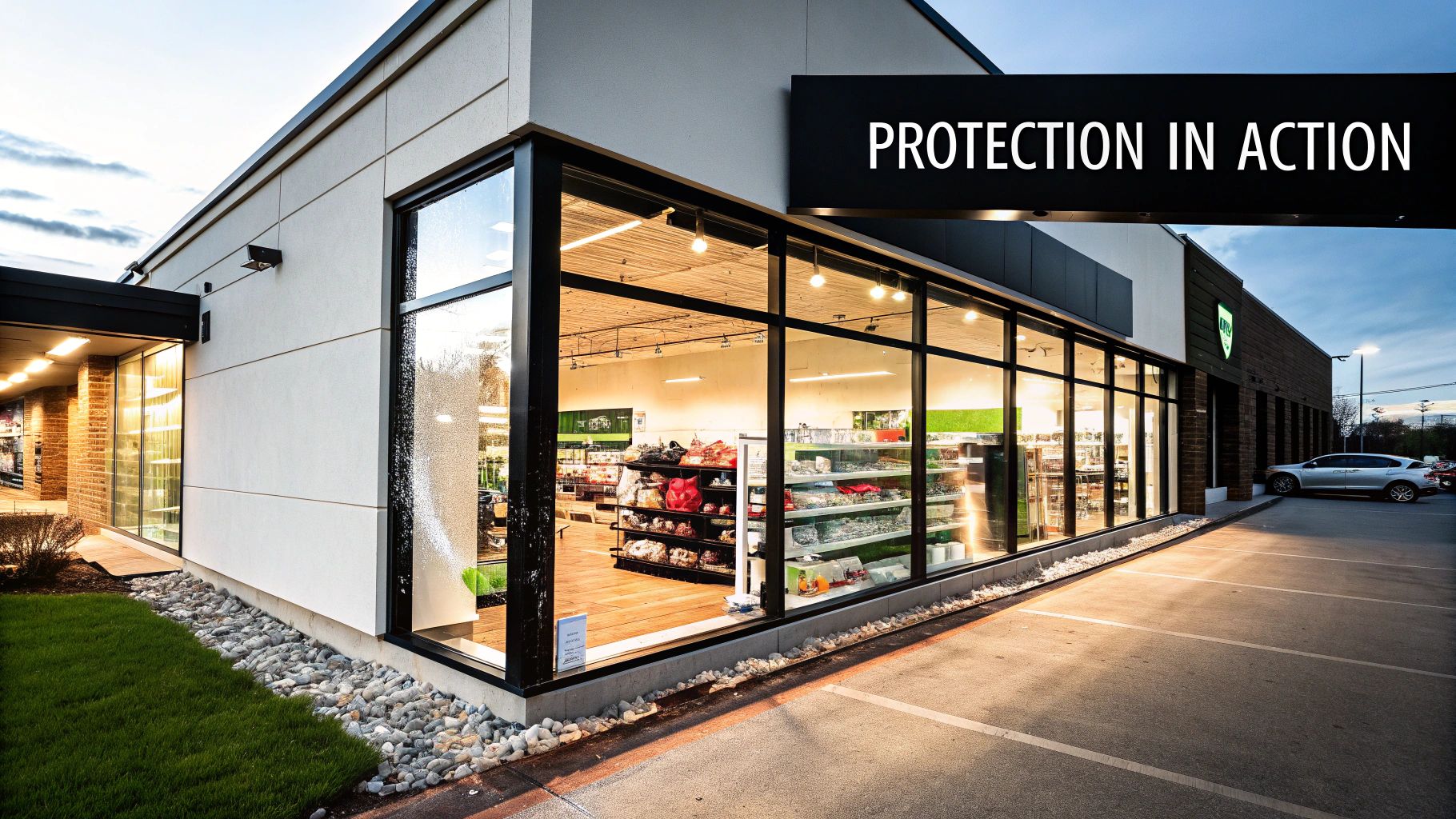
Businesses deal with a different breed of threat, from organized smash-and-grabs to simple vandalism. If you own a retail shop with a big glass storefront, you know how vulnerable you are.
A typical smash-and-grab is over in less than a minute. Thieves rely on being faster than the police. Security window film completely upends their game plan.
It turns an easy smash into a loud, difficult, and time-consuming struggle. That’s the key. By robbing criminals of the speed and surprise they count on, you make your business a much harder target—often convincing them to just move on.
This is a game-changer for:
- Retail Storefronts: Protecting high-value inventory like jewelry, electronics, or designer apparel from lightning-fast raids.
- Office Buildings: Fortifying ground-floor windows and glass entryways against vandalism and after-hours break-ins.
- Anti-Graffiti Protection: A special, sacrificial layer of film can be applied on the outside of the glass. When vandals hit it with spray paint or etching tools, they’re only damaging the film. You can just peel it off and replace it for a tiny fraction of what a new window would cost.
Enhancing Safety in Schools and Educational Facilities
School security is, tragically, a top priority for every community. While there's no single magic bullet, security window film is a vital piece of a layered defense strategy. In this context, its entire purpose boils down to one thing: buying time.
In an active threat situation, every single second counts. An attacker can shatter a standard classroom window instantly. But a window reinforced with a heavy-duty security film and attachment system can take a beating for several crucial minutes.
That delay is everything. It achieves two life-saving goals:
- Time to React: It gives students and staff precious moments to lock down, barricade doors, and get out of sight.
- Time for Help to Arrive: It slows the intruder down, keeping them outside long enough for law enforcement to get on scene and neutralize the threat before they can get into a classroom.
By hardening the most vulnerable entry points, security film helps create safer spaces for learning. It's a practical, effective tool that protects students and educators when they need it most.
Choosing and Installing Your Security Film
Picking the right security window film isn't just about grabbing something off the shelf. It starts with a simple, practical question: what are you trying to protect against? Your answer completely changes the game.
Are you primarily worried about a smash-and-grab burglar trying to get in and out fast? Or do you live in a coastal area where hurricane-force winds and flying debris are the real threat? The film you need for one scenario isn't necessarily the best for the other.
From there, you’ll need to weigh your security goals against your budget and any local building codes. It's not uncommon for cities in high-wind zones, for instance, to have specific rules for window safety. A little research upfront ensures your investment is both effective and fully compliant.
Selecting the Right Film for Your Needs
Once you know your main concerns, you can start zeroing in on the perfect film. This is where you balance raw protective power with other factors, like how it looks and whether you want other benefits.
- Know Your Weak Spots: Think about your property's vulnerabilities. A ground-floor jewelry store with a massive display window has a much higher risk profile than a quiet suburban home office on the second floor. Be honest about where you're most exposed.
- Pick Your Thickness: For basic home safety—think deterring a casual burglar or preventing injury from an accidental impact—a 4 to 7 mil film is a solid choice. But for high-risk commercial buildings or serious storm protection, you really need to step up to the 8 to 15 mil range.
- Look for Extra Perks: Do you also want to cut down on solar heat gain or stop your furniture from fading? Many people opt for a combination solar security film. You get the robust protection and the energy-saving benefits all in one package.
Why Professional Installation Is Essential
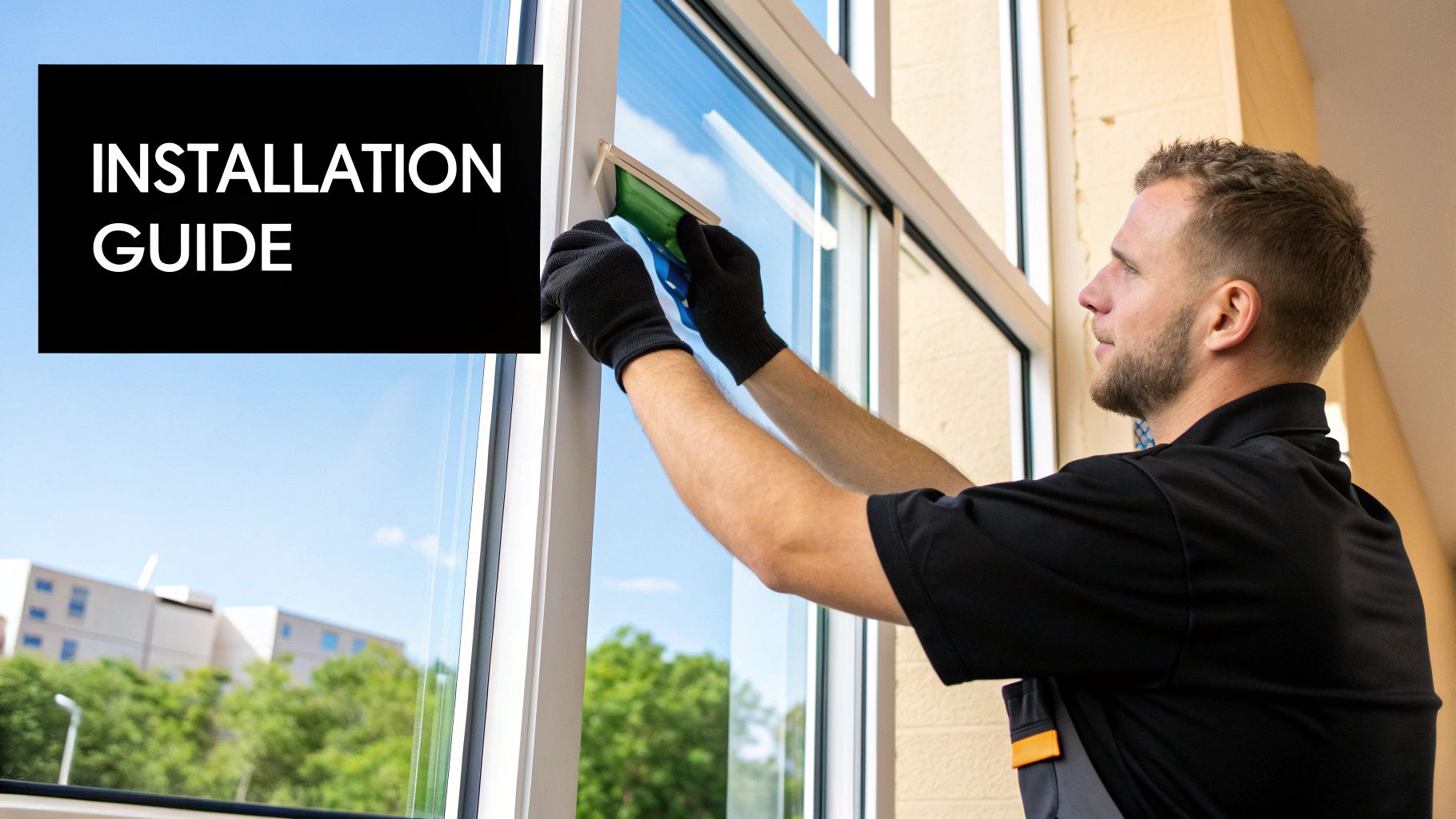
I get the appeal of a good DIY project, but this isn't the place to cut corners. The effectiveness of your security film is completely dependent on how well it's installed. You could buy the strongest, most advanced film on the market, but if it's applied poorly, it's virtually useless.
A professional installation is a painstaking process. The goal is to make the film and the glass one seamless, unified barrier. This is non-negotiable for security. Even tiny flaws like air bubbles, creases, or a speck of trapped dust can create a weak point that will fail under stress. To see what a top-tier job involves, you can learn more about the details of a professional security window film installation.
A flawless application isn't just about looking good—it’s a critical part of the security system. The film has to be perfectly bonded to the glass to do its job when someone is trying to break in or a storm is raging outside.
The Role of Attachment Systems
For the highest level of security, you need to go one step further and anchor the film directly to the window frame. We do this using an attachment system, which is typically a special structural silicone or a mechanical frame that locks the film-covered glass to the window frame itself.
Think of it like this: without an attachment system, a determined intruder could break the glass and simply push the entire pane—film and all—right out of the frame. The attachment system makes that impossible. It creates a single, incredibly strong unit, forcing an intruder to waste precious time and energy trying to tear through the film itself.
This is the key to withstanding major impacts, whether from a crowbar or hurricane-force winds. It’s what transforms a standard window into a truly fortified opening.
Common Questions About Security Window Film
Even after digging into the specifics, you probably still have a few practical questions. It makes sense—when you're investing in the safety of your home or business, you want to be completely sure. Let's clear up some of the most common questions and myths that come up.
We'll start with the big one.
Is Security Window Film Bulletproof?
In short, no. Standard security window film is not bulletproof or bullet-resistant. Think of its job as holding shattered glass together, not stopping a bullet. This buys you precious time against an intruder and keeps dangerous glass shards from flying everywhere.
True bullet-resistant glass is a completely different animal—it's a thick, multi-layered beast of a product. While a very thick film (14 mil or more) combined with a solid attachment system adds a serious amount of impact resistance, it is absolutely not rated to stop bullets. Never treat it as a substitute for certified ballistic glass.
How Long Does Security Window Film Last?
This is a long-term upgrade, not a temporary fix. When a professional installs a quality security film, you're typically looking at a manufacturer's warranty of 10 years to a lifetime for a home installation. For commercial buildings, warranties usually sit in the 10-15 year range.
Honestly, with proper care, the film often outlasts its warranty. Today's films are made with seriously advanced adhesives and scratch-resistant coatings that are designed to go for decades without bubbling, peeling, or turning yellow. This durability and performance is why the broader window film market, which includes these security products, keeps growing.
In fact, the global market for all window films was valued at around USD 2.4 billion in 2024 and is expected to hit nearly USD 4 billion by 2032, thanks to huge demand in construction and automotive. You can get a deeper look into the global window film market on fortunebusinessinsights.com.
Will It Change How My Windows Look?
If you're worried about ruining your home's aesthetic, you can relax. Most high-quality security films are optically clear, meaning they're pretty much invisible once they're on the glass. The whole point is to add a tough layer of protection without changing your view or the look of your property.
Of course, you can also choose a film that does more than just protect. Combination films offer a whole suite of extra benefits:
- Tints: Great for cutting down on heat and sun glare.
- Frosts: Add a layer of privacy with decorative patterns.
- Reflective finishes: Give a modern look while offering top-notch glare reduction.
So you can go for a film that’s completely unnoticeable or one that actively enhances the comfort and style of your space.
The real beauty of security film is its invisible strength. It's a silent guardian, working 24/7 to protect your property without you having to do a thing or sacrifice your home's design.
The cost of this invisible peace of mind is often much more affordable than most people assume. To get a clearer picture of the investment for your property, take a look at our guide on security window film cost.
Ready to strengthen your property's weakest points without compromising its appearance? The experts at Fortress Security Films offer professional consultations and installations for homes, businesses, and even vehicles.
Secure your free estimate today at https://fortresssecurityfilms.com
