


When we talk about school security, we often think of cameras, locks, and access control. But one of the most effective, yet often overlooked, layers of protection is security window film. It's a powerful tool that reinforces a school's most vulnerable points—its glass windows and doors.
The core job of this film is to hold shattered glass together. This simple function has a profound impact: it significantly slows down anyone trying to force their way in and, just as importantly, prevents sharp, dangerous shards from flying everywhere during an emergency. That delay is absolutely critical, giving everyone precious time to initiate lockdown procedures and for first responders to get to the scene.
An Invisible Shield for Modern School Safety
School administrators are constantly navigating a tough challenge: how do you make a campus safer without making it feel like a prison? Windows and glass doors are essential for creating a welcoming, bright learning environment, but they're also a building's weakest link. This is where security window film really shines.
Here's a simple way to think about it. An untreated window is like a single sheet of paper—easy to tear right through. Applying security film is like laminating that paper. You can still bend or even crack it, but the laminate holds all the pieces together, making it incredibly difficult to create an opening.
That's exactly how security film works. It’s a micro-thin, surprisingly strong sheet of polyester that's bonded to the inside of the glass. If something hits the window hard enough to break it, the glass will crack, but the film's aggressive adhesive keeps all those dangerous fragments locked in place within the frame.
Delaying Threats and Buying Time
Let's be clear: the goal isn't to make glass bulletproof or unbreakable. The real purpose of security film is to make breaking through a window a loud, difficult, and time-consuming process.
For an intruder, speed is everything. A standard window that shatters on the first hit means instant access. But a window treated with security film forces them to make repeated, loud, and forceful impacts just to create a small hole. This buys time.
That delay isn't just an inconvenience for an attacker—it's a critical strategic advantage for the school. It creates an invaluable window of opportunity for students and staff to find safety, for lockdown protocols to be activated, and for law enforcement to respond.
This practical benefit is why we're seeing such a huge increase in adoption. The global market for security films was recently valued at around USD 1.5 billion and is expected to nearly double to USD 2.8 billion by 2033. As you can see in data from sources like Verified Market Reports, this growth is directly tied to the heightened focus on protecting people in schools and other public buildings.
More Than Just a Barrier
The protection doesn't stop with deterring intruders. Security film also addresses the most common danger from any broken window: flying glass.
Whether it's during a natural disaster like an earthquake, a severe storm, or even just an accident like a stray baseball, the film contains the broken glass. This simple act of containment protects anyone standing nearby from potentially life-threatening injuries. It’s a passive safety feature that’s working around the clock, turning a building’s weakest points into a quiet source of strength.
How Security Film Reinforces School Windows
It’s tough to imagine how a thin, clear sheet can make a huge pane of glass so much stronger. The secret behind security window film for schools is both surprisingly simple and incredibly effective, transforming a building's most fragile surface into a tough, resilient barrier. At its core, the film is made from several layers of exceptionally strong polyester, all fused together with powerful, specialized adhesives.
When this film is professionally applied to a window, the layers bond with the glass to form a single, unified shield. It works a lot like the laminated safety glass in your car's windshield. If a rock hits your windshield, it might crack and spiderweb, but it doesn't just explode into a million sharp pieces. That inner plastic layer holds it all together, protecting you from harm.
Security film functions on that very same principle. It's engineered to absorb and spread the energy of an impact across the entire window pane, preventing the glass from failing catastrophically all at once.
Turning Impact into Delay
For an intruder, this technology creates one thing: frustration. When a regular, untreated window is hit, it shatters instantly, leaving a wide-open entry point. A window treated with security film is a completely different story.
Even if the glass breaks, the film grips those hazardous shards and holds them firmly within the window frame. The window remains a solid barrier. To breach it, an attacker has to keep hitting the same spot over and over, trying to tear through the tough polyester film itself. This is a loud, slow, and exhausting process.
This built-in delay is the film’s most powerful security feature. It takes away an intruder's most valuable weapon—time—and gives it directly back to the school.
The primary function of security window film is to hold shattered glass in place, thereby delaying entry and mitigating injury from flying fragments. This delay is the most critical element, providing the precious minutes needed for staff and students to implement lockdown procedures and for law enforcement to arrive.
This delay tactic is a cornerstone of modern educational facility protection. It doesn't make the glass unbreakable, but it makes forcing entry so difficult and time-consuming that it can deter an attack or slow it down enough for help to arrive.
The Mechanics of Resistance
So, what’s happening on a micro-level when force is applied? Whether it's a thrown brick, a hammer, or even the shockwave from a nearby explosion, the film fights back in a few key ways.
- Impact Absorption: The film’s flexible polyester layers act like a shock absorber, flexing on impact to soak up a huge amount of the initial force. This dramatically reduces the stress put on the glass.
- Energy Dispersion: Instead of the force being concentrated on one small point, the film spreads it out across the entire surface of the pane, making it much harder to create a clean break.
- Tear Resistance: The multi-layered design is incredibly resistant to tearing and puncturing. Even if a small hole is created, it won’t easily rip open, forcing an attacker to keep working at it.
- Adhesive Strength: The film is bonded to the glass with an aggressive, high-strength adhesive. This bond is what tenaciously holds the shattered pieces together, keeping the barrier intact.
This combination of features turns a standard window from a vulnerability into an active part of a school's security plan. It's a passive system that's always on, silently standing guard. By simply being there, security window film provides a constant, invisible layer of protection, reinforcing the safety of everyone on campus. That delay it creates is a simple concept with life-saving potential.
Selecting the Right Film for Your School's Needs
Choosing the right security window film for your school isn’t a one-size-fits-all decision. It's about taking a hard look at your building's unique vulnerabilities, potential threats, and, of course, your budget. The films on the market offer wildly different levels of protection, so getting familiar with the options is the first step toward making a smart investment in student safety.
Think of it like choosing a bike helmet. A standard helmet is great for a casual ride around the neighborhood, but for mountain biking on a rugged trail, you'd want something far more robust. Security films are no different. Their strength is measured in mils (one-thousandth of an inch), and even a few extra mils can make a world of difference in how much force a window can withstand.
Matching Film Thickness to School Vulnerabilities
Most security films you'll encounter range from 4 to 21 mils thick, with each level designed for specific situations. For schools, the real challenge is striking the perfect balance between delaying an intruder and working within a public-sector budget. The key is to be strategic—you don't need the same level of protection on every single window.
For instance, a glass door at the main entrance faces a much higher risk than a second-story classroom window. A smart approach means putting the strongest protection where you need it most.
This breakdown highlights the core benefits that make these films so effective, from their brute strength to other protective qualities.
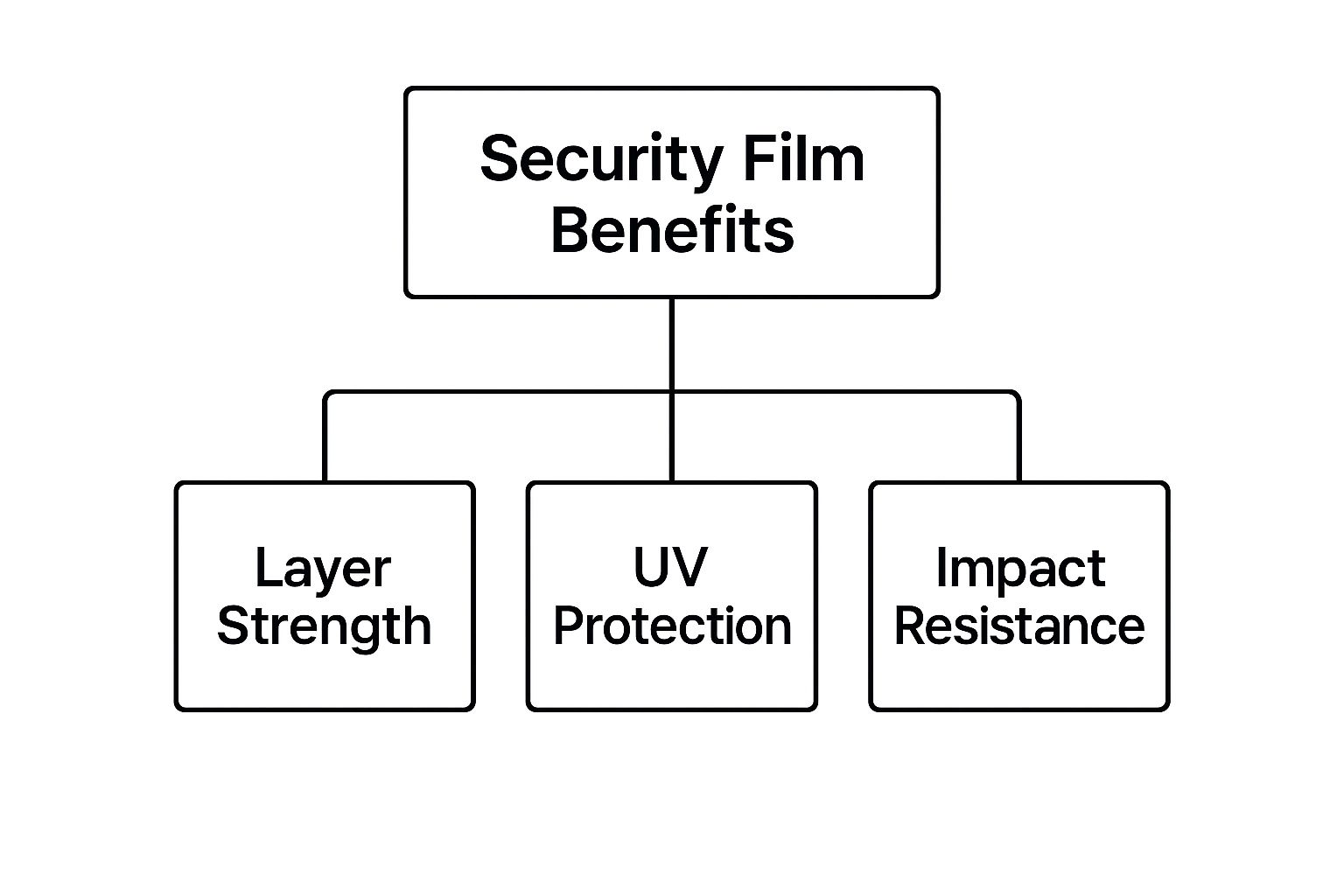
As you can see, the foundation is layer strength and impact resistance, but you also get critical secondary benefits like UV protection.
To help you match the right film to the right risk, the following table breaks down how different film thicknesses translate to real-world protection levels in a school setting.
Security Film Thickness and School Protection Levels
| Film Thickness (Mil) | Primary Protection Level | Common Use Cases for Schools | Relative Cost |
|---|---|---|---|
| 4-7 Mil | Basic Safety & Shatter Resistance | Interior glass partitions, high-traffic hallways, areas prone to accidental breakage. Good for weather protection. | $ |
| 8-14 Mil | Intruder & Forced Entry Delay | Main entrances, ground-floor classrooms, libraries, administrative offices, and any easily accessible exterior window. | $$ |
| 15+ Mil | Blast Mitigation & High-Impact Resistance | High-risk entry points, buildings in high-threat areas, or where blast protection is a specific concern. | $$$ |
This table makes it clear that you can—and should—use a mix of films to protect your campus effectively without overspending. Most schools will find their sweet spot in that 8-14 mil range for critical areas.
Exploring the Tiers of Protection
Let's dig a little deeper into what those tiers actually mean for your school.
-
Standard Security Film (4-7 Mil): Think of this as your foundational safety layer. It’s fantastic for preventing injuries from flying glass, whether it's from a stray baseball or severe weather. While it offers a minor delay to an intruder, its primary job is mitigating everyday hazards and accidents.
-
Intruder Delay Film (8-14 Mil): This is the go-to for most schools, and for good reason. An 8-mil film is a huge leap in strength from a standard one, requiring repeated, determined blows to get through. This is where you get that priceless benefit of "buying time," giving students and staff precious moments to enact lockdown procedures while law enforcement responds.
-
Heavy-Duty and Blast Mitigation Film (15+ Mil): These are the heavy hitters. Reserved for high-risk environments, these films are engineered to stand up to extreme attacks, even bomb blasts. They are almost always installed with special anchoring systems that fuse the film, glass, and frame into one super-strong barrier.
The growing adoption of these films tells a story. The global market for safety and security window films, valued at USD 636.4 million in 2025, is expected to surge to USD 991.2 million by 2033. For most school applications, industry analysis shows that films in the 8 to 14 mil range provide the best combination of performance and value. You can explore more data on these security solutions to see just how integral they've become.
Beyond Security: A Holistic Investment
Today's advanced window films are true multi-taskers. They do much more than just reinforce glass, allowing schools to tackle several challenges with a single project. This turns what seems like a pure security expense into a smart facility-wide improvement.
Selecting a multi-benefit film allows a school to layer its investments. A single product can enhance security, lower energy bills, and protect students from UV radiation, delivering a far greater return on investment than a standalone security product.
Think about these powerful combinations:
- Solar Control Security Films: These films pull double duty, blending intruder resistance with powerful solar heat rejection. They can slash the heat coming through a window by over 50%, taking a huge load off your HVAC system and cutting cooling costs during hot months.
- UV Protection Films: Nearly all quality security films block 99% of damaging UV rays. This not only protects students and staff from sun exposure but also prevents the school's books, furniture, and flooring from fading over time.
- Anti-Graffiti Films: Perfect for ground-floor windows, these films act as a sacrificial shield. If they get tagged with paint or scratched, you can simply peel off the damaged film and replace it—a solution that costs a tiny fraction of replacing the entire glass pane.
What to Expect During the Installation Process
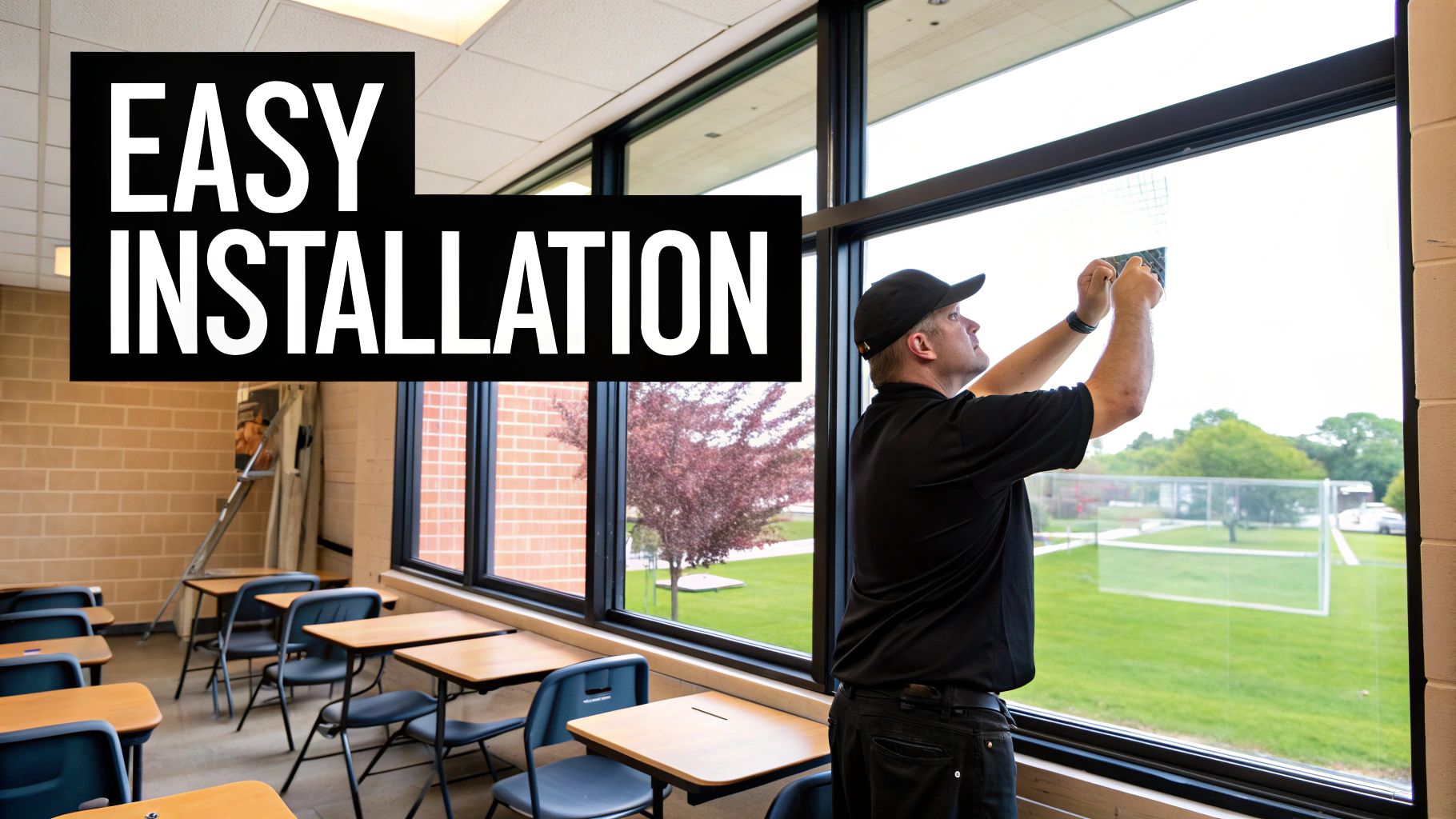
For any school administrator, the thought of another campus-wide project can be daunting. The good news is that a professional security film installation is surprisingly low-impact, designed from the ground up to avoid disrupting your school's daily rhythm. Knowing what to expect makes the entire process feel less like a construction project and more like a manageable, predictable upgrade.
This isn’t just about slapping a film onto a window. It's a craft. Think of it less like applying a big sticker and more like a skilled technician custom-fitting a critical piece of safety equipment. Each step is vital for ensuring the film not only looks invisible but also performs when it matters most.
Hiring a professional isn't just a suggestion—it's the only way to ensure the film actually works and that your warranty remains valid. A botched job with bubbles, peels, or trapped debris completely undermines the film's ability to hold glass together under force.
The Phased Installation Approach
Experienced installers know that schools can't just shut down. That's why they work in phases, often tackling entire wings or buildings after hours, on weekends, or during school holidays. This flexibility means zero disruption to class time.
No matter the window, the method is consistent and proven.
- Step 1: On-Site Prep: Before anything starts, the crew does a final walkthrough. They'll confirm measurements and check the glass and frames for any pre-existing conditions that might affect the bond. Then, they’ll carefully lay down drop cloths to protect every surface, from floors to furniture.
- Step 2: Surgical-Level Cleaning: This is where the magic really begins, and it’s probably the most important step. The glass has to be absolutely spotless. Installers use special scrapers and cleaning agents to remove every speck of dust, oil, and grime.
- Step 3: Precise Film Application: The film, already cut to the exact size of the window pane, gets sprayed with a slip solution. This lets the installer slide the film into the perfect position on the glass. It’s a delicate dance that requires a steady hand and a keen eye for alignment.
Achieving a Flawless and Secure Finish
With the film in place, the next steps are all about locking it in and making it look like it was always part of the glass. This is where you can really see the difference between an amateur and a pro.
The installer uses a set of specialized squeegees, applying firm, even pressure to push the film against the glass. This does two critical things at once: it forces out every last drop of the slip solution and activates the powerful adhesive that gives the film its incredible strength.
The squeegee work is a true skill. An installer has to use just the right amount of pressure, moving across the glass with a consistent technique to create a powerful bond. This prevents any air bubbles or water pockets from forming, which are weak points that can compromise the film's integrity.
After the main surface is bonded, the installer does a final, razor-sharp trim to fit the film perfectly to the frame's edge. For most high-security jobs, the final touch is edge sealing. Here, a bead of structural silicone is run around the perimeter, chemically bonding the film, the glass, and the window frame into one solid unit. This makes it incredibly difficult for an intruder to push the entire pane out of its frame.
The entire process is built for efficiency and perfection. If you're thinking about this critical upgrade, you can get an estimate for your school's project to see how it might fit your budget and schedule.
More Than Security: Additional Benefits for Schools
When school administrators think about security window film, their first thought is usually about deterring intruders and buying precious time during an emergency. That’s the primary job, of course. But the reality is that a modern film installation does so much more, delivering tangible benefits every single day. It’s a smart upgrade that transforms a security measure into a facility-wide improvement.
This isn't just a niche idea; it's a major driver in the global window film market. The Asia Pacific region, for instance, commands about 41% of the market share, largely fueled by new construction in sectors like education. These institutions see the bigger picture—they want a product that boosts security and energy efficiency. It's a key reason schools are embracing window films as a standard for new and existing buildings.
Ultimately, this shifts the perspective. Security window film isn't just a silent guardian against threats; it's an active contributor to a safer, more comfortable, and more efficient school.
Enhanced Safety from Natural Disasters and Accidents
The same strength that makes security film a barrier against forced entry also makes it an invaluable defense against Mother Nature and everyday mishaps. Its real power lies in its ability to hold shattered glass together.
- Protection During Storms and Earthquakes: When a hurricane, tornado, or earthquake strikes, windows are often the weakest and most dangerous part of a building. The intense pressure or shaking can cause glass to shatter and fly inward, turning into deadly projectiles. Security film acts like a net, catching those dangerous shards and keeping the pane largely intact.
- Mitigation of Accidental Impacts: Schools are buzzing with energy. A student might trip and fall against a glass wall in a hallway, or a stray baseball could slam into a classroom window during recess. On their own, these common accidents can cause severe injuries. Security film provides a tough, invisible layer of protection that turns a potential emergency into a simple cleanup.
The principle is simple but powerful: by keeping broken glass in one piece, the film transforms a major hazard into a contained problem. The source of the impact doesn't matter—the result is a safer space for everyone inside.
This round-the-clock, passive protection is always working, safeguarding students and staff from a whole host of unexpected dangers.
A More Comfortable and Health-Conscious Learning Environment
Beyond just holding glass together, many security films are engineered with advanced solar properties that dramatically improve the indoor environment. This tackles two big issues for any school: student comfort and exposure to harmful UV rays.
First off, many high-quality films are designed to block up to 99% of damaging ultraviolet (UV) radiation. Think about students and teachers spending hours every day in classrooms with large windows. This feature is crucial for protecting them from the long-term effects of sun exposure. It also acts as a shield for the school’s assets, preventing books, furniture, and flooring from fading and degrading over time.
On top of that, these films are fantastic at reducing solar heat gain by rejecting much of the sun's infrared light. This helps stabilize room temperatures, getting rid of those distracting hot spots near windows and creating a more comfortable, focused atmosphere for learning. In the summer, this translates directly to significant energy savings because the air conditioning system isn't fighting a constant battle against the sun. You can see how these benefits stack up in our portfolio of educational projects and get a feel for the real-world impact.
Common Questions About School Security Window Film
When you're looking into a significant upgrade like security window film, it's natural to have questions. School administrators, board members, and parents all want to be sure they're making the right call. Getting straight, honest answers about what this technology can and can’t do is the only way to make an informed decision.
Let's cut through the noise and address the most common concerns. My goal here is to give you the practical information you need to feel confident about adding this layer of protection to your school.
Will Security Film Make Our School's Windows Bulletproof?
This is always the first, and most important, question. The answer is an unequivocal no. Standard security window film is not bulletproof or bullet-resistant. Its real job is to hold shattered glass together after a powerful impact, which makes it incredibly difficult for someone to get through a window quickly.
It’s all about delaying entry. The film turns a quick smash-and-grab into a noisy, time-consuming struggle, buying precious seconds and minutes for first responders to arrive. True bullet-resistant glazing is a completely different animal—a much thicker, more complex, and significantly more expensive system.
Think of security film as an intruder-delay tool. It’s a critical part of a layered defense, not a magic shield that stops bullets. Its true power lies in creating that crucial time buffer during an emergency.
Getting this distinction right is key. It helps set realistic expectations for how the film fits into your overall safety plan.
How Visible Is the Film and Will It Change Our School's Appearance?
Schools should feel welcoming, not like fortresses. That's another common concern, and the good news is that high-quality, clear security film is virtually undetectable once it's installed.
It's designed to be optically clear, so after it fully cures on the glass, you won't even know it's there. It doesn’t create a hazy look, distort the view, or darken rooms. You get to keep all the natural light that makes a learning environment feel positive and open. While you can get tinted versions for added solar control, the standard clear film adds a powerful layer of security without changing your school's aesthetic one bit.
What Is the Lifespan and Warranty for Security Film?
This isn't a short-term fix. When professionally installed, security film is incredibly durable and can easily last 15-20 years or even longer. It's a sustainable, long-term investment in your school's safety infrastructure.
Top-tier manufacturers stand behind their products with comprehensive commercial warranties, usually for 10 to 15 years. These warranties protect against defects like bubbling, peeling, or cracking and typically cover the cost of both the replacement material and the labor to install it. Just remember, using a certified professional for the installation is a must—a DIY or improper job can void that valuable warranty.
How Does Film Work with Other Security Systems?
Security film doesn't work in a vacuum; it’s a team player. Its main role is to enhance all your other security measures by adding the crucial element of delay. It makes everything else you have in place work even better.
Think about how it connects:
- Alarm Systems: An intruder can't just shatter a window and hop inside. They have to keep hitting it, making a lot of noise and giving your alarm system more time to activate and alert the authorities before they gain entry.
- Surveillance Cameras: That delay is a gift to your camera system. It gives you more time to capture clear, actionable video of the person trying to get in, which is invaluable for law enforcement.
- Lockdown Procedures: By keeping the glass barrier intact for longer, the film gives students and staff more time to execute lockdown protocols properly and move to a safer location within the room.
The film doesn't replace your locks, alarms, or access control. It fortifies them, turning a traditional weak point into a real obstacle and making your entire security strategy more robust.
Ready to create a safer environment for your students and staff? Fortress Security Films provides expert installation of advanced security window films designed specifically for educational facilities. Strengthen your school's defenses with a proven, invisible layer of protection. Learn more about our solutions at FortressSecurityFilms.com.
