


At its core, a security window cover is anything you install on or over a window to make it tougher against break-ins, extreme weather, or other physical impacts. The solutions are surprisingly diverse, ranging from films so thin they're practically invisible to heavy-duty shutters and bars that offer a very clear warning.
Why Windows Are Your First Line of Defense
It's easy to focus on heavy-duty doors and sophisticated alarm systems when thinking about security. But what about your windows? For most intruders, a standard pane of glass is the path of least resistance. It’s fragile, shatters with very little noise or effort, and offers a fast way inside. An unprotected window is, frankly, an open invitation.
Making these vulnerable spots more resilient is one of the smartest security upgrades you can invest in. This is precisely where security window covers come into play, forming a critical part of a layered defense designed to deter, delay, and defend.
The Core Purpose of Window Security
Think of a security window cover as armor for your building's weakest points. The main goal isn't just to stop a determined intruder cold—it's to make breaking in so loud, difficult, and time-consuming that they simply give up and leave. The extra noise and effort required to defeat a reinforced window drastically increase the risk of being caught.
It's a well-known fact among security professionals that most burglars will bail if they can't get inside within 60 seconds. A good security window cover is specifically designed to withstand an attack for much, much longer than that.
That delay is your single greatest advantage. It buys precious time for you, your security team, or law enforcement to react. Whether it's a thief trying a quick smash-and-grab at a storefront or someone attempting to break into a home, making entry a real challenge is the name of the game.
An Introduction to the Main Options
Because no two properties are alike, security window solutions aren't one-size-fits-all. There are four main categories to consider, and knowing the difference is the key to picking the right protection.
- Security Films: Think of these as a super-tough, multi-layered polyester skin applied directly to your existing glass. If the window breaks, the film holds all the dangerous shards together, frustrating entry and preventing injury from flying debris.
- Security Bars or Grilles: The classic choice for a reason. These steel bars create a powerful visual deterrent and an obvious physical obstacle that’s incredibly difficult to bypass.
- Roller Shutters: These are interlocking aluminum or steel slats that roll down to cover the entire window opening. When closed, they block both physical access and visibility completely.
- Laminated Security Glass: This isn't a cover but a full replacement. It’s a specialized glass made of multiple layers fused together with a tough polymer interlayer—much like your car's windshield, but far stronger.
Each of these options turns a simple pane of glass from a liability into a formidable part of your security plan.
Comparing the Four Core Types of Window Security
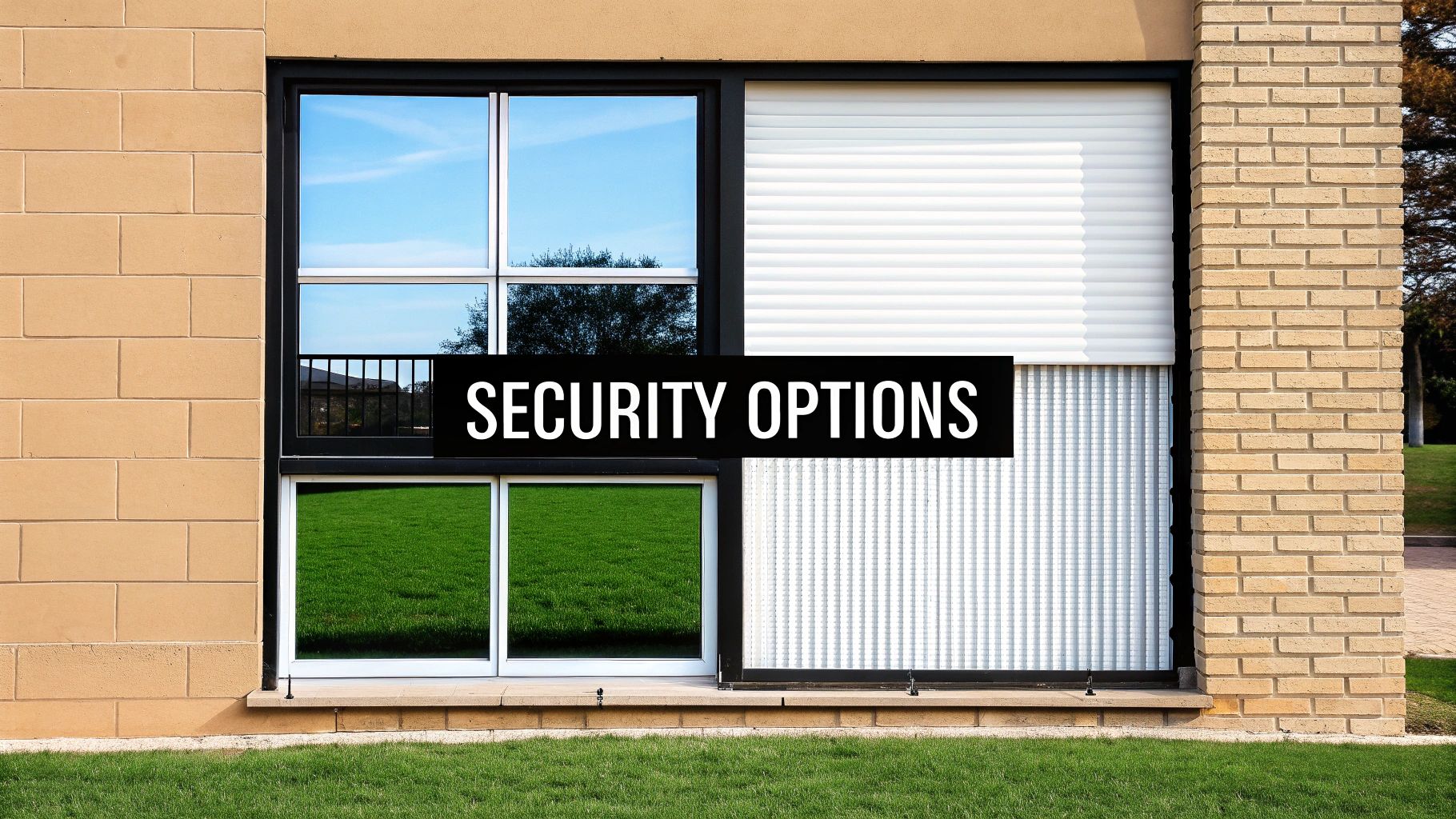
When it's time to choose the right security for your windows, you're really balancing three things: looks, budget, and the specific threats you're trying to stop. Each of the four main solutions takes a different approach, from discreetly reinforcing your glass to putting up an undeniable physical barrier. Getting a handle on these differences is the first real step to making a smart decision.
And more people are making that decision every day. The global market for window coverings, valued at USD 14.36 billion, is expected to climb to USD 20.85 billion by 2032. A big driver for this growth is the understandable concern over residential burglaries and a demand for products that don't sacrifice style for safety. It's clear that proactive protection is on everyone's mind.
So, let's break down each option to see how they work and where they really shine.
Security Film: The Invisible Reinforcement
Think of security film as an invisible shield for your existing glass. It’s a tough, multi-layered polyester sheet that gets bonded directly to the window with an incredibly strong adhesive. If something hits the window, the glass might shatter, but the film holds all those dangerous shards together. This keeps the window intact, preventing an intruder from simply walking through.
The main job of security film is to delay an attacker. It won't stop a bullet on its own (unless you're using a specialized ballistic version) or hold up forever against someone with a sledgehammer. But it will make breaking through the window a loud, difficult, and time-consuming process. What would have been a quick, silent smash-and-grab becomes a frustrating struggle that draws attention and buys you critical time.
Key advantages of security film include:
- Aesthetic Preservation: It's practically invisible, so the look of your home or storefront stays exactly the same.
- UV Protection: Most quality films block up to 99% of harmful UV rays, which helps prevent your furniture and floors from fading.
- Safety: It's a lifesaver in storms or accidents, keeping broken glass from flying everywhere.
Because it's so low-profile, security film is a fantastic choice for retail stores that need to keep their merchandise on full display, historic buildings with strict architectural codes, and any home where curb appeal is a top priority. For those facing more serious threats, you can explore how specialized ballistic film for windows takes this protection to the next level.
Security Bars and Grilles: The Visual Deterrent
Security bars are the classic, most obvious form of window protection. Typically made from steel or iron, they are bolted directly to the building's frame, creating a physical grid over the window. Their biggest advantage is their sheer presence.
A would-be intruder sees the bars, immediately recognizes a hardened target, and often just moves on to find an easier victim. That powerful visual deterrence is their number one job.
And forget the clunky, jail-like bars of the past. Modern security grilles have come a long way. Today, you can find beautifully designed custom options with decorative patterns and scrolls that actually enhance a building's architecture instead of detracting from it.
Security bars offer an uncompromising physical barrier. While other solutions focus on delaying entry, a well-installed set of bars is designed to completely prevent it, forcing an attacker to try and defeat the building's structure itself.
They're a common sight on ground-floor apartments, vulnerable basement windows, and commercial properties in high-risk areas where sending a clear "stay away" message is essential.
Roller Shutters: The Complete Barrier
Roller shutters are the go-to solution for creating a solid, all-encompassing shield over your windows. They're made of interlocking slats (usually aluminum or steel) that roll down from a housing box above the window, completely covering the opening. When they're down, they form a solid wall that blocks access, sight, and light.
This solution goes way beyond just delaying or deterring—it offers total denial of access. Once a roller shutter is locked, the window behind it is completely sealed off from impacts, prying, and vandalism. This makes them perfect for businesses that need to lock up tight overnight or for homeowners wanting peace of mind during a vacation or a nasty storm.
Beyond pure security, shutters pack a few extra punches:
- Storm Protection: They are incredibly effective against flying debris during hurricanes or severe windstorms.
- Insulation: The air gap they create provides excellent thermal insulation, which can help lower your heating and cooling bills.
- Light and Noise Control: They can create a total blackout effect and significantly muffle outside noise.
This versatility makes them a popular choice for coastal homes, street-level retail shops, and any property that needs a mix of security, privacy, and environmental control.
Laminated Security Glass: The Integrated Solution
Unlike the other options that are added on, laminated security glass is a full window replacement. It’s engineered from the start for security, with two or more panes of glass bonded together by a tough, clear polymer interlayer (usually polyvinyl butyral, or PVB). When struck, the outer glass may crack, but that interlayer holds everything together, maintaining a strong barrier.
It's the same technology used in your car's windshield, just scaled up and toughened for buildings. The security benefit is similar to film—it's all about delaying entry by withstanding repeated impacts. The key difference is that the protection is built right into the glass itself, giving it superior longevity and a completely seamless appearance.
This is definitely a premium option. It's an ideal choice for new construction or major renovations where you can design top-tier security into the building's DNA from day one. You'll often see it used in high-value homes, government buildings, museums, and luxury boutiques where flawless aesthetics are just as crucial as robust protection.
Security Window Cover Feature Comparison
The table below offers a quick side-by-side look at the four main types of security window covers. Use it to easily compare their strengths and see which one aligns best with your security goals, budget, and the look you want to achieve.
| Feature | Security Film | Security Bars | Roller Shutters | Laminated Glass |
|---|---|---|---|---|
| Primary Goal | Delay Entry, Hazard Mitigation | Deter & Prevent Entry | Deny Access, Storm Protection | Delay Entry, Integrated Protection |
| Visual Impact | Invisible | High (Visible Deterrent) | High (Visible when closed) | Invisible (Seamless) |
| Best For | Aesthetics, Retail, Historic Buildings, UV Protection | High-Crime Areas, Maximum Deterrence | Overnight Security, Storm-Prone Areas, Privacy | New Construction, High-End Properties, Renovations |
| Cost | Low to Moderate | Moderate | Moderate to High | High |
| Additional Benefit | UV/Fade Protection, Safety from Shattered Glass | Unmatched Visual Deterrence | Insulation, Light/Noise Control, Storm Shield | Superior Durability, Seamless Look |
| Vulnerability | Can be defeated with time and heavy tools | Can be aesthetically intrusive | Obstructs view when closed, requires mechanical parts | Requires full window replacement, higher upfront cost |
Ultimately, there is no single "best" solution—only the best solution for your specific situation. Whether you need the subtle strength of film or the absolute lockdown of a shutter, understanding these trade-offs is the key to securing your property effectively.
Of course. Here is the rewritten section, designed to sound natural, human-written, and authoritative.
More Than Just a Barrier: The Hidden Perks of Security Windows
Most people start looking into security window covers for one reason: to stop a break-in. And they’re fantastic at that. But if you stop there, you’re missing half the picture. The real value of these systems goes way beyond just keeping intruders out.
Think of it less like a deadbolt and more like a complete upgrade for your windows. It's a multi-tool that quietly improves your home or business in ways you might not expect. From freak storms to the daily assault of the sun, these covers deliver a surprising amount of protection and comfort.
A Shield Against Storms and Flying Debris
When the weather gets ugly, standard glass is your home’s weakest link. High winds and flying debris from a hurricane, tornado, or even a severe thunderstorm can shatter a window in an instant. Once that happens, you’re not just dealing with rain and wind inside; the sudden pressure change can even lift the roof right off your house.
- Impact Resistance: This is where solutions like roller shutters, laminated glass, and security films really shine. A good security film, for example, won’t stop the glass from breaking, but it will hold all the dangerous shards together in the frame. No flying glass projectiles inside your living room.
- Debris Shield: Roller shutters are even better. They act like a suit of armor, deflecting branches, hail, and whatever else the wind throws at your home before it even has a chance to hit the glass. There’s a reason you see them all over storm-prone coastal areas.
Having that level of resilience offers a kind of peace of mind you can't put a price on when the storm sirens start blaring.
Saving Your Valuables from Sun Damage
The sun is relentless. Over time, its invisible UV rays will bleach the color right out of your hardwood floors, furniture, artwork, and even merchandise in a storefront. This slow-motion damage is irreversible, fading and degrading everything it touches.
Security films are the unsung heroes here. Many are engineered to block up to 99% of harmful UV radiation without you even knowing they’re there. It’s like putting a powerful, invisible sunscreen on your property. This single feature preserves the value and vibrancy of your interiors for years, paying dividends every single sunny day.
Lowering Your Energy Bills
Windows are notorious energy sieves. They let precious heat leak out in the winter and invite the sweltering sun in during the summer, forcing your HVAC system to work overtime. Certain security upgrades can put a serious dent in that energy waste.
Roller shutters are a perfect example. When you close them, they create a pocket of air between the shutter and the window. This air gap is a fantastic insulator, dramatically reducing heat transfer. Your indoor temperature stays more stable, your HVAC system gets a break, and your utility bills go down. This isn't just a niche benefit anymore; Grand View Research projects the global window coverings market will hit USD 60.16 billion by 2030, with energy-efficient models making up 50% of all sales. You can learn more about these market trends and their financial impact.
It's not a small number, either. By improving insulation, energy-efficient window coverings are on track to save a mind-boggling 1.2 trillion kWh of energy globally by 2030. It’s a powerful example of how security and sustainability are starting to overlap.
Knowing the Limits
As effective as these solutions are, it’s important to be realistic. Security window covers are designed to deter and delay an intruder, not make your property an impenetrable fortress. A determined attacker who has enough time and the right tools can eventually get through almost any system.
You also have to think about getting out in an emergency. Security bars are a classic example—if they don't have a quick-release mechanism that works from the inside, they can turn into a death trap during a fire. Always make sure your security choices comply with local fire codes. The goal is to keep threats out, not to lock yourself in.
Finding the Right Solution for Real-World Scenarios
Theory is one thing, but seeing how these security solutions work in the real world is where the rubber really meets the road. The "best" window cover is completely dependent on the situation you're trying to solve. After all, a quiet suburban home has entirely different security needs than a high-end retail shop downtown or a sprawling school campus.
Let's walk through a few practical examples. By looking at specific scenarios, we can see exactly which type of security window cover offers the best strategic advantage. This moves us from talking about abstract features to understanding concrete applications. Each situation brings its own unique set of challenges, calling for a very specific defensive playbook.
This is the best way to understand why there's no "one-size-fits-all" answer. It all starts with a careful, honest assessment of your environment.
Securing a Family Home from Break-Ins
Picture a family living in a nice, quiet suburb. Their biggest worry is opportunistic burglars, who almost always target vulnerable ground-floor windows and those big, tempting sliding glass doors out back. They want real protection but don't want their home to look like a fortress. Sacrificing natural light or curb appeal is a non-starter.
For this kind of setting, laminated security glass or a professionally installed, high-thickness security film is pretty much the perfect fit.
- Discreet Protection: Both of these options are nearly invisible. A would-be intruder won't have a clue the window is reinforced until they try to smash it.
- Delaying Entry: When an attacker hits the glass, it will spiderweb and crack but won't collapse. The film or inner layer holds everything together, creating a loud, frustrating delay. This buys the family precious seconds to react and for the alarm system to do its job.
- Added Safety: Beyond stopping burglars, these solutions are a huge safety bonus for families with kids. An accidental stray baseball or a fall won't result in a dangerous spray of shattered glass.
The strategy here is all about subtle strength. You're turning a weak point into a hardened barrier without ever advertising the upgrade.
Protecting a Ground-Floor Retail Store
Now, let's shift gears to a high-end boutique on a busy city street. The owner’s nightmare is a smash-and-grab robbery. These crews can shatter a display window, grab thousands of dollars in merchandise, and be gone in under a minute. The solution here needs to be uncompromising overnight but also allow for crystal-clear, attractive displays during business hours.
This dual requirement usually points toward a layered approach, often combining two different types of window security.
Daytime Defense: A top-quality security film is ideal for when the store is open. It’s completely transparent, so it won’t distort the view of the merchandise. But it’s tough enough to withstand the first few impacts from a hammer or crowbar, stopping a quick smash-and-grab attempt in its tracks.
Overnight Lockdown: For absolute, no-questions-asked protection after hours, roller shutters are the gold standard. When they come down, they form an impenetrable physical wall. The glass is completely shielded, sending a powerful message to any would-be thieves or vandals that this business is locked down tight.
This combination offers true 24/7 peace of mind, adapting to the store’s security posture as it changes throughout the day and night.
The demand for these versatile security measures is on the rise. The global window coverings market is currently valued at USD 25.5 billion and is expected to climb to USD 43.8 billion by 2035. This growth is fueled in part by a 15% rise in home invasions worldwide and a growing need for smarter security. In fact, studies show that security-focused products can reduce forced entry attempts by up to 60%. You can discover more insights on the window coverings market from Future Market Insights.
Hardening Schools Against Active Threats
Securing a school involves a much more serious set of challenges. Here, the absolute priority is protecting students and staff from the most extreme threats imaginable, where every single second counts. The solution must be able to slow—or completely stop—an attacker from getting into classrooms, all while allowing for visibility and rapid lockdown procedures.
In this kind of high-stakes environment, ballistic-rated security film or laminated glass is not a luxury; it's essential.
- Access Denial: These systems are engineered from the ground up to withstand impacts from firearms. They are designed to keep an attacker on the outside of a classroom or administrative office, period.
- Maintaining Visibility: Unlike a solid door or barrier, fortified glass allows staff and first responders to see what is happening. This provides critical situational awareness during a chaotic emergency.
- Critical Time Buffer: This is the most important function. By hardening these entry points, the security glass or film buys invaluable time for law enforcement to arrive and neutralize the threat. In any active shooter response plan, that delay is often the key to saving lives.
This is where security window covers are pushed to their absolute limits, moving far beyond theft prevention and into the realm of life-saving technology.
Understanding Security Ratings and Professional Installation
When you’re looking to secure your windows, it's easy to get lost in product descriptions. But how do you know if a security cover is genuinely tough or just claims to be? The answer lies in industry certifications and ratings.
Think of these ratings as an official report card. They're not just marketing fluff; they come from independent labs that put these products through intense, real-world stress tests. When you see a certification, you know the product has been hammered, battered, and pushed to its limits to prove it can stand up to everything from blunt force and hurricane winds to even ballistic threats.
Decoding Impact and Ballistic Ratings
Two of the most critical ratings you'll come across are for impact and ballistic resistance. They tell you completely different things about what a window cover can handle.
-
Impact Resistance Ratings: These are all about withstanding brute force and harsh weather. For instance, the Miami-Dade County Notice of Acceptance (NOA) is one of the highest honors a window product can achieve. It signifies that the system has survived brutal testing for air pressure, water leakage, and impacts from flying debris that mimic what happens in a hurricane.
-
Ballistic Resistance Ratings: When you need protection from firearms, the gold standard is the National Institute of Justice (NIJ). Their rating system classifies how well a material can stop different types of ammunition. A common rating like NIJ Level IIIA, for example, tells you the security glass or film is engineered to stop most handgun rounds.
Knowing what these ratings mean helps you cut through the jargon and match the product's proven strength to your specific security needs.
Why Professional Installation is Non-Negotiable
Here’s the hard truth: you can buy the most advanced, highest-rated security window cover on the planet, but it's practically worthless without proper installation. This is the one step where cutting corners is not an option. A security film with a tiny air bubble or a shutter that isn't perfectly anchored to the wall can fail at the exact moment you need it most.
An improperly installed security window cover isn't just a waste of money—it's a dangerous liability. It gives you a false sense of security while failing to provide the protection you paid for, and it will almost certainly void the manufacturer's warranty.
A professional installation is about more than just sticking a film on glass. A real pro meticulously preps the surface, ensures a flawless fit, and uses specialized anchoring systems to bond the film or frame directly to the window frame. This crucial step turns the window into one unified, resilient structure that can distribute the force of an impact.
Proper security window film installation is what truly activates the protective power of the product. To see what this critical process involves, you can learn more about a professional security window film installation.
Finding the right installer isn't complicated. Ask to see their certifications, check out their portfolio, and make sure they are an authorized dealer for the products they offer. A little due diligence here ensures your investment performs exactly as promised when it counts.
How to Assess Your Needs and Choose Wisely
Picking the right security window cover isn't about buying the most expensive or toughest-looking product on the shelf. It’s about making a smart, strategic choice for your specific property and the real-world risks you face. The first step is to do a quick security walk-through of your own space.
Put yourself in the shoes of a potential intruder for a few minutes. Walk the perimeter of your home or business and really look at your windows. Which ones are most vulnerable? Are they ground-floor windows hidden by bushes? Maybe they’re next to a back door, offering a convenient entry and exit point. Identifying these weak spots is the foundation of any good security plan.
Identifying Your Primary Threats
Once you've spotted the vulnerable areas, get real about the threats you're actually trying to stop. Are you worried about a random burglar looking for an easy target? Or are you a retailer concerned about organized smash-and-grab crews? Maybe your biggest threat isn't a person at all, but a hurricane or a severe storm.
Each of these scenarios points to a different solution. A family in a quiet suburban neighborhood simply doesn't have the same security needs as a jewelry store on a busy downtown street.
This guide can help you think through which option best fits your main concerns, whether it's weather, privacy, or keeping intruders out.
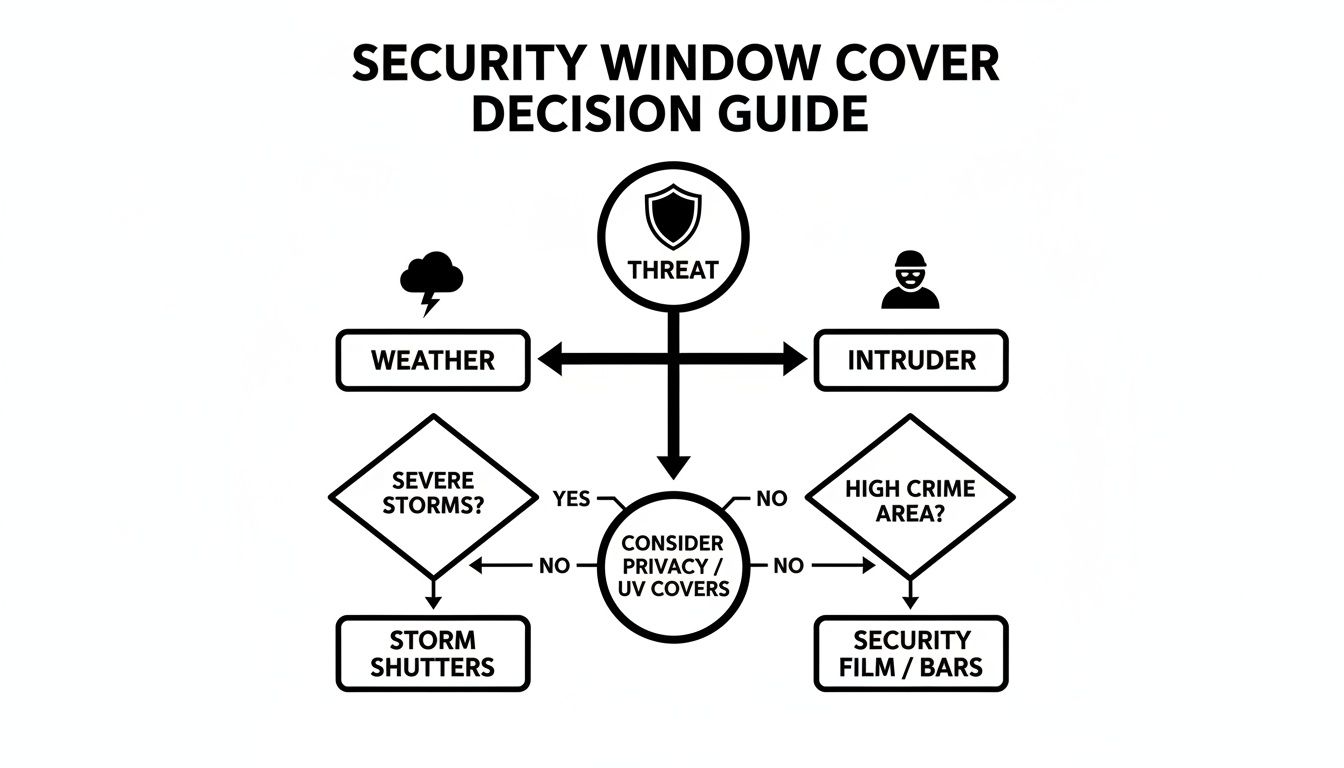
As the flowchart shows, some products are specialists, while others are great all-rounders. This can help you quickly zero in on the right category for you.
Balancing Cost, Aesthetics, and Security
Now for the final piece of the puzzle: finding the sweet spot between your budget, your security goals, and the look you want for your property. Costs can vary dramatically, from budget-friendly security films to top-of-the-line laminated glass. The key is to see this as an investment, not just another expense.
It's a shift in mindset. A high-quality security window cover doesn't just protect your assets and family—it can also boost your property's value and may even score you a discount on your insurance premiums.
Thinking about the big picture is smart. When you're upgrading your windows, it's also a good time to consider other vulnerabilities. Getting professional advice from experts in residential locksmith services can help you build a complete security strategy. And to make sure you're budgeting realistically, check out a full breakdown of https://fortresssecurityfilms.com/security-window-film-cost/ to understand how the numbers add up.
At the end of the day, the right choice is one that gives you genuine peace of mind without making your home or business feel like a fortress. The next step is to talk to a professional who can give you a personalized assessment and a quote based on your specific needs.
Your Questions, Answered
Can I Install Security Window Film Myself?
You might see DIY security film kits on the shelf and think it’s a simple weekend project, but it’s a bit more involved than applying a decal. Getting a flawless, bubble-free finish is tough, and that's not even the most critical part.
The real strength of security film comes from the attachment system that anchors the film directly to the window frame. This is what stops an intruder from just pushing the whole pane in. Professionals are trained to install this system correctly, which is what truly fortifies the window. A botched DIY job won't just look bad; it will provide a false sense of security and will almost certainly void the manufacturer's warranty.
Will Security Bars Lower My Property Value?
This is a common worry, and the answer really comes down to style and location. If you’re picturing clunky, prison-like bars, then yes, those can absolutely hurt your home's curb appeal.
But modern security grilles have come a long way. Many are now custom-designed to actually complement a home’s architecture, sometimes even adding a touch of elegance. In neighborhoods where security is a high priority for buyers, well-designed, professionally installed bars are often viewed as a smart and valuable upgrade.
Are Security Shutters Only for Commercial Buildings?
Not at all. While you see them on storefronts all the time, roller shutters are becoming a go-to choice for homeowners, too. The security they offer is top-notch, but the perks don't stop there.
They’re fantastic for storm protection, they significantly muffle outside noise, and they give you total control over light—perfect for a home theater or just sleeping in. Modern designs are sleek and can blend right into your home’s exterior, making them a practical, multi-purpose investment.
Ready to secure your property without sacrificing its style? The experts at Fortress Security Films offer professional assessments and installations for homes, businesses, and vehicles. Explore our advanced security solutions at https://fortresssecurityfilms.com.
