


At its core, a security threat assessment is a systematic way to look at your organization through the eyes of someone who wants to do it harm. It's all about identifying, analyzing, and then sizing up the potential threats to your most valuable assets.
This isn't just a technical checklist. Think of it as developing a strategic blueprint that answers critical questions: Who might attack us? What are they after? And how might they try to get it? Getting ahead of these questions is what allows you to build a truly resilient security plan, rather than just cleaning up after a crisis.
Why Security Threat Assessments Are Essential
Imagine a ship captain getting ready for a long voyage. They don't just point the bow toward the horizon and hope for the best. They meticulously study weather charts, inspect the ship for any weaknesses, and drill the crew on what to do if things go wrong.
A security threat assessment is the exact same principle applied to your business. It's the difference between being reactive—frantically patching holes as they appear—and being proactive, where you anticipate the storms and reinforce the ship before you leave the harbor. It’s a structured process for answering the tough questions before an adversary forces you to.
The Core Components of an Assessment
A solid security threat assessment really boils down to four key elements. Understanding how they all fit together is the first step toward building a defense that actually works.
-
Assets: These are the things you can't afford to lose. We're not just talking about laptops or inventory. Your assets include everything from sensitive customer data and trade secrets to your company's reputation and, most importantly, the safety of your people.
-
Threats: A threat is anything or anyone with the potential to harm an asset. This could be a sophisticated hacker, a disgruntled former employee, a natural disaster like a hurricane, or even simple human error.
-
Vulnerabilities: These are the weak spots—the gaps in your armor that a threat could exploit. An unpatched piece of software, an unlocked door, or an employee who hasn't been trained to spot phishing emails are all classic vulnerabilities.
-
Risks: This is where it all comes together. Risk is the potential for loss when a specific threat takes advantage of a specific vulnerability. You figure this out by weighing the likelihood of an attack happening against the impact it would have on your organization.
People often mix up threats and risks, but the difference is crucial. A hurricane is a threat. The risk is the potential for catastrophic damage to your coastal office because it lacks storm-rated windows and a proper disaster recovery plan.
From Big Corporations to Small Businesses
Not too long ago, formal security threat assessments felt like something only government agencies or Fortune 500 companies did. That way of thinking is completely outdated.
The reality is that threats come in all shapes and sizes, and so do the methods for assessing them. A small retail shop faces a very different set of threats than a major bank, but the fundamental need to identify and deal with them is exactly the same. The principles are universal, whether you’re protecting a single storefront’s glass from a smash-and-grab or a multinational corporation's data centers.
To see how these concepts apply to physical security in more detail, you can find a wealth of information on the Fortress Security Films blog. By regularly conducting these assessments, organizations of any size can stop guessing and start making informed decisions that protect what truly matters.
Navigating the Modern Threat Landscape
Not too long ago, security threats fit neatly into boxes. You had physical threats, like someone forcing a door, and you had digital threats, like a computer virus. Today, those boxes have been smashed to pieces. The modern threat landscape is a tangled web where a cyberattack can unlock a physical door, and a stolen laptop can expose a company's entire digital nervous system.
This convergence isn’t just a trend; it's the new reality. Attackers don't play by the old rules. They drift between the physical and digital worlds, always looking for the path of least resistance. A genuine security threat assessment has to see the world this way, treating security not as separate silos but as a single, interconnected ecosystem. If you don't, you're leaving behind dangerous blind spots that clever adversaries are more than happy to exploit.
The Blurring Lines Between Physical and Cyber Threats
Think about a high-end jewelry store. A decade ago, a smash-and-grab meant just that: a brick through a window. Today, that same heist might start weeks earlier with a carefully crafted phishing email sent to a store manager.
The moment they click the link, the thieves are in the network. From there, they can disable security cameras, shut down the alarm system, and even unlock electronic doors just seconds before their crew arrives on-site. The glass is still the last barrier, but the break-in truly began miles away, in cyberspace.
This is a classic blended threat. It's not a far-fetched movie plot; these attacks are happening more and more because they work. They prey on the fact that most organizations still have a wall between their physical security team and their IT department, creating communication gaps that attackers can slip right through.
A Spectrum of Modern Dangers
Beyond a simple robbery, a thorough security threat assessment needs to consider a whole range of actors and potential events. Each one has different motives, different tools, and different ways of operating.
A truly useful assessment should weigh threats from several key directions:
- Organized Criminal Networks: These aren't petty thieves. They're professional, well-funded, and profit-driven. They use sophisticated tools for everything from ransomware attacks to coordinated physical thefts, and any asset with a high value is a potential target.
- State-Sponsored Actors: When a nation-state is behind an attack, the goal is usually espionage, intellectual property theft, or widespread disruption. They go after critical infrastructure, defense contractors, and major tech firms to gain a strategic or economic edge.
- Insider Threats: It's an uncomfortable truth, but threats from within are often the most devastating. This isn't just about a malicious employee looking to steal data. It's also about the well-meaning but careless team member who accidentally opens the door to an attack through weak security habits.
- Environmental and Natural Disasters: Not all threats are human. An earthquake, a hurricane, or a severe flood can destroy physical assets and grind operations to a halt just as effectively as any hacker. A holistic security plan absolutely has to account for these risks.
The modern security environment has grown so multifaceted that it demands a broader perspective. The 2025 Homeland Threat Assessment emphasizes that effective security threat assessments must now account for everything from cyber threats and organized crime to geopolitical competition, noting that many attackers operate across both cyber and physical domains. You can explore the complete findings in the official threat assessment from the Department of Homeland Security.
By looking at this full spectrum, you shift from having a narrow, tunnel-vision view of security to achieving 360-degree awareness of the real risks you face. In today's interconnected world, that’s the only way to build a defense that is resilient, adaptive, and truly prepared for what's coming.
Choosing the Right Assessment Methodology

Once you’ve grasped why a security threat assessment is so critical, the next question is always how. Not all assessments are created equal. Choosing the right approach is a bit like a mechanic picking the right tool—using a complex, data-heavy method for a quick check-up wastes time, but using a simple one for a major overhaul can leave you with dangerous blind spots.
The methodology you pick will shape the entire process, from how you gather information to the final report you present. It’s all about finding that sweet spot between the depth of analysis you need, the resources you have on hand, and the people you need to convince. Let's break down the three main approaches to see which fits your situation best.
The Qualitative Approach
Think about how you'd describe the weather to a friend. You might say it's "a bit chilly," "pleasantly warm," or "blazing hot." That's the heart of a qualitative assessment. It relies on descriptive scales and expert judgment rather than crunching hard numbers to size up risks.
Instead of calculating the exact dollar amount of a potential loss, this method uses simple labels like Low, Medium, or High. This makes it fast, intuitive, and a perfect starting point for organizations that are new to this process. It helps you quickly map out your biggest worries so you can prioritize what to fix first without getting stuck in the weeds of complex calculations.
The Quantitative Approach
Sticking with the weather analogy, a quantitative approach is the meteorologist's official report. It doesn't just say it's "hot." It says, "There is a 75% chance of temperatures hitting 98°F, which could spike energy costs by $5,000 per day." This method is all about translating risks into cold, hard numbers.
A quantitative assessment uses historical data, industry stats, and financial models to put a specific price tag on potential losses. It calculates things like the Annual Loss Expectancy (ALE), giving you a concrete dollar figure for a particular risk over a year. While it definitely requires more data and expertise, its power is in its objectivity. It gives you the solid evidence you need to justify a security budget and make smart investments that executives can easily understand.
The real magic of the quantitative method is turning abstract security fears into a clear business case. When you can say that spending $20,000 on reinforced glass can prevent a potential $150,000 loss from a single smash-and-grab, the decision becomes a no-brainer for leadership.
The Hybrid Model
For most places, the best path isn't choosing one or the other but blending them. A hybrid methodology gives you the best of both worlds. It usually kicks off with a broad qualitative assessment to quickly flag and rank the most serious threats.
Once those high-priority risks are identified, you can zoom in with a more focused quantitative analysis on just those specific areas. This lets you get precise financial data where it matters most, without wasting time and money analyzing every little thing. For example, you might qualitatively rank vandalism as a "Medium" risk, but then quantitatively analyze the exact financial fallout of a storefront breach. This is where you'd dig into how specialized solutions could be a game-changer. When weighing these kinds of physical security upgrades, it's wise to understand all the options; exploring various glass security services can show you how they fit into a solid risk mitigation strategy.
This pragmatic approach gives you both the big-picture context and the detailed financial insights you need for a truly robust and efficient security plan.
Comparison of Threat Assessment Methodologies
Choosing between these methodologies isn't just a technical decision; it's a strategic one. The right choice depends on your organization's maturity, resources, and specific goals. The table below breaks down the key differences to help guide your decision.
| Methodology | Approach | Best For | Pros | Cons |
|---|---|---|---|---|
| Qualitative | Uses descriptive scales (e.g., Low, Medium, High) and expert opinion to rank risks. | Organizations new to assessments, initial risk prioritization, and situations with limited data. | Fast to implement, cost-effective, easy for non-experts to understand. | Highly subjective, lacks financial precision, can be difficult to justify budgets. |
| Quantitative | Uses historical data and financial metrics to assign a specific monetary value to risks. | Mature security programs, justifying large security investments, and comparing specific mitigation options. | Objective and data-driven, provides clear financial impact, excellent for ROI analysis. | Time-consuming, requires extensive data and expertise, can be complex. |
| Hybrid | Combines a qualitative overview with a targeted quantitative analysis on high-priority risks. | Most organizations seeking a balance between speed, cost, and analytical depth. | Efficient and practical, provides both strategic overview and detailed financial insight. | Requires careful planning to integrate both methods effectively. |
Ultimately, the goal is to choose the method—or combination of methods—that provides the clearest, most actionable insights for protecting your assets. A well-chosen methodology is the foundation of an effective security strategy.
Your Step-By-Step Threat Assessment Playbook
Okay, let's move from theory to action. This is where a security threat assessment really earns its keep. It might sound intimidating, but when you break it down, it's a completely logical process. Think of it as a playbook you can follow.
This five-step approach will guide you through systematically taking apart your security setup, figuring out what the real dangers are, and building a smarter defense. Each step builds on the one before it, giving you a complete picture of your unique risk environment from start to finish.
Step 1: Identify and Value Your Assets
You can't protect what you don't know you have. Simple as that. The first step is to take a detailed inventory of everything that’s critical to your home or business—the tangible and intangible things you absolutely can't afford to lose.
And I mean everything. Don't just think about computers and equipment. Your list needs to cover:
- People: First and foremost, the safety of your family, employees, clients, and visitors is paramount.
- Data: This could be anything from sensitive customer information and family photos to intellectual property and financial records.
- Physical Property: The building itself, inventory, high-value equipment, and crucial infrastructure like servers or even your home's HVAC system.
- Reputation: For a business, this is the brand image and trust you've worked so hard to build.
Once you have your list, you have to assign a value to each asset. For a piece of equipment, that’s easy—it’s the replacement cost. But for things like your family's sense of security, customer data, or your brand's reputation, the value lies in the potential fallout a loss would cause. We're talking fines, legal trouble, and lost business. Getting this right is what helps you prioritize what to protect most urgently.
Step 2: Uncover Potential Threats
Now that you have a clear picture of what you’re protecting, it’s time to put on your "bad guy" hat. This part is all about brainstorming the threats that could actually harm those assets. You need to think like an adversary to see the moves they might make.
Look at threats from every possible angle:
- Human Threats: This is the most common category. It includes external threats like burglars, vandals, or organized criminals, but also internal ones like a disgruntled employee or just plain old human error.
- Natural Threats: Think about acts of God. This includes events like earthquakes, floods, hurricanes, or wildfires that could wreck your property and grind everything to a halt.
- Technical Threats: These are system failures. Everything from a simple power outage and hardware malfunction to a software glitch can pose a real threat.
The point isn't to spiral into a panic about every terrible thing that could happen. Instead, you want to focus on threats that are actually relevant to your specific location, industry, and assets. A coastal storefront, for instance, should be way more concerned about hurricanes than a business in the Midwest.
Step 3: Pinpoint Your Vulnerabilities
A threat by itself is just a potential problem. It only becomes a real, active danger when it can take advantage of a weakness—a vulnerability—in your security. This step is about taking a hard, honest look at your current setup to find the gaps.
Walk around your property and through your daily processes. Ask the tough questions. Where are the weak spots?
A vulnerability is any weakness that could be exploited by a threat to harm an asset. For instance, a determined thief (the threat) can only succeed if they find a vulnerability, such as an unreinforced glass door, an outdated alarm system, or a poorly lit entryway.
Keep an eye out for common vulnerabilities. Things like inadequate physical barriers (like standard glass instead of security-laminated glass), sloppy access controls, a lack of security awareness among family or staff, or blind spots in your camera coverage are all open invitations for trouble.
Step 4: Analyze Likelihood and Impact
This is where you start connecting the dots to figure out what your real risk is. For every threat scenario you've come up with, you need to weigh two key factors: the likelihood of it happening and the impact it would have if it did.
- Likelihood: How probable is this event, really? You can rate this on a simple scale like low, medium, or high. Base your rating on past incidents, your location, and what you know about current threats. A smash-and-grab robbery is far more likely for a street-facing jewelry store than for a tenth-floor law office.
- Impact: If this actually happened, how bad would it be? Use the same kind of scale to rate the potential damage to your assets, from a minor headache to a catastrophic failure.
When you multiply the likelihood by the impact, you get a clear risk level for each scenario. This gives you a data-driven, prioritized list, showing you exactly which risks demand your immediate attention and which can wait.
Step 5: Create a Mitigation and Response Plan
The final, and most important, step is to build a concrete plan to deal with your highest-priority risks. Your goal is to put controls in place that either make an event less likely to happen in the first place or soften the blow if it does.
Your plan needs to spell out specific actions, assign who is responsible for them, and set clear deadlines. These strategies generally fall into a few buckets:
- Technical Controls: This is where you upgrade your physical security by installing things like security window films, better alarm systems, or more comprehensive video surveillance.
- Administrative Controls: This involves creating smarter security policies, improving employee or family training on security protocols, or running regular drills.
- Physical Controls: These are the basics, like installing better locks, reinforcing doors and windows, or improving the lighting around your property's exterior.
This visualization shows the cycle of how a solid response plan works once a security event is spotted.
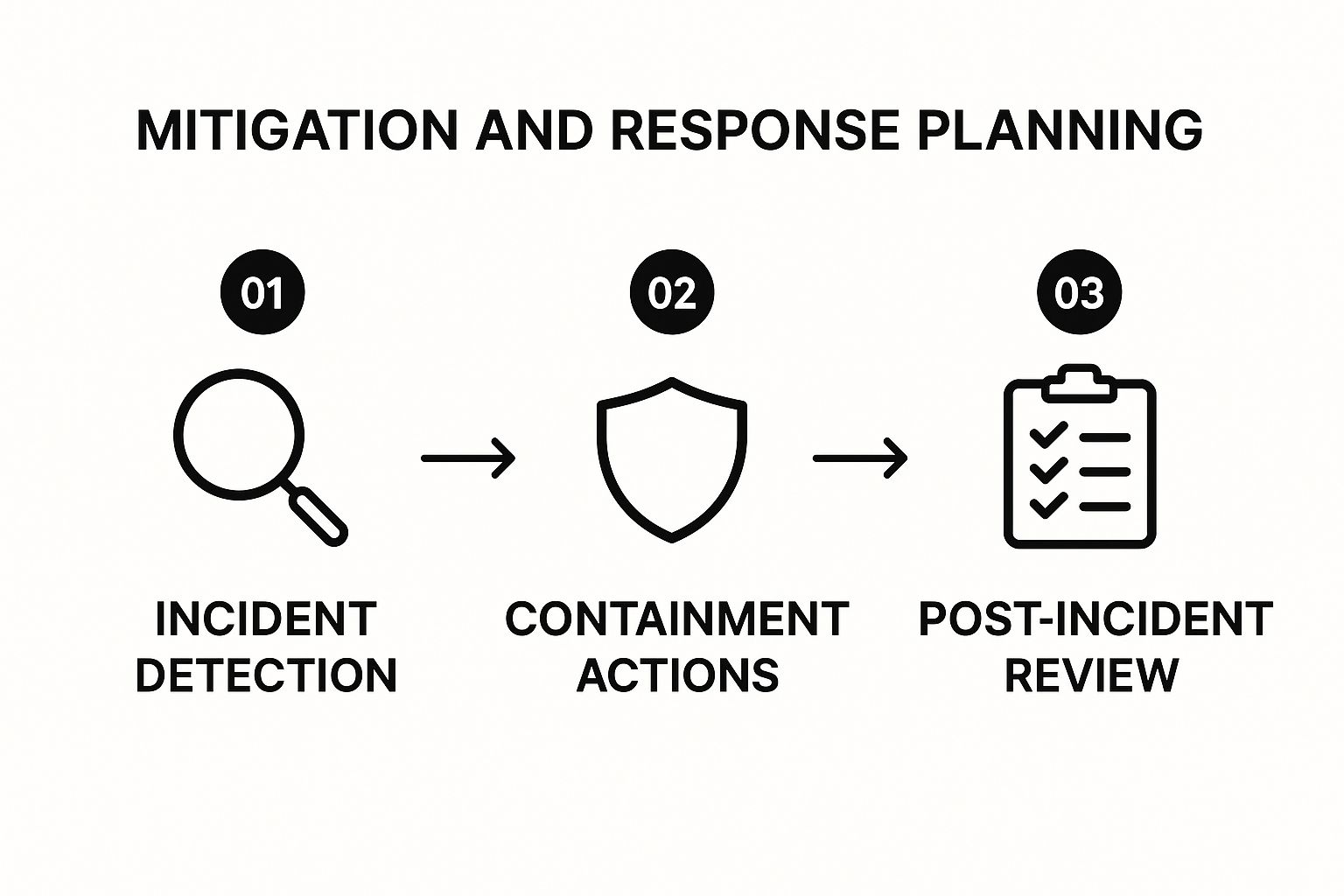
As the chart shows, after you detect a problem, you have to contain it immediately. Then, you need to circle back and review what happened to prevent it from happening again. Remember, your security threat assessment isn't a one-and-done document. It’s a living guide that you should revisit and update at least once a year, or anytime you have a major change.
Analyzing Geopolitical and State-Level Threats
In a world this connected, a geopolitical event on the other side of the planet isn't just a news headline anymore. It's a direct variable in any modern security threat assessment. The actions of nation-states create ripple effects that can turn abstract international tensions into very real risks for businesses, schools, and even homes thousands of miles away.
Ignoring these macro-level threats is like building a coastal city without ever checking the hurricane forecast. Sure, you might be ready for a local squall, but you’ll be completely blindsided when a predictable, major storm finally rolls in. State-sponsored threats operate on a totally different level, with resources, sophistication, and patience that dwarf typical criminal efforts.
The Tactics of State-Sponsored Actors
Nation-state actors aren't after a quick payday. Their motivations are strategic—think corporate espionage, economic disruption, intellectual property theft, or simply projecting power. Naturally, their methods are far more advanced and persistent.
A thorough assessment has to account for the unique tactics they bring to the table:
- Advanced Persistent Threats (APTs): These aren't smash-and-grab jobs. APTs are stealthy, long-term campaigns where an intruder might hide in a network for months or even years, quietly stealing data or mapping out critical systems for a future attack.
- Complex Supply Chain Attacks: Why attack a fortress head-on? State actors will often compromise a smaller, less secure vendor in their target’s supply chain, using that trusted relationship as a Trojan horse to get inside.
- Zero-Day Exploits: With immense resources, nation-states can discover and weaponize software flaws that nobody else knows exist. They deploy these "zero-day" exploits against high-value targets long before a patch is ever developed.
Weaving geopolitical intelligence into your planning means recognizing that when tensions flare between two countries, organizations in key sectors like technology, finance, and defense instantly become higher-priority targets for cyber operations.
Why Global Events Matter to Your Security
The line connecting global politics to local security is clearer than ever. An international conflict can spark widespread cyberattacks against critical infrastructure, causing collateral damage to countless businesses. A new round of economic sanctions might push a nation to greenlight state-sponsored ransomware as a way to generate revenue.
This is exactly why facilities needing the highest degree of protection, like government buildings and schools, must build these threats into their physical security plans. Analyzing potential state-level actions is a core part of hardening vulnerable entry points like glass windows and doors. You can dive deeper into specific strategies by reading our guide on security window film for schools.
Recent intelligence reports only confirm the growing danger. As the 2025 Annual Threat Assessment of the U.S. Intelligence Community points out, the global security landscape is becoming more complex and dangerous as major state actors continuously target critical infrastructure, putting both our economic security and public safety at risk.
By broadening your security threat assessments to include this crucial geopolitical layer, you shift from a reactive stance to one of strategic foresight. You start preparing your defenses not just for the threats you see today, but for the ones you know are forming over the horizon.
Looking Up: Why Space-Based Threats Are Now on the Security Radar
When we think about security, our minds usually go to things happening on the ground, at sea, or even online. But the next major security frontier isn't down here—it’s up there, in orbit. This might sound like something out of a movie, but the reality is that emerging risks to our space-based assets are becoming a critical part of any modern security threat assessment.
Think about it. Our entire global economy is now deeply intertwined with this orbital infrastructure. GPS gets you where you're going, global financial markets execute trades, and weather forecasters predict storms, all thanks to a fragile network of satellites. This reliance has opened up a brand-new attack surface, and smart organizations are starting to pay close attention. As space becomes more militarized, the threats orbiting above us have very real consequences for all of us on the ground.
A New Battlefield of Vulnerabilities
For decades, security planning was all about terrestrial and digital threats. That’s no longer enough. As countries develop and test more sophisticated anti-satellite technology, a whole new category of vulnerabilities is demanding our attention.
Here are a few of the key threats we're now facing in this new domain:
-
Satellite Jamming and Spoofing: Hostile actors can deliberately interfere with or completely fake satellite signals. Imagine the chaos that would cause in shipping logistics, communication networks, and navigation systems.
-
Anti-Satellite (ASAT) Weapons: Yes, these exist. These are weapons designed to physically hit and destroy satellites, directly threatening the very backbone of our digital world.
-
Orbital Debris: When a satellite is destroyed, either by accident or on purpose, it creates a massive cloud of high-speed junk. This debris can trigger a chain reaction, taking out other critical assets in orbit.
What happens in orbit no longer stays in orbit. To get ahead of the next wave of security challenges, organizations have to start looking up and building this new domain into their threat models.
The Growing Threat from Counterspace Capabilities
This isn't a problem for the distant future; it's happening right now. The 2025 Space Threat Assessment from the Aerospace Security Project paints a stark picture of the escalating risks. The report details how nations like China, Russia, Iran, and North Korea are developing increasingly advanced counterspace capabilities that directly threaten vital security interests.
Over the past year alone, we've seen a steady rise in sophisticated GPS jamming and spoofing, particularly in and around conflict zones. To get the full picture, you can dive into the complete analysis and read more about the growing space-based security threats.
Common Questions About Threat Assessments
Even with a clear playbook, diving into security threat assessments can bring up some practical questions. It’s completely normal to wonder about timing, terminology, and where to even begin if you're running a smaller organization. Let's tackle some of the most common queries to clear up any confusion and help you get started with confidence.
Answering these questions helps bridge the gap between knowing the theory and actually putting it into practice. We'll demystify a few key areas.
How Often Should You Conduct an Assessment?
A security threat assessment should never be a one-and-done event, filed away in a cabinet to gather dust. The best way to think of it is as a living document, one that needs to adapt as your environment and the dangers around you change.
As a general rule of thumb, you should perform a comprehensive assessment at least once a year. That said, certain events should trigger an immediate review, regardless of where you are in your annual cycle.
- Significant Operational Changes: Are you opening a new facility, launching a major product line, or fundamentally changing how you operate? Time for a review.
- Emergence of New Threats: Perhaps a new type of attack is becoming common in your industry or region. That's a clear signal to reassess.
- After a Security Incident: A post-mortem assessment is absolutely crucial. It helps you understand what went wrong and how to prevent it from happening again.
- Major Technology Updates: Implementing new software or overhauling your network infrastructure can introduce new vulnerabilities.
The real goal here is continuous monitoring. Your annual assessment provides a deep dive, but staying vigilant year-round is what ensures your security posture never falls out of sync with reality.
Threat Assessment vs. Risk Assessment
People often use these terms interchangeably, but they refer to two distinct—though closely related—processes. Getting the difference right is fundamental to building a clear and effective security strategy.
A security threat assessment is laser-focused on identifying and evaluating potential threats. It's all about answering the questions: Who or what could cause us harm, and how might they do it? You're basically getting to know your potential adversaries and the hazards you face.
A risk assessment, on the other hand, is a much broader process that builds directly on the threat assessment. It takes the threats you've identified and calculates the likelihood of one of them successfully exploiting one of your vulnerabilities. Then, it measures the potential impact on your business.
Here’s a simple way to look at it: a threat assessment identifies the approaching storm, while a risk assessment calculates the odds of that storm hitting your specific location and estimates the cost of the damage.
First Steps for a Small Business
If you run a small business, the idea of a formal, comprehensive assessment can feel pretty overwhelming. Don't let that stop you. The key is to start simple and focus on what matters most.
Begin by identifying your most critical assets. What is absolutely essential for your business to function day-to-day? This might be your customer database, your point-of-sale system, or a key piece of manufacturing equipment.
Next, just brainstorm the most probable threats to those specific assets. You don’t need to worry about state-sponsored hackers just yet. Instead, think about more common issues like physical theft, employee error, or a ransomware attack. This focused approach makes the whole process manageable and ensures you’re directing your limited resources to protect what truly keeps the lights on.
Ready to move from assessment to action? The most effective security plans integrate physical hardening with smart strategy. Fortress Security Films provides advanced window and glass protection that acts as a powerful first line of defense against forced entry, smash-and-grabs, and extreme weather. Strengthen your most vulnerable entry points by visiting us at https://fortresssecurityfilms.com to schedule a consultation.
