


Think of your security system as more than just a necessary expense—it’s one of the smartest investments you can make for the health and longevity of your retail business. A well-thought-out security plan does more than just protect your inventory; it safeguards your employees and builds the kind of customer trust that keeps people coming back. It's about creating an environment where your business can truly flourish.
Why Investing in Retail Security Is Non-Negotiable
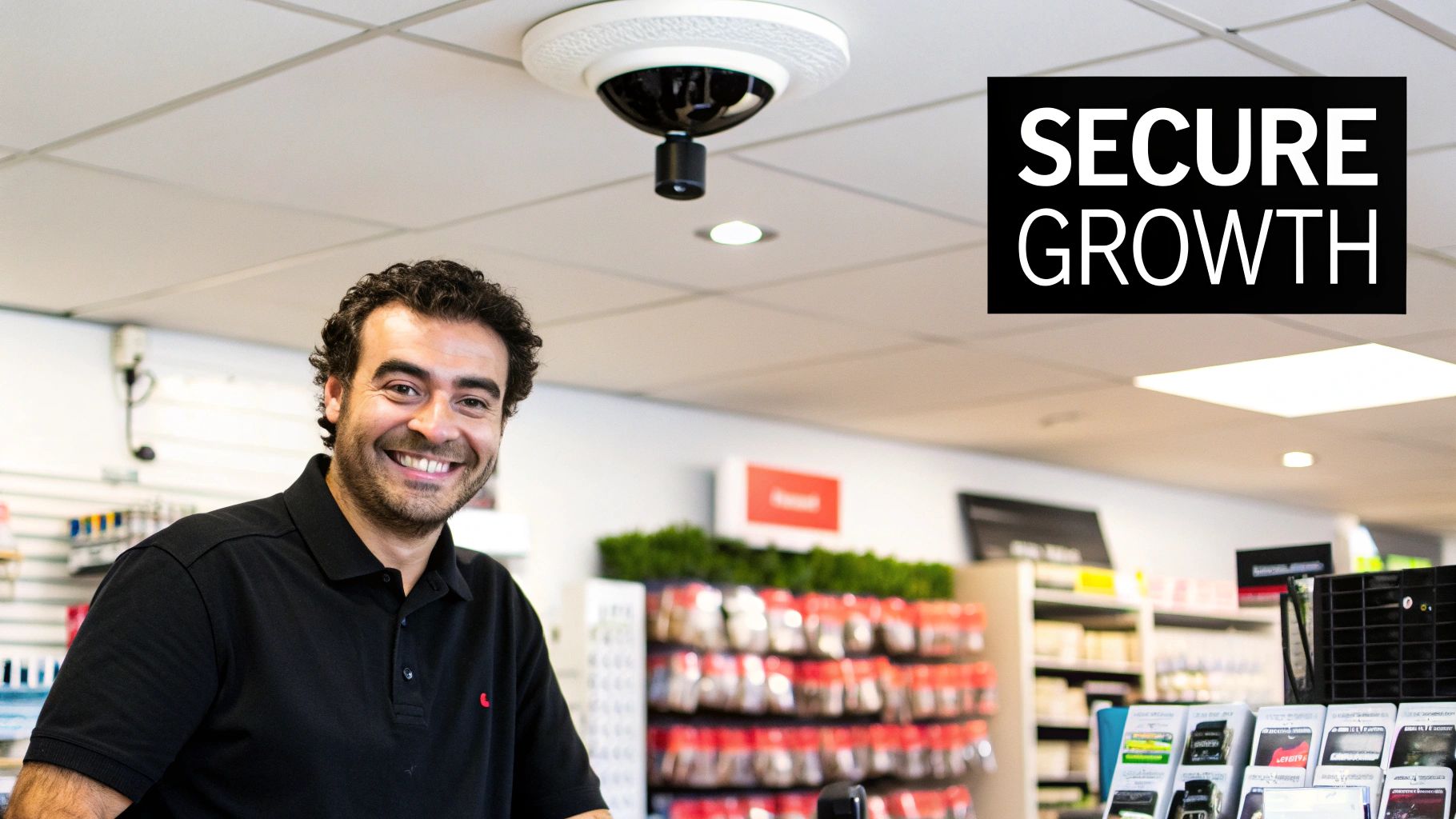
The hard truth of retail is that shrinkage—the industry term for losses from theft, fraud, and simple errors—can bleed a promising business dry. For many store owners, it feels like a constant battle against an invisible force chipping away at your bottom line. But what if you could turn that vulnerability into a real advantage?
Imagine a small boutique owner I worked with who was watching her inventory numbers drop week after week. Fed up with the losses, she decided to get serious and moved beyond just a lock on the cash register. She opted for a layered security approach: discreet HD cameras, storefront glass reinforced with security film, and a modern access control system for her stockroom.
The Tangible Impact of a Security Strategy
The results were almost immediate. Within a few months, shoplifting incidents plummeted as would-be thieves saw the store was no longer an easy target. Even better, the crisp video footage helped her shut down a fraudulent slip-and-fall claim, saving her thousands in potential legal costs.
But the return on her investment went far beyond just stopping theft. Her employees felt safer coming in early and leaving late, which boosted morale and cut down on staff turnover. Customers subconsciously picked up on the professional, secure atmosphere, which only increased their trust in her brand. Her story really drives home a critical point.
Investing in security is a proactive business decision that yields a significant return. It's not just about stopping theft; it's about building a resilient and profitable operation from the ground up.
The Growing Need for Advanced Protection
This boutique's experience is a small-scale version of a massive, industry-wide trend. Retail losses are a huge and escalating problem. In the U.S. alone, they hit a staggering $112.1 billion in 2023, with theft making up 65% of that total.
In response, retailers are moving toward AI-powered surveillance and deeply integrated systems to get ahead of crime. As you can find in market trend reports, this is about proactively protecting people and assets, not just reacting to incidents.
For anyone serious about building a sustainable business, a comprehensive approach to security isn't just a good idea—it's absolutely essential.
Establishing Your First Line of Defense
Before you even think about cameras or alarms, your first and most effective security measures are baked right into the physical environment of your store. High-tech gadgets are fantastic, but they're only as good as the foundation they're built on. Think of it like building a fortress—you have to secure the walls, windows, and gates first.
This foundational layer is all about making your store a "hard target." The idea is to make a potential criminal look at your shop and think, "Too much trouble, not worth the risk." Surprisingly, some of the best ways to do this are simple and don't cost a fortune. It often starts with just how you arrange your space.
Strategic Store Layout and Visibility
A smart store layout is one of the most powerful, and underrated, security tools you have. The main principle is dead simple: get rid of blind spots. When your staff and other customers can see every nook and cranny, shoplifters who need to hide what they’re doing have nowhere to go.
Here are a few layout tricks that make a huge difference:
- Low-Profile Shelving: Keep your displays low enough so you can see right across the sales floor. Tall shelving units create hidden alleys that are a shoplifter's dream.
- Strategic Mirror Placement: A few well-placed convex security mirrors are a cheap and effective way to open up visibility in tight corners and behind tall fixtures.
- Bright, Even Lighting: A brightly lit store leaves no shadows for suspicious activity to hide in. Make sure your lighting is strong and consistent, both inside and out, paying special attention to entrances and exits.
A good layout doesn't just discourage theft. It also creates a more open and inviting space for your actual customers, making their shopping experience better while making your store a nightmare for thieves.
Fortifying Entry Points
Let's be honest, your doors and windows are the weakest links. A standard glass door can be smashed in a few seconds, giving a smash-and-grab thief instant access to your inventory. This is where you need to bring in the reinforcements.
Good locks are a no-brainer. You should absolutely invest in commercial-grade deadbolts and beef up the door frames with reinforced strike plates. But a lock is useless if the glass next to it is fragile. That’s why adding security window films to your glass is such a critical move.
Think of security film as invisible armor for your glass. It’s a super-thin but incredibly tough layer of polyester that’s bonded to the inside of your windows. When a thief tries to smash the glass, the film holds all the shattered pieces together, forming a stubborn barrier that can delay them for minutes or stop them completely.
That delay is everything. It frustrates the would-be burglar and, more importantly, gives your alarm system precious time to do its job and alert the police. Suddenly, your most vulnerable points become a real obstacle.
Of course, in today's world, physical security is only half the battle. A truly comprehensive strategy must also include an effective cyber incident response plan to handle digital threats. Protecting your storefront and your data are two sides of the same coin; you need to be prepared on both fronts to build a truly resilient business.
Understanding Core Electronic Security Systems
While physical barriers are your store's armor, an electronic security system is its nervous system. It’s the part that sees, senses, and reacts to threats in real time. Think of it as having three different teams of digital guards on duty, each with a very specific job.
The three main players here are video surveillance (CCTV), intrusion detection (alarms), and access control. Each one tackles a different retail headache, but when you put them together, you get a powerful defense against threats from both inside and out. They're the tools that help you solve customer disputes, stop a break-in before it happens, and keep an eye on your bottom line.
The demand for these systems is growing, especially as retail expands in busy urban areas. According to a detailed report on commercial security systems from Precedence Research, hardware like HD cameras and AI-powered analytics are a huge part of this trend, giving retailers smarter ways to spot trouble.
Video Surveillance: The All-Seeing Eyes
Video surveillance, or CCTV, gives you a constant visual record of your store. It’s your set of "all-seeing eyes," and modern high-definition cameras capture footage so clear it can be used for much more than just catching a shoplifter.
This visual proof is a game-changer for:
- Investigating Incidents: When a theft, an employee issue, or even a slip-and-fall claim happens, you can rewind the tape and see exactly what went down.
- Deterring Crime: Just the sight of a camera can be enough to make a potential thief decide your store isn't worth the risk.
- Monitoring Operations: You can log in remotely to check on everything from store cleanliness to how your team is interacting with customers, helping you improve how the business runs day-to-day.
When you start looking at cameras, it's easy to get overwhelmed. Checking out a detailed Homeboy Security Camera review or similar breakdowns can give you a real feel for how different features perform in the real world, helping you choose the right fit.
This infographic shows how these electronic systems build upon a solid foundation of physical security.
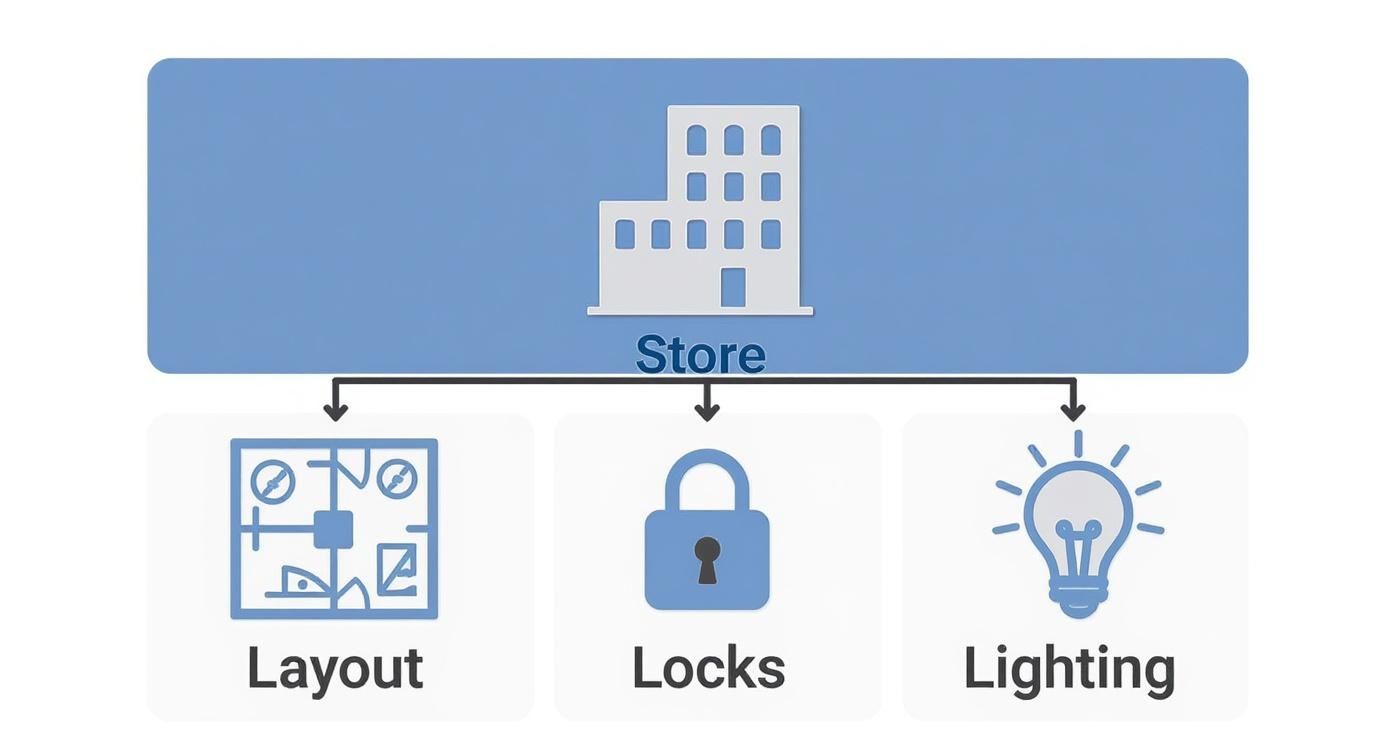
As you can see, it all starts with the basics—good lighting, smart layout, and strong locks. Once those are in place, your electronic security can do its job much more effectively.
To help you understand how these systems fit together, here’s a quick comparison.
Comparison of Core Retail Security Systems
| System Type | Primary Function | Best For | Key Consideration |
|---|---|---|---|
| Video Surveillance (CCTV) | Records visual evidence and deters public-facing crime. | Monitoring sales floors, entrances, and high-traffic areas. | Balancing camera quality with data storage costs. |
| Intrusion Detection | Detects unauthorized entry and triggers an immediate alert. | Protecting the premises after hours from break-ins. | Choosing between a self-monitored system and a professional 24/7 monitoring service. |
| Access Control | Restricts entry to secure areas for authorized personnel only. | Securing stockrooms, cash offices, and sensitive inventory. | The trade-off between higher security (biometrics) and user convenience (keycards). |
Each system has its strengths, and the best security plans use a mix of all three to cover every possible vulnerability.
Intrusion Detection: The Digital Tripwire
If cameras are your eyes, an intrusion detection system is your digital tripwire. It’s your first line of defense when the doors are locked, designed to send out an immediate alert the second someone tries to get in who shouldn't be there.
A typical alarm system has a few key parts working together:
- Sensors: These are the triggers. They’re placed on doors and windows to detect if they're opened, or they can be motion detectors that cover large, open spaces.
- Control Panel: This is the brain of the operation. It takes the signals from the sensors and decides when to sound the alarm.
- Siren/Strobe: A loud siren and a flashing light do two things: scare the intruder into leaving and alert anyone nearby that something is wrong.
- Monitoring Service: With a monitored system, a signal is sent to a central station where a team of professionals can contact the police on your behalf.
An unmonitored alarm just makes a lot of noise and hopes someone notices. A monitored system guarantees a professional response, which massively increases the odds of catching a burglar and minimizing your losses.
Access Control: The Intelligent Gatekeeper
Finally, access control acts as your intelligent gatekeeper. It’s what you use to control who gets into your most sensitive areas, like the stockroom, the cash office, or a server closet.
Forget old-school locks and keys that can be lost, stolen, or copied. Modern systems use keycards, fobs, PIN codes, or even fingerprints to grant access. This gives you total control over who can go where and when. If an employee leaves, you can revoke their access in seconds without having to change a single lock. This level of control is absolutely critical for preventing internal theft, which is a huge source of loss for retailers.
How AI and IoT Are Making Retail Security Smarter
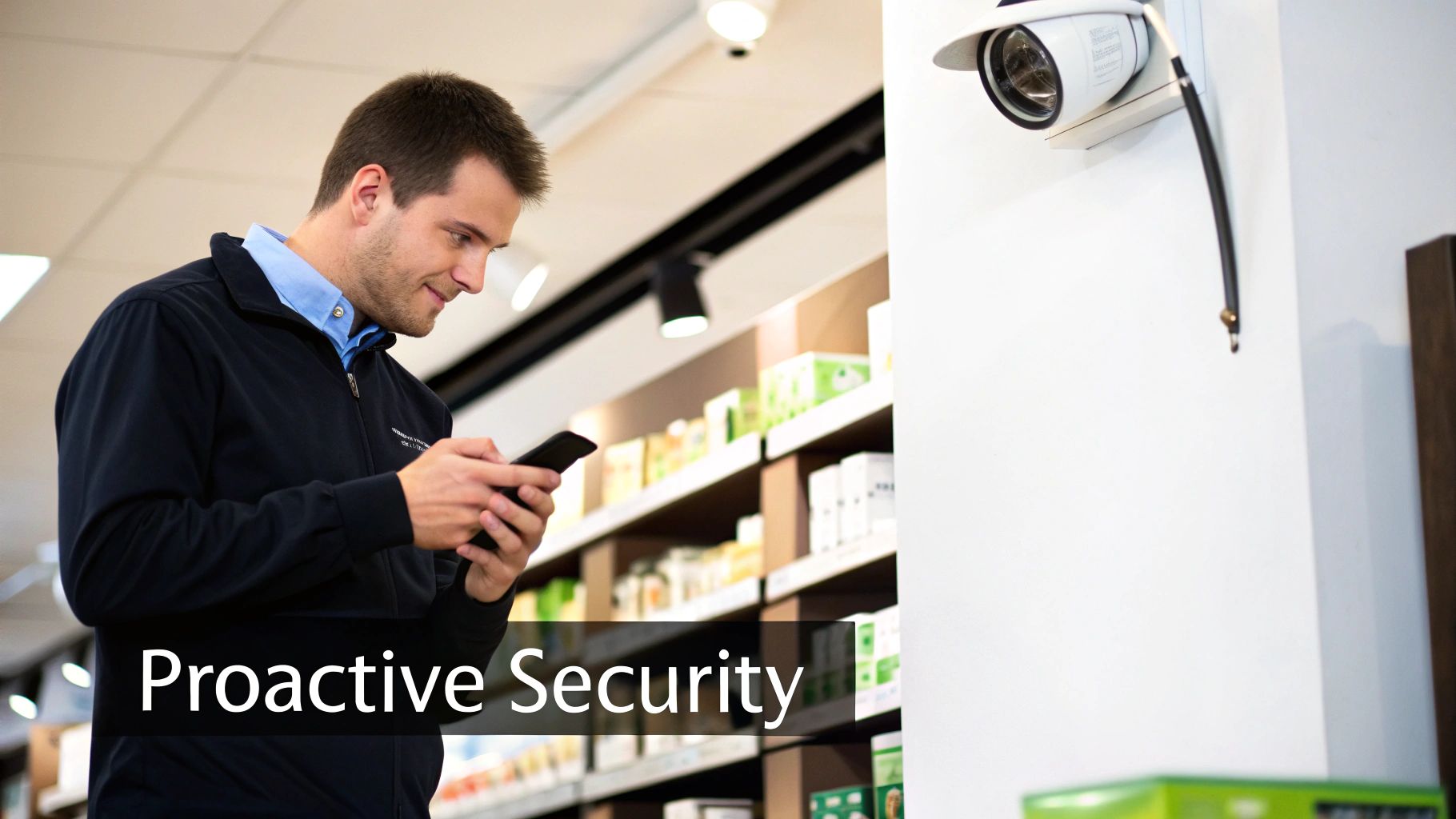
Traditional security systems are pretty good at telling you what happened after the fact. But what if your system could help you stop an incident before it even starts? That’s the shift we’re seeing with the introduction of Artificial Intelligence (AI) and the Internet of Things (IoT).
This isn't just a minor upgrade. It's like changing your security from a passive observer into an active, intelligent partner. Think of it as promoting your security system from a guard who just watches monitors to a seasoned detective who can spot trouble brewing and act instantly.
AI-powered video analytics, for instance, can be taught to recognize specific behaviors that a human might miss. Instead of someone having to stare at hours of footage, the system itself can flag suspicious activity in real time. It might spot someone loitering near a high-value display for an unusual amount of time or identify a group entering the store in a pattern often linked to organized retail crime. When that happens, an alert can be sent straight to a manager's phone for immediate intervention.
Smart Devices That Talk to Each Other
The Internet of Things (IoT) adds another powerful layer by connecting all sorts of devices into a single, cohesive network. We're not just talking about cameras and alarms anymore. These are smart sensors creating an invisible web of protection across your entire store, with each one acting as a tiny digital lookout.
Here’s how this works in the real world:
- Smart Shelves: Imagine placing high-value merchandise on shelves with built-in weight sensors. If a large number of products are grabbed at once—a classic "shelf sweep"—the system can instantly alert staff and direct a nearby camera to zoom in on that exact spot.
- Smart Tags: Modern security tags are much more than just noise-makers at the exit. They can send an alert the moment someone tries to tamper with or conceal them, giving your team a heads-up while the shoplifter is still browsing the aisles.
- Environmental Sensors: IoT also helps guard against non-theft threats. Tiny sensors can detect a sudden spike in temperature that might signal a fire or a failing freezer. Others can detect water, helping you prevent major flood damage in a stockroom before it’s too late.
This network of smart devices gives you a much richer, more detailed picture of what’s happening in your store at any given moment.
The Real Power Is in Predictive Analytics
When you combine AI and IoT, your system starts to do more than just send alerts—it starts to learn. Over time, your security systems for retail can analyze all the data they collect to predict when and where incidents are most likely to happen. For example, the system might learn that shoplifting attempts in the electronics department spike on Saturday afternoons.
This predictive power is a game-changer for how you manage resources. Instead of guessing where to station staff, you can use data-driven insights to put your team exactly where they’re needed most, right before a problem is likely to pop up. It’s the difference between reacting to a fire alarm and preventing the fire in the first place.
This move toward intelligent, interconnected security isn't just a passing fad; it's where the entire industry is headed. The global market for smart access control and surveillance is projected to hit around $26.8 billion by 2025. This growth isn't surprising—businesses are clearly looking for smarter tools to protect their assets from increasingly sophisticated threats. You can dig deeper into these trends by exploring global security market insights from industry analysts.
Ultimately, integrating AI and IoT lets you move beyond simply catching thieves. It helps you build a security strategy that is constantly learning, adapting, and actively working to stop losses before they ever hit your bottom line.
How to Choose and Implement Your Ideal Security System
Knowing your options for security systems for retail is one thing. Actually picking the right mix for your unique space and getting it all working? That’s where the real strategy kicks in. This isn't just about buying the latest tech; it’s a careful process of assessing your store, planning your defense, and making sure everything is installed just right.
A well-chosen system should feel like it was custom-built for your store's layout, your products, and your daily rhythm. By following a clear roadmap, you can go from feeling overwhelmed to making a confident decision, ensuring every dollar you invest delivers real protection and peace of mind. Let's walk through the steps to make that happen.
Start with a Practical Risk Assessment
Before you even think about looking at cameras or sensors, you need to put on a different hat: think like a thief. Walk through your store—inside and out—and be brutally honest about where you're vulnerable. This risk assessment is the foundation of your entire security plan, so it pays to be thorough.
A good assessment goes way beyond the obvious. Don't just glance at the front door; you need to examine every single potential entry point.
- Entry Points: What about the back doors, delivery entrances, and windows? Are they truly secure? Have you checked for potential weak spots like skylights or roof hatches?
- Interior Blind Spots: Where can someone hide from your staff or the cash wrap? Tall shelving units often create perfect hidden aisles for would-be shoplifters.
- High-Value Zones: Pinpoint where you keep your most expensive or easily pocketed merchandise. These areas, along with your cash office and stockroom, demand extra layers of security.
- Exterior Vulnerabilities: Is the area around your store well-lit at night? Are there hiding spots like overgrown bushes or dark, unlit alleys nearby?
This hands-on audit gives you a clear map of what you actually need. It turns the fuzzy idea of "security" into a concrete to-do list, like putting a camera in that blind corner or adding a sensor to the stockroom window.
Asking Vendors the Right Questions
Once you have your risk assessment done, you're ready to start talking to security vendors. This is not the time to be shy. Your goal is to find a true partner who understands the specific challenges of retail, not just a salesperson trying to push a generic package.
Coming prepared with sharp, specific questions will quickly show you who knows their stuff and whose system is the right fit.
A great security partner doesn't just sell you equipment; they help you build a solution. Their answers should demonstrate deep expertise in retail environments and a commitment to your long-term success, not just a quick sale.
Here’s a checklist of must-ask questions for any provider you're considering:
- Scalability: Can this system grow with my business? If I open another store or expand this one, how easy is it to add more cameras, sensors, or controlled doors?
- Integration: Do your cameras, alarms, and access control systems all play nicely on a single platform? Or am I going to be stuck juggling three different apps and dashboards?
- Remote Access: What can I do from my phone? Can I check live camera feeds, arm or disarm the alarm, and manage employee access when I'm not at the store?
- Data Storage: Where is my video footage stored—locally or in the cloud—and for how long? What are the ongoing costs, and how do you protect my data from cyber threats?
- Monitoring and Support: What exactly does your professional monitoring service cover? If a piece of equipment goes down, what's your average response time for a service call?
The answers you get will tell you everything you need to know about how future-proof the system is and how reliable the vendor will be down the road.
Best Practices for Flawless Installation
Finally, even the world's best security system is useless if it's installed poorly. Professional installation is almost always the way to go. A pro understands the small details of placement that make a huge difference in how effective the system is.
As the installation is happening, make sure these best practices are followed:
- Strategic Camera Placement: Cameras at entrances and exits need to be positioned to capture clear, well-lit facial images—this is absolutely critical for any investigation. Other cameras should cover your high-value displays and cash registers without creating new blind spots.
- Comprehensive Sensor Coverage: Every single potential entry point needs a sensor. That includes all windows, back doors, and even roof hatches. Motion detectors should be placed to cover large open areas and the pathways to your most valuable assets.
- User Training: The job isn't done until you and your key employees are fully trained on how to use the system. This means knowing how to arm and disarm it, how to review footage, and exactly what to do when an alarm goes off.
A thoughtfully chosen and correctly installed security system isn't just an expense; it's a powerful asset actively working to protect your inventory, your team, and your bottom line.
Measuring the ROI of Your Security Investment
It’s easy to look at a new security system and just see a line item on an expense report. That's a huge mistake. A well-planned security setup isn't a cost; it's a serious investment that pays you back in ways you might not expect. The conversation shouldn't be about what it costs, but what it earns for your store over time.
Think of it this way: you’re not just buying cameras and alarms. You're buying a tool that actively boosts your profitability. When you shift your perspective from a defensive necessity to an offensive business strategy, you'll see how security systems for retail become a cornerstone of a healthier bottom line.
Calculating Your Tangible Returns
To really get the full picture, you have to look beyond the obvious wins. The most straightforward return, of course, comes from cutting down on shrinkage—that’s the industry catch-all for losses from theft, fraud, and simple errors. Preventing just a handful of high-ticket thefts each year can easily cover the cost of the entire system.
But the payback doesn't stop at the front door. Did you know many business insurance carriers will give you a pretty hefty discount on your premiums for having a professionally installed and monitored system? Those savings can often cover a big chunk of your monthly monitoring fees, giving you an immediate and recurring return right there.
Beyond the direct cash savings, there are other financial benefits that are just as real, even if they're a bit harder to quantify at first glance:
- Lower Employee Turnover: When your team feels safe at work, they’re happier and more likely to stick around. That means you spend less time and money on the endless cycle of hiring and training new staff, which can save you thousands.
- Increased Customer Confidence: People can sense when a store is secure and well-managed, even if they don't consciously think about it. That feeling of safety builds trust, encouraging them to browse longer and, ultimately, buy more.
- Reduced Fraudulent Claims: That crystal-clear HD video is your best friend when someone tries to pull a fast one with a phony slip-and-fall claim. A single lawsuit avoided can save you more than the entire security system cost you in the first place.
When you stack up the total cost of the system against the combined savings from prevented theft, insurance discounts, and a smoother operation, the math speaks for itself. A smart security strategy isn't a drain on your resources; it's a direct contributor to your profitability.
A Simple Framework for ROI
Figuring out a rough ROI is what gets the investment signed off. Start by adding up all your security costs—the equipment, the installation, and any ongoing monthly fees.
Then, start tallying up the gains. Estimate the value of the inventory you're no longer losing to theft. Add in your annual insurance savings. Factor in any other cost reductions you've identified. You'll quickly see that the right security system doesn't just protect what you have; it actively helps your business thrive.
Got Questions About Retail Security? We’ve Got Answers.
Diving into the world of retail security systems can feel overwhelming. You've got questions, and you need clear, straightforward answers to protect your business. Let's tackle some of the most common things store owners ask.
What’s the Single Most Important Security System for a Store?
Everyone wants to know the "one thing" they should get, but security doesn't really work that way. The best defense is a layered one, where different systems cover each other's weaknesses. Think of it like securing a castle—you wouldn't just build a high wall and call it a day. You'd also have a moat, guards, and a reinforced gate.
For most retail spots, video surveillance (CCTV) is your foundation. It’s a powerful deterrent and gives you eyes on everything. But cameras alone aren't enough. Pair them with an intrusion detection system (alarms) to stop after-hours break-ins and access control to keep unauthorized people out of your stockroom or office. When all three work together, you've got a truly solid setup.
What's the Real Cost of a Retail Security System?
This is the big question, and the honest answer is: it depends. The price tag for a security system for your retail space can swing wildly based on a few key things:
- Your Store's Footprint: A small, single-room boutique has very different needs—and a different budget—than a massive department store with multiple entrances and floors.
- The Tech You Choose: Are you looking for a few basic cameras and door sensors? Or do you need an advanced system with smart analytics, cloud video storage, and 24/7 professional monitoring?
- Quality of the Gear: You can get basic cameras, or you can invest in high-definition cameras with night vision and more sophisticated sensors. The better the equipment, the higher the initial cost.
Try to think of it as an investment, not just an expense. The right system pays for itself over time by cutting down on theft, potentially lowering your insurance premiums, and even giving you insights into how your store operates.
Don’t get caught in the trap of just looking for the lowest price. A cheap system that fails you during a break-in will cost you far more in the long run than a reliable, professionally designed solution. It’s about value, not just upfront cost.
Can I Just Install a Security System Myself?
You could, but for a business, it's rarely a good idea. While there are plenty of DIY security kits out there, a professional installer brings experience that you just can't get from a YouTube tutorial. They know the subtle details that make a huge difference.
A pro knows exactly where to place a camera to get a clear, identifiable shot of someone's face, not just the top of their head. They understand how to position motion sensors to avoid frustrating false alarms from an HVAC vent or a passing car's headlights. Professional installation ensures your investment actually works when you need it most, without any weak spots or blind spots.
How Long Should I Hang On to Security Footage?
This is a great question. The right amount of time to keep security video depends on your specific business and any local laws, but a good rule of thumb is 30 to 90 days.
That window is usually long enough to spot and investigate an issue. Sometimes you don't realize a theft or a fraudulent slip-and-fall claim has happened until weeks later. For certain industries or areas with specific regulations, you might even need to keep it longer. Modern cloud storage makes this much easier and more affordable than trying to manage a mountain of on-site hard drives.
At Fortress Security Films, we know that a smart security plan starts at your weakest points: your glass doors and windows. While alarms and cameras are essential, reinforcing that glass with our advanced security films creates a tough physical barrier that stops intruders in their tracks. See how our nearly invisible layer of protection can become the powerful first defense in your layered security strategy. Explore our solutions for retail businesses at https://fortresssecurityfilms.com.
