


You’ve probably never thought much about your window glass beyond keeping the weather out. But in reality, it's the most vulnerable entry point in your entire home or business. That’s where security film comes in.
At its core, security film is a heavy-duty polyester membrane that gets applied directly to the interior surface of your glass. The magic isn't in making the glass unbreakable—that's a common misconception. Instead, its job is to hold all the shattered pieces together when the glass is struck. It transforms a fragile pane into a surprisingly resilient barrier.
Your First Line of Defense Against Glass Hazards
Think about what happens when you hit a standard window. It explodes inward. Instantly, there’s an open hole for an intruder and a spray of razor-sharp shards flying into the room. Security film completely changes that equation.
By bonding a powerful, tear-resistant layer to the glass with a specialized, aggressive adhesive, you add strength and flexibility. When something hits the window—a crowbar, a piece of storm debris, even a blast wave—the glass will still crack. But the film’s powerful grip keeps all those dangerous fragments locked together in the frame. This simple concept has huge real-world security benefits.
The Core Protective Mechanism
Instead of the glass instantly failing, the window remains a tough, stubborn barrier. A burglar expecting a quick, quiet smash-and-grab is suddenly faced with a frustrating, rubbery membrane. Breaching it requires a ton of continued effort, creating a racket and, most importantly, buying you precious time.
That delay is everything. It's often enough to make them give up and move on. It’s also more than enough time for your alarm to sound and for help to get on the way.
This isn’t just some niche product; it’s one of the fastest-growing upgrades in property protection. The global market for security window film was already valued at around USD 1.5 billion and is climbing fast as more people recognize the need for effective, real-world security. You can find more insights about the security film market growth and what’s driving this trend.
More Than Just Break-In Protection
The best part is that the benefits don't stop with crime prevention. The same technology that holds glass together during an attempted break-in provides a critical safety net in so many other situations.
Here’s a quick overview of what installing security window film can do for you.
Security Film At-a-Glance Benefits
| Benefit Category | Primary Function | Best Use Case |
|---|---|---|
| Forced Entry Deterrence | Delays and deters intruders by keeping glass intact. | Homes, retail storefronts, ground-floor offices |
| Blast Mitigation | Contains glass shards from explosions, protecting occupants. | Government buildings, commercial high-rises |
| Weather & Storm Safety | Prevents debris penetration and shard dispersal. | Coastal homes, areas prone to high winds or quakes |
| Accident Prevention | Holds glass together from accidental impacts. | Homes with children, schools, public-facing businesses |
Ultimately, security film addresses a wide array of potential threats, not just a single one.
- Natural Disasters: In a hurricane or earthquake, the film can stop flying debris from punching through your windows and keeps broken glass from turning into a major hazard inside.
- Accidental Impacts: It’s a lifesaver in homes with kids or busy commercial spaces. An errant baseball or someone tripping into a glass door won't result in a trip to the emergency room.
- Blast Mitigation: For higher-risk targets like government buildings or corporate headquarters, thicker films are engineered to hold glass in the frame during a blast, which is crucial for protecting people from the primary danger—flying glass.
In the end, installing security film for windows is a smart way to turn your property's weakest links into a source of strength. It’s a completely invisible upgrade that adds a constant, passive layer of defense against a whole range of threats, all without changing the look of your home or business.
Getting to Know the Different Types and Strengths of Security Film
Choosing the right security film is a lot like picking the right tire for a car. You wouldn't put standard street tires on a vehicle meant for rugged off-roading, and the same principle applies here. Window films come in a whole range of thicknesses and strengths, and each one is engineered to handle a specific level of threat.
It’s crucial to understand that not all security films are the same—not by a long shot. The key difference comes down to thickness, which we measure in "mils" (one-thousandth of an inch).
While a mil sounds incredibly small, adding just a few can make a night-and-day difference in how the film holds up under pressure. A film's thickness is directly tied to its tensile strength, which is just a technical way of saying how well it resists tearing or being punctured when the glass behind it breaks.
Standard Security and Safety Films
For most homes and small businesses, the sweet spot is a film in the 4 to 8 mil range. Think of this as your first line of defense. It’s designed to handle the most common, everyday threats without breaking the bank.
- Smash-and-Grab Prevention: This is where these films really shine. A burglar expects to smash a window and be inside in seconds. When the glass breaks but stays in the frame, it creates a noisy, time-consuming obstacle. Most will just give up and move on.
- Accident Protection: Life happens. A kid bumps into a glass door, a stray ball hits the living room window. This film holds the sharp, dangerous shards in place, turning a potential trip to the ER into a simple cleanup job.
- Basic Weather Shield: During a storm, a 4-8 mil film can be the difference between a broken window and a dry interior, keeping wind-driven debris from shattering the glass.
For the average property owner, this level of film provides a massive security upgrade over raw glass, effectively hardening your most vulnerable entry points.
A simple 4-mil security film can make standard glass up to 250% more shatter-resistant. It’s an invisible layer that turns a fragile window into a surprisingly tough barrier.
Heavy-Duty and Blast Mitigation Films
When you’re protecting high-value assets or facing more serious threats, it’s time to step up the protection. Films in the 8 to 14+ mil range are built for a completely different level of impact. You’ll find these on high-end retail storefronts, government buildings, and other critical facilities.
These thicker films are incredibly tough, designed to withstand a prolonged, brutal attack from tools like hammers, crowbars, or bricks. The goal isn’t just to deter, but to delay. The film creates a formidable barrier that buys precious time for help to arrive.
This is also where blast mitigation comes into play. In an explosion, the most lethal threat is often the shower of high-velocity glass fragments. A heavy-duty film, especially when combined with a frame attachment system, is engineered to catch that glass and absorb a huge amount of the blast's concussive force.
A Critical Note on "Bulletproof" Claims
Let's clear up a common and very dangerous myth: no window film, by itself, is bulletproof. Anyone who tells you otherwise is either misinformed or being dishonest. Stopping a bullet requires a complete, engineered system.
In a true ballistic-rated system, a thick security film is just one piece of the puzzle. Here’s what a real setup involves:
- Multiple Layers of Film: Thick layers are applied to specialized glass, not your standard window pane.
- Specialized Glazing: The glass itself is usually a multi-layered or laminated security glass.
- A Robust Anchoring System: This is key. The film and glass are physically anchored to the window frame, creating a single, unified structure that can absorb and distribute the massive energy from a bullet’s impact.
It's this entire integrated assembly that earns a certified NIJ (National Institute of Justice) rating. To get a better sense of what these true protective systems look like, you can dive deeper into our guide on ballistic film for windows. Without all these components working together, a film alone offers no real protection from gunfire.
What Security Film Actually Does For You
It’s one thing to talk about polyester layers and mil thickness, but what do those technical details actually mean for your home or business? The real magic of security film is how it transforms your most vulnerable entry points—your windows—into a powerful shield, giving you tangible benefits and genuine peace of mind.
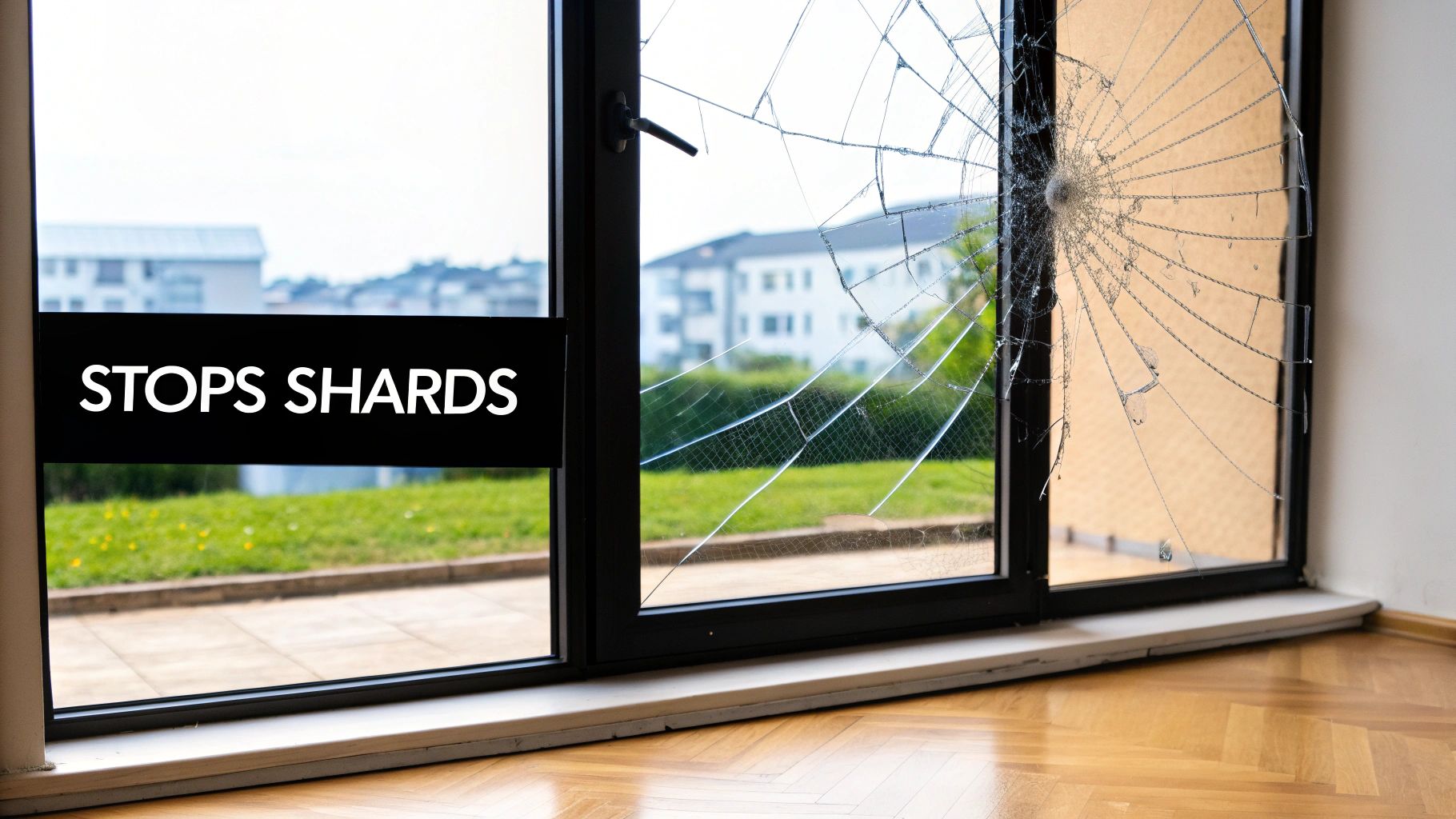
Think of it less as just stronger glass and more as a complete upgrade to your property's defense, tackling everything from break-ins to accidents and even severe weather.
A Powerful Deterrent Against Break-Ins
For most people, this is the number one reason to install security film. Burglars count on two things: speed and surprise. Their plan is simple: smash a window, get in, and get out in seconds, long before anyone has a chance to react.
Security film throws a massive wrench in that plan. When an intruder strikes a treated window, the glass will crack, but it won't shatter and fall out. Instead, they’re met with a tough, rubbery membrane holding all the pieces together.
What was supposed to be a quiet, instant entryway is now a stubborn, noisy obstacle. Breaking through it requires a lot of time and effort—exactly what a burglar wants to avoid. More often than not, they'll just give up and look for an easier target.
That extra time is everything. It lets your alarm system do its job, gets the attention of neighbors, and gives you a critical head start to call for help. While film provides a physical stopgap, for total peace of mind, many people also look into protecting property with remote viewing trail cameras as part of a layered security strategy.
Keeping People Safe from Blasts and Impacts
During an explosion or a serious impact, it’s rarely the blast wave itself that causes the most harm. It's the thousands of razor-sharp glass shards that fly through the air like daggers. Standard glass becomes a deadly weapon in these situations.
Security film for windows acts like a safety net. It catches and holds the shattered glass, absorbing a huge amount of the impact energy. This prevents those dangerous projectiles from flying into a room and injuring the people inside.
This is a life-saving feature for:
- Commercial Buildings: Protects employees and customers in busy urban environments.
- Government Facilities: Adds an essential layer of defense against terrorism.
- Homes: Offers a shield against everything from a stray baseball to civil unrest.
A Tough Barrier Against Extreme Weather
Mother Nature can be incredibly destructive. In a hurricane, tornado, or major storm, high winds can turn small pieces of debris into high-speed projectiles that can easily smash through a normal window.
Once a window breaks, wind and rain can pour in, leading to catastrophic water damage and even structural failure. Security film creates a robust barrier that can deflect smaller debris. Even if a major impact cracks the glass, the film holds it in place, keeping the opening sealed and protecting the inside of your property from the storm.
More Than Just Security: Everyday Perks
Beyond the heavy-duty protection, this upgrade comes with some fantastic everyday benefits that add comfort and value to your property. One of the best is its ability to block up to 99% of damaging ultraviolet (UV) rays.
This UV protection does two great things:
- Stops Fading: It acts like sunscreen for your interior, protecting your hardwood floors, furniture, rugs, and artwork from the sun damage that causes them to fade and break down.
- Reduces Glare & Heat: Many films also have solar control properties built-in. This cuts down on annoying glare and blocks a good amount of solar heat, which can actually help lower your A/C bills in the summer.
So, with one installation, you're not just making your property safer from immediate threats—you're also preserving your investments and improving your energy efficiency. That’s a return that pays off in more ways than one.
What to Expect from a Professional Installation
The security film you choose is only half the battle. To get the full protective benefit, the installation has to be perfect. This isn't a DIY weekend project; it's a meticulous craft that turns a sheet of polyester into an invisible shield, and the quality of the work makes all the difference.
It all starts with a real conversation, not a sales pitch. A true professional begins with a threat assessment of your property. They'll look at your window sizes, the type of frames you have, and listen to your specific worries—are you trying to stop smash-and-grabs at your shop, or protect your family's home from hurricane debris?
This initial evaluation is what helps them recommend the right film thickness and determine if you need an advanced anchoring system for your situation.
The Art and Science of Application
Once the right film is chosen, the real work begins with painstaking preparation. This is the step most people underestimate. The glass has to be surgically clean, free from any speck of dust, oil, or residue that could get trapped and ruin the bond.
Installers use special tools and cleaning solutions to create a flawless surface. They then use a slip solution to float the film into the perfect position, carefully squeegeeing out every last drop of moisture. The goal is a completely bubble-free, distortion-free finish that's so clean, you won't even know it's there.
Understanding the Curing Phase
After the film is on the glass, there's still one more crucial step: the curing phase. This is the period where the film’s powerful adhesive fully bonds to the glass, creating that permanent connection. This can take anywhere from 30 to 60 days, depending on the film's thickness and the weather.
During this time, you might see a bit of a hazy or cloudy look. Don't worry—that's totally normal. It's just the last bits of moisture evaporating through the film. It’s really important to avoid cleaning the windows or touching the film during this period. Just let it be, so it can form that unbreakable bond.
Why Attachment Systems Are a Game Changer
For anyone serious about security, just putting film on the glass isn't always enough. The weakest link can become the entire pane of glass being knocked out of the frame. That’s where a frame attachment system comes in—it’s the gold standard for turning a window into a true barrier.
This involves using either a structural silicone or a mechanical clamp to physically anchor the film-covered glass directly to the window frame.
By bonding the film and glass to the frame, you create a single, unified system. This ensures that even under the extreme force of a bomb blast or a determined intruder, the entire window holds together, buying you precious time and offering the highest level of protection.
This advanced technique is what separates a basic application from a genuine security installation. For a closer look at how this all comes together, you can check out our detailed guide on professional security window film installation. It really shows the craftsmanship involved in turning your windows into a formidable line of defense.
Choosing the Right Film and Installer
Picking the right security film for your windows is a big decision, but it’s really only half the battle. The skill of the person installing that film is just as crucial—if not more so—to getting the protection you’re paying for.
Think about it: even the best, most expensive film is practically useless if it’s installed incorrectly. It can peel, bubble, or simply fail when an impact happens. Getting this right is about creating a complete security system, not just buying a product. It all comes down to choosing the right material and the right hands to apply it.
Evaluating the Security Film Itself
Before you start looking for an installer, you first need to have a solid idea of what you want them to install. Security films aren't one-size-fits-all; they’re engineered to counter specific threats. The first step is always matching the film's capabilities to your actual security needs.
When you're comparing different films, here are the technical specs that really matter:
- Film Thickness (Mil): This is the most common starting point. A standard 4-mil film is a great deterrent for basic smash-and-grab burglaries. But if you’re looking for serious protection against determined intruders or blast mitigation, you'll want to look at films that are 8-mil or thicker.
- Tensile Strength: Measured in pounds per square inch (PSI), this tells you how much stretching force the film can take before tearing. A higher PSI means an intruder will have a much harder time trying to rip or puncture the film, even after they’ve shattered the glass behind it.
- Break Strength: This number tells you how much force it takes to actually break the film itself. Just like with tensile strength, the higher the number, the tougher the barrier. It's a direct measure of its resilience against repeated hits.
This decision tree gives you a straightforward way to think about what level of protection you really need.
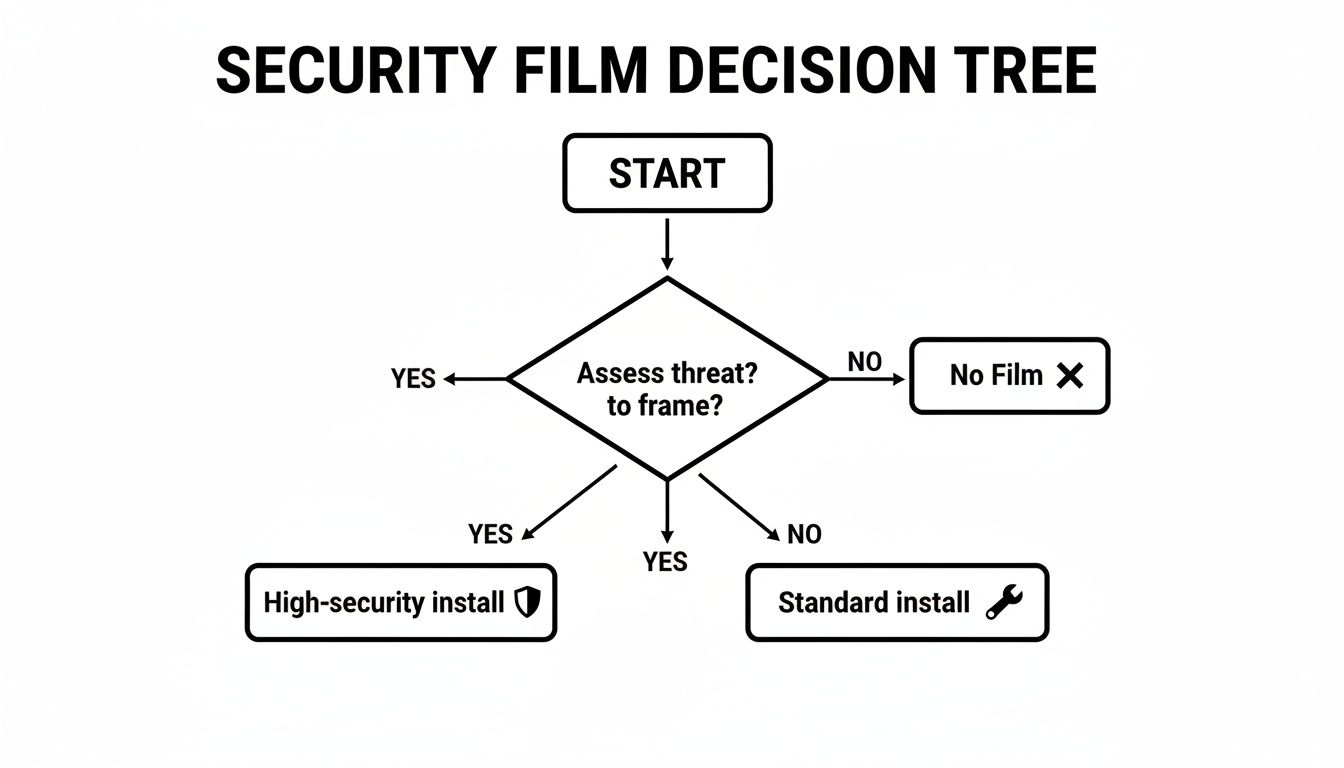
As you can see, for any serious threat, simply applying the film isn't enough. Anchoring it securely to the window frame is what creates a truly formidable barrier.
How to Vet Your Installation Company
Once you know the type of film you need, your focus should shift entirely to finding the right team for the job. Not every company has the specific training and hands-on experience required to install high-performance security films. A shoddy installation is a recipe for disaster, leading to a product that won't perform when you need it most.
The installer is the bridge between a roll of high-tech material and a fully secured window. Their skill determines whether the film performs as engineered or fails under pressure.
Finding a top-notch installer requires a bit of homework. You need to look past the sales pitch and check for real credentials and a proven track record.
Here’s a quick checklist to help you vet potential installation companies and ensure you're hiring a true professional.
Installer Vetting Checklist
| Criteria | What to Look For | Why It Matters |
|---|---|---|
| Manufacturer Certifications | Proof of official training and certification from the film manufacturer (e.g., 3M, Llumar, Hanita). | This is non-negotiable. It confirms they know the product inside and out and follow the exact installation protocols required for the warranty to be valid. |
| Local Experience | A long, verifiable history of projects in your specific area (e.g., Southern California). | A local pro understands regional crime trends, common building materials, and local codes. They aren't just an installer; they're a local security partner. |
| Diverse Portfolio | A gallery of completed projects, including residential, commercial, school, and government work. | This shows their versatility and proves they’ve handled complex jobs. It’s evidence of real-world experience, not just theoretical knowledge. |
| Comprehensive Warranty | A clear warranty that covers both the film material (against defects) and the installation labor. | A strong warranty is a sign of confidence. It means the company stands behind its products and its workmanship, giving you long-term peace of mind. |
By using these criteria, you can sift through the options and find a team that has the expertise to get the job done right the first time.
Ultimately, taking the time to find a local, certified, and experienced installer is the best way to guarantee your investment pays off. For a deeper dive into budgeting for your project, our guide on security window film cost breaks down the key factors that influence the final price.
Your Security Film Questions, Answered
When you're looking into serious security upgrades, you're bound to have questions. And when it comes to something as vital as protecting your property with security film, you deserve straight answers from people who work with this stuff every day.
This section is all about tackling the most common questions we hear from homeowners and business owners. We'll cut through the noise, clear up some dangerous misconceptions, and give you the confidence you need to make the right call.
Is Security Film Really Bulletproof?
Let's get right to the most critical question. Window film by itself is never bulletproof. Any company that tells you a simple film application can stop a bullet is being dishonest and putting you at risk. True ballistic resistance is a completely different animal—it’s an engineered system, not just a product.
For a window to actually stop a bullet, several components have to work together perfectly:
- A Specialized, Ultra-Thick Film: We're talking about a film that's many times thicker and more robust than even a heavy-duty security film.
- Laminated Security Glass: This isn't your standard window pane. The film is applied to multi-layered, specialized glass designed for this exact purpose.
- A Robust Anchoring System: The entire unit—film and glass—is mechanically fastened directly into the window frame, creating a single, incredibly strong barrier.
Only this complete, integrated system can earn a rating from the National Institute of Justice (NIJ) for stopping specific types of ammunition. Standard security film is fantastic for preventing break-ins and holding glass together during a blast, but it will not defeat a firearm. For that level of protection, you absolutely must work with a certified expert to design and install a rated ballistic system.
How Much Does Window Security Film Cost?
This is an investment in your safety, so it’s natural to wonder about the price tag. The honest answer is: it varies. There's no one-size-fits-all cost because every job is different. The final price really comes down to the film you choose and the specifics of the installation.
Here’s a breakdown of what drives the cost:
- Film Thickness and Type: A standard 8-mil film for deterring break-ins is going to cost less than a thicker 14-mil film designed for higher-level threats.
- Total Square Footage: This is the biggest factor. The more glass you need to cover, the higher the project cost.
- Job Complexity: Are the windows hard to reach? Are they an unusual shape? Does old, failing film need to be removed first? These things add to the labor involved.
- Attachment Systems: If you need an advanced anchoring system to bond the film to the frame for blast mitigation, that will be an additional cost to the film itself.
As a ballpark figure, you can expect standard security films (in the 4-8 mil range) to cost somewhere between $9 and $18 per square foot, installed. For heavy-duty systems or films that require advanced anchoring, the cost can climb, sometimes reaching $30 to $50 per square foot or more. The only way to get an exact number is to have a professional come out, measure your windows, and assess your specific needs.
How Long Does Security Film Last?
High-quality security film, when installed by a professional, is built to last. It's an incredibly durable product designed to handle years of direct sun and weather without bubbling, peeling, or turning yellow. You can realistically expect it to protect your property for decades.
The warranties from top manufacturers tell the real story of their durability.
- For Homes: Most residential installations come with warranties ranging from 10 years to a full lifetime.
- For Businesses: Commercial projects are typically covered by a 10 to 15-year warranty.
These warranties cover any manufacturing defects like cracking, peeling, or delaminating, giving you peace of mind that your investment is protected.
And the maintenance? It’s surprisingly simple. Once the film has fully cured (which takes about 30 days), you can clean your windows just like you always have, with one small tweak. Just use a soft microfiber cloth and a gentle cleaner—mild soap and water is perfect. You'll want to avoid ammonia-based products and anything abrasive that could scratch the film's protective hard coat. That’s it. With that little bit of care, the film will stay crystal clear and strong for years to come.
Will Security Film Make My Windows Look Dark?
This is a common worry we hear, but it’s a total myth. One of the best things about modern security film is its incredible optical clarity. You won't even know it's there.
Top-tier clear security film for windows is engineered to be virtually invisible once it's installed. Its job is to add strength, not to add a tint. This is what separates it from solar films, which are specifically designed to block light and heat.
With a pure security film, the goal is to add a powerful, invisible layer of protection without changing your view or the architectural look of your building. A professional installation ensures there’s no distortion, haziness, or bubbles—just the glass you're used to, only much, much stronger. While you can get products that combine security and solar control, a standard security film is all about protection you can't see.
Ready to turn your property's weakest points into its strongest defense? The experts at Fortress Security Films provide professional consultations and installations throughout Southern California. We'll help you choose the right solution to protect what matters most. Schedule your free security assessment today!
