


At its core, security film for glass windows is a heavy-duty, multi-layered polyester membrane that gets applied directly to glass.But it's nothing like a simple sticker. This professional-grade film uses an incredibly powerful adhesive to bond with the glass, holding dangerous fragments together if the window shatters.
It essentially creates an invisible safety net for what are often the most vulnerable points of a home or business.
Your Invisible First Line of Defense
Think of a spiderweb. When an insect flies into it, the impact energy doesn't just break a single strand; it spreads across the entire web. Security film works on a similar principle for your windows.
When a window is struck hard enough to break, the glass will still shatter. However, the film holds all those dangerous shards tightly in place, keeping the barrier intact. This simple upgrade transforms a fragile pane of glass into a surprisingly tough line of defense.
This completely foils the quick, catastrophic failure that intruders are counting on. Instead of a fast smash-and-grab, a would-be burglar is met with a stubborn, webbed pane of glass that takes a lot of time, effort, and noise to get through. More often than not, that delay is all it takes to make them give up and move on.
The Core Benefits of Window Security Film
The real value of installing security film goes well beyond just stopping a burglar. It’s a multi-pronged approach to protecting your property and the people inside.
Here are the key advantages:
- Forced-Entry Deterrence: It dramatically slows down intruders, buying precious time for an alarm to go off and for help to arrive.
- Blast and Storm Mitigation: In a severe storm or even an explosion, the film contains the flying glass shards that are a leading cause of serious injury.
- Accident Prevention: It offers crucial protection for family members, especially kids, from injuries that can happen from accidental impacts with glass doors or large windows.
- UV Ray Protection: High-quality films can block up to 99% of damaging UV radiation, which saves your furniture, wood floors, and artwork from fading over time.
This technology isn't just about reacting to a threat; it's about proactively strengthening your environment. It's an invisible yet powerful upgrade that boosts the structural integrity of your existing glass.
Think of it this way: A standard pane of glass is like a single sheet of paper—it tears instantly. Glass with security film is like that same paper after it's been laminated. You can bend it or crease it under pressure, but it stubbornly refuses to tear apart.
This fundamental strength gives you real peace of mind, knowing your property's weakest links are now reinforced. It's a foundational piece of any solid security plan. To see how this fits into a bigger picture, check out this guide on the best ways to enhance building security.
Now that you understand the basic concept, we can dive into how it actually works and figure out which type is right for your needs.
How Security Film Makes Glass Stronger
The secret to security film's strength isn't just one thing—it’s the powerful combination of the film's physical thickness and the incredible bond of its adhesive. On its own, glass is notoriously brittle. A sharp impact causes it to shatter and fly apart instantly. Before diving into how film changes the game, it’s worth understanding glass as a material to appreciate why this reinforcement is so effective.
Think of it like rebar in concrete. Concrete is great under compression but cracks easily when stretched or bent. The steel rebar provides the tensile strength, holding everything together under pressure. Security film does the same for glass, giving it the flexibility and resilience it naturally lacks.
When something hits a window with security film, the film absorbs and spreads that impact energy across the entire pane. Instead of a single, catastrophic break, the film holds the shards together, preventing immediate entry and keeping dangerous fragments contained.
This diagram shows how these layers work in concert to turn a weak point into a barrier.
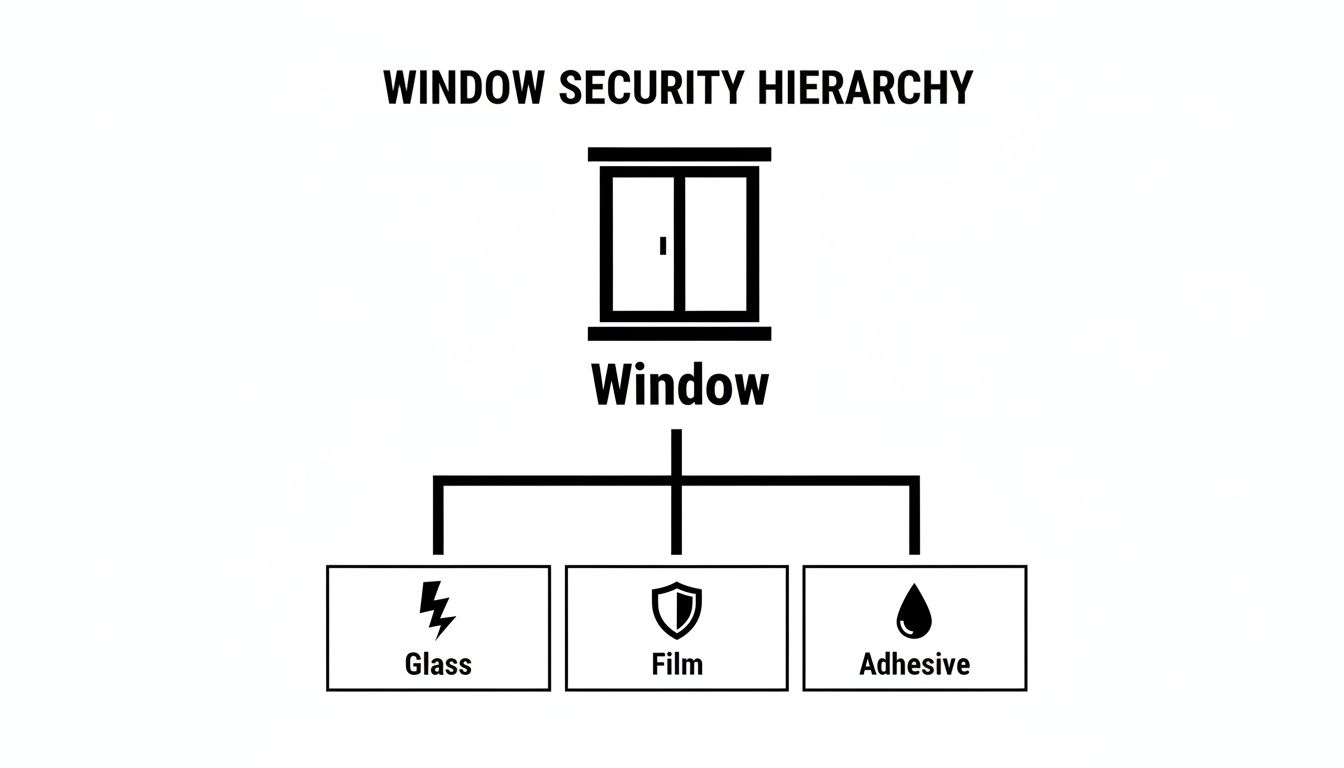
As you can see, the film and its powerful adhesive create a single, unified layer that dramatically reinforces standard glass.
The Role of Film Thickness
We measure security film thickness in mils—one mil is simply one-thousandth of an inch. It sounds tiny, but the difference between a 4-mil film and a 14-mil film in terms of performance is night and day. Each thickness is engineered for specific threat levels.
The table below breaks down what you can expect from standard film thicknesses.
Security Film Thickness and Protection Levels
| Film Thickness (mils) | Primary Application | Protection Against | Ideal Use Case |
|---|---|---|---|
| 4-8 mil | Safety & General Security | Accidental breakage, smash-and-grab theft, minor storm debris | Residential homes, retail storefronts, basic property protection. |
| 10-14 mil | Forced-Entry Resistance | Sustained attacks, serious forced entry attempts, blast mitigation. | High-value homes, commercial buildings, schools, high-risk areas. |
| 15+ mil | High-Threat Environments | Aggressive attacks, bomb blasts, extreme weather events. | Government facilities, embassies, jewelry stores, critical infrastructure. |
Ultimately, a thicker film buys you more time by absorbing more energy. A 14-mil film might hold up against a determined attacker for 60-90 seconds or more. That's often more than enough time for an alarm to sound and for the intruder to give up and flee. This delay is the most critical function of a security film system.
The Power of a Professional Adhesive Bond
The second piece of the puzzle is the adhesive. This isn't your craft store glue; it's a highly specialized, pressure-sensitive adhesive engineered to form a molecular-level bond with the glass. A flawless, professional installation is crucial here, as it ensures there are no air bubbles or weak spots.
This bond is what prevents shattered glass from turning into deadly projectiles. During a blast or a severe storm, the adhesive's strength is what holds thousands of razor-sharp shards in place, protecting anyone inside. This containment feature is one of the most important safety benefits of any quality security film.
It's this elegant partnership between polyester thickness and a professional-grade adhesive that transforms a fragile pane of glass into a tough, resilient security barrier, turning your weakest point into a reliable line of defense.
More Than Just Security: Unexpected Benefits
Most people get security film for one reason: to stop a burglar from smashing through a window. But that’s just scratching the surface of what this product can do. The best upgrades are the ones that solve multiple problems at once, and security film is a prime example of an investment that pays you back in ways you might not expect.
Think of it as an invisible shield that does more than just stop bad guys. It adds a surprising amount of resilience, comfort, and protection to your home, working silently in the background every single day.
Everyday Safety and UV Protection
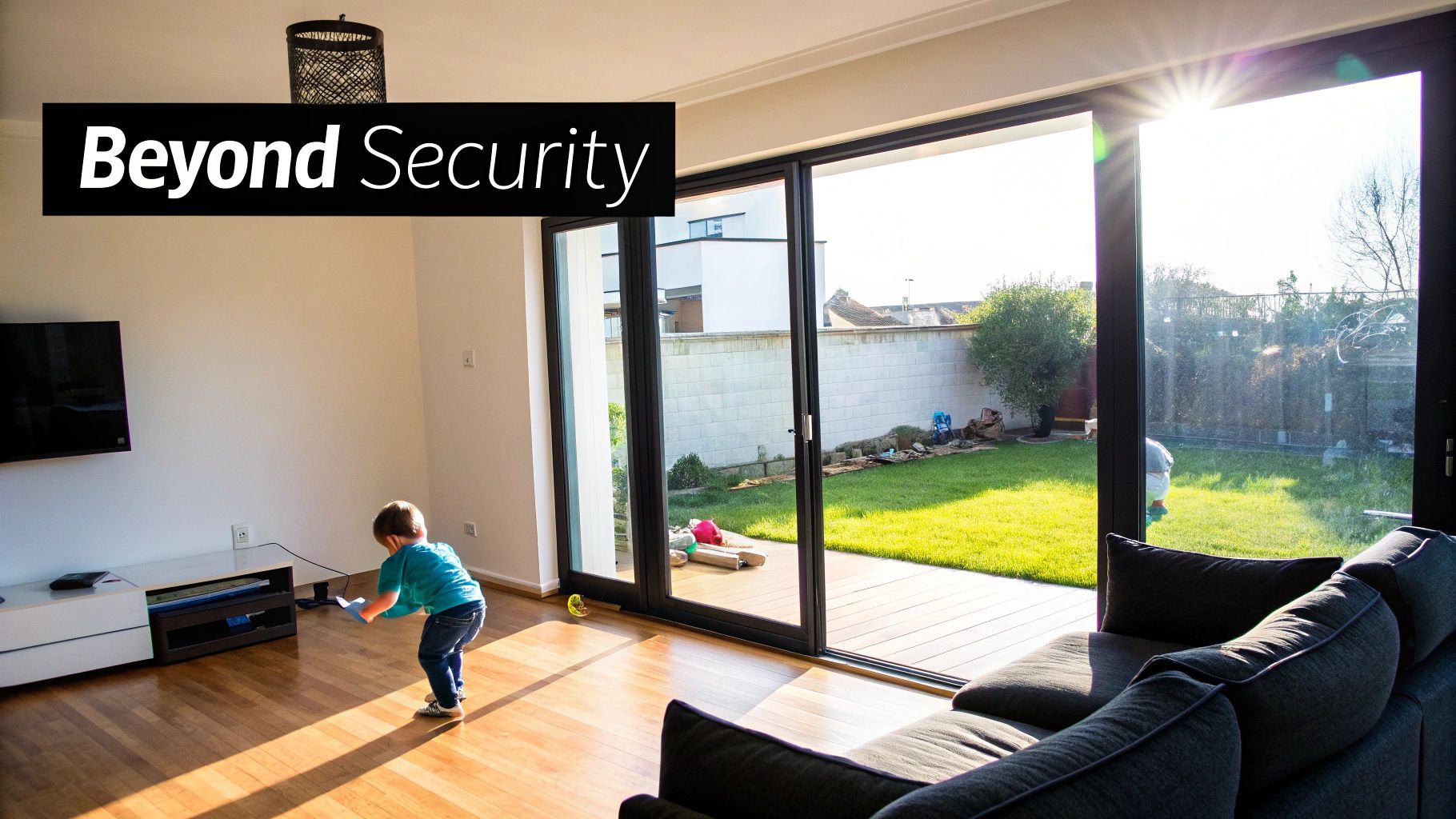
One of the biggest, and often overlooked, benefits is simple accident prevention. If you have kids or pets running around, you know that large glass doors or low windows can feel like a disaster waiting to happen. An accidental fall or a stray ball can instantly turn a pane of glass into a shower of dangerous shards. Security film holds that broken glass together, containing the hazard and preventing a mishap from becoming a medical emergency.
On top of that, the film acts like a powerful, invisible sunscreen for your home. Most quality security films block up to 99% of damaging ultraviolet (UV) rays.
This is huge for two reasons:
- It Stops Fading: UV rays are the primary culprit behind faded hardwood floors, sun-bleached rugs, and damaged artwork. The film preserves your valuable interiors.
- It Protects Your Family: It significantly cuts down on the daily UV radiation coming into your home, which is better for your skin and eyes over the long term.
This dual-purpose functionality means your investment is working for you every single day, not just during a crisis. It preserves the value and beauty of your interiors while providing constant peace of mind.
Surprising Energy Savings and Comfort
Here's another benefit most people don't see coming: lower energy bills. Many security films have solar control properties built right in, which is a game-changer during those hot Southern California summers. By rejecting a good portion of the sun's heat before it ever enters your home, the film helps keep your indoor spaces much cooler.
The result? Your air conditioning doesn't have to run on overdrive just to keep up. That translates directly into real savings on your utility bills month after month. It's a smart, eco-friendly perk that actually puts money back in your pocket.
This multi-faceted value is why the industry is booming. The global window films market was valued at USD 10.3 billion in 2020 and is expected to hit USD 17.5 billion by 2030. This growth isn't just about security; it's fueled by homeowners realizing they can strengthen their glass while addressing the rising threat of residential break-ins, which cost Americans $4.5 billion annually. You can dive deeper into these trends in the full research report.
Ultimately, security film isn't just a purchase to stop a crime. It’s an investment in a safer, more comfortable, and more efficient home.
Understanding Security Ratings and Industry Standards
Not all security film is created equal. Far from it. The difference between a thin, decorative layer and a professional-grade protective barrier comes down to proven performance—and that performance is verified through a series of demanding industry tests.
Trying to decipher all the codes and ratings can feel like reading a foreign language at first. But knowing what they mean is the only real way to separate genuine protection from marketing hype. Think of it like a car's safety rating; you wouldn't buy a vehicle without knowing its crash test results. The same logic applies here. These standards give us a common language for measuring how well a film will hold up against everything from an accidental impact to a determined attack.
Key Safety and Security Standards
When you dig into a product's technical specs, you’ll see a bunch of acronyms and numbers. While the list can be long, there are a few heavy hitters you absolutely need to know. These are the benchmarks that matter.
These tests aren't theoretical; they simulate real-world threats in a controlled lab to see exactly how a window system performs under extreme stress.
-
ANSI Z97.1: This is the baseline safety standard for glass. It's designed to answer one simple question: if a person accidentally falls into the glass, will it break in a way that minimizes serious injury? Film that meets this standard is certified to hold dangerous shards together, which is a must-have for preventing injuries, especially with kids around or in busy commercial spaces.
-
ASTM F3561: This standard gets more specific, testing the glazing's resistance to forced entry. In this test, a heavy impactor is dropped onto the glass from a specific height to see if the film can prevent it from breaking through. It’s a direct measure of how well the film can thwart a smash-and-grab attempt or a blunt-force attack.
-
GSA (General Services Administration) Ratings: The GSA sets the security criteria for U.S. federal buildings, which includes mitigating the devastating effects of bomb blasts. A GSA-rated film has proven its ability to contain shattered glass during an explosion, dramatically reducing the lethal spray of high-velocity fragments. While originally designed for government facilities, this rating has become the gold standard for blast protection.
Getting familiar with these codes helps you cut through the noise and identify products that have been independently proven to do their job when it counts.
The Truth About Ballistic Resistance
Let's clear up one of the biggest—and most dangerous—myths in the industry: the idea of "bulletproof" film. The reality is that no film, by itself, can stop a bullet. It simply doesn't work that way.
Achieving true ballistic resistance requires a comprehensive, engineered system. This isn't just about applying a product to your existing windows. A true ballistic system involves multiple layers of extremely thick security film, a specialized anchoring system that mechanically bonds the film to the window frame, and often, replacing the glass itself with multi-layered polycarbonate or laminated glass.
In this system, the film's job is to absorb the immense shockwave from the impact and contain the pulverized glass. But it’s the entire reinforced assembly—the thick glazing, the robust film, and the anchored frame—that provides the stopping power.
When a company talks about "bullet-resistant" film, they are referring to its role as one component within a complete, professionally installed system. Be extremely skeptical of anyone claiming a simple film application will make your windows bulletproof. It won't.
If you’re seeking this level of protection, the conversation needs to be about the entire assembly. For a deeper look at how these components work together, you can explore the details of complete ballistic window film systems. When you talk to an installer, make sure you're asking about their system-based approach, not just the film itself. Knowing these realities is how you make a smart, informed decision about protecting what matters most.
Your Guide to Choosing the Right Security Film
Picking the right security film for your windows isn't as simple as just grabbing the thickest one off the shelf. It’s really about matching the product to your property's specific weak points and what you're trying to protect against. Let's walk through how to make a smart, effective choice.
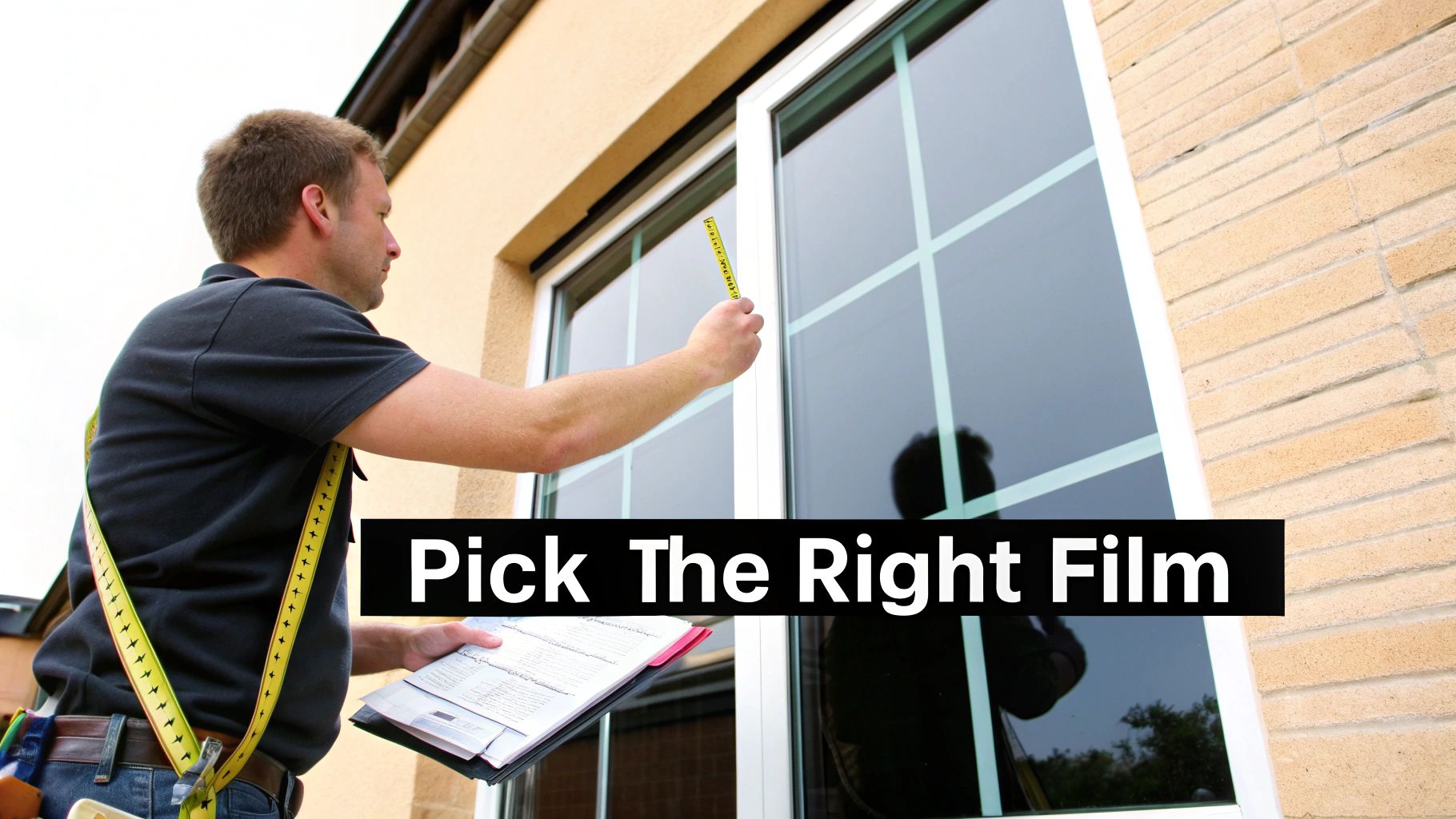
The first step is a practical risk assessment. What keeps you up at night? Are you trying to stop a quick smash-and-grab robbery, keep your family safe from flying debris during a storm, or prepare for a more serious, active threat? Each of these scenarios needs a different solution.
It's a lot like choosing tires for a car. You wouldn't put racing slicks on a truck you're taking off-road. In the same way, a thin safety film designed to handle accidental bumps won't stand a chance against a determined intruder at a high-end storefront.
Matching Film to Your Specific Threats
Start by zeroing in on your biggest concerns. This single step will guide every other decision you make, from how thick the film should be to the type of installation you’ll need.
- For Smash-and-Grab and Burglary: The main goal here is to create a delay. An 8-mil to 14-mil film is usually the sweet spot. It provides enough resistance to make breaking in loud, difficult, and too time-consuming for the average thief.
- For Storm Damage and Safety: If your primary concern is high winds or someone accidentally falling into a glass door, a 4-mil to 8-mil safety film is generally all you need. It does an excellent job of holding shattered glass together, stopping dangerous shards from flying through the air.
- For High-Security Needs: When dealing with threats from determined attackers or even blasts, you need a complete system. That means a 14-mil or thicker film that is physically anchored to the window frame with an attachment system.
This approach ensures you're putting your money toward the right level of defense, without paying for overkill you don't actually need.
Why Professional Installation Is Non-Negotiable
This is one job where trying to DIY it is a huge mistake. The real-world performance of security film is completely dependent on the quality of the installation. A sloppy job with bubbles, gaps at the edges, or poor cuts creates weak points that an attacker can easily exploit, making the film almost useless.
A professionally installed film creates a seamless, edge-to-edge bond with the glass. This ensures impact energy is distributed evenly across the entire pane, which is essential for maximizing its strength and containment capabilities.
A certified technician guarantees a flawless application, which is also a requirement to keep the manufacturer's warranty valid. To see what a proper job looks like, you can learn more about professional security window film installation.
The Critical Role of Attachment Systems
For any serious threat, the film is only one part of the equation. An attachment system is the other essential component. This is just a method for locking the film and the glass directly to the window frame, usually with a special structural silicone or a mechanical gasket.
Think of it this way: the film holds the broken glass together in one sheet, but the attachment system is what holds that entire sheet in the frame. Without it, a strong enough blow could just pop the whole web of shattered glass out in one piece, defeating the purpose entirely.
Calculating the Cost and Return on Investment
When you’re thinking about security film, it’s natural to focus on the protection it offers. But let’s talk about the dollars and cents. The initial price is, of course, a major factor, but looking at it as just another expense means you’re missing the bigger picture of its long-term value.
The cost of any security film project is typically priced by the square foot. However, that rate isn't one-size-fits-all; it can swing quite a bit depending on what your specific job requires.
Key Factors Influencing Your Final Cost
Several things will shape the final quote for your property. Knowing what they are helps you understand exactly where your money is going and ensures you get a clear, accurate estimate from the get-go.
- Film Thickness: A heavy-duty 14-mil film built for serious security is going to cost more than a standard 4-mil safety film. The difference comes down to more material and a more complex manufacturing process.
- Window Accessibility: Are we working on third-story windows or ones tucked away in hard-to-reach spots? Tricky access means more time, specialized equipment, and careful labor, all of which will be reflected in the cost.
- Window Size and Shape: Large picture windows, arched panes, or classic French doors require a lot more precision and time to get right. The intricate cutting and application are far more involved than with simple, standard rectangles.
- Attachment Systems: For top-tier security, you'll want to anchor the film directly to the window frame with a structural silicone or a mechanical attachment system. This adds to the cost, but it's absolutely crucial for getting the maximum performance out of the film.
If you want to dive deeper into budgeting, our complete guide on what security window film costs breaks down all these variables in detail.
The Real Return on Your Investment
Once you look past the initial price tag, the true financial benefits of security film start to become clear. It's not a sunk cost; it's an asset that pays you back in several ways.
The most direct return is preventing a single burglary. The average financial loss from a home break-in can easily hit thousands of dollars, and that's before you even factor in the cost of replacing a shattered door or window. Stopping just one of those incidents can often pay for the entire film installation right there.
Beyond immediate threat prevention, the financial benefits accumulate over time. Think of it as a multi-purpose upgrade that enhances your property's value, efficiency, and safety all at once.
There are other, quieter returns, too. Many insurance companies offer discounts on premiums for professionally installed security film because it’s a proven way to reduce their risk. Over the years, those savings really add up. The film's UV protection also saves you money by preventing the expensive fading of your furniture, hardwood floors, and artwork.
And if you opt for a film with solar control properties, you'll see a tangible return on your utility bills every summer from lower cooling costs. When you add it all up, the financial case for strengthening your glass is incredibly compelling.
Frequently Asked Questions About Security Film
It's only natural to have a lot of questions when you're looking into something as important as security film for your property. Getting the right information is the first step toward making a smart investment. Let's walk through some of the most common questions we hear from clients.
How Long Does Security Window Film Last?
This is usually one of the first things people ask, and for good reason. You want to know you're getting lasting value. When a high-quality security film is put on by a professional, you can expect it to last a very long time—typically 15 to 20 years, sometimes even longer.
In fact, the best manufacturers stand behind their products with lifetime residential warranties. These guarantees usually cover things like peeling, bubbling, cracking, or the film changing color, giving you confidence that your windows will stay protected for decades.
Will the Film Make My Windows Dark?
That's a very common myth. The truth is, most security films are designed to be optically clear. Once they're on the glass, they are practically invisible. You get all the strength and protection without changing the look of your home or losing any of that beautiful natural light.
Now, if you do want to add some privacy or cut down on sun glare and heat, you can. Security films are also available in tinted and reflective versions. This lets you combine serious protection with the benefits of solar control film, all in one product.
Can Security Film Be Installed on Any Window?
Pretty much. Security film is incredibly versatile and works on most glass you'll find in a home or business—annealed, tempered, and even double-pane insulated windows. The critical part is having a professional look at your specific windows first.
For example, windows with special Low-E coatings or certain types of gas-filled panes require a specific approach. An experienced installer knows exactly how to work with these nuances to avoid issues like thermal stress, which could damage the window or even void its original warranty.
Is Professional Installation Really Necessary?
For security applications? Yes, 100%. This isn't a DIY weekend project. The entire effectiveness of the film—its ability to actually stop an intruder—hinges on a perfect installation.
A DIY job might look okay from a distance, but tiny air bubbles, lifted edges, or an imperfect bond with the glass create massive weak spots. An attacker will find and exploit those flaws in seconds, and the film will fail. A professional ensures a flawless, edge-to-edge application, which is the only way the film can properly absorb and distribute impact. It's the difference between real security and a false sense of it.
Ready to add a powerful, invisible layer of defense to your property? The experts at Fortress Security Films offer professional assessments and installations designed for your unique needs. Contact us today to schedule your consultation.
