


Staring at your storefront, it's easy to feel a little exposed. With retail theft on the rise, a solid retail store security system isn't just a good idea—it's essential for staying in business. But a truly effective strategy goes way beyond just sticking a camera in the corner. It’s about weaving together electronic surveillance, physical barriers, and smart technology to create a defense that actually works.
Building Your First Line of Defense
Think about building your store's security like constructing a fortress. You wouldn't just build one big wall and call it a day, right? Real security comes from layers: a moat, strong walls, and lookouts, all working together. For a retail store, that means combining different tools so that if one fails, another is already in place to pick up the slack.
This guide will walk you through creating those layers. We’ll break down everything from crystal-clear CCTV cameras to shatter-resistant window films, helping you pinpoint your store's unique weak spots and make smart, confident decisions. The goal here is to turn security from a grudging expense into a real business advantage—one that protects your inventory, keeps your staff safe, and gives your customers peace of mind.
To give you a quick lay of the land, here are the core security components we'll be diving into throughout this guide. Think of this as your menu of options for building that fortress.
Overview of Retail Security Layers
| Security Layer | Primary Function | Best For |
|---|---|---|
| CCTV Surveillance | Visual monitoring, recording incidents, and deterring criminals. | High-traffic areas, POS systems, entrances, and stockrooms. |
| Alarm Systems | Detecting unauthorized entry and alerting authorities. | After-hours protection, perimeter security, and high-value zones. |
| Access Control | Restricting entry to sensitive areas like offices and stockrooms. | Limiting employee access and securing back-of-house operations. |
| Security Window Film | Reinforcing glass to delay and deter forced entry. | Protecting vulnerable glass storefronts from smash-and-grab attacks. |
Each of these layers plays a crucial role, and the real power comes from integrating them into a single, cohesive system.
Understanding the Modern Security Landscape
The push for more comprehensive security isn't just a feeling; the numbers back it up. The global market for retail security systems was valued at $7.3 billion in 2023 and is expected to double, hitting $14.6 billion by 2032. That kind of growth shows a clear, worldwide consensus: you need advanced security to survive and thrive.
And it’s not just about physical threats anymore. A complete security plan has to account for what happens online. For total protection, it’s worth looking into dedicated cybersecurity services for small businesses to shield your sales data and customer information from digital thieves.
Your Path to a Secure Storefront
Before you spend a dime on new hardware, you need to know exactly where your weak points are. A careful, honest evaluation of your current setup is the most important first step.
This means walking through your space—and your daily operations—with a critical eye. Start asking questions like:
- Physical Vulnerabilities: How strong are my front windows and doors? Are there back entrances, loading docks, or dark alleyways that are easy targets?
- Operational Risks: Where is the cash handled? Are my most expensive items sitting right by the front door, ready for a quick grab?
- Staff Training: Does my team know what to look for? Are they confident in how to respond if something happens?
By systematically looking at these areas, you start to build a security blueprint that tackles your biggest risks first. It’s this proactive thinking that lays the foundation for a business that can withstand real-world threats.
Sometimes, a professional eye can spot vulnerabilities you'd never notice. To get a better handle on this process, you can learn more about how to conduct thorough security threat assessments for your retail space. This initial step sets the stage for everything we'll build on in the rest of this guide.
The Four Pillars of Modern Retail Security
A truly secure retail space isn't protected by a single gadget or a lone security guard. It’s a carefully woven net, a layered defense system built on four distinct but interconnected pillars. When these elements work together, they create a security posture that’s far stronger than the sum of its parts, turning a necessary expense into a strategic asset.
Think of it like setting up a complete sensory network for your store. Each pillar acts as a different sense—sight, hearing, touch—giving you a 360-degree awareness of your environment. This approach is all about eliminating blind spots and protecting your inventory, your team, and your customers from every angle.
Pillar 1: Surveillance as Your Eyes
The most visible and perhaps most familiar pillar is Surveillance. This is your network of CCTV and IP cameras, acting as the store's ever-watchful eyes. Their mere presence is a powerful deterrent, but their real job is to capture crystal-clear evidence if an incident does occur.
But modern surveillance is so much more than a passive recording device. Today's systems provide real-time data on foot traffic, help you spot suspicious behavior before it escalates, and can even offer insights to optimize your store layout. When placed strategically, cameras cover critical zones like entrances, cash wraps, and stockrooms, ensuring nothing goes unnoticed.
Pillar 2: Detection as Your Voice
Next up is Detection, which acts as your store's voice—an immediate, loud, and unignorable alert system. This pillar covers everything from traditional burglar alarms and motion sensors to glass-break detectors that scream for attention the second a perimeter is breached.
While your cameras observe, your detection systems react. When a sensor trips after hours, it does more than just make noise. It kicks off a chain reaction, instantly notifying you, a third-party monitoring service, or even local law enforcement. It turns a silent break-in attempt into a high-priority event that demands an immediate response.
A layered security strategy is fundamentally about buying time. The more obstacles and alerts you can place between a threat and your assets, the higher the probability of preventing a significant loss.
The diagram below shows how these core security layers—physical barriers, integrated tech, and constant surveillance—work together to form a cohesive defense.
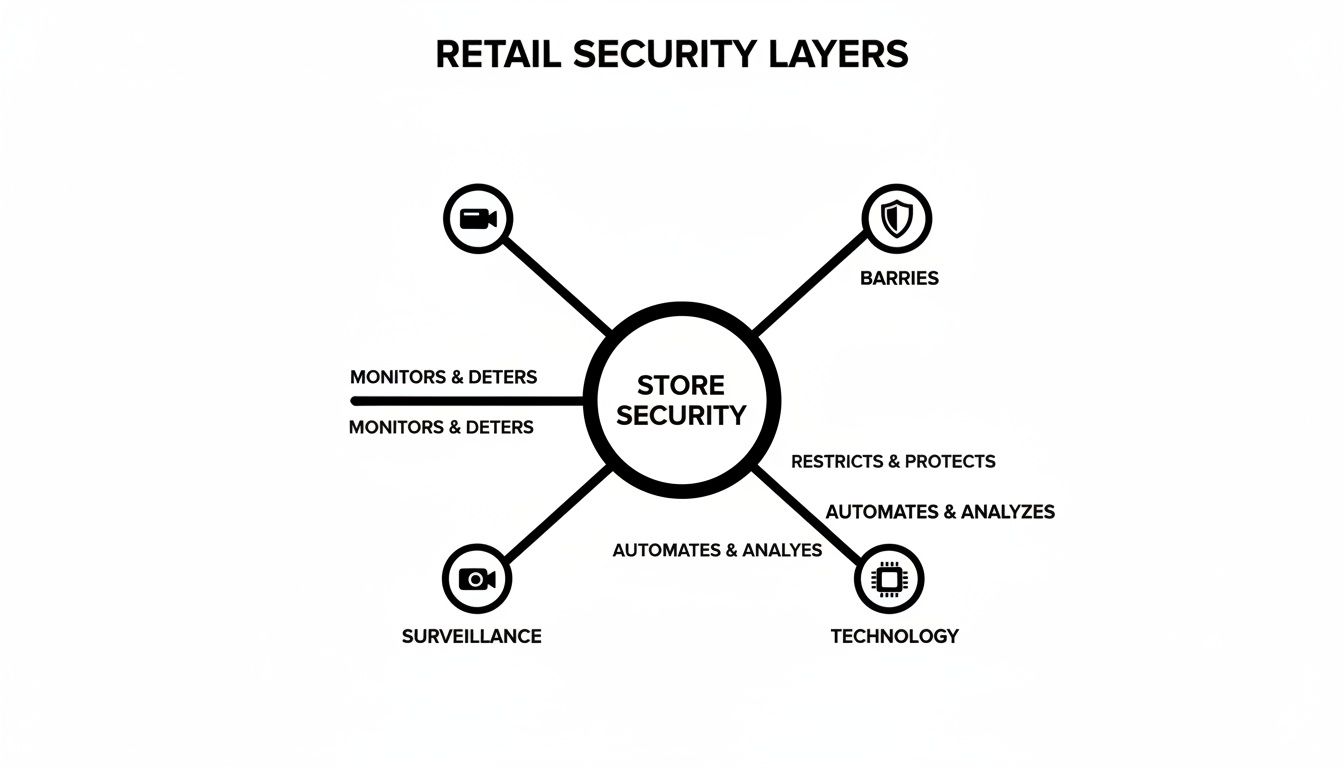
As you can see, real security isn't just one thing. It's the synergy between proactive barriers, reactive technology, and vigilant observation.
Pillar 3: Access Control as Your Gatekeeper
The third pillar, Access Control, serves as the strict gatekeeper for your most sensitive areas. This is what dictates who can go where, and when. It's the system that protects high-value inventory in the stockroom, cash in the back office, and employee-only spaces.
Forget old-school keys that can be lost, stolen, or copied. Modern access control relies on key cards, fobs, or even biometrics. Every entry attempt creates a digital timestamp, giving you a clear audit trail and total control over who is moving through your secure zones. It’s an absolute must for preventing internal theft and locking down your back-of-house operations.
Pillar 4: Physical Reinforcement as Your Shield
Finally, we have the pillar that often makes the biggest difference in a real-world attack: Physical Reinforcement. This is your store's armor. It's the shield that stands up to brute force. This includes security gates, steel bollards, and—most critically for storefronts—advanced security glazing and window films.
In a smash-and-grab robbery, a criminal’s biggest advantage is speed. Reinforced glass is their worst enemy. Security window film bonds directly to your glass, making it incredibly difficult to shatter and penetrate. This one upgrade can introduce a critical delay, frustrating thieves and often forcing them to give up and flee. An alarm tells you a window has been broken; reinforced glass can stop it from breaking in the first place. For more on this, our guide on how to prevent retail theft offers even more strategies.
Each pillar is strong on its own, but together, they form an unbreakable security chain. Your cameras see, your alarms shout, your doors control access, and your windows hold the line. That synergy is the heart of any modern retail security system.
Integrating Your Security Technology
Having a few cameras and an alarm system is a decent start, but a truly effective retail store security system works less like a collection of solo acts and more like a symphony orchestra. Each piece of your technology needs to communicate and work in harmony to create a smart, proactive defense. Integration is what turns a box of security parts into a cohesive security strategy.
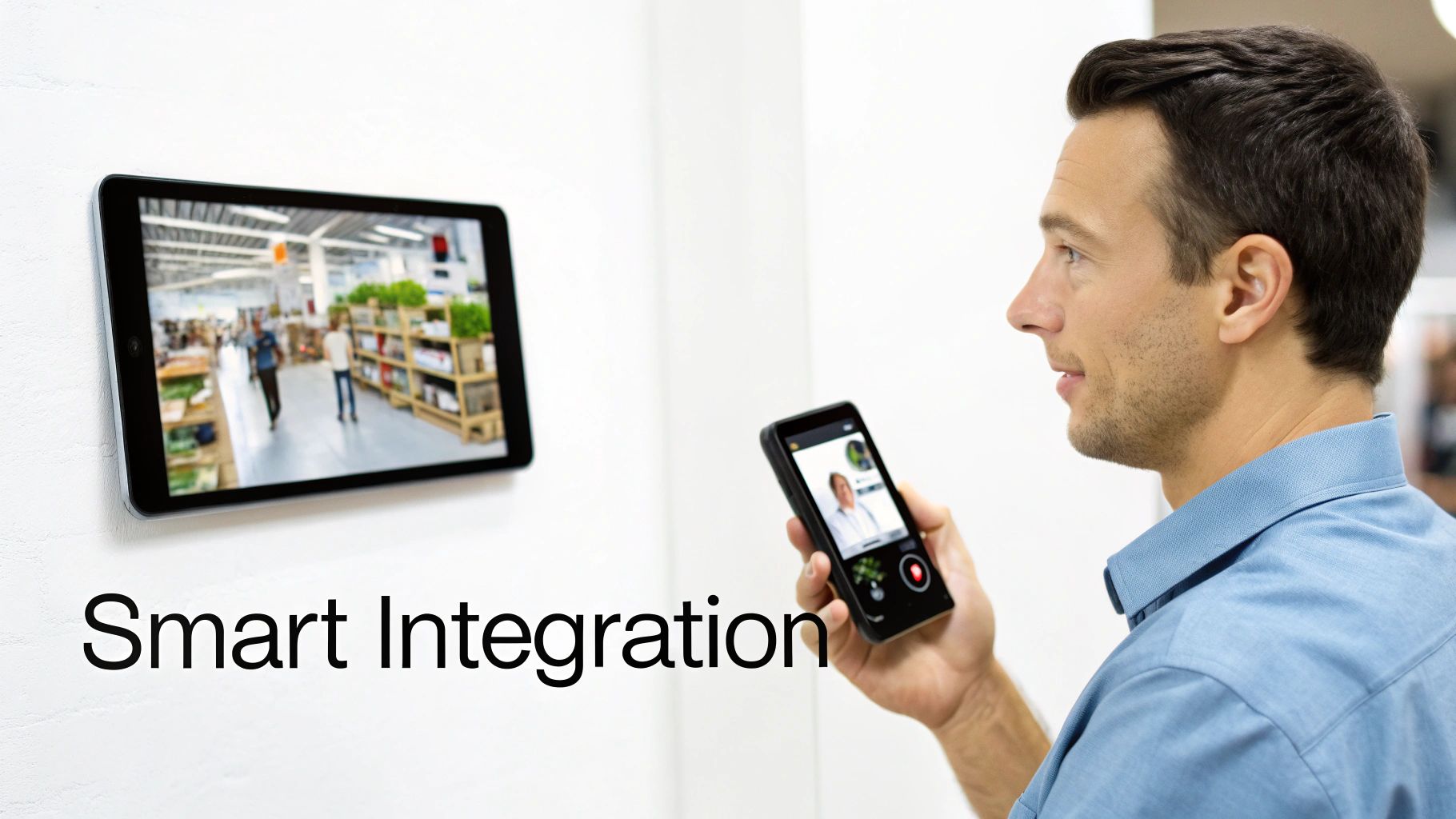
Think about it this way: a motion sensor on your back door trips after hours. In a disconnected setup, you just get a loud, blaring alarm. But in an integrated system, that single event triggers a coordinated response. The closest Pan-Tilt-Zoom (PTZ) camera instantly swivels to focus on the door, your phone buzzes with a notification and a live video feed, and the entire event is logged for you to review.
This is where integration really shines. It transforms isolated, reactive alerts into a unified, intelligent response. Your security data becomes infinitely more powerful when all your systems are talking to each other.
Unlocking Proactive Security with AI Analytics
Modern integration gets a serious boost from Artificial Intelligence (AI) and advanced video analytics. Instead of just recording what happens, today’s smart cameras can actually understand it. They learn the normal rhythm of your store—the daily foot traffic, vehicle patterns, and employee movements—and can instantly flag anything out of the ordinary.
This ability to spot anomalies before they become incidents is a game-changer. Key AI-powered features include:
- Loitering Detection: The system can automatically alert you to people or vehicles hanging around entrances or loading docks for too long, which is often a precursor to a break-in.
- Object Detection: Smart cameras can tell the difference between people, cars, and stray animals, dramatically cutting down on false alarms.
- Facial Recognition: You can build a watchlist of known offenders, and the system will notify your team the moment a recognized individual walks in.
This shift toward smarter, more active monitoring is exactly what people want. Recent data shows that both frontline retail workers and customers feel safest with visible security. In fact, 49% identified video security monitoring as the top source of peace of mind—far more than just alarms. You can find out more about these trends in retail security to see why this preference is shaping modern security decisions.
Connecting Security to Business Operations
The perks of an integrated system go well beyond just stopping theft. When you link your security data to other business platforms, you can uncover some incredibly powerful operational insights. The most valuable connection you can make is with your Point-of-Sale (POS) system.
By tying video footage directly to transaction data, you create an airtight record of every single sale. This means you can instantly pull up the video for suspicious activities like fraudulent returns, "sweethearting" (employees giving friends unapproved discounts), or excessive voids just by searching the transaction ID.
Suddenly, your camera system isn't just a passive observer—it's an active tool for protecting your bottom line. It helps you pinpoint training issues, catch internal theft, and settle customer disputes with cold, hard proof.
Choosing Technology That Plays Well Together
To build this kind of interconnected security network, you have to pick technologies that are designed to be compatible from the get-go. As you select components for your retail store security system, make it a priority to choose solutions built on open standards.
Look for devices that are ONVIF-compliant. The Open Network Video Interface Forum (ONVIF) is a global standard that ensures IP-based security products from different companies can communicate with one another. Choosing ONVIF-compliant cameras, recorders, and software means you’ll never be locked into one vendor’s ecosystem.
This gives you the freedom to mix and match the best tool for each job—say, a high-res dome camera for the sales floor and a weather-proof bullet camera for the parking lot—and know they will all work together seamlessly on a single platform. It ensures your security orchestra can always add a new instrument without skipping a beat.
Spotlighting Physical Security: Your Unsung Hero
Alarms and cameras are crucial parts of any retail store security system, but they're fundamentally reactive. They tell you when something bad is already happening. Physical security, on the other hand, is your proactive defense—it's the unsung hero that can stop a crime before it even starts.
Think about it like this: an alarm alerts you that a window has been smashed, but a reinforced window simply refuses to shatter in the first place. This is where physical upgrades, especially security window film, become your most valuable player.
This isn't your average window tint. We're talking about a micro-thin, incredibly tough layer of polyester that's bonded directly to your existing glass. It’s like giving your most vulnerable entry points—your windows and glass doors—a suit of invisible armor.
When a criminal tries to smash through, the glass might crack, but the film holds all the dangerous shards tightly together. This creates a surprisingly strong and flexible barrier that is incredibly difficult to get through.
The real magic here is that it buys you time. Smash-and-grab robberies depend entirely on speed; thieves want to be in and out in less than a minute. Security film completely robs them of this advantage, turning a quick smash into a loud, frustrating, and very public struggle.
A Tale of Two Storefronts
To see how this plays out in the real world, let's imagine a scenario. Picture two jewelry stores, right next to each other, both targeted by the same crew at 3 a.m.
-
Store A (No Film): A brick sails through the large plate-glass window, which explodes on impact. In just 5 seconds, thieves are inside, scooping valuables into bags. The alarm is screaming, but they're gone long before anyone can respond. The result? Thousands in stolen goods, plus the headache and cost of replacing a massive window.
-
Store B (With Security Film): The same brick hits the window with a loud crack. But the glass stays in the frame, held together by the security film. The thieves hit it again, and again, making a ton of noise but getting nowhere. After 30 seconds of failing spectacularly, they give up and flee. The alarm has done its job, and more importantly, the store is still secure.
This is what we mean by delaying and deterring. That small investment in window film just saved the business owner tens of thousands of dollars in losses and damages.
Physical reinforcement is the ultimate test of a criminal's resolve. By making entry difficult, noisy, and time-consuming, you dramatically increase the chances that they will simply give up and move on.
The image below shows you exactly what happens when treated glass is attacked. It spiders and cracks but doesn't collapse, denying easy entry.
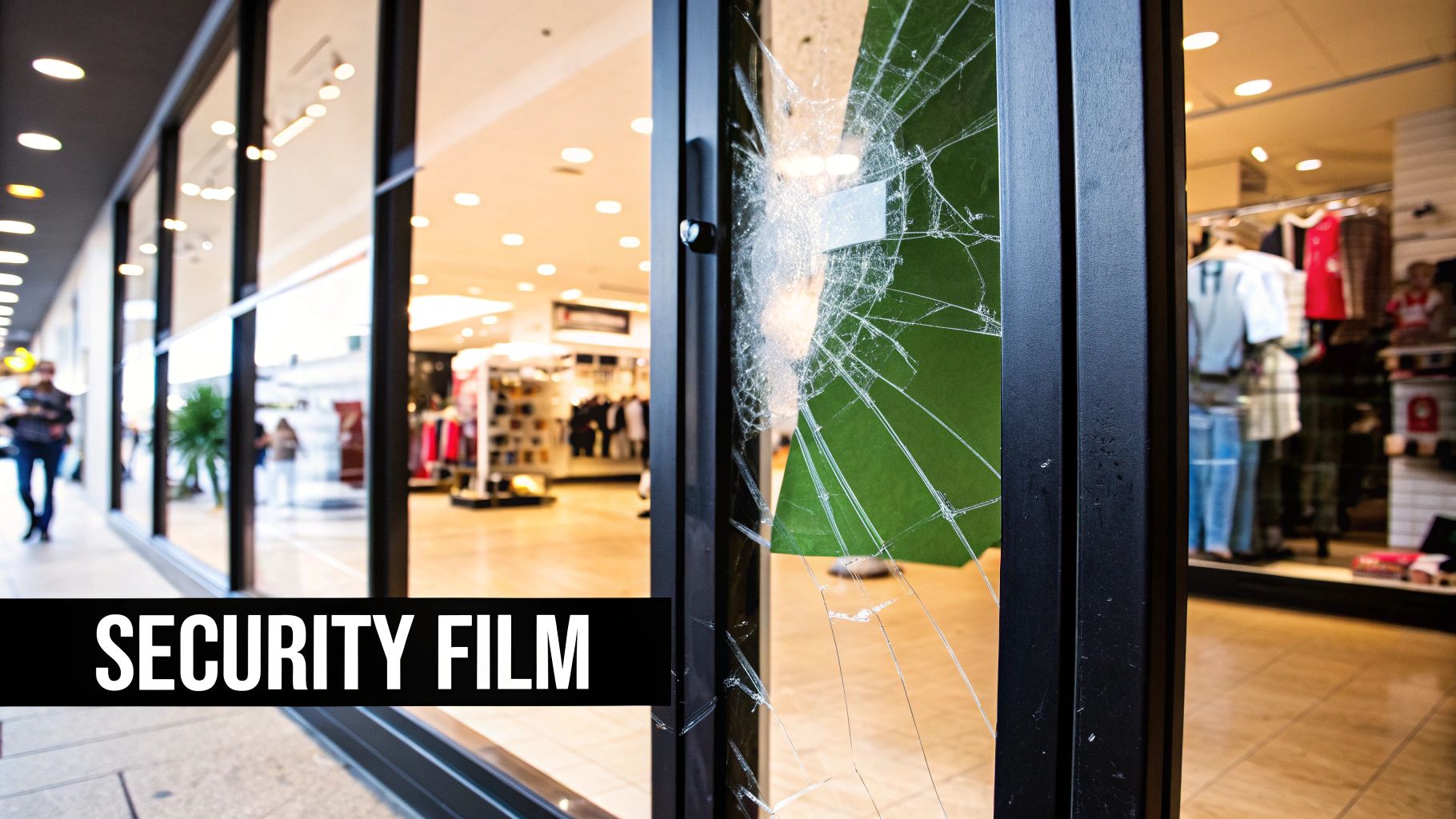
This is a perfect illustration of how the film keeps shattered glass in place, turning a weak point into a formidable barrier against intruders.
Beyond Film: Other Physical Deterrents
While security film gives you a fantastic blend of protection and aesthetics, it's just one piece of the physical security puzzle. Other effective options include:
- Security Gates and Shutters: These are a powerful visual deterrent, especially for after-hours protection. The big downside, of course, is that they completely block your window displays, which is a non-starter for many retailers.
- Bollards: If you're worried about ram-raids, these heavy-duty steel posts installed out front are your best defense against a vehicle crashing through your storefront.
- Reinforced Doors and Frames: Your door is only as strong as its weakest link. Upgrading to a steel frame and high-security locks can fortify one of the most common points of forced entry.
The unique advantage of security film is that it provides serious protection without forcing you to compromise on your store's appearance. Your merchandise stays visible, natural light still streams in, and your storefront looks as inviting as ever.
It’s the perfect balance between robust security and great retail aesthetics. You can learn more about how these commercial and retail security film solutions are tailored to different business needs and see if it's the right fit for you.
4. Calculating Your Security Investment and ROI
It's easy to fall into the trap of viewing a retail store security system as just another expense on the balance sheet. But that’s a shortsighted view. The smarter way to look at it is as a strategic investment, one that directly protects your financial health and long-term viability.
To really grasp its value, you have to look beyond the initial price tag and think in terms of Return on Investment (ROI). This isn't just about what you spend; it's about what you save.
Figuring out the ROI starts with tallying up the total cost of ownership. This isn't just the price of the cameras or alarms. You have to account for installation fees and any recurring costs, like monthly subscriptions for professional monitoring. Those are your total investments.
The "return" part of the equation is where things get interesting. This is all about the losses you avoid because your new security measures are in place. This is where the real value shines through.
How to Measure the Real Returns
To get a concrete number for your ROI, you need to track the financial hit you take from security incidents. The biggest factors are pretty straightforward:
- Shrinkage Reduction: In retail, "shrinkage" is the polite term for inventory lost to theft, fraud, or even internal error. A good security setup doesn't just catch thieves; it deters them, which can dramatically cut these losses and directly pad your profit margins.
- Property Damage Prevention: Think about it—the cost to replace a single shattered storefront window can easily run into the thousands, not to mention the lost business during repairs. Physical deterrents like security film stop that damage before it ever happens.
- Insurance Premium Discounts: Most insurance carriers are happy to offer lower premiums to businesses that are actively protecting themselves. These discounts are a direct, recurring saving that chips away at your initial investment year after year.
By tracking these numbers before and after you upgrade your security, you can put a real dollar amount on your savings.
A security system’s ROI isn't just about stopping a single theft. It's about building a more resilient, profitable business over the long haul. You're shifting from reactive damage control to proactive asset protection.
Cost vs. Long-Term Value of Security Systems
Different security components pay for themselves in different ways and on different timelines. A monitored alarm system can stop a catastrophic burglary in its tracks, while a one-time investment in security window film can fend off countless smash-and-grab attempts over its lifetime.
This table provides a comparative look at the initial investment against the potential long-term savings and benefits for key security components.
| Security System | Typical Initial Cost | Primary ROI Driver | Long-Term Value |
|---|---|---|---|
| Monitored Alarm | Moderate (plus monthly fees) | Catastrophic loss prevention | Absolutely essential for after-hours protection and getting police or fire on-site fast. |
| HD Camera System | Moderate to High | Shoplifting deterrence & evidence collection | Reduces daily shrinkage and provides the hard evidence needed for prosecution or insurance claims. |
| Security Film | Low to Moderate (one-time) | Smash-and-grab prevention | Offers years of 24/7 protection against forced entry, saving thousands in potential inventory loss and repair bills. |
Thinking this way helps you justify security upgrades not as a burdensome cost, but as a smart financial move that safeguards your assets and strengthens your business for the future.
Got Questions? We've Got Answers.
When you're thinking about upgrading your store's security, it's easy to get bogged down in the details. It’s a big decision, and you want to get it right. Let's tackle some of the most common questions retailers have about installation, compatibility, and what actually works in the real world.
Think of this as a practical Q&A to build on what we've already covered. The core idea is simple: the best defense is a layered one.
How Much of a Hassle Is It to Install Security Film?
This is a big one. Nobody wants their business turned upside down for a security upgrade. The good news? Installing security film is surprisingly low-impact.
Professionals are used to working around a retailer’s schedule. They can often do the entire job after hours—overnight or in the early morning—so you don't lose a single minute of business. It's a clean, quiet process that's way faster and less disruptive than putting in things like roll-down metal gates.
Can I Just Add New Cameras to My Old System?
It’s a tempting shortcut, but mixing old and new tech can be tricky. Sure, some new IP cameras might technically work with an older DVR, but you'll almost certainly miss out on the features you're paying for.
To get the full power of modern security—like smart, AI-driven alerts and instant access on your phone—you really need a system where every component is designed to work together. A good security pro can look at what you have and map out the smartest upgrade path, whether that means a complete overhaul or phasing in new equipment over time.
If you take one thing away from this guide, let it be this: start with a professional risk assessment. Every store is different. An expert will spot vulnerabilities you’d never see, from a weak back door to a blind spot in your camera's view, and help you build a smart, layered plan that actually fits your budget.
Will an Alarm Actually Stop a Smash-and-Grab?
Here's the hard truth: an alarm is a reactive measure. It goes off after someone has already broken in. In a smash-and-grab, the whole event is over in less than a minute—long before police can possibly respond.
This is exactly why layers are so critical. An alarm alerts you to the problem, but a physical barrier like security window film is proactive. It’s designed to stop them from getting in at all. By making the glass incredibly difficult to break through, you buy precious time. You might even stop them cold. It’s the difference between getting a notification that you've been robbed and preventing the robbery from ever happening.
Ready to add that crucial proactive layer to your security? The experts at Fortress Security Films specialize in reinforcing your most vulnerable entry points with advanced, nearly invisible security films. Protect your assets, deter criminals, and gain true peace of mind by making forced entry nearly impossible. Schedule your free security consultation with Fortress Security Films today!
