


Staring at empty shelves after a smash-and-grab or dealing with the aftermath of vandalism isn't just a line item on a spreadsheet. It’s a gut punch. It's a clear signal that the old ways of thinking about security just don't cut it anymore.
True retail shop security is no longer about just reacting to theft. It’s about getting ahead of aggressive threats like organized crime and forced entry. It's all about hardening your physical space before an incident ever happens.
Understanding Modern Threats to Retail Security
Imagine your store is a fortress. Your cameras and alarms are your high-tech surveillance systems—absolutely essential for spotting trouble. But what good are they if your fortress walls—your glass windows and doors—are paper-thin? The best alarm in the world can't stop a brick from flying through standard glass. This is the new reality for retailers.
The game has changed. We've moved beyond trying to stop simple shoplifting. Now, we're defending against coordinated, often violent attacks. The retail world is seeing an unprecedented wave of organized crime, and it's far more serious than petty theft. In fact, annual retail security incidents have shot up, making retail the seventh-most targeted industry. This new landscape demands a new strategy: a layered defense that starts with your most obvious weak points.
The Rise of Organized Retail Crime
Organized Retail Crime (ORC) isn't a random person grabbing something off a shelf. These are sophisticated criminal networks stealing high-value goods in bulk to resell them. They often operate with terrifying confidence, pulling off "smash-and-grab" robberies in broad daylight, putting both your inventory and your people at risk.
A proactive security posture is no longer a "nice-to-have." It's the absolute baseline for protecting your assets, keeping your staff safe, and getting some peace of mind in a pretty tough environment.
These attacks are fast and destructive by design. They're meant to overwhelm any typical security response. Sure, an alarm might go off, but by the time anyone can react, the crooks—and your merchandise—are long gone. This is exactly why a hardened physical barrier is so crucial. It buys you the one thing these criminals don't have: time.
From Reactive to Proactive Defense
For years, the standard playbook was reactive. A break-in happens, you file an insurance claim, and you hope it doesn't happen again. That model is a financial and operational dead end today. A proactive approach flips the script by focusing on deterrence and prevention. The goal is simple: make your storefront such a difficult and time-consuming target that criminals decide to just move on to an easier one down the street.
Adopting this proactive mindset means taking a hard look at your entire physical space:
- Forced Entry Vulnerabilities: Where are your weak spots? Are they the flimsy back door, the standard plate glass windows, or the basic locks that offer almost no resistance?
- Vandalism Hotspots: Which areas seem to attract graffiti or damage? A storefront that looks neglected can be a magnet for more serious crime.
- Inventory Shrinkage: To truly secure your business, you need to understand all the ways you're losing product. Digging into the various retail shrinkage causes and prevention strategies gives you the bigger picture.
When you address these physical weaknesses first, you build a strong foundation. Suddenly, all your technology—your cameras, your alarms—becomes exponentially more effective. It goes from being a passive recording device to an active part of a truly formidable security system.
Conducting Your Own Security Health Check
How secure is your storefront, really? It’s a tough question, but one you can't afford to ignore. Giving your business a security health check is like a physical for your shop—it helps you find the weak spots before they turn into something serious. This isn't about hiring expensive consultants; it's about walking through your space and learning to think like someone trying to get in.
You have to shift your perspective. Stop seeing your store as an owner and start looking at it through the eyes of a potential thief. Where are the blind spots? What are the easiest entry points? What does your shop look like after everyone’s gone home? This simple mindset switch will instantly reveal vulnerabilities you probably walk past every single day. Identifying these weak points yourself is the first step to building a smart action plan, rather than just reacting after a costly break-in.
The game has changed in retail security. We've had to move past old-school methods to adopt a smarter, layered approach to defense.
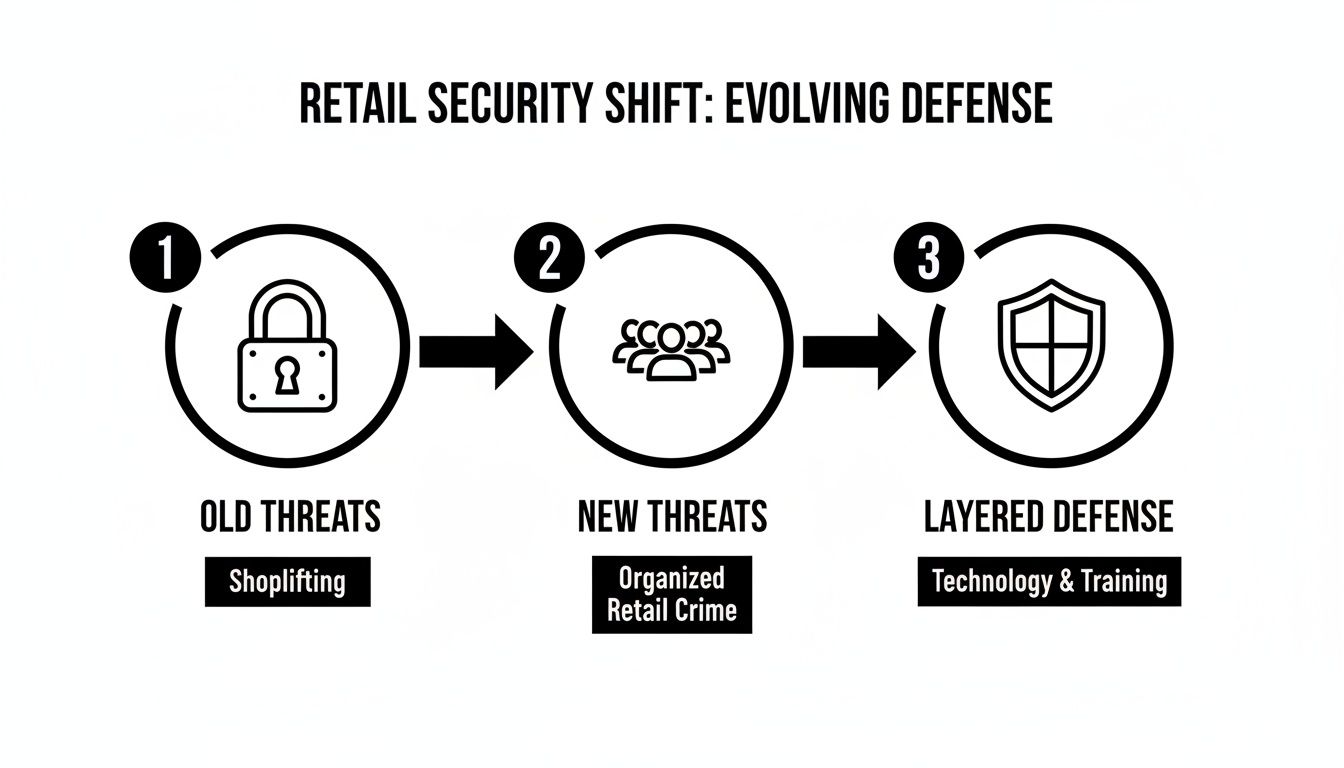
As you can see, the industry has evolved from just worrying about petty shoplifting to fighting organized crime. The solution lies in building multiple layers of defense.
Step 1: Pinpoint Your Most Valuable Assets
Before you can protect anything, you need a crystal-clear inventory of what you’re trying to protect. And it's not just about the merchandise on the shelves. You have to think bigger. Your goal here is to make a complete list of everything a criminal might find valuable.
Start by listing out your critical assets:
- High-Value Inventory: What are your big-ticket items? Think electronics, jewelry, designer clothes, or anything that's easy to grab and resell.
- Cash and Financials: This means the cash in the register, the safe, and even the sensitive financial data on your POS systems.
- Data and Systems: Customer lists, employee records, and the software that runs your business are all prime targets.
- People: Let's be clear—the safety of your staff and customers is, and always will be, your single most important asset.
This first step gives you the "why" behind your retail shop security plan. It clarifies exactly what's at stake and helps you focus your time and money where it will do the most good.
Step 2: Identify the Threats You Face
Once you know what you're protecting, you need to figure out who you're protecting it from. The threats facing a retail business aren't one-size-fits-all. They can range from a kid on a dare to a sophisticated criminal crew.
Think about these common threat actors:
- Organized Retail Crime (ORC) Groups: These are the pros. They plan coordinated attacks like smash-and-grabs, hitting stores for high-value goods they can quickly flip online.
- Opportunistic Criminals: This is anyone who sees an easy opening—an unlocked back door, a poorly lit alley, or an unattended register—and decides to take advantage.
- Vandals: Sometimes the goal isn't theft, it's just destruction. Vandals can cause thousands in damage to your windows, doors, and storefront for no reason at all.
- Internal Risks: It’s an uncomfortable truth, but threats can also come from within. Employee theft or just plain carelessness can be incredibly costly.
Understanding the specific threats in your area and for your type of business is the absolute foundation of an effective security strategy. You can't build the right defense if you don't know what you're fighting.
Step 3: Spot Your Specific Vulnerabilities
Okay, now it’s time to connect the dots. You have your assets and you have the threats. Where do they meet? Those are your vulnerabilities—the specific weak points a criminal could use against you. Walk your property, inside and out, during business hours and again after you've closed for the night. For a deeper dive into how the pros do it, you can learn more about professional security threat assessments.
Keep an eye out for these common weak spots:
- Unprotected Glass: Are your big storefront windows and glass doors made of standard, easy-to-break glass? This is the #1 entry point for smash-and-grab thieves.
- Poor Lighting: Do a walkthrough at night. Are there dark corners by your entrance? Unlit alleyways behind the store? These are perfect spots for someone to hide or work without being seen.
- Outdated Locks and Doors: Check the locks on every single door, especially back entrances and storage areas. Are the door frames flimsy or are they properly reinforced?
- Operational Gaps: Take a hard look at your daily routines. Are opening and closing procedures followed every single time? How is cash handled at the end of the night?
To help you put all this together, you can use a simple tool called a threat matrix. It helps you visualize your risks so you can prioritize what to fix first.
Retail Security Threat Matrix
This matrix helps you weigh the likelihood of a threat against its potential damage, guiding you toward the most critical countermeasures.
| Threat Type | Likelihood (Low/Medium/High) | Potential Impact (Low/Medium/High) | Primary Countermeasure |
|---|---|---|---|
| Smash-and-Grab | High | High | Reinforced Glass / Security Film |
| Forced Entry (Back Door) | Medium | High | Reinforced Doors & Alarms |
| Vandalism | Medium | Medium | Security Film & Lighting |
| Internal Theft | Low | Medium | Access Control & Procedures |
| Shoplifting | High | Low | Staff Training & Store Layout |
By analyzing your risks this way, you can see that a high-likelihood, high-impact threat like a smash-and-grab should be your top priority.
Once you complete this health check, you're no longer dealing with abstract fears. You have a concrete, prioritized to-do list. This is your roadmap to strengthening your retail shop security and protecting what matters most.
Building Your First Line of Physical Defense
Now that you've finished your security health check, you should have a pretty clear picture of where your store's weak spots are. It's time to start building your fortress, and that begins with the most critical layer: your physical defenses. This is all about hardening the outer shell of your business to create a powerful, visible deterrent that stops criminals in their tracks.
Think of it like the safety features in your car. Your side windows are made of tempered glass, which shatters into a million tiny pieces with one good whack. But your windshield is different—it's laminated safety glass. When something hits it, the glass cracks and spiders but holds together, keeping everyone inside safe. Your goal is to make your storefront act more like that windshield: a tough, resilient barrier that refuses to give way easily.
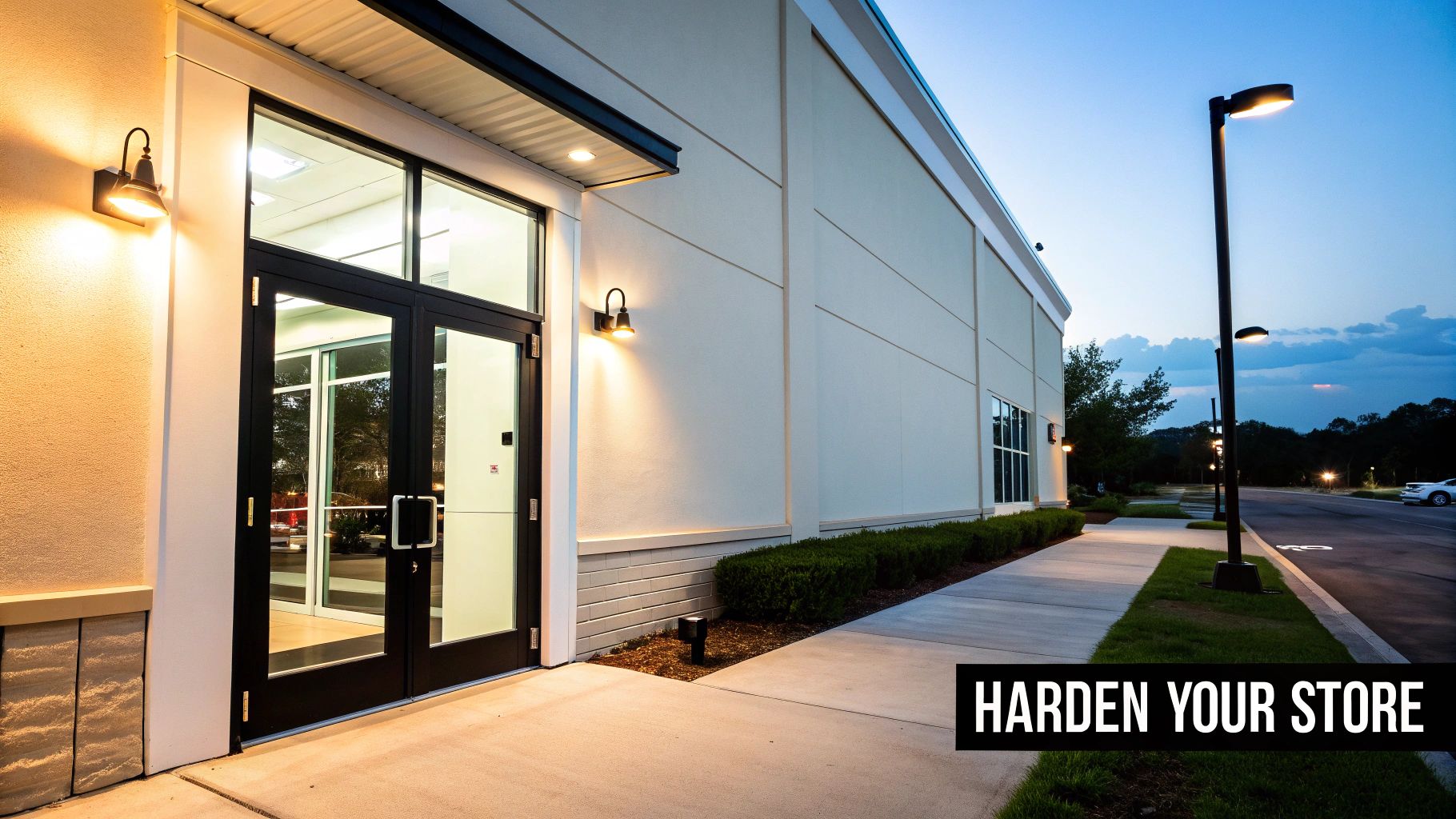
This first line of defense is where you’ll get the biggest bang for your buck in retail shop security. By focusing on the fundamentals—glass, doors, locks, and lighting—you create an environment that screams "prepared and protected."
Reinforcing Your Most Vulnerable Asset: Glass
For most retailers, those big, beautiful glass windows and doors are a marketing dream and a security nightmare. Standard plate or tempered glass offers almost no resistance to a determined thief with a brick. It's the path of least resistance for smash-and-grab crews who count on being in and out in seconds.
This is where high-performance security window films can be a total game-changer. These aren't your average window tints. We're talking about thick, multi-layered polyester films that are professionally bonded directly onto your existing glass.
When an attacker strikes, the glass might crack, but the film holds all those dangerous shards together, right in the frame. It creates a tough, flexible barrier that is shockingly difficult to get through. That delay is everything. Instead of getting instant access, a criminal is forced to make loud, repeated attempts to break in, completely derailing their plan and drastically increasing the odds they’ll get caught.
The real job of reinforced glass isn't to be unbreakable; it's to deny instant entry. That crucial delay of 60 to 90 seconds is often all it takes to convince an attacker to give up and run.
When you're choosing a solution, you'll need to look at both the film itself and how it's anchored to the window frame. The combination of the two is what creates a truly formidable defense.
Securing Your Entry Points: Doors and Locks
While your glass is a huge priority, don't forget about your doors. A weak door or a cheap lock can completely undermine even the most secure windows. The goal is to make sure every single entry point is just as tough as the next.
Start by taking a hard look at all your doors—especially the back and delivery entrances, which are common targets.
- Door Material: Solid-core wood or steel doors provide way more resistance than the hollow-core doors you find in most homes. If you have glass doors, make sure they're beefed up with security film.
- Door Frames: A strong door is useless without a strong frame. Reinforce the frame and hinge points using heavy-duty strike plates and longer screws that bite deep into the wall studs.
- Commercial-Grade Locks: Ditch the basic locks and upgrade to high-quality, commercial-grade deadbolts. Look for features like hardened steel bolts and protection against drilling or picking.
These pieces all have to work together as a system. A $300 deadbolt is worthless if it's mounted on a flimsy frame that can be kicked in with one good shove. Real security means reinforcing the entire entry point.
Illuminating Your Exterior to Eliminate Shadows
Criminals love the dark. Poor exterior lighting creates shadows and hiding spots, giving them all the cover they need to scope out your property, tamper with locks, or set up for a break-in without being seen. Good, strategic lighting is one of the most cost-effective deterrents you can possibly install.
The principle here is simple: get rid of the shadows.
- Entry Point Lighting: Make sure all your doorways, front and back, are brightly lit. Use downward-facing fixtures to cut down on glare and fully illuminate anyone who approaches.
- Perimeter Illumination: Light up the sides and rear of your building. Pay special attention to alleyways, loading docks, and those dark corners near dumpsters.
- Consistent Coverage: Walk your property at night and hunt for dark spots. The goal is to create overlapping fields of light so there are no convenient places for someone to hide.
Well-designed lighting makes your business feel occupied and watched, even in the middle of the night. It sends a clear signal that this is not an easy target. When you combine that with reinforced glass and secure doors, you complete your first line of physical defense—a formidable barrier that protects your assets and gives you some much-needed peace of mind.
Investing in Security Window Film Protection
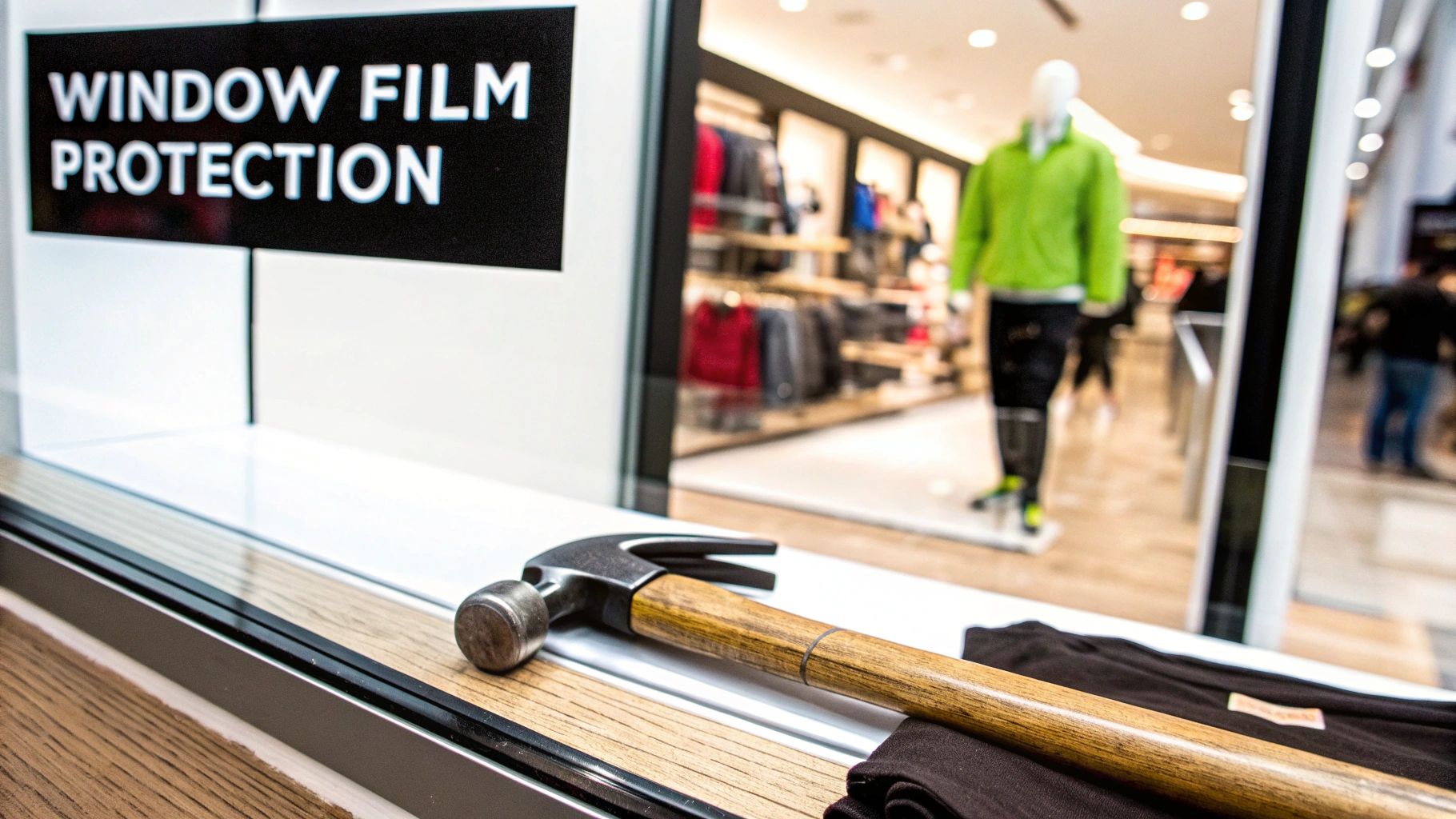
When it comes to smart upgrades for modern retail shop security, window film is one of the most effective investments you can make. This isn't just a tint or a simple sticker. We're talking about an advanced, multi-layered polymer engineered to bond directly with your glass, absorbing and dispersing the force from a hammer, crowbar, or brick.
Think of it as an invisible shield for your most vulnerable entry points. Standard glass shatters on impact, falling away and giving a thief instant access. A window treated with security film, however, holds together. The glass might crack under a heavy blow, but the film’s aggressive adhesive keeps the shards locked tightly in the frame. It creates a formidable barrier that’s incredibly tough to get through.
It’s all about buying you critical time. For a criminal who relies on speed, that unexpected delay is their worst enemy.
How Security Film Works
At its core, security film is all about impact absorption and shatter resistance. The film’s layered construction is specifically designed to stretch and give upon impact—almost like a trampoline. Instead of letting the force concentrate on a single point and break the glass, it spreads that energy across the entire windowpane.
The result is a tough, flexible membrane that denies intruders the quick, quiet entry they were counting on. That forced delay, and the noise they have to make to even try to get through, is often more than enough to make them give up and run.
The primary job of security film is to transform a storefront's weakest link into a powerful deterrent. By holding shattered glass in place, it creates a frustrating and noisy barrier that completely disrupts a smash-and-grab attempt.
Beyond thwarting break-ins, these films also provide a critical layer of safety. By preventing glass from exploding inward during an attack or even from severe weather, they protect your staff and customers from dangerous flying shards.
Choosing the Right Protection Level
Not all security films are created equal. When you're selecting a film for your retail business, you need to look at a few key performance metrics to make sure you’re getting the protection you actually need. The single most important factor is film thickness, which is measured in mils (one-thousandth of an inch).
Here’s a quick breakdown of what to look for:
- Film Thickness (Mils): You’ll find films ranging from 4 to 21 mils. A basic 4-mil film offers decent safety from accidental breakage, but for effective smash-and-grab deterrence, you should be looking at 8 mils or higher.
- Attachment Systems: For maximum strength, the film needs to be anchored to the window frame itself. An attachment system—usually a bead of specialized silicone or a mechanical gasket—bonds the film-covered glass to the frame, which stops the entire pane from being pushed in.
- Optical Clarity: Your window displays are a critical part of your business. High-quality security films are optically clear and virtually invisible after installation. They won't compromise your store's aesthetic, curb appeal, or the natural light your customers and staff enjoy. This invisible strength is a key feature of effective commercial retail security film.
This level of physical protection is becoming more crucial than ever. A recent report highlighted a staggering 57% year-over-year increase in physical assaults on retail employees, creating unprecedented safety concerns for business owners. You can read more about this alarming trend and what it means for the 2025 retail threat landscape.
The Importance of Professional Installation
Finally, remember that even the best security film on the market will fail if it isn't installed correctly. Professional installation is non-negotiable.
Certified technicians have the right tools and deep expertise to properly prepare the glass, apply the film without bubbles or flaws, and correctly install the attachment system. This process ensures a seamless bond between the film, the glass, and the frame, guaranteeing the system performs exactly as designed when you need it most. It’s the crucial final step in hardening your business against attack.
Layering Technology Over a Strong Foundation
Physical barriers are your first line of defense, but technology is what makes them truly formidable. Think of it like this: your reinforced storefront is the castle wall. It's tough, but it's the watchmen on the towers—your alarms and cameras—who spot trouble brewing and sound the alarm. Tech doesn't replace physical security; it supercharges it, turning a passive defense into an active, intelligent one.
This partnership is the core of modern retail shop security. For example, security film is fantastic at one thing: buying you time. When a would-be thief smashes the glass, the film holds the shards together, delaying their entry. But the real magic happens when a glass-break sensor instantly trips a blaring alarm. That delay created by the film becomes a critical window for police to arrive before anyone gets inside.
Integrating Your Security Ecosystem
The best security setups don't rely on standalone gadgets. They're integrated, meaning all the different pieces talk to each other. This creates a smart, responsive network that gives you a complete picture of what’s happening during an incident.
A well-integrated system usually brings a few key players to the table:
- High-Definition Cameras: Today's cameras give you crystal-clear footage, even in near darkness. Placed correctly, they're not just for recording evidence—their very presence can make a criminal think twice.
- Smart Alarm Systems: These are more than just noisemakers. We're talking motion detectors, glass-break sensors, and door contacts that can ping your phone and a monitoring service the second they're tripped.
- Access Control Systems: Putting keypads or card readers on stockroom doors and employee entrances creates a digital log of who comes and goes, and when. It’s an indispensable tool for keeping an eye on internal security risks.
When these components work together, a triggered sensor on the back door can instantly tell the nearest camera to start recording and send a live feed straight to your phone. Suddenly, you have eyes on the scene from anywhere.
The Power of Remote Monitoring and Oversight
One of the biggest wins with modern security tech is the ability to check in on your business from anywhere on the planet. Internet-connected systems let you pull up live camera feeds, arm or disarm your alarm, or even lock a door, all from an app on your smartphone. The peace of mind this offers, especially after you've locked up for the night, is huge.
Technology excels at detection and response, but it’s the physical barriers that provide the essential delay and deterrence. One without the other is an incomplete solution.
This remote capability is a good reminder that your physical and digital security are more connected than ever. Cyber attacks are a massive and growing problem for retailers, with criminals targeting everything from your POS system to customer data. In fact, recent data shows attacks on the retail sector jumped by 34% in a single year. You can get a deeper look into the rise of retail cyber attacks on heimdalsecurity.com. Protecting your network is just as vital as protecting your front door.
At the end of the day, you're building a system of layers where each piece backs up the others. Your reinforced glass provides the delay, the alarm provides the alert, and your cameras provide the proof. Together, they create a tough, responsive security posture that tells criminals to go look for an easier target.
Training Your Team to Be a Security Asset
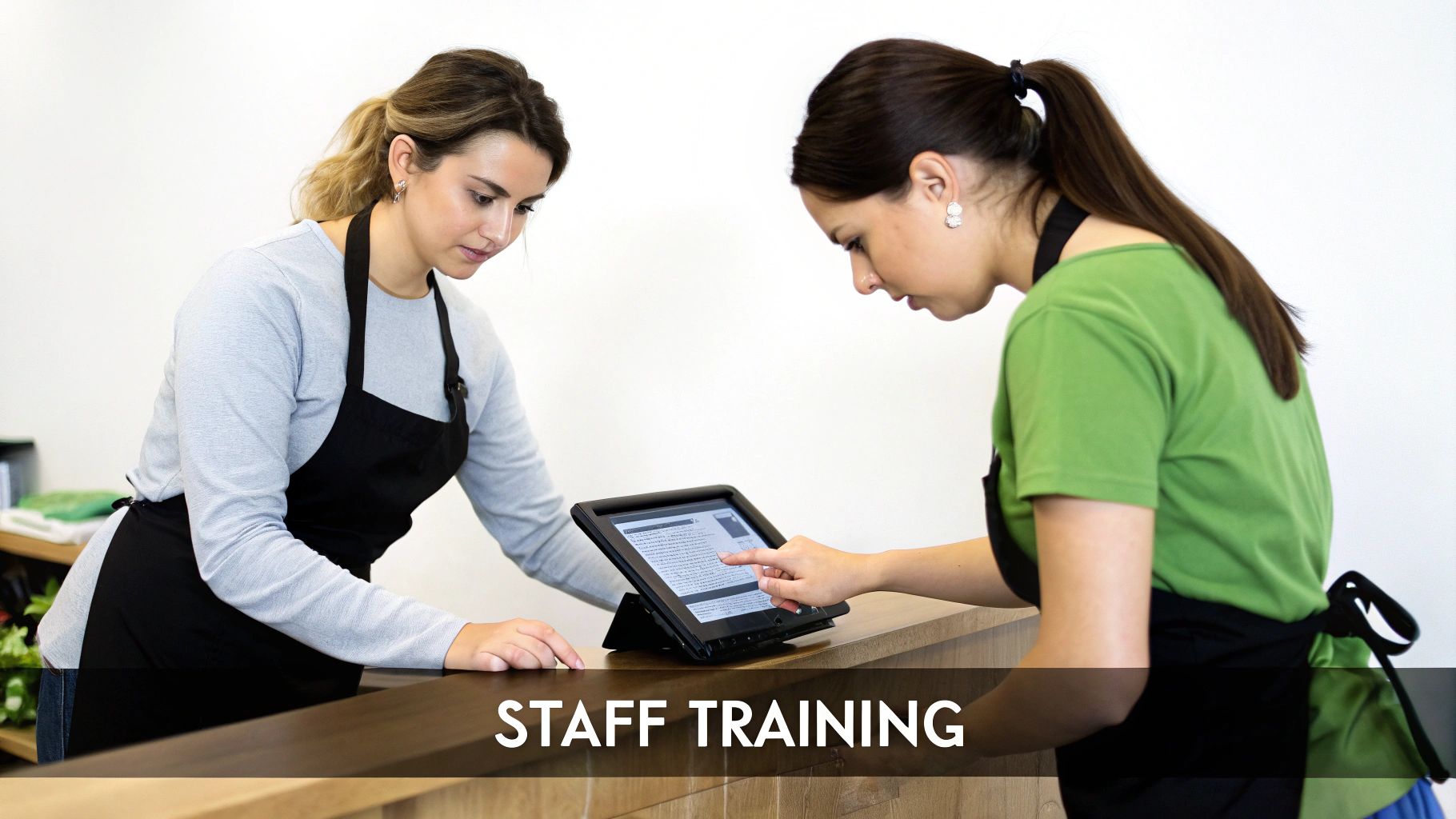
Your reinforced glass and high-definition cameras are essential, but they can't greet a customer or get that gut feeling when something is off. The most overlooked part of any retail shop security plan is your team. When your employees are well-trained and aware, they stop being potential targets and become your first line of defense—a human firewall that can spot trouble brewing.
Investing in your staff's security training builds a culture of proactive awareness. It gives them the skills and the confidence to protect themselves, each other, and your business. This isn't about a simple checklist; it's about creating a shared responsibility for keeping the store safe.
Establishing Ironclad Daily Procedures
Good security is built on consistency. When routines get sloppy or ambiguous, you open the door for criminals to walk right in. By creating clear, non-negotiable procedures for daily operations, you take human error out of the equation.
Focus on locking down these critical moments:
- Opening and Closing Protocols: These are your most vulnerable times. Make it a rule that at least two employees are always present. They should do a quick visual scan of the area before entering or exiting and have strict rules for handling keys and alarm codes.
- Smart Cash Handling: Keep the cash in registers to a minimum. Use regular drops into a time-locked safe, and just as importantly, vary the times and routes you take for bank deposits. Predictable patterns are a robber's best friend.
- Inventory Management: You need tight controls for receiving and stockroom access to combat internal theft, which is a surprisingly large source of loss for many retailers. These practices are a huge part of learning how to prevent retail theft from every angle.
These routines eliminate guesswork. Secure actions become second nature for everyone on the floor.
Fostering Situational Awareness and De-escalation
A camera can't spot suspicious behavior, but a person absolutely can. Teaching your staff how to be situationally aware is like giving your security system a brain. They need to know what to look for: individuals lingering without a purpose, watching the staff more than the merchandise, or asking odd questions about the store's layout or security measures.
Just as critical are de-escalation skills. With threats of violence on the rise, your team must know how to handle a tense situation without making it worse.
The goal is never confrontation; it is always to create distance and disengage safely. Teach employees to remain calm, use non-threatening language, and comply with demands in a robbery scenario. Their safety is the number one priority.
Simple role-playing exercises during training can build the muscle memory needed to react correctly under extreme stress, rather than freezing up. This kind of preparation is just as vital as any alarm system you install.
A key part of making your team a security asset also includes solid IT security awareness training. As retail becomes more digital, protecting your business from phishing scams and data breaches is just as important as preventing a physical break-in.
When you arm your team with knowledge and clear procedures, you build a resilient, layered defense. An observant, confident employee is one of the best deterrents you can have, creating an environment where criminals feel exposed and look for an easier target.
Your Top Retail Security Questions Answered
Making a big decision like upgrading your store’s security always comes with questions. It’s a serious investment, and you need straight answers to feel confident you're making the right move for your business. Let’s tackle some of the most common things I hear from retailers when they start looking into modern security solutions.
One of the biggest hang-ups is always the customer experience. Retailers spend so much time creating a welcoming vibe, and the last thing they want is for security measures to make the shop feel like a fortress.
Will Security Film Make My Storefront Look Dark or Uninviting?
Absolutely not, and that's the real beauty of it. Today’s high-quality security films are designed to be optically clear. Once they’re professionally installed, you won’t even know they're there.
They’re engineered for one thing: to provide serious protection without changing the look of your glass. You’ll still get all that beautiful natural light, and customers will have a perfect view of your merchandise. It’s about adding a hidden layer of strength, not changing your store's aesthetic.
Another question that always comes up is how these films stack up against the old-school stuff, like roll-down shutters.
The best retail shop security is the kind that works around the clock without screaming "we're worried about crime." Invisible protection is where the industry has moved.
Is Security Film a Better Investment Than Shutters or Grilles?
For most storefronts, yes. Think about it: shutters and grilles are only useful when you’re closed. They tell everyone "we're shut, come back later," but they do nothing to protect you from a brazen smash-and-grab attack during business hours. They also completely block your window displays overnight.
Security film, on the other hand, provides 24/7 passive protection. It’s always on, always working. It's your silent guardian against forced entry, whether you're open or closed, and it does it all without making your store look like it's on lockdown.
How Much Does Professional Security Film Installation Cost?
This is where it really depends on your specific situation. The cost is based on a few key factors: the total square footage of glass you need to cover, the thickness and type of film you choose, and how complex the installation is.
The only way to get a real number is to have a professional come out and take a look. A proper security assessment will pinpoint your vulnerabilities and help you find a solution that gives you the right level of protection without overspending.
Ready to secure your storefront without sacrificing its appeal? The experts at Fortress Security Films provide professional assessments and installations to give you peace of mind. Learn more and get a custom quote today at fortresssecurityfilms.com.
