


Retail shrinkage, the loss of inventory from factors like theft, fraud, or operational error, is a persistent and costly challenge that directly erodes profit margins. For businesses ranging from high-end boutiques in Beverly Hills to large-scale commercial properties, mitigating this loss is a critical component of financial health. With organized retail crime incidents increasing and economic pressures mounting, a reactive approach is no longer sufficient. Proactive, multi-layered retail loss prevention strategies are essential for survival and growth.
This comprehensive guide moves beyond surface-level tips to provide a detailed roundup of ten proven tactics to protect your assets. We will dissect a wide array of solutions, from sophisticated technologies like RFID tracking and AI-powered video analytics to foundational practices such as strategic staff training and robust inventory controls. Each strategy is presented with actionable implementation guidance, practical examples, and clear return on investment (ROI) considerations.
Whether you are a retail manager, a security consultant, or a commercial property owner, this article is designed to be your go-to resource. It provides the specific, actionable insights needed to fortify your business against internal and external threats. You will learn how to create a secure environment that deters theft, minimizes errors, and ultimately safeguards your bottom line. Let's explore the practical methods that will make your establishment a harder target for loss and a more profitable enterprise.
1. Electronic Article Surveillance (EAS) Systems
Electronic Article Surveillance (EAS) systems are a cornerstone of modern retail loss prevention strategies, acting as a powerful visual and electronic deterrent against shoplifting. These systems operate on a simple principle: security tags or labels are attached to merchandise, and antennas placed at store exits trigger an alarm if an item with an active tag passes through. This immediate alert allows staff to intervene and prevent the theft.
The system consists of three core components: the security tags (either hard tags for apparel or soft adhesive labels for packaged goods), deactivation devices at the point of sale, and the detection antennas at the exits. Major retailers like Target and Macy's have successfully integrated Sensormatic EAS technology, tailoring tag types to specific product categories, from high-end electronics to designer clothing, significantly reducing their shrinkage.
Implementation and Best Practices
To maximize the effectiveness of an EAS system, a disciplined approach is essential. Simply installing the hardware is not enough; operational excellence is key.
- 100% Tagging Compliance: Focus on consistent application. Ensure every designated high-risk, high-value item is tagged without fail. Inconsistent tagging creates vulnerabilities that experienced shoplifters can easily exploit.
- Staff Training: Proper alarm response is critical. Train employees to approach customers confidently and non-confrontationally when an alarm sounds. The goal is customer service and recovery, not accusation.
- System Maintenance: Regularly test the system's sensitivity and the coverage area of the detection gates. A malfunctioning or poorly calibrated system provides a false sense of security.
- Strategic Placement: Position detection antennas to cover all possible exit points, including main entrances, secondary exits, and even restroom hallways if they offer a path out of the store.
The following chart illustrates the typical return on investment for a mid-sized retail operation, balancing the upfront costs against the potential reduction in theft.
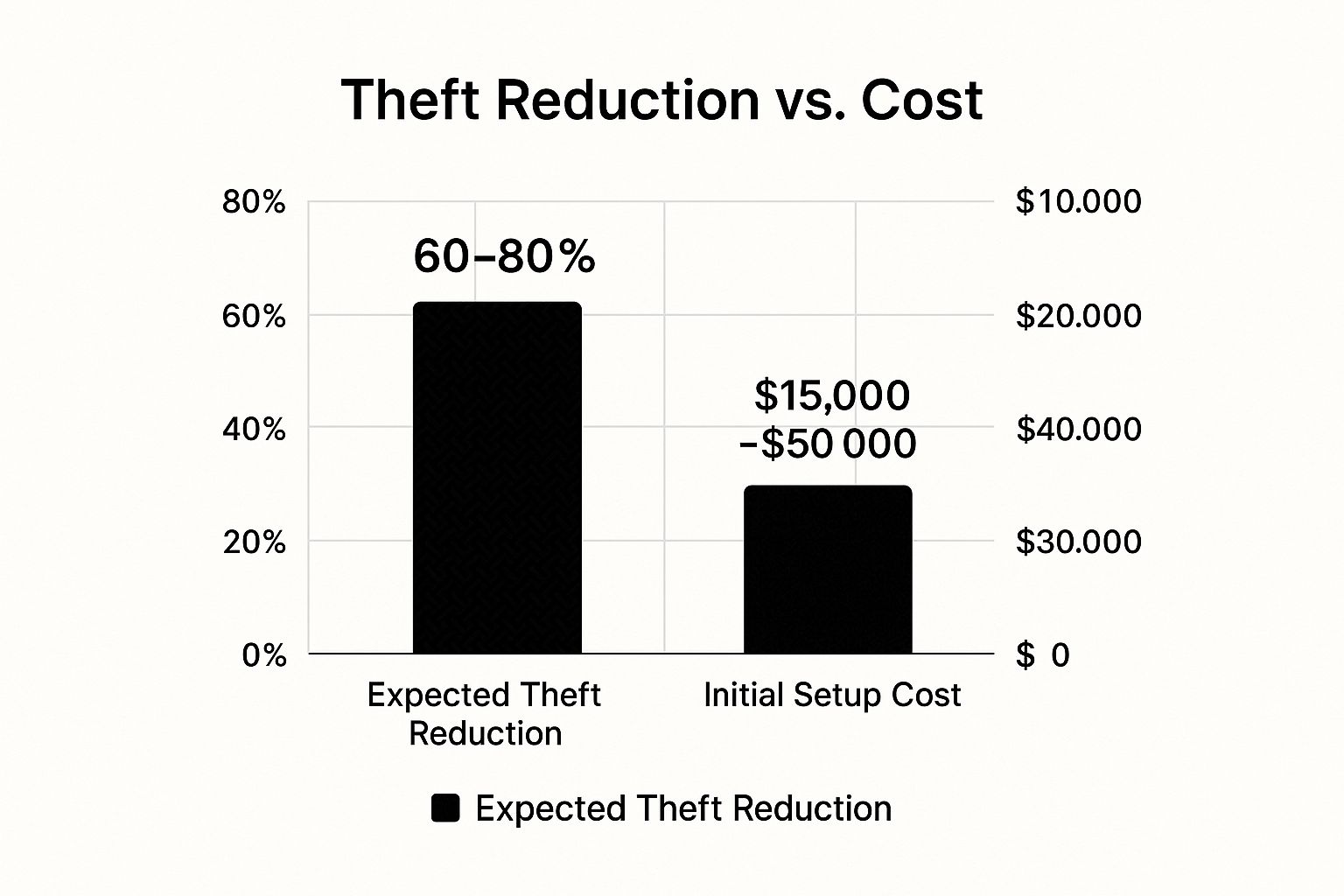
This data highlights that while the initial investment can be substantial, a properly managed EAS system can reduce theft by up to 80%, often providing a return on investment within 12 to 24 months.
2. Advanced Video Surveillance and Analytics
Beyond simple recording, advanced video surveillance and analytics have transformed CCTV from a passive, after-the-fact tool into an active, real-time retail loss prevention strategy. These systems leverage artificial intelligence (AI) and machine learning to automatically analyze video feeds, detecting suspicious behaviors and potential theft activities as they happen. This proactive approach allows security personnel to intervene before a loss occurs.
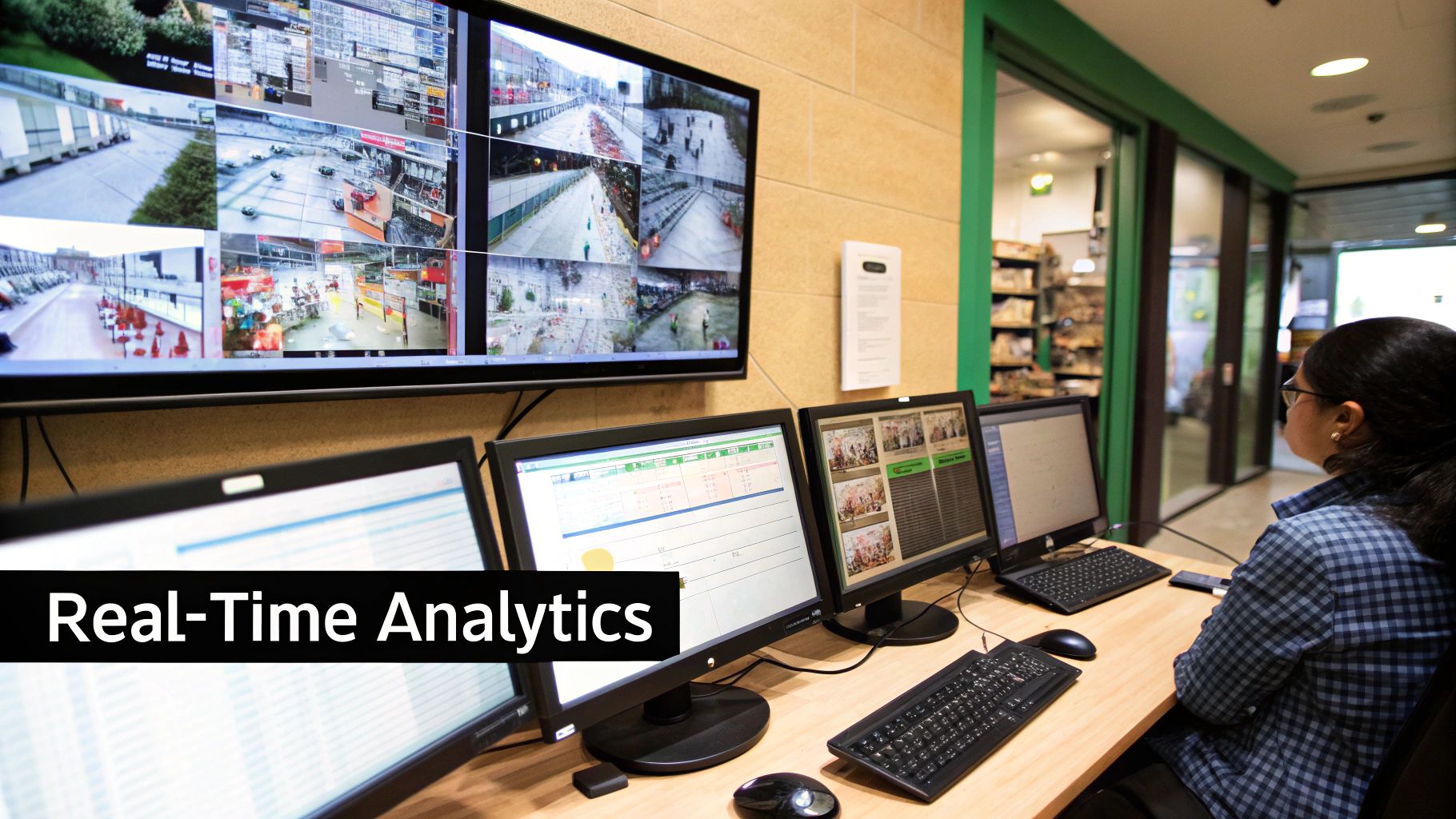
The technology works by training algorithms to recognize patterns associated with theft, such as merchandise concealment, ticket switching, or even the coordinated movements of organized retail crime groups. Leading retailers like Home Depot have implemented AI video analytics to monitor self-checkout lanes for unusual activity, while Best Buy uses it to keep a close watch on high-value electronics sections. These systems, pioneered by companies like Verkada and Axis Communications, provide an intelligent layer of security over traditional camera setups.
Implementation and Best Practices
Deploying an intelligent video system requires careful planning to ensure it is both effective and compliant. The goal is to leverage technology to augment human oversight, not to replace it entirely.
- Focus on High-Risk Zones: Position cameras and focus analytics on areas most prone to theft, such as high-value merchandise aisles, blind spots, stockrooms, and all points of entry and exit.
- Integrate with Existing Systems: Connect your video analytics platform with other security measures like EAS and point-of-sale systems. This creates a unified response where, for example, a POS void transaction can trigger a video review of that specific event.
- Ensure Privacy Compliance: Be vigilant about local and federal privacy laws. Transparently disclose camera usage with clear signage and ensure your policies for data handling and retention are legally sound.
- Train Staff for Alert Response: Automated alerts are only useful if your team knows how to respond. Train security and floor staff to quickly and appropriately react to real-time notifications from the system.
This video from Verkada demonstrates how modern cloud-based surveillance systems and analytics can provide actionable insights for retailers.
By turning raw video data into intelligent alerts, these advanced surveillance systems empower retailers to identify and address threats with unprecedented speed and accuracy, making them a vital component of modern retail loss prevention strategies.
3. RFID (Radio Frequency Identification) Technology
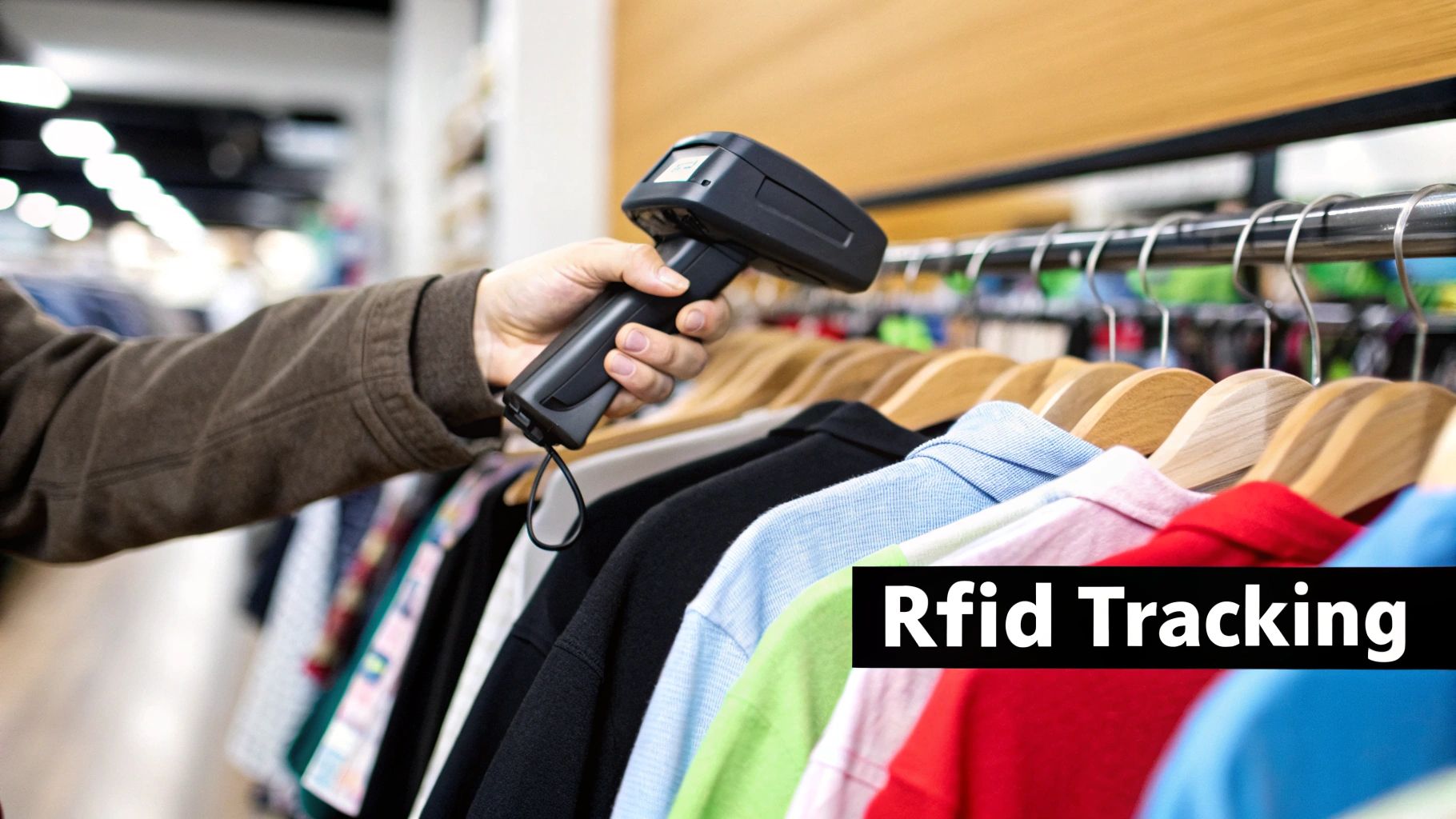
Radio Frequency Identification (RFID) technology elevates retail loss prevention strategies by moving beyond simple theft deterrence to providing item-level intelligence. Unlike traditional barcodes or EAS tags, RFID uses radio waves to automatically identify and track tags attached to individual products. This allows for real-time inventory visibility, as tags can be read in bulk without a direct line of sight, offering precise data on what is in the store, in the stockroom, or leaving through the exit.
This technology consists of RFID tags (or inlays), readers, and software that processes the collected data. Leading retailers have leveraged this for dual benefits. Zara uses RFID tags on every garment to maintain near-perfect inventory accuracy, which also helps identify missing items instantly. Similarly, sporting goods giant Decathlon implements RFID across its product range, enabling seamless self-checkout and robust inventory management, significantly cutting down on shrinkage from both theft and operational errors.
Implementation and Best Practices
Deploying an RFID system requires a strategic approach that integrates the technology into existing retail operations for maximum impact. A successful rollout focuses on both the technical and human elements.
- Phased Rollout: Start by tagging high-value or high-theft categories first. This allows you to prove the concept, measure the ROI on a smaller scale, and work out any operational kinks before a store-wide implementation.
- System Integration: For RFID to be truly effective, its data must feed into your core retail systems. Integrate it with your Point of Sale (POS) and inventory management software to create a single, accurate view of your stock.
- Staff Training and Procedures: Employees must understand how the technology works, from receiving and tagging new inventory to using handheld readers for cycle counts. Establish clear protocols for responding to alerts when an un-purchased item passes through an RFID-enabled exit.
- Privacy Communication: Be transparent with customers about the use of RFID technology. Clear signage explaining that the tags are used for inventory management and are deactivated upon purchase can help address any privacy concerns.
4. Trained Security Personnel and Loss Prevention Officers
Employing trained security personnel is a proactive and highly effective retail loss prevention strategy that adds a critical human element to your security program. Unlike passive systems, professional security officers, whether uniformed or plainclothes, can adapt to evolving situations, identify suspicious behavior patterns, and intervene before a theft occurs. Their presence alone serves as a significant deterrent to would-be shoplifters and organized retail crime groups.
This strategy involves more than just placing a guard at the door. It includes plainclothes Loss Prevention Officers (LPOs) who blend in with shoppers to observe and apprehend suspects, as well as uniformed guards who manage access control and provide a visible security presence. For example, Nordstrom utilizes plainclothes officers to maintain its upscale shopping experience, while Costco stations uniformed personnel at exits to check receipts, a practice that both recovers merchandise and deters theft.
Implementation and Best Practices
Deploying security personnel requires a strategic approach focused on training, clear protocols, and targeted placement to maximize their impact and ensure legal compliance.
- Comprehensive Training: Invest in rigorous training that covers not only surveillance and apprehension techniques but also de-escalation, customer service, and the legal parameters of their role. This minimizes liability and ensures professional conduct.
- Establish Clear Protocols: Develop and implement a clear Standard Operating Procedure (SOP) for every potential incident, from observing a potential shoplifter to apprehension and contacting law enforcement. This consistency is vital for effective and lawful responses.
- Strategic Deployment: Analyze store data to identify high-risk departments and peak theft times. Position personnel accordingly to provide optimal coverage where and when it is needed most, rather than maintaining static, predictable posts.
- Ensure Proper Licensing: Verify that all security personnel, whether in-house or contracted, hold the necessary state and local licenses and certifications. This is a non-negotiable aspect of legal and operational integrity. You can find out more about how professional staff contribute to comprehensive strategies by reading these tips on how to prevent retail theft.
5. Point-of-Sale (POS) System Integration and Monitoring
The Point-of-Sale (POS) system, once just a digital cash register, has evolved into a powerful tool in modern retail loss prevention strategies. Advanced POS systems now act as a crucial line of defense against internal theft and fraud by actively monitoring transaction data for suspicious activities. These systems flag anomalies such as an unusual number of voids, excessive discounts, manual price overrides, or fraudulent returns, which are often indicators of employee misconduct.
This technology provides retailers with real-time alerts and exception-based reports, turning transactional data into actionable intelligence. For instance, fast-food giant McDonald's leverages POS analytics to identify and investigate unusual discount patterns that could signal employee-led fraud. Similarly, beauty retailer Sephora integrates its POS monitoring with video surveillance, allowing managers to instantly verify high-value transactions or returns by reviewing associated camera footage. Major POS providers like NCR Corporation and Square now build these sophisticated monitoring features directly into their platforms.
Implementation and Best Practices
Deploying a POS monitoring system effectively requires more than just enabling the feature; it demands a strategic and ongoing management process to combat internal shrink effectively.
- Establish Smart Thresholds: Configure alert parameters and thresholds to be sensitive enough to catch genuine theft but not so strict that they generate constant false positives. This ensures managers can focus on credible threats without becoming overwhelmed by noise.
- Train Investigative Procedures: Equip store and regional managers with the skills to interpret exception reports and conduct professional, fair investigations. Training should cover how to approach an employee, review transaction data, and document findings appropriately.
- Regularly Update Parameters: Fraud schemes evolve. Periodically review and adjust your monitoring rules to adapt to new methods of theft and changes in business operations, such as new promotional campaigns or return policies.
- Integrate for a Complete Picture: Maximize effectiveness by integrating your POS system with other security tools like video surveillance and inventory management systems. Linking a flagged transaction directly to video footage provides irrefutable evidence and a comprehensive view of events.
6. Inventory Management and Cycle Counting
Effective inventory management is a foundational retail loss prevention strategy that focuses on data accuracy to expose and deter theft. Instead of relying solely on physical security, this approach uses systematic tracking to quickly identify discrepancies between recorded stock and physical counts. When inventory data is precise, any missing items immediately signal potential shrinkage, whether from internal theft, shoplifting, or administrative error, allowing for swift investigation.
This strategy involves using perpetual inventory systems, which update stock levels in real-time with every sale and delivery, combined with regular physical counts. For example, Best Buy leverages RFID-enabled inventory management for high-value electronics, allowing for rapid and accurate stock takes. Similarly, Whole Foods implements daily cycle counts in high-shrink departments like fine cheeses and vitamins, maintaining tight control over its most vulnerable products and reducing opportunities for loss.
Implementation and Best Practices
A disciplined approach to inventory control turns routine operational tasks into a powerful loss prevention tool. Accurate data is the goal, and consistent processes are how you achieve it.
- Prioritize with ABC Analysis: Classify inventory into A (high-value, low-quantity), B (moderate value/quantity), and C (low-value, high-quantity) items. Focus your most frequent and rigorous cycle counting efforts on the "A" items, as their loss has the greatest financial impact.
- Implement Two-Person Counts: For high-value merchandise or during key reconciliation periods, require two employees to conduct and verify counts. This simple control measure significantly reduces the risk of internal theft and collusion.
- Train Staff on Procedures: Ensure all team members understand proper receiving, stocking, and point-of-sale procedures. Errors in these areas can mimic theft in your data, wasting valuable investigation time.
- Reconcile Discrepancies Quickly: Establish a clear process for investigating stock discrepancies as soon as they are identified. The faster you act, the more likely you are to uncover the root cause and prevent recurrence.
By integrating precise inventory control with other security measures, retailers can create a comprehensive defense. Just as physical barriers are crucial, so is the data integrity that highlights when those barriers are breached. Learn more about how a complete security plan protects commercial retail spaces.
7. Access Control and Physical Security Measures
Effective access control and physical security measures form the foundational layer of a robust loss prevention program, creating a secure environment that deters both external and internal threats. This strategy involves more than just locking doors; it encompasses a holistic approach to controlling entry to sensitive areas, optimizing store layout for visibility, and utilizing physical barriers to protect assets. By strategically managing who can go where, retailers can significantly reduce opportunities for theft in stockrooms, offices, and high-value product zones.
The system is a blend of technology and design, from electronic keycard systems that log every entry to the intentional layout of a sales floor. For instance, jewelry stores often implement multi-layer access controls, requiring employees to pass through several secure points to reach vaults. Similarly, pharmacies utilize systems from providers like Schlage Commercial to restrict access to prescription storage areas, ensuring compliance and preventing diversion. This combination of physical hardening and smart design is a critical component of modern retail loss prevention strategies.
Implementation and Best Practices
Deploying a comprehensive physical security plan requires a detailed assessment of the store's unique vulnerabilities and a commitment to operational discipline.
- Layered Security Zones: Divide the store into zones based on risk. The sales floor is public, but stockrooms, cash offices, and high-value cages should require escalating levels of authorization. Use key fobs, keypads, or biometric scanners to enforce these boundaries.
- Strategic Store Layout: Design the sales floor to maximize sightlines and eliminate blind spots. Use low-profile shelving, convex mirrors in corners, and a logical flow that naturally guides customers past employee service points. The open, highly visible layouts of Apple Stores are a prime example of this principle in action.
- Employee Training: Staff must be rigorously trained on all access control procedures. This includes never propping open secure doors, not sharing access codes or cards, and understanding procedures for granting temporary access to vendors or maintenance personnel.
- Regular Security Audits: Periodically conduct thorough security assessments of the physical premises. Check locks, lighting, alarm sensors, and camera placements to ensure everything is functioning correctly and hasn't been compromised. Address any identified weaknesses promptly.
8. Data Analytics and Predictive Modeling
Data analytics and predictive modeling represent a proactive shift in retail loss prevention strategies, moving beyond reaction to anticipation. These advanced systems analyze historical theft data, sales patterns, inventory levels, and even external factors like local crime rates or seasonal events to forecast where and when theft is most likely to occur. This data-driven approach allows retailers to allocate their loss prevention resources more effectively, targeting high-risk areas and times with precision.
Major retailers leverage this technology to gain a strategic advantage. Walmart uses predictive analytics to identify stores at the highest risk for organized retail crime, enabling them to preemptively increase security. Similarly, Home Depot analyzes seasonal sales and inventory data to predict theft trends for specific product categories, such as power tools in the spring or holiday decorations in the winter, and adjust its security posture accordingly.
Implementation and Best Practices
Deploying predictive analytics requires a blend of good data hygiene and strategic focus. The goal is to turn raw data into actionable intelligence that prevents loss.
- Start with Clean Data: The accuracy of your predictions depends entirely on the quality of your input. Ensure data from your POS, inventory management, and incident reporting systems is clean, accurate, and standardized.
- Focus on Actionable Insights: Avoid getting lost in overly complex models. The objective is to generate clear, understandable insights that front-line managers and loss prevention teams can act upon, such as "increase staff presence in aisle 7 on Saturday afternoons."
- Validate and Refine: Regularly compare the system's predictions against actual loss incidents. Use this feedback loop to refine and improve the accuracy of the predictive models over time.
- Combine with Human Expertise: Technology is a powerful tool, but it works best when combined with the experience of seasoned loss prevention professionals. Use analytics to guide strategy, but empower your team to use their judgment on the ground, a core part of comprehensive security threat assessments.
9. Customer service and Staff Training Programs
One of the most effective retail loss prevention strategies is not a piece of technology, but a people-centric approach: exceptional customer service. This strategy operates on the principle that engaged, attentive, and well-trained employees are the single best deterrent to theft. By fostering a culture of proactive customer engagement, retailers create an environment where would-be shoplifters feel seen and are less likely to act.
This approach transforms employees from passive observers into active participants in loss prevention. When staff are trained to greet every customer, offer assistance, and maintain a visible presence on the sales floor, they naturally disrupt a shoplifter's process. Renowned retailers like Nordstrom build their entire model on high-touch customer service, which organically reduces theft opportunities. Similarly, REI's highly knowledgeable and proactive staff engage customers in detailed conversations, making it difficult for theft to go unnoticed.
Implementation and Best Practices
To integrate customer service as a loss prevention tool, the focus must shift from security-centric training to people-centric engagement. This requires a comprehensive and ongoing training program.
- Proactive Engagement Training: Train employees to greet and make eye contact with every person who enters the store. Teach them to offer assistance and be genuinely helpful, as this positive interaction is a powerful deterrent.
- Awareness Over Confrontation: Focus on recognizing suspicious behaviors, not profiling individuals. Educate staff on common shoplifting tactics and provide clear, non-confrontational protocols for reporting their observations to a manager or loss prevention specialist.
- Role-Playing Scenarios: Regularly conduct role-playing exercises that cover various situations, from a simple customer inquiry to a potential theft in progress. This builds confidence and ensures employees know how to react appropriately and safely.
- Incentivize Vigilance: Create programs that reward employees for their role in reducing shrinkage. Recognizing and rewarding staff for positive contributions to loss prevention reinforces the importance of their vigilance.
10. Return and Refund Policy Controls
A well-defined and consistently enforced return policy is a critical component of retail loss prevention strategies, specifically designed to combat return fraud. This type of fraud, which includes returning stolen merchandise, using counterfeit receipts, or exploiting lenient policies, costs the industry billions annually. By implementing structured controls, retailers can verify transactions, track return behavior, and set clear boundaries that protect their assets without alienating legitimate customers.
These systems work by creating a transparent and data-driven process for handling returns. For instance, Best Buy utilizes return tracking systems from companies like The Retail Equation to flag customers with unusually high return frequencies or suspicious patterns. Similarly, The Home Depot often requires a government-issued ID for non-receipted returns, logging the information to prevent serial fraudsters. These measures allow retailers to balance a positive customer experience with robust fraud prevention.
Implementation and Best Practices
To effectively manage returns and minimize fraud, a multi-faceted approach is required. The goal is to create a system that is fair to customers but difficult for criminals to exploit.
- Implement Return Authorization Technology: Use specialized software, often integrated into your POS system, to track return history by individual customer. This technology can identify and flag high-risk transactions automatically, allowing for intervention.
- Establish Clear, Visible Policies: Your return policy should be simple, clearly written, and displayed prominently at checkout and on your website. Clarity reduces both customer confusion and opportunities for policy abuse.
- Train Staff on Fraud Recognition: Equip your employees to recognize common return fraud schemes, such as returning items purchased with stolen credit cards or "wardrobing" (wearing an item once and returning it). Training should also cover the proper, non-confrontational way to handle and deny a fraudulent return.
- Set Reasonable Limits: Require a receipt for all cash refunds and consider offering store credit for non-receipted returns. Setting a limit on the number of non-receipted returns a customer can make per year is also an effective deterrent.
Retail Loss Prevention Strategies Comparison
| Item | Implementation Complexity 🔄 | Resource Requirements ⚡ | Expected Outcomes 📊 | Ideal Use Cases 💡 | Key Advantages ⭐ |
|---|---|---|---|---|---|
| Electronic Article Surveillance (EAS) Systems | Medium – requires hardware setup and tagging processes | Moderate – tags, antennas, deactivation devices | 60-80% theft reduction with tagged merchandise | High-volume retail stores needing visible deterrents | Cost-effective, low maintenance, strong theft reduction |
| Advanced Video Surveillance and Analytics | High – AI integration and IT support needed | High – cameras, AI software, infrastructure | 30-50% improvement in theft detection rates | Stores needing real-time alerts and evidence collection | 24/7 monitoring, proactive detection, supports prosecution |
| RFID (Radio Frequency Identification) Technology | High – complex infrastructure and tag deployment | High – tags, readers, integration with inventory systems | 95%+ inventory accuracy, 20-30% shrinkage reduction | Retailers requiring real-time inventory and theft tracking | Accurate inventory, supply chain visibility, multi-purpose use |
| Trained Security Personnel and Loss Prevention Officers | Medium – hiring and continuous training needed | High – ongoing labor and training costs | 40-60% deterrence of opportunistic theft | Stores requiring human judgment and immediate response | Adaptive tactics, dual customer service role, visible security |
| Point-of-Sale (POS) System Integration and Monitoring | Medium – requires IT integration and setup | Moderate – software and terminal upgrades | Detects 70-80% of POS-related fraud and errors | Retail environments vulnerable to internal fraud and checkout theft | Detailed audit trails, automated monitoring, fraud detection |
| Inventory Management and Cycle Counting | Medium – procedural and training focused | Moderate – labor-intensive cycle counts and staff training | 25-40% shrinkage reduction when consistently applied | Stores aiming for inventory accuracy and shrinkage control | Quick theft identification, improves inventory accuracy |
| Access Control and Physical Security Measures | Medium to high – installation of systems and layout planning | Moderate to high – hardware and design costs | 30-50% reduction in theft opportunities | Stores focusing on physical access and high-value item protection | Multiple security layers, improves safety, customizable setups |
| Data Analytics and Predictive Modeling | High – requires data integration and expert analysis | High – significant data infrastructure and software | 25-40% improvement in loss prevention efficiency | Retailers seeking proactive resource optimization and trend identification | Proactive prevention, resource optimization, pattern detection |
| Customer Service and Staff Training Programs | Low to medium – ongoing training and cultural change | Low to moderate – training development and delivery costs | 20-35% theft reduction through staff vigilance | Stores leveraging existing employees to deter theft naturally | Improves customer experience, cost-effective, builds awareness |
| Return and Refund Policy Controls | Low to medium – policy design and staff enforcement | Low to moderate – verification systems and training | 60-80% reduction in return fraud | Retailers with high return volumes prone to return fraud | Direct fraud targeting, low tech investment, audit trails |
Building Your Integrated Defense System
Navigating the complex landscape of retail loss requires more than a piecemeal approach; it demands a unified, multi-layered defense. Throughout this guide, we have explored ten distinct yet interconnected retail loss prevention strategies, moving from high-tech solutions like RFID and video analytics to foundational practices such as rigorous inventory management and comprehensive staff training. The central theme is clear: there is no single solution. True resilience is not found in adopting one strategy but in weaving several into a cohesive security fabric tailored to your unique operational environment.
The effectiveness of your loss prevention program hinges on synergy. An advanced Electronic Article Surveillance (EAS) system, for example, is powerful on its own, but its value skyrockets when paired with well-trained employees who know how to respond to an alert calmly and effectively. Similarly, sophisticated Point-of-Sale (POS) monitoring software can flag fraudulent returns, but its insights are only actionable if you have clear, consistently enforced return policies. This integration transforms individual tactics into a formidable, holistic system.
From Strategy to Action: Your Next Steps
The journey toward a more secure retail space begins with a thorough and honest assessment. Before investing in new technology or overhauling procedures, take a step back and analyze your specific vulnerabilities.
- Conduct a Risk Assessment: Identify your highest-risk products and pinpoint the most common sources of loss. Is shrinkage primarily driven by external shoplifting, organized retail crime (ORC), internal employee theft, or administrative errors? Data from your inventory and POS systems is your best starting point.
- Prioritize Based on Impact: You cannot implement everything at once. Focus first on strategies that address your most significant and costly problems. If smash-and-grab incidents are a major concern, fortifying physical security with measures like reinforced glass protection should be a top priority. If internal fraud is the issue, enhanced POS monitoring and stricter access controls are critical.
- Create a Phased Rollout Plan: Develop a realistic timeline for implementation. Start with foundational elements like improved employee training and clear policy documentation. Then, layer in technological solutions, ensuring each new system is fully integrated with your existing infrastructure before moving to the next. This methodical approach prevents operational disruption and maximizes the return on each investment.
The True Value of Proactive Loss Prevention
Mastering these retail loss prevention strategies delivers benefits that extend far beyond a healthier bottom line. A well-secured environment fosters a sense of safety and confidence among both employees and customers. Staff can focus on providing excellent service instead of constantly worrying about theft, while shoppers enjoy a more relaxed and welcoming experience. This positive atmosphere directly contributes to employee retention, customer loyalty, and ultimately, a stronger brand reputation.
Ultimately, a proactive loss prevention program is not merely a defensive measure; it is a strategic investment in the stability, profitability, and long-term success of your business. By thoughtfully combining technology, procedural discipline, and a well-trained, engaged workforce, you can create a resilient retail ecosystem that deters threats, protects assets, and empowers your team to thrive.
Ready to strengthen the first line of defense for your physical storefront? A smash-and-grab can happen in seconds, but a professional installation from Fortress Security Films provides a powerful, invisible barrier that delays intruders and protects your inventory. Secure your most vulnerable entry points by exploring our tailored security film solutions at Fortress Security Films today.
