


So, you're wondering what residential window film is going to cost. The short answer? It can range anywhere from $2 to over $25 per square foot once it's installed.
But that's a huge range, right? The final price tag is about a lot more than just the film itself. Think of it as an investment in your home's long-term comfort, energy efficiency, and protection from sun damage.
What to Expect for Window Film Pricing
Figuring out the cost of window film is a bit like pricing out new tires for your car. You could get a basic, no-frills set that gets the job done, or you could opt for high-performance tires designed for better handling, longevity, and fuel efficiency. The one you choose depends on your needs and budget.
It’s the same with window film. The specific technology packed into the film is the biggest factor driving the cost. A simple decorative film is going to be on the lower end of the spectrum. But a high-tech solar control film that blocks serious heat or a thick security film designed to reinforce your glass? That's going to command a higher price because of the advanced engineering and materials involved.
Core Pricing Tiers
The market really breaks down into three general tiers, which makes it easier to understand what you're getting for your money.
- Entry-Level Films ($2 – $8/sq ft): This is where you'll find most basic decorative, privacy, or simple glare-reducing films. They're perfect for aesthetic updates or solving a minor annoyance without a huge upfront cost.
- Mid-Tier Films ($8 – $15/sq ft): This is the sweet spot for many homeowners. You'll find quality solar control and privacy films that offer a great balance of performance and price. They provide noticeable energy savings and UV protection.
- Premium Films ($15 – $25+/sq ft): Here, you're getting the best of the best. These are the advanced films from industry leaders like 3M, LLumar, and SolarGard. They deliver maximum heat rejection, near-total UV blocking, and incredible durability, offering the best performance and long-term value. For a deeper dive into market trends, you can check out this window film market analysis.
To give you a clearer picture, let's break down these tiers in a simple table.
Estimated Cost Per Square Foot at a Glance
This table summarizes typical cost ranges for different residential window film tiers, helping you quickly gauge where your needs and budget might align.
| Film Tier | Average Cost per Square Foot (Installed) | Best For |
|---|---|---|
| Entry-Level | $2 – $8 | Basic privacy, decorative projects, and minor glare reduction. |
| Mid-Tier | $8 – $15 | A great balance of solar heat control, UV protection, and affordability. |
| Premium | $15 – $25+ | Maximum energy savings, superior UV and fade protection, and advanced security. |
Remember, these are just estimates to get you started. The actual quote you receive will depend on the specifics of your home and the film you ultimately choose.
Ultimately, the residential window film cost is a direct reflection of the value it adds. A higher upfront investment often translates to greater energy savings, superior protection for your interiors, and a more comfortable living environment for years to come.
What Drives Your Final Window Film Price
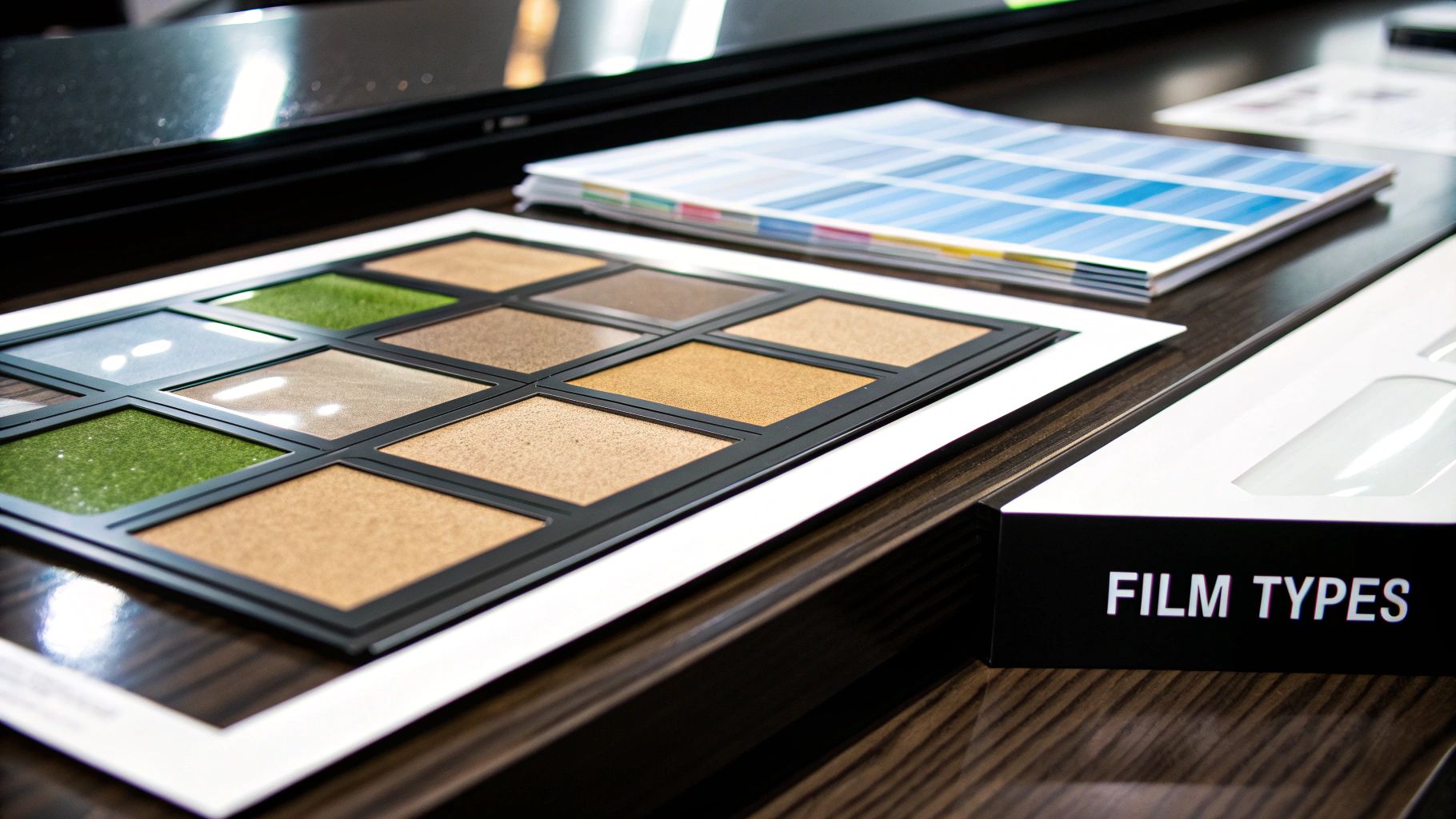
Trying to understand what goes into a window film quote is a lot like comparing a basic cotton t-shirt to a high-tech athletic shirt. Sure, both cover you, but the materials, the technology baked into the fabric, and the specific job they're designed to do are worlds apart. It's the same with window film—several key factors all play a role in shaping the final number.
The single biggest factor is the film technology you choose. Your entry-level options, like simple dyed or decorative films, are the most affordable because they mostly just change the look of your windows or add a bit of privacy. As you move up the ladder, you get into films that do a lot more work, like metalized films that reflect heat. But the real game-changers are the advanced ceramic and spectrally selective films.
These high-end options are packed with nano-ceramic particles that are engineered to target and block specific parts of the solar spectrum—namely infrared light (which is what you feel as heat) and damaging ultraviolet (UV) rays. The amazing part is they do all this without making your rooms dark. This is the sophisticated science that separates a film that just adds tint from one that actively helps manage your home’s indoor climate.
Film Type and Performance Level
It helps to think about different films as filters, each with a different level of "smarts." A basic film is like a simple mesh screen. An advanced ceramic film, on the other hand, is like a highly selective gatekeeper that only lets the good stuff—visible light—pass through while blocking all the undesirable elements.
- Decorative Films: These are your most wallet-friendly options. They're all about aesthetics, letting you add frosted privacy, etched patterns, or a splash of color to your glass. Their job is purely visual.
- Solar Control Films: This is a big category with a wide price range. At the lower end, you have simple dyed films that cut down on glare. At the high end, you find multi-layered ceramic films that provide incredible heat rejection and can seriously reduce your energy bills.
- Security Films: Built tough. These films are much thicker and stronger because they're designed to hold glass fragments together if the window shatters. The robust materials and powerful adhesives required for this level of protection mean they come at a higher price point.
- Spectrally Selective Films: These are the top-of-the-line films and often the most expensive. They can be virtually invisible but are capable of blocking an astonishing 97% of infrared heat. This is how you get maximum performance without changing the look of your home one bit.
As you can see, there's a clear hierarchy. Every step up in technology brings tangible benefits, from lower cooling costs to protecting your furniture from fading, and the price naturally reflects that added value.
Window Size and Installation Complexity
After you've chosen a film, the specifics of your windows become the next major piece of the pricing puzzle. Of course, the total square footage is the starting point for any quote, but the complexity of the job can quickly add to the bottom line.
A standard, rectangular window on the ground floor? That’s about as straightforward as it gets. The installation gets trickier—and the price goes up—when the installers have to deal with a few challenges.
It's important to remember that labor costs aren't just about the time spent on the job; they're about skill. An experienced technician meticulously fitting film to a tricky, hard-to-reach window is providing a specialized service, and the price reflects that level of expertise.
Here are a few common things that can make an installation more involved:
- Shape and Size: Got a giant picture window, a circular porthole, or an arched window over the door? Anything that isn't a standard rectangle requires precise, custom hand-cutting on-site, which takes more time and skill.
- Accessibility: Those beautiful second-story windows, skylights, or even a ground-floor window hidden behind thorny rose bushes all present access challenges. This means installers need ladders, scaffolding, and extra safety measures, which adds to the labor cost.
- Glass Condition: If there's old, bubbling film on the windows that needs to be removed, that’s a project in itself. The painstaking process of peeling the film and scraping off every bit of old adhesive adds significant time to the job. The same goes for French doors or windows with lots of small, individual panes—each one has to be prepped, cut for, and installed separately.
Finally, things like the manufacturer's reputation and the warranty they offer play a part, too. Well-known brands like 3M or LLumar have invested millions in R&D and stand behind their products with comprehensive warranties. That peace of mind and assurance of quality is often worth the premium.
Comparing Costs Across Different Film Types
Choosing the right window film is a lot like picking tires for your car. You wouldn't put racing slicks on a family SUV, right? The same logic applies here. The residential window film cost is directly linked to what you need the film to do, and each type comes with its own set of benefits and a corresponding price tag.
A good rule of thumb is that the more complex the problem the film solves, the more sophisticated the technology—and the higher the cost. A simple frosted film is mostly about looks, but a heavy-duty security film is a serious investment in your family's safety.
Let's break down the most common options and see how their costs and benefits compare.
Decorative And Privacy Films
On the most affordable end of the scale, we have decorative and privacy films. Think of these as the interior designers of the window film world. Their main job is to change the look of your glass, whether that's adding a frosted finish to a bathroom window for privacy or a tasteful etched pattern to your front door sidelights.
- Cost Range: You can expect to pay around $6 to $8 per square foot.
- Primary Function: To add style and obscure the view without killing the natural light.
- Best For: Bathrooms, entryways, and interior glass doors where you want some privacy but don't need heat rejection or security.
They won't do much for your energy bills, but they're a fantastic, budget-friendly way to get a custom look.
This image gives a great visual breakdown of what goes into the total price of a window film project.
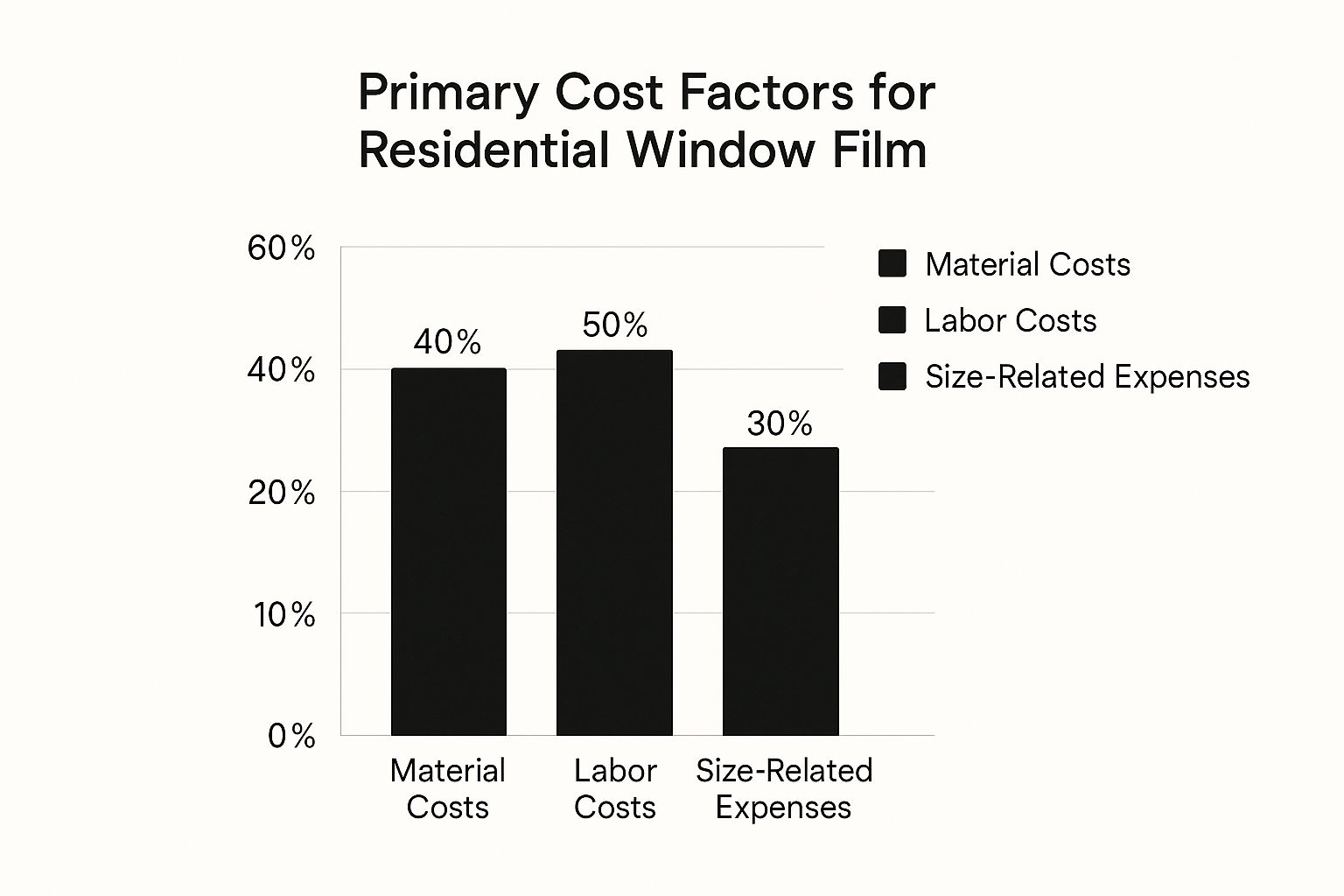
As you can see, the two biggest pieces of the pie are always the film material itself and the professional installation labor.
To make this even clearer, here’s a quick comparison of the different film types we're discussing.
Residential Window Film Type Cost and Benefit Comparison
| Film Type | Typical Cost Range (per sq. ft.) | Primary Benefit | Ideal Use Case |
|---|---|---|---|
| Decorative/Privacy | $6 – $8 | Aesthetics & Visual Privacy | Bathrooms, front doors, interior glass |
| Solar Control | $8 – $16 | Heat & UV Rejection, Glare Reduction | Sun-facing rooms, whole-home energy savings |
| Security/Safety | $9 – $20+ | Impact Resistance, Forced Entry Deterrent | Ground-floor windows, sliding doors, storm safety |
This table should help you quickly narrow down which category best fits your needs and budget.
Solar Control Films
Stepping up in both performance and price, we get to solar control films. These are the real workhorses when it comes to energy efficiency. They are specifically engineered to block solar heat, stop nearly all damaging UV rays, and cut down on annoying glare. The result is a more comfortable home and lower cooling costs.
The price for solar film can vary quite a bit depending on the technology inside. A high-performance ceramic film, for example, can block up to 80% of the sun's infrared heat, which makes a massive difference in rooms that get blasted by the afternoon sun.
With solar films, you really do get what you pay for. A higher upfront cost for a premium film almost always translates to greater energy savings over time, giving you a real, measurable return on your investment.
Security And Safety Films
At the top of the performance ladder are security and safety films. These films are built for one main purpose: protection. They are made from a thick, heavy-duty polyester bonded to your window with an incredibly strong adhesive. If the glass breaks, the film holds all the dangerous shards together in the frame.
- Cost Range: Prices generally run from $9 to $20+ per square foot.
- Primary Function: To reinforce glass against impact from break-in attempts or severe weather.
- Best For: Ground-floor windows, sliding glass doors, and any vulnerable area where security is your number one concern.
This makes it much harder for an intruder to get in and, just as importantly, protects your family from flying glass during a storm. If you live in a hurricane-prone area, it's definitely worth looking into specific window film for hurricane protection to see how these products can fortify your home. This is an investment in both your property's safety and your own peace of mind.
Calculating Your Return on Investment
It’s easy to look at window film as just another line item on a home improvement budget. But that misses the point entirely. Think of it as an investment that starts paying you back from day one. While the initial residential window film cost is a one-time expense, the savings it creates just keep rolling in, year after year.
That return on investment (ROI) is what really turns window film from a simple purchase into a savvy upgrade for your home.
The most obvious payback comes directly from your energy savings. Solar control films are like a thermal shield for your windows, fighting back against the sun's intense heat, especially during those long, hot summer months. By rejecting a huge chunk of infrared light, these films give your HVAC system a much-needed break.
Your air conditioner won't have to cycle on as often or run as hard to keep things cool, and that's something you'll see right away on your monthly utility bills.
Breaking Down the Energy Savings
Pinpointing your exact savings depends on a few things, like your local climate, what you pay for electricity, and the type of film you install. But the core principle is the same everywhere.
- Slash Cooling Costs: In sunny climates, a good solar film can block up to 78% of the heat coming through your windows. That translates directly into less time your AC is running at full blast.
- Add Winter Insulation: It's not just about the summer. Certain films also add a layer of insulation that helps trap heat inside during the colder months, trimming down your heating bills, too.
- Quick Payback: For many homeowners, the combined energy savings are enough to completely pay for the installation in just a handful of years.
This push for energy efficiency is a huge reason the window film market is booming. The industry is on track to hit over USD 24 billion by 2029, driven by the growing demand for smarter, more efficient homes.
Beyond the Utility Bill
The financial perks don't end with a lower energy bill. Window films also deliver a powerful ROI by protecting everything inside your home from sun damage.
Think of UV-blocking window film as sunscreen for your valuables. It prevents the irreversible fading and degradation of expensive furniture, hardwood floors, cherished artwork, and delicate fabrics, saving you thousands in potential replacement costs down the road.
This protective quality also extends to your family’s safety. While solar films are quite thin, their thicker security film cousins provide a seriously tough barrier. Digging into the burglar-proof windows cost shows how an investment in security can protect your property while delivering priceless peace of mind.
For a wider look at how smart upgrades pay off in the long run, it's worth checking out the ROI for properties upgrading with technology.
Professional Installation vs. DIY
When you're looking at the total residential window film cost, one of the first big decisions you'll face is whether to hire a pro or try to install it yourself. The idea of saving some cash with a DIY kit is definitely appealing, but it’s crucial to understand what you're giving up in exchange.
Hiring a certified installer isn't just paying for convenience—it's paying for a perfect, lasting result. These pros handle window film every single day. They have the right tools, the muscle memory, and the techniques down to a science, ensuring a finish free of the bubbles, creases, and trapped dust that almost always show up in DIY jobs. A professional knows exactly how to manage huge panes of glass, cut around odd-shaped windows, and seal the edges so the film lasts for years to come.
On top of that, professionals get their hands on much better film. The contractor-grade materials they use offer superior optical clarity, more powerful adhesives, and significantly longer lifespans than anything you'll find on the shelf at a big-box store.
The Benefits of Professional Service
Bringing in an expert is the best way to protect your investment from day one. A professional job almost always includes a solid warranty covering both the film material and the installation itself.
Think of a professional warranty as your safety net. If the film starts to peel, bubble, or change color before it should, the installer comes back and fixes it—no extra cost to you. That's a level of peace of mind a DIY project just can't offer.
Here’s what you’re really paying for with a professional installer:
- A Perfect Finish: No frustrating bubbles, trapped dirt, or crooked cuts. Just a clean, seamless look.
- Access to Premium Films: You get higher-quality materials that perform better and last longer.
- Comprehensive Warranty: Your investment is protected against both product defects and sloppy work.
Assessing the DIY Route
Let's be honest, the main draw for DIY is saving money on labor costs. And you can, at least upfront. But this path is loaded with hidden costs and frustrations that can quickly turn those savings into a bigger expense.
Applying window film is a surprisingly finicky job. It demands a ton of patience and an almost surgically clean, dust-free environment—something that’s nearly impossible to create in the average home.
A single speck of dust or a stray pet hair can create a permanent, glaring bubble. One slip of the blade can ruin an entire, expensive sheet of film. Without the right squeegees and a lot of practice, you can easily end up with a messy-looking job that you'll have to tear off and do all over again.
The global demand for window film is exploding—the market is expected to hit USD 3.99 billion by 2032, and that's because homeowners are seeing real value in energy savings and privacy. You can dig into more of the global window film market trends if you're curious.
So, while a small bathroom window might be a decent first project, hiring a pro is the only way to go for the big, highly visible windows in your living room or entryway. And if security is your main goal, knowing the details of a proper security window film installation is non-negotiable, as a bad application can render it almost useless.
Common Questions About Window Film Costs
Alright, we've covered the different types of film, installation costs, and all the variables that go into the final price. But you probably still have a few lingering questions. That's completely normal.
Getting straight answers to these common concerns is the last step before you can feel truly confident about your decision. Let's tackle the questions I hear most often from homeowners.
How Long Does Residential Window Film Last?
This is a big one. Nobody wants to invest in a home improvement project that needs to be redone in a few years. The good news is that professional-grade window film is built for the long haul. You can realistically expect a high-quality film to last anywhere from 10 to 20 years, sometimes even longer.
Of course, the exact lifespan depends on a few things, like your local climate, how much direct sun your windows get, and the quality of the film you choose. This durability is what really separates the pro-grade stuff from the cheap DIY films you see at big-box stores, which often start to bubble, peel, or turn purple within a couple of years.
Think of it this way: paying for a professional product and installation upfront means you won't be paying to have it stripped and replaced multiple times down the road. It just makes financial sense.
Can Window Film Void My Window Warranty?
This is a fantastic and very important question. It's something every homeowner should ask. The honest answer is: it depends on your window manufacturer. Some companies do have clauses stating that applying any kind of aftermarket film can affect the warranty.
However, the window film industry is well aware of this. To put homeowners at ease, reputable film manufacturers almost always offer their own, separate warranty.
This warranty is designed to fill any gaps. It typically covers not only the film itself against defects but also your window glass. So, if a rare issue like a thermal stress fracture or seal failure were to occur and could be linked to the film, the film manufacturer's warranty would step in to cover the replacement. Just be sure to ask for the details on both warranties before you sign off on the project.
Are There Any Hidden Costs I Should Know About?
A good installer will always be upfront about pricing, but certain job-site conditions can add to the final cost. Knowing what these are ahead of time can help you avoid any surprises when the final bill arrives.
Here are a few common situations that might increase the total residential window film cost:
- Old Film Removal: Do your windows already have old, faded film? It has to be carefully removed and the glass scraped clean of all adhesive before the new film goes on. That’s a time-consuming job that adds labor costs.
- Difficult Access: High-up windows, like those in a two-story great room or skylights, require ladders and sometimes scaffolding. This adds to the setup time and complexity, which is reflected in the price.
- Extra Glass Prep: If windows have paint overspray, silicone, or are just unusually grimy, they'll need more intensive prep work before the film can be applied perfectly.
- Complex Window Shapes: Small French panes, arched windows, or any other non-standard shape requires much more precise, custom cutting from the installer. More time and skill equals a higher cost.
Any trustworthy professional will point these things out during your initial consultation and include them in the quote.
Ready to enhance your home's comfort and security with a solution that pays for itself? At Fortress Security Films, we provide expert consultations to help you choose the perfect film for your needs and budget. Visit us at https://fortresssecurityfilms.com to get a clear, transparent quote for your project.
