


Privacy film for large windows is a thin, adhesive layer that's applied directly to the glass. Its main job is to obscure the view from the outside while letting natural light stream in, giving you the best of both worlds. It’s a clean, modern alternative to bulky curtains or dusty blinds, offering everything from a simple frosted appearance to high-tech, switchable smart glass effects.
It’s the perfect answer to a common problem: how do you maintain a bright, open feel without sacrificing personal or professional privacy?
A Clear Solution for Window Privacy and Style
We all love large windows. They’re a fantastic architectural feature, bathing our homes and offices in beautiful, natural light and connecting us to the world outside. But that wide-open view works both ways, often forcing a tough choice between an airy atmosphere and our own seclusion.
That's where privacy window film comes in.
Think of it as a sophisticated upgrade for your existing glass. Instead of reaching for heavy, light-blocking drapes or clunky blinds, the film gives you a sleek, minimalist way to manage who sees in. It directly tackles the core issue of large windows: keeping prying eyes out without losing the daylight you enjoy.
More Than Just a Visual Barrier
While privacy is the main event, the benefits go much deeper than just blocking a line of sight. A single installation can genuinely transform a space, making it more comfortable, secure, and even more stylish. The right film is really a multi-tool, solving several common problems that come with large panes of glass.
Here’s what else it can do for you:
- Boosts Comfort: By softening and diffusing harsh sunlight, window film cuts down on annoying glare. That makes it far easier to watch a screen or work on a computer without squinting.
- Blocks UV Rays: Quality films can block up to 99% of damaging ultraviolet rays. This acts as a powerful shield, protecting your furniture, flooring, and artwork from fading and sun damage over time.
- Improves Energy Efficiency: Some films are designed with solar control properties. They can reject the sun's heat in the summer and help keep warmth inside during the winter, which can lead to lower energy bills.
- Adds a Layer of Security: You can even get specialized security versions of privacy film that hold shattered glass in place if it breaks. This can deter a potential intruder and dramatically reduce the danger from flying shards of glass.
Ultimately, privacy film isn't just about hiding. It's about taking control of your environment. It lets you define the line between your private space and the public world, all while keeping the architectural beauty of your windows intact.
This guide will walk you through everything you need to know. We’ll cover the classic, elegant frosted films and dig into the cutting-edge smart films that turn from clear to opaque at the flip of a switch. You'll learn how to pick the right level of opacity, what to consider for installing on massive panes, and how to weigh the long-term performance benefits.
Exploring Your Privacy Film Options
Choosing the right privacy film for a large window isn't just about blocking a view—it's about finding the perfect blend of function, style, and light for your space. With today's massive glass panes being a cornerstone of modern architecture, the right film can make all the difference. Not all films are the same, and understanding what sets them apart is the first step to a great decision.
The demand for these solutions is booming. The global window film market is expected to hit $17.5 billion by 2030, a massive leap from $10.3 billion back in 2020. This trend is driven by our need for privacy and security in cities, where glass-heavy offices and high-rise homes are the norm. You can read more about this expanding market and what's fueling the growth.
Let's walk through the main types of privacy film so you can figure out what works best for you.
Frosted Films: The Classic Go-To
When you think of privacy film, frosted is probably what comes to mind. For good reason. It gives you the elegant, high-end look of sandblasted or acid-etched glass for a fraction of the price.
Think of it as putting a soft-focus filter on your window. It blurs out the details, so you can't see in or out clearly, but it’s fantastic at letting in diffused natural light. This keeps your rooms feeling bright and open without leaving you feeling exposed.
- Best For: Bathrooms, office partitions, conference rooms, and any ground-floor windows that need reliable, around-the-clock privacy.
- Privacy Level: High. The effect works day and night, regardless of the lighting.
- Natural Light: Excellent. It cuts harsh glare while still letting in plenty of soft, usable sunlight.
This is a timeless choice that fits with almost any design, from ultra-modern to classic and traditional.
Decorative and Patterned Films: Privacy with Personality
If you see your large windows as a blank canvas, decorative films open up a world of creative possibilities. These films move beyond simple frosting to include patterns, textures, and colors that make a real design statement.
You can find everything from clean geometric stripes and dots to intricate floral designs, gradient fades, or even custom-cut logos for branding a commercial space. It's a fantastic way to add a unique architectural touch while getting the exact level of privacy you need.
A well-chosen decorative film does more than just obscure a view; it can pull an entire room's design together. For example, a film with horizontal lines can make a space feel wider, while a botanical pattern can bring a bit of the outdoors in.
Reflective and Mirrored Films: Daytime Privacy Powerhouse
Reflective films, often called one-way mirror films, work on a clever trick of the light. During the day, they use the light imbalance to turn the outside of the window—the brighter side—into a mirror, while you can still see out perfectly from the inside.
This is the ideal solution for daytime privacy if your windows face a busy street or a close neighbor. But here's the catch you absolutely have to know: at night, the effect reverses. When you turn your lights on inside and it's dark out, people outside can see right in.
This quick illustration shows the key benefits that most privacy films share.
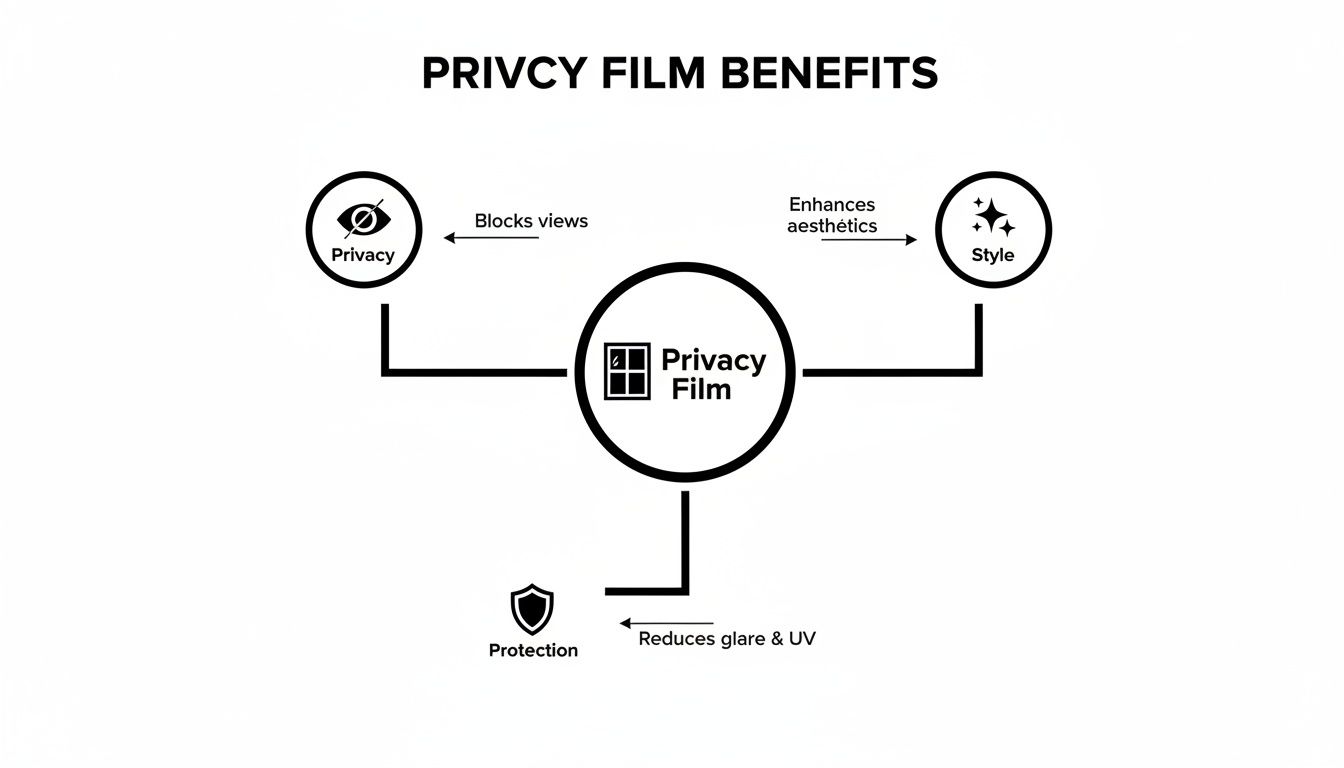
It’s a great visual reminder of how one product can solve for privacy, add style, and protect your interiors all at once.
Switchable Smart Films: Privacy on Demand
Welcome to the future of window treatments. Switchable smart films, also known by their technical name PDLC (Polymer Dispersed Liquid Crystal) films, offer dynamic privacy at the touch of a button.
Flip a switch or tap an app on your phone, and the film instantly goes from crystal clear to completely opaque. It works by sending a tiny, safe electrical current through the film. The current either aligns liquid crystals to let you see through (the clear state) or scatters them to block the view (the opaque state).
- Best For: Conference rooms, executive offices, high-end homes—anywhere the need for privacy changes in an instant.
- Privacy Level: Total control. You can go from zero privacy to 100% opaque whenever you want.
- Natural Light: Great in its clear state, and it provides good light diffusion when opaque.
While it's a bigger upfront investment, the incredible flexibility of switchable film is unbeatable for modern, multi-use spaces.
Comparing Privacy Film Types for Large Windows
With so many options, it can be tough to keep them straight. This table offers a side-by-side comparison to help you choose the best fit for your space.
| Film Type | Primary Benefit | Best For | Privacy Level (Day) | Privacy Level (Night) | Natural Light |
|---|---|---|---|---|---|
| Frosted | Consistent, 24/7 privacy | Bathrooms, meeting rooms, ground-floor windows | High | High | Excellent (diffused) |
| Decorative | Style and customization | Branding, interior design, partial privacy areas | Varies by pattern | Varies by pattern | Varies by design |
| Reflective | Daytime "one-way" privacy | Street-facing windows, offices overlooking public areas | High | Low (reverses) | Good (can reduce glare) |
| Switchable | On-demand, instant privacy | Multi-use spaces, executive offices, modern homes | Variable (clear to opaque) | Variable (clear to opaque) | Excellent (in clear state) |
Ultimately, the best film is the one that solves your specific problem—whether that’s a need for round-the-clock seclusion, a touch of style, or the flexibility to switch between open and private on a whim.
More Than Just Privacy: Unlocking the Hidden Benefits of Window Film
Most people hear "privacy film" and, understandably, think about one thing: blocking the view. But that's just the tip of the iceberg. Modern high-performance films do so much more than just provide seclusion. Think of them less as a simple screen and more as a sophisticated upgrade that enhances the comfort, efficiency, and safety of your space—especially when you’re dealing with large windows.
Your windows are portals, but they let in more than just light. They also welcome invisible elements, some of which cause real, long-term damage. Installing a quality privacy film is like adding a nearly invisible shield that filters the good from the bad.
A Powerful Shield Against UV Radiation
One of the most valuable benefits is something you can't even see: powerful protection from ultraviolet (UV) radiation. Just like sunscreen for your skin, professional-grade window film acts as an essential barrier for everything inside your home or office.
High-quality films are engineered to block up to 99% of damaging UV rays. This one feature makes a huge difference in preserving the value and appearance of your interior furnishings.
Think about the sun pouring through a big window, day after day, year after year. Without protection, that constant exposure leads to irreversible fading and damage to:
- Furniture: The vibrant colors on your sofas and chairs will slowly wash out.
- Flooring: Hardwood floors can discolor and develop sun-bleached patches.
- Artwork: Cherished paintings, prints, and photographs can be permanently ruined.
- Rugs and Decor: Textiles lose their richness, becoming brittle and faded over time.
By blocking the main culprit behind this fading, the film essentially preserves your belongings, extending their life and keeping them looking new for years.
Dramatically Reduce Unwanted Glare
We love large windows for the views and natural light, but they can also create blinding glare at certain times of day. That harsh, reflected light makes a room feel uncomfortable, causing eye strain and making it almost impossible to see computer screens or the TV.
Privacy film is like putting a pair of high-end sunglasses on your building. It softens and diffuses the incoming light, cutting glare way down without making the room dark. This simple change can transform a space from irritating to inviting.
This is a game-changer for both homes and businesses. Suddenly, the living room is a perfect spot for a movie, and the office conference room is a productive space for presentations—all without having to pull the shades and block out the world.
Improve Energy Efficiency and Lower Your Bills
Those beautiful, big panes of glass are often a weak point in a building's energy efficiency. In the summer, they let solar heat pour in, forcing your AC to work overtime. In the winter, they let all your cozy indoor heat escape, driving up your heating costs.
Many privacy films come with solar control properties that tackle this problem head-on. They're designed to reflect a huge portion of solar heat before it ever gets inside. In fact, sun control films are a major reason the window film market is booming, as they help make buildings with large windows far more energy-efficient, reducing heat gain by up to 78%. This trend is especially strong in North America, where over 60% of commercial buildings built before 1980 now use film to boost comfort and cut costs. You can discover more about the window film market and its impressive growth.
This improved thermal regulation creates a more stable, comfortable indoor temperature all year long and can lead to some very real savings on your energy bills.
Enhance Safety and Security
Finally, some privacy films are bonded with a tough security layer. While any film adds a bit of shatter resistance, these specialized security films are designed to hold broken glass together if the window is ever shattered.
This provides two critical layers of protection:
- Accident Prevention: If a window is broken by a stray baseball or an accidental fall, the film holds the dangerous shards together, preventing a shower of sharp glass and reducing the risk of serious injury.
- Forced Entry Deterrence: For an intruder, a window treated with security film is a serious obstacle. Smashing the glass doesn't create a clean opening; it results in a web of contained, sharp glass that’s loud and difficult to breach.
This extra layer of security offers genuine peace of mind, reinforcing your largest and most vulnerable entry points against both accidents and intruders.
Why Professional Installation Is Non-Negotiable
Thinking about applying privacy film to a small bathroom window? That can be a totally manageable weekend project. But when you’re staring up at a massive, floor-to-ceiling pane of glass, it's a whole different ballgame. For privacy film for large windows, the stakes are sky-high, and the margin for error is razor-thin.
Professional installation isn’t just a nice-to-have; it's the only way to guarantee a flawless, long-lasting result.
The sheer size of large windows creates technical problems that a DIY approach just can't handle. The biggest enemy is contamination. A single speck of dust or a stray pet hair that you’d never notice on a small window becomes a glaring, permanent flaw when it’s trapped under a huge sheet of film. Professionals have this down to a science, working in controlled conditions and using specialized cleaning methods to create a perfectly pristine surface.
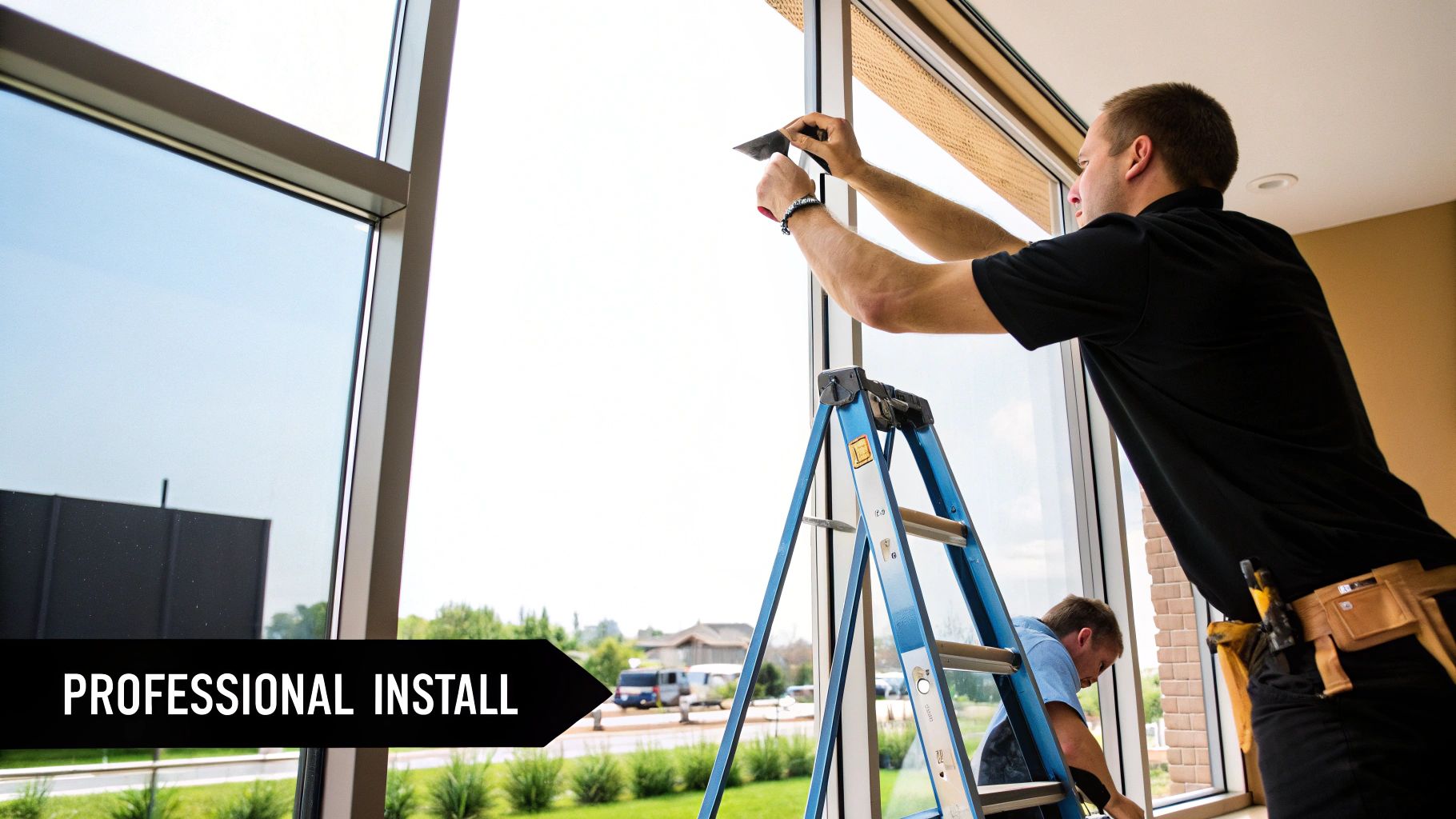
The Anatomy of a Failed DIY Job
When someone tries to install film on a large window without proper training, it usually ends in a few common, irreversible mistakes. These slip-ups don’t just look sloppy; they can ruin the film's performance and cut its life short, turning a great upgrade into a costly eyesore.
Here's what a DIY job often looks like:
- Bubbles and Tunnels: Pockets of trapped air or water that are almost impossible to get out once the adhesive starts to cure.
- Creases and Wrinkles: It’s incredibly easy to accidentally fold or crease a large, unwieldy sheet of film, leaving permanent marks.
- Misalignment: Being off by just a millimeter at the start can lead to a visibly crooked application across the entire pane.
- Contamination: Dust, lint, and other tiny particles get trapped underneath, creating distracting blemishes.
Fixing these mistakes almost always means ripping off the botched film and starting from scratch. That means you’re out the money for the film and all the time you wasted.
The Professional Difference: Specialized Tools and Techniques
Certified installers don't just roll up with a spray bottle and a basic squeegee. They come equipped with a specialized toolkit and a methodical process honed over years of experience. They use specific slip solutions to slide the film into the perfect position, unique squeegees designed to apply consistent pressure, and ultra-sharp trimming tools for clean, edge-to-edge precision.
Their process is deliberate, starting with meticulous surface prep. After all, the importance of hiring professional services for your windows extends beyond just cleaning; a pro installer ensures the glass is surgically clean before the film is even unrolled.
A professional's goal isn't just to stick film on glass. It’s to create a bond so perfect that the film looks like it was always part of the window—utterly seamless and without a single flaw.
Avoiding a Costly Phenomenon: Thermal Stress
Here’s the single most important reason to hire a pro, and it’s something most people have never even heard of: thermal stress. Large windows, particularly those getting blasted by direct sun, absorb and radiate a tremendous amount of heat. If you apply the wrong kind of film, you can cause the glass to heat unevenly, creating internal stress that can lead to cracks or, in the worst case, a complete shatter.
This risk, known as thermal stress fracture, is a very real and serious concern.
Certified installers are trained to conduct a glass-to-film compatibility assessment. They know which films are safe for different types of glass (annealed, tempered, double-pane) and can calculate the risk based on the window's size, its sun exposure, and even its elevation. This expert analysis protects your investment and prevents a catastrophic failure—a guarantee you simply can't get from a DIY job.
Getting a Handle on Cost and Return on Investment
Let’s talk numbers. Budgeting for a privacy film project isn't as complicated as you might think, but it’s more than just a single price tag. The final cost for installing privacy film for large windows really boils down to a few key variables. Once you understand them, you'll start to see the project less as a cost and more as a smart, long-term upgrade.
The biggest factor influencing the price is, unsurprisingly, the type of film you choose. Standard frosted and decorative films are the most wallet-friendly, giving you fantastic privacy and a clean look without a hefty investment. On the other end of the spectrum, you have high-tech options like switchable smart films, which come with a higher upfront cost because of the sophisticated technology involved.
Breaking Down the Main Cost Factors
Besides the film itself, a professional installer will look at a few other things to give you a precise quote. It's all about the specifics of your space.
- Total Square Footage: This is the big one. The more glass you need to cover, the more material and time the job will take. It’s the starting point for almost any estimate.
- Window Accessibility: Are we talking about easy-to-reach ground-floor windows, or a soaring multi-story atrium? If the job requires scaffolding or special lifts, that will naturally add to the labor costs.
- Installation Complexity: A standard rectangular window is one thing. An arched or circular window that requires meticulous trimming and a skilled hand is another, and the price will reflect that extra precision.
As a general rule of thumb, you can expect professionally installed privacy films to land somewhere in the $6 to $20+ per square foot range. Standard frosted films will be at the lower end, while premium security films or innovative smart films will push you toward the higher end of that scale.
More Than a Cost—An Excellent ROI
Thinking of window film as just another expense is missing the point. It's an improvement that starts paying you back from day one, making it a genuinely savvy investment in your property. The return on investment (ROI) isn't just a buzzword here; it comes from real, measurable savings over time.
Privacy film is a cost-effective alternative to replacing entire windows with expensive privacy glass. It delivers the same aesthetic and functional benefits for a fraction of the cost and with far less disruption.
There's a reason the global demand for these films is skyrocketing—it just makes financial sense. High-performance films can slash HVAC costs by 25-40%, a staggering number that means the film can often pay for itself in just two to three years from energy savings alone. It's an upgrade that aligns perfectly with today's focus on sustainability. If you're curious, you can discover more about the growing window privacy film market and why it's booming.
When you add it all up—preventing UV damage to your furniture and flooring, cutting down your energy bills, and beefing up your security—the film delivers continuous value that makes the initial price tag look smaller and smaller over time.
Choosing the Right Film for Your Home or Business
Alright, now that you've got the lay of the land—the types, the benefits, and the installation quirks—it's time to zero in on the perfect privacy film for your windows. There's no single "best" option. The right choice for a downtown office isn't going to be the same as what you'd want for your living room.
Think about it this way: a hospital clinic needs absolute, around-the-clock privacy for its patients, making a frosted film a no-brainer. But a ground-floor storefront might only need daytime privacy, so a one-way mirror film that lets them see out while stopping people from peering in is ideal. The key is aligning the film's function with how you use the space every day.
Your Decision-Making Checklist
To cut through the noise, you need to get clear on your priorities. A few simple questions can help you narrow down the options and avoid picking a film that looks great but doesn't actually solve your problem. A little honesty here goes a long way in making sure your investment in privacy film for large windows pays off.
Run through this quick checklist to figure out what you truly need:
- What's the main goal here? Are you after 24/7 privacy, just daytime discretion, serious UV protection, or cutting down on that afternoon glare? Maybe it's a mix of everything.
- How much daylight can you afford to lose? Is letting in the maximum amount of natural light non-negotiable, or would a softer, diffused glow work for the room?
- What kind of look are you going for? Do you want something sleek and modern, a bold decorative pattern, or that high-tech feel of smart film?
- What's the budget? Are you looking for a straightforward, cost-effective solution, or are you ready to invest in advanced features like on-demand, switchable privacy?
When you define your needs first, the search becomes much simpler. You're no longer staring at a huge wall of options; you're just picking from a handful of great candidates. It turns what could be an overwhelming task into a clear, logical process.
When you're ready to dig into the specs, a good product guide is your best friend. For a detailed look at what's out there, the HGS Product Brochure is a great resource. It gives you the details you need to confidently move forward and transform your space with the perfect film.
Window Film FAQs: Your Questions Answered
Even with all the details covered, you probably still have a few practical questions. That’s perfectly normal. Getting straight answers to these common concerns is the best way to feel confident about installing privacy film on your large windows.
Let’s tackle a few of the questions we hear most often.
How Long Does Privacy Film Last on Large Windows?
This is usually the first thing people ask, and for good reason. The great news is that high-quality, professionally installed privacy film is incredibly durable. You’re not just buying a temporary fix; you're making a long-term investment.
Most top-tier films come with a manufacturer's warranty that lasts 10-15 years for commercial buildings, and some residential warranties even last a lifetime. While things like direct sun exposure and climate play a role, you can count on your film to look great for years—no bubbling, peeling, or fading.
Can Privacy Film Be Removed Without Damaging My Windows?
Yes, absolutely. And this is a huge advantage over options like etched or sandblasted glass. Window film is designed to be completely removable without leaving a trace.
If your style changes or a new tenant moves in, a professional can remove the film using specific techniques that soften the adhesive. The film peels away cleanly, and your original glass is left in perfect condition. No sticky mess, no damage, just total flexibility.
Will Privacy Film Make My Rooms Too Dark?
That’s a common myth we’re happy to bust. Unless you’re specifically choosing a blackout film or a very dark tint, most privacy film for large windows is designed to let in as much natural light as possible.
Think of it this way: the film diffuses light rather than blocking it. Frosted and decorative films work by scattering light to obscure the view from the outside, but they still allow the majority of visible light to pour into the room.
You get to keep that bright, open feeling you love from your large windows, but with an added layer of seclusion. Your space will feel just as bright and inviting as before, just more private.
Ready to upgrade your space with better privacy and security? At Fortress Security Films, we specialize in high-performance window film solutions that protect what's important without sacrificing your light and views. See what a difference professional-grade film and expert installation can make.
Learn more and get a personalized consultation at https://fortresssecurityfilms.com.
