


When you're trying to protect something valuable, it’s about more than just a strong lock. Real security is a complete system built on layers of deterrence, detection, delay, and response. It’s the combination of smart tech, clear rules, and watchful people all working together.
Why Physical Security Is More Than Just a Lock
Most people think a heavy-duty lock on the front door is enough. But that’s a single point of failure. A better way to think about it is like a medieval castle—it wasn't just one big wall, but a whole series of defenses designed to stop an intruder in their tracks.
This mindset is all about being proactive. You want to make your property look like too much trouble from the very beginning. This is how you build a truly secure environment where every piece of the puzzle fits together.
The Core Principles of Layered Defense
Great security isn't about finding one perfect gadget. It's about creating a sequence of obstacles that slow an intruder down, buying you precious time to respond. The entire goal is to make the effort of breaking in far outweigh any potential reward.
The best security system is the one a potential intruder looks at and decides to walk away from. It's a smart mix of things they can see that scare them off and tough barriers that will stop them if they're foolish enough to try.
These layers are designed to work in tandem, creating a powerful defense. Picture it as a series of hurdles an attacker has to clear. Each one slows them down and increases the chance they'll get caught. This infographic breaks down how those initial layers work.
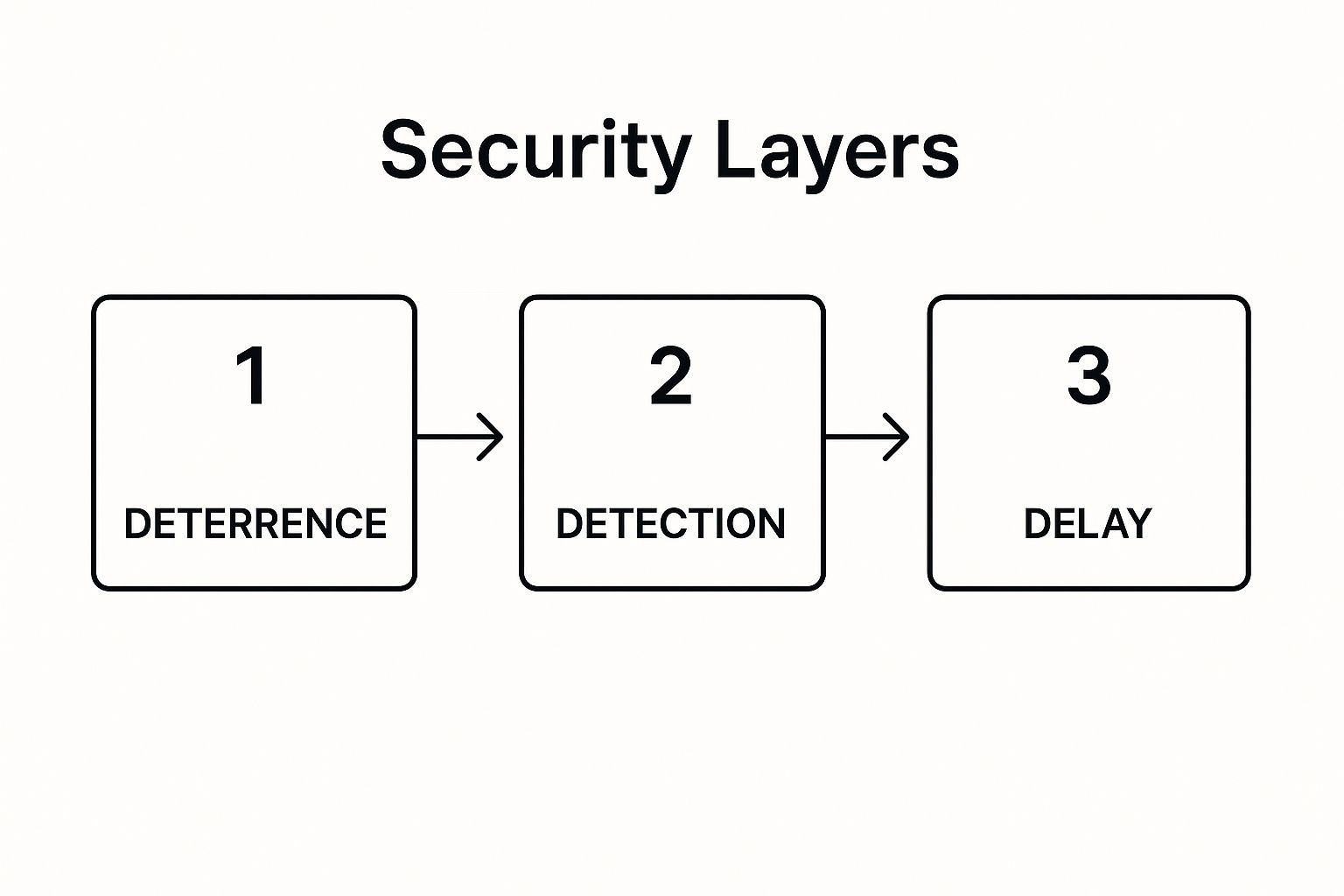
As you can see, it’s a logical flow. First, you try to scare them off (Deterrence). If that doesn't work, you need to know they're there (Detection). Then, you slow their progress (Delay). That delay is absolutely crucial—it's the window of opportunity you need to mount an effective response.
This whole system—the people, the policies, and the technology—is the foundation of all solid physical security best practices. Before you get into the how, you have to understand this why. The philosophy of layered defense is where it all begins.
How to Conduct a Security Risk Assessment
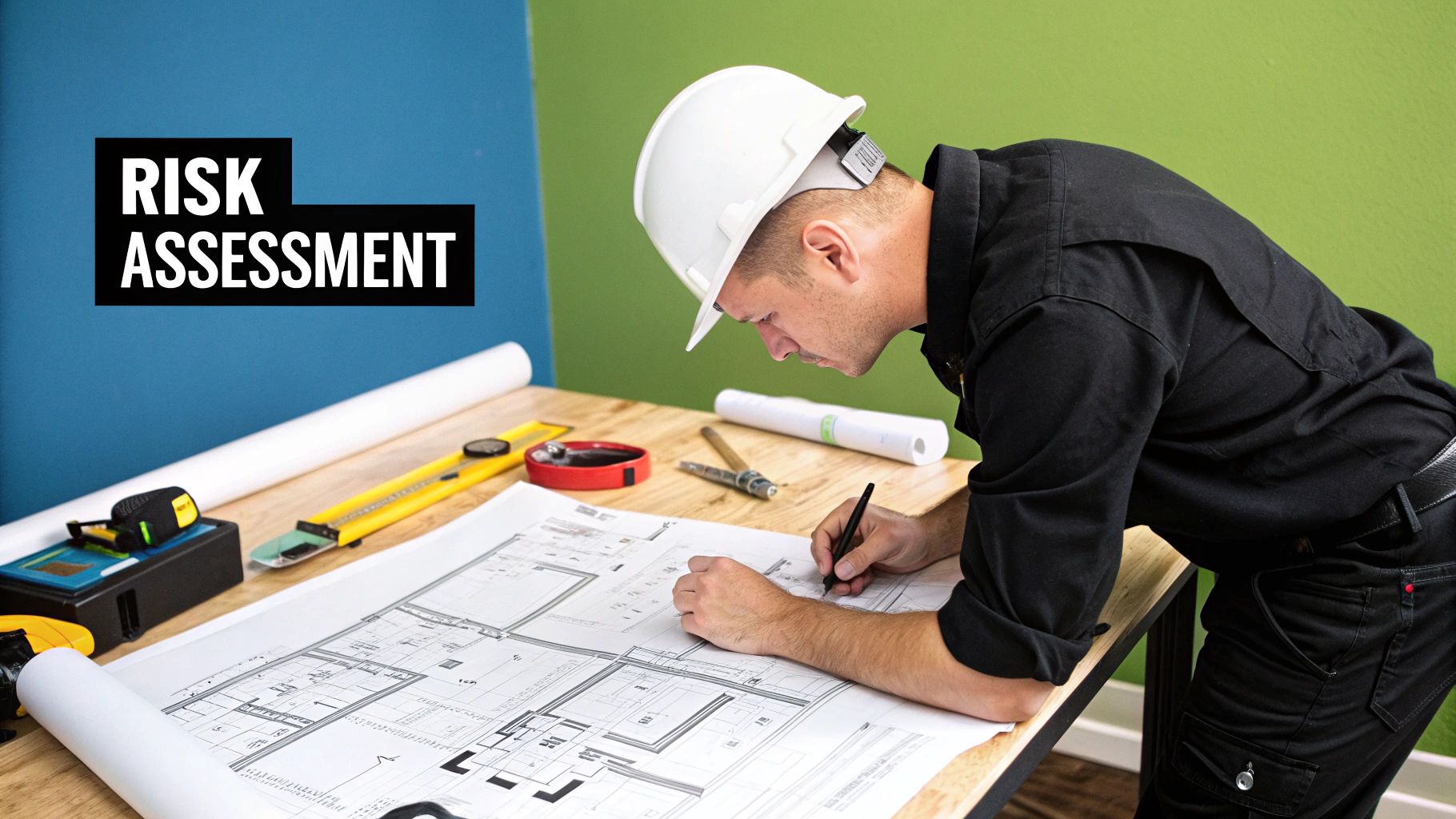
Before you can build a solid defense, you have to know where the cracks are. Jumping into buying security gear without first conducting a risk assessment is like navigating a minefield with a blindfold on. You might get lucky, but you're really just guessing.
A proper assessment gives you a clear blueprint for your entire security strategy. It's not about being paranoid; it's about being prepared. This process helps you make smart, cost-effective decisions, channeling your time and money where they'll actually make a difference.
First, Identify Your Critical Assets
The first question you have to answer is, "What am I actually trying to protect?" An asset isn't just a high-dollar piece of equipment. It's anything and everything that is vital to keeping your home life or business running smoothly.
Start by creating an inventory. Literally walk through your property and make a list of everything that, if lost, stolen, or damaged, would cause a major headache. For a deeper dive, understanding security threat assessments can give you a more structured way to tackle this.
Your list of assets might include:
- People: At the top of any list should be your employees, family members, customers, and any other visitors. They are always the most valuable asset.
- Physical Property: This is the more obvious stuff—computers, servers, machinery, inventory, and company vehicles.
- Information: Think about sensitive data like customer lists, financial records, or your company's secret sauce—its intellectual property. This is often a huge target.
- Reputation: The trust you've built with clients and your community is priceless. A security breach can shatter it in an instant.
Next, Pinpoint Potential Threats and Vulnerabilities
Once you know what you're protecting, you need to figure out what you're protecting it from. Threats are the "who" or "what" that could cause harm, while vulnerabilities are the weak spots that let them in. Think of it this way: a burglar is the threat, but an unlocked back window is the vulnerability they exploit.
Look at threats from every angle:
- External Threats: These are the dangers coming from the outside. We're talking burglars, vandals, and even natural disasters like floods or major storms.
- Internal Threats: These come from within your own walls. This could be a disgruntled employee or just an honest mistake, like someone accidentally leaving a secure door propped open.
After you've listed the threats, it's time to find the vulnerabilities. Put on your "bad guy" hat and walk the perimeter. Are there dark, unlit corners that provide perfect hiding spots? Are the doors and windows flimsy or unreinforced? Can anyone just wander into the server room? This audit will show you exactly where the gaps are.
It's a classic mistake to focus only on high-tech threats while completely ignoring simple physical weaknesses. What good is the best cybersecurity money can buy if an intruder can just walk into an unlocked office and steal the server?
Finally, Analyze and Prioritize Your Risks
Okay, you have your list of assets, threats, and vulnerabilities. Now it’s time to connect the dots. Not all risks are created equal, so the goal here is to figure out which ones need your immediate attention. You'll want to determine the likelihood of a threat happening and the potential damage—the impact—if it does.
A simple risk matrix can be a huge help. For each risk you've identified, assign a score for both likelihood (how likely is this to happen?) and impact (how bad would it be?). A smash-and-grab at a street-facing retail shop is likely a high-likelihood, high-impact risk that needs to be addressed now. A minor threat with a low impact can wait.
This final step is what turns a long, overwhelming list of problems into a clear, actionable plan. It becomes the guide for every security decision you make from this point forward.
2. Implementing Smart Access Control Systems
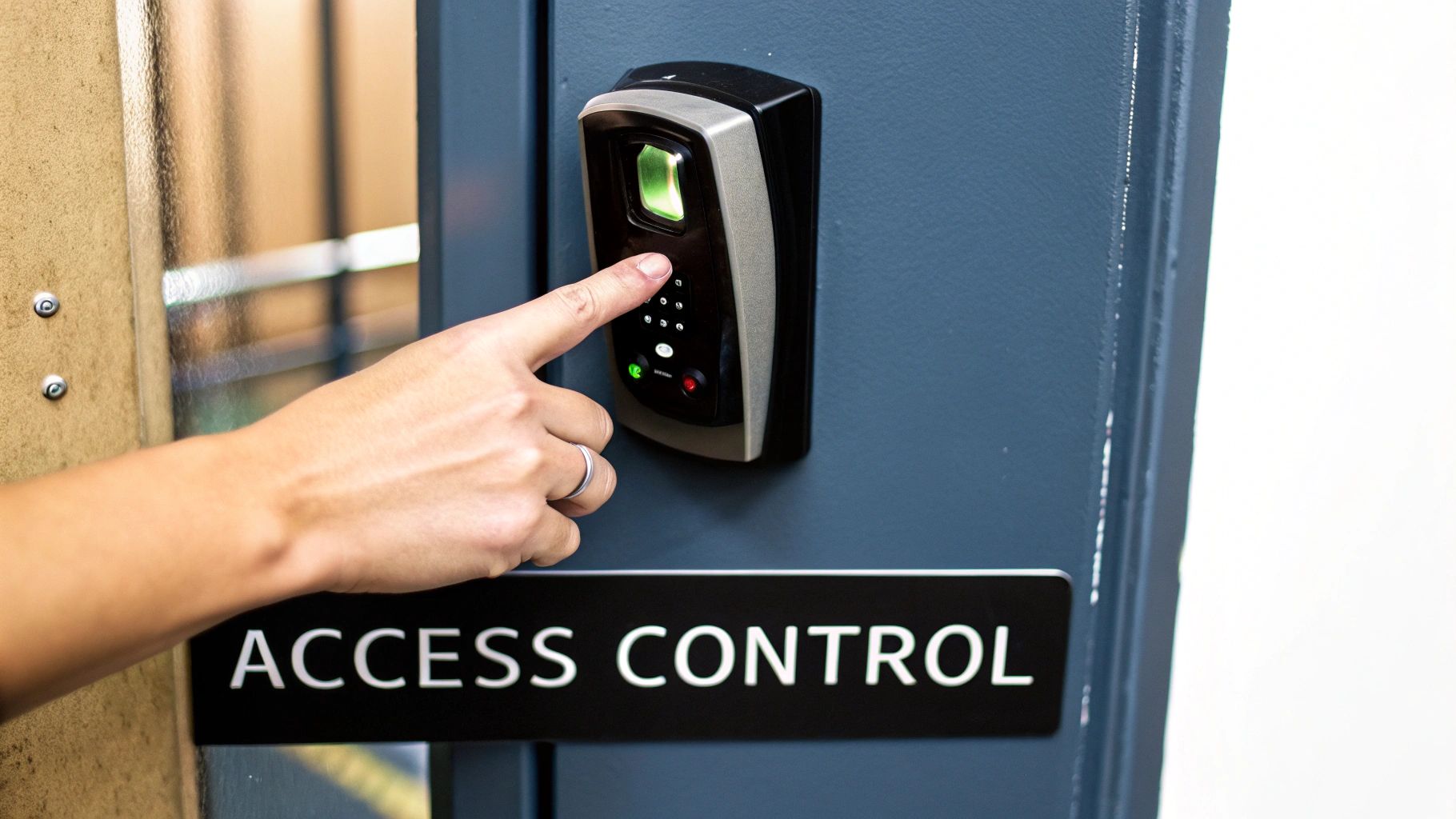
At its core, physical security is all about controlling who can go where—and when. Think of your property as a series of zones, from public-facing lobbies to highly restricted areas. Access control is the system that acts as the gatekeeper, enforcing the boundaries between these zones to protect your most valuable assets.
Modern systems are much more sophisticated than a simple lock and key. They give you fine-tuned control, create detailed logs of every entry, and let you grant or revoke access in an instant. Getting a handle on how these systems work is a crucial part of implementing effective physical security best practices.
Essentially, every access control system has to answer one question: "Are you who you say you are?" The way it verifies that identity usually falls into one of three categories.
The Three Flavors of Credentials
Every time you unlock a door with something other than a traditional key, you're using a credential. Each type offers a different mix of security and convenience, which is why you see different methods used in different places.
- Something You Know: This is the most common and basic credential. It's a piece of secret information only the authorized person should possess, like a PIN for a keypad or a password for a computer.
- Something You Have: This involves a physical object you carry. Obvious examples are an electronic key card, a key fob, or even your smartphone running a specific app.
- Something You Are: Known as biometrics, this is the most personal and secure category. It uses your unique biological traits for identification, like a fingerprint, a facial scan, or an iris scan.
For areas that demand the highest level of security, you’ll often see two-factor authentication (2FA) in play. This means the system requires two different types of credentials to grant access—for instance, swiping a key card (something you have) and then entering a PIN (something you know). This layered approach is incredibly effective, as a thief would need to steal both your card and your code to get in.
Adopt the "Least Privilege" Mindset
One of the most powerful ideas in access control is the principle of least privilege. The concept is simple but profound: a person should only have the absolute minimum level of access needed to do their job, and nothing more.
Giving the overnight cleaning crew a master key that opens the server room and the CEO's office is a huge, unnecessary risk. The principle of least privilege demands a much smarter approach.
You’d program their key card to only open specific doors (hallways, break rooms) and only during their shift (say, from 10 PM to 4 AM). This simple set of rules shrinks the opportunity for misuse or theft down to almost zero.
This isn't just about controlling who gets in; it's about controlling where they can go and when. This kind of granular control is what makes modern systems so powerful. You can see how this technology comes to life by exploring different smart security solutions that bake these principles right in.
Design a Layered Access Strategy
A single unlocked door should never compromise your entire facility. A layered security strategy ensures that as someone moves deeper into a building, the security gets progressively tighter. It creates a series of internal checkpoints that shield your most critical assets, even if an outer defense is breached.
Here’s how it might look in a typical office building:
- Layer 1 (Perimeter): The main lobby is open to the public during business hours but requires a key card for entry after 5 PM.
- Layer 2 (Departmental): To get onto the engineering floor, your key card needs to be authorized for that specific department. Someone from marketing wouldn't be able to get in.
- Layer 3 (Sensitive Areas): The most vital zones—like the data center, HR records room, or executive suite—demand two-factor authentication. Maybe a key card swipe followed by a fingerprint scan.
This tiered model compartmentalizes your building, containing any potential breach. An intruder who slips past the lobby is stopped cold at the next layer, preventing a single point of failure from turning into a catastrophe. It effectively turns your building into a maze for unauthorized people while remaining completely seamless for your team.
Leveraging Modern Surveillance and Monitoring Tech
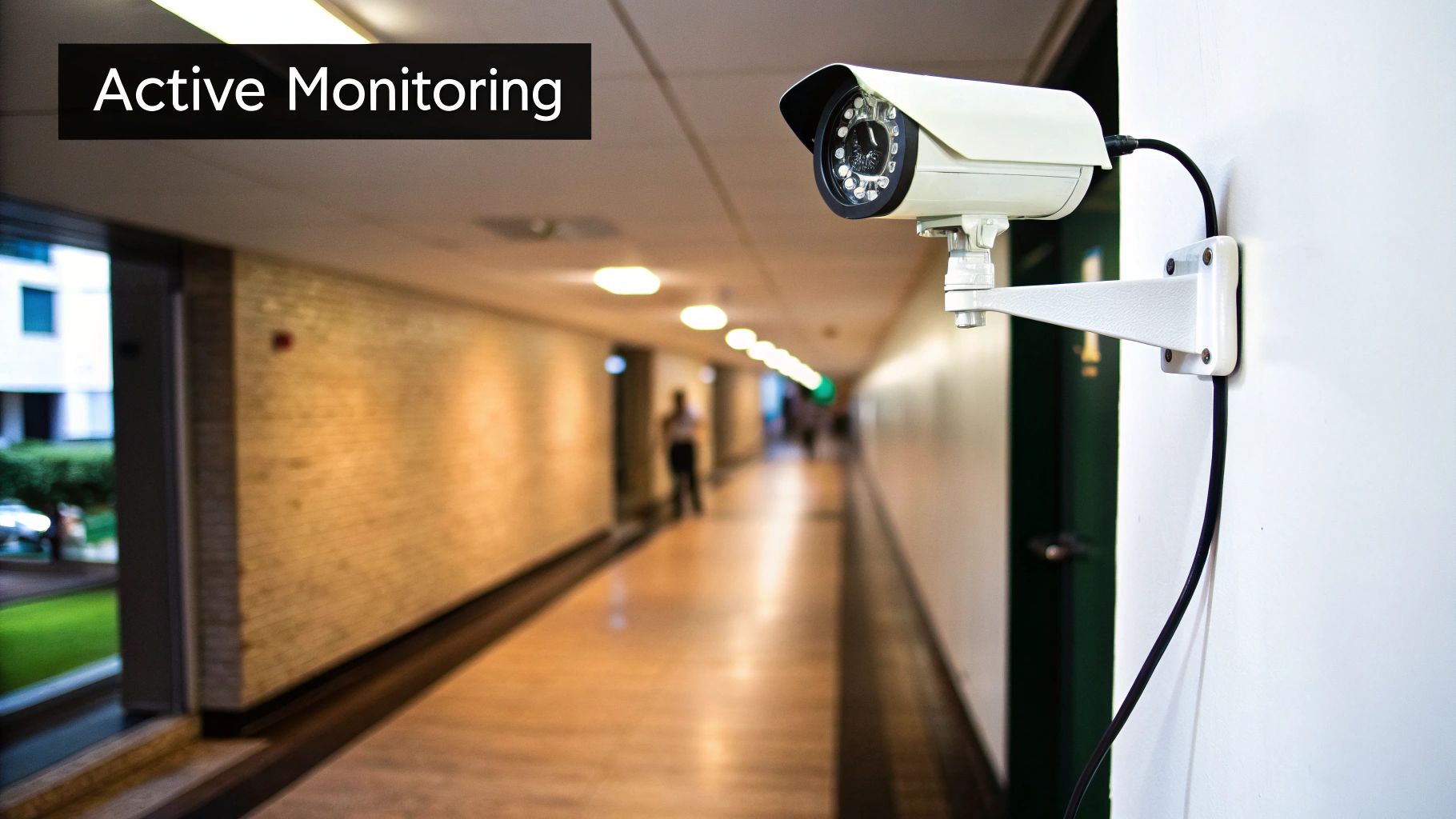
Effective security is all about having eyes and ears where you need them most, acting as your digital sentinels. Modern surveillance has come a long way from the grainy, passive CCTV footage we used to see. Today’s systems are intelligent, active partners in your security strategy, giving you clarity and vital information right when it counts.
The real skill lies in deploying this technology correctly. It’s about turning a simple camera from a passive recording device into a proactive detection tool. A well-thought-out setup doesn't just capture events as they happen—it can actually stop them from happening in the first place.
The Evolution of Surveillance Cameras
The leap from old-school analog CCTV to modern IP (Internet Protocol) cameras is like switching from a flip phone to the latest smartphone. IP cameras hook into your network, delivering far better image quality, remote access from anywhere, and a whole host of smart features that once seemed like something out of a spy movie.
These new capabilities transform a monitoring system from something you review after an incident into an active alert network. You get real-time intelligence that helps you prevent a problem before it escalates.
Here are the key features to look for:
- High-Definition Resolution: You need crystal-clear video (1080p or even 4K) to see crucial details like faces or license plates. Without it, the footage is almost useless for identification.
- Low-Light Performance: Advanced sensors and infrared (IR) technology are non-negotiable. They provide sharp images even in near-total darkness, ensuring you’re covered 24/7.
- Intelligent Motion Detection: The best systems can tell the difference between a person, a car, and a cat wandering by. This intelligence dramatically cuts down on annoying false alarms.
- Video Analytics: This is where AI comes in. These features can automatically flag specific behaviors, like someone loitering near a restricted area or a vehicle parked too long where it shouldn't be.
Figuring out the best setup can feel overwhelming, but breaking it down makes it manageable. This guide on choosing the right security camera system is a great starting point for making an informed decision.
Strategic Placement for Maximum Coverage
Where you put your cameras is just as critical as the technology inside them. The goal is to create overlapping fields of view that leave no blind spots, especially around key entry and exit points. A badly placed camera is really just a security decoration.
Put yourself in an intruder's shoes. Where would you approach the building? Where are the dark corners or hidden spots? These are your priority locations.
A common mistake is focusing only on the obvious entrances like the front door while neglecting vulnerable secondary points like ground-floor windows, back doors, or loading docks. Comprehensive coverage means seeing the property from every possible angle of approach.
Strategic placement is about covering all primary entryways, high-traffic hallways, and sensitive areas like server rooms or inventory storage. You want to create a complete visual story of movement throughout your property, all while respecting privacy laws and expectations.
Integrating Alarms and Sensors
A camera system is a powerful tool on its own, but its true strength is unlocked when you pair it with alarms and sensors. This integration turns your system from a passive observer into an immediate response mechanism.
When a sensor is tripped, the system can take action automatically.
Imagine this scenario:
- A door contact sensor on a secure entrance is triggered after hours.
- The system instantly pings your phone with an alert and a live video feed from the closest camera.
- At the same time, it can sound an audible alarm on-site and flip on floodlights to startle the intruder.
This interconnected web of devices creates a powerful cause-and-effect security shield. When a potential threat is detected, it isn't just recorded—it's detected, challenged, and reported in a matter of seconds. This rapid response is what turns surveillance from a forensic tool into a formidable, real-time defense.
Fortifying Your Building's Perimeter and Structure
Your building's physical shell is its first, and arguably most important, line of defense. All the high-tech cameras and access systems in the world won't do you much good if an intruder can just kick in a weak door or smash a window to get inside. Hardening the structure itself is the foundation of any real security plan, turning your property from an easy mark into a tough nut to crack.
The best way to start is to think like a criminal. Take a walk around your property and look for every possible way in—not just the front door. Are there ground-floor windows hidden by bushes? What about that back loading dock, or the skylights on the roof? Every one of these is a potential weak spot that needs a solution.
Securing All Entry Points
Every door and window is a potential welcome mat for an unwanted guest, so beefing them up is non-negotiable. The standard lock that came with your door probably isn’t cut out for a commercial setting or any location that needs serious protection. The goal here is simple: make getting in without a key as loud, difficult, and time-consuming as possible.
Here are a few essential upgrades to consider:
- High-Security Locks: Don't skimp here. Invest in commercial-grade deadbolts with hardened steel bolts and cylinders designed to resist picking and drilling.
- Reinforced Door Frames: A rock-solid lock is useless if the door frame around it crumbles. Use heavy-duty strike plates and long screws that bite deep into the wall studs, not just the flimsy door jamb.
- Solid-Core Doors: Hollow-core doors offer about as much protection as cardboard. For all exterior entry points, you absolutely need solid-core wood or, even better, steel doors.
Windows are notorious for being the Achilles' heel of a building's security. A single pane of glass can be shattered in a silent instant, giving an intruder immediate entry. Luckily, you can dramatically strengthen these vulnerable spots without making your place look like a prison with ugly bars. Homeowners and businesses can get a great overview of modern solutions by learning about security film for home windows. This nearly invisible film holds shattered glass together, which can delay an intruder for several critical minutes and often deters them entirely.
Here’s a quick comparison of the most common ways to reinforce your glass.
Comparison of Window Reinforcement Methods
This table breaks down the most popular methods for strengthening glass against forced entry, looking at what they do best, what they cost, and where they make the most sense.
| Reinforcement Method | Primary Benefit | Relative Cost | Best For |
|---|---|---|---|
| Security Window Film | Delays entry by holding shattered glass together; nearly invisible. | Low to Moderate | Homes, retail storefronts, and offices needing smash-and-grab protection. |
| Laminated Glass | A tough interlayer of plastic is bonded between glass panes. | Moderate | High-risk commercial buildings, jewelry stores, and government facilities. |
| Polycarbonate Panels | Exceptionally strong plastic; offers high-impact resistance. | High | Schools, correctional facilities, and locations needing maximum protection. |
Each of these options offers a different level of protection and cost. The right choice really depends on your specific risks and budget, but doing nothing is rarely the right answer.
Think of your building's perimeter as a single, continuous barrier. Any weak link—be it a flimsy lock, an unreinforced window, or an unsecured loading dock door—compromises the integrity of the entire system.
Using Environmental Design as a Weapon
Beyond just hardware, the very layout of your property can be a powerful security tool. This strategy is called Crime Prevention Through Environmental Design (CPTED), and it’s a brilliant way to use landscaping, lighting, and thoughtful design to make your property an unappealing target from the get-go.
CPTED is built on a few common-sense principles that have a huge impact:
- Natural Surveillance: Shape the environment so that would-be intruders feel exposed. This means getting rid of overgrown bushes that create blind spots and making sure you have clear lines of sight from your windows to your parking areas and sidewalks.
- Territorial Reinforcement: Use fences, hedges, or even just clear signage to create an obvious boundary between public and private space. This creates a psychological barrier that makes trespassers feel like they don't belong.
- Natural Access Control: Use designated walkways, gates, and landscaping to channel foot traffic toward the main entrance. This makes it incredibly awkward for someone to sneak around to a back window without being noticed.
- Strategic Lighting: A well-lit exterior is one of the cheapest and most effective deterrents available. Install motion-activated floodlights in dark corners and make sure every entryway is bathed in light at night.
Finally, while you’re hardening your building, don’t forget about getting out safely. It's critical to understand and follow all emergency exit signage requirements to ensure a clear path to safety during any incident. By weaving these practices together, you turn your building from a passive structure into an active part of your defense, creating a place that no intruder wants to mess with.
Building a Security-Aware Culture with Policies and Training
You can have the most sophisticated locks, cameras, and alarms on the market, but all that technology can be defeated by one simple human mistake. A door propped open for a moment or a keycard left on a desk can bypass millions of dollars in security investment. This is why people are the final, and most crucial, layer of any solid security plan.
Your team can be either your biggest weakness or your greatest strength. What makes the difference? A strong, security-aware culture where every single person understands the role they play. This comes from having clear policies and ongoing, engaging training that turns human instinct from a liability into an asset.
Crafting Clear and Actionable Security Policies
Good security begins with clear expectations. Your policies are the official rules of the game—they get rid of the guesswork and make sure everyone is on the same page. These documents need to be straightforward, direct, and focused on what to do, not just on abstract ideas.
Think of these policies as the foundation of your daily security operations. They aren't just for checking a compliance box; they're practical, day-to-day guides for your people.
Here are a few essential policies to start with:
- Visitor Management Protocol: Lay out a clear process for how every non-employee is signed in, identified, and escorted. This simple procedure ensures that you never have strangers wandering your halls unaccounted for.
- Incident Response Plan: Create step-by-step instructions for what to do when something goes wrong, whether it's a minor alarm or a major emergency. Who do they call first? Where should they go?
- Clean Desk Policy: This is an easy one. It just means employees need to put away sensitive documents and lock their computers when they step away. It's a simple habit that shuts down a huge opportunity for theft.
Security policies should empower employees, not burden them. The goal is to make secure behavior the easiest and most natural choice through clear, consistent guidelines.
And remember, these policies aren't meant to be written once and then filed away forever. They need to be living documents. Review and update them regularly to keep up with new threats or changes in how you operate. A policy is only useful if it reflects how your team actually works today.
Implementing Training That Actually Sticks
A policy manual collecting dust on a shelf is completely worthless. Real security awareness is built through training that’s memorable, hands-on, and happens all the time. The objective is to get away from the boring annual presentation and weave security thinking into everyone's daily rhythm.
Forget the mind-numbing slideshows. Training that works gets people involved and thinking critically. It should use practical drills and real-world situations to build muscle memory, making the right reaction automatic when a crisis hits.
Try some of these more engaging training approaches:
- Practical Drills and Simulations: Run unannounced tests. For example, you could hire a professional to try and "tailgate" an employee through a secure door. It creates a powerful "aha!" moment without any real danger.
- Scenario-Based Workshops: Instead of just reading rules off a page, give your teams a situation to solve. "An angry-looking person without a badge is demanding to be let into the office. What do you do?"
- Regular Security Reminders: Keep security at the front of everyone's mind with short, frequent messages. A quick weekly email, a poster near the exit, or a friendly reminder in a team meeting about not holding secure doors open can make a huge difference.
In the end, building a security-aware culture is about creating a sense of shared ownership. When every employee, from the CEO to the intern, sees themselves as a vital part of the defense, your entire organization becomes exponentially safer. This human firewall is one of the most powerful physical security best practices you can ever put in place.
Your Physical Security Questions, Answered
Diving into physical security can feel a bit overwhelming, and it's natural to have questions. Getting the basics right is the first step toward building a defense that actually works. Let's tackle some of the most common questions I hear from people.
How Often Should I Run a Security Risk Assessment?
Think of a security risk assessment as a regular check-up for your property’s health, not a one-time event. Things change, and your security needs to change with them.
As a rule of thumb, you should perform a full-blown assessment at least once a year. You'll also want to do one immediately after any major event, like a significant renovation, a big shift in how your business operates, or—most importantly—after you've experienced a security incident.
Security isn't a "set it and forget it" deal. Constant vigilance and regular check-ins ensure you’re protected against what's happening now, not just what was a threat last year.
What’s the Biggest Mistake People Make With Physical Security?
The most common pitfall I see is a lack of layered defenses. It happens all the time: a business will spend a fortune on a state-of-the-art surveillance system but completely ignore the flimsy door in the back alley or forget to train their staff. This creates a critical weakness, making that expensive tech almost useless.
An intruder might see the fancy cameras and think twice. But if they know they can pop open a weak back door in under 10 seconds, those cameras just become a great way to record the crime, not stop it.
True security is about making sure all your measures—deterrence, detection, delay, and response—work together. You need a complete system, not just one impressive piece of gear.
How Can I Boost Security Without Breaking the Bank?
You don't need a huge budget to make a real difference. Some of the most effective security improvements are surprisingly low-cost. It’s all about focusing your efforts where they'll have the biggest impact.
Here are a few budget-friendly places to start:
- Light It Up: A well-lit exterior is one of the cheapest and most effective deterrents you can have. Criminals hate the spotlight.
- Master Your Keys: Implement a strict key control policy. Always know who has a key and, just as importantly, get it back the moment someone leaves the company.
- Train Your Team: An alert and well-trained staff is your first line of defense. Teaching them what to look for costs very little but can prevent a world of trouble.
By concentrating on these fundamentals, you can build a much tougher defense without needing a massive security budget.
