


When you hear the term "school lockdown," your mind probably jumps to a worst-case scenario. But in reality, a modern lockdown plan is a sophisticated, multi-layered system designed to turn chaos into a calm, methodical response. It's not about a single, dramatic action, but a series of well-rehearsed steps triggered by specific events.
The key to a truly effective plan is moving past the one-size-fits-all approach. Today's protocols are built to match the response to the threat level, ensuring everyone's safety without causing unnecessary panic. This starts with understanding the fundamental difference between the two most common alerts: a lockout and a lockdown.
Lockout vs. Lockdown: Knowing the Difference is Critical
While people often use these terms interchangeably, they mean very different things and demand completely different actions from staff and students. Misunderstanding this can be the difference between a minor disruption and a major security failure.
A lockout is triggered by a potential threat outside the school building. Think of police activity in the neighborhood or a potential danger in the surrounding community. The goal is to secure the building's perimeter. All exterior doors are locked, but inside, it's business as usual. Classroom instruction continues to minimize disruption while keeping everyone safely inside.
A lockdown, on the other hand, is the response to a serious, immediate threat inside the school or right on its grounds. This is a much higher-level alert that demands immediate and specific action from everyone.
The core directive for a true lockdown is simple but incredibly effective: Locks, Lights, Out of Sight. This phrase is easy to remember under stress and tells teachers exactly what to do: lock the classroom door, turn off the lights, cover any windows, and move students to a part of the room where they can't be seen from the hallway.
Making this distinction clear across your entire school community is the first step. It allows you to tailor your response, providing maximum protection when a real internal threat exists while avoiding undue alarm for external issues.
Lockdown vs Lockout at a Glance
To make it even clearer, here's a quick comparison of the two primary security alerts. Understanding these triggers and actions is fundamental for every staff member.
| Scenario | Typical Trigger | Classroom Action | Hallway Movement |
|---|---|---|---|
| Lockout | Police activity in the neighborhood, community threat | Secure exterior doors. Normal teaching continues inside the classroom. | Limited and approved by admin only. |
| Lockdown | Intruder or active threat inside the building or on campus | Lock classroom door, turn off lights, move students out of sight. Maintain silence. | No one is in the hallways. All movement ceases. |
This table provides a simple, at-a-glance reference that can be a powerful training tool for staff and a clear guide during a high-stress event.
Building Your Plan from the Ground Up
So where do you start? A truly robust lockdown procedure can't be built on assumptions. It must begin with a deep, honest evaluation of your campus's specific weak points. Professional security threat assessments give you the critical data you need to design a plan that's realistic and effective for your unique environment.
If you're building a plan from scratch or refining an existing one, a good emergency response plan template can provide a solid framework. But remember, the best plans are living documents. They should be constantly updated based on drills, feedback, and a clear-eyed understanding of the security challenges your school faces every day.
Identifying Triggers and Initiating the Lockdown
Knowing when to call a lockdown is just as critical as knowing how. A fast, decisive call can stop a dangerous situation from getting worse. But acting too soon—or waiting too long—can either cause unnecessary panic or, far worse, put lives on the line. The real key is having established triggers that take the guesswork out of the equation when seconds are all you have.
These triggers aren't always as dramatic as an active threat inside the school. It could be a credible online threat a student reports, a suspicious person seen near the property line, or even a call from local police about an incident in the neighborhood. Each of these situations demands an immediate, practiced response.
You absolutely need a crystal-clear chain of command. In most cases, the principal or a designated administrator has the authority to initiate a lockdown. But in a crisis that’s unfolding fast, any staff member who sees a direct, credible threat needs to feel empowered to sound the first alarm. This isn't the time to hesitate or hunt for approvals.
Clear and Immediate Communication Systems
Once the call is made, the alert has to go out instantly and without ambiguity. We've moved past the days of old-fashioned coded messages like "Dr. Seuss is in the building," which can cause confusion. Modern school lockdown procedures rely on plain, simple language that everyone understands.
An announcement like, "Lockdown! This is a real lockdown. Locks, Lights, Out of Sight," is direct and gets the point across immediately. That kind of clarity is what drives a quick, orderly response from staff and students.
Schools have several tools at their disposal to get the word out:
- Intercom Systems: The old standby. It’s still one of the most effective ways to make a campus-wide announcement.
- Mass Notification Apps: These are a game-changer. They can send text messages and push notifications to every staff member's phone, delivering real-time instructions and updates as the situation evolves.
- Silent Panic Buttons: Placed strategically in classrooms and offices, these buttons discreetly alert administrators and law enforcement without letting an intruder know you've called for help.
- Automated Systems: Some security systems can be integrated. For example, a break-glass alarm can be set up to not only sound a siren but also automatically trigger lockdown alerts to key personnel.
The flowchart below gives a good visual of how to think through an incident as it happens.
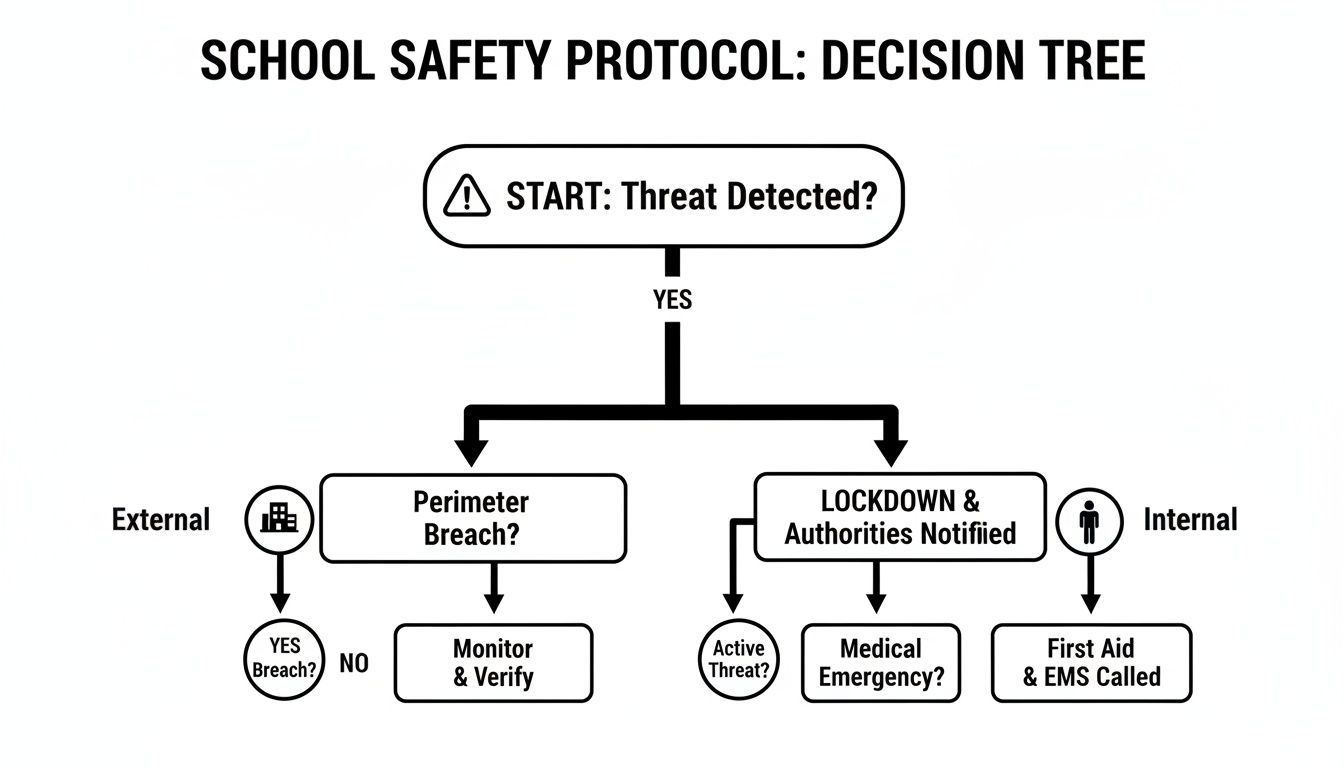
This helps break down the immediate decision-making process, showing how to distinguish between an external and internal threat to guide the right initial actions.
Real-World Scenarios and Swift Action
Let's walk through a real-world example. Imagine the school receptionist gets a threatening phone call. The established protocol demands they initiate a lockdown immediately. The receptionist hits a silent panic button mounted under their desk, which instantly sends an alert to the principal's office and the local police department.
At the same time, the principal gets on the intercom and announces the lockdown using plain language. Within seconds, teachers are locking doors, hitting the lights, and getting students moved to safe corners of the room. There’s no confusion, no second-guessing. The trigger was clear, and the communication was direct.
A well-defined protocol ensures that a school’s response is a reflex, not a debate. The time saved by eliminating hesitation is invaluable and directly translates into increased safety for everyone on campus.
Here’s another one. A teacher on yard duty spots someone trying to climb a fence. That teacher’s immediate radio call to the front office is the trigger. This is a perfect example of decentralized authority—giving staff on the ground the power to get the ball rolling. The whole point is to close the gap between seeing a threat and taking action, making sure the campus is secured as fast as humanly possible, no matter who sees the danger first.
Defining Roles and Communication During a Crisis
When a lockdown hits, confusion is the enemy. An effective response lives or dies by a pre-defined command structure where everyone knows their exact role without having to ask.
This isn't about guesswork; it's about building muscle memory through clear protocols and consistent training. Every second wasted trying to figure out who does what is a second lost in securing your campus and keeping everyone safe.
A solid lockdown plan formally assigns responsibilities, ensuring every critical task is covered from the moment an alert is issued. This clarity prevents overlap and, more importantly, keeps crucial duties from falling through the cracks.
Core Responsibilities During a Lockdown
Your lockdown's success depends on a clear division of labor. While every school's structure is a little different, the core responsibilities generally break down along these lines.
-
Administrators (Principals, VPs): Think of them as Incident Command. This team is the single point of contact for law enforcement, manages all campus-wide communication, and makes the high-level decisions. Their job is to see the big picture and coordinate the entire response.
-
Teachers and Classroom Staff: Their one and only focus is the immediate safety of their students. This means executing the "Locks, Lights, Out of Sight" protocol perfectly, taking attendance to account for every single child, and keeping the classroom as calm and silent as humanly possible. They are the frontline defenders.
-
Support Staff (Custodians, Librarians, Aides): These folks are your eyes and ears in the common areas. They have the critical role of clearing hallways, restrooms, libraries, and cafeterias, getting any stray students or staff into the nearest lockable room before securing their own area.
This structured approach ensures that potential chaos is managed through a clear hierarchy. Everyone has a mission, and that focus is what maintains order.
Crafting Calm and Clear Communication
The words you use during a lockdown are just as important as the actions you take. Your communication has to be clear, authoritative, and calm to prevent panic from taking over. Every announcement and message should be scripted well in advance so no one is improvising under extreme pressure.
Here are a few examples of scripted messages that work:
| Communication Channel | Audience | Sample Script |
|---|---|---|
| PA System | All Staff & Students | "Lockdown. This is a real lockdown. Locks, Lights, Out of Sight. Await further instructions." |
| Staff Text Alert | Teachers & All Staff | "IMMEDIATE LOCKDOWN. Secure your classroom now. Account for all students. Await updates via text." |
| Parent Notification | Parents/Guardians | "The school is in a lockdown due to a situation on campus. All students are safe. Please DO NOT come to the school. We will provide updates via text and email." |
Notice how direct and simple these scripts are. They provide clear instructions without unnecessary detail. For parents, the key is to give them essential information while explicitly telling them what not to do. A flood of parents rushing to the school can easily obstruct emergency responders and create a second crisis.
The primary goal of your initial crisis communication is to deliver actionable instructions, not detailed explanations. Simplicity and clarity prevent panic and ensure a faster, more uniform response.
To make sure your alerts and updates get out instantly, it's worth exploring effective real-time crisis communication tools designed to manage this flow of information seamlessly.
Managing the Information Overload
Once a lockdown is underway, the demand for information becomes intense. Parents will be calling nonstop, the media may show up, and misinformation can spread like wildfire on social media. Your plan has to account for this.
Designate a single person, often the superintendent or a district communications officer, as the sole Public Information Officer (PIO). All external inquiries—from frantic parents to news reporters—must be funneled to this person. This simple step prevents conflicting messages from getting out and ensures the information being released is accurate and approved by law enforcement.
It’s also critical to have backup communication systems. What happens if the power goes out and the PA system is dead? What if cell networks get overloaded?
- Have two-way radios for key personnel.
- Implement a phone tree for staff check-ins.
- Designate a pre-determined district website or social media page for official public updates.
Building these redundancies into your plan ensures your lines of communication stay open even when primary systems fail. By clearly defining roles and mastering your communication plan, you create a resilient framework that can withstand the immense pressure of a true emergency, turning potential chaos into a controlled, effective response.
Executing Effective Lockdown Actions On Campus
When a lockdown is announced, theory goes out the window. What takes over is muscle memory, and every single second counts. The cornerstone of classroom safety boils down to a simple, unforgettable directive: Locks, Lights, Out of Sight. This isn't just a catchy phrase; it's a critical sequence that's easy to recall and execute under extreme stress.
Think of it as the immediate action drill for every classroom. It’s a direct, unified response that every teacher can implement on the spot, buying precious time and dramatically increasing the safety of everyone inside.
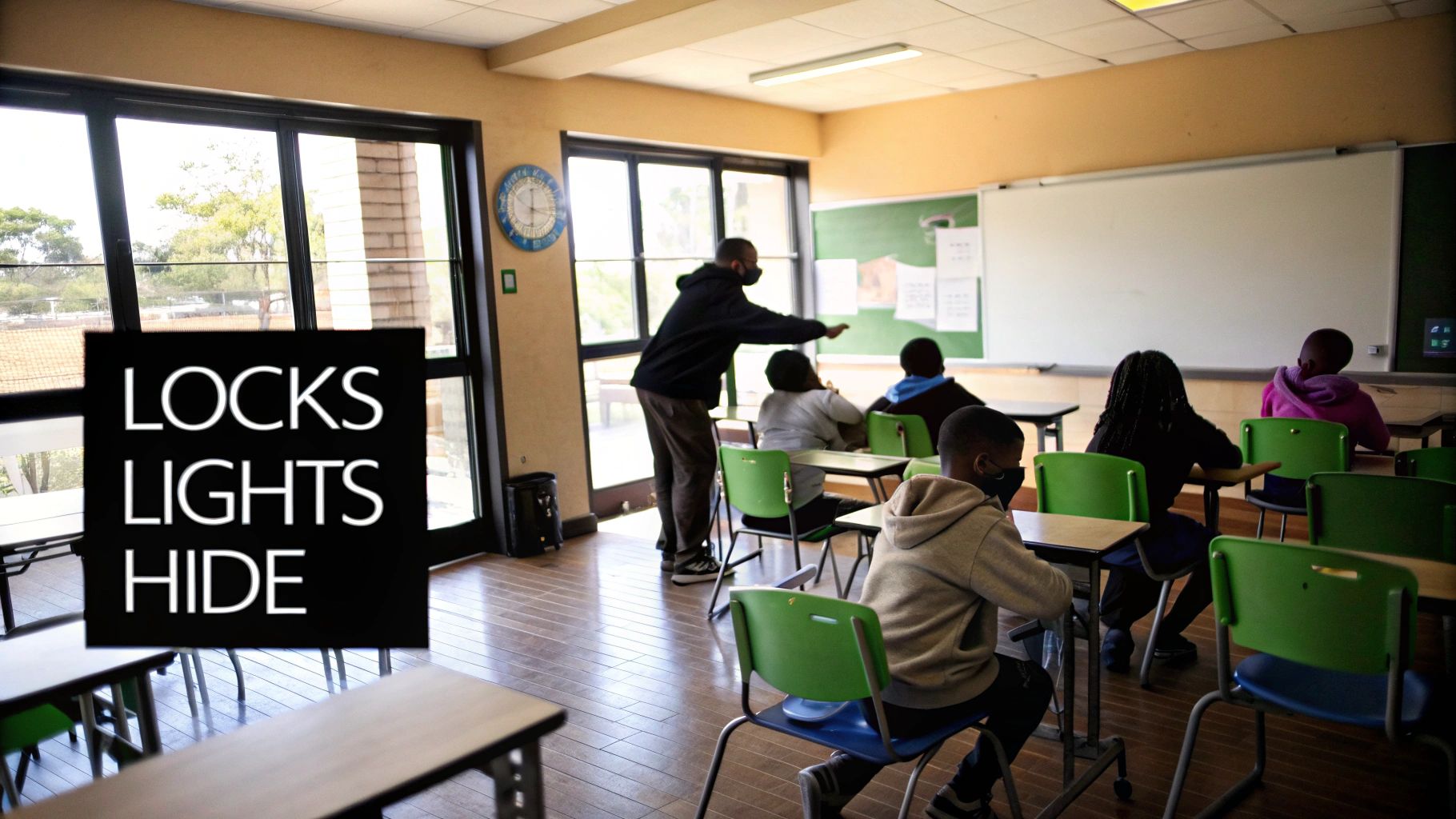
The Core Protocol: Locks, Lights, Out of Sight
The genius of this protocol is its simplicity. Let's dig into what each step means and why it works.
Locks
First thing's first: secure the door. This is your initial physical barrier. Ideally, every classroom door should lock from the inside, preventing a teacher from having to step into a potentially dangerous hallway.
Lights
Next, kill the lights. A dark room makes it incredibly difficult for an intruder to know if anyone is inside. From the hallway, it looks empty. This simple act can be enough to make a threat bypass your room entirely.
Out of Sight
Finally, get everyone hidden. This means moving all students and staff away from doors and windows and into a corner of the room—a spot pre-determined during drills—that offers the most concealment. The goal is to make the room appear completely empty and quiet.
In an active threat situation, an intruder is often looking for the path of least resistance. A locked, dark, and silent classroom presents a significant obstacle, increasing the likelihood they will move on to find an easier target.
Securing Vulnerable Common Areas
Classrooms are one thing, but what about the wide-open spaces? A lockdown is only as strong as its weakest link. Students caught in hallways, cafeterias, or gyms need clear, practiced instructions.
Hallways and Restrooms
Anyone caught in a hallway when a lockdown starts must get into the nearest lockable room—period. Whether it’s a classroom, an office, or even a secure closet. We train our staff to be vigilant, quickly pulling anyone they see in the hall into their room before locking that door.
Cafeterias, Libraries, and Gyms
These large areas with multiple entrances are a real challenge. Staff in these spaces have to be decisive, directing students to the most concealable locations available.
- Cafeteria: Get students under tables, far away from glass entryways and large windows.
- Library: Use the bookshelves for cover. Move people into interior offices or behind solid structures.
- Gym: The locker rooms or equipment storage areas are your best bet. Use them as makeshift safe rooms.
The key in these spaces is breaking the line of sight and getting away from entrances. Running specific drills for these unique environments is absolutely essential so everyone knows exactly where to go.
Critical Rules During Lockdown
Beyond the basic actions, a couple of non-negotiable rules must be drilled into every person on campus.
The Rule of Silence
Once you’re hidden, absolute silence is mandatory. No talking, no whispering, and definitely no cell phone sounds. A single noise can betray your location to an intruder. This is often the hardest rule for students to follow, which is precisely why it has to be practiced over and over again during drills.
Treating Fire Alarms as a Potential Tactic
Tragically, attackers have used fire alarms to lure people out of secure rooms. During a lockdown, the standing order must be to ignore all fire alarms. The only exception is if you see or smell smoke, or if a trusted administrator or law enforcement officer gives a direct, in-person order to evacuate. It feels counterintuitive, but it's a life-saving reality of modern school security.
Bolstering Your Protocols with Physical Security
Drills and procedures are the human element of safety, but they become exponentially more effective when backed by physical security upgrades. Glass doors and windows are almost always the weakest points in a school building, and this is where security window film makes a huge difference.
Standard tempered glass shatters easily, giving an intruder instant access. You can learn more about how security window film for schools reinforces this vulnerability. This specialized film is designed to hold broken glass together, keeping the window pane intact even after multiple impacts.
Instead of walking right in, an intruder is forced to waste precious time and energy—and make a lot of noise—trying to get through the fortified glass. This delay is critical for two reasons:
- It buys time: Every second an intruder is delayed is another second for law enforcement to arrive on the scene.
- It acts as a deterrent: Faced with unexpected resistance, an intruder may give up and move on.
When you integrate physical security like safety film with well-practiced lockdown protocols, you create a powerful, layered defense. It ensures that both the actions of your people and the strength of your building are working in concert to keep everyone as safe as possible.
Managing Reunification and Post-Crisis Recovery
Once law enforcement gives the "all-clear," it’s tempting to breathe a sigh of relief. The immediate danger is over, but a new, incredibly challenging phase is just beginning. The time right after a crisis is a delicate dance between precise logistics and deep, compassionate care. Your plan for reuniting students with their families and handling the emotional fallout is every bit as critical as the lockdown itself.
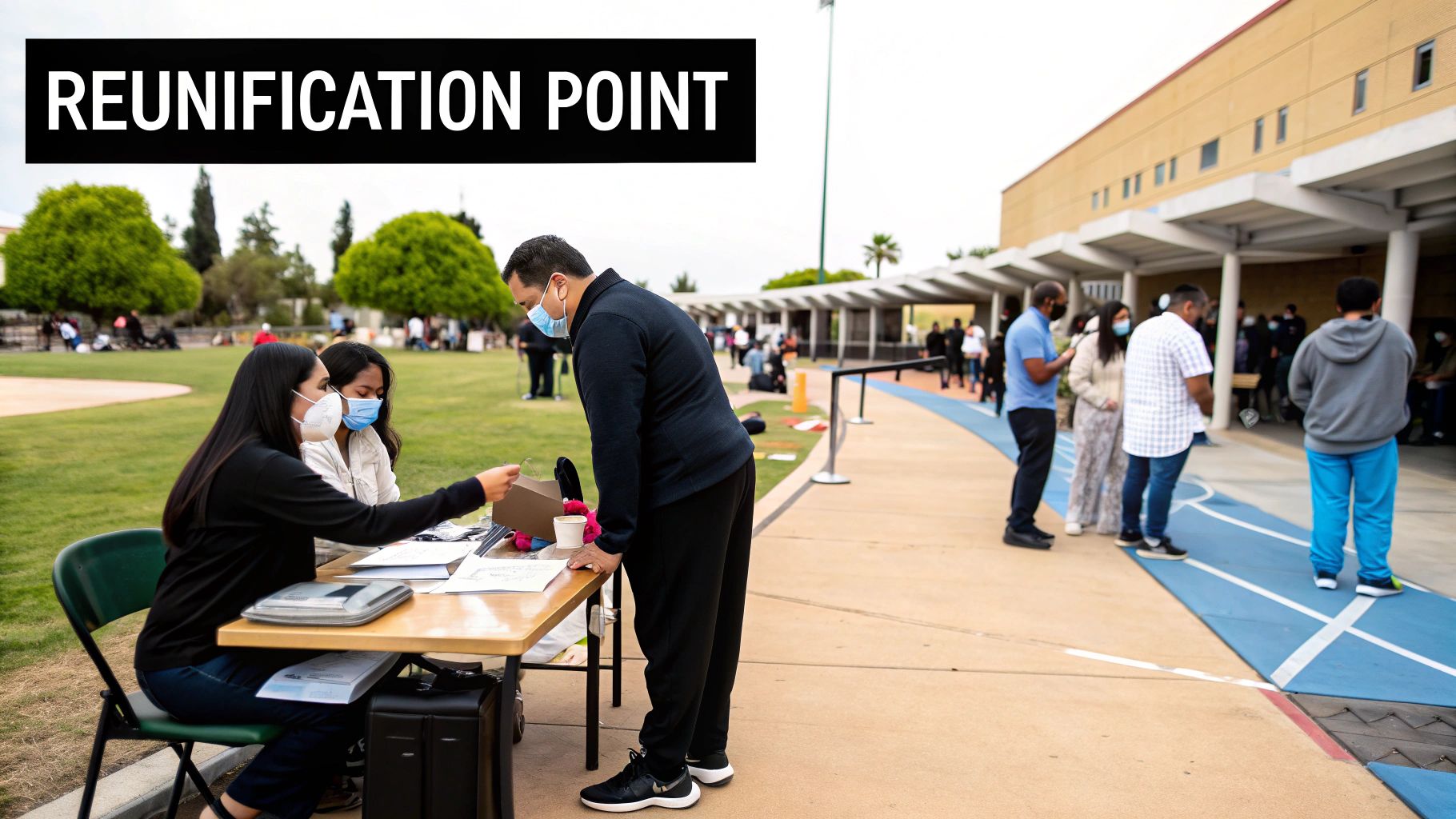
The gut reaction is to throw open the doors and let frantic parents in. But that's a recipe for chaos, creating huge accountability gaps and cranking up the anxiety for everyone involved. A structured, methodical reunification process isn't just a good idea—it's essential.
Establishing a Secure Reunification Process
First things first: activate your pre-planned reunification center. This has to be a safe spot away from the school, like a local community center, a church, or even another school in the district. This separation is crucial. It keeps the incident scene clear for investigators and stops parents from gathering in what could still be an unsecure area.
With the location secured by staff and law enforcement, you have to get the word out to parents—clearly and quickly.
Parent Communication Example: "The lockdown at Northwood High has ended. All students are safe. Please come to the Northwood Community Center at 123 Main Street for student reunification. Bring a valid ID. DO NOT come to the school."
A message like this gives them what they need to know while helping manage traffic and setting expectations. The process itself needs to run like a well-oiled machine, ensuring every single student is accounted for and released only to an authorized adult.
- Check-In Station: Parents arrive and show their ID. Staff cross-reference it with the student’s emergency contact information.
- Holding Area: After they're verified, parents move to a waiting area. This keeps the check-out zone from getting congested.
- Student Escort: Designated staff members (runners) bring students from their separate, secure area to their verified parents.
- Check-Out Documentation: A final sign-out sheet is filled out, giving you a clear paper trail for every single student.
Navigating the Emotional and Psychological Recovery
Getting kids home safely is just one piece of the puzzle. The emotional recovery for your entire school community starts the moment the lockdown ends. The trauma of an event like this doesn't just vanish when the doors unlock.
You have a responsibility to provide immediate and ongoing psychological support. This means having counselors—from your district or partner agencies—on-site at the reunification center to offer support right away. In the days and weeks that follow, both students and staff will need continued access to mental health resources. Some people might seem perfectly fine at first, only to show signs of distress later on.
A critical mistake is assuming "no physical injuries" means no one was harmed. The psychological impact of a lockdown is significant and requires a proactive, long-term support strategy to help students and staff process the event and rebuild their sense of security.
These disruptions have lasting effects that go beyond immediate trauma. Even planned school closures have had major consequences. For example, a World Bank analysis found that pandemic-related closures resulted in substantial learning loss, equal to about half a year for the average student. While a security lockdown is different, this data highlights that any major disruption to the school environment has ripple effects that must be part of your recovery plan. You can read the full findings on the impact of school closures to understand more.
Conducting a Post-Incident Debrief
After the dust has settled, a thorough debrief is non-negotiable. This isn't about pointing fingers; it's about making your plan stronger. Bring together everyone involved—administrators, teachers, key staff, and first responders—to walk through what happened, step by step.
- What went right?
- Where did communication falter?
- Did we run into unexpected challenges securing certain rooms or areas?
- How could the reunification process have been smoother?
The honest answers to these questions are your roadmap for improvement. This cycle of review and refinement is what turns a good plan into a great one. It ensures you learn from every single event, whether it's a real incident or just a drill, making your campus safer for whatever comes next.
Common Questions About School Lockdown Procedures
Even with a rock-solid plan on paper, questions are going to pop up. It’s inevitable. Getting ahead of these common queries from parents, teachers, and staff is one of the most important things you can do. When you clarify roles and explain the why behind the rules, you build trust and confidence across the whole school community.
When things get stressful, clarity is everything. If everyone knows not just what to do but the reasoning behind it, your response will be faster, calmer, and far more effective.
How Often Should Schools Practice Lockdown Drills?
Most safety experts and state laws will tell you to run lockdown drills at least twice per year. But honestly, just checking that box isn't enough. The quality and variety of your drills are what really make the difference. You have to mix it up to prevent people from just going through the motions.
Think about running different scenarios. One drill could be a full, hard lockdown for a threat inside the building. The next could be a "secure" or "lockout" response to a police situation down the street. Practicing these variations gets staff and students used to different commands and actions. And a quick debrief with staff afterward is non-negotiable—it's where you find out what went right, what didn't, and how to make the plan even better.
What Is the Parent's Role During a School Lockdown?
This is one of the toughest things to ask a parent, but it’s critical: during a real lockdown, your most important job is to stay calm, stay away from the school, and wait for official updates.
It’s every parent’s first instinct to rush to their child. But that can cause massive traffic jams, blocking police, fire, and ambulance crews from getting to the scene. It also adds more chaos to an already dangerous situation. Please, don't call the school or your child's cell. Extra calls can jam up the phone lines that first responders rely on, and a ringing phone could give away a classroom's location. Keep an eye on the official channels—district text alerts, emails, or the website—for instructions about when and where the reunification will happen.
By staying away from the campus, parents directly help keep all students and staff safer. It gives emergency crews the space they need to manage the situation effectively and without interference.
How Does Security Window Film Improve Lockdown Safety?
Security window film is all about adding a crucial layer of physical defense that buys you time. This isn't just a simple tint; it's a tough, durable membrane that bonds directly to the glass, making it incredibly difficult to shatter and break through.
During a lockdown, that resistance is priceless. An intruder can't just smash a window and climb in. They're forced to make a lot of noise and waste valuable seconds—or even minutes—trying to get through the fortified glass. That delay gives law enforcement a much bigger window to arrive on the scene and neutralize the threat. Many security films also come in tinted or reflective versions, which directly support the "out of sight" principle by blocking an intruder's view into a classroom.
A truly effective safety plan layers well-practiced procedures with physical hardening of the building itself. At Fortress Security Films, we specialize in reinforcing your school's most vulnerable points—its glass doors and windows. Learn how our advanced security film solutions can provide the critical delay needed to keep students and staff safe. You can explore security film options for your school on our website.
