


When you need the absolute best in safety glass, there’s one option that stands head and shoulders above the rest: laminated tempered glass. It’s the product of combining the incredible strength of tempered glass with the shatter-retaining safety of laminated glass. The result is a high-performance material that provides superior protection against impact and holds itself together even when broken, preventing deadly shards from flying. This hybrid design makes it the go-to choice wherever security and human safety are top priorities.
Unpacking the Power of Hybrid Safety Glass
The easiest way to think of laminated tempered glass is as a high-tech safety sandwich. It isn't just one sheet of glass; it's a meticulously engineered composite built for maximum resilience. The "bread" of this sandwich consists of two sheets of tempered glass. These aren't just regular glass—they've been put through an intense heating and rapid cooling process that makes them four to five times stronger than standard annealed glass.
The "filling" holding these two powerful layers together is a tough, clear polymer interlayer, usually made from Polyvinyl Butyral (PVB) or a specialty material like SentryGlas Plus (SGP). This interlayer is the real magic of the system. It functions as a super-strong glue, so if the glass ever takes a hit hard enough to break, all the dangerous fragments stay bonded in place. Instead of exploding into a shower of sharp projectiles, the pane stays mostly intact, forming a characteristic spider-web cracking pattern.
This brilliant construction gives you the best of both worlds:
- Exceptional Impact Resistance: The tempered glass layers are tough enough to brush off everything from heavy blows to extreme weather.
- Post-Breakage Safety: Should the glass ever fracture, the interlayer keeps it all together, preventing entry and minimizing the risk of serious injury from sharp edges.
- Enhanced Security: Because the pane remains a solid barrier even when broken, it's a powerful deterrent against forced entry attempts like smash-and-grab robberies.
The core idea is brilliantly simple: take the raw strength of tempered glass and fuse it with the cohesive safety of laminated glass. You get a material that doesn't just resist breaking; it manages failure in the safest possible way.
This dual-action protection is what truly separates laminated tempered glass from other types of safety glazing. It handles both the initial impact and the dangerous aftermath of a break, something that single-material solutions simply can't do. That's why it's become an essential material for storefronts, school windows, skylights, and even car windshields—basically, any place where protecting people and property is a non-negotiable. Grasping this basic structure is the key to understanding why it’s specified for the most demanding applications.
How Laminated Tempered Glass Is Made
Creating laminated tempered glass isn't as simple as just slapping a few pieces of glass together. It’s a sophisticated, two-part manufacturing process where each step is designed to build on the last. The goal is to create a final product that’s vastly stronger and safer than any of its individual parts.
You can think of it as a journey with two key transformations. First, we make the glass incredibly strong through tempering. Then, we make it hold together under pressure through lamination. Let's break down how it works.
Stage One: The Tempering Process
Everything starts with a standard sheet of annealed glass. Before we do anything else, the glass is cut to the exact size and shape needed. If it requires any holes drilled or edges polished, it has to happen now—once glass is tempered, you can't alter it.
Next, the prepared glass goes into a tempering furnace, where it's heated to an intense 1,100°F (600°C) or more. At this temperature, the glass becomes almost molten. As soon as it hits that critical point, it’s pulled out and hit with jets of high-pressure cold air in a process known as "quenching."
This sudden cooling is the secret sauce. The outer surfaces of the glass cool down and harden almost instantly, while the inside cools much more slowly. As the inner core gradually cools and shrinks, it pulls on the already-rigid outer layers. This creates a fascinating internal battle: the outer surfaces are squeezed into a state of high compression, while the center is locked in a state of tension.
Imagine a tightly wound spring. The compressed outer shell acts as a powerful protective layer, while the tension in the middle stores a huge amount of energy. It’s this carefully engineered stress that makes tempered glass four to five times stronger than regular glass.
Stage Two: The Lamination Process
With two sheets of freshly tempered glass ready, it’s time to build the "safety sandwich." This is where we bond the incredibly strong glass panes to a tough, flexible interlayer in a meticulously clean environment to avoid any imperfections.
The process is very precise:
- Assembly: A sheet of a polymer interlayer, usually Polyvinyl Butyral (PVB) or SentryGlas Plus (SGP), is placed between the two sheets of tempered glass.
- Initial Fusion: This three-layer stack is then sent through a series of rollers that apply heat and pressure. This squeezes out any air and creates a temporary bond, tacking everything together for the final step.
- The Autoclave: The assembly is then moved into an autoclave, which is basically a high-tech industrial pressure cooker. For several hours, the glass is subjected to extreme heat and pressure, forcing the interlayer to permanently fuse with the two glass panes.
This infographic gives you a great visual of the finished layered construction, showing how the tough tempered glass and the resilient interlayer come together.
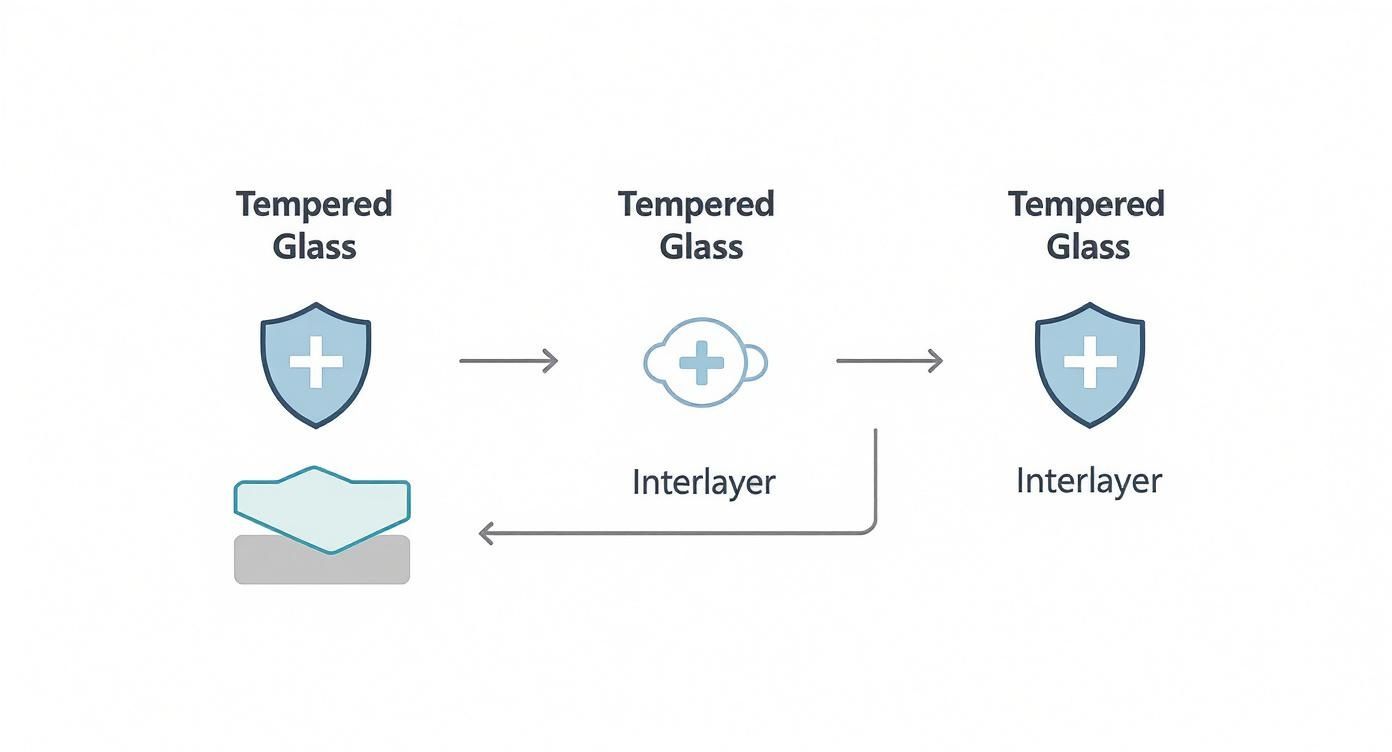
As you can see, the real magic is in this combination of materials, creating a synergy that a single material could never achieve.
The autoclave process creates a bond so strong that the layers become one solid unit. You simply can't separate them without completely destroying the panel. The final product is laminated tempered glass—a material that has the sheer impact strength of tempered glass and the critical post-break safety of laminated glass, making it ready for the most demanding jobs.
Picking the Right Safety Glass for Your Needs
When you start looking into safety glass, it's easy to get lost in the jargon. You'll hear terms like "tempered" and "laminated" thrown around, but they aren't interchangeable. They describe completely different products that behave in very different ways when put to the test. Getting this choice right is crucial—it can be the difference between a minor incident and a full-blown security disaster.
The three big players are tempered glass, laminated glass, and the hybrid that combines them both: laminated tempered glass. All of them are considered "safety glazing," which just means they're designed to be much safer than the standard annealed glass in older windows. But how they keep you safe is where things get interesting.
Understanding Standard Tempered Glass
Think of tempered glass as the brute force option. As we covered earlier, it's made by heating a pane of glass to over 1,100°F and then flash-cooling it. This process creates immense surface compression, making the glass about four to five times stronger than regular glass.
This strength is great for resisting blunt impacts or sudden temperature changes. But here's the catch: that strength is also its biggest vulnerability. When tempered glass finally gives way, it doesn't just crack—it explodes. The pent-up energy releases all at once, shattering the entire pane into thousands of tiny, dull-edged cubes.
While this "dicing" prevents deadly, jagged shards, it also means your barrier is instantly gone. For an intruder, one solid hit is all it takes to create an open invitation inside. There’s zero post-break security.
Exploring Basic Laminated Glass
Laminated glass plays a totally different game. It’s not about preventing the glass from breaking; it’s about what happens after it breaks. This glass is a sandwich made of two layers of standard glass with a tough, clear polymer interlayer (usually PVB) bonded between them.
When something hits laminated glass, the glass layers might crack and spiderweb, but all those broken pieces stay glued to the interlayer. The window remains a solid barrier, preventing glass from flying and making it incredibly frustrating for anyone trying to force their way through. It's the same principle as your car's windshield—it can take a serious hit but stays in its frame. The trade-off? The individual glass panes aren't tempered, so they don't have that super-high initial impact strength.
The Superior Hybrid: Laminated Tempered Glass
This is where you get the best of both worlds. Laminated tempered glass is exactly what it sounds like: a multi-layered sandwich made by bonding two sheets of powerful tempered glass together. It’s a formidable combination that delivers on all fronts:
- Extreme Initial Strength: The tempered outer layers can shrug off powerful impacts that would shatter lesser glass.
- Post-Breakage Integrity: If an attacker finally manages to break it, the interlayer grabs hold of all the small, pebble-like tempered fragments, keeping the barrier intact.
This one-two punch creates a barrier that is exceptionally difficult to breach. It withstands repeated attacks and stays in the frame even after being compromised, buying precious time. It’s no surprise that its superior performance has made it a market leader. In fact, tempered laminated glass has held the top spot in the laminated glass industry by value since 2024, solidifying its role as the go-to for high-security situations. You can read more about this market trend in a report from [MarketsandMarkets.com](https://www.marketsandmarkets.com/Market-Reports/laminated-glass-market-1393 laminated-glass-market.html).
By fusing the shatter-retaining properties of laminated glass with the sheer force resistance of tempered glass, this hybrid material creates a security barrier that excels at every stage of an attack—from the first impact to the last.
To make the differences even clearer, let's break down how these three types of safety glass stack up side-by-side.
Safety Glass Features at a Glance
Choosing the right glass often comes down to balancing strength, post-break safety, and cost. This table gives a quick overview to help you see which option best fits your specific security goals.
| Feature | Laminated Tempered Glass | Tempered Glass | Laminated Glass |
|---|---|---|---|
| Initial Strength | Highest | High | Moderate |
| Post-Break Safety | Excellent (Stays in Frame) | Poor (Shatters Completely) | Excellent (Stays in Frame) |
| Forced Entry Delay | Excellent | Very Poor | Good |
| UV Protection | ~99% | Minimal | ~99% |
| Sound Insulation | Very Good | Poor | Good |
| Cost | Highest | Low | Moderate |
As you can see, while tempered and laminated glass are great for specific safety needs, laminated tempered glass consistently comes out on top for comprehensive security, offering an unmatched combination of raw power and staying power.
Real-World Applications: Where Laminated Tempered Glass Shines
The theory behind laminated tempered glass is impressive, but its true value comes to life when you see where it's actually used. This isn't just a stronger piece of glass; it's a critical safety component in places where failure is simply not an option.
From storefronts that need to stop a thief in their tracks to homes that have to stand up to a hurricane, this material delivers a level of protection that other glass types can't touch.
So, where is this powerful safety glass making a real difference? Let's take a look.
Protecting Homes and Families
For a homeowner, laminated tempered glass is more than just a window—it's a shield. In coastal regions where hurricanes and violent storms are a yearly threat, you'll find it in windows and large glass doors. It’s engineered to withstand incredible wind pressure and impacts from flying debris, keeping the building's envelope intact and preventing catastrophic damage.
But its benefits go well beyond weather. It's also a formidable barrier against forced entry. A burglar can't just smash a patio door made from this stuff and walk in. Even after repeated, heavy blows, the tough interlayer keeps the fractured glass in place, denying access and giving people inside crucial time to call for help. It's no surprise that when selecting the right materials for luxury home design, this glass is a top choice for its blend of aesthetics and uncompromising security.
Common residential uses include:
- Large Patio Doors: These are often the weakest point in a home's security, but laminated tempered glass turns them into a serious obstacle.
- Skylights: This is a crucial application. If a skylight is shattered by hail or a falling tree branch, the lamination prevents a cascade of dangerous glass shards from falling into the living space below.
- Pool Fencing: It provides a safe, durable barrier around pools that won't break into hazardous pieces on impact.
Securing Commercial and Public Spaces
For any business, security is a constant concern. Retail storefronts, especially jewelers or electronics stores, are prime targets for smash-and-grab robberies. Laminated tempered glass completely changes the equation. Because it won't shatter and fall out, thieves can't gain instant access. More often than not, they give up and flee empty-handed.
In public buildings like schools, airports, and government offices, the focus is squarely on protecting people. Laminated tempered glass is specified here for its ability to contain threats, offering enhanced safety during active emergencies and even mitigating the deadly pressure waves from a blast.
You'll also find this robust glass in places like:
- Museum Display Cases: Keeping priceless artifacts safe from both theft and accidental damage.
- Bank Teller Windows: A crystal-clear barrier that provides robust protection for employees.
- Glass Balustrades: Essential for safety on staircases and balconies, these panels hold together even if one cracks under severe impact.
Advancing Automotive Safety
The automotive world is one of the biggest users of this technology, and for very good reason. Your car’s windshield is a classic example of laminated glass, designed specifically to protect occupants in a crash. While standard laminated glass is the norm for windshields, the move toward laminated tempered glass is accelerating, particularly for side windows and massive panoramic sunroofs in modern vehicles.
These larger glass panels need the extra strength of tempering to resist road debris and impacts, plus the safety of lamination to prevent passengers from being ejected. The glass also plays a key role in the vehicle's structural integrity and ensures airbags deploy correctly against a solid surface.
This demand is reshaping the global market. The Asia Pacific region is the powerhouse, accounting for nearly 48% of global sales in 2024. This surge is fueled by booming automotive production, especially in the EV sector where complex and expansive glass designs are becoming the new standard. Whether it's for our homes, high-rises, or highways, laminated tempered glass is the clear choice when safety and security are on the line.
Exploring the Hidden Benefits Beyond Strength
While the sheer strength of laminated tempered glass is what usually gets people's attention, the real story is in the other advantages it brings to the table. Think of it less as just a security feature and more as a smart upgrade for your entire property, enhancing comfort and protecting your investments in ways you might not expect.
These hidden perks make it a truly multifunctional material.
The secret ingredient is the polymer interlayer sandwiched between the glass panes. It does a lot more than just hold shattered glass in place; it’s also an incredible sound dampener.
Unlocking a Quieter Environment
Imagine that interlayer as a shock absorber, but for sound. When noise from traffic, construction, or even a loud neighbor hits the window, that soft, flexible polymer layer vibrates and deadens the acoustic energy. It effectively stops a significant amount of sound from ever entering your room.
The result is a noticeably quieter, more peaceful indoor space. For anyone living on a busy street or a business that needs a focused, calm atmosphere, this sound insulation is a game-changer. It’s like hitting the mute button on the outside world.
Superior UV and Thermal Protection
That same interlayer also doubles as a powerful shield against the sun's damaging, invisible rays. While standard glass lets ultraviolet (UV) radiation pass right through, the polymer in laminated tempered glass is a different story—it blocks up to 99% of harmful UV rays.
This has a couple of very practical benefits:
- Prevents Fading: Your furniture, hardwood floors, carpets, and artwork are protected from the sun's bleaching effects, keeping them vibrant for years longer.
- Protects Your Health: It cuts down your exposure to the UV radiation that contributes to skin damage.
On top of that, this type of glass can be a huge asset for energy efficiency. Manufacturers can incorporate specialized interlayers and add low-emissivity (Low-E) coatings to the glass. These additions work to reflect heat, which helps keep your home or office cooler in the summer and warmer in the winter. Your HVAC system won't have to work as hard, which means lower energy bills and a more comfortable building all year.
The added functionalities of UV protection, acoustic insulation, and energy efficiency are not just minor perks; they are significant drivers in the material's growing adoption across multiple industries.
You can see the demand for these combined benefits reflected in market trends. The global laminated glass market has grown substantially, largely because sectors like construction and automotive now expect more than just safety—they want noise reduction and UV blocking as standard features. You can get more details by checking out the full laminated glass market report.
Ultimately, investing in this advanced glass means you’re enhancing not just security, but the overall quality of life inside your space.
Is There a Practical Alternative to Full Window Replacement?
Let's be realistic. Swapping out every window in a building for new laminated tempered glass is a massive undertaking. While the protection is top-notch, the reality is that a full replacement project can be incredibly expensive, disruptive, and time-consuming. It's often just not a practical option, especially when you're looking to upgrade an entire school or retail storefront.
Thankfully, there's a highly effective way to get many of the same safety benefits without tearing out your existing windows: installing high-performance security window film.
Think of it as an invisible suit of armor for your glass. A specialized, thick-gauge polyester film, like the kind we offer at Fortress Security Films, is applied directly to the interior surface of your windows. This film fuses with the glass, creating a surprisingly powerful membrane that mimics the function of the interlayer in laminated glass.
How Does Security Film Actually Make Windows Safer?
The magic happens when the glass breaks. Instead of exploding into a shower of dangerous shards, the security film holds the entire pane of glass together. The window will still shatter from a heavy impact, but it creates a "spider-web" pattern of cracks while remaining locked in its frame. This is the exact same principle that makes laminated glass a go-to safety product.
This ability to hold broken glass in place is a game-changer. For a homeowner, it means an intruder can't just smash a window and walk right in. For a business, it's a powerful defense against the quick smash-and-grab robberies that depend on instant access. The film denies that immediate entry, which buys precious seconds for alarms to go off and for law enforcement to be on their way.
A Head-to-Head on Cost and Installation
This is where security film really shines for most people. The difference in cost and convenience compared to a full window replacement is huge.
- A Fraction of the Cost: Installing brand new laminated tempered glass can easily cost two to five times more than retrofitting your current windows with a premium security film. This makes it a far more accessible solution for protecting an entire property.
- A Painless Installation: Tearing out old windows is a full-blown construction job. It’s messy, noisy, and can take days or even weeks to complete. Professional security film installation, on the other hand, is a clean and quiet process that’s often finished in just a day, with almost no disruption to your home or business operations.
Security window film gives you a strategic edge. It delivers a serious upgrade in protection for a fraction of the cost and without the headache of a major renovation. It works with the glass you already own.
The Extra Perks of Window Film
High-quality security film does more than just stop bad guys. It brings a few other great benefits to the table, many of which are also features of new laminated glass.
For starters, most security films block up to 99% of damaging UV radiation. This is a huge deal for protecting your hardwood floors, furniture, and artwork from fading over time. Many films also offer solar control benefits, cutting down on heat and glare, which can make your space more comfortable and even lower your energy bills.
When it comes down to it, security window film is a smart, powerful, and practical solution. It allows property owners to dramatically improve the safety of their existing windows against break-ins, severe weather, and accidents. By replicating the shatter-resistant performance of laminated tempered glass, it delivers robust security without the hefty price tag and operational downtime of a complete window overhaul.
Common Questions About Laminated Tempered Glass
Even after getting a good grasp of what laminated tempered glass can do, it’s normal to have some practical questions. It’s a serious investment in safety and security, after all, so you want to be sure you have all the facts straight. We’ve pulled together some of the most common questions we hear to give you clear, direct answers.
From figuring out what kind of glass you already have to understanding its real-world limits, these answers should help you decide if it’s the right choice for your home or business.
How Can I Tell if My Glass Is Laminated and Tempered?
You can usually spot this type of glass with a quick inspection. Take a look at one of the corners for a small, permanent stamp etched right into the glass. This mark, sometimes called a "bug," will typically have codes on it. Look for abbreviations like "TEMP" for tempered and "LAMI" for laminated.
Another dead giveaway is the edge of the glass. If you can see it, you’ll notice a distinct, multi-layered look caused by the polymer interlayer sandwiched between the glass panes. One final trick: if you look at tempered glass through polarized sunglasses, you might see faint, wavy patterns or dark spots. That’s the visual evidence of the stress created during the tempering process.
Is This Type of Glass Bulletproof?
This is a huge and very important misconception. Standard laminated tempered glass is not bulletproof. It’s incredibly tough and can stand up to repeated blows from a hammer or a crowbar, but it wasn't designed to stop a bullet.
True bullet-resistant glass is a different beast entirely. It's a highly engineered system with multiple, much thicker layers of glass and specialized interlayers designed to meet specific ballistic ratings, like those from UL 752. Think of laminated tempered glass as one component, but not the whole system.
How Much More Does It Cost?
Given the complex, two-step manufacturing process, this is definitely a premium product. You can generally expect laminated tempered glass to cost anywhere from two to five times more than a standard pane of tempered glass.
The final price tag will depend on a few things, like the thickness of the glass, the size of the pane, and whether you’ve added any special coatings for energy efficiency (like Low-E). The initial cost is higher, no doubt, but many find it’s a fair trade-off for the huge leap in safety, security, and durability.
Can You Cut or Drill This Glass After It Is Made?
No, you absolutely cannot. The tempering process puts the glass under immense, balanced stress—that’s where its strength comes from. The moment you try to cut, drill, or even sand the edge of tempered glass, you release all that stored energy. The entire pane will instantly and safely disintegrate into thousands of tiny, pebble-like pieces.
This means any and all shaping—cutting to size, drilling holes for hardware, or creating custom shapes—has to be done before the glass goes into the tempering furnace.
On a less dramatic note, day-to-day upkeep is also a common concern. For example, knowing how to remove hard water stains from car glass is a useful skill for keeping any high-quality glass in pristine condition.
While laminated tempered glass offers incredible protection, upgrading your existing windows with security film is a powerful and cost-effective alternative. Fortress Security Films provides advanced solutions that reinforce the glass you already have, delivering robust security against forced entry and severe weather without the hassle and expense of a full replacement. Discover how our nearly invisible films can fortify your property by visiting https://fortresssecurityfilms.com.
