


Impact window ratings are basically a report card for how well a window can stand up to Mother Nature's worst. Think of it like a car's crash-test rating—it's a standardized score that tells you exactly how the window will perform under the incredible stress of hurricane-force winds and flying debris. Getting a handle on these critical safety numbers is the first step toward truly protecting your home.
Why Impact Window Ratings Are Your First Line of Defense
Picture your home in the middle of a major storm. The wind is howling, rain is coming down sideways, and the air pressure is going wild. Your windows are, by far, the most vulnerable part of your house in this scenario. If just one of them shatters, wind can pour inside, creating a massive upward pressure on your roof and outward pressure on your walls. That's how a home can be torn apart from the inside out.
This is exactly why impact window ratings aren't just technical mumbo-jumbo; they're the language of safety. They give you a reliable, unbiased way to measure performance, confirming that a window has been put through brutal, standardized tests that simulate the conditions of a hurricane. When you learn to read this language, you stop hoping your home is safe and start knowing it's fortified.
Before we get into the nitty-gritty of specific tests, let's look at the major rating systems you'll encounter. This table gives you a quick overview of who's who and what they measure.
Key Impact Window Rating Systems at a Glance
| Rating System | What It Measures | Primary Use Case |
|---|---|---|
| ASTM/ANSI | Overall performance, including air/water leakage, structural load, and forced entry resistance. | A general baseline for window quality and safety across the U.S. |
| Miami-Dade (TAS) | Extreme windborne debris impact and cycling pressure tests. | Required in Florida's High-Velocity Hurricane Zone (HVHZ), the gold standard for hurricane protection. |
| ASTM E1886/E1996 | Specific missile impact and pressure cycling tests. | The most common standard used outside of the HVHZ for hurricane-prone regions. |
| Design Pressure (DP) | The window's ability to withstand positive and negative wind pressure, measured in psf. | Determines if a window is suitable for the wind loads in a specific geographic location. |
Think of these as different layers of certification. While most windows will have some form of ASTM and DP rating, those destined for hurricane alley need to prove themselves against much tougher standards like Miami-Dade or ASTM E1996.
Beyond Storms: A Comprehensive Safety Barrier
Here’s something a lot of people don’t realize: the features that make a window strong enough to stop a 2×4 flying at 50 mph also make it a fantastic security barrier. That laminated glass and heavily reinforced frame are incredibly difficult for an intruder to break through.
So, while you might be buying them for hurricane season, you're getting a powerful, year-round upgrade to your home's security. It's this kind of multi-purpose protection that provides real peace of mind.
An impact window's rating is a promise from the manufacturer—a promise that the product has been tested and proven to withstand specific, measurable forces. It's the most reliable indicator of how your home's protective shield will hold up when you need it most.
Making an Informed Decision
Choosing new windows is a big deal, and it should feel that way. Your decision has a direct line to your family’s safety, your home's stability, and your finances. This guide is designed to walk you through what those ratings mean, how to read the labels, and how to make sure you’re getting the right product for where you live.
By the time you're done, you'll be able to look at a window's specs and know exactly what you're getting. While impact windows are a cornerstone of storm protection, a complete security plan often involves multiple layers. To bolster your defense against break-ins, you might also look into quality security screens for windows, ensuring your home is protected on all fronts, all year long.
Breaking Down the Alphabet Soup of Safety Standards
When you first look into impact windows, you're hit with a jumble of acronyms—ASTM, TAS, HVHZ. It feels like you need a secret decoder ring just to figure out what you're buying. But behind this alphabet soup are the critical tests that prove a window can actually protect your home when everything is on the line.
Think of these standards as a window’s final exam. Each one is a brutal, carefully designed gauntlet meant to simulate the raw power of a hurricane. A window doesn't get a passing grade with a good guess; it has to physically survive impacts and pressures that would leave a normal window in shards.
Let's translate these complex codes into plain English.
The Two-Part Gauntlet: ASTM E1886 and E1996
The most common standards you'll see across the U.S. are ASTM E1886 and ASTM E1996. It's best to think of this as a one-two punch: first, a violent impact, then a relentless wrestling match. The whole point is to see if a window can handle both flying debris and the crushing, sustained force of hurricane-force winds.
First up is the impact test, which mimics storm-tossed debris. We’re not talking about a gentle tap. In the most common version, a 9-pound 2×4 stud is fired from an air cannon at the window, hitting it at roughly 34 miles per hour (50 feet per second). This is the "large missile impact test," and it’s a terrifyingly realistic simulation of what a major storm can throw at your house.
If the window survives without creating a hole, it’s not done yet. It moves on to the "wrestling match"—the window is blasted with thousands of cycles of positive and negative air pressure. This process copies the chaotic, fluctuating winds of a real hurricane that push and pull on your home. To pass, the window must hold its seal and structural integrity without failing.
The Gold Standard: The Miami-Dade TAS Protocols
For coastal areas in the crosshairs of the most severe hurricanes, there’s an even higher bar: the Miami-Dade County Test Protocols, specifically TAS 201, 202, and 203. These are widely considered the gold standard for impact windows and are required in Florida’s High-Velocity Hurricane Zone (HVHZ), which covers Miami-Dade and Broward counties.
Why so strict? These protocols were born from disaster. After Hurricane Andrew ripped through South Florida in 1992, it became painfully clear that existing building codes were nowhere near strong enough. The TAS protocols were created to establish a much tougher, more realistic set of performance standards.
The Miami-Dade TAS protocols don't just test the glass. They test the entire window system—the frame, the sealant, the hardware, and even the installation method. A window only earns this certification if every single piece works together to resist failure.
This concept map shows how these protective ratings translate into real-world benefits: safety for your family, security for your property, and invaluable peace of mind.
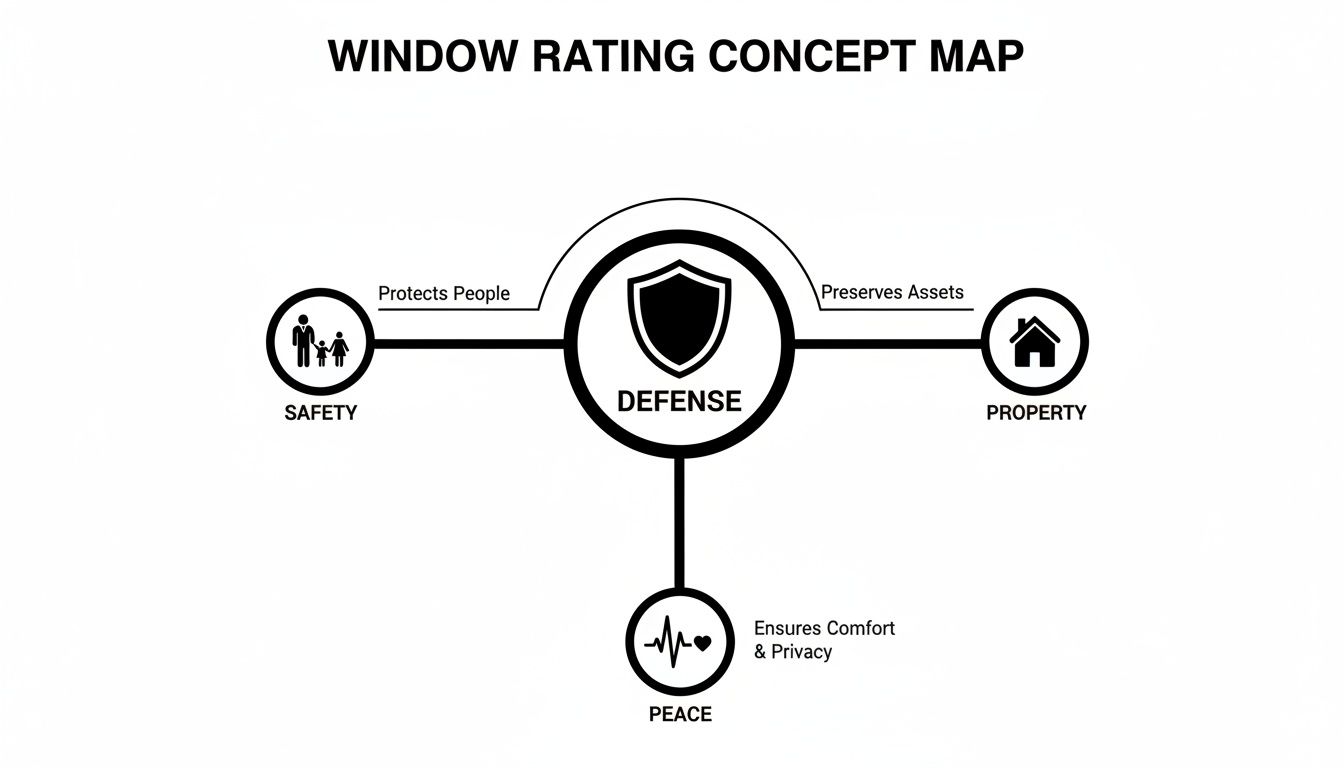
The shield at the center represents the window's proven defensive strength, which branches out to protect the most important parts of your life.
More Than Just Debris Resistance
While stopping flying debris is the main event, these tests also check for other critical failures. The goal is to ensure that even if the glass cracks, the tough inner layer holds everything together. This is what prevents wind and water from breaching your home's "envelope," which is the very thing that leads to catastrophic roof failure and structural collapse.
The incredible strength required to stand up to a hurricane brings a powerful side benefit: security against forced entry. The same engineering that stops a 2×4 can easily deter a would-be intruder. Of course, for those needing protection against more extreme threats, there are even more specialized solutions. To learn more, check out our comprehensive guide to ballistic window film.
By understanding what these ratings really mean—a grueling series of physical challenges—you can see why they're such a reliable measure of a window's resilience. When you see a window with an ASTM E1996 or a Miami-Dade TAS certification, you know it's not just a window. It’s a tested piece of engineering designed to be your home's first line of defense.
What a Design Pressure Rating Really Tells You
If impact tests are about a window taking a single, hard punch from debris, the Design Pressure (DP) rating is about its ability to survive a prolonged, brutal wrestling match with the wind. It’s the window's endurance score. This isn't just one number; it's a comprehensive grade that tells you exactly how much relentless force a window system—frame, glass, and all—can handle before it starts to fail.
To earn a DP rating, a window goes through a grueling series of lab tests that push it to its limits in three key areas. It has to pass all three to get a final score.
- Structural Load Test: This is a pure brute-force test. We find out exactly how much wind pressure the window can take before the glass shatters or the frame gives out.
- Water Penetration Test: Simulating a hurricane's driving rain, the window is blasted with water while under intense pressure to see if a single drop gets through.
- Air Infiltration Test: This measures how much air leaks through the window assembly under pressure. A leaky window isn't just bad for your energy bill; it compromises your home's structural shell during a storm.
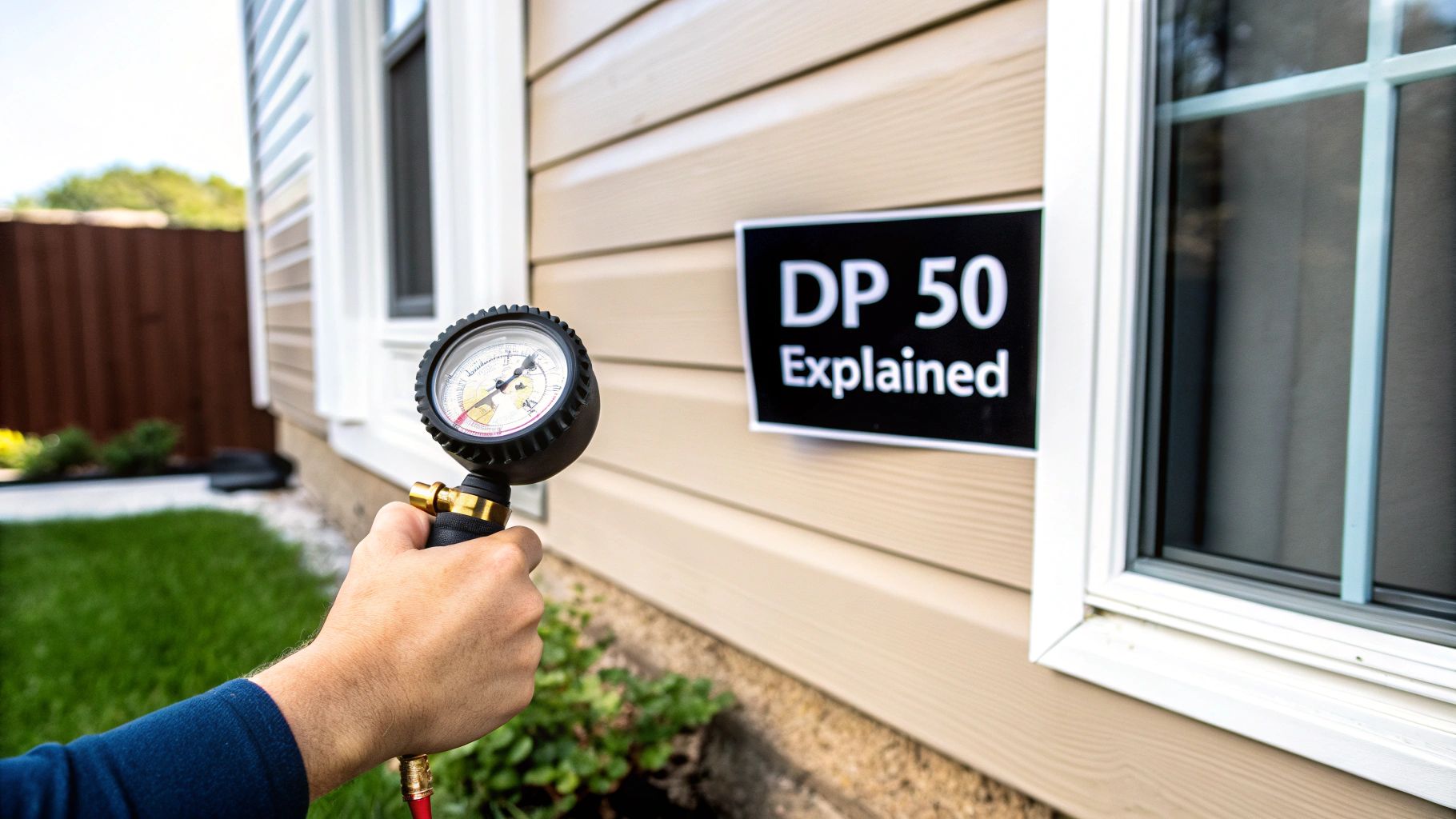
The final score is given in pounds per square foot (psf). So, a window with a DP50 rating has proven it can stand up to test pressures of 50 pounds on every square foot of its surface.
Positive and Negative Pressure: The Push and Pull of a Storm
Here’s something most people don’t realize: hurricane winds don’t just push against your house. They also create a powerful vacuum effect that tries to pull it apart. The DP rating has to account for both.
- Positive Pressure (+): This is the straightforward inward force of wind pushing against the window.
- Negative Pressure (-): This is the suction force pulling the window outward, away from the house.
That’s why you’ll often see a DP rating with two numbers, like +50/-55. The negative number is often higher because the suction forces on a home, especially at the corners and roofline, can be even more violent than the direct pressure. This dual rating is your assurance that the window is built to resist both the intense push and the vicious pull of a major storm.
The DP rating isn't just about the glass; it's a reflection of the entire window assembly. The strength of the frame, the quality of the seals, and the sturdiness of the locking hardware all contribute to achieving a high DP score.
Translating DP Ratings into Real-World Resilience
Okay, so what do these numbers actually mean when the wind is howling? A higher DP rating directly translates to a window that can handle stronger winds. While there isn't a perfect one-to-one conversion, a general rule of thumb is that a window with a DP50 rating is built to withstand wind speeds up to around 170 mph.
This is precisely why a high DP rating is non-negotiable in hurricane-prone areas. It’s the single most important number that tells you if a window can maintain your home's protective envelope. For comparison, a standard window in a calm climate might have a DP rating of 15—totally fine there, but dangerously inadequate for a coastal home.
Here’s a quick cheat sheet to make sense of the numbers:
| DP Rating | General Wind Speed Resistance | Suitable For |
|---|---|---|
| DP 15-25 | Up to 80 mph | Inland areas with low risk of severe storms |
| DP 30-40 | Up to 110-130 mph | Areas with moderate storm risk |
| DP 50+ | Up to 170+ mph | Coastal regions and high-velocity hurricane zones |
Ultimately, the DP rating is a promise of performance. It’s a clear, standardized benchmark that lets you compare products and feel confident you're choosing a window truly engineered for the weather threats in your specific region. In the complex world of impact windows ratings, it's one of the most critical factors to understand.
How Your Zip Code Dictates Your Window Choice
The complex world of impact window ratings isn't just something for architects and engineers to worry about. For a huge swath of the country, these ratings are tied directly to local building codes. That means they stop being helpful guidelines and become legal requirements. Where you live doesn’t just influence your lifestyle—it literally determines the minimum level of protection your home must have.
Think of it like this: your zip code places you on a specific point of a “wind-speed map.” Building authorities use these maps to chart the maximum expected wind speeds for different regions. The faster the wind blows in your area, the tougher your windows have to be.
For anyone living in a high-risk area, choosing the right windows isn’t about personal preference. It's about safety and legal compliance, plain and simple.
The Hurricane Andrew Effect
The critical link between geography and building codes became painfully obvious after Hurricane Andrew ripped through South Florida in 1992. The storm exposed just how tragically inadequate the existing building standards were, leading to the catastrophic failure of countless homes.
In response, Florida established the High-Velocity Hurricane Zone (HVHZ). This designation covers its most vulnerable areas—primarily Miami-Dade and Broward counties—and enforces the most stringent building codes in the entire country. Windows here must pass the grueling Miami-Dade TAS protocols. This wasn't a random decision; it was a direct, life-saving reaction to a real-world disaster, proving that building codes evolve from hard-earned lessons.
Building codes aren't arbitrary rules. They are a community's response to past tragedies, written to ensure future homes can withstand known threats. Following them means your investment is not only effective but also legally sound.
Today, this principle extends far beyond Florida. The entire Gulf Coast and the Eastern Seaboard have specific window requirements based on their proximity to the coast and historical storm data. It’s no surprise that a home right on the North Carolina coast needs a much higher Design Pressure (DP) rating than one located 200 miles inland.
Navigating Your Local Requirements
This is why your very first step—before you even start shopping—should be to check with your local building department. They are the ultimate authority on the exact minimum DP and impact resistance ratings required for your specific address. Walking into the process with this knowledge saves a ton of time, money, and the massive headache of failing a home inspection down the road.
Here’s exactly what you need to ask them:
- Your Wind Zone: What is the designated wind speed for my location?
- Required DP Rating: What is the minimum Design Pressure rating for new or replacement windows at my address?
- Impact Protection Rules: Is impact protection mandatory? If it is, what standard do the windows need to meet (e.g., ASTM E1996 or a specific Miami-Dade TAS protocol)?
Understanding these local rules is everything. While fully engineered impact windows offer the highest level of passive, 24/7 protection, other code-compliant solutions might be available. To see how different products compare, you can explore various hurricane window protection options that could work for your region's specific demands.
Ultimately, your location is the foundation for every decision you make about your windows. By starting with your local codes, you ensure your project is compliant from day one and that your home is genuinely fortified against the weather threats unique to your corner of the world.
The Hidden Returns of High-Rated Impact Windows
When you invest in windows with high-level impact ratings, you're buying more than just storm protection. You're making a savvy financial move. While their main job is to stand up to hurricanes, these seriously engineered windows deliver returns and everyday benefits that go way beyond storm season.
One of the first places you'll see a payback is on your insurance bill. This isn't just your insurer being nice; it's a cold, hard business calculation. A home protected with certified impact windows is way less likely to get blown apart in a storm, meaning they're far less likely to have to pay out a massive claim. It's a win-win.
The data backs this up. After Hurricane Andrew flattened parts of Florida in 1992, the state completely overhauled its building codes. Homes built to these new, tougher standards—which included impact-resistant glass—saw insured loss reductions of 20–40% compared to older homes in later storms. These aren't small numbers.
More Than Just Storm Protection
Putting aside the annual insurance savings, high-rated impact windows bring a ton of daily perks that just make life better. These benefits are a direct result of the heavy-duty materials and construction needed to pass those brutal tests.
-
Superior Home Security: The same laminated glass and beefy frames that shrug off 2x4s launched from a cannon are also a fantastic burglar deterrent. Trying to smash through an impact window is loud, difficult, and takes a lot of time—three things a potential intruder hates.
-
Dramatic Noise Reduction: It turns out that the multi-layer glass and tight seals that stop wind-driven rain are also brilliant at blocking outside noise. If you live on a busy street or have noisy neighbors, the sudden peace and quiet inside your home can be a game-changer.
-
Improved Energy Efficiency: To get these ratings, impact windows often come loaded with features like low-E coatings and argon gas fills. This creates a powerful thermal barrier, keeping your home cooler in the summer and warmer in the winter, which means lower energy bills all year long.
Think of impact windows as a multi-purpose upgrade. You install them for hurricane season, but you benefit from their security, tranquility, and energy savings every single day of the year.
Impact Windows vs. Standard Windows Comparison
To really see the difference, let's put a standard window head-to-head with an impact-rated one.
| Feature | Standard Double-Pane Window | Impact-Rated Window |
|---|---|---|
| Glass | Two panes of annealed glass; shatters into sharp shards. | Two panes of glass bonded to a tough polymer interlayer (PVB or SGP). |
| Frame | Standard construction (vinyl, aluminum, wood). | Heavily reinforced and structurally integrated with the glass. |
| Debris Impact | Will likely shatter on impact, leaving a large opening. | Designed to remain in the frame even if the glass cracks, preventing penetration. |
| Wind Pressure | Moderate resistance; can fail under high cyclonic pressures. | Rated for high Design Pressure (DP), resisting intense positive and negative wind loads. |
| Security | Easily broken by an intruder. | Extremely difficult to break through, providing significant forced-entry resistance. |
| Noise Reduction | Offers some sound dampening. | Offers superior noise reduction due to laminated glass and robust construction. |
| Cost | Lower initial cost. | Higher initial investment (50-100% more). |
| Insurance | May not qualify for any discounts. | Often qualifies for significant home insurance premium discounts. |
As you can see, the value of an impact window goes far beyond its ability to stop a storm. It’s a fundamentally different, more robust product.
The Long-Term Financial Picture
When you add up the lower insurance premiums, reduced energy bills, and enhanced security, that initial price tag starts to make a lot more sense. These windows aren't just an expense; they're a capital improvement that adds real, measurable value to your home. In storm-prone areas, potential buyers see a house with impact windows as a huge plus, often making it a key selling point that helps your property stand out.
Of course, a full window replacement is a major project. For homeowners looking to add shatter resistance to their existing glass without the cost of a full tear-out, it's smart to look at all your options. Understanding the security window film cost can give you a solid point of comparison for different levels of protection. Whether you go for a full replacement or a security film upgrade, fortifying your windows is a decision that pays you back in both safety and savings.
Your Essential Checklist for Choosing the Right Windows
Alright, let's cut through the noise. Picking the right impact windows can feel like a huge task, but it doesn't have to be. Think of this as your personal game plan—a straightforward checklist to make sure you get this crucial investment right, from checking the product specs to finding a top-notch installer.
Verifying the Window’s Certification
First things first: you need to see the proof. Don't just rely on a slick brochure or a salesperson's pitch. The real story is right there on the window itself.
- Find the Permanent Label: Every single certified impact window will have a permanent mark on it. It’s usually etched into a corner of the glass or on a label tucked away inside the frame. This isn't just a sticker; it's a guarantee. It tells you the manufacturer, the specific standards it passed (like ASTM E1996), and its all-important Design Pressure (DP) rating.
- Match the Numbers to Your Needs: Pull out your local building code requirements and compare them directly to that label. If your home needs a DP50 rating to be properly protected, the label on that window better show a DP of 50 or higher. No exceptions.
This one simple check ensures you're actually getting the protection you’re paying for.
Vetting Your Installer
Here’s a hard truth: the best impact window in the world is useless if it's installed incorrectly. A shoddy installation completely negates the window's strength. Your installer is just as critical as the window itself.
A top-rated impact window installed incorrectly will fail under pressure. Your installer's expertise is the final, crucial piece of the puzzle that ensures your home's protective envelope remains intact during a storm.
Don't be shy about grilling potential installers. Ask them these non-negotiable questions:
- Are you licensed and insured in this state? And don't just take their word for it—ask to see the documents. Proper insurance protects you from any on-site accidents.
- How many years of experience do you have installing impact windows specifically? This is key. It’s a specialized skill that requires precise knowledge of anchoring and sealing, far beyond what a general contractor might have.
- Can you provide references from recent jobs in my area? A confident pro will happily share them. Actually calling a few past customers is the single best way to find out what it's really like to work with them.
Understanding the Fine Print
Before you sign on the dotted line, you have to dig into the warranty. A manufacturer that stands behind its product will offer a solid warranty—it's a huge tell.
- What does the warranty cover? Get specific. Does it just cover glass breakage, or does it also include the frame, the hardware, and the seals against moisture? The details matter.
- Is the warranty transferable? If you think you might sell your home down the road, a transferable warranty can be a great perk for the next owner and a nice selling point for you.
When building your essential checklist, consider exploring diverse types of affordable window solutions to understand the full spectrum of choices available. By working through these steps—verifying the product, vetting the pro, and understanding the warranty—you’ll be in a powerful position to make a smart choice that protects your home for years.
Common Questions About Impact Window Ratings
Even after getting a handle on the technical stuff, you probably still have a few questions rolling around. That's perfectly normal. Let's tackle some of the most common ones homeowners ask so you can move forward with total confidence.
Do I Need Impact Windows if I Live Far From the Coast?
It’s easy to think of impact windows as a "coastal" product, but that's a risky assumption. While building codes are definitely strictest along the shoreline, dangerous weather doesn't stop at the county line. Tornadoes and straight-line winds from severe thunderstorms can easily blast past 100 mph, which is more than enough force to turn a standard window into a shower of glass shards.
Your local building department has the final say on what's required for your specific address by assigning you a "wind zone." But even if you're not legally required to have them, impact windows offer a level of constant, built-in protection that goes beyond storms. They're a major security upgrade against break-ins, giving you a peace of mind that's valuable no matter where you live.
What Is the Difference Between Laminated and Tempered Glass?
This is a big one, and the difference is critical. You've probably seen tempered glass before—it's heat-treated to make it stronger than regular glass. When it does break, it shatters into thousands of tiny, pebble-like pieces. Think of a car's side window or a glass shower door. It's designed for safety to avoid large, jagged shards.
Laminated glass, on the other hand, is the real muscle behind an impact window. It’s actually a sandwich: two sheets of glass are bonded together with a tough, clear polymer interlayer (usually PVB or SGP) in the middle.
When an object hits laminated glass, the outer layer might crack, but that sticky inner layer holds everything together. The window remains intact, preventing wind, rain, and debris from blowing into your home. It’s this tenacious bond that delivers real-deal hurricane protection.
Are Hurricane Shutters or Security Film a Good Alternative?
They have their place, but they work very differently. Code-approved hurricane shutters are an effective active defense. The key word there is "active"—you have to put them up before a storm, which can be a real hassle, especially if you're out of town or have mobility issues.
Security films are great for adding shatter resistance to existing glass, but they don't do anything for the window frame or its anchoring to the wall. An impact window is a complete, passive system that protects you 24/7 without you having to lift a finger. The glass, frame, and hardware are all engineered and tested to work together as a single unit. That integrated strength is what allows the entire window to stand up to incredible force, ensuring it's always ready to defend your home.
At Fortress Security Films, we specialize in reinforcing your existing windows to provide an exceptional layer of protection without the need for full replacement. Our advanced security films are engineered to hold glass together against impacts, deterring intruders and providing critical resilience during severe weather. Learn how our discreet, powerful solutions can fortify your home at https://fortresssecurityfilms.com.
