


When you're shopping for impact windows, the labels can look like a jumble of letters and numbers. But those codes are actually the window's "report card," telling you exactly how it will stand up to wind, rain, and flying debris, while also measuring how well it insulates your home.
Think of it like checking the safety ratings on a new car. You want to see objective proof that it can perform under pressure. Understanding these impact window ratings is the key to making a smart investment in your home's safety and comfort.
Decoding Your Window's Secret Language
At first glance, a window sticker covered in acronyms like DP, SHGC, and U-Factor can be intimidating. But once you know what they mean, you can quickly assess a window's strengths and weaknesses.
Each rating tells a different part of the story. Some speak to its raw power against hurricane-force winds, while others tell you how much it can help lower your energy bills. This isn't just about technical specs; it’s about practical protection. Knowing this language empowers you to choose windows that are truly right for your home, especially if you live in a storm-prone area.
Translating The Key Metrics
The ratings you’ll see most often fall into two main buckets: structural performance (how strong it is) and energy performance (how well it insulates). Both are critical for a high-quality impact window.
Here are the big three you absolutely need to know:
- Design Pressure (DP): This is the main event for structural strength. The DP rating tells you how much wind pressure the entire window assembly—glass, frame, and hardware—can take before failing. The higher the DP number, the stronger the window.
- Solar Heat Gain Coefficient (SHGC): This one is all about blocking the sun's heat. A lower SHGC means less solar heat gets into your house, which is a huge deal in warmer climates for keeping your home cool and your AC costs down.
- U-Factor: This rating measures how well a window prevents heat from escaping. Think of it as an insulation score. A lower U-Factor is always better, as it helps keep your home's temperature stable year-round.
To make this even easier, here's a quick reference table.
Quick Guide to Key Window Ratings
This table breaks down the essential ratings and what they measure, giving you a quick reference for understanding window performance.
| Rating | What It Measures | Why It's Important |
|---|---|---|
| Design Pressure (DP) | The window's ability to resist wind loads. | Higher DP means better performance in high winds and storms. |
| SHGC | How much solar heat the window blocks. | Lower SHGC keeps your home cooler and reduces energy bills. |
| U-Factor | How well the window insulates against heat loss. | Lower U-Factor means better insulation and comfort. |
Once you get a feel for these numbers, you can compare products with confidence.
By understanding these core impact window ratings, you transform from a confused shopper into an educated buyer. You gain the ability to compare products effectively and ensure you are investing in a solution that provides true security and long-term value.
To truly decode your window's secret language, it's beneficial to understand the broader context of what defines high-performance windows and doors. For a deeper look into these concepts, check out a homeowner's guide to high-performance windows, which offers additional valuable insights. This foundational knowledge is crucial for confidently navigating product choices and understanding why these numbers are so important for your home’s security, comfort, and efficiency.
What Design Pressure Reveals About a Window's Strength
When you're looking at impact window ratings, one number tells you more about a window's raw ability to stand up to a storm than any other: the Design Pressure (DP) rating. While other numbers might tell you about energy efficiency, the DP rating is all about pure structural strength.
Think of it like this: if a window were a boxer, the DP rating would be its ability to take a punch. A higher DP rating means the window can handle more intense, sustained force from wind and rain before it even thinks about bending, breaking, or failing. It’s the single most important number that tells you how the entire window unit—glass, frame, and hardware—will hold up when a storm is raging outside.
But a DP rating isn't some arbitrary number. It’s the result of a grueling, three-part lab test that simulates the absolute worst conditions of a hurricane. To earn its rating, a window has to pass all three phases of this trial by fire (or rather, wind and water).
The Three Pillars of a DP Rating
This testing process is a gauntlet, plain and simple. It pushes the window to its absolute limits, with each stage measuring a different kind of performance. This ensures the window offers well-rounded protection, not just strength against one type of force.
- The Structural Load Test: This is the big one for wind resistance. A window is locked into a test chamber, and technicians throw massive amounts of air pressure at it from both sides. This mimics the brutal positive (pushing) and negative (pulling) forces of hurricane winds, which can literally suck windows right out of their frames. To pass, the window has to withstand 1.5 times its rated pressure without breaking or suffering permanent damage.
- The Water Penetration Test: Right after surviving the wind test, the window gets blasted with a simulated downpour. We’re talking the equivalent of eight inches of rain an hour, driven by intense pressure. The window fails if even a single drop of water makes it through to the other side.
- The Air Infiltration Test: Finally, the window is checked for air leakage. This test measures how much air can sneak through the window’s seals and frame under pressure. A window with tight seals not only prevents drafts but also helps maintain the home’s structural integrity during a storm, and that's what this test proves.
A window only gets its DP rating if it passes all three of these brutal tests. If it fails even one, it doesn't get certified at that pressure level.
Translating DP Numbers into Real-World Protection
So, what does a number like "DP50" actually mean for your home? That number directly corresponds to the pounds per square foot (psf) of pressure the window is proven to handle. A DP50 rating means the window has been tested to withstand a punishing 50 psf of pressure.
For coastal areas, a DP50 rating is often the gold standard. It tells you the window can hold its own against wind speeds of up to approximately 170 mph, which is why it's frequently required in high-risk hurricane zones.
But the right DP rating for your home isn't a one-size-fits-all number. What you need depends entirely on a few key factors:
- Your Location: Homes on the coast need much higher DP ratings than homes located safely inland. It’s all about the hurricane risk.
- The Height of Your Building: Wind gets stronger the higher you go. A window on the third floor needs a beefier DP rating than one on the ground floor.
- Local Building Codes: Your local building code is the final word. Places like Florida have very specific, non-negotiable DP requirements for all new and replacement windows.
Choosing a window with a DP rating that meets or, even better, exceeds your local code isn't just about checking a box. It's about buying a proven defense system for your home. This single number is the most powerful summary of a window's ability to protect your family and property from wind and water, making it the most critical rating to understand when preparing for a storm.
The Science Behind Surviving Flying Debris
A high Design Pressure (DP) rating is great for proving a window can stand up to punishing wind and rain, but that's only half the battle in a hurricane. The real test of an impact window isn't just about pressure; it's about surviving a direct hit from flying debris. This is where we move beyond pressure chambers and into the dramatic, high-stakes world of projectile impacts.
To earn its "impact-rated" stripes, a window has to go through a brutal series of tests designed to mimic the most dangerous parts of a hurricane. It isn't enough for the window to just be strong. It has to prove it can take a punch from a projectile moving at highway speeds and still keep the inside of your home safe. That's what separates a standard window from a true hurricane-proof barrier.
The Missile Impact Test: A Trial by Force
The single most important evaluation is the large missile impact test. This is governed by a few key industry standards, namely ASTM E1996 and the famously tough Miami-Dade Test Protocols: TAS 201, 202, and 203. These aren't just calculations on a spreadsheet—technicians physically launch projectiles at the window to see what gives.
In the most common version of the test, they take a 9-pound 2×4 lumber stud (about eight feet long) and shoot it out of an air cannon straight at the center of the glass. It travels at a blistering 50 feet per second, which works out to about 34 miles per hour. That speed isn't random; it’s specifically chosen to simulate the destructive force of debris kicked up by a major hurricane.
But one shot isn't enough. To make sure the entire window is secure, they then fire the 2×4 at the corners of the glass, which are typically the most vulnerable points. To pass, the glass can shatter—and frankly, it usually does—but it absolutely cannot let the 2×4 create an opening. The key is that the laminated interlayer holds all those broken pieces together, keeping the window sealed.
The Cyclic Pressure Gauntlet
Surviving the impact is just round one. A window that's now cracked but still in one piece faces the second, equally grueling phase: the cyclic pressure test. This part of the process simulates the violent, fluctuating wind pressures that push and pull on a building for hours during a storm.
The window, already weakened and shattered from the missile impact, is subjected to thousands of cycles of intense positive and negative pressure. This is the ultimate test of the frame and the laminated glass, proving the window will stay in its opening even after being severely damaged.
This two-part trial by fire—impact first, then pressure—is what truly defines impact window ratings. A window that can pass both is certified to protect the building envelope, preventing that catastrophic structural failure that happens when a window blows out and lets hurricane-force winds rush inside.
This is a great visual breakdown of the key elements that impact window ratings evaluate through this kind of rigorous testing.
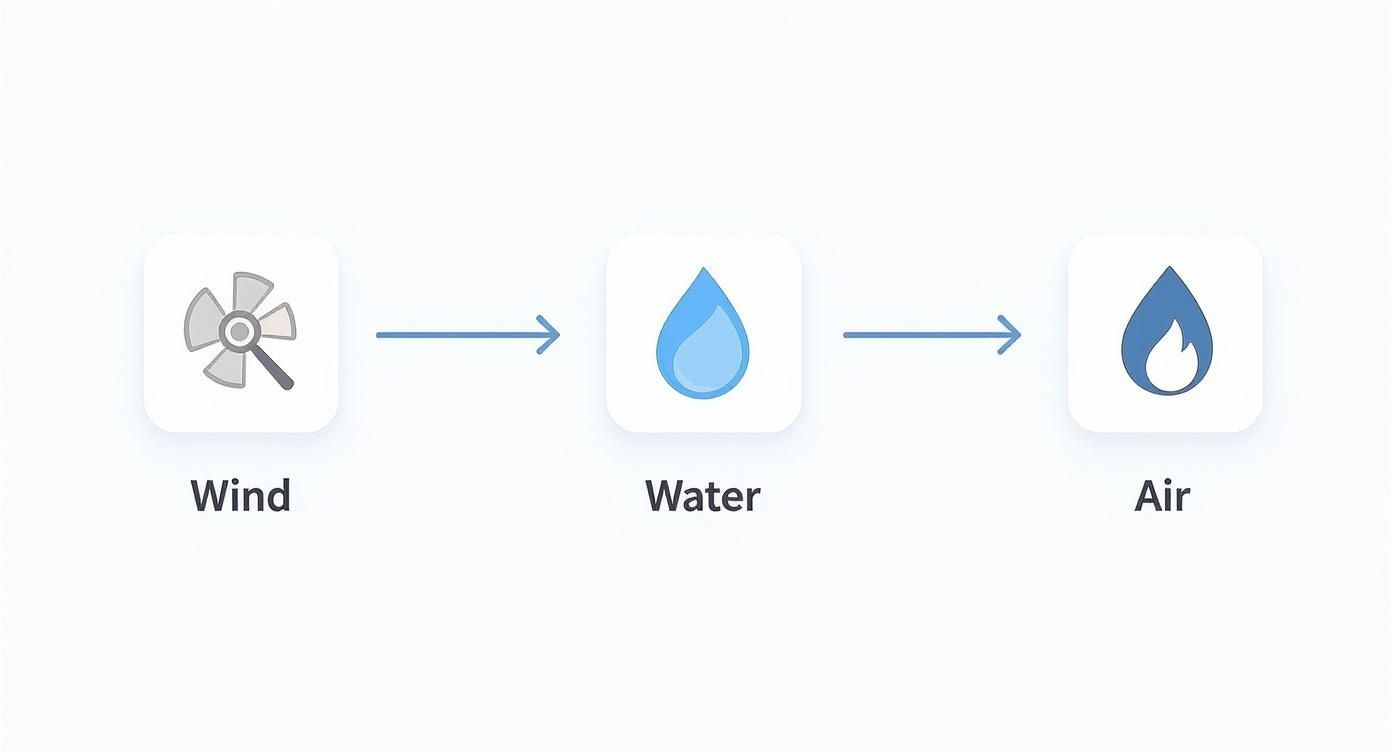
As the infographic shows, a window's real-world strength is a combination of its resistance to wind, water, and air intrusion—all of which are pushed to their absolute limits during certification.
Comparing Major Impact Test Standards
With different acronyms like ASTM and TAS floating around, it's easy to get confused. This table breaks down the most common testing standards, helping you understand their focus and where they are required.
| Testing Standard | Key Focus | Where It's Typically Required |
|---|---|---|
| ASTM E1886/E1996 | The foundational U.S. standard for missile impact and cyclic pressure testing for the building envelope. | Widely adopted in hurricane-prone regions across the U.S. Gulf and Atlantic coasts. |
| Miami-Dade TAS 201, 202, & 203 | Considered the most stringent tests, with more rigorous large missile impacts and cyclic pressure cycles. | Required in Florida's High-Velocity Hurricane Zone (HVHZ), which includes Miami-Dade and Broward counties. |
| Florida Building Code (FBC) Test Protocols | State-specific standards that often reference and build upon ASTM and TAS protocols. | Required throughout Florida, with specific requirements depending on the wind-borne debris region. |
Each standard is designed to ensure safety, but the Miami-Dade protocols are often seen as the "gold standard" because they were developed in response to the massive destruction of Hurricane Andrew.
Why These Impact Ratings Are Non-Negotiable
Once you understand what goes into these tests, it's clear why standards like ASTM E1996 and the Miami-Dade TAS protocols are so critical, especially in high-risk areas. They aren't just arbitrary numbers on a sticker; they are a direct simulation of real-world hurricane conditions.
When a window carries a certification based on these tests, it means it has physically survived conditions that would obliterate ordinary glass. For homeowners in coastal regions, this rigorous validation is everything. It’s tangible proof that your windows are an active defense system, engineered not just to resist wind, but to defeat the flying debris that poses the single greatest threat during a storm.
How Windows Can Lower Your Energy Bills
Impact windows are famous for protecting your home during a storm, but their real value shows up every single day—right on your energy bill. The same design that makes them tough enough to withstand hurricane-force winds also makes them incredible insulators. Think of them as a thermal shield for your house, keeping you comfortable while cutting down on heating and cooling costs.
To really see the savings, you need to understand the energy ratings on an impact window's label. Just like the Design Pressure (DP) rating tells you how strong a window is, a few other key numbers reveal its energy performance. These ratings are all about how the window manages heat and light, which are the two biggest drivers of your home's energy use.
The Window's Insulation Power: U-Factor
First up is the U-Factor. The easiest way to think about U-Factor is as a window’s "winter coat." It measures how well the window stops heat from escaping your home.
The rule here is simple: the lower the U-Factor, the better the insulation. In the winter, a low U-Factor window keeps your expensive furnace-heated air right where you want it—inside. That same benefit works in reverse during the summer, preventing the cool, conditioned air from seeping out.
Blocking the Sun's Heat: SHGC
Next, we have the Solar Heat Gain Coefficient (SHGC). If U-Factor is the winter coat, SHGC is the window’s “sunglasses.” This number tells you how much of the sun's radiant heat the window blocks from entering your home.
SHGC is rated on a scale from 0 to 1. Again, lower is better, especially in sunny climates. A low SHGC is your best defense against a constantly running air conditioner. For example, a window with an SHGC of 0.25 is blocking 75% of the sun's direct heat. That's a huge deal for both your comfort and your wallet.
Letting the Light Shine Through: VT
Finally, there’s Visible Transmittance (VT). This rating is all about daylight. It measures how much visible light streams through the glass, also on a scale from 0 to 1.
Unlike the other two ratings, a higher VT is often better. More natural light means you can keep your artificial lights off longer. The sweet spot is a window that has a low SHGC (to block heat) but a high VT (to let in light), giving you a bright, comfortable room without the unwanted heat.
An energy-efficient window is basically a smart filter. It keeps unwanted solar heat out while welcoming in natural light, all while creating a thermal barrier that keeps your indoor temperature steady, regardless of the season.
The Technology Behind the Ratings
So, how do manufacturers pull off these impressive energy stats? It all comes down to a few key technologies that work together to control how heat moves through the window.
Here's what’s going on behind the glass:
- Low-E Coatings: This is the real magic. A Low-Emissivity (Low-E) coating is a microscopically thin, transparent layer of metal oxide on the glass. It reflects infrared heat (the kind you feel) back to its source, keeping your house cooler in the summer and warmer in the winter, all without blocking the visible light.
- Argon Gas Fills: The space between the glass panes in a double- or triple-pane window isn't just empty air. It’s often filled with an inert gas like argon. Argon is much denser than air, making it a far superior insulator and dramatically lowering the window’s U-Factor.
- Warm-Edge Spacers: Around the perimeter of the glass panes are insulated strips called warm-edge spacers. These prevent heat from transferring through the frame, which is a notorious weak spot for energy loss in older, less advanced windows.
These features have completely changed the game for window performance. By combining things like Low-E coatings, multiple panes, and gas fills, modern windows offer incredible insulation while keeping your home bright and airy.
To give your high-performance windows an extra boost, you can also add treatments like insulated and thermal curtains, which provide another layer of thermal protection. Pairing the right windows with the right treatments is a smart strategy that pays you back in comfort and savings year after year.
Building Codes: The Official Rulebook for Your Windows
Understanding the alphabet soup of ratings—DP, SHGC, impact tests—is a great start. But here’s where the rubber really meets the road: local building codes. These aren’t just friendly suggestions; they are the law, and they dictate exactly what kind of window you can legally install on your property.
Think of it this way: a window that's perfectly fine for a home in a landlocked state could be completely illegal—and dangerously inadequate—for a house on the coast. Local governments set these rules to make sure every building can stand up to regional threats, especially hurricanes. Your specific address determines the exact standards your windows must meet.
Hurricane Zones and Why Your Location is Everything
Geography is the single most important factor. If you live in a coastal area, especially somewhere like Florida, you’re dealing with some of the strictest building codes on the planet. These regions are carefully mapped out into different risk zones based on how close they are to the water and their history with major storms.
The most famous of these is Florida's High-Velocity Hurricane Zone (HVHZ), which covers Miami-Dade and Broward counties. This is the big league of window requirements. Any window going into an HVHZ home must have passed the brutal Miami-Dade TAS protocols—tests that are even tougher than the standard ASTM impact tests.
If your home is in an HVHZ or another designated "wind-borne debris region," this isn't a recommendation. You must use windows with the specific certification for that zone. Trying to cut corners here can lead to failed inspections, hefty fines, and, most importantly, putting your family and property at serious risk.
Finding and Reading the Certification Labels
So, how do you know if a window actually meets these tough standards? Legitimate manufacturers make it simple. They put official certification labels right on the glass, giving you all the proof you need.
Keep an eye out for these stickers:
- NFRC (National Fenestration Rating Council): This is your cheat sheet for energy performance. It will clearly list the window’s U-Factor, SHGC, and Visible Transmittance, so you can see exactly how efficient it is.
- AAMA (American Architectural Manufacturers Association): The AAMA Gold Label is a badge of honor for structural quality. It verifies the window passed a battery of tests for air leaks, water resistance, and structural load—including its Design Pressure (DP) rating.
These labels are your guarantee. They confirm you’re getting the performance you paid for. Pro tip: Always tell your installer to leave the stickers on until after the final building inspection is done and passed.
Why Compliance is About More Than Just Passing Inspection
Getting your windows right does more than just keep the building inspector happy. It has a massive ripple effect on your home's safety, durability, and even your wallet. When you install code-compliant windows, you're putting in a product that has been proven to hold the line and protect your home during a major storm. This increased protection often qualifies you for some serious discounts on your homeowner's insurance.
There’s a huge energy-saving benefit, too. Buildings are major energy consumers, but choosing certified, high-performance windows is a powerful way to fight back. Depending on the U-Factor and SHGC, new energy-efficient windows can slash a home's energy consumption by up to 40%. You can dive deeper into how this works by checking out the latest window energy statistics. It’s a choice that protects your home from storms while actively reducing your energy bills and carbon footprint.
Putting It All Together to Choose the Right Windows
Alright, you've done the homework. You know the difference between a DP rating and a missile impact test, and you understand what those energy efficiency numbers mean. Now it’s time for the final step: turning all that knowledge into a smart purchase.
It's all about matching the proven performance of a window to your home's unique needs. This isn't a one-size-fits-all decision. The first thing to consider is where you live. Are you right on the coast or in a designated High-Velocity Hurricane Zone (HVHZ)? Your location sets the baseline, determining the absolute minimum DP and impact certifications you need to meet local building codes. Those rules aren't suggestions—they're the law.
Your Pre-Purchase Checklist
Before you sign on the dotted line, you need to ask your installer some direct questions. Think of it as a final check to ensure you’re getting exactly what you're paying for. Any good, reputable installer will not only expect these questions but will be happy to answer them.
Here’s a simple checklist to keep handy during that conversation:
- Ask for Proof of Certification: "Can I please see the NFRC and AAMA labels for this exact window model? If we're in South Florida, I'll need to see the Miami-Dade Notice of Acceptance (NOA)."
- Confirm Key Ratings: "Just to be sure, can you confirm this window meets a DP rating of [Your Required Number] and is certified for large missile impact?"
- Talk About the Warranty: "What, specifically, does the warranty cover? Does it include the glass, the frame, and the installation itself?"
- Understand the Installation: "Could you walk me through your installation process? How do you guarantee the window is sealed properly against water intrusion?"
An Investment in More Than Just Glass
At the end of the day, choosing the right impact windows is a serious investment in your home’s strength and your family’s safety. But the benefits go far beyond just storm protection. These windows are fantastic for home security, they do a great job of muffling outside noise, and they can lead to some serious energy savings.
The financial upside is real. The global market for energy-efficient windows is booming and is expected to reach USD 43.69 billion by 2032. Even the U.S. Department of Energy notes that installing Energy Star-certified windows can trim your annual energy bills by up to 15%. You can learn more about the energy-efficient windows market and how it translates to homeowner savings.
Selecting windows with verified impact ratings is one of the single most effective upgrades you can make. It’s an investment that not only raises your property value but also provides daily comfort and—most importantly—delivers priceless peace of mind when the sky turns dark.
With the information in this guide, you're no longer just a buyer; you're an informed consumer. You're ready to ask the right questions, check the labels, and choose a window system that will protect your home and family for years to come.
Got Questions? We’ve Got Answers.
Even after getting the hang of the ratings, a few common questions always seem to pop up. Let's clear up some of the most frequent ones so you can feel completely confident in your choices.
Are Impact Windows, Shutters, and Security Film the Same Thing?
Not at all—they're entirely different approaches to protecting your home. Hurricane shutters are temporary armor you have to rush to install before a storm hits. Security film is a fantastic retrofit that makes your existing glass stronger, but it doesn't do anything for the window frame itself.
Think of certified impact windows as a permanent, built-in security system. The whole assembly—the glass, the seals, and the frame—is designed as a single, unified structure. It’s "always on" and ready to defend against impacts and pressure without you having to lift a finger.
Can Upgrading to Impact Windows Lower My Insurance Bill?
It's very likely, especially if you live in a coastal area. Insurance companies love to see certified impact windows because they’re a proven way to mitigate wind damage, which can save them a fortune in claims.
By preventing the initial breach that leads to catastrophic wind and water damage, these windows drastically lower the risk profile of your home.
Pro Tip: Don't just assume you'll get the discount. To make it happen, you have to show your insurance agent the proof—the official certification paperwork, like the NFRC label or a Miami-Dade Notice of Acceptance (NOA).
If a Window Has a High DP Rating, Is It Automatically a Hurricane Window?
This is a big misconception. While a high Design Pressure (DP) rating is absolutely essential, it only tells you how well the window stands up to wind pressure. It says nothing about its ability to stop a 2×4 flying at it.
A window could have a stellar DP rating but shatter into a million pieces from a single impact. For true hurricane-level protection, you need a window that’s been certified for both high DP and large missile impact. That's the only way to know it can handle everything a major storm can dish out.
While factory-certified impact windows offer the ultimate in code-approved storm protection, reinforcing your existing glass is a powerful first step in bolstering your home's security. At Fortress Security Films, we specialize in advanced film solutions that strengthen your windows against forced entry and impact, buying you critical time when it matters most. Learn how our nearly invisible films can enhance your home's defenses.
