


Think of impact resistant windows and doors as your home's personal bodyguard. Unlike standard glass that shatters into a million dangerous shards on impact, these advanced systems are engineered to take a punch and stay standing. They behave a lot like your car's safety windshield—they might crack under extreme force, but they won't break apart, keeping the danger outside.
Understanding Your Home's First Line of Defense
At its heart, an impact-resistant window or door is all about maintaining the integrity of your home's "protective envelope," especially during a hurricane or a break-in attempt. When a major storm hits, the real trouble starts the moment a window shatters. That single breach allows vicious winds to rush inside, creating an explosive pressure change that can literally blow the roof off your home and push the walls outward.
These specialized systems are designed to stop that initial failure from ever happening. They aren't just a strong piece of glass; they're a complete defensive system where every part works together. By holding strong against flying debris or a crowbar, they keep wind, rain, and intruders outside where they belong.
How the Core Components Work Together
To deliver this level of protection, three key elements have to work in perfect harmony. It's this combination of raw strength and smart engineering that makes them so different from standard windows and doors.
Let's break down what makes these systems so tough.
Table: Core Components of Impact Resistant Systems
| Component | Function | Analogy |
|---|---|---|
| Laminated Glass | The core of the system, this "glass sandwich" features a tough polymer interlayer bonded between two panes of glass, preventing shattering. | Like a car's safety windshield, it will crack but won't break apart. |
| Reinforced Frames | Made from heavy-duty aluminum or reinforced vinyl, the frames are designed to resist twisting and bending under immense pressure. | A strong frame is like a powerful skeleton, providing the structural support needed to withstand an assault. |
| Heavy-Duty Hardware | Upgraded multi-point locks, corrosion-resistant hinges, and stronger fasteners ensure the window or door stays anchored. | Think of it as the system's muscles and joints—the parts that hold everything securely in place. |
In short, the world's strongest glass is useless if the frame gives way or the locks fail. It's the synergy between these three components that provides real-world protection.
This market's rapid expansion isn't just a trend; it's a direct response to a growing need. More people are realizing that proactive protection is a necessity, not a luxury, especially in vulnerable areas.
This shift in thinking is easy to see in the numbers. The global impact-resistant windows and doors market was valued at around $20.5 billion in 2023 and is expected to grow at a compound annual growth rate of roughly 8.5% through 2033. This growth is fueled by tougher building codes in hurricane zones and a greater overall focus on security. If you're interested in the data, you can review the latest market growth projections.
How These Windows and Doors Actually Work
So, what's the secret behind a window or door that can take a serious hit? It's not just thicker glass; it's a clever combination of materials and engineering designed to absorb and deflect extreme force.
At the core of this technology is laminated glass, which is essentially a high-tech glass sandwich. It's made by fusing two panes of glass around a tough, flexible interlayer. When something strikes the window, this interlayer is the unsung hero.
The concept map below breaks down how all the key components—the glass, the frame, and the hardware—work in concert to create such a formidable barrier.
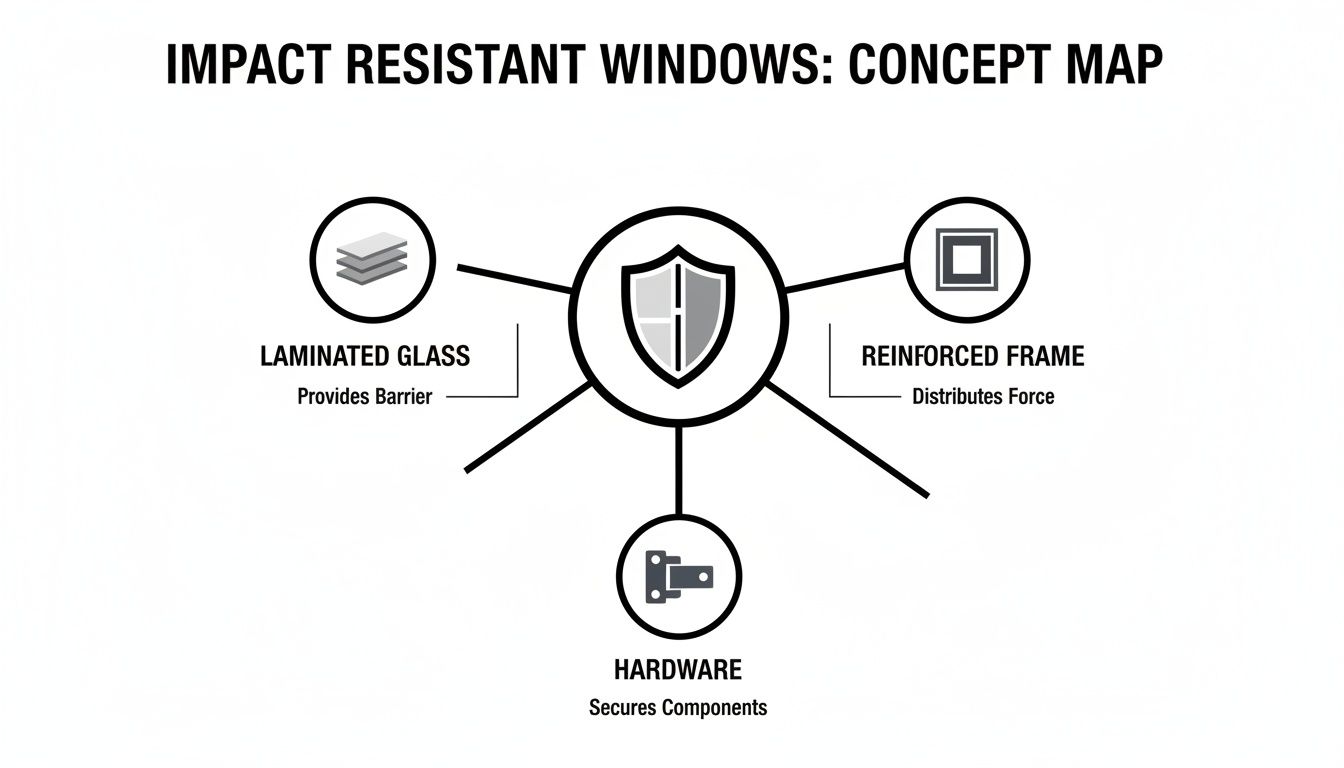
As you can see, it's not just one thing. True impact resistance comes from the Laminated Glass, the Reinforced Frame, and the heavy-duty Hardware all functioning as a single, unified shield.
The Magic of Laminated Glass
Laminated glass is built around a polymer interlayer, most commonly Polyvinyl Butyral (PVB) or SentryGlas Plus (SGP). This is the crucial layer that binds the glass panes together.
Think of this interlayer like a safety net or the seatbelt in your car. If the glass cracks under a heavy blow, the interlayer holds all the sharp, dangerous shards in place. The window might look like a spiderweb, but it won't collapse and let wind, water, or intruders inside.
The real benefit here is life-saving protection. Laminated glass holds together even after it breaks, maintaining a barrier when you need it most.
A few key details on laminated glass:
- It’s designed to prevent the glass from falling out of the frame and into your home or business.
- The thickness of the PVB layer can range from 0.38 mm to over 1.52 mm, allowing for different levels of protection.
- Using multiple interlayers not only boosts impact resistance but also provides fantastic sound insulation.
How Does It Compare to Tempered Glass?
You’ve probably heard of tempered glass. It’s heat-treated to make it stronger than standard glass, and when it breaks, it shatters into thousands of small, pebble-like pieces instead of sharp daggers.
While it’s a great safety feature, it’s not designed for impact protection. There's no interlayer to hold those pieces together.
- Tempered glass is safer than standard glass because the broken pieces are less likely to cause serious injury.
- However, because there’s no polymer layer, the entire pane of glass can fall away from the frame after a heavy impact, leaving a gaping hole.
- It's best used for applications like shower doors or car side windows, not for true impact defense.
The Importance of a Reinforced Frame
The world's strongest glass is useless if the frame holding it gives way. That's why true impact-resistant systems pair laminated glass with incredibly sturdy frames.
These frames, typically made from heavy-duty aluminum or reinforced vinyl, are engineered to resist the bending and twisting forces of a major impact. They are anchored securely to the building's structure, ensuring the glass and frame act as one solid, unyielding barrier.
It makes a real difference. A recent survey showed that 73% of users report feeling more secure after installing impact resistant windows and doors.
Bringing It All Together: A Unified System
The final piece of the puzzle is the hardware. We're talking about multi-point locks, heavy-duty hinges, and corrosion-resistant components that tie everything together.
This isn't just about locking the window shut. It’s about creating a system where any force is distributed evenly across the glass, the frame, and the hardware, preventing any single point from failing.
- Multi-point locking bars engage the frame in several places, providing far more security than a single latch.
- Corrosion-resistant finishes are critical, especially in coastal areas, to prevent hardware from weakening and failing over time.
Of course, regular maintenance is key to keeping those seals tight and the hardware operating smoothly for years to come.
For those looking for an even higher level of protection with film-based solutions, especially against ballistic threats, check out our comprehensive guide on ballistic window film.
What About Security Film Systems?
Another approach is to retrofit existing windows with security film. This involves applying layers of strong polyester film to the inside of the glass.
These films are surprisingly effective at holding shattered glass together, but their performance hinges entirely on the quality of the adhesive and, most importantly, a secure anchoring system that attaches the film to the window frame.
Security films offer a flexible and often more cost-effective retrofit option, but they require a meticulous, professional installation to even come close to the performance of factory-laminated glass.
These films come in various thicknesses, typically from 4 mil to over 12 mil, offering different levels of protection.
A Closer Look at Interlayer Materials
The two main players in the interlayer world are PVB and SGP.
Polyvinyl Butyral (PVB) has been the industry standard for years. It's cost-effective, offers good clarity, and provides excellent protection for most applications.
SentryGlas Plus (SGP) is the next generation. It’s significantly stiffer and stronger, allowing for high-performance protection in a slimmer, lighter profile. Choosing SGP can add about 30% to the cost, but the performance boost is substantial.
- PVB is the go-to choice for most residential and light commercial projects.
- SGP is better suited for high-rise buildings, hurricane zones, or critical facilities that demand the highest level of resilience.
Why the Seal and Glass Interface Matters
A continuous, high-performance seal around the glass is just as important as the glass itself. This isn't just about weatherproofing; it's a critical part of the system.
High-quality gaskets cushion the glass panels, absorb vibrations from impacts, and prevent wind and water from getting in. This interface makes the entire barrier airtight and also dampens outside noise significantly.
A proper seal is non-negotiable. Without it, the performance of the entire impact-resistant system is compromised.
Real-World Example: Surviving the Storm
Think this is all just theory? A coastal home in Florida was hit by a Category 4 hurricane with sustained wind gusts over 120 mph. The home was fitted with windows using SGP laminated glass and reinforced frames.
The result? The barrier held firm. Not a single window was breached.
- The homeowner avoided an estimated $15,000 in interior water damage and repairs.
- Despite a massive field of flying debris outside, the homeowner reported that zero debris made it inside the house.
Understanding the science behind these systems makes it clear why they offer such superior protection. It's not just one component, but the synergy between the right interlayer, a robust frame, and quality hardware that allows you to tailor a defense for specific threats.
The Physics of an Impact
When an object strikes the window, the system goes to work dissipating that energy. The outer layer of glass may crack, but the polymer interlayer immediately stretches and absorbs the force, acting like a shock absorber.
The glass panes and the interlayer work together to distribute the load across the entire window. The bending and strain within these layers convert the kinetic energy of the impact into internal stress, slowing and stopping the object.
- These advanced polymer interlayers can withstand incredible tensile forces—over 1,000 psi—before they even begin to tear.
This science is what allows these windows to survive not just one, but multiple strikes without failing completely.
What This All Means For You
Ultimately, this technology gives you a barrier that peels or webs instead of shattering into a million pieces.
This buys you critical seconds to react in a crisis, whether it’s a storm, a break-in, or something worse. It's peace of mind, engineered.
How to Decode Performance Ratings and Certifications
Walking into the world of impact-resistant windows and doors can feel like you're trying to read a foreign language. It's all acronyms and technical specs. But here’s the secret: understanding these ratings is the only way to know you’re actually getting the protection you’re paying for.
Think of these certifications as a report card. They tell you exactly how a product held up under some of the most punishing conditions imaginable. These aren't just marketing stickers; they’re earned through intense, real-world testing that mimics the raw power of a major storm. When you see these labels, you can confidently compare products based on proven performance, not just clever advertising.
The Gold Standard: Miami-Dade and TAS Protocols
In the impact-resistance industry, all eyes are on Miami-Dade County, Florida. Thanks to its long and brutal history with hurricanes, this region developed the toughest testing standards in the entire country, known as the Testing Application Standards (TAS).
When a product earns a Miami-Dade Notice of Acceptance (NOA), it's a big deal. It means that window or door has been through a series of grueling tests designed to simulate a hurricane at its worst. These protocols are so respected that they're often the benchmark for safety and resilience in other coastal areas.
A Miami-Dade certification isn't just a piece of paper. It's a guarantee that the product has survived forces that would shatter lesser windows and doors, representing the highest level of storm protection available.
Understanding the Missile Impact Tests
The heart of the TAS protocols lies in the large and small missile impact tests. These aren't just random whacks; they're meticulously designed to replicate the two primary types of airborne debris a building faces during a hurricane.
-
Large Missile Impact Test (TAS 201): This is the heavy hitter. The test involves firing a nine-pound 2×4 lumber stud at the window at 50 feet per second—that's about 34 mph. To pass, the glass can crack, but it absolutely cannot be penetrated. This is critical for windows on the first couple of floors, where large, heavy debris is the biggest threat.
-
Small Missile Impact Test (TAS 201): This test simulates a barrage of smaller, faster debris like roof gravel. Multiple steel ball bearings are fired at the window at roughly 80 feet per second (around 55 mph). This is a crucial test for windows above 30 feet, which are more likely to get peppered by smaller objects caught in high-velocity winds.
But surviving the hit is only half the battle. Afterward, the window is put through 9,000 cycles of positive and negative pressure (TAS 203) to simulate the relentless push-and-pull of hurricane-force winds. Only if the window remains fully intact in its frame after all of that does it earn its certification.
What Is a Design Pressure (DP) Rating?
Another key number you'll come across is the Design Pressure (DP) rating. This is all about how well a window can stand up to extreme wind pressure without breaking, popping out of the frame, or letting air and water leak through. Simply put, the higher the DP rating, the stronger the window.
A DP rating is the result of three different tests:
- Air Infiltration: Measures how much air seeps through a fully closed and locked window.
- Water Penetration: Blasts the window with wind-driven rain to see if any water gets inside.
- Structural Load: Pushes and pulls on the window with intense pressure—1.5 times its designated rating—to test its overall strength.
So, a window with a DP50 rating has proven it can handle a test load of 75 pounds per square foot of pressure. The right DP rating for your home will depend on where you live, how tall your building is, and what your local building codes require.
Just How Tough Are They? Comparing Protection Against Different Threats
When people hear "impact-resistant," their minds usually jump straight to hurricanes. And for good reason! But these windows and doors are far from a one-trick pony. Think of them less as "storm windows" and more as a comprehensive security upgrade for your entire home or business, defending against a whole range of modern threats.
Understanding how they hold up against everything from a crowbar-wielding burglar to a full-blown gale is the key to seeing their real value. It’s this versatility that’s driving huge growth in the market. In fact, the global impact-resistant glass market was valued at around $31.32 billion in 2025 and is expected to rocket to nearly $62.87 billion by 2033. This isn't just for homes; the automotive world relies on it for windshields and to protect official vehicles from attack. You can dig into the numbers yourself by checking out the latest industry forecasts on Market Data Forecast.
Defense Against Forced Entry
For most of us, keeping intruders out is just as important as keeping the weather out. A standard pane of glass is a burglar's dream—it's fragile, quiet to break, and offers a fast way inside. Impact-resistant windows completely flip the script, turning your home's weakest link into one of its strongest.
The magic is in the tough polymer interlayer sandwiched between two panes of glass. When a thief tries to smash it with a hammer or a brick, the outer glass might crack, but it won't shatter and fall out. That inner layer holds all the broken pieces together, creating a frustratingly tough barrier that refuses to give way.
- It Stays Put: Even after repeated hits, the laminated glass remains a solid wall.
- It Makes a Racket: Trying to get through it is loud and takes a lot of effort, which is the last thing a burglar wants.
- It Buys You Time: That delay is priceless. It gives your alarm system a chance to go off and for you or the police to react.
Impact-resistant windows essentially turn your most vulnerable entry points into fortified positions. They're like having a silent, 24/7 security guard on duty, without making your home look like a fortress with bars or shutters.
Resilience in Violent Storms
This is where impact-resistant products really earned their reputation. Their core purpose is to protect the "building envelope"—the shell of your home—during extreme weather like hurricanes, tornadoes, and severe windstorms.
When hurricane-force winds slam into a building, they create incredible pressure. If a window or door gives way, that wind rushes inside, and the sudden pressure change can be powerful enough to blow the roof right off. It’s a catastrophic failure.
Impact windows are built to take a double-punch. The laminated glass is designed to absorb the force of flying debris—think tree branches or patio furniture—while the beefed-up frames and heavy-duty hardware keep the whole unit locked securely in place. This prevents wind and water from getting in, saving not just the structure of your home, but your furniture, electronics, and irreplaceable personal belongings from ruin.
To truly appreciate the difference, it helps to see how these windows perform against various challenges. Below is a quick comparison of how they stack up.
Impact Resistance vs. Different Threats
| Threat Type | Protection Level | Key Feature |
|---|---|---|
| Forced Entry | High | The tough polymer interlayer prevents the glass from shattering inward, creating a significant barrier against intruders. |
| Hurricane Winds | Excellent | The entire system—glass, frame, and hardware—is engineered to withstand extreme positive and negative wind pressures without failing. |
| Flying Debris | Excellent | Laminated glass is specifically designed to absorb impacts from wind-borne objects without being breached. |
| Tornadoes | Good to High | While no window is "tornado-proof," impact windows provide significant protection against the debris and pressure changes common in tornadic events. |
| UV Radiation | Excellent | The polymer interlayer blocks over 99% of harmful UV rays, protecting furniture, floors, and artwork from fading. |
| Noise Intrusion | Good | The layered construction and interlayer dampen sound waves, resulting in a noticeably quieter indoor environment. |
This table shows that while storm protection is a headline feature, the day-to-day benefits—like enhanced security and noise reduction—are just as compelling.
Clarifying Ballistic Protection
One of the most common questions we get is, "Are impact windows bulletproof?" It's a great question, and the answer requires a clear distinction: standard residential impact-resistant windows are not designed to stop bullets. They are incredibly tough, but they aren't rated for ballistic threats.
That said, the core technology—laminated glass—is the foundation for actual bullet-resistant glass. The difference is in the engineering.
- Standard Impact Glass: Designed to stop blunt force from flying debris or a would-be burglar.
- Ballistic-Rated Glass: This is a whole other level. It's made with multiple, much thicker layers of glass and specialized interlayers, all tested and certified to stop specific types of ammunition.
This kind of protection is usually for high-security places like banks, government buildings, or private homes needing an exceptional degree of safety. While it’s not a standard feature, it shows just how adaptable this technology is. The key takeaway is to choose a product that's been specifically tested and certified for the threat you need to defend against.
Calculating the Cost and Return on Investment
Putting impact-resistant windows and doors on your property is a big decision, and it’s natural to focus on the price. While it’s true they cost more upfront than standard windows, it's better to think of it as a long-term investment in your property’s safety and value, not just another line-item expense.
The final bill can swing quite a bit depending on a few key things. The size and style of the window or door are the obvious starting points, but the materials you pick are just as important. For example, opting for high-performance aluminum frames or a premium glass package with an SGP interlayer will cost more than the standard options.
Key Factors That Influence Cost
So, what actually goes into the final price? Understanding the moving parts helps you budget properly. Remember, you're not just buying glass; you're getting a complete system engineered to perform under pressure.
Here’s a breakdown of the main cost drivers:
- Frame Material: Aluminum is a tough, popular choice, while reinforced vinyl gives you great insulation. Each has its own price tag.
- Glass Package: The type of laminated glass, the thickness of the interlayer (PVB vs. SGP), and any extra coatings for energy efficiency all play a role in the cost.
- Product Certifications: Windows that have passed the toughest tests, like those with a Miami-Dade Notice of Acceptance (NOA), are going to be a bigger investment.
- Customization: If you need custom sizes, unique shapes, or special finishes, expect the price to go up compared to standard, off-the-shelf products.
It’s tough to give a universal number, but a quality impact-resistant window can run anywhere from $900 to over $2,000 per window once installation is factored in. Doors are usually more. The best way to know for sure is to get a detailed quote for your specific project. As an alternative, you can also check out our guide on the cost of security window film.
Unpacking the Powerful Return on Investment
The initial price tag isn't the whole story. The real value is how this upgrade pays you back over time, and it does so in more ways than just storm protection.
The financial benefits of installing impact-resistant windows and doors often compound over the years, making it one of the smartest and most practical upgrades a property owner can make for both security and financial well-being.
First off, you’ll likely see immediate savings on your homeowners' insurance. Many providers offer hefty discounts—sometimes up to 20% or more—because these products dramatically lower the risk of major damage. It’s a win-win for you and them.
Second, these systems are a serious upgrade to your property's value. They’re a feature people actively look for, especially in storm-prone areas or neighborhoods where security is a top concern. This kind of improvement fits right in with other smart strategies to enhance your property's value.
Finally, don't overlook the energy savings. The very same technology that makes them so strong also makes them fantastic insulators. They keep heat from passing through, block 99% of damaging UV rays, and create a much tighter seal. That means your air conditioner and heater don’t have to work as hard, and you’ll see the difference in your energy bills every month. When you add it all up—the savings, the increased value, and the peace of mind—it’s clear this is a truly worthwhile investment.
Finding a Qualified Installer in Southern California
Even the best impact-resistant windows and doors on the market are useless without a rock-solid installation. A sloppy fit can create gaps, invite leaks, and totally defeat the purpose of your investment. Here in Southern California, finding a truly qualified installer isn't just the last step—it’s the most critical part of making your home genuinely secure.
Our region has its own set of building codes and environmental challenges, so you need a contractor who knows the local landscape inside and out. It’s about more than just getting the basics right.
Vetting Installers The California Way
When you start looking for an installer, the first thing on your checklist should be their credentials. In California, any contractor installing windows and doors legally must hold a C-17 Glazing Contractor license. This license is your proof that they have the specialized skills needed for the job. It’s well worth your time learning about the importance of verifying a contractor's CSLB License before you sign any contracts.
Beyond the license, a trustworthy installer should have no problem showing you:
- Proof of Insurance: Make sure they have both general liability and worker’s compensation. This is non-negotiable, as it protects you from any liability if an accident happens on your property.
- Local References: Don't be shy about asking for a list of recent projects they’ve completed nearby. Talking to a few past clients is one of the best ways to get a real feel for their work quality and professionalism.
- Detailed Written Estimates: The quote shouldn't be a one-liner. It needs to break down every cost—materials, labor, permits, and even cleanup—so there are no hidden fees later on.
Unique Southern California Considerations
Working in Southern California means navigating a unique minefield of regulations and environmental factors. A pro knows it’s not just about popping a window into an opening; it's about making it a seamless, compliant part of your home's structure.
An experienced local team will have a deep understanding of:
- Title 24 Energy Standards: California's energy efficiency laws are some of the toughest in the country. Your installer needs to know precisely how to install your new windows to meet these standards for optimal thermal performance.
- Seismic Requirements: We live in earthquake country. Proper anchoring and flashing aren't just best practices; they're essential for ensuring the installation can handle seismic stress without failing.
- Waterproofing and Flashing: Sealing the window correctly is crucial for keeping water out. One small mistake here can lead to huge problems with mold and structural rot down the road.
The installation process is where engineering meets execution. A flawless installation ensures the window performs as designed, delivering maximum protection against forced entry, storms, and even seismic stress for years to come.
While people often think of impact windows for hurricane-prone areas, North America is actually the top market for these products. The U.S. drives about 83% of the demand, not just due to coastal building codes but also a nationwide increase in security awareness. If you need help finding a professional team you can trust, our experts can connect you with the right people for a security film installation near me.
Frequently Asked Questions
Making the decision to upgrade to impact-resistant windows and doors is a big one. It's only natural to have a few questions before you move forward. We've put together answers to some of the most common things people ask, hoping to give you the confidence you need to make the right choice.
Do Impact Windows Reduce Outside Noise?
Yes, they make a huge difference. The secret is in the same laminated glass construction that provides incredible impact protection—it also happens to be a fantastic sound barrier. That polymer interlayer sandwiched between the panes of glass is a master at dampening sound vibrations.
What does that mean for you? A noticeable drop in noise from traffic, loud neighbors, or nearby construction. In fact, many people say the newfound peace and quiet inside their home is one of the first and most welcome benefits they experience.
Can These Windows Be Installed In Older Homes?
Absolutely. It's a common myth that impact-resistant systems are just for new builds. In reality, skilled professional installers are experts at retrofitting these modern windows and doors into older homes, all without disrupting the building's original charm or structure.
The process is meticulous. Old units are carefully taken out, and the new, reinforced frames are custom-fit into the existing openings. A good installer ensures a perfect, weather-tight seal that honors your home's character while giving its safety and efficiency a major upgrade.
The key is a professional installation. An experienced team can seamlessly integrate modern impact-resistant technology into a historic or older home, preserving its aesthetic while dramatically improving its resilience.
How Much Maintenance Do They Require?
You'll be pleasantly surprised—they're designed for durability and are very low-maintenance. The frames, typically made from heavy-duty aluminum or reinforced vinyl, are built to stand up to corrosion and general wear and tear. The hardware is equally tough, engineered to last even in harsh environments.
Your upkeep routine is pretty straightforward, much like any standard window:
- Regular Cleaning: A simple wash with mild soap and water will keep the glass and frames clear of dirt and salt, which is especially important if you're near the coast.
- Hardware Checks: Every so often, give the locks, hinges, and weatherstripping a quick check to make sure everything is moving smoothly and sealing tightly.
- Avoid Harsh Chemicals: Steer clear of abrasive cleaners or strong solvents. They can damage the frame's finish or the special coatings on the glass.
With just a bit of basic care, your investment will keep protecting your property for decades to come, always ready when you need it most.
Is Impact Resistant Glass the Same as Tempered Glass?
That's a great question, and the answer is no—they are very different. While both are types of safety glass, they're built for completely different jobs. Tempered glass is treated with heat to make it about four times stronger than regular glass. Its main safety feature is how it breaks: it shatters into thousands of tiny, dull-edged pebbles instead of dangerous, sharp shards.
Impact-resistant glass, on the other hand, is a laminated "sandwich" with a tough polymer interlayer. When this glass is struck, it may crack, but that interlayer holds all the broken pieces firmly together. This keeps the window sealed and the barrier intact. Tempered glass, once shattered, leaves a wide-open hole. For real protection against forced entry or storm-flung debris, laminated impact-resistant glass is the only way to go.
Ready to secure your home or business with the best protection available? The team at Fortress Security Films provides expert consultations and installations for advanced window security solutions throughout Southern California.
