


When we talk about the impact resistance of glass, we're not talking about glass that's impossible to break. Instead, it’s about how glass behaves when it is struck with force. Does it shatter into a thousand dangerous daggers, or does it fail in a way that minimizes harm?
Think of it like this: a normal pane of glass is like a thin sheet of ice—it cracks and splinters into sharp, dangerous pieces. Impact-resistant glass, on the other hand, is more like a car's windshield. It might crack, but it’s designed to hold together.
What Makes Glass Impact Resistant
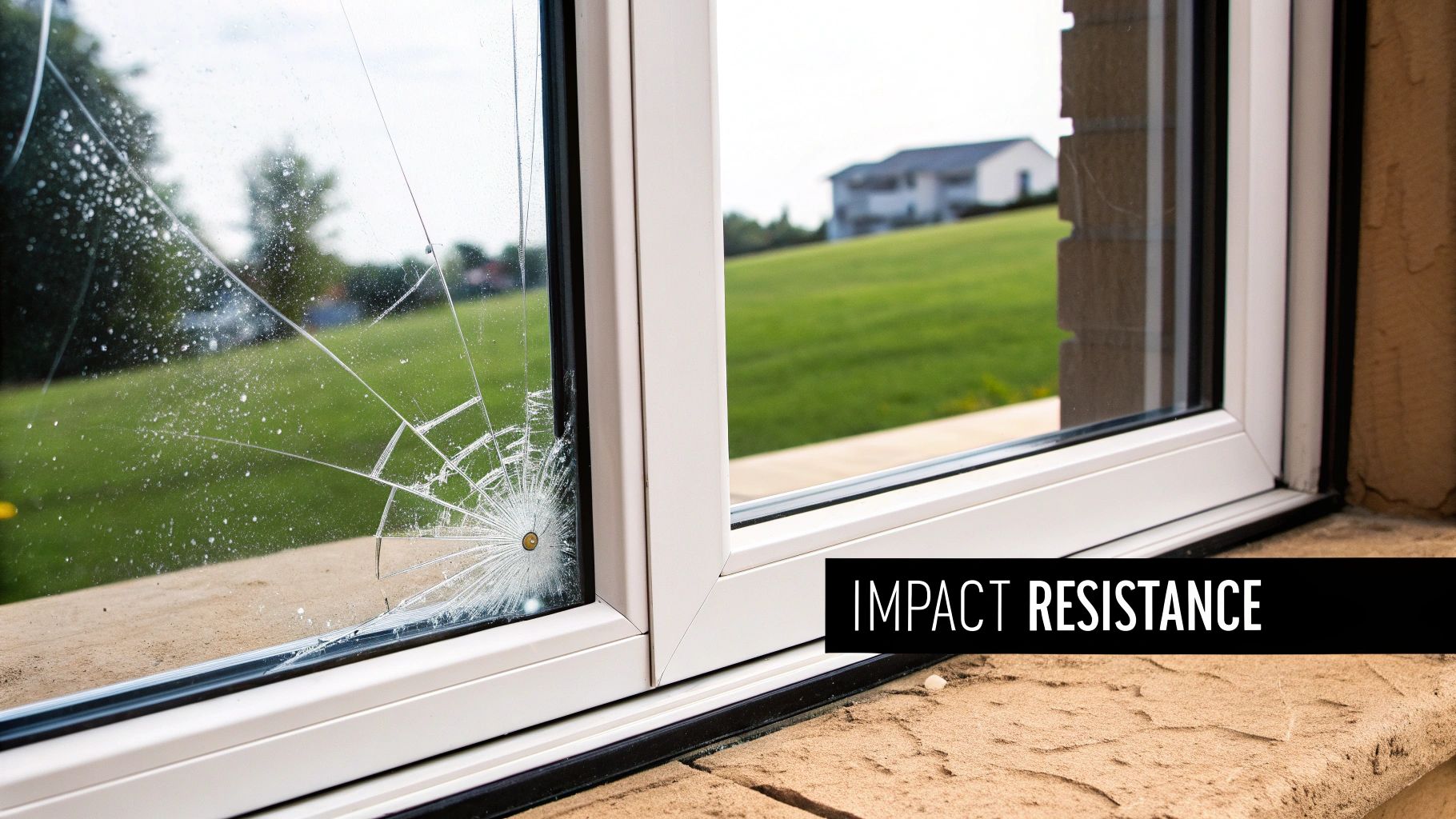
The standard glass in most older homes, known as annealed glass, is incredibly brittle. When it breaks, it creates long, razor-sharp shards that are a serious safety risk. To improve on this, manufacturers use special processes to change how glass responds to stress, making it fail gracefully rather than catastrophically.
The two most common ways to achieve this are through tempering and lamination. Each method gives the glass unique properties, but both are designed with safety in mind.
The Science of Strength
Tempered glass is all about thermal conditioning. Regular glass is heated to a very high temperature and then its surface is cooled rapidly. This creates a state of compression on the outside surfaces and tension in the middle. This internal tug-of-war makes the glass about four times stronger than standard annealed glass. When it finally reaches its breaking point, all that stored energy is released at once, causing it to crumble into small, relatively harmless, pebble-like cubes.
Laminated glass takes a different approach. It’s essentially a glass sandwich. Two or more sheets of glass are bonded together with a tough, transparent plastic interlayer, typically polyvinyl butyral (PVB). If an impact is strong enough to crack the glass, the broken pieces adhere to that sticky interlayer instead of flying everywhere. The pane remains largely intact, continuing to act as a barrier.
Why It Matters More Than Ever
The need for stronger, safer glass isn't just a niche concern anymore. Stricter building codes, especially in hurricane-prone areas, and an increased focus on security for both commercial and residential properties have pushed this technology into the mainstream.
The market reflects this growing demand. Valued at roughly USD 4.24 billion, the global impact-resistant glass market is on track to hit USD 7.57 billion by 2030. If you're interested, you can find more detailed data on the impact resistant glass market growth to see just how fast it's expanding.
The core principle of impact-resistant glass is simple but effective: control the failure. By ensuring the glass breaks in a predictable, safe manner, it transforms from a liability into a protective barrier.
At the end of the day, a glass's impact resistance is a direct measure of its ability to protect people and property. Whether it's withstanding a wind-borne projectile during a storm, delaying an intruder, or preventing a serious injury from an accidental fall, this technology adds a critical layer of defense to our buildings.
How We Measure Glass Strength and Safety
Figuring out how tough a piece of glass is isn't just a guessing game. It's a science, backed by strict, standardized tests designed to mimic the real world. These tests aren't just about whether the glass breaks; they focus on how it breaks, which is the most important part when it comes to keeping people safe. The ultimate goal is to certify that a glass product will fail in a predictable, safe way.
To really get a feel for how glass handles an impact, it helps to start with an understanding why glass breaks in the first place. This basic knowledge puts the need for safety testing into perspective. Essentially, these procedures are designed to push glass to its breaking point to see if it shatters into dangerous, jagged shards or holds together as it should.
Putting Glass to the Test
So, how do we simulate real-world accidents? One of the most common and critical standards in the United States is ANSI Z97.1, which outlines tests that replicate scenarios like someone tripping and falling into a glass door. The go-to method here is the pendulum impact test.
Picture a heavy bag, weighing up to 100 pounds, swinging like a pendulum and slamming into a pane of glass with a specific, controlled amount of force. This is meant to simulate the impact of a person colliding with the glass. Experts then carefully observe what happens to determine if the glass meets the safety criteria.
Another key evaluation is the ball drop test. For this, a solid steel ball, often weighing several pounds, is dropped from various heights directly onto the glass. This is a great way to see how the glass holds up against smaller, more focused impacts—critical for things like security windows or skylights.
Understanding the Safety Ratings
The results from these tests aren't just for a lab report; they lead to specific safety classifications that tell you exactly how a piece of glass will perform. These ratings aren't just arbitrary labels—they represent very real levels of protection.
For example, under the ANSI Z97.1 standard, you'll typically see two main classifications:
- Category I: This rating confirms the glass can handle an impact of 150 foot-pounds of force. Think of this as the force from a small child or a smaller adult running into the glass.
- Category II: This is the tougher rating. Glass with this classification has to withstand 400 foot-pounds of force, which simulates the impact of a full-grown adult. This is the level of safety you'll find in most home applications, like sliding patio doors and large windows.
Here's the most important thing to remember: the classification isn't about preventing breakage. It's about ensuring that when the glass breaks, it does so safely. This means it either crumbles into small, relatively harmless cubes (like tempered glass) or the broken pieces stick to a plastic interlayer (like laminated glass).
These standards ensure the glass we use every day in our homes, offices, and schools provides a reliable shield against accidental injury. It’s what turns a potentially dangerous material into a safe, functional part of our buildings.
Key Glass Impact Safety Standards Compared
While ANSI Z97.1 is a cornerstone in the U.S., it's just one piece of a global puzzle. Different regions and applications call for different standards, each with its own specific testing methods and goals.
The table below breaks down some of the most common standards you might encounter.
| Standard | Governing Body | Primary Test Method | Key Application |
|---|---|---|---|
| ANSI Z97.1 | American National Standards Institute (USA) | Pendulum Impact Test | Safety glazing in buildings (doors, windows, showers) |
| CPSC 16 CFR 1201 | U.S. Consumer Product Safety Commission | Pendulum Impact Test | Consumer safety glazing (architectural glass) |
| EN 12600 | European Committee for Standardization (CEN) | Pendulum Impact Test (classifies breakage) | Building glass in Europe (classifies performance) |
| ASTM F1233 | ASTM International | Forced Entry / Ballistic / Blunt Impact | Security glazing (detention and correctional facilities) |
Each of these standards plays a crucial role in its respective domain, from preventing household accidents to fortifying high-security environments. By understanding these ratings, you can be confident that the glass being installed is up to the task.
Tempered vs. Laminated: Which Glass Is Stronger?
When you’re looking at impact-resistant glass, two options always come to the forefront: tempered and laminated glass. Both are miles ahead of standard annealed glass and fall under the "safety glass" category, but they get their strength from completely different manufacturing methods. The real question isn't just about raw strength, but about how each type of glass acts under pressure to keep people and property safe.
Think of tempered glass like a tightly wound spring. It’s created through a process of extreme heating followed by rapid cooling, which puts the outer surfaces into compression and the interior into tension. This internal stress makes the glass incredibly tough—about four to five times stronger than regular glass. Its main job is to resist a direct hit.
The moment an impact overcomes that strength, all that stored energy releases instantly. This is where you see its most well-known safety feature in action: the glass explodes into thousands of small, blunt, pebble-like pieces instead of sharp, dangerous shards. That’s why it’s the go-to choice for things like shower doors and the side and rear windows in your car, where human impact is a real risk.
Laminated Glass: The Security Sandwich
Now, let's look at laminated glass. A great way to picture it is as a security sandwich. Instead of using internal tension for strength, it’s made by bonding a tough, clear plastic interlayer—usually polyvinyl butyral (PVB)—between two or more layers of glass. This layered construction provides a totally different kind of strength, one focused on holding itself together and resisting penetration.
When laminated glass gets hit, the outer glass layers might crack, but all those broken pieces stay glued to the plastic interlayer. It doesn't shatter and fly everywhere like tempered glass. Instead, it maintains a solid barrier against whatever hit it. This is precisely why it’s the law for car windshields—it keeps occupants from being thrown out in a crash and stops rocks from coming into the cabin.
The core difference is simple: Tempered glass is designed for strength and a safe breakage pattern, while laminated glass is engineered for security and containment, holding together even when it fails.
This infographic gives a great visual breakdown of how safety glass is tested and rated.
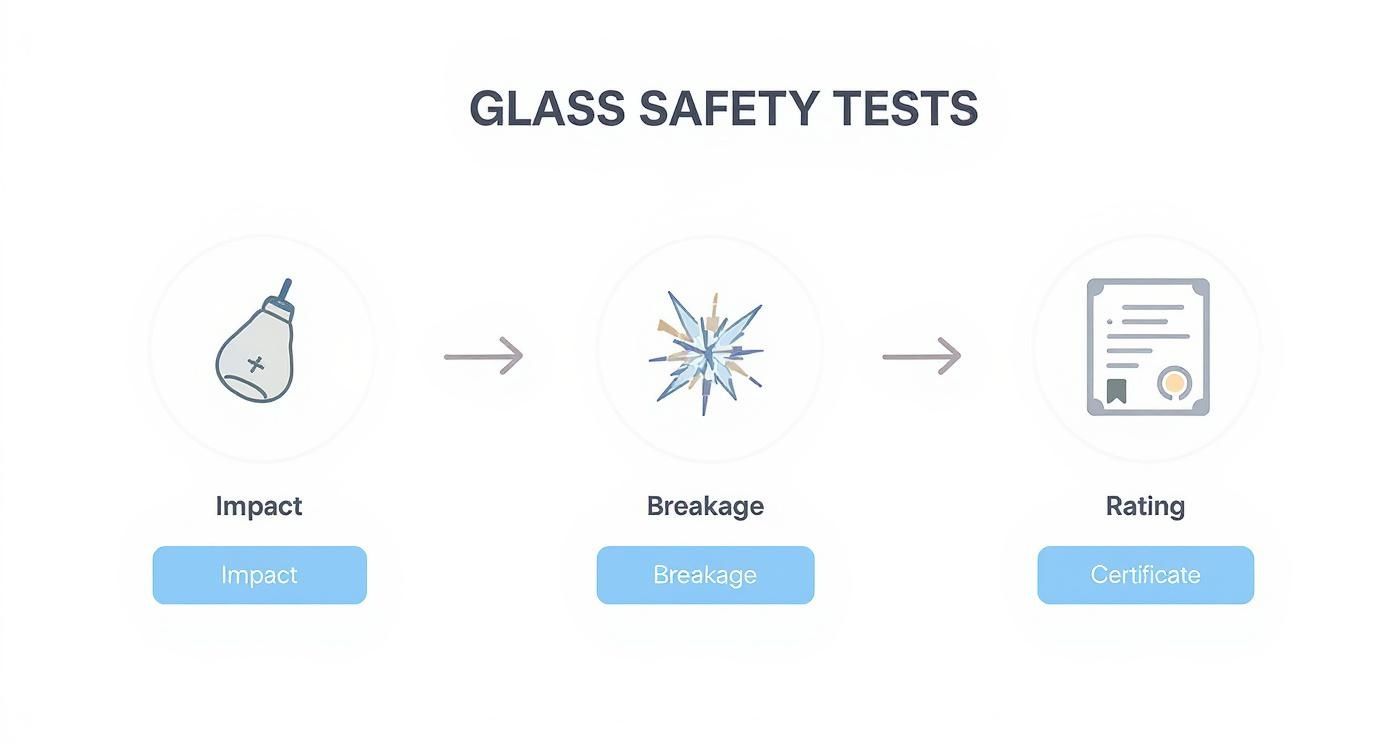
As you can see, it's a full process. It starts with the initial impact, moves to how the glass breaks, and ends with a safety rating based on its performance under stress.
Choosing the Right Glass for the Job
So, which one is actually stronger? If you’re talking about pure surface strength and the ability to resist a blunt force without breaking, tempered glass often wins. But when it comes to security against a determined intruder or containing a blast, laminated glass is the clear champion because it stays in the frame.
Their unique strengths make them suitable for very different jobs:
- Tempered Glass: Perfect for places where strength and a safe failure are the priority. Think patio doors, large architectural glass walls, and even your phone screen. Its ability to crumble into safe bits prevents serious injury from accidental impacts.
- Laminated Glass: The top pick for security and protection. You'll find it in storefronts to stop smash-and-grab thieves, in hurricane-rated windows to block flying debris, and in skylights to prevent shattered glass from falling on people below.
Modern advancements in interlayer materials, like polyvinyl butyral (PVB), have been a game-changer for laminated glass. The construction industry is the biggest user, with automotive and transportation close behind. These advanced interlayers do more than just absorb impact; they also improve optical clarity and even energy efficiency. You can learn more about the growing market for impact-resistant materials and its trends.
In the end, choosing between tempered and laminated glass comes down to the specific threat you're trying to defend against. For nearly all security-focused situations, the resilient barrier that laminated glass provides makes it the superior choice for protecting what matters most.
Here's the rewritten section, designed to sound like an experienced human expert:
What Makes or Breaks Glass Impact Performance
When we talk about how well glass stands up to an impact, it’s easy to think it’s all about the glass itself. But that's only one piece of the puzzle. Real-world performance comes down to the entire system—the glass, its internal layers, and how it's all held together. Get one part wrong, and the whole setup can fail.
Let’s start with the obvious: glass thickness. It’s just common sense. A thick pane of glass is always going to be tougher to break than a thin one. If you double the thickness, you dramatically increase the amount of force it can take before fracturing. This is your first line of defense.
But thickness alone won’t get you very far, especially when dealing with serious threats. What’s inside the glass matters just as much.
It's Not Just the Glass—It's the Interlayer and Frame
In laminated glass, the interlayer is the secret sauce. This isn't just a basic sheet of plastic; it's a high-tech polymer specifically engineered to absorb and distribute the energy from a blow. Some interlayers are designed to be more flexible, almost like a trampoline, catching the force and spreading it out. Others are made to be incredibly rigid, creating a stubborn barrier that’s much harder to punch through.
The choice of interlayer completely changes how the glass behaves when struck. It’s the difference between a window that shatters instantly and one that holds together even after multiple hits.
You can have the strongest, most advanced impact-resistant glass in the world, but if you put it in a weak frame, it's virtually useless. It’s like putting a bank vault door on a flimsy wooden frame—the door might hold, but an intruder will just rip the whole frame out of the wall.
This leads us to the most frequently overlooked, yet absolutely critical, element: the framing and installation. The frame is what anchors the glass to the building. If that frame bends, breaks, or pulls away from the wall during an attack, the entire pane of glass can just pop out. Game over.
A proper installation creates a rock-solid connection between the glass, the frame, and the structure of the building. Here’s what really counts:
- Frame Material: You need heavy-duty steel or aluminum. Your standard residential window frame simply won't cut it.
- Anchoring Method: How the frame is bolted into the wall has to be strong enough to withstand the incredible forces transferred during an impact.
- Glazing System: Specialized gaskets and structural sealants are used to lock the glass into the frame, ensuring it stays put even if it cracks.
At the end of the day, true impact performance is a team effort. It’s the right combination of glass type, its thickness, the interlayer's properties, and a bulletproof installation that creates a truly formidable shield.
How Impact Resistant Glass Is Used in the Real World
https://www.youtube.com/embed/-tHaHIgHzUA
The science behind impact-resistant glass is interesting, but seeing where it's actually used is what really shows its value. This technology is a quiet hero, woven into the fabric of our daily lives and protecting us in ways we rarely notice. From the car you drive to the buildings you walk into, its applications are as common as they are critical.
One of the most universal examples is right in front of you every time you drive: your car's windshield. It’s made from laminated glass, and its primary job in a crash is to keep people from being ejected. It also stops road debris from flying into the car and even helps support the roof in a rollover. This one piece of glass saves countless lives every year.
Protection from Nature and Threats
In places where severe weather is a regular event, impact-resistant glass isn't a luxury—it's a lifeline. Coastal areas, especially those in hurricane zones, have completely changed their building regulations because of it.
For instance, the Florida Building Code now requires glazing in new buildings to withstand major wind impacts. States like Louisiana and Texas have followed suit. After major hurricanes, insurance data showed that properties with compliant impact-resistant windows had far fewer claims than those with standard glass. Because of this, insurers often give big discounts on premiums for buildings with impact-rated windows and doors. You can get more details about the growing impact-resistant glass market on Mordor Intelligence.
This forward-thinking approach transforms a building's weakest points into a solid line of defense, dramatically cutting down on property damage and keeping people safe inside.
Everyday Security and Safety
Beyond protecting against Mother Nature, impact-resistant glass is a workhorse in public safety and security. Its ability to take a punch makes it the perfect choice for all sorts of places where protection matters.
Here are a few common examples you might see every day:
- Retail Security: High-end shops, especially jewelry stores, rely on laminated security glass for their display cases and storefronts. It’s a simple but effective way to stop smash-and-grab robberies, as the glass holds together even when shattered, creating a tough barrier that buys precious time.
- Public Venues: Ever leaned against a glass railing in a stadium, mall, or airport? Chances are it was made from tempered or laminated glass. These panels have to be strong enough to handle the force of large crowds, preventing what could be a dangerous fall.
- Educational Institutions: More and more, schools and universities are using security glass and films to reinforce entrances and classroom windows. It’s an added layer of defense that makes forced entry much more difficult.
The job of the glass in all these situations is the same: to stay put even after being hit. Whether it’s facing a burglar’s hammer or the full force of a storm, the goal is to keep the outside out and the inside safe.
From protecting priceless jewels to making public spaces safer, the practical uses of impact-resistant glass prove it’s a cornerstone of modern building and security.
Upgrading Existing Windows with Security Film
What if you want to make your windows tougher without the expense and headache of a full replacement? There's a fantastic and highly effective solution for that: security window film. It's a retrofit application that dramatically strengthens the glass you already have.
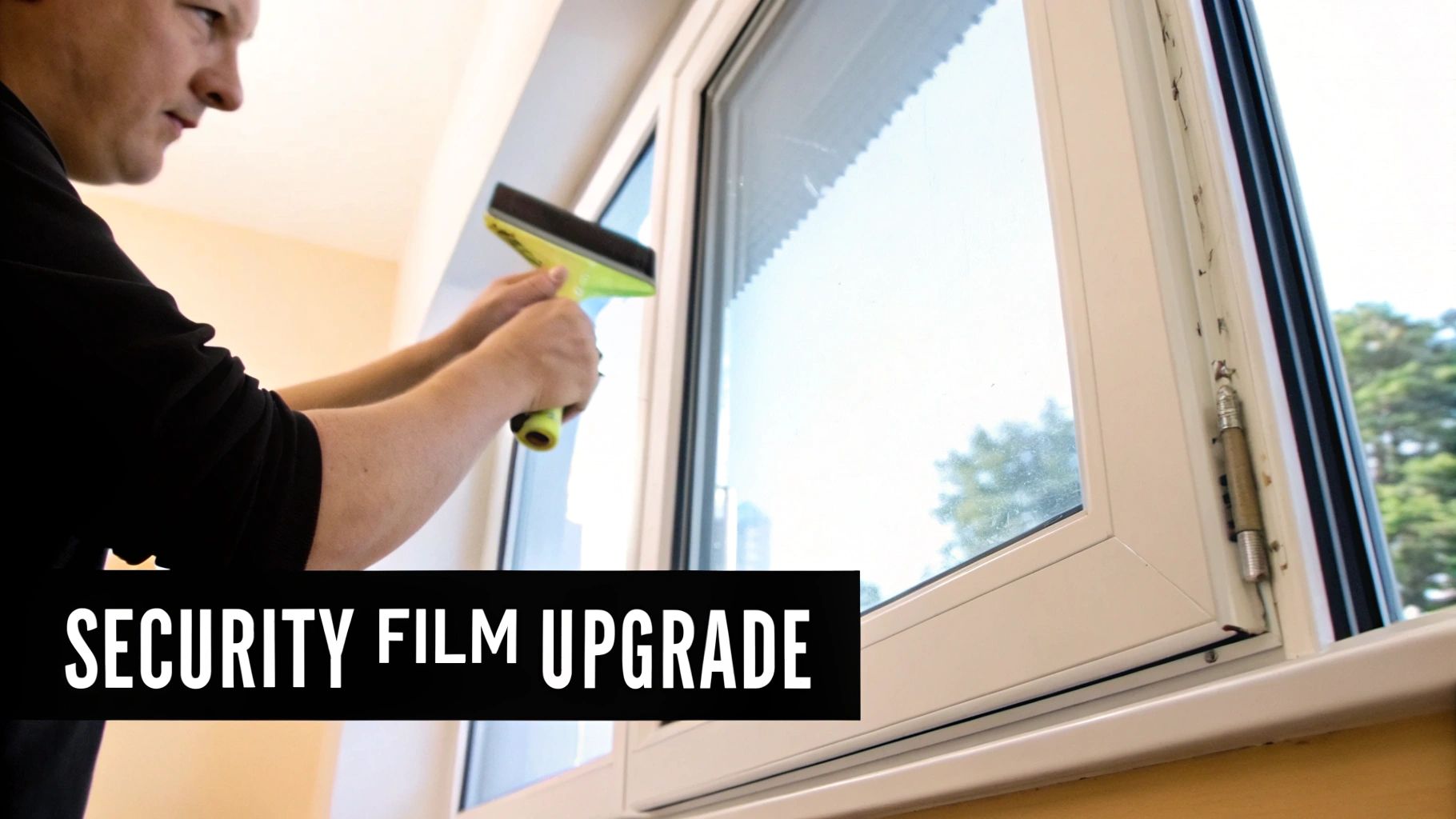
Think of it like a clear, heavy-duty shield for your windows. These films are made from incredibly strong, micro-layered polyester and are applied directly to the interior surface of the glass. Once installed, they're nearly invisible but add a powerful layer of protection.
How Security Film Works
The main purpose of security film is to hold shattered glass together. When something hits the window—whether it's a burglar, a piece of storm debris, or just an accident—the glass itself might crack, but the film keeps all those dangerous shards locked in place.
This is huge. It means the glass remains a solid barrier within the window frame, even after it's broken.
By preventing the glass from collapsing on impact, security film denies a burglar quick entry and protects anyone inside from flying glass fragments—a leading cause of injury during severe weather.
For even greater protection, the film can be anchored to the window frame with an attachment system, turning the entire window into a surprisingly formidable shield.
Films come in different thicknesses, offering various levels of protection, from basic safety to serious security. This makes security film a practical and scalable way to give your glass a major upgrade in impact resistance, turning your weakest points into a real line of defense.
Common Questions About Impact-Resistant Glass
Once you get a handle on the science behind stronger glass, a few practical questions almost always pop up. Let's tackle some of the most common ones with clear, no-nonsense answers.
Is Impact-Resistant Glass the Same as Bulletproof Glass?
Absolutely not. Standard impact-resistant glass is tough, but it’s not bulletproof. It’s engineered to stand up to blunt force—think flying debris in a hurricane or a would-be intruder trying to break in. It’s simply not designed to stop a bullet.
Bullet-resistant glass is a whole different beast. It's a highly specialized product made of multiple, thick layers of laminated glass and polycarbonate, built specifically to stop high-velocity projectiles. While safety glass handles everyday threats, it doesn't offer ballistic protection.
Can It Actually Lower My Insurance Premiums?
There’s a good chance it will. Many homeowners, especially those in hurricane zones or high-risk areas, can see significant discounts on their insurance premiums after installing certified impact-resistant windows.
Insurance providers know that this type of glass dramatically cuts down the risk of property damage during a storm. Fewer broken windows mean fewer (and smaller) claims, and they often pass those savings on to you. It's always a good idea to call your agent and ask what specific discounts they offer.
So, Is Impact-Resistant Glass Unbreakable?
That's a common myth. The truth is, no glass is truly unbreakable. The goal of impact-resistant glass isn’t to be indestructible; it’s designed to fail safely.
When it’s hit with extreme force, it will still crack or even break. The magic is in how it breaks. The interlayer in laminated glass holds the broken pieces together in a spiderweb pattern, while tempered glass crumbles into small, harmless pebbles. Either way, it prevents dangerous shards from flying and keeps the opening sealed.
What About Noise? Does It Help with Sound?
Definitely. The multi-layered design of impact-resistant glass also makes it a fantastic sound insulator. That combination of glass panes sandwiching a polymer interlayer does a much better job of dampening sound waves than a single pane of ordinary glass ever could.
The result is a much quieter home or office, with a noticeable reduction in noise from traffic, loud neighbors, or storms.
Ready to upgrade your property's defenses without changing its look? Fortress Security Films provides advanced, nearly invisible film solutions that dramatically increase the impact resistance of your existing glass. Protect your home or business today.
