


Impact-resistant glass is specifically engineered to take a hit without exploding into a million dangerous pieces. Unlike the standard glass in most windows, which shatters on impact, this type of safety glass uses special layering or heat-treating processes to hold the pane together, even when it cracks.
This creates a tough, reliable barrier against everything from forced entry and storm debris to everyday accidents.
What Is Impact Resistance Glass and Why It Matters
Picture a regular windowpane. It’s a lot like a thin sheet of ice—it looks solid, but a single sharp blow is all it takes to shatter it into a spray of razor-sharp fragments. A thrown rock, an errant baseball, or a burglar’s crowbar will go right through it. That brittleness is a massive weak spot for any home or business.
Now, imagine that sheet of ice is replaced with something much tougher, built in layers. When it gets hit, it might spiderweb with cracks, but it won't break apart. The layers work together, absorbing and spreading out the force of the blow, keeping the barrier in one piece. That's the whole idea behind impact-resistant glass. It's not about being "unbreakable"—it's about engineered resilience.
The Core Value of Resilience
For property owners here in Southern California, that resilience brings serious peace of mind. We have to think about everything from security threats to seismic activity, and the main job of this glass is to keep the building's "envelope"—the shell separating inside from outside—secure.
By holding the glass together, it achieves a few critical things:
- It Deters Forced Entry: Trying to break through this glass is loud, difficult, and takes time. That's often enough to make a potential intruder give up and move on.
- It Protects Against Storms: During high winds or an earthquake, it stops flying debris from smashing through windows and prevents the sudden, dangerous pressure changes that can damage a building's structure.
- It Enhances Personal Safety: If a window does break from an accident, you’re protected from flying shards of glass, which are a major cause of injury.
To really get why this technology is so effective, it's helpful to start with understanding why ordinary glass breaks in the first place. It's no surprise that demand for this level of protection is on the rise. The global market for impact-resistant glass was recently valued at USD 3.37 billion and is projected to grow substantially as safety codes and public awareness continue to increase.
Here’s a quick look at the major advantages this technology delivers.
Key Benefits of Impact Resistance Glass at a Glance
This table breaks down the primary perks of upgrading to impact-resistant glass, giving you a fast overview of what makes it such a smart investment for security and safety.
| Benefit | Description |
|---|---|
| Enhanced Security | Creates a formidable barrier against break-ins, smash-and-grab theft, and vandalism by resisting penetration. |
| Storm & Weather Protection | Withstands high-velocity impacts from wind-borne debris during hurricanes, tornadoes, and other extreme weather events. |
| Increased Safety | Prevents glass from shattering into dangerous shards upon impact, significantly reducing the risk of injury to occupants. |
| UV Ray Filtering | Laminated versions can block up to 99% of harmful UV radiation, protecting interiors from fading without tinting the glass. |
| Noise Reduction | The interlayer in laminated glass provides excellent sound-dampening qualities, creating a quieter indoor environment. |
Ultimately, whether you choose a film retrofit or a full glass replacement, the goal is the same: to turn your most vulnerable entry points into a source of strength and security.
Exploring the Different Types of Safety Glass
When you're looking to upgrade your windows for better security, it's easy to think all "safety glass" is the same. But that couldn't be further from the truth. The world of impact-resistant glass is actually a family of different products, each engineered with a specific purpose in mind. Think of it like this: a hammer and a sledgehammer both hit things, but you wouldn't use one for the other's job.
Each type of safety glass is built differently and, more importantly, behaves differently under attack. Knowing these key differences is the first step to making a smart choice for your home or business. Let's walk through the main players.
Laminated Glass: The Safety Sandwich
Picture a glass sandwich. You have two panes of glass as the "bread" and a super-strong, sticky plastic filling in the middle. That's essentially what laminated glass is. A tough, transparent layer of polyvinyl butyral (PVB) is fused between two sheets of glass using intense heat and pressure.
So, what happens when it gets hit? The real magic is in that sticky interlayer. Even if the glass cracks, the broken pieces stay glued to the PVB film instead of flying everywhere. The pane develops a spiderweb pattern but remains a solid barrier, which is exactly what you want to stop a burglar or protect against storm debris.
This reliable performance is a huge reason why laminated glass commands 45.18% of the impact-resistant glass market. With the total market expected to grow from USD 32.68 billion to USD 44.04 billion by 2030, its role in construction and automotive safety is only getting bigger. You can discover more insights about these market trends and see why it's such a popular choice.
Tempered Glass: Forged for Strength
If laminated glass is a sandwich, then tempered glass is like a blade forged by a blacksmith. It starts out as a normal pane of glass but then goes through an extreme heat-treatment process. The glass is heated to over 1,000 degrees Fahrenheit and then flash-cooled with jets of high-pressure air.
This rapid cooling, known as quenching, creates a state of constant tension. The outer surfaces are locked in compression while the inner core is in tension. This internal tug-of-war makes tempered glass about four times stronger than standard glass of the same thickness.
But its real safety feature isn't just its raw strength—it's how it breaks. When tempered glass finally fails, all that stored energy is released at once, causing the entire pane to crumble into thousands of small, dull, pebble-like cubes. This dramatically reduces the risk of serious cuts and injuries.
This diagram helps visualize how these advanced glass types protect against multiple common threats.
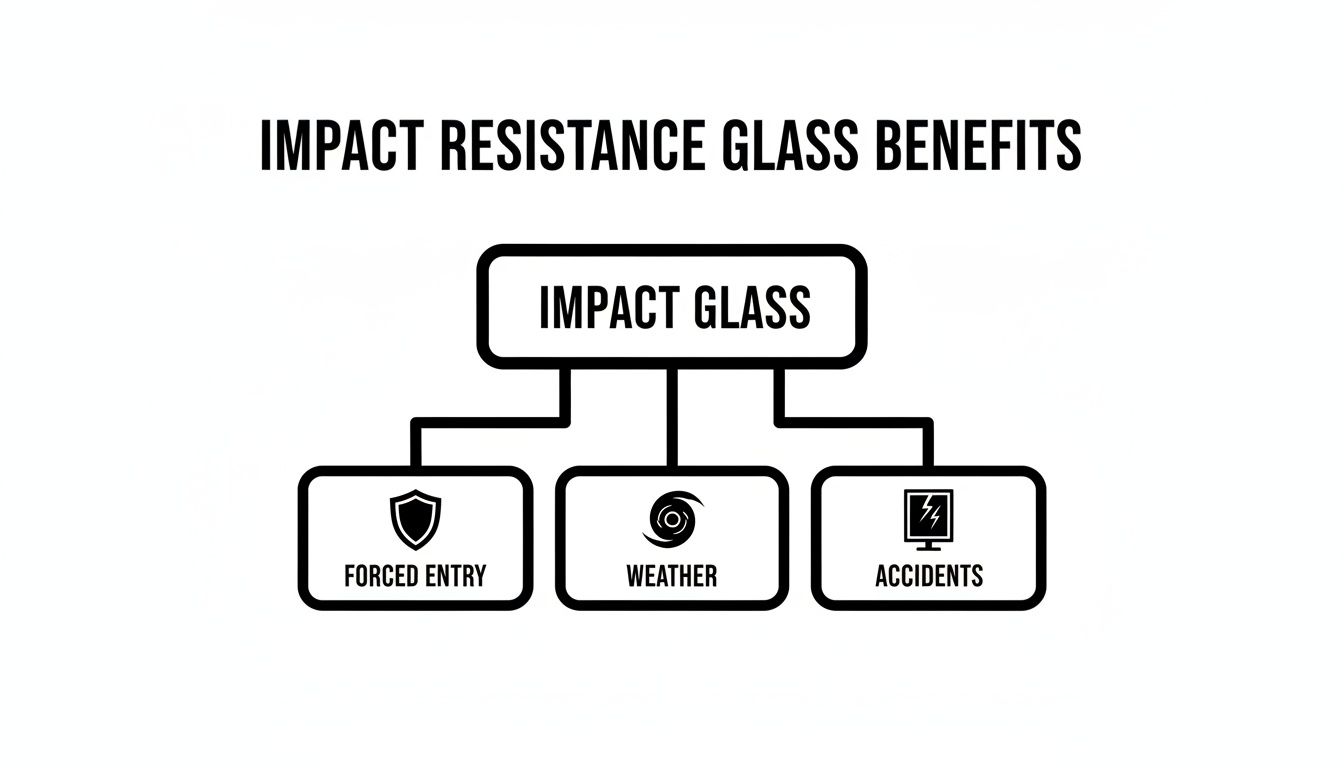
As you can see, the true value of impact-resistant glass lies in its ability to defend against a range of risks at the same time, from criminals to acts of nature.
Other Specialized Impact Glass Types
Beyond laminated and tempered glass, a few other highly specialized options are designed for specific, high-stakes environments. These are the go-to solutions when standard products just won't cut it.
-
Wired Glass: This type has a metal wire mesh embedded inside the glass during manufacturing. While it looks tough, its main job is actually fire resistance. The wire grid holds the glass together when it cracks under extreme heat, helping to contain fire and smoke.
-
Ballistic-Rated Glass: Often called "bulletproof glass," this is the pinnacle of security glazing. It's a heavy-duty, multi-layered product made from alternating layers of glass and polycarbonate. Each layer works to absorb and slow down a projectile's energy. Its thickness and specific makeup are engineered to meet strict NIJ (National Institute of Justice) standards for stopping different types of ammunition.
Each of these options offers a very different kind of protection, tailored to unique security needs and potential threats.
How to Read Safety Standards and Performance Ratings
Diving into the world of impact-resistant glass, you’ll immediately encounter a confusing mess of acronyms and technical codes. This alphabet soup can feel overwhelming, but these standards are actually your best friend for figuring out what a piece of glass can really handle. They aren't just random letters—they're proof of performance, backed by some seriously tough, real-world testing.
Think of these ratings like the spec sheet for a car. You wouldn't buy a truck without knowing its towing capacity, and you shouldn't choose safety glass without understanding its performance ratings. Once you know what to look for, you can cut through the marketing fluff and pick a product with certified, life-saving credentials.
These standards are all developed by independent organizations to create a level playing field for safety. By learning how to translate the most common ones, you can confidently compare different options and make sure you’re getting the right level of protection for your home or business.
Decoding Hurricane and Impact Standards
For anyone living in a storm-prone area—and yes, that includes parts of Southern California that get hit with extreme weather—hurricane codes are the first thing you should look for. The go-to standards here come from ASTM International, a global leader in this field.
The most famous test is often called the "2×4 cannon test," and it's every bit as intense as it sounds. Officially, it's known as ASTM E1886/E1996, and it’s built to mimic the violent force of flying debris in a hurricane. During the test, a nine-foot-long 2×4 is shot out of an air cannon, slamming into the glass at speeds up to 34 mph.
To pass, the glass absolutely cannot shatter and leave an opening. It can crack, but the key is that it must stay in one piece, forming a solid barrier that keeps wind and debris from tearing through the building. This is what separates true impact-rated glass from standard window panes.
Another common one you'll see is ANSI Z97.1. This is more of a general safety standard that checks what happens if a person accidentally falls into the glass. It confirms the glass will break safely—either crumbling into harmless, pebble-like pieces (tempered glass) or staying held together in the frame (laminated glass).
The whole point of impact-resistant glass isn’t to make it "unbreakable." The goal is to make sure it fails in a predictable, safe way that protects people and keeps the building secure.
Understanding Ballistic and Forced Entry Ratings
When your primary concern is a deliberate attack instead of a storm, a completely different set of standards applies. These ratings measure how well a product holds up against bullets and determined physical assaults, giving you a clear roadmap for high-security situations.
The National Institute of Justice (NIJ) is the authority for ballistic resistance in the U.S. Their standard, NIJ 0108.01, sorts ballistic-rated glass and films into different levels based on the specific type of ammunition they can stop.
Here's a quick rundown of what those levels really mean:
- NIJ Level I: This is your baseline, designed to stop smaller handgun rounds like a .22LR and .380 ACP.
- NIJ Level IIA, II, & IIIA: These levels get progressively stronger, stopping more powerful handgun ammunition all the way up to a .44 Magnum. You’ll often see these ratings in commercial buildings and for law enforcement use.
- NIJ Level III & IV: Now we're talking about serious stopping power. These top-tier levels are engineered to defeat high-powered rifle rounds and are typically reserved for military, government, and other high-risk facilities.
For forced entry protection, you’ll want to look for ratings from organizations like Underwriters Laboratories (UL). Their UL 972 standard, for instance, is a burglary-resistance test where the glass is pummeled with hammers, pry bars, and pipes. It’s a brutal test designed to ensure the glass can delay intruders long enough for law enforcement to respond.
Security Film Versus Full Glass Replacement
So, you're ready to make your windows safer. The big question is: do you strengthen the glass you already have, or is it time to tear out the old panes and start fresh? This is the core dilemma when weighing security window film against a full impact resistant glass replacement. Both are fantastic upgrades, but they solve the problem in fundamentally different ways.
You can think of security window film like a high-tech suit of armor for your existing windows—it's a powerful and affordable way to fortify what's already there. A full glass replacement, on the other hand, is more like building a new, stronger wall from scratch. Each has its place, and the right choice really boils down to your budget, timeline, and what you’re trying to protect against.
Let's break down the pros and cons of each to figure out which path makes the most sense for your property.
The Case for Security Window Film
Security film is a specialized polyester membrane that our technicians bond directly to the inside surface of your glass. It’s almost completely invisible once installed, but it acts like a powerful net, holding the glass together even if it shatters. This simple addition makes it incredibly frustrating and time-consuming for someone to force their way inside.
The biggest draws for a film retrofit are almost always cost and convenience.
- Budget-Friendly: Applying a professional-grade film costs a fraction of what it takes to replace entire window units. It’s an easy and accessible first step toward better security.
- Minimal Disruption: The installation is quick, clean, and typically done in a day without any of the mess you’d get from construction. That’s a huge plus for both homeowners and businesses that need to stay open.
- Versatility: Film can be applied to just about any glass shape or size, making it a perfect solution for unique architectural designs or historic windows you want to preserve.
On top of that, many of the security films we offer at Fortress Security Films pull double duty. They can also block up to 99% of damaging UV rays, which is a great side benefit for protecting your furniture, floors, and artwork from fading.
The Argument for Full Glass Replacement
While film is an amazing retrofit, replacing your old panes with laminated or tempered impact resistant glass provides the absolute highest level of built-in protection. Here, the strength isn't just an add-on; it's an integral part of the glass itself, usually installed within heavy-duty frames. The result is one seriously tough, unified barrier.
This is the go-to option when maximum security and structural resilience are the top priorities.
A full replacement isn't just about stronger glass; it’s about creating a complete, engineered system. The heavy-duty frames required for impact glass are designed to withstand the same forces as the glass, ensuring there are no weak points for an intruder or storm to exploit.
The main benefits of a full replacement are clear:
- Superior Strength: Laminated glass, with its tough PVB interlayer, can take an incredible amount of punishment from repeated blows or high-speed impacts.
- Structural Integrity: The whole unit—glass and frame—is engineered to work as a team. This system is what earns it certifications against tough standards like ASTM E1886/E1996 for hurricane protection.
- Longevity: This is a permanent upgrade that becomes part of the building's core structure, often adding to the property's value.
This approach is best suited for new construction projects or major renovations where the budget and schedule can accommodate a more involved installation. It's the ultimate investment in the safety of your property and the people inside it.
A Side-By-Side Look
Choosing between these two great options can be tough. This table breaks down the key differences to help you see which one aligns best with your needs.
| Feature | Security Window Film | Impact Resistant Glass Replacement |
|---|---|---|
| Primary Benefit | Cost-effective deterrent and hazard mitigation | Maximum structural protection against extreme force |
| Installation | Quick, non-disruptive retrofit to existing glass (usually 1 day) | More involved; requires removing old windows and frames |
| Cost | Significantly lower upfront investment | Higher initial cost, a major capital improvement |
| Protection Level | Good to excellent; delays entry, contains shattered glass | Superior; engineered to withstand repeated, high-force impacts |
| Best For | Homes, storefronts, schools needing an affordable security boost | New construction, high-risk locations, hurricane zones |
| Additional Benefits | UV protection, anti-graffiti options, privacy tints | Often includes improved energy efficiency and sound insulation |
| Aesthetic Impact | Virtually invisible; preserves original look of windows | Can change the look; requires new, often thicker, window frames |
| Overall Value | High ROI for immediate security improvement on a budget | Long-term investment that increases property value and resilience |
Ultimately, both solutions are designed to make your property a harder target. The right one for you simply depends on where your priorities lie.
Making the Right Decision for You
Deciding between security film and a full glass replacement comes down to a practical look at your specific situation—your property's risk level, your budget, and your long-term goals.
For many of our Southern California clients, a professionally installed security film strikes the perfect balance of performance and price, effectively shutting down the most common threats like smash-and-grab burglaries.
However, for properties in high-risk areas or for those who want ironclad protection against extreme weather or a determined attacker, investing in a full impact resistant glass replacement is the better long-term play. By weighing these factors, you can choose the solution that gives you the most valuable thing of all: peace of mind.
Where Security Glass and Films Make a Real-World Difference
The theory behind impact-resistant glass is interesting, but seeing where it’s actually put to work is what really drives the point home. This is where lab tests and performance specs become powerful, practical tools for protecting people and property in the places we live and work every day. From suburban homes to busy downtown storefronts, the need for a stronger barrier is a universal concern.
By looking at how and where this specialized glass and security film are used, you can get a much clearer picture of how they might fit into your own security plan. The applications are incredibly diverse, but they all boil down to one thing: turning a building's weakest points into its most reliable defense.
Securing Homes Against Intrusion
For any homeowner, peace of mind starts with shoring up the most obvious break-in points. Ground-floor windows, sliding glass doors, and elegant French doors are the go-to targets for burglars simply because standard glass puts up no fight. One swift, hard hit, and they're in.
This is exactly where impact-resistant glass and security films change the game. By reinforcing these vulnerable areas, you create a powerful deterrent. A burglar who was counting on a quick, quiet entry is suddenly faced with a window that just won't give way, creating a racket and buying you critical time.
Fortifying Retail and Commercial Properties
Retail shops, particularly those showcasing expensive merchandise in their windows, are all too familiar with the threat of "smash-and-grab" burglaries. These brazen attacks are over in seconds, leaving thousands of dollars in losses before an alarm can even trigger a response. A simple layer of security film or laminated glass can stop these thieves in their tracks.
Instead of shattering on impact, the glass holds together, denying criminals the instant access they need to succeed. This is an essential upgrade for:
- Jewelry Stores and Boutiques: Protecting high-value inventory from being snatched in seconds.
- Electronics Retailers: Securing storefronts filled with expensive, easy-to-grab gadgets.
- Office Buildings: Shielding ground-floor windows and lobbies from vandalism and after-hours entry.
For a truly robust defense, it's wise to layer your security. Looking into commercial security gate solutions to complement your reinforced glass creates a formidable barrier against a much wider range of threats.
Protecting Schools and Public Buildings
In places where safety is non-negotiable—like schools, government buildings, and hospitals—the need for better protection is crystal clear. Impact-resistant glazing acts as a crucial first line of defense, slowing down intruders and protecting people from immediate harm.
By reinforcing classroom windows and main entrances, these facilities create safer environments. The entire strategy is to delay an attacker, giving law enforcement the precious minutes they need to arrive and neutralize the threat before it escalates.
This push for greater safety is a massive force in the building industry. In fact, the construction and infrastructure sector drives about 60% of the demand for impact-resistant glass, a market valued at over USD 18.66 billion within the USD 31.1 billion global market. This growth is a direct result of updated building codes and a deeper awareness of public safety needs. You can read the full research about these market dynamics to grasp just how widespread its adoption has become. From homes to huge commercial projects, impact-resistant glass is now a fundamental part of modern, secure construction.
Installation, Maintenance, and What to Expect with Costs
You’ve done the research and picked out the perfect impact-resistant glass or security film. That's a huge step, but what comes next is just as important. The reality is, the best product in the world won't do its job if it's installed poorly. And of course, there’s the bottom line—what does this all cost, and is it really worth it?
This isn’t just about buying a product; it's about making a smart, long-term investment in your property’s safety and durability. Let's walk through the practical side of things—installation, upkeep, and the real return on your investment.
Why Professional Installation Is Non-Negotiable
The performance of your new security glass or film is completely dependent on how well it's installed. Think of it like a world-class deadbolt installed on a flimsy, misaligned door frame. The lock itself is strong, but the system's weak point will fail every time. An improper fit, a bad seal, or even a tiny bubble in the film can become a critical vulnerability that a storm or an intruder will find.
This is exactly why getting it done by a professional, certified team is an absolute must. Our installers at Fortress Security Films are trained to handle the nuances that make all the difference:
- A Perfect, Edge-to-Edge Fit: We take precise measurements to ensure there are absolutely no gaps for an intruder to exploit.
- The Right Adhesives and Sealants: The bond between the glass, film, and frame has to be incredibly strong. Using the correct materials creates a unified system that can absorb and distribute immense force.
- Following Strict Manufacturer Protocols: Every product has specific installation requirements to perform as advertised. We follow those to the letter, so you get the full protection you paid for.
Trying to DIY this kind of project might look like a cost-saver on paper, but it almost always leads to compromised security, voided warranties, and a false sense of safety.
Simple Care for Long-Term Protection
One of the most common questions we get is about upkeep. The good news is, modern impact-resistant products don't require a complicated maintenance routine. Taking care of your security glass or film is surprisingly straightforward—not much different from cleaning regular windows.
Just stick to a few simple guidelines to keep everything clear and effective:
- Use a soft cloth or sponge with a gentle, non-abrasive cleaner.
- Avoid ammonia-based products (like some Windex formulas) on security films, as they can break down the adhesives over time.
- Never use sharp tools or abrasive scouring pads that could scratch the surface.
A little bit of routine care is all it takes to make sure your investment keeps protecting your property and looking great for years.
Understanding the Cost and the Real ROI
Let's talk numbers. Yes, impact-resistant solutions have a higher upfront cost than standard glass—you can expect to see prices ranging from $30 to $70 per square foot for full glass replacements. But looking at that number as just an expense is missing the point entirely.
The initial cost is an investment that pays you back in multiple ways. It’s not just about what you spend, but what you gain in security, property value, and peace of mind.
The return on that investment shows up in a few key areas:
- Increased Property Value: A secure, protected building is inherently more valuable on the market.
- Lower Insurance Premiums: Many insurance companies offer significant discounts for properties with certified impact protection.
- Energy Savings: The extra layers in laminated glass or the properties of certain films provide better insulation, which can help lower your heating and cooling bills.
- UV Protection: Laminated glass and security films block up to 99% of harmful UV rays, preventing your furniture, floors, and artwork from fading.
When you add up all these benefits, it becomes clear that upgrading your glass is one of the most practical and valuable decisions you can make for your property.
Frequently Asked Questions About Window Security
We hear a lot of the same questions from property owners across Southern California who are thinking about upgrading their windows. Let's tackle some of the most common ones to help you get the facts straight.
How Much Stronger Is Impact Glass Than Normal Glass?
This is a great question, but it's less about raw strength and more about how the glass behaves under stress. When standard glass breaks, it shatters into dangerous shards, leaving a wide-open hole for an intruder. Impact-resistant glass, on the other hand, is specifically engineered to hold together even after it fails.
Think of it like this: a solid hit might spiderweb the glass, but the pane itself remains a barrier. Tempered glass does this by crumbling into tiny, harmless cubes, while laminated glass uses a tough, sticky interlayer to glue all the broken pieces in place. The window stays intact.
Will Security Film Make My Windows Unbreakable?
Honestly, no product can make glass truly "unbreakable," and you should be skeptical of anyone who claims it can. The real magic of security film is in deterrence and delay. By holding shattered glass together, the film turns a would-be quick smash-and-grab into a noisy, difficult, and time-consuming struggle.
An intruder is banking on a fast, quiet entry. When a window just won't break open after a few hard hits, it draws a ton of attention and gives you critical time. More often than not, that frustration is enough to make them abandon the attempt and look for an easier target.
The goal isn't to make your property invincible; it's to make it a much harder target. That delay is everything.
Does Security Glass or Film Distort the View Outside?
Not in the slightest. This is probably the biggest myth we have to bust. High-quality impact resistance glass and the advanced security films we install are optically clear. Once they're on, you won't even know they're there.
You get all the security benefits without compromising your view, losing natural light, or changing the look of your home or business. In fact, you actually gain a few perks. Laminated glass, for example, is fantastic at dampening outside noise, and both options block up to 99% of harmful UV rays, protecting your furniture, floors, and artwork from fading.
Ready to turn your most vulnerable entry points into your strongest? The expert technicians at Fortress Security Films are here to design a custom security solution for your property. Secure your home or business today by visiting us at https://fortresssecurityfilms.com.
