


When you hear "impact glass door," don't picture a sheet of glass that's simply unbreakable. Think of it as an expertly engineered entryway designed to stand its ground against extreme weather and forced entry. At its core is a special type of shatter-resistant laminated glass that holds itself together, even when it's been hit hard.
Unlike a standard glass door that shatters into a million dangerous pieces, this multi-layered design keeps your home sealed and secure, maintaining a solid barrier when you need it most.
Deconstructing the Strength of Impact Glass Doors
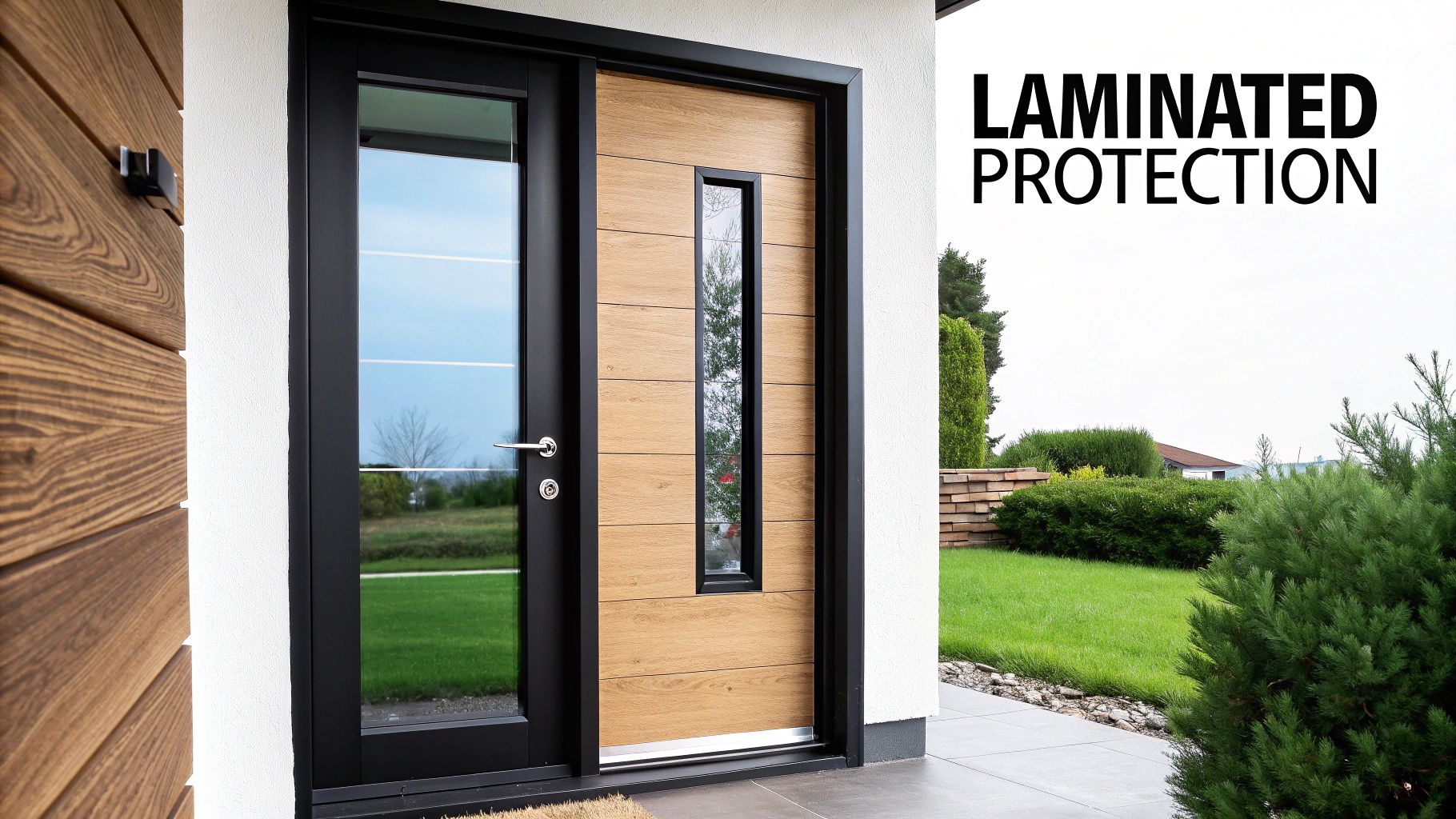
The best way to understand how an impact glass door works is to think about your car's windshield. When a rock hits it, you see a spiderweb of cracks, but the glass doesn't just fall out. It holds its shape. That's the exact same principle at work here.
Impact doors aren't designed to be invincible; they're designed to fail safely. The goal is to keep the opening sealed against wind, rain, and intruders, even after taking a significant blow. This incredible resilience is all thanks to its "glass sandwich" construction.
This isn’t your average pane of glass. It’s a sophisticated laminate made by fusing a tough, clear polymer interlayer—typically polyvinyl butyral (PVB) or SentryGlas Plus (SGP)—between two strong outer layers of glass. This fusion creates a single, remarkably resilient panel.
When something strikes the door, whether it's debris from a hurricane or a would-be burglar’s crowbar, the impact is absorbed and spread out across the entire surface. The outer glass layer might crack under the strain, but that powerful inner layer tenaciously holds all the broken pieces together.
The Science Behind Shatter Resistance
The real genius of an impact glass door is that sticky, flexible interlayer. It acts like a sheet of incredibly strong, invisible tape that's permanently bonded to the glass. It simply refuses to let go of the shards, which prevents two dangerous things: the spray of hazardous glass fragments and the creation of an open hole.
This is a world away from how other common types of glass doors behave.
- Standard Annealed Glass: This is the basic glass you find in many older homes. When it breaks, it explodes into large, jagged shards that are incredibly dangerous and leave your property wide open.
- Tempered Glass: This glass is heat-treated to make it about four times stronger. Its safety feature is that it crumbles into small, pebble-like pieces when it breaks, reducing the risk of cuts. But it still leaves you with a gaping hole, offering zero protection after that initial impact.
The core purpose of impact glass isn't to prevent cracks—it's to prevent a breach. By keeping all the broken pieces glued to the interlayer, the door maintains its structural integrity and protects your home from the elements and intruders.
More Than Just Glass
While the laminated glass is definitely the star of the show, a true impact-rated door is a complete system. The frame and hardware are just as crucial. After all, what good is a super-strong pane of glass if the frame holding it in place gets twisted or ripped right out of the wall?
That's why impact glass door systems always include heavily reinforced frames, often built from industrial-grade aluminum or steel. They also feature upgraded locking mechanisms and corrosion-resistant hardware that can withstand immense pressure.
Every single component is tested as one unified assembly to guarantee it can handle the forces of a major storm or a determined intruder. To appreciate just how specialized these doors are, it helps to understand the basics of all types of glass doors, their benefits, and installation tips. This context really drives home why an integrated impact system is the superior choice for anyone serious about security and storm protection.
More Than Just Storm Protection: The Everyday Perks
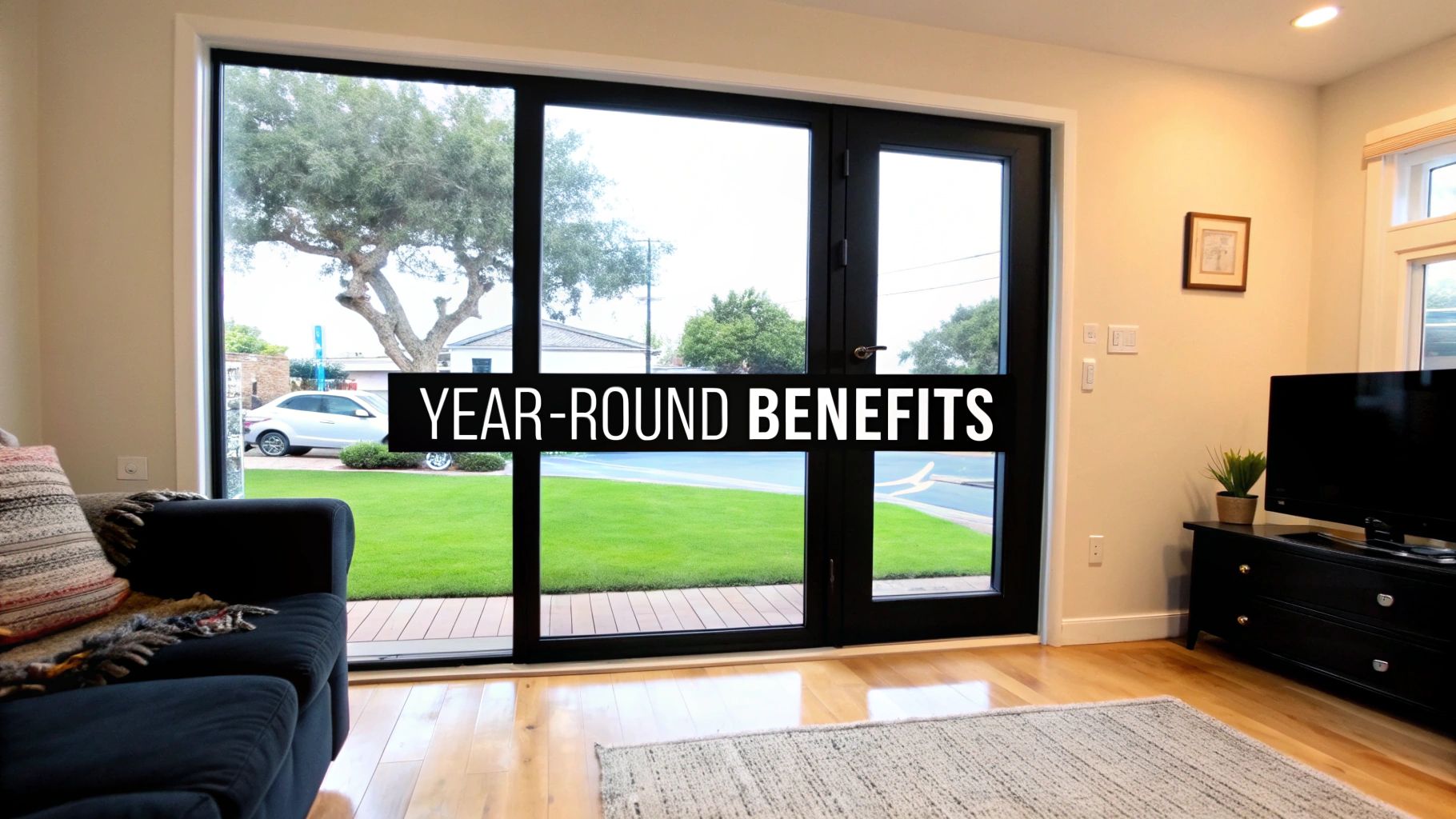
When you hear "impact glass doors," your mind probably jumps straight to hurricanes and severe weather. And for good reason—they are phenomenal at that. But to pigeonhole them as just storm protection is to miss the bigger picture. The very same engineering that makes these doors a fortress against high winds delivers some incredible benefits you'll appreciate every single day of the year.
Think of it this way: their storm-readiness is just the beginning. Once installed, many homeowners are genuinely surprised by the other advantages that quickly become their favorite features. We're talking about a stronger sense of security, a more peaceful home, and even lower utility bills. Let's dig into these three game-changing benefits.
A Serious Upgrade to Your Home Security
The weak point of many homes is a standard glass door. It’s an open invitation for a burglar, who can shatter it in seconds and gain access. Impact glass completely rewrites that script. The same design that shrugs off flying debris in a storm also stands up impressively to forced entry.
It all comes down to that tough polymer interlayer sandwiched between the glass panes. If an intruder tries to smash the glass with a brick or crowbar, they’re in for a surprise. Instead of a loud crash and a gaping hole, the glass will just spiderweb. The interlayer holds everything together, keeping the door sealed and the intruder out.
This creates a powerful deterrent. Burglars are all about speed and ease. The amount of noise and effort it takes to even try to get through an impact door is a huge turn-off, usually sending them looking for a much softer target.
The security isn't just a bonus feature; it's baked into the very DNA of the door. By choosing impact glass, you're fundamentally fortifying your home against intruders and gaining priceless peace of mind.
While these doors are a massive step up, layering your security is always a smart move. Getting familiar with how to secure glass doors with other measures can create an even more robust defense system.
Your Own Quiet Sanctuary
One of the most immediate and welcome changes after installing impact glass doors is the quiet. Suddenly, the constant noise of the outside world—the traffic, the lawnmowers, the neighborhood chatter—just fades into the background.
This sound-dampening magic comes from the multi-layer construction. The combination of rigid glass and a soft, flexible polymer interlayer is fantastic at disrupting and absorbing sound waves before they can enter your home. It’s like having high-end, soundproof windows, but with the strength to match.
The difference is night and day. Your home becomes a more tranquil retreat where you can hold a conversation without shouting or simply enjoy the silence. If you live near a busy street, a school, or anything that generates a lot of noise, this benefit alone can dramatically improve your daily life.
An Energy-Efficient Home and Lower Bills
Beyond keeping you safe and sound, impact glass doors are workhorses when it comes to energy efficiency. They create a far superior thermal barrier than standard doors, helping you maintain a stable temperature inside your home and easing the burden on your HVAC system.
Their laminated glass and heavy-duty frames are excellent at preventing air leaks and heat transfer. In the summer, they do a fantastic job of keeping the sweltering heat out, letting your AC run more efficiently. Come winter, they keep your expensive heated air from escaping.
This isn't just a small improvement; the numbers are significant. Laminated glass can improve U-values (a measure of heat transfer) by 25% over standard glass, potentially leading to annual energy savings of up to $300. Buildings using impact glass often see their HVAC demand drop by 15%. It's no wonder homeowner adoption has surged 35% since 2020, with many seeing their utility bills fall by an average of 10-15%. This isn't just about comfort; it's about real money back in your pocket every month.
Understanding Impact Ratings and Local Codes
Choosing the right impact glass doors is about more than just looks—it’s about understanding the language of safety and strength. All those technical terms and building codes might seem intimidating at first, but they’re really just a way to measure and guarantee a door's ability to protect your home and family. Think of these ratings as the door's official report card, showing you exactly how it held up under extreme, real-world conditions.
Without these certifications, you're essentially just guessing about your home's safety. Getting a handle on what terms like Design Pressure (DP) and Performance Grade (PG) really mean is the key to making sure the door you pick is truly up to the task, especially if you live where storms are a real threat. These aren't just abstract numbers; they're the direct result of some seriously intense physical testing.
Deciphering Design Pressure and Performance Grade
Let's break down the two most important ratings you'll come across.
Design Pressure (DP) is a straightforward measurement of how much force a door can take before it fails. This rating, measured in pounds per square foot (psf), tells you how well the door resists wind load—a critical factor in coastal regions. It’s simple: a higher DP rating means a stronger door.
For instance, a door with a DP50 rating has been tested to withstand a pressure of 50 psf. That's a significant amount of force, easily equivalent to winds well over hurricane strength.
Performance Grade (PG), on the other hand, gives you a more complete picture. While it includes the DP value, it also certifies that the door has passed a whole series of other grueling tests, including:
- Water Infiltration: How well does it keep out punishing, wind-driven rain?
- Air Infiltration: How much air leaks through the door assembly? (Think energy efficiency).
- Structural Load: Can the door resist intense wind pressure without breaking?
- Forced-Entry Resistance: How well does it stand up to a potential break-in?
A PG rating is a much better indicator of the door's overall quality and real-world performance, going far beyond just wind resistance.
The Missile Tests Behind the Ratings
So how do these doors earn their stripes? They have to survive what are known as large and small missile impact tests. These aren't computer simulations; they are aggressive, physical trials designed to mimic the devastating effect of debris being thrown around in a hurricane.
- Large Missile Impact Test: This is the big one. Technicians fire a 9-pound 2×4 wooden stud from an air cannon directly at the door, hitting it at about 34 miles per hour. To pass, the door must take two separate hits without creating a hole large enough for a 3-inch sphere to pass through.
- Small Missile Impact Test: After surviving the 2×4, the same door is then peppered with ten steel ball bearings traveling at a blistering 88 miles per hour.
Passing these tests is non-negotiable. It is the definitive proof that an impact glass door can do its most important job: maintaining a protective barrier even after being smashed by heavy, fast-moving objects.
But it doesn't stop there. After the impacts, the door is mounted on a test wall and subjected to 9,000 cycles of positive and negative wind pressure. This final torture test ensures that even a damaged door won't be ripped from its frame by the fluctuating pressures of a major storm.
Connecting Ratings to Your Local Building Codes
All these ratings tie directly back to your local building codes, which can vary dramatically from one place to another. The toughest codes are found in places like Florida's High-Velocity Hurricane Zone (HVHZ), which covers Miami-Dade and Broward counties. In an HVHZ, only the highest-rated impact products are even allowed to be installed.
The demand for this level of protection is growing fast. The global impact-resistant windows and doors market is projected to hit about $8,500 million in 2025, driven largely by these strict codes in states like Florida and Texas. After devastating storms like Hurricane Ian, which caused insurance premiums to jump by 40%, more and more homeowners are looking for impact glass doors rated for winds up to 150 mph. Laminated glass, which makes up 45.18% of the market, is central to this trend, as its ability to hold shards together can reduce burglary rates by up to 60% in fortified homes. You can dive deeper into these market trends on impact-resistant products.
At the end of the day, you have to choose a door that meets or, even better, exceeds the specific code requirements for your location. Your best bet is to always check with your local building department or a qualified installer to make sure the product you’re considering is compliant. It’s the only way to be certain you're protecting both your family and your investment.
How Impact Doors Compare to Other Solutions
When it's time to protect your home from storms and intruders, the number of options can feel a bit dizzying. Impact glass doors are a fantastic, all-in-one solution, but they aren’t the only game in town. Let's break down how they stack up against other popular choices, like security films and traditional hurricane shutters, so you can make a decision that fits your home, budget, and peace of mind.
Each option strikes a different balance between cost, convenience, and performance. Impact doors are what we call a passive system—they’re on guard 24/7 without you having to lift a finger. On the other hand, shutters are an active system, meaning you have to physically put them up before a storm hits. Security films sit somewhere in the middle, offering a passive upgrade to your existing glass but with different limitations.
Impact Doors vs. Security Window Film
At a glance, security window film looks like a great budget-friendly alternative. It’s a tough, adhesive polyester layer that’s applied directly to your existing glass to hold the pane together if it shatters. It’s a definite improvement over standard glass and can be a solid deterrent.
But here’s the catch: the film is only as strong as the glass and frame it’s stuck to. While it’s great at preventing a quick smash-and-grab, a powerful impact from a piece of flying debris or a determined burglar could still compromise the entire door. The frame might fail even if the glass shards stay stuck to the film. You can dig deeper into the specifics of security film for glass doors to see how it can be a valuable piece of a layered security plan.
Here's a simple analogy: Applying security film is like putting a high-quality, shatter-resistant case on your smartphone. It provides great protection from everyday drops, but it doesn't fundamentally change the phone's design. An impact door is like buying a brand-new, rugged phone that was engineered from the ground up to survive extreme conditions.
Impact Doors vs. Traditional Hurricane Shutters
Hurricane shutters are the old guard of storm protection. They offer incredible, brute-force protection by creating a solid barrier over your glass. They come in all shapes and sizes, from old-school panels you have to bolt on by hand to slick, modern roll-down systems.
The biggest downside to shutters is pure inconvenience. They have to be deployed before a storm and then taken down or retracted afterward. That can be a stressful, physically demanding job when you’re already worried about an approaching hurricane. Worse yet, when they're closed, they plunge your home into total darkness and offer zero security or noise reduction benefits on a normal day.
This flowchart shows how local building codes often point you toward a certified, impact-rated product.
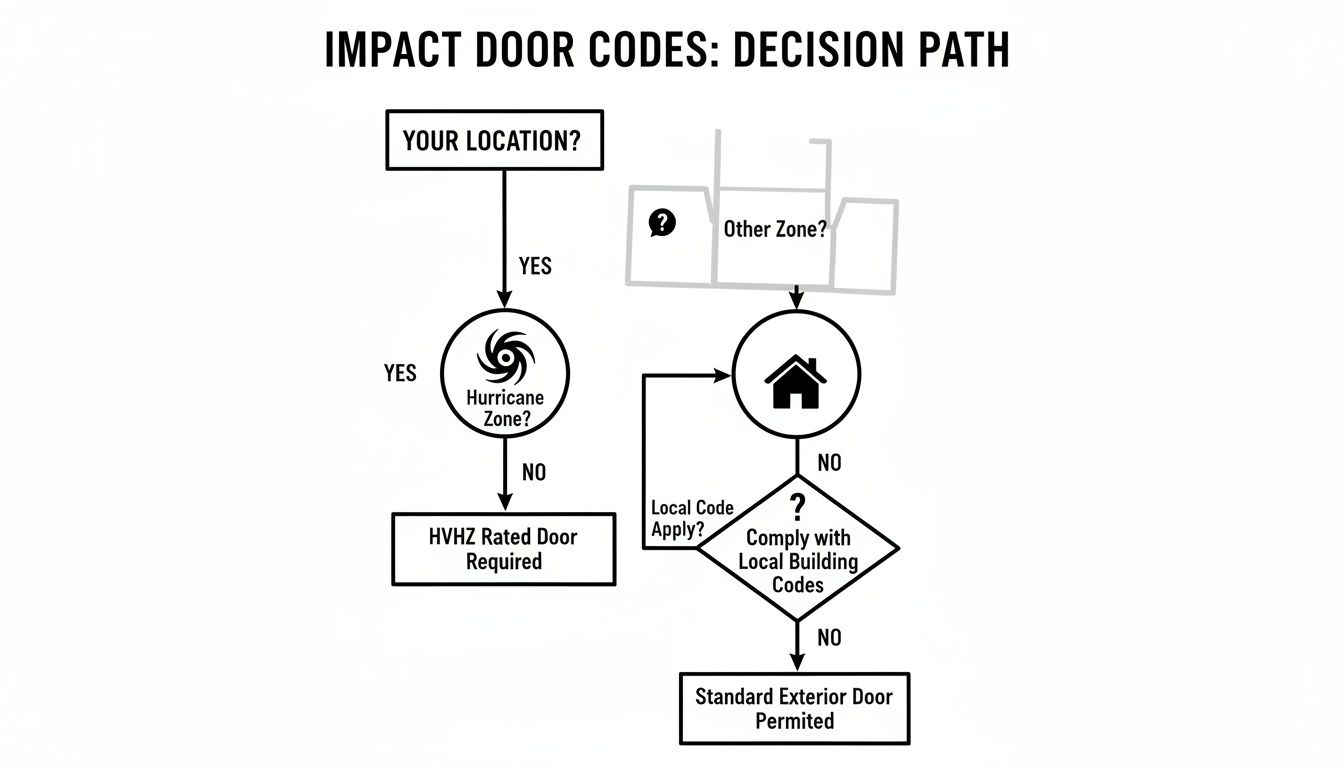
As you can see, if you live in a hurricane-prone area, investing in a door that meets or exceeds the strict High-Velocity Hurricane Zone (HVHZ) ratings isn't just a good idea—it's often the law.
Impact Doors vs. Alternatives: A Head-to-Head Comparison
To make things even clearer, let's put these options side-by-side. This table compares impact glass doors with security film and hurricane shutters across the factors that matter most, helping you decide on the right protection for your home.
| Feature | Impact Glass Doors | Standard Glass with Security Film | Hurricane Shutters |
|---|---|---|---|
| Protection Type | Passive (always on) | Passive (always on) | Active (requires deployment) |
| Upfront Cost | High | Low to Medium | Medium to High |
| Day-to-Day Security | Excellent | Good | None (unless deployed) |
| Storm Protection | Excellent | Moderate | Excellent |
| Aesthetics | Unobstructed view, high-end look | Nearly invisible, maintains original look | Bulky, obstructs view when closed |
| Convenience | Zero effort required | Zero effort required | High effort, requires storage/labor |
| Other Benefits | Noise reduction, UV filtering, energy efficiency | UV filtering, some shatter resistance | None |
At the end of the day, the right choice really boils down to your priorities. Impact glass doors offer a complete, seamless, and always-on shield that boosts your home’s security, beauty, and comfort every single day. While the alternatives certainly have their place, nothing else provides that same integrated, hassle-free blend of powerful protection and everyday benefits.
Calculating Your Return on Investment
When you're looking at a significant upgrade like impact glass doors, it’s easy to get hung up on the initial price tag. But thinking of it as just another expense misses the bigger picture. It's more accurate to see it as a long-term investment in your property—one that pays you back in tangible ways for years to come.
Sure, the upfront cost is higher than a standard door. But when you start to tally up the savings from lower insurance premiums, reduced energy bills, and a nice bump in your property value, the return on investment (ROI) really starts to make sense. This isn't just about spending money; it's a strategic move to make your home safer, more efficient, and more valuable.
Breaking Down the Financial Benefits
The value you get from impact glass doors isn't just limited to hurricane season. The financial perks start adding up the day they're installed and continue for the life of the door, building a strong case for the initial investment.
Here’s a look at the key ways these doors pay for themselves:
- Serious Insurance Premium Reductions: In storm-prone regions, most insurance companies offer big discounts for homes with certified wind mitigation features. Impact doors are at the top of that list and can significantly reduce the hurricane-related portion of your premium.
- Monthly Energy Savings: The laminated glass and heavy-duty frames are fantastic insulators. They help keep your home’s temperature stable, which means your HVAC system doesn't have to work nearly as hard. The result? Lower heating and cooling bills, every single month.
- Increased Property Value: Impact doors are a major selling point for homebuyers, especially in coastal areas. They're a permanent, high-quality upgrade that enhances curb appeal and tells buyers that the home is modern and well-protected, often leading to a higher resale value.
Think of an impact door as a financial asset. It's a one-time purchase that actively cuts your monthly expenses while building the equity in your home.
Beyond just storm protection, adding impact glass doors can be a smart part of your overall home insurance plan. For a deeper dive into this, check out this guide to choosing homeowners insurance.
The Numbers Behind the Investment
The data really shows how quickly these doors can start paying for themselves. While the initial cost for an impact glass door might be 20-30% higher than a standard one (think $1,200 vs. $900 per door), the lifecycle savings are compelling. With insurance premiums potentially 50% lower and maintenance costs cut by 20%, you could see a full return on your investment in about five years.
These cost savings are a huge reason why the market for these products is projected to grow from $38.81 billion in 2025 to $67.82 billion by 2032. It's a clear signal that property owners see the long-term value.
It's also useful to compare this one-time upgrade with other options. For example, understanding the security window film cost helps you weigh the pros and cons of retrofitting existing doors versus a full replacement. Ultimately, impact glass doors provide a comprehensive solution where the long-term financial benefits often make the upfront cost a very sound decision for protecting your property.
Frequently Asked Questions About Impact Doors
It’s completely normal to have a few last questions before you pull the trigger on a big home improvement project like impact doors. After all, it's a major investment in your property's safety, and you want to be sure you've covered all the bases. Think of this as our final chat over the counter, where we clear up the common questions we hear every day.
We'll skip the jargon and give you straight answers. From what "shatter-resistant" really means when a storm is raging to how much upkeep these doors actually need, our goal is to give you that last bit of confidence. Let’s dive in and get you the clarity you need.
Are Impact Glass Doors Actually Unbreakable?
This is probably the number one question we get, and the answer is really important. Impact glass doors are not unbreakable; they are shatter-resistant. It might sound like splitting hairs, but that distinction is the secret to their success. They're engineered to take a punch and fail safely.
A great analogy is a car's windshield. In a collision, it might spiderweb with cracks, but it doesn't just disintegrate and leave a gaping hole. That tough inner layer holds everything together, keeping you protected. An impact door works the exact same way.
When a two-by-four or a burglar's crowbar hits it, the outer glass layers will likely crack. But that powerful polymer interlayer inside absorbs the blow and holds firm. It prevents a breach, keeping the wind, rain, and anyone who shouldn't be there on the outside. This ability to stay in one piece, even when damaged, is what makes them a fortress for your home.
Will I Really Get a Homeowners Insurance Discount?
For most people living in areas prone to hurricanes, the answer is a big yes. Insurance companies love when you reduce their risk, and installing certified impact doors is one of the best ways to do that. It can often lead to some serious savings, especially on the hurricane portion of your premium.
But don't expect the discount to just appear on your bill. Once the installation is complete, you'll need to arrange for a wind mitigation inspection. A certified inspector will come out, document all your storm-ready upgrades, and create a report you can send straight to your insurance company.
Your exact discount will depend on where you live, who your insurer is, and your specific policy. The smartest thing you can do is call your agent before you buy the doors to get an estimate of the savings.
Taking that one extra step helps you understand the real return on your investment and confirms you'll get the financial perk you're hoping for.
What Is the Difference Between Laminated and Tempered Glass?
Both are known as "safety glass," but when it comes to protecting your home from intruders or storms, they are worlds apart. Knowing the difference makes it obvious why impact doors are the superior choice.
-
Tempered Glass: This glass is treated with heat to make it roughly four times stronger than regular glass. Its main safety feature is how it breaks—it explodes into thousands of tiny, dull, pebble-like cubes. This prevents serious injury from sharp shards, but it also leaves your home completely exposed the second it breaks.
-
Laminated Glass: This is the core technology in impact doors. It's made by sandwiching a tough, clear plastic interlayer (like PVB) between two panes of glass. When it takes a hit, the glass might crack, but the interlayer holds all the pieces together. It maintains a solid barrier, keeping the elements and intruders out.
For true protection, laminated glass is the undisputed champion. It doesn't just break safely; it keeps on protecting you long after it has been damaged.
How Much Maintenance Do Impact Doors Require?
Here’s some good news: impact doors are incredibly low-maintenance, especially when you compare them to the hassle of putting up and taking down hurricane shutters every season. You basically care for them just like you would any other high-quality exterior door.
Clean the glass with your favorite household cleaner. Every so often, it’s a good idea to wipe down the tracks, hardware, and weatherstripping to keep things running smoothly and ensure a tight seal.
That's it. No seasonal wrestling matches with heavy panels, no storage issues. Impact doors provide invisible, around-the-clock protection 24/7/365 without asking for much in return. For homeowners who want safety without the fuss, it’s a huge win.
At Fortress Security Films, we believe in creating security solutions that integrate seamlessly into your life. While impact doors offer a robust physical barrier, our advanced security films can provide an additional layer of protection for all the glass in your home, reinforcing its strength without altering its appearance. Discover how our nearly invisible technology can fortify your property by visiting us at https://fortresssecurityfilms.com.
