


When it comes to securing a sliding patio door, you need to think in layers.When it comes to securing a sliding patio door, you need to think in layers. Simply relying on the flimsy latch that came with the door is one of the biggest—and most common—mistakes a homeowner can make. That little latch is almost always the first thing to fail.
Why Sliding Patio Doors Are a Security Weak Spot
We love our sliding patio doors, especially here in Southern California where they connect our living spaces to the outdoors. They flood our homes with natural light and create that seamless flow we all want. But that beautiful design comes with a serious security risk.
Burglars know this. They often see these doors as an easy way in, and frankly, they’re right. The standard design has a few predictable flaws that are surprisingly easy for an intruder to exploit.
The Most Common Points of Failure
Let's break down exactly where these doors fall short. The primary weaknesses aren't secrets; they're well-known tactics among criminals. Once you understand them, you can start building a real defense.
-
Weak Factory Latches: The standard latch is really there for privacy, not security. It’s typically a small, weak mechanism that can be jimmied open with a simple pry bar or even a sturdy screwdriver. It just doesn't offer any real resistance.
-
The 'Lift-Off' Technique: This one sounds wild, but it's incredibly effective. An intruder can use a lever to lift the entire sliding door panel up and pop it right out of its track. Older doors with worn-out rollers are especially susceptible to this trick.
-
Exposed Glass Panes: The biggest part of your door is, of course, a giant sheet of glass. Without any reinforcement, it’s an open invitation for a smash-and-grab entry. A quick, loud break is all it takes for someone to reach in and unlock the door from the inside, bypassing the lock completely.
A sliding glass door is only as strong as its weakest component. For most, that’s the factory latch. For others, it's the unreinforced glass. Addressing both is non-negotiable for real security.
These aren't just hypothetical scenarios. The numbers are pretty stark—up to 22% of all home break-ins happen through a sliding patio door. Think about that. Most factory latches can be defeated in under 30 seconds, even by an amateur.
This is a particularly big issue in high-value Southern California neighborhoods like Beverly Hills, Arcadia, and Palos Verdes, where sprawling homes with large glass doors are the norm. The more glass you have, the bigger the target. You can find more details on patio door lock vulnerabilities from security equipment experts.
By pinpointing these specific weak spots, we can stop talking in generalities and start implementing targeted fixes. The goal is to turn this well-known liability into a hardened part of your home’s security, making a potential intruder think twice and move on.
Fortifying Your Door with Advanced Locking Mechanisms
Let's be honest: the standard latch on most sliding patio doors is little more than a suggestion. It’s flimsy and often the first thing to fail in a forced entry. If you're serious about securing your home, upgrading this basic hardware isn't just a good idea—it's your first line of defense.
Many people think a wooden dowel in the track is enough. While it's better than nothing, a dowel only stops the slide. It does absolutely nothing to prevent a burglar from simply lifting the entire door panel right out of its track. Real security means physically anchoring the door to the frame in multiple ways.
As you can see, a weak latch is often just the starting point for a break-in.
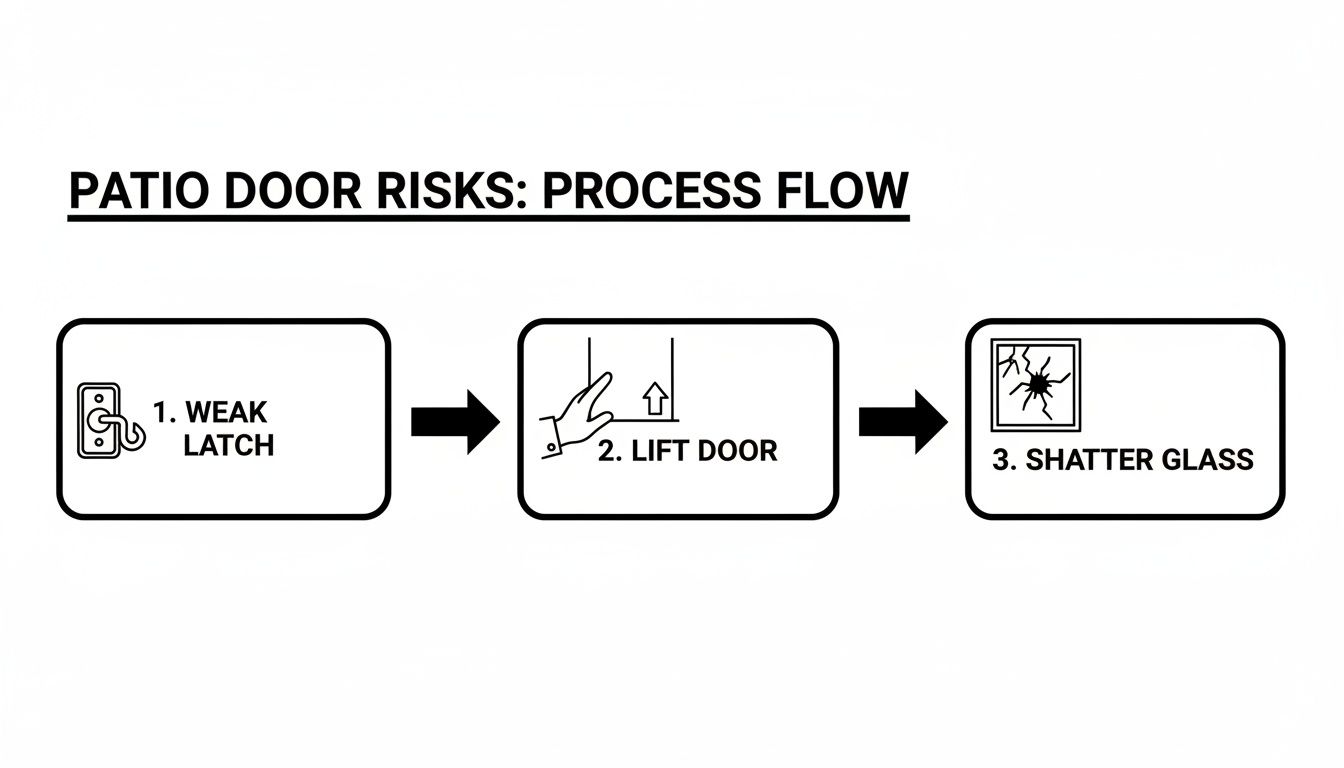
From there, burglars can exploit other vulnerabilities, like lifting the door or just breaking the glass.
Embrace Multi-Point Locking Systems
If you're looking for the gold standard in patio door security, it's the multi-point locking system. Unlike a standard lock that secures the door at a single, weak point near the handle, a multi-point system engages the frame in several places at once—usually at the top, middle, and bottom.
With a single turn of the key, a series of heavy-duty bolts or hooks shoot out from the door and lock into the frame. This genius design distributes any prying force along the entire height of the door, making it incredibly resistant to being forced open. It’s the difference between one person holding a door shut and three or four people doing it.
While these systems typically come on higher-end doors, a good locksmith can sometimes retrofit them onto an existing door. It essentially turns the entire edge of your door into one solid, fortified barrier.
Practical and Powerful Aftermarket Locks
A full multi-point system isn't always in the budget, but that doesn't mean you're out of options. There are some fantastic aftermarket locks that provide a massive security upgrade for a fraction of the cost.
-
Foot-Operated Bolts: Mounted at the bottom of the sliding panel, you simply step on a bolt to drive a steel pin deep into the floor or track. It’s a simple, powerful way to immobilize the door, creating a secondary lock that’s completely separate from the main handle.
-
Loop Locks: This is a two-piece device with a receiver on the frame and the lock on the door panel itself. When you engage it, a U-shaped metal bar slides into the receiver, physically stopping the door from opening even if the primary latch is completely broken.
-
Charley Bars: An old-school classic that's been updated for modern doors. This hinged bar is mounted on the door frame and swings down to brace against the sliding panel, preventing it from budging. Because it's permanently attached, it's always there when you need it.
Key Takeaway: The best strategy is to layer these locks. A foot bolt combined with an upgraded handle lock presents two entirely different problems for an intruder to solve, drastically increasing the time and noise they’d have to make.
Countering the Lift-Off Technique
One of the most overlooked—and effective—ways burglars defeat sliding doors is by lifting the panel right out of its track. You'd be surprised how much vertical play many older doors have. Luckily, the fix is both easy and cheap.
You need an anti-lift device or track blocker. These are small but mighty pieces of hardware you install in the upper door track. They screw into place and reduce the clearance, making it physically impossible for the door to be lifted high enough to pop out of the bottom track. This is a non-negotiable upgrade for any sliding door.
When you're thinking about locks, you also have to consider modern threats like lock snapping. It's worth reading an in-depth guide on preventing lock snapping and upgrading your lock cylinder to an anti-snap model.
Ultimately, the goal is to make breaking in too difficult, too noisy, and too time-consuming. By combining a strong primary lock with secondary bolts and anti-lift devices, you turn a notorious weak point into a hardened barrier that will send most burglars looking for an easier target.
Reinforcing the Glass Without Sacrificing Your View
It's easy to get a false sense of security after installing a top-tier lock on your sliding patio door. But what about the biggest part of the door—the glass itself? An intruder knows that a quick, hard hit can shatter a standard glass panel in seconds, letting them waltz right past that brand-new lock. A truly secure patio door needs to address the glass, not just the frame.
For many homeowners, especially here in Southern California where we live for our backyard views, the thought of reinforcing glass brings to mind ugly bars or grilles. Thankfully, we've moved far beyond that. Modern security technology offers a solution that's both incredibly effective and completely invisible.
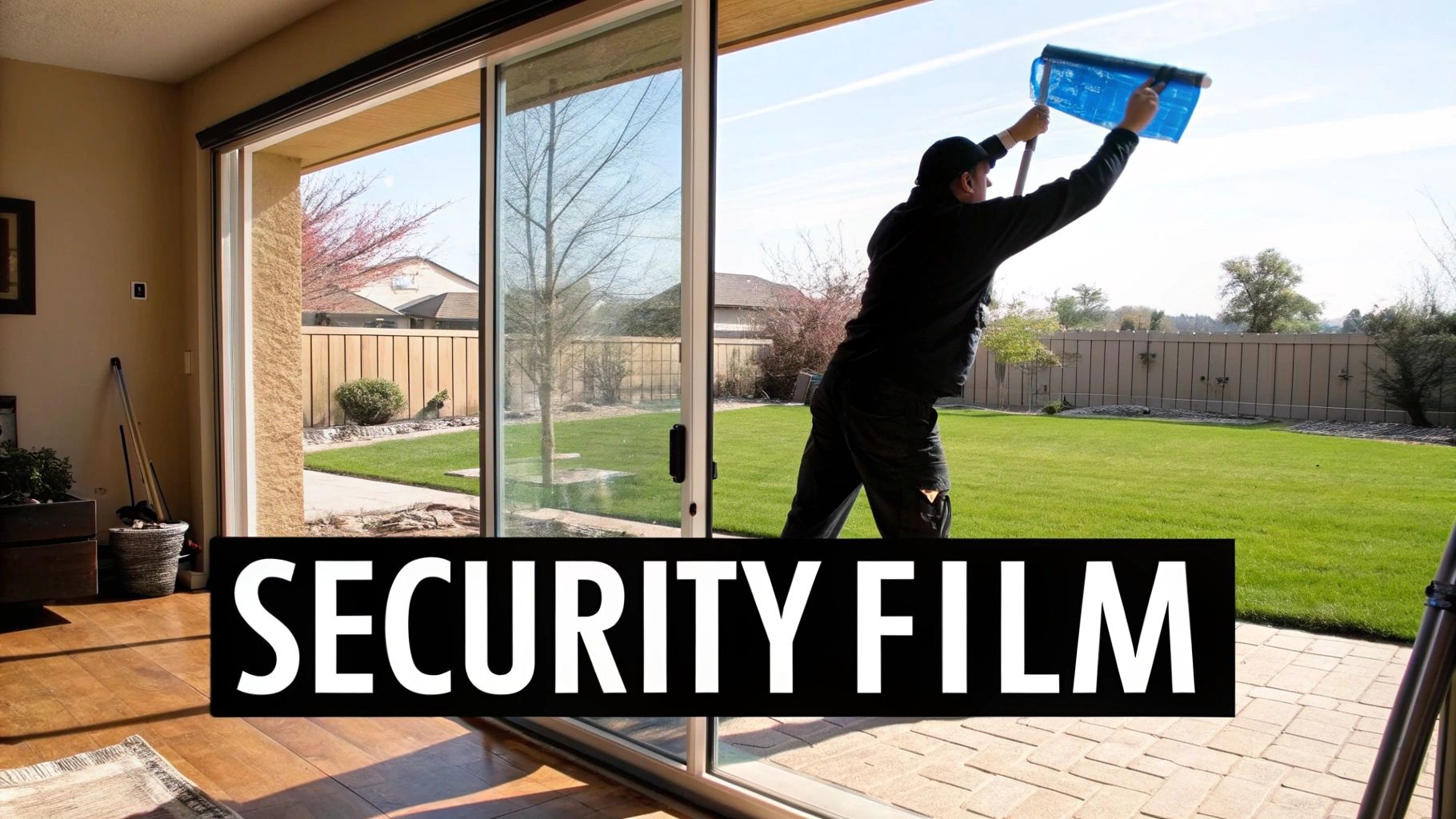
The answer is a high-performance, clear security window film. This isn't some flimsy decorative tint; it’s a serious piece of material science engineered for one job: to make your glass a nightmare to break through.
Tempered Glass Isn't Security Glass
A common mistake I see homeowners make is assuming their door is safe because it has tempered glass. While tempered glass is a safety feature—it's designed to crumble into small, less-lethal pebbles instead of dangerous shards—it does almost nothing to stop a determined intruder. It shatters just as easily as regular glass.
Security film changes the entire dynamic. It's a micro-thin, tear-resistant polyester membrane that a professional bonds directly to the inside surface of your glass.
Now, when a burglar strikes the door, the glass will still crack. But the film holds every last shattered piece together in the frame. Instead of the glass caving in, it remains a solid, flexible barrier. This simple concept is a total game-changer for your home's defense. You can get a great breakdown of how security film for glass doors works on our site to see more specifics.
A lot of people think security film makes glass "unbreakable." That's not quite right. Its real strength is in buying you time. It turns a silent, 10-second smash-and-grab into a loud, frustrating, and high-risk ordeal for the burglar.
The Science of Delaying a Break-In
For a criminal, time is everything. The longer it takes to get inside, the more likely they are to be seen or heard. Security film is engineered to buy you—and your alarm system—precious minutes.
Picture this: a burglar walks up to a patio door, expecting to smash the glass, reach in, and unlock it, all in under 10 seconds. But when they hit the filmed glass, it just spiders and holds firm. They have to keep hitting it, over and over, making a ton of noise just to create a small hole. Most will give up and run.
The numbers back this up. Over 76% of home burglaries happen through doors or windows, and sliding doors are a favorite target. Unprotected glass can be breached in just a few strikes with a blunt object. In contrast, glass fortified with security film can withstand a prolonged attack, stretching the entry time from seconds to minutes.
For homeowners in neighborhoods like Palos Verdes or Arcadia, that delay is crucial. It directly counters the smash-and-grab threat without compromising the home's aesthetic.
Choosing the Right Film for Your Home
Not all security films are the same. Their strength is measured by thickness, in mils (a thousandth of an inch). The thicker the film, the more resistance it provides.
Here’s a quick guide to what the different thicknesses mean for you:
- 4-7 Mil Film: This is a great starting point for residential security. It’s more than enough to stop a casual smash-and-grab attempt and adds significant shatter resistance.
- 8-14 Mil Film: This is where you get a serious upgrade in protection. Films in this range can take a much more violent, sustained assault, making them a popular choice for homes in higher-risk areas or for those who want extra peace of mind.
- 15+ Mil Film: This is the heavy-duty stuff. You typically see it on government buildings or high-value commercial properties to protect against extreme threats.
For most homeowners looking to secure a sliding patio door, an 8-10 mil film hits the sweet spot. It provides a formidable barrier that will deter and defeat the vast majority of burglars, all while being completely invisible and keeping your beautiful view pristine.
Layering on Alarms and Environmental Deterrents
Physical barriers like sturdy locks and reinforced glass are your first line of defense, but a smart security strategy goes much deeper. Real security is all about layers. The goal is to create an environment that makes your home a difficult, unappealing, and high-risk target for any would-be intruder. This is where detection and deterrence come into play, turning your door from a passive barrier into an active part of your home’s security system.
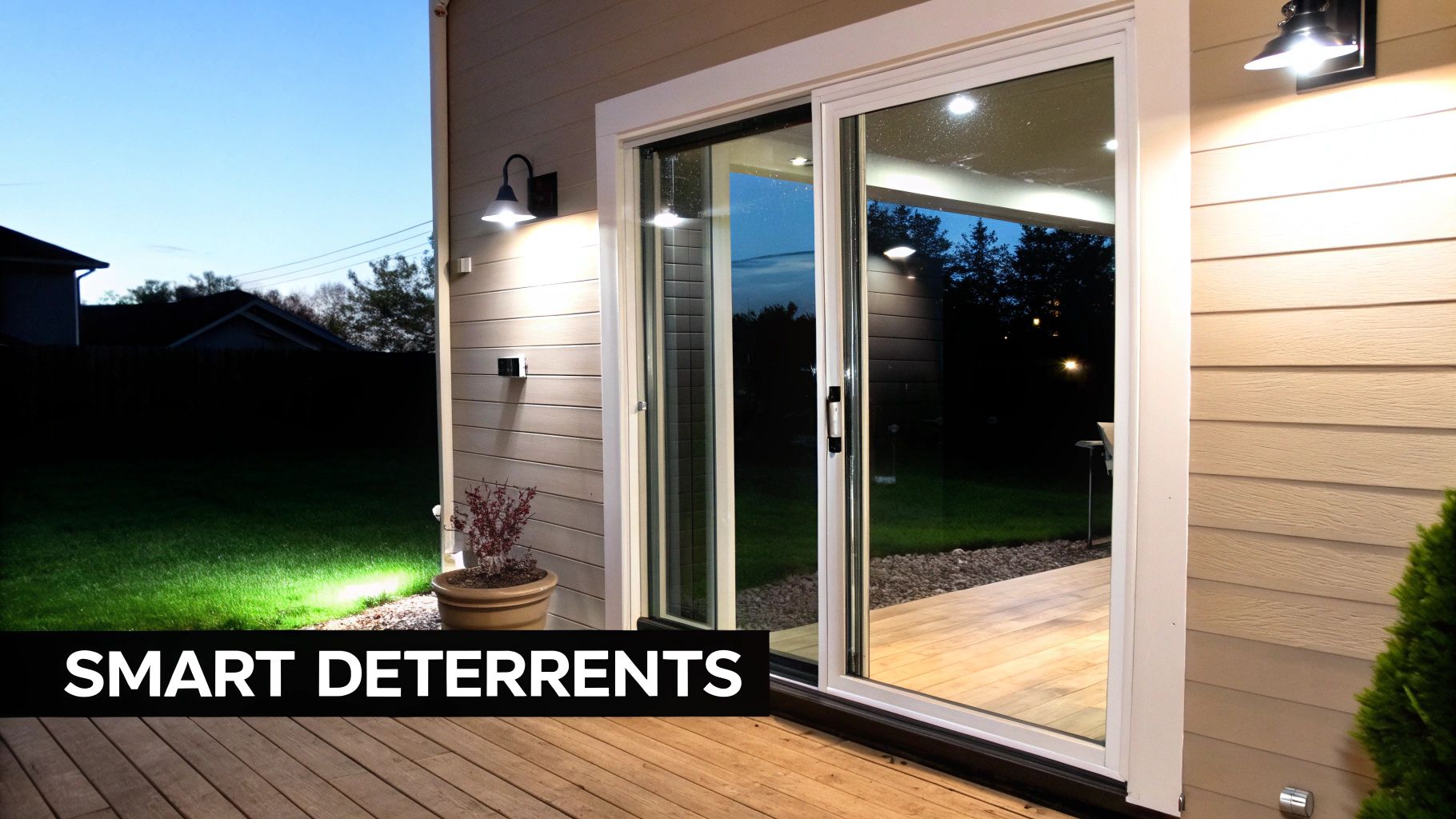
When you integrate alarm sensors and use smart landscaping, you're sending a powerful message: this home is being watched. These elements work in concert to create a psychological deterrent that can convince a burglar to move on before they even try to touch your door.
Choosing the Right Alarm Sensors
Your home alarm system is the nerve center of your security, and your sliding door absolutely must be a key part of that network. Different sensors are designed to detect different types of threats, so combining a few is always the best approach for complete coverage.
Here’s what I recommend for patio doors:
-
Contact Sensors: This is your foundational sensor. It's a simple two-piece magnetic device, one part on the door and the other on the frame. If the door slides open even a crack, the magnetic connection breaks, and the alarm sounds. They’re reliable, straightforward, and a non-negotiable first step.
-
Glass Break Detectors: These are far more specialized. They're basically tiny microphones fine-tuned to listen for the exact acoustic frequency of shattering glass. This is crucial because a thief could simply smash the glass and step through, completely bypassing a contact sensor. For a large pane of glass like a patio door, a dedicated break glass alarm is a smart addition.
-
Motion Detectors: Think of an interior motion sensor as your final backstop. If an intruder somehow gets past every other defense without making a sound, this sensor, aimed at the door from inside, will pick up their movement the second they step into the room.
Expert Takeaway: A layered sensor approach is your best bet. A contact sensor catches someone sliding the door open, while a glass break sensor catches a smash-and-grab attempt. Together, they cover the two main ways a burglar will try to defeat your door.
Knowing how your system works is just as important as having one. To get the most out of it, it helps to understand effective alarm response measures—because an alert is only as good as the action that follows.
Choosing the right sensor can feel overwhelming, but breaking them down by function makes it easier.
Patio Door Sensor Comparison
This table compares the most common sensor types to help you decide which combination is right for your home.
| Sensor Type | How It Works | Best For | Potential Drawbacks |
|---|---|---|---|
| Contact Sensor | Uses a magnet and reed switch. When the door opens, the circuit is broken, triggering an alarm. | Detecting any unauthorized opening of the door. It's a must-have for all entry points. | Won't detect forced entry through broken glass if the door itself remains closed. |
| Glass Break Sensor | An acoustic sensor calibrated to detect the specific sound frequency of breaking glass. | Protecting large glass surfaces, like patio doors or large windows, from being smashed. | Can sometimes be triggered by other loud, high-frequency noises (false alarms). |
| Motion Detector | Uses infrared (PIR) or microwave technology to detect movement within a specific zone. | A backup layer of interior security; it detects an intruder after they have entered. | Not pet-friendly unless specifically designed to ignore small animals. Useless if the intruder doesn't enter the detection zone. |
| Vibration Sensor | Detects the shock and vibration of an intruder trying to pry open or force the door. | Catching an attempted forced entry before the door is breached. Good for high-risk areas. | Can be overly sensitive and triggered by things like heavy hail or a bouncing ball. |
Ultimately, a combination of a contact sensor and a glass break sensor provides the most comprehensive protection specifically for a sliding glass door.
Lighting and Landscaping: Your 24/7 Deterrents
Technology is great, but don't underestimate the power of your home's immediate environment. Burglars love darkness and places to hide. You can take both away with a few strategic, low-cost adjustments.
Smart outdoor lighting is one of the most powerful deterrents available. A motion-activated floodlight mounted above your patio door will blast the area with light the moment someone approaches. That sudden exposure is jarring and instantly removes the cover of darkness, making a prowler feel visible to the entire neighborhood.
At the same time, take a critical look at your landscaping. Are you accidentally providing the perfect hiding spot right next to your door?
- Keep all shrubs and bushes near the door trimmed down below the windowsill.
- Consider planting something thorny and unpleasant, like bougainvillea or roses, directly under the door area. It creates a painful, natural barrier.
- Most importantly, make sure there’s a clear line of sight from the street or your neighbors’ windows to your patio door. Don't let a tree or a large planter block the view.
These environmental tactics cost very little but pay huge dividends in security. They work around the clock to make the area around your most vulnerable entry point an unwelcoming place for criminals.
DIY or Call in a Pro? Making the Right Call
Once you’ve decided on the security upgrades for your patio door, the next big question is: who’s going to install everything? Deciding between a DIY weekend project and hiring a professional really boils down to the specific task, your comfort level with tools, and whether you want a performance guarantee.
Some jobs are perfect for the handy homeowner, while others absolutely need an expert's touch.
For the simpler mechanical stuff, going the DIY route can work out great. Installing a security bar, a Charley bar, or even a basic foot lock are usually straightforward projects. Most of the time, it’s just a matter of measuring carefully, drilling a few holes, and sinking some screws. If you can follow instructions, you can add a pretty solid layer of security in an afternoon.
But the difficulty curve gets steep fast. Take a multi-point locking system, for instance. That requires incredibly precise alignment with the door frame. If you're off by even a fraction of an inch, the bolts can bind or miss the mark entirely, making the whole expensive lock useless. That’s a job you want a professional locksmith or a specialized door company to handle.
Why You Can't Skimp on Professional Security Film Installation
When it comes to reinforcing your glass with security film, the DIY vs. pro debate is pretty much over before it starts. Sure, you can find DIY security film kits online, but this is one area where professional installation is non-negotiable if you actually want it to work. The film’s strength isn’t just in the material—it's in the flawless application.
A professional installation from a certified technician is worlds apart from a DIY attempt. Here’s why:
- No Contaminants: Pros work in a way that eliminates dust, lint, and air bubbles from getting trapped underneath. A single speck of dust can create a weak spot that will fail under impact.
- Perfect Edge-to-Edge Fit: They have the tools and experience to trim the film for seamless, edge-to-edge coverage. This perfect fit is critical for spreading the force of a blow across the entire pane of glass.
- The Right Curing and Bond: A pro knows exactly how to squeegee the film and how long it needs to cure for the adhesive to form a permanent, molecular bond with the glass. This bond is what holds shattered glass together.
The difference between a DIY film job and a professional one becomes painfully obvious during an attempted break-in. Professionally installed film is an invisible shield. Poorly applied film peels, bubbles, and fails at the edges—creating the exact vulnerability you were trying to solve.
The Value of a Warranty and Your Peace of Mind
At the end of the day, hiring a professional for trickier jobs like security film or complex locks is an investment in certainty. A professional job comes with a warranty, covering both the product and the labor. If the film starts peeling or the lock misaligns, you have someone to call. With a DIY project, any mistake is on you to fix.
For homeowners in Southern California, where we value our views, a flawless and invisible application is everything. To see what goes into a perfect job, take a look at our guide to the professional security window film installation process. It breaks down why certified technicians are the only way to guarantee both security performance and crystal-clear aesthetics.
Have More Questions? Let's Clear Them Up
It's smart to have questions when you're thinking about how to properly secure your patio door. Getting straight answers helps you feel confident you're making the right call and spending your money wisely.
We get a lot of the same questions from homeowners, so let's tackle the most common ones right here.
Are Security Films Actually Going to Stop a Determined Intruder?
Yes, absolutely. Look, nothing can make your home 100% "burglar-proof," but high-quality security film is a serious deterrent. Its main job is to keep shattered glass in one piece, turning what should be an easy entry point into a tough, flexible barrier. The intruder is expecting a quick smash-and-grab, but instead, they're met with a window that just won't cooperate.
That delay is the film’s biggest advantage. We're talking 60 to 90 seconds or more of loud, attention-grabbing struggle. That’s more than enough time for your alarm to go off and for someone to notice. For a burglar, every extra second increases their risk of getting caught, and most will simply give up and move on.
Is a Security Bar or a Dowel Rod Good Enough on Its Own?
A security bar or a sturdy wooden dowel in the track is a great starting point. It’s a classic for a reason and definitely beats relying on the flimsy lock that came with the door. It physically stops the door from sliding open. But you have to think of it as just one piece of the puzzle, not the whole solution.
Here’s where that single line of defense falls short:
- It does zero to protect the glass from being shattered.
- It can't stop a burglar from simply lifting the entire door panel off its track—a surprisingly common technique.
A security bar is a must-have, but it needs backup. The best approach is to pair it with reinforced glass (using security film) and an anti-lift device. That way, you've covered all the weak points.
Can I Just Install Security Film Myself to Save a Few Bucks?
You’ll find plenty of DIY security film kits online, but I always steer homeowners toward professional installation. This is one of those jobs where the quality of the application is just as important as the quality of the product. Applying security film correctly is a real skill. It demands a perfectly clean environment, precision trimming, and the right squeegee technique to get an invisible finish without bubbles, creases, or peeling corners.
Any of those little mistakes can create a weak spot that will fail when you need it most. A pro has the right tools and years of experience to get a seamless, edge-to-edge bond that’s practically invisible. Plus, a professional job almost always comes with a solid manufacturer's warranty, which is peace of mind you won't get from a DIY kit.
What’s the Real Cost to Professionally Secure a Sliding Patio Door?
The final bill can really vary because it all comes down to how many layers of security you choose to add.
For hardware, you could be looking at $25 to $100 for a good auxiliary lock or security bar. If you're adding sensors to an alarm system you already have, the hardware might run $30 to $100 per sensor, plus any potential bump in your monthly monitoring fee.
The biggest chunk of the budget is usually the professional security film installation. For a standard sliding door, expect a range from several hundred to over a thousand dollars. The price depends on the thickness and specific features of the film. My advice is to see this as a long-term investment in your family's safety. Start with a professional assessment to figure out what makes the most sense for your home and budget.
Ready to turn your most vulnerable entry point into a source of strength? The experts at Fortress Security Films specialize in providing invisible, high-performance security solutions that protect your home without sacrificing your view. Contact us today for a professional security assessment and discover how we can help you secure your peace of mind.
