


To truly prevent home invasions, you have to get inside an intruder's head. It’s less about turning your home into Fort Knox and more about thinking like a predator—spotting the easy opportunities and eliminating them, one by one.
This means taking a hard look at the obvious weaknesses: that side door you rarely lock, the dim lighting by the back patio, or the overgrown bushes that offer perfect cover. Most break-ins aren’t the work of criminal masterminds. They’re crimes of convenience, plain and simple. Intruders follow the path of least resistance.
How Intruders Choose Their Targets
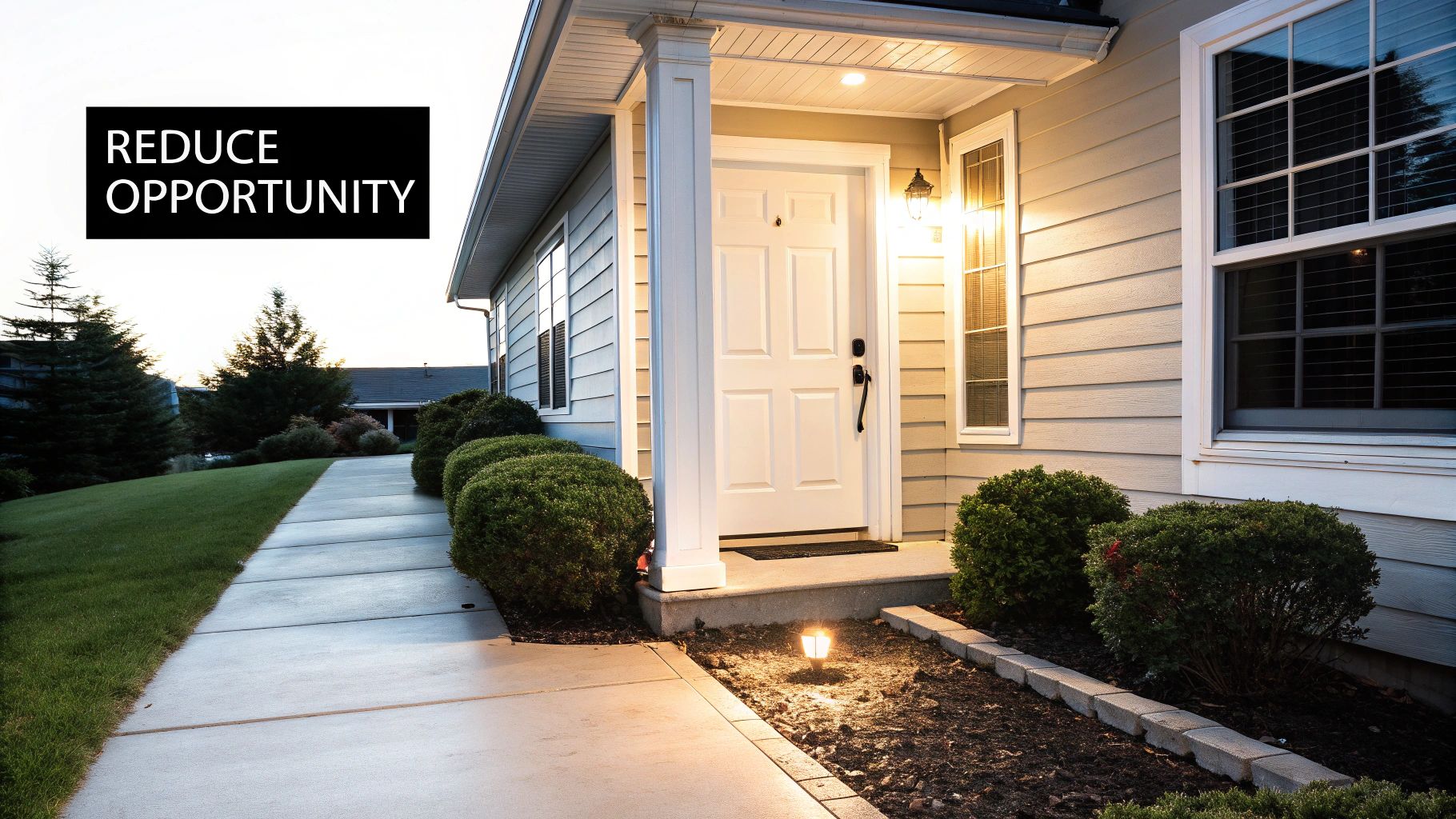
Learning how to stop a home invasion before it starts requires a mental shift. You have to stop seeing your property as just a home and start viewing it through the eyes of someone looking for an easy score.
At their core, intruders are trying to manage risk. Their goal is to get in, grab what they want, and get out—all without being seen or confronted. This simple fact makes their selection process surprisingly predictable. They're not looking for a challenge; they're scanning the block for the softest target.
A home that looks occupied, well-kept, and like it would be a hassle to enter is often skipped. They’ll just move on to the next house that presents a simpler opportunity.
What Makes a Home an Easy Target?
So, what exactly makes a home scream "easy target"? It usually boils down to a few common-sense oversights that signal a low-risk, high-reward situation for an intruder.
Someone casing a neighborhood in Southern California is on the lookout for a few key things:
- Signs No One Is Home: A week's worth of mail piled up, trash cans left out long after pickup day, or a house that's completely dark night after night.
- Plenty of Cover: Overgrown trees and shrubs are an intruder's best friend. They offer a place to hide near windows and doors, allowing them to work undetected. A lack of good exterior lighting creates deep shadows where they can operate unseen.
- An Open Invitation: Unlocked doors or windows are a gift. So are open garage doors or those flimsy sliding glass doors that haven't been secured with a secondary lock.
Here's the most critical part: intruders almost always exploit the simplest entry points first. Research consistently shows that around one-third of burglars just walk right in through an unlocked front door. The overwhelming majority gain access through first-floor entry points—the front door, back door, or a ground-level window. You can dig deeper into common entry methods by reviewing recent burglary statistics.
Your real goal isn't to build an impenetrable fortress. It's to make your home a less appealing and more difficult target than the house next door. Adding a few visible deterrents and closing those obvious security gaps is the foundation of effective home defense.
Home Invasion Prevention Quick-Start Checklist
Getting started can feel overwhelming, so let's cut through the noise and focus on the highest-impact changes you can make right now. This checklist targets the most common weak spots that intruders love to exploit. Taking these actions today will immediately harden your home and significantly reduce your risk.
| Action Item | Why It's Critical | First Step to Take |
|---|---|---|
| Install 3-inch screws in door strike plates. | This simple fix stops most kick-ins cold. It anchors the lock deep into the sturdy wall stud, not just the flimsy door frame. | Go to any hardware store and buy a pack of #9 or #10 three-inch wood screws. Replace the short factory screws. |
| Trim landscaping around all entry points. | Eliminates hiding spots near windows and doors. Intruders hate feeling exposed to neighbors and passing cars. | Cut back all bushes so they sit below window-sill level and are at least three feet away from the house walls. |
| Add motion-activated exterior lighting. | A sudden blast of light is a powerful deterrent. It startles intruders, ruins their night vision, and removes the cover of darkness. | Install motion-sensing floodlights over your driveway, back patio, and any dark side entrances. |
| Use a secondary lock on sliding doors. | The standard latches on sliding glass doors are notoriously weak and can often be bypassed in seconds. | Place a custom-cut wooden dowel or a purpose-built security bar in the track. It physically blocks the door from opening. |
Tackling these four items is the best way to make an immediate and noticeable improvement in your home's security. They are simple, cost-effective, and directly counter the most common tactics used by residential burglars.
Strengthening Your Home's Physical Defenses
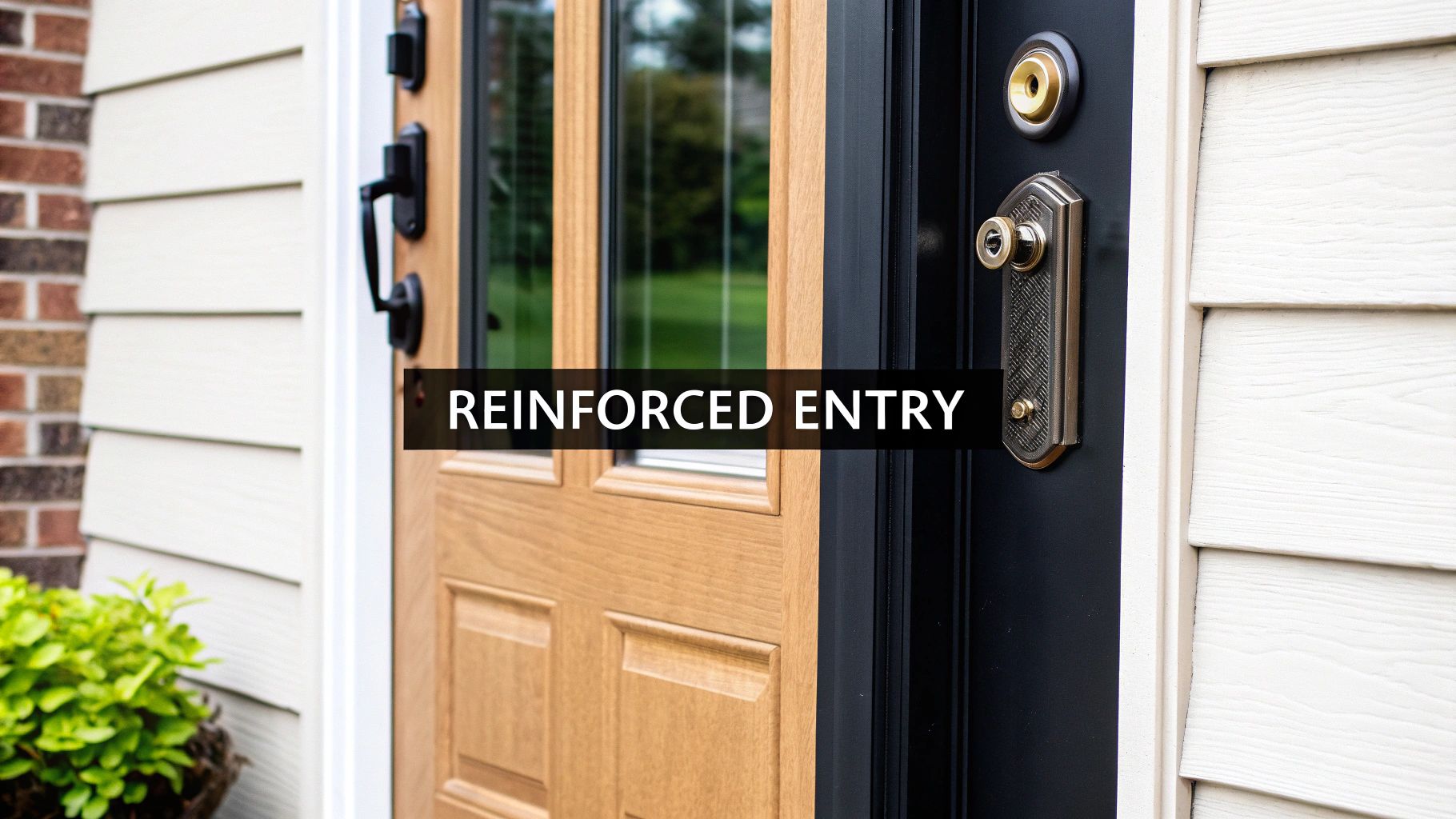
All the smart tech in the world won't help if your doors and windows are an easy target. The physical integrity of your home is the absolute bedrock of your security plan. We call this target hardening, and the goal is simple: make breaking in so difficult, loud, and time-consuming that any would-be intruder just gives up.
This isn't just theory; the numbers back it up. When homes are harder to get into, break-ins drop. One major study tracked security habits over two decades and found that as the use of basic window locks jumped from under 50% to nearly 87%, burglaries involving forced entry fell by an incredible 77%. The takeaway is clear—stronger barriers work.
Fortifying Your Doors Against Forced Entry
Think of your front door as the gatekeeper. It’s also the most common point of failure in a home invasion. A single, well-placed kick can splinter a weak door frame, making even the best lock totally useless.
First, look at the door itself. If you can easily knock on it and hear a hollow sound, it's a hollow-core door and needs to go. Your first move should be upgrading all exterior doors to solid-core doors made from wood, fiberglass, or steel. That density alone is a huge deterrent.
Next, let's talk hardware. A standard deadbolt is fine, but for real peace of mind, you need an ANSI Grade 1 deadbolt. This is the highest residential security rating, built to withstand a serious amount of force and tampering.
Pro Tip: When you're shopping for a Grade 1 deadbolt, look for two key features: a hardened steel pin inside that resists sawing, and a throw bolt that extends at least a full inch into the door frame. That one-inch throw is crucial for preventing someone from prying the door open.
But even the toughest lock is only as strong as the frame it's set in. This is where most homes have a critical vulnerability. To stop a kick-in, you need to reinforce the frame:
- Reinforce the Strike Plate: That little metal plate on the door jamb is probably held on by short, half-inch screws. Pop those out and replace them with 3-inch wood screws. This anchors the plate directly into the wall stud behind the frame, transforming a weak point into a bastion of strength.
- Install a Door Reinforcement Kit: For the ultimate protection, these kits are fantastic. They typically include a steel plate that wraps the lock area and another long steel plate that reinforces the entire jamb. It turns your door frame into a steel-enforced barrier.
Securing Your Windows: The Weakest Link
Windows are an intruder’s best friend—they’re naturally weaker than doors and offer a clear path inside. The goal here is to make breaking them as loud and frustrating as possible. Locking them is just step one.
Those flimsy factory-installed latches are easily defeated. You need to add a second layer of defense. I often recommend:
- Window pins: A simple but effective solution where you drill a small hole through the sash and into the frame, dropping a pin in to physically block it from opening.
- Ventilation locks: These are great for allowing you to get some fresh air while keeping the window secure, as it can only be opened a few inches.
- Keyed locks: For any easily accessible ground-floor windows, keyed locks add a significant obstacle.
But what about the glass itself? A swift, hard impact can shatter a standard window pane in seconds, letting an intruder bypass your locks entirely. This is where security film makes all the difference.
The Power of Security Window Film
Security window film is a clear, multi-layered polyester film applied directly to the inside of your windows. Once it’s installed, you won’t even know it’s there, but it dramatically increases the glass's strength and shatter resistance.
When an intruder tries to break a window with security film, the glass will crack, but the film holds it all together in the frame. The quick, silent entry they were hoping for is gone. Now, they have to repeatedly smash the window, making a ton of noise and drawing attention. That delay is often everything you need for an alarm to go off and for you to respond.
Ultimately, a secure home is built on a foundation of smart strategies to keep uninvited visitors off your property. By fortifying every potential entry point, you’re not just adding locks; you're creating a formidable, layered defense that makes your home a very unappealing target.
Using Smart Technology for Active Security
While hardened doors and reinforced windows are your home's physical armor, modern tech provides the intelligent nervous system. It's the active layer of security that spots a threat the moment it appears. Building a truly effective smart security system isn't about buying a single camera—it's about creating a fully integrated network that sees, hears, and responds to danger in real-time.
Think of it as creating total situational awareness for your property. The goal is to eliminate every blind spot, paying special attention to primary entry points like doors and ground-floor windows. A well-placed camera doesn't just record what happens; its mere presence is a powerful deterrent, sending a clear message to any would-be intruder: you are being watched.
Professional Monitoring vs. Self-Monitoring
One of the first, and most critical, decisions you'll face is whether to go with professional or self-monitoring. A self-monitored system is straightforward—it sends an alert directly to your phone when a sensor trips. It’s certainly better than nothing, but it places the entire burden of response squarely on your shoulders.
What happens if you're in a meeting, on a plane, or simply asleep? A missed notification can have devastating consequences. This is the crucial gap that professional monitoring is designed to fill.
A professionally monitored alarm system links your home to a 24/7 command center staffed by trained security professionals. When an alarm goes off, they immediately verify the threat—is it a false alarm or a real intrusion?—and dispatch emergency services for you. This guarantees a rapid response even when you're completely unreachable.
In a real emergency, the seconds saved by a professional dispatcher can be the difference between a close call and a catastrophe. This service elevates your system from a passive notification tool into an active, responsive defense network.
Key Components of an Integrated Smart System
A truly comprehensive security network is built by layering different technologies that communicate and work together. Each piece of the puzzle serves a specific function, contributing to a home that is safer and far more aware of its surroundings.
Think about incorporating these essentials into your security plan:
-
High-Definition Security Cameras: Position cameras with excellent night vision and smart motion detection to cover every entry point, your driveway, and any secluded areas of your property. Look for must-have features like two-way audio and intelligent alerts that can tell the difference between a person, a vehicle, and a stray animal.
-
Video Doorbells: These are invaluable frontline tools. They allow you to screen visitors without ever opening the door, provide a live video feed, and record any motion at your doorstep. They are also brilliant for deterring both porch pirates and individuals who might be casing your home.
-
Smart Lighting: A dark, empty-looking house is an open invitation. Smart lighting gives you the power to set schedules and control lights from anywhere in the world, creating the convincing illusion that someone is always home. When integrated with motion sensors, they can also startle an intruder by instantly flooding a dark yard with light.
-
Door and Window Sensors: These simple, reliable devices are the backbone of any alarm system. The moment a secured door or window is breached, they trigger an immediate alert, giving you the earliest possible warning of an intrusion.
When you combine these elements, you create a system that is far greater than the sum of its parts. For instance, a tripped window sensor can instantly trigger your exterior smart lights to flash and command your security cameras to start recording. This kind of automated, coordinated response is a cornerstone of modern home defense.
Smart Security Technology Comparison
Navigating the world of smart security devices can feel overwhelming. This table is designed to simplify things, breaking down the main purpose and essential features of the most common technologies to help you build a system that fits your home perfectly.
| Technology | Primary Purpose | Key Features |
|---|---|---|
| Video Doorbell | Screen visitors and deter package theft. | HD video, two-way audio, motion alerts, night vision. |
| Outdoor Cameras | Monitor property perimeter and entry points. | Weather resistance, 4K resolution, floodlight integration, person detection. |
| Smart Locks | Control and monitor door access remotely. | Keyless entry codes, auto-locking, activity logs, integration with alarms. |
| Smart Lighting | Create the illusion of occupancy and deter intruders. | Scheduling, remote control, motion activation, color/brightness control. |
Ultimately, technology acts as your ever-vigilant lookout. It provides real-time awareness and the power to respond instantly, transforming your home from a static target into a dynamic and highly protected sanctuary.
Landscaping and Lighting as a Deterrent
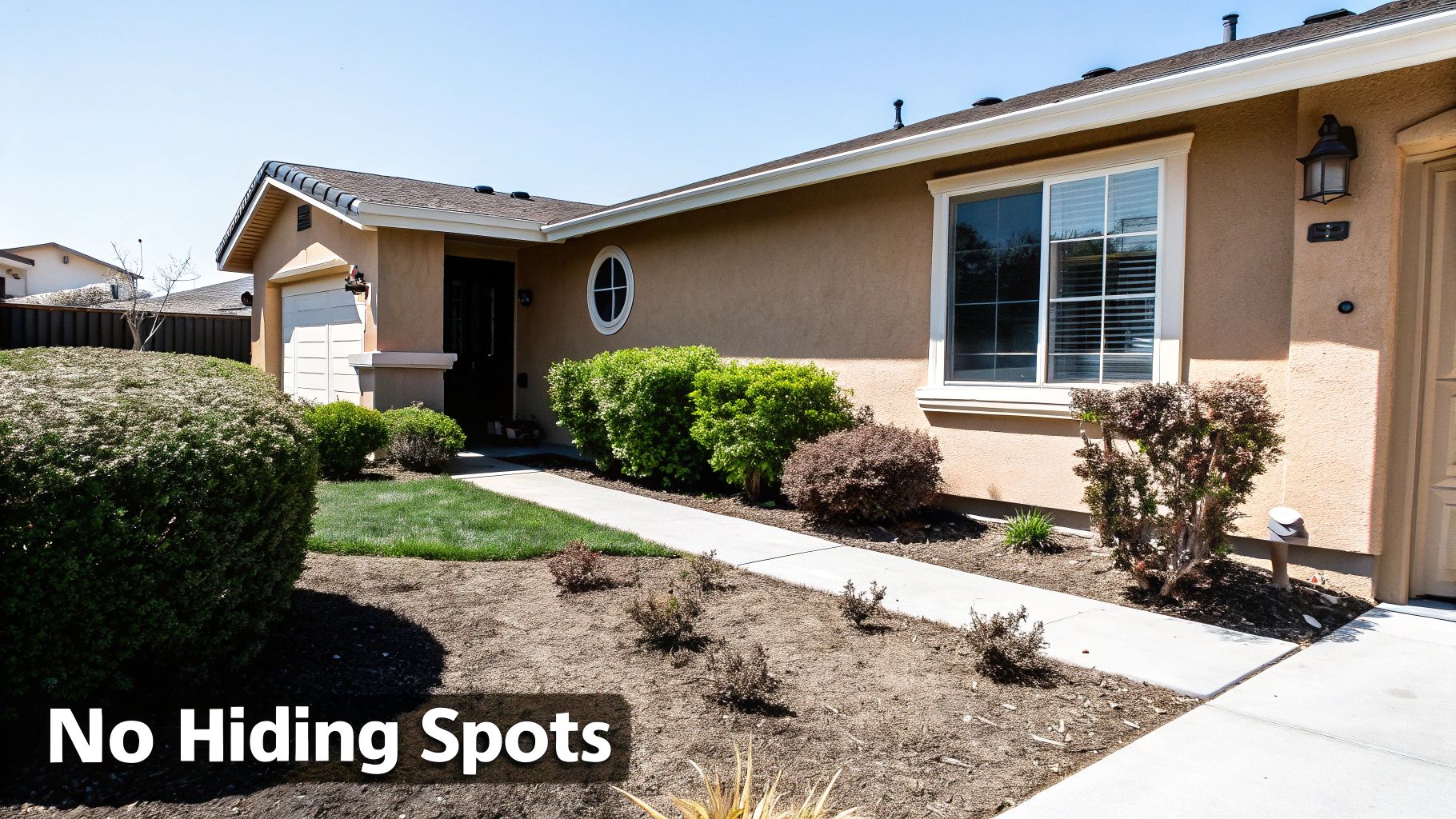
Your yard isn't just for curb appeal; it's one of the most powerful—and often overlooked—layers of your home security. The right landscaping and lighting can either give a would-be intruder plenty of cover to work unseen, or it can put them on full display for the entire neighborhood to see.
This whole concept is rooted in a field called Crime Prevention Through Environmental Design (CPTED), which is a fancy way of saying you use your property’s layout to make crime less likely.
With a few smart adjustments, you can make any intruder feel completely exposed and vulnerable the second they step onto your property. It’s an effective way to make your home a much harder target before they even get close to the door.
Pruning for Clear Sightlines
Overgrown trees and dense bushes are an open invitation for trouble. They create the perfect hiding spots right next to your home's weakest points—the ground-floor windows and doors. The key is to open up those sightlines and create natural surveillance zones.
Take a walk around your property and try to see it through an intruder's eyes. Where could someone hide without being seen from the street or a neighbor’s window? Those are the spots to tackle first.
- Shrubs: Keep any bushes under windows trimmed to below three feet. This simple rule eliminates the most obvious hiding place.
- Foundation: Don't let plants grow right up against your house. Maintain a gap of at least two to three feet between large bushes and your walls.
- Trees: Prune the lower branches of trees on your property up to about six or seven feet. This is called "limbing up," and it stops someone from using a low-hanging canopy for cover.
Using Hostile Landscaping
Beyond just trimming back what you have, you can use plants as a physical barrier. This is often called "defensive" or "hostile" landscaping, and it's all about using thorny or prickly plants to make certain areas difficult and painful to access.
Think about planting dense, thorny bushes like roses, barberry, or holly directly beneath your first-floor windows. No one is going to try and climb through a wall of thorns to get to a window, especially at night. It's a surprisingly effective deterrent that blends right into your garden.
The best security landscaping feels completely natural. It doesn't make your home look like a fortress, but it subtly guides people away from private areas and eliminates the shadows and hiding spots that criminals rely on to operate undetected.
Illuminating Your Property Strategically
Darkness is a criminal's best friend. A well-lit home sends a clear signal that the property is occupied and monitored. But effective lighting isn't about blasting your yard with stadium lights; it's about strategically eliminating shadows.
The best approach is to use a few different types of lighting in key spots:
- Motion-Activated Floodlights: Put these over driveways, back patios, and side entrances. A sudden burst of bright light is jarring, ruins an intruder’s night vision, and is often enough to send them running.
- Dusk-to-Dawn Fixtures: These are perfect for your front entrance and back door. They provide constant, low-level illumination, ensuring your main entry points are never cloaked in darkness.
- Pathway Lighting: Low-level landscape lights along walkways do more than just look nice. They make it impossible for someone to sneak toward your house without being clearly lit up.
A smart combination of thoughtful landscaping and strategic lighting is one of the most cost-effective ways to secure your property. It creates an environment where intruders feel exposed and unwelcome from the moment they approach.
Building Secure Daily Habits
All the high-tech gear and reinforced doors in the world won’t help if the back door is left unlocked. That's a hard truth, but it’s the most important one. Your daily routines—the small, seemingly insignificant things you do every day—are the living, breathing part of your security plan. They're what hold everything else together.
Think of it as muscle memory. You want locking up and staying aware to become as automatic as turning off a light when you leave a room. These small, consistent actions are what truly transform a house with security gadgets into a genuinely secure home.
Non-Negotiable Daily Routines
Some habits are simply non-negotiable. These are the basics that shut down the easy opportunities that criminals actively hunt for. You have to consciously practice them until they become second nature.
-
Lock All Doors and Windows: This isn't just for when you're leaving. A shocking number of break-ins happen when people are home, watching TV or working in another room. Make it a rule to lock doors and windows the moment you close them.
-
Secure Sliding Glass Doors: The factory latch on a sliding door is flimsy at best. It’s a well-known weak point. You should always back it up with a secondary lock or a simple, sturdy dowel cut to fit the track. This one tiny step hardens a massive vulnerability.
-
Always Close the Garage Door: An open garage is an advertisement. It gives thieves a clear view of your tools, your cars, and provides them with a covered, hidden place to work. The garage door goes down the second the car is in or out. No exceptions.
These are the fundamentals of preventing a home invasion. They don't cost a dime, just a moment of attention.
Overlooked Vulnerabilities in Everyday Life
Beyond the obvious, we all have modern habits that can accidentally create security holes. A professional thief is an opportunist, and they are incredibly skilled at noticing these subtle oversights that give them the opening they need.
One of the biggest mistakes I see is people leaving a garage door opener clipped to the visor of a car parked in the driveway. A simple car break-in suddenly becomes a home invasion because you’ve handed them a key to your house. Always bring the opener inside or switch to a keychain remote.
And please, get rid of the spare key under the fake rock or flowerpot. Burglars know every single "clever" hiding spot because they’ve seen them all a thousand times. A far better solution is to give a spare key to a trusted neighbor you know is home often. Or, even better, install a high-quality smart lock with a keypad and give guests or family a temporary code.
Never assume a small oversight will go unnoticed. A security-conscious mindset involves actively looking for these minor weak points in your daily life and systematically eliminating them before someone else can exploit them.
Managing Your Digital Footprint
Home security today doesn't stop at the property line; it extends right into your digital life. What you post online can directly and immediately affect your physical safety, especially when it comes to telling the world you’re not home.
It’s so tempting to post those beautiful beach photos while you're still on vacation, but doing so is like putting up a giant sign that says, "My house is empty." It's not just a theory—a few years ago, a study found that nearly 80% of burglars were using platforms like Facebook and Twitter to find their next target.
Keep your social media use from becoming a liability with a few simple rules:
- Post After You Return: The golden rule. Share all your amazing photos and stories after you’re safely back home.
- Check Your Privacy Settings: Go into your social media accounts right now and check who can see what you post. It should be limited to friends and family you actually know and trust, not "Friends of Friends" or the public.
- Be Wary of Location Tagging: Disable automatic geotagging. Don’t broadcast your live location from your favorite restaurant or, even worse, from your own home.
By turning these actions into ingrained habits, you dramatically shrink the window of opportunity for an intruder. It all comes down to consistency. Making security a seamless part of your daily life is the single most effective thing you can do to protect your family and your home.
Creating a Family Emergency Plan
Even with the best security systems in place, we have to prepare for the unthinkable. A well-rehearsed emergency plan is what keeps your family safe if an intruder ever makes it inside. When panic sets in, a clear plan is the only thing that will guide you to make the right decisions.
First thing’s first: designate a safe room. This doesn't have to be a steel-vaulted panic room from a spy movie. It just needs to be a pre-planned spot where everyone knows to go. The best choices are rooms with a solid-core door and a good deadbolt, few or no windows, and located away from the home's main entry points. Think of an upstairs master bedroom closet or a sturdy basement office.
The Critical Decision: Escape or Barricade
In the terrifying first moments of a break-in, you have two choices: get out or lock down. The right call depends entirely on where you are and where they are.
If an intruder is downstairs while your family is upstairs, your best bet is to barricade everyone in your safe room. The absolute last thing you should ever do is try to confront them.
On the other hand, if you're on the ground floor and see a clear and safe path to an exit, escaping is probably the smarter move. The critical part is making sure everyone in the family understands these two options and can quickly assess which one makes sense for their situation.
Pro Tip: Keep a dedicated, fully charged cell phone hidden in your safe room. You don’t want to be fumbling around for a phone with a dead battery when you're under extreme stress. This guarantees you can call for help the second you're secure.
Running Drills and Calling 911
The moment you're barricaded inside, call 911. Stay as calm as you can and speak clearly.
- Start with your full address.
- Give your name and explain the emergency.
- State clearly: "There is an intruder in my house."
- Tell them how many people are with you and where you are in the house.
- Stay on the line with the dispatcher until police arrive.
This daily routine chart is a great reminder that small, consistent habits are your first line of defense, dramatically reducing the chances you'll ever need to use this emergency plan.
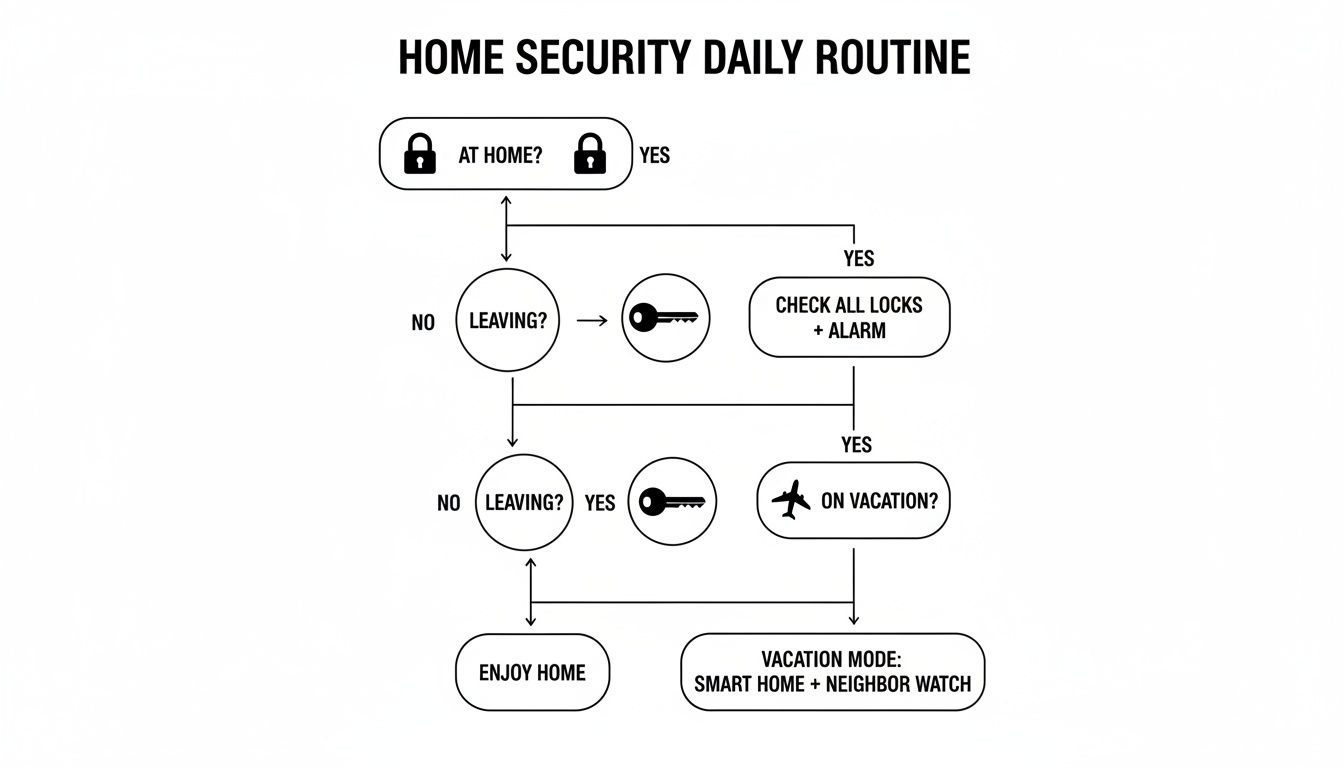
As you can see, simple actions create a strong foundation for a secure home, whether you're there or away.
Prevention is everything, especially when you consider that arrest rates for home invasions are frustratingly low—some reports indicate fewer than one in eight incidents lead to an arrest. You can read more about crime resolution statistics and their impact on prevention strategies. This sobering reality is why a proactive security plan is non-negotiable; you can't rely on justice being served after the fact.
Finally, a plan on paper is useless. You have to practice it. A few times a year, run drills with your entire family, kids included. Walk through the motions of getting to the safe room, locking the door, and making a simulated 911 call. Drills build muscle memory, turning panic into a calm, automatic response when it matters most.
Your Home Security Questions, Answered
Even with a detailed security plan, you’re bound to have some specific questions. I get asked these all the time. Let's tackle some of the most common concerns homeowners have when it comes to balancing real-world safety with everyday life.
Are Security Window Films Actually Worth It?
Absolutely. I consider security film one of the single most effective upgrades for delaying a break-in. Think of it this way: while the film won't make your glass bulletproof, it's engineered to keep all the shattered pieces of glass locked together in the frame.
Instead of a quick, quiet smash-and-grab, an intruder now has to make a huge, loud, and sustained effort to actually create a hole big enough to climb through. That noise and delay are often enough to make them give up and run. More importantly, it buys you precious seconds for your alarm to trip and for your family to get to a safe room.
Is Professional Monitoring Really Necessary?
For a high-value property, I’d say yes, professional monitoring is non-negotiable. Self-monitored systems are great for sending an alert to your phone, but what happens if you're in a meeting, on a flight, or asleep? The entire system relies on you seeing that notification and calling 911 yourself.
Professional monitoring is about guaranteeing a response. A dedicated command center has trained operators watching over your home 24/7. The moment an alarm is triggered, they verify the threat and dispatch the police or fire department immediately. It’s a completely different level of response readiness.
How Do I Secure My Home Without It Looking Like a Prison?
This is a big one. Nobody wants to live in a fortress. The secret is layering subtle, integrated defenses that work together without screaming "high security."
It’s about making smart choices that enhance security without sacrificing your home’s aesthetic.
- Doors: You can find beautiful, high-end solid-core doors that are compatible with heavy-duty, Grade 1 deadbolts. The security is built-in, not bolted on.
- Windows: Security films are the MVP here—they are completely invisible once installed. On less visible windows, like in a basement or a hidden corner, you can find surprisingly elegant decorative grilles that add to the design.
- Landscaping: This is my favorite trick. Plant attractive but thorny bushes like bougainvillea, roses, or barberry beneath first-floor windows. It's a natural, beautiful deterrent that's incredibly effective.
- Cameras: Modern security cameras are nothing like the bulky old models. Many are now sleek, minimalist, and designed to blend right into your home's exterior architecture.
At Fortress Security Films, we specialize in reinforcing your home's most vulnerable points without compromising its beauty. Our advanced window films provide an invisible shield against forced entry, giving you peace of mind. Learn more about our residential security solutions and schedule a consultation today.
