


So, how thick is bulletproof glass? The straightforward answer is that it varies dramatically—from less than an inch to well over three inches thick. There's no single standard because the glass is engineered to defeat a specific threat. A panel designed to stop a handgun round will be worlds apart in thickness and weight from one built to withstand a high-powered rifle.
Your Guide to Bulletproof Glass Thickness
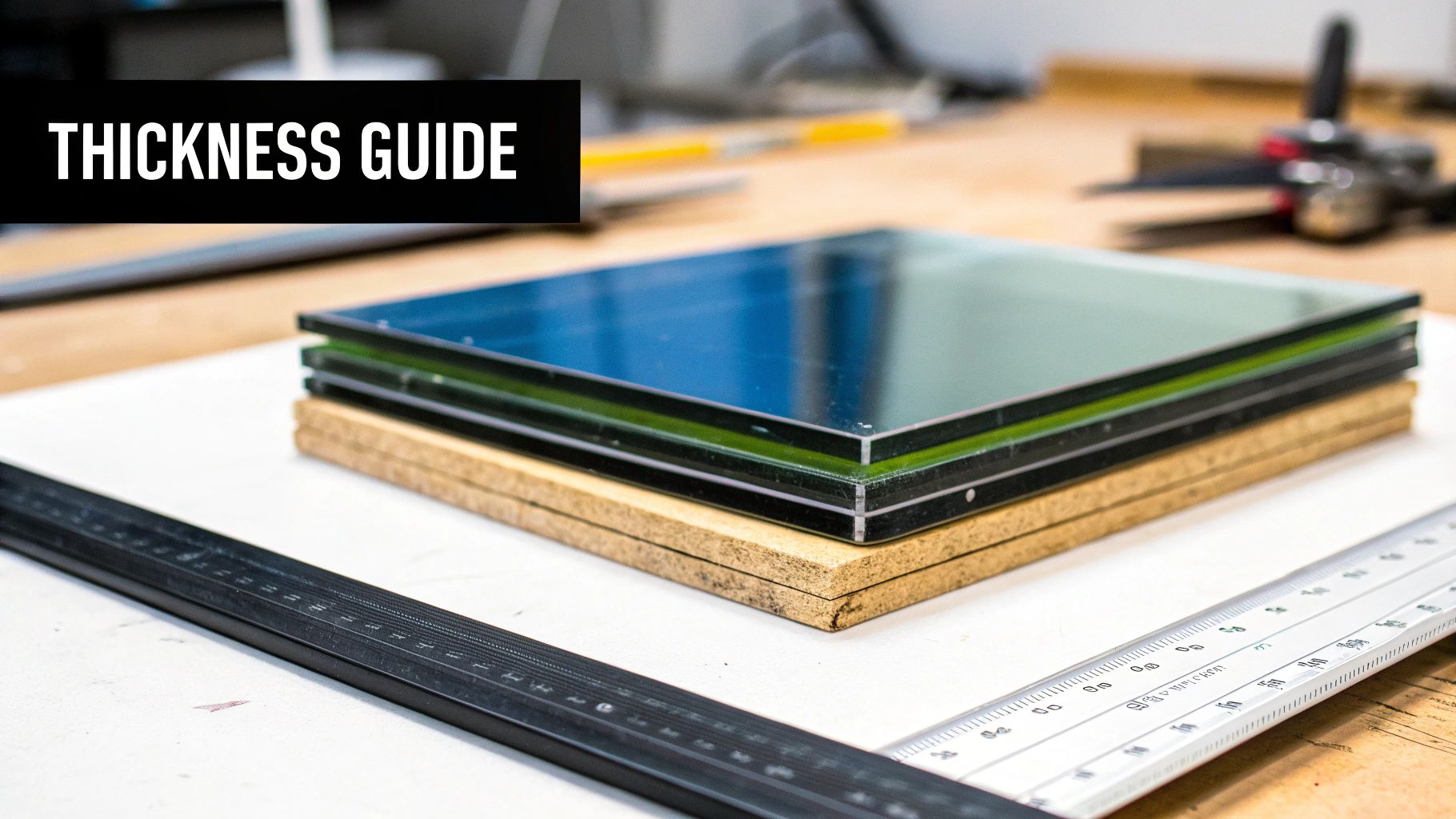
It's a common misconception to think of "bulletproof" glass as a single product. In reality, it’s a whole spectrum of protection levels. A good analogy is body armor; a police officer on a routine patrol wears a very different vest than a soldier heading into a combat zone. The same logic applies here—the threat dictates the design.
At its core, the principle is about absorbing and dispersing energy. Different firearms launch projectiles with vastly different levels of force. A round from a simple handgun carries far less kinetic energy than one fired from a military-style rifle. To stop these threats, manufacturers create layered "sandwiches" of glass and plastic. More layers and tougher materials create a thicker, heavier panel that offers greater protection.
Understanding the Common Thickness Ranges
For most homes and many storefronts, the main worry is protection from common handguns. In these cases, the glass needs to be effective without being so thick and heavy that it becomes impractical or distorts the view. It’s a balance of security and usability.
On the other hand, high-risk locations demand much more formidable solutions. The thickness of bullet-resistant glazing can range from as thin as 0.25 inches (6 mm) for smash-and-grab resistance to over 3.5 inches (90 mm) for stopping armor-piercing rounds.
For typical residential and light commercial security, you'll often see glass between 0.75 inches and 1.25 inches (20–32 mm) thick, which is more than enough to handle most handgun threats. But for places like government buildings, police stations, or embassies, that thickness jumps significantly, usually to between 1.75 inches and 3.5 inches (45–90 mm) to defeat powerful rifle fire. You can find more detailed examples of bullet-resistant glass applications and their typical thicknesses.
The key takeaway is simple: You don't just ask "how thick is bullet proof glass?" Instead, you first define the threat you need to stop, and that determines the necessary thickness.
A Quick Look at Thickness by Threat
Before we get into the nitty-gritty of materials and construction, let's set a baseline. The table below gives you a quick summary of typical thickness ranges based on the threat they're designed to stop. Think of this as a practical frame of reference for what to expect at different protection levels.
Typical Bulletproof Glass Thickness by Threat Level
| Threat Level | Typical Thickness (Inches) | Typical Thickness (mm) | Protects Against |
|---|---|---|---|
| Level 1 | 0.75" – 0.90" | 19 – 23 mm | Common handguns (e.g., 9mm, .38 Special) |
| Level 2 | 1.0" – 1.15" | 25 – 29 mm | High-power handguns (e.g., .357 Magnum) |
| Level 3 | 1.25" – 1.40" | 32 – 36 mm | Super-power handguns (e.g., .44 Magnum) |
| Level 4 | 1.6" – 1.8" | 41 – 46 mm | High-power rifles (e.g., .30-06) |
| Level 8 | 2.5" – 3.5" | 64 – 90 mm | Multiple shots from high-power rifles (e.g., 7.62mm NATO) |
This table shows a clear pattern: as the power of the firearm increases, so does the thickness and complexity of the glass required to stop it. Now, let’s explore what actually goes into making these impressive protective barriers.
What Actually Makes Glass Bullet Resistant?
First, let's get one thing straight. No glass is truly "bulletproof." A much better term is bullet-resistant, because even the toughest transparent armor has its limits. The incredible strength of this material doesn't come from a single, super-thick pane of glass but from a clever, layered construction.
Think about trying to catch a 95 mph fastball with your bare hands. The impact would be brutal, and you'd probably break your hand. Now, imagine trying to catch that same pitch with a stack of five thick, fluffy pillows. Each pillow would give way, absorbing a bit of the ball's energy until it slowed to a harmless stop.
Bullet-resistant glass works on that exact same principle: absorbing and spreading out the force. It’s not a single material, but a laminated "sandwich" made of multiple, specialized layers.
The Science of the Sandwich
This protective sandwich is built by alternating stiff layers with flexible ones. The outer layers are typically made from tough materials like tempered glass or acrylic. Sandwiched between them are softer, more elastic interlayers, usually polycarbonate or polyvinyl butyral (PVB). This combination is the real secret to its strength.
When a bullet hits the glass, a whole sequence of events happens in a fraction of a second:
- Impact and Flattening: The first thing the hard outer glass layer does is shatter on impact. This isn't a failure; it's by design. As it breaks, it flattens the tip of the bullet, which increases its surface area and starts slowing it down immediately.
- Energy Absorption: The now-blunted bullet smashes into the softer, flexible inner layers. These plastic interlayers act like a catcher's mitt, absorbing the bulk of the projectile's remaining kinetic energy.
- Dispersion: The energy doesn't stay in one spot. It spreads out across the entire surface of the panel, dissipating the force so it can't punch through.
This layered system is wildly more effective than a single, thick piece of glass could ever be. A solid pane, no matter how thick, is brittle. It would just shatter. The laminated structure, however, works as a team to systematically stop the threat.
Layers and Protection Levels
The thickness and the sheer number of these layers are what determine the level of protection the glass provides. For instance, a panel designed to stop a round from a 9mm handgun might only have a few layers, adding up to about three-quarters of an inch thick.
On the other hand, stopping multiple shots from a high-powered rifle requires a much beefier construction. These panels will have many more alternating layers of glass and heavy-duty polycarbonate, pushing the total thickness to three inches or more. Each additional layer gives the panel more capacity to absorb and dissipate increasingly violent impacts.
Think of it like a vehicle's suspension. A family sedan has a simple system designed for potholes. But an off-road trophy truck built for jumping dunes has a massive, multi-stage suspension to absorb huge hits. The principle is the same—you match the absorptive power to the expected force.
Sometimes, ripping out old windows to install thick new glazing just isn't an option. In those cases, there are retrofit solutions. Learning about ballistic film for windows can show you how existing glass can be significantly reinforced. This approach uses a similar energy-dispersing principle without the need for a full replacement.
Ultimately, the question "how thick is bullet proof glass" is really asking about the complexity of this layered defense system.
Understanding Ballistic Protection Levels
When people ask, "how thick is bulletproof glass," they're often surprised to learn that thickness isn't the most important part of the equation. In the security world, we don't pick protection based on a simple measurement. Instead, we focus on its ballistic protection level—a certified rating that tells us exactly what kind of threat it can stop.
Think of it like buying a fire extinguisher. You don't just grab the biggest one; you look for its rating. Is it for Class A (wood/paper), Class B (liquids), or Class C (electrical) fires? Each rating is engineered for a specific job. Ballistic glass works the same way. The thickness is just a result of the level of protection needed.
Translating Ratings Into Real-World Security
The go-to standard in the United States is UL 752, a set of rigorous tests developed by Underwriters Laboratories. This system takes all the guesswork out of the process. It defines the exact weapon, ammunition, and number of shots a panel must defeat to earn its rating. It’s a simple pass/fail test, ensuring a product performs exactly as promised.
For example, a UL Level 1 rating is what you’ll often find in gas stations or convenience stores. It’s designed to stop multiple rounds from a 9mm handgun, which is a common threat in those settings. Glass built to this standard is usually between 0.75 and 0.90 inches thick.
On the other end of the spectrum, a high-security government building or military base needs something far more robust. A UL Level 8 panel is built to stop multiple shots from a 7.62mm rifle—a serious military weapon. To do that, the glass assembly is a beast, often measuring over 2.5 inches thick.
The key takeaway is this: the threat determines the rating, and the rating determines the construction and its final thickness. It’s not about "how thick is it?" but "what can it reliably stop?"
The diagram below shows the layered construction that makes this all possible.
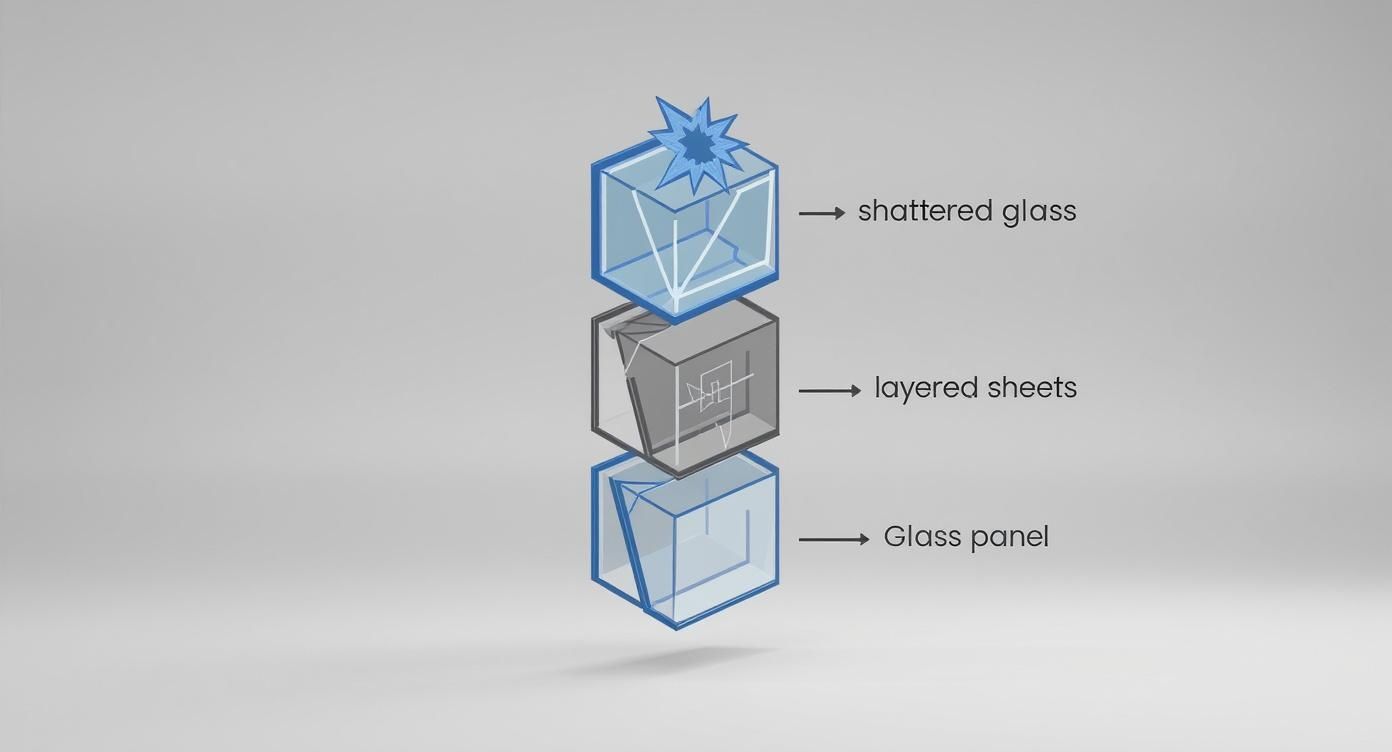
You can see how the layers of glass and polymer work together. When a bullet hits, its energy is absorbed and spread out across these layers, preventing it from passing through. Higher ratings simply mean more, and tougher, layers.
A Closer Look at UL 752 Levels
Diving into the UL 752 levels gives you a clearer picture of how protection scales with the threat. Each level is a significant step up, which also means an increase in the product's weight, complexity, and, of course, thickness.
Here’s a quick breakdown:
- Levels 1-3: These are your handgun ratings. They’re designed to stop everything from a common 9mm (Level 1) to a very powerful .44 Magnum (Level 3). This range covers the vast majority of commercial and public-facing buildings.
- Levels 4-8: Now we’re talking about high-powered rifles. A Level 4 panel can stop a .30-06 hunting rifle, while a Level 8 is built to defeat multiple impacts from military-grade rounds.
To put this into perspective, let's compare some of the most common UL 752 levels and where you're likely to see them in the real world.
UL 752 Protection Levels and Common Applications
| UL 752 Level | Typical Thickness Range (Inches) | Protects Against (Example Firearm) | Common Applications |
|---|---|---|---|
| Level 1 | 0.75" – 0.90" | 9mm Handgun | Gas stations, retail stores, check-cashing facilities |
| Level 2 | 1.0" – 1.2" | .357 Magnum Handgun | Banks, financial institutions, high-end retail |
| Level 3 | 1.25" – 1.75" | .44 Magnum Handgun | Police stations, government buildings, data centers |
| Level 8 | 2.5"+ | 7.62mm Rifle (AK-47, M14) | Military bases, embassies, critical infrastructure |
This standardized system ensures that when you specify a UL level, you get a product that has been independently tested and proven to do its job. It provides true peace of mind that you have the right protection for the threats you face. You can find more details on ballistic glass standards and products at Standard Bent Glass.
How Material Choice Affects Glass Thickness
https://www.youtube.com/embed/uGvE9PYnY7U
When people ask, "how thick is bulletproof glass?" they're really asking two questions at once: how much protection does it offer, and what's it made of? The materials used in a bullet-resistant panel are just as important as the final thickness—they dictate its weight, clarity, and overall performance.
Think of it like building a retaining wall. You could stack up a massive wall of heavy, solid stone. It'll absolutely work. Or, you could engineer a slimmer wall using reinforced steel and advanced composites. Both achieve the same goal, but one is far more efficient in its design. Bullet-resistant glass works on the very same principle.
This balancing act between materials is what allows for practical applications. A super-thick, heavy panel might be fine for a fixed ticket window, but it’s completely impractical for an armored car that needs to stay mobile.
Traditional All-Glass Lamination
The old-school method, and one still used today, is laminating several sheets of glass together with a flexible interlayer, typically polyvinyl butyral (PVB). This approach has been around for decades because it works. It offers fantastic optical clarity and is very resistant to scratching.
The downside? Glass is heavy. To get to higher protection levels, you just have to keep adding more layers. For instance, a UL Level 3 panel made this way might be 1.25 inches thick. It's the "solid stone wall" of the ballistic world—incredibly strong and reliable, but it comes with a significant weight penalty.
The Rise of Polycarbonate Composites
This is where modern materials completely change the equation. Polycarbonate is a powerful thermoplastic known for its incredible toughness and light weight—it's roughly 50% lighter than glass. By layering polycarbonate into the panel, manufacturers can achieve the same ballistic rating with a much thinner and lighter product.
Of course, there's always a trade-off. Polycarbonate is softer than glass, so it can be more prone to scratching or hazing if not protected. That's why you often see it used where weight is the absolute top priority, like in armored vehicles or portable shields for law enforcement. A UL Level 3 panel incorporating polycarbonate might be only 1.0 inch thick, a major difference.
Choosing the right material is a strategic decision. It's a constant negotiation between weight, thickness, durability, clarity, and cost. There is no single "best" material, only the best material for a specific application.
Glass-Clad Polycarbonate: The Hybrid Solution
So, how do you get the best of both worlds? You combine them. Glass-clad polycarbonate is a hybrid construction that does exactly that. It features a hard, scratch-resistant glass layer on the exterior (the "threat side") and a thick, impact-absorbing core of polycarbonate on the interior (the "safe side").
This brilliant combination delivers on all fronts:
- Scratch Resistance: The outer glass layer gives you the durability and easy cleaning of a traditional window.
- Impact Absorption: The inner polycarbonate layer does the heavy lifting, catching and delaminating to absorb the bullet's energy.
- Reduced Weight and Thickness: These panels are significantly lighter and thinner than all-glass alternatives for the same UL rating.
While this hybrid approach is often the most expensive, it offers the most balanced performance overall. If completely replacing your windows isn't an option, you can still bolster existing glass by exploring the best window film for security, which provides a powerful retrofit solution.
Where Thickness Matters Most in The Real World
It's one thing to understand the technical jargon of ballistic ratings and material science, but it’s another to see how it all comes together in the real world. The answer to "how thick is bulletproof glass?" changes dramatically depending on where it’s being used. Every application—from a home to an armored truck—is a careful balance of risk, cost, and practicality.
Let's ground these concepts in a few common scenarios. You'll see that the chosen thickness and materials are never random; they're tailored to stop a specific threat without causing other problems.
Security in Residential and Commercial Spaces
If you're a homeowner looking to secure an entryway or a vulnerable ground-floor window, your main concern is likely handguns. In this case, a massive, heavy panel would be overkill. It would require expensive, and sometimes impossible, structural changes to the building's frame.
A much more practical solution is a UL Level 1 or 2 rated panel, which typically comes in at around one inch thick. This thickness gives you solid protection against common threats without sacrificing natural light or turning your home into a fortress.
Retail stores and 24-hour gas stations have a similar, yet slightly elevated, set of risks. Armed robbery is the primary threat, so the protection needs to be a step up. You'll often see panels around 1.25 inches thick, which usually carries a UL Level 3 rating. This is enough to stop rounds from a more powerful handgun, like a .44 Magnum, protecting employees and cash registers.
The goal in these settings is to find the sweet spot: enough protection to deter and defeat common threats, but not so much that it becomes visually intimidating or prohibitively expensive.
High-Security and Government Applications
When we get into places like banks, courthouses, or school entrances, the potential threats become far more serious. Here, security professionals have to plan for attacks from higher-caliber weapons, which means the glazing needs to be significantly tougher. They'll typically specify panels with a UL rating of Level 3 or much higher.
For a bank teller window, a panel that's 1.25 to 1.5 inches thick is a common starting point. At this thickness, the glass isn't just designed to stop bullets but also to withstand a physical assault. A school’s main entrance is a critical chokepoint against an active threat, so planners might opt for glass approaching 1.5 inches thick or more, capable of stopping multiple rounds from powerful handguns or even some rifles.
The Unique Demands of Armored Vehicles
Vehicles are a completely different animal. In an armored car or SUV, weight is the enemy. Every extra pound hurts fuel economy, wears down suspension, and makes the vehicle harder to handle. Simply installing a three-inch-thick slab of laminated glass isn't an option—it would make the vehicle dangerously top-heavy and sluggish.
This is where advanced material science really shines. Armored vehicles almost always use glass-clad polycarbonate composites. This hybrid material gives you the same ballistic protection as a much thicker all-glass panel but at a fraction of the weight.
The thickness of the glass in a vehicle corresponds directly to the threat it’s built to stop.
- Protection against low-powered handguns might only require glass as thin as 6 mm (0.24 inches).
- Defending against high-powered rifles demands thicknesses from 20 to 35 mm (0.79 to 1.38 inches).
- To stop rounds from common assault rifles (a Level B6 protection), you're looking at a thickness of about 25 mm (0.98 inches) or more.
If you want to dig deeper into vehicle-specific armoring, you can find more insights on how ballistic glass thickness is determined on armormax.com.
Looking at these different situations, it’s clear there’s no single, one-size-fits-all answer. The right thickness is always a direct response to a specific, real-world security need.
Common Questions About Bulletproof Glass Thickness
Once you get a handle on the basics of ballistic ratings and materials, a few practical questions almost always pop up. The world of security glazing is surprisingly nuanced, and getting clear answers can make all the difference when you're deciding on the right protection for your building or vehicle.
Let's walk through some of the most common things people ask.
Is Thicker Always Better?
It’s a totally natural assumption—thicker glass has to be stronger, right? Not necessarily. When it comes to bullet-resistant glass, what it's made of and how it's put together matter far more than just its raw thickness.
Think of it this way: you could have a heavy, old-fashioned iron shield or a modern, lightweight Kevlar plate. The Kevlar is way thinner and lighter, but it stops threats much more effectively because it’s engineered specifically to absorb and disperse energy.
It's the same with ballistic glass. A well-designed, one-inch-thick panel made from a glass-clad polycarbonate composite can offer the same UL protection as a 1.25-inch panel made from layers of just glass. The hybrid material is simply more efficient at its job, giving you a slimmer, lighter solution without compromising on safety.
So, while thickness can be a rough guide, the UL rating is the true measure of strength. Always trust the certified rating over how thick the panel looks.
Can Bulletproof Glass Stop Multiple Shots?
Absolutely. In fact, it's a requirement. A single-shot defense wouldn't be very useful in a real-world attack.
The UL 752 testing standard is designed to simulate a genuine threat, which almost always involves more than one round. Testers don't just fire a single bullet into the center of the glass; they fire multiple shots in a tight pattern to make sure the panel holds up even after it's been weakened.
For instance, to earn a UL Level 3 rating, a panel must stop three shots from a .44 Magnum. To pass the test for a Level 8 rating, it has to defeat five shots from a high-powered 7.62mm rifle. The whole point of the laminated construction is to absorb repeated impacts without letting anything through.
Does Bulletproof Glass Degrade Over Time?
High-quality bullet-resistant glass is engineered to last for years. But like any material exposed to the elements, it can be affected over the long haul. The main thing to watch out for is delamination, which is when the internal layers start to separate. This is usually caused by years of exposure to extreme temperature swings or constant, direct UV radiation.
Thankfully, modern manufacturing has gotten really good at preventing this. The interlayers used today, like polyvinyl butyral (PVB), are incredibly stable and are formulated to resist yellowing or clouding from UV light. Most top-tier manufacturers back their products with warranties guaranteeing optical clarity and structural integrity for 10 years or more.
How Much Does Thicker Glass Cost?
No surprise here—as thickness and protection levels go up, so does the price. Every step up the UL rating ladder means more material, more sophisticated engineering, and a more intensive manufacturing process.
The cost doesn't just climb steadily; it jumps. Going from a UL Level 1 to a UL Level 3 might double the cost. But jumping from Level 3 to a rifle-rated Level 8 could easily triple it again. The materials required for that level of protection are in a different league.
It’s also crucial to think about the total project cost, not just the price of the glass panel. Thicker, heavier glass demands stronger, custom-built frames and a much more involved installation. If you're looking to upgrade existing windows, looking into the security window film cost can sometimes be a more budget-friendly way to add a layer of defense without a complete tear-out and replacement.
Can You Tell If Glass Is Bulletproof Just by Looking?
To the average person, it’s almost impossible, especially at the lower protection levels. A one-inch-thick panel can look surprisingly ordinary once it's set in a proper frame. This is often intentional. High-end homes, banks, and luxury retail stores want security that doesn’t scream "fortress."
Once you get into the higher, rifle-rated levels (UL Level 4 and up), the thickness becomes much more obvious. A two-inch panel has a noticeable depth, and you might see a bit of visual distortion when looking through it at an angle. To know for sure, you’d have to find the manufacturer's certification, which is usually etched discreetly in a corner of the glass.
Does Weight Become an Issue?
Weight is a massive factor. This is one of the biggest practical challenges, especially for doors, windows that open, and vehicles. Glass is already heavy, and ballistic glass is on another level.
Just to give you an idea, a single square foot of UL Level 1 glass weighs around 10 pounds. A square foot of UL Level 8 glass? That can be over 30 pounds.
This has huge real-world consequences:
- Structural Support: The window frame and the wall around it have to be built to handle that kind of load.
- Hardware: Doors and operable windows need seriously heavy-duty hinges, pivots, and operating mechanisms just to function.
- Installation: You can’t just pop these panels in. It’s a specialized job that takes a skilled crew and the right equipment to move and set them safely.
This is a big reason why lighter-weight materials like polycarbonate composites and glass-clad polycarbonates have become so popular. They deliver the protection you need while making the weight far more manageable.
At Fortress Security Films, we understand that choosing the right protection involves balancing security, aesthetics, and budget. Our advanced, nearly invisible window security films can reinforce your existing glass, providing a powerful deterrent against forced entry and impact threats. Secure your property without compromise by visiting https://fortresssecurityfilms.com to schedule a consultation.
