


When you start looking into bulletproof windows, the first question on everyone's mind is, "What's this going to cost me?" Let's get right to it. While the raw materials might run anywhere from $25 to over $100 per square foot, that's only a small part of the story.
For a complete, professionally installed window, you’re typically looking at a range between $1,000 and $10,000 per window. That's a huge spread, I know. But it reflects the fact that you're not just buying a pane of glass; you're investing in a complete security system.
The Real Cost of Bulletproof Windows Explained
It's tempting to focus only on the glass, but that's like judging a high-performance car just by its engine. What about the reinforced chassis, the high-grade brakes, and the advanced electronics? They all work together to create a machine that performs under pressure. A ballistic window is exactly the same—it's a system where every component has to do its job.
The final price tag you see is really a combination of three crucial elements:
- The Glazing (The "Glass"): This is the core barrier. Costs here swing wildly depending on the material and, most importantly, the level of protection you need. A window designed to stop a handgun round will be far more affordable than one engineered to defeat a high-powered rifle.
- The Frame: Your average vinyl or wood frame just won't cut it. It can't handle the sheer weight of ballistic glazing or the force of an impact. You need specialized, reinforced steel or heavy-duty aluminum frames, and they add a significant amount to the total cost.
- The Installation: This is absolutely not a weekend DIY job. Proper installation requires certified technicians who know how to securely anchor the entire heavy assembly into your building's structure. If it's not installed correctly, it simply won't perform when you need it most.
To give you a better sense of how these factors influence the price, I've put together a quick reference table. It breaks down the numbers by common protection levels and where you'd typically see them used.
Estimated Bulletproof Window Costs at a Glance
This table provides a quick overview of estimated costs based on protection level and common applications, helping you quickly gauge potential expenses.
| Protection Level (UL Rating) | Typical Application | Estimated Material Cost (Per Sq Ft) | Estimated Installed Cost (Per Window) |
|---|---|---|---|
| UL Level 1-3 (Handgun) | Retail Stores, Schools, Residential Homes | $40 – $75 | $1,500 – $4,500 |
| UL Level 4-6 (Rifle) | Banks, Government Buildings, High-Security | $80 – $150+ | $4,000 – $8,000 |
| UL Level 7-8 (High-Power) | Embassies, Military Facilities, VIP Homes | $120 – $250+ | $7,000 – $12,000+ |
Think of this table as a starting point. It gives you a ballpark idea of the investment required, setting the stage for a more detailed look at what really drives these costs up or down.
Decoding the Price Tag on Ballistic Glass
When you start looking into bulletproof windows, the price range can be staggering. It's easy to wonder why one window might cost thousands of dollars more than another of the same size. The secret isn't just in the dimensions; it’s in the complex, life-saving engineering and high-performance materials meticulously layered together.
Think of it this way: you’re not just buying a piece of glass. You're investing in a sophisticated barrier designed to absorb and deflect the incredible energy of a bullet. Understanding what goes into that barrier is the key to decoding the cost.
The Science Behind the Strength: Materials Matter
At its heart, the price is driven by the glazing—the clear part of the window. This is where the magic happens. We’re not talking about a single, thick pane of glass. It’s a multi-layered composite, almost like a high-tech sandwich, where each layer has a critical job.
-
Acrylic: Often used for lower-level protection, this is a single, tough piece of thermoplastic. It’s known for great optical clarity and being relatively lightweight, making it a solid choice for stopping rounds from smaller handguns.
-
Laminated Polycarbonate: This is a big step up. It combines incredibly strong and flexible polycarbonate sheets with layers of acrylic or polyurethane. The outer layers help absorb the initial shock, while the polycarbonate does the heavy lifting. This layered approach is far more effective than any single material on its own.
-
Glass-Clad Polycarbonate: This is the heavyweight champion. It sandwiches inner layers of polycarbonate between outer layers of hardened glass. When a bullet hits, the glass shatters, flattening the projectile and spreading its energy. The flexible polycarbonate layers behind it then catch the slug, stopping it cold.
As you move up that list, the manufacturing complexity, material costs, and sheer weight increase dramatically. A simple acrylic panel just doesn't require the same intensive process as a multi-layered, rifle-rated glass-clad system.
Protection Levels: The Ultimate Cost Driver
The single biggest factor dictating the price of a bulletproof window is its UL 752 rating. This is the industry-standard test that certifies what kind of ammunition a window can stop. The higher the level, the more powerful the threat it can handle—and the more it’s going to cost.
A UL Level 1 window, designed to stop a 9mm handgun, requires far less material and engineering than a UL Level 8 window, which has to stop multiple rounds from a high-powered 7.62mm rifle. That massive difference in capability is directly reflected in the price tag.
This is why understanding your specific threat level is so important for budgeting. A boutique on Rodeo Drive might only need a lower-level system to deter smash-and-grab attempts. But a government building or a high-profile residence in the Hollywood Hills will likely need the serious protection—and higher investment—of a Level 8 system.
The production costs for these levels vary wildly. Independent research shows the raw material and production cost for bulletproof glass can run anywhere from $100 to $500 per square meter, depending entirely on its security rating. Basic handgun-rated glass sits at the lower end, while advanced, rifle-rated materials command those premium prices. You can see more on these production insights from Maximize Market Research.
Beyond the Glass: Size, Shape, and Frame
While the glazing and its UL rating make up the core cost, other factors play a huge role in the final quote.
1. Window Size and Customization
It's simple: bigger windows mean more material and a higher cost. But it’s not always a straight line. Custom shapes—like arches, circles, or anything non-standard—are much more labor-intensive to produce. They require specialized cutting and fabrication, which adds to the bill. A standard rectangular window will almost always be more affordable than a custom-shaped one of the same size.
2. Frame Materials
A ballistic window is only as strong as the frame holding it. Your standard vinyl or wood residential frames simply can’t handle the job. They can't support the immense weight of ballistic glazing (which can be over ten times heavier than normal glass) and would fail instantly on impact.
- Reinforced Aluminum: A popular and effective choice that gives you a good balance of strength, weight, and cost. It's a great fit for many residential and commercial projects up to the mid-range ballistic levels.
- Heavy-Duty Steel: When you get to the highest levels of protection (UL Level 7-8), steel is often the only option. It offers unmatched durability and structural integrity, but it's also heavier and more expensive.
The frame isn't an add-on; it's a non-negotiable part of the certified security system. The cost of these heavy-duty frames and the specialized hardware needed for them is a major part of the overall price. When you get a quote, you’re not just paying for glass—you’re investing in a complete, engineered system designed to work in perfect concert under the worst possible conditions.
Comparing Bulletproof Windows and Security Film
When you're looking to upgrade your property's security, one of the first questions that comes up is whether you need to go all-in on a full bulletproof window system. It's a fair question, especially when you see the more wallet-friendly price tag on security film. But it's absolutely critical to understand that these two products are not in the same league; they're designed to solve completely different problems.
Think of it this way: a high-end security film is like a reinforced leather jacket. It’ll do a great job protecting you from scrapes, bumps, and maybe even a minor scuffle. But a true bulletproof glass system? That's a Kevlar vest. You wouldn't rely on the jacket when your life is on the line, and the same logic applies here.
Let's break down the real-world differences in what they do, how much they cost, and what the installation really involves. This way, you can make a smart decision based on the actual threats you're trying to stop.
What’s the Real Difference?
The distinction all comes down to their fundamental purpose and engineering.
A ballistic glass system is a complete, purpose-built assembly engineered from the ground up to stop a bullet. We’re talking about multiple layers of specialized glass and polycarbonate, a heavily reinforced frame designed to absorb incredible force, and an installation process that anchors the entire unit deep into the structure of your building.
On the other hand, security film is a very thick, tough sheet of polyester that gets applied directly onto your existing window glass. Its main job is to hold the glass together when it shatters. This makes it a fantastic tool for stopping smash-and-grab burglars, delaying forced entry, and preventing glass from becoming deadly shrapnel in an explosion.
It's important to be crystal clear here: while a good security film can seriously slow down an attacker, it is bullet-resistant, not bulletproof. A bullet will punch right through the film and the glass. The film might hold the pane together, but it won't stop the projectile.
A Tale of Two Budgets: Cost and Installation
The cost difference between these two options is massive, and frankly, it’s often the biggest factor in the decision-making process.
-
Security Film: This is the much more accessible route. You can expect to pay somewhere between $15 and $30 per square foot for the film and professional installation. The work is clean, fast, and won't turn your home or business into a construction zone.
-
Ballistic Glass: As a complete, engineered system, you're looking at a serious investment. As we covered earlier, the materials alone can start at $40 per square foot and climb past $100 per square foot for rifle-rated protection. A fully installed window will run into the thousands, and the installation itself is a major project that often requires structural work.
This huge price gap really brings your threat assessment into focus. If your main worry is a burglar with a brick or a crowbar, security film provides an incredible amount of protection for the money. But if you’re planning for the possibility of gunfire, only a true ballistic system will do the job.
Bulletproof Glass vs Security Film Comparison
To lay it all out clearly, let's put these two solutions head-to-head. This table breaks down the key features so you can see where each one shines and where its limits are.
| Feature | Bulletproof Glass System | Security Film |
|---|---|---|
| Primary Protection | Stops bullets (UL-rated) | Delays forced entry, mitigates blast |
| Material | Laminated glass, polycarbonate | Multi-layered polyester film |
| Frame | Required reinforced steel/aluminum | Uses existing window frames |
| Installation | Major, structural retrofitting | Simple, applied to existing glass |
| Typical Cost (Installed) | $1,500 – $12,000+ per window | $15 – $30 per square foot |
| Best For | High-threat environments, ballistic defense | Smash-and-grab, forced entry, safety |
| Key Limitation | High cost and complex installation | Does not stop bullets |
In the end, this isn't about which option is "better." It's about which one is right for your specific situation. Security film is a valuable, effective layer of defense against common crime and a great safety feature. But when you’re asking, "how much do bullet proof windows cost," it's because the threat is a gun. For that, there is simply no substitute for a professionally installed, UL-rated ballistic glass system.
Understanding Installation and Labor Costs
The high-tech materials in a ballistic window are just one side of the coin when it comes to the final cost. The other, often underestimated, piece of the puzzle is the specialized labor needed to install it correctly. This is far from a standard window replacement—it's a serious structural security upgrade.
Think of it this way: you wouldn't just screw a commercial bank vault door into a flimsy wooden frame and call it a day. The entire wall and structure around it would need to be reinforced to match the strength of the door. The exact same principle applies to bulletproof windows. The window is only as strong as the frame holding it in place.
This decision tree gives you a good idea of when to go all-in on a ballistic glass system versus when a tough security film might be enough for your needs.
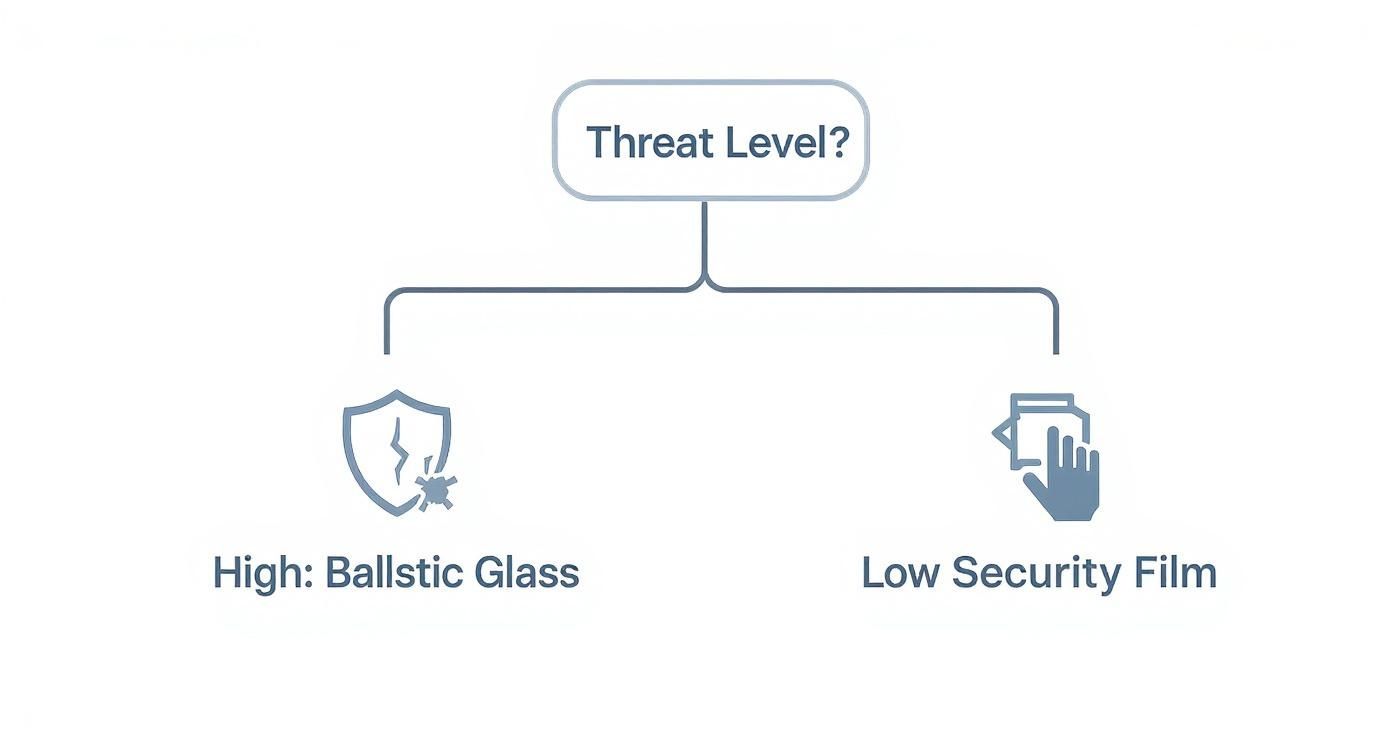
Ultimately, the solution has to match the threat. High-threat situations demand the comprehensive engineering and installation of true ballistic glass, which naturally brings higher labor costs with it.
Why Installation Is Such a Critical Cost Factor
Installing bulletproof windows is a job for certified pros, not your neighborhood handyman. It’s a complex process that requires absolute precision. The glazing, the frame, and the way it's anchored into your wall all have to work together as one seamless, impenetrable unit.
Several things really drive up these labor costs:
- Sheer Weight: Ballistic glass is incredibly heavy, often weighing 10 times more than the standard glass it replaces. A single square foot of a UL Level 8 panel can tip the scales at over 20 pounds. This means bringing in specialized lifting equipment and a larger, more experienced crew.
- Structural Reinforcement: The existing wall has to be able to support all that weight and handle the massive force of a ballistic impact. This usually involves reinforcing the window openings with steel or other heavy-duty materials, adding significant costs for both labor and materials.
- Specialized Know-How: The installers need specific training. They know how to handle and fit these systems perfectly. Even a tiny gap or an improperly secured anchor can create a fatal weak spot, making your entire investment worthless when you need it most.
This is not the place to try and save a few bucks. The performance of your multi-thousand-dollar window depends entirely on the quality of the installation. It’s the final, critical step that guarantees the window will actually do its job.
New Construction vs. Retrofitting Costs
When the installation happens matters a lot, too.
- New Construction: Putting ballistic windows in during a new build is by far the most cost-effective way to do it. Architects can design the necessary structural supports right into the blueprints from the get-go, making the whole process much smoother for the installation team.
- Retrofitting: Adding these windows to an existing home or building is a whole different ballgame. It's much more complex and expensive. Installers have to start by assessing the current structure, then carefully demolish parts of the wall to expose and reinforce the window openings before the new unit can be installed. This extra work can easily double the installation cost compared to a new build.
The demand for this level of security is on the rise. The global bulletproof glass market was valued at $9.3 billion in 2023 and is projected to skyrocket to $29.5 billion by 2033. As noted in a full market research report on PR Newswire, one of the biggest challenges in this growing market is the high cost of both production and installation. This industry trend really highlights why both the materials and the labor contribute so heavily to the final price tag you see.
Real-World Cost Scenarios for Homes and Businesses
Square-foot pricing is a great starting point, but the numbers don't really come to life until you see them applied to actual projects. To get a practical handle on the question, "how much do bullet proof windows cost?", let's walk through a few tangible scenarios.
We'll look at three distinct projects: a luxury home, a high-end retail shop, and a financial institution. Each has its own unique security needs, aesthetic goals, and budget, showing how all the factors we've discussed—threat levels, materials, and installation—come together to determine the final price tag.
Scenario 1: A Luxury Residence in Beverly Hills
Picture a modern home in an affluent neighborhood. The owner's priority is securing the ground floor against potential home invasions and handgun threats without making it look like a fortress. The large glass doors and windows overlooking the backyard are a key concern, as they need to remain an aesthetic highlight.
- Threat Assessment: Low to medium. The main goal is protection against common handguns, making UL Level 3 the right choice.
- Scope of Work: The project covers eight windows of various sizes and two large sliding glass doors, adding up to roughly 220 square feet of glass.
- Material Choice: Glass-clad polycarbonate is selected for its exceptional clarity and durability. The reinforced aluminum frames are powder-coated to perfectly match the home's existing trim, making the upgrade almost invisible.
- Installation Type: This is a retrofit, meaning we're working with an existing structure. It involves carefully removing the old windows and adding minor structural reinforcement to support the heavier ballistic systems, especially around the large door openings.
The complexity of retrofitting, combined with the demand for high-end, seamless finishes, pushes this project into the premium range for residential installations.
Projected Total Cost: Somewhere in the neighborhood of $75,000 – $90,000. This quote would typically include all materials, the specialized labor required for a clean retrofit, finishing work, and disposal of the old units.
Scenario 2: A High-End Downtown Retail Storefront
Now, let's consider a luxury watch and jewelry boutique on a busy city street. The owner needs to protect against two distinct threats: smash-and-grab robberies and potential armed attacks. The challenge is to fortify the entrance and display windows without intimidating legitimate customers.
- Threat Assessment: Medium to high. The solution needs to stop handgun rounds and withstand a sustained physical assault, which points to UL Level 4 protection.
- Scope of Work: The job involves two large display windows and a double-door entrance, totaling 150 square feet.
- Material Choice: Laminated polycarbonate with an anti-spall layer is crucial here to prevent glass fragments from flying inside during an attack. Heavy-duty steel frames are chosen for maximum rigidity.
- Installation Type: Another retrofit, but this one is in a commercial building. It requires after-hours work to avoid disrupting business and careful coordination with building management.
The jump to a higher UL rating and the switch to steel frames significantly increase material costs, while the logistics of a downtown installation add to the labor bill.
Estimated Project Breakdown:
- Glazing & Frames: ~$40,000
- Specialized Labor & Equipment: ~$15,000
- Permitting & Logistics: ~$5,000
This brings the total investment into a clear commercial bracket.
Scenario 3: A Community Credit Union Branch
Finally, think about a local credit union upgrading its security. The goal is to protect employees and customers while satisfying strict insurance and industry regulations. This requires comprehensive protection for teller windows and offices against higher-caliber threats.
- Threat Assessment: High. Financial institutions often require protection against high-powered rifles, making UL Level 8 the standard.
- Scope of Work: This project includes a full teller line with five transaction windows, a manager's office window, and the main entrance vestibule, covering about 180 square feet.
- Material Choice: At this level, thick, multi-layered glass-clad polycarbonate is the only option. The system also requires certified transaction passers (like deal trays) and heavy-duty steel frames.
- Installation Type: This is part of a branch remodel, which actually simplifies the process. Integrating the system into new construction is easier than retrofitting because the necessary structural reinforcements can be built in from the start.
The demand for this level of security is significant and growing. Depending on the source, the global ballistic glass market in 2024 is estimated at anywhere from $5 billion to over $8.8 billion. One detailed analysis from the IMARC Group sized it at $8.48 billion in 2024, projecting it to reach $20.2 billion by 2033 as security concerns rise worldwide.
Projected Total Cost: Approximately $110,000 – $135,000. The extreme weight and thickness of UL Level 8 materials, coupled with the specialized transaction hardware, are what drive the cost to this level.
Is Bulletproof Glass Worth the Investment?
After running the numbers and seeing what goes into a professional installation, you're probably asking the big question: is it actually worth it?
To answer that, you have to look past the price tag. Installing bullet-resistant glass isn't just another home renovation project or business expense. It's a fundamental investment in safety and, just as importantly, in peace of mind. The real ROI here isn't something you can track on a spreadsheet; it's the priceless value of protecting your family, your employees, and your assets.
For a business, the benefits are obvious. You're protecting high-value inventory, deterring armed robberies, and showing your team that you're serious about their safety. For a high-end home, it's a silent, invisible guardian for your family. There can even be some financial perks. It's always a good idea to chat with your insurance agent, because a major security upgrade like this might lead to a break on your premiums. Taking the time for understanding your homeowners insurance coverage is crucial to see how this improvement could impact your policy.
Long-Term Value and Durability
One of the best things about a professionally installed ballistic window system is that it's built to last. This isn't a security camera that needs software updates or a subscription service you have to pay for year after year. It's a permanent, physical upgrade to your property.
- Lifespan: Top-tier ballistic glass is engineered to last for 20 years or more. The main thing that ages it is long-term UV exposure, which can eventually affect the internal polycarbonate layers, but you're looking at decades of solid protection.
- Maintenance: Keeping it clean is simple. You'll need to use special non-abrasive cleaners to avoid scratching the surface, but it's hardly a chore.
- Warranty: Any reputable installer will back their work with a solid warranty, often covering things like delamination for up to ten years. This protects your investment from the get-go.
The real power of bullet-resistant glass is that it's always on duty. It provides 24/7 protection without you having to do a thing. That constant state of readiness delivers a sense of security that very few other measures can ever hope to match.
The Intangible Return on Security
In the end, the most important return you get from this investment isn't something you can hold in your hand. It's the quiet confidence that comes from knowing you've done everything possible to prepare for a worst-case scenario.
For a business owner, it’s about meeting your responsibility to keep people safe. For a homeowner, it’s about making your home a true sanctuary.
When you weigh the upfront cost of bullet-resistant windows against the devastating consequences of a violent attack, the choice becomes much clearer. You're turning a potential target into a fortified space, buying precious time for people to get to safety and for help to arrive. That peace of mind? That's the real, lasting benefit of your investment.
Common Questions About Bulletproof Window Costs
When you're considering a serious security upgrade like this, you're bound to have some practical questions. You need straightforward answers to feel good about where your money is going. Let's tackle some of the most common things people ask when they're trying to get a real-world handle on the cost of bulletproof windows.
Think of this as clearing up the final details so you can make a confident decision. We'll cover comparisons, installation realities, property value, and how to pay for it all.
How Much More Do They Cost Than High-Impact Windows?
This is a great question and one of the first things people want to nail down for their budget. While both are security upgrades, they're built for completely different threats, and the price tag reflects that. High-impact or hurricane windows are made to stand up to brute force and wind, and you can usually get those installed for $50 to $100 per square foot.
Bulletproof windows, on the other hand, have to stop a projectile moving at incredible speed. That level of engineering is much more complex. A basic system will start around $150 per square foot and can easily climb past $500 per square foot for higher-level protection. The bottom line? You should expect a ballistic window to cost anywhere from three to ten times more than a high-impact window of the same size.
Can I Use My Existing Window Frames?
It’s a tempting thought—just swap the glass and save a bundle, right? Unfortunately, it’s almost never a safe or workable option. Your existing window frames, whether they're vinyl, wood, or standard aluminum, were never designed to hold the massive weight of ballistic glazing. We're talking about glass that can be ten times heavier than what's in there now.
The bigger issue is safety. A standard frame would buckle and fail the instant it was hit, making the expensive ballistic glass totally worthless. A certified bullet-resistant system is a complete package—the specialized glazing and a heavily reinforced steel or aluminum frame, both engineered and tested to stop a bullet together.
Do Bulletproof Windows Affect My Property Value?
For the right kind of property, absolutely—in a good way. In high-end residential and commercial buildings, especially in affluent Southern California communities, professionally installed ballistic windows are a huge value-add. They're a premium security feature that a certain type of buyer, one who puts a premium on safety, is actively looking for.
And don't worry about them looking clunky or out of place. Modern systems are designed to blend right in with a property's architectural style. This kind of upgrade tells potential buyers that the property is a secure, protected asset, which can absolutely justify a higher price tag.
Are Financing Options Available for This Upgrade?
Yes, most people don't pay for an investment of this size out of pocket. Many homeowners and businesses use financing to manage the upfront cost. Some common routes include:
- Home Equity Lines of Credit (HELOCs): A popular way to use your home's equity to fund major improvements.
- Specialized Security Lenders: Some financial institutions focus specifically on loans for security projects.
- Installer Financing: Many installation companies have partnerships with lenders and can offer financing plans directly, making the process much simpler.
Looking into these options can make a critical security upgrade feel much more manageable, letting you protect your property without draining your cash reserves.
At Fortress Security Films, we know that security is one of the most important investments you can make. Our experts are here to help you design a solution that gives you total protection without compromising your property's look or your budget. Secure your peace of mind by exploring our advanced window protection systems today.
Learn more about our ballistic security solutions at Fortress Security Films
