


When people ask about the cost of a bulletproof window, the quick answer is that the material alone runs between $25 and $100 per square foot. For a standard window, you could be looking at anywhere from $900 for basic protection to $3,600 or more for serious security—and that's before installation.
Breaking Down the Price of Ballistic Protection
Thinking about the price of a bulletproof window is a lot like shopping for a car. The sticker price for the base model looks great, but the final cost depends on the performance and features you actually need. The single biggest factor is the UL protection level, which is a standardized rating that tells you exactly what kind of threat the window can stop.
A higher UL level means more layers of material and a more complex manufacturing process, which naturally drives up the price.
This chart gives a good visual breakdown of how costs scale from a simple residential project to a high-security commercial installation.
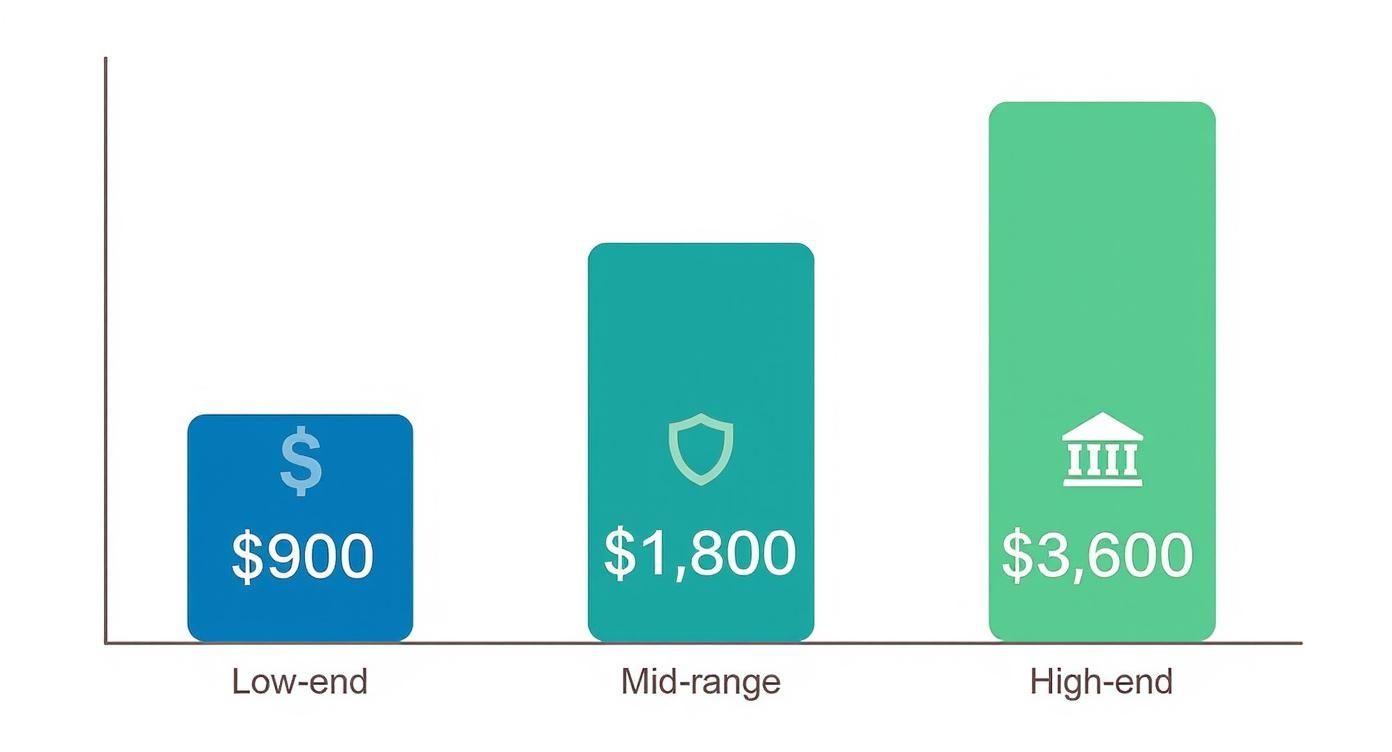
It’s clear that jumping from one tier of security to the next can easily double or even quadruple what you spend.
Here's a more detailed look at how costs break down by the specific UL protection level you choose.
Estimated Bulletproof Window Cost by Protection Level
| UL Protection Level | Typical Threat Stopped | Avg. Cost Per Sq. Ft. | Est. Cost for 3'x4' Window (Material Only) |
|---|---|---|---|
| Level 1 | 9mm handgun rounds | $40 – $60 | $480 – $720 |
| Level 2 | .357 Magnum handgun rounds | $60 – $80 | $720 – $960 |
| Level 3 | .44 Magnum handgun rounds | $75 – $100 | $900 – $1,200 |
| Level 4 | .30-06 rifle rounds | $120 – $200+ | $1,440 – $2,400+ |
| Level 8 | 7.62mm rifle rounds (multiple shots) | $250 – $400+ | $3,000 – $4,800+ |
As you can see, the price escalates quickly when you need to defend against higher-powered rounds from rifles. For an even more detailed breakdown, you can explore a full market analysis on bulletproof glass to see global trends and material costs.
Key Takeaway: The right question isn't just "how much does a bulletproof window cost?" It's "how much security do I actually need?" Your specific threat assessment is what will ultimately shape the budget and give you real peace of mind.
Understanding Your Material Options
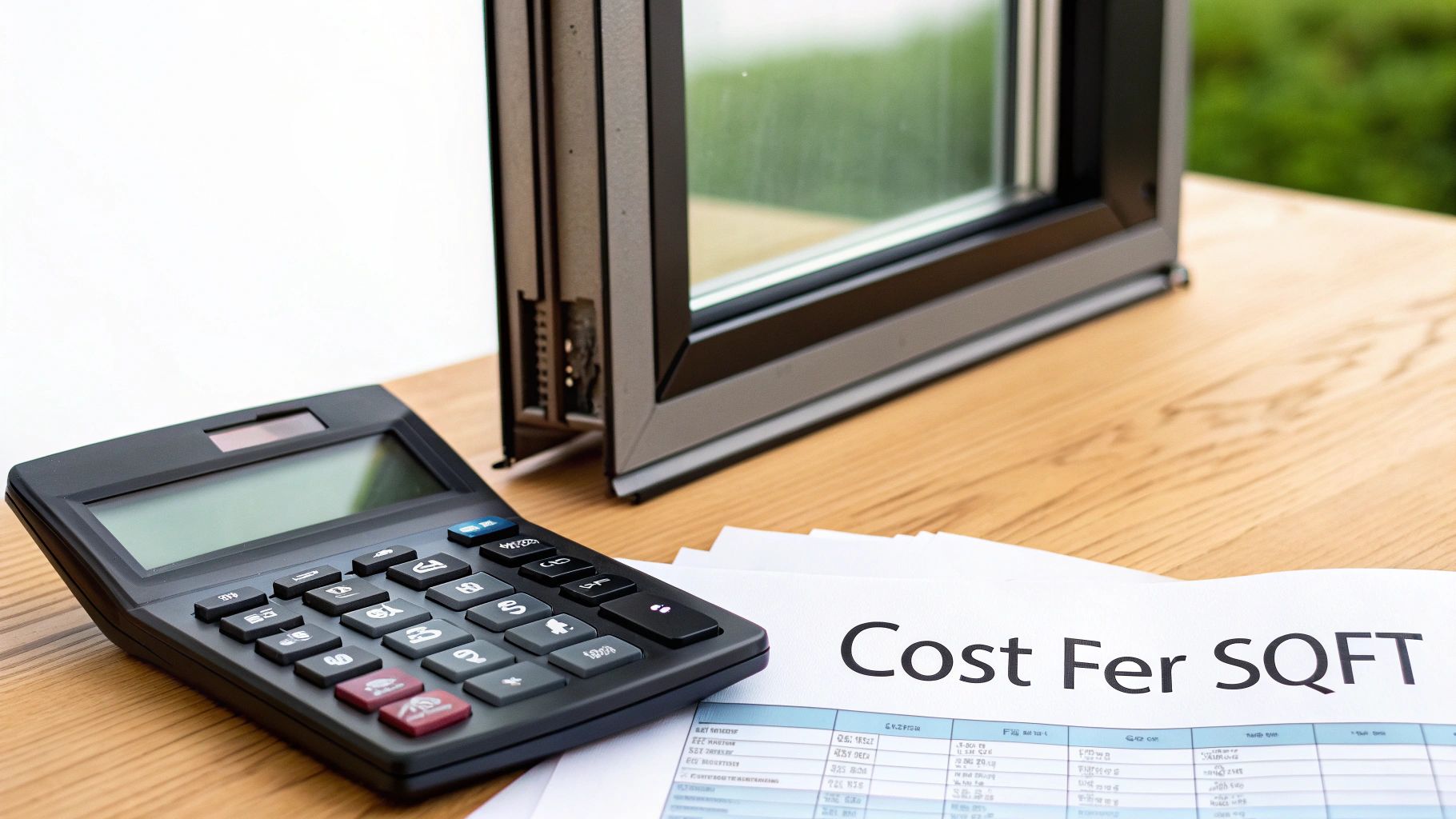
When it comes to bulletproof windows, the material you pick is the single biggest driver of both cost and performance. Think of it like choosing body armor—you could go with a flexible Kevlar vest or a rigid ceramic plate. Both stop threats, but they do it in completely different ways and are designed for different situations.
The same idea holds true for ballistic glazing. Your choice is where your security needs meet your budget, so getting a handle on the main options is the first real step toward a smart decision.
The Three Core Materials
You're generally looking at three main players: acrylic, polycarbonate, and laminated glass. Each one has a distinct personality, which affects how it stops a bullet, how clear it looks, how much it weighs, and, of course, how much it costs.
-
Acrylic: This is a stiff, rigid plastic. Much like a ceramic armor plate, it works by being harder than the bullet, shattering the projectile on impact. It’s known for being incredibly clear and is usually the most budget-friendly choice.
-
Polycarbonate: This material is the opposite—it's soft and flexible. It acts more like a catcher's mitt, absorbing and dispersing the bullet's energy across its surface to "catch" it. It offers much higher impact resistance than acrylic but comes at a higher price point.
-
Laminated Glass: This is a hybrid, usually made by layering glass with polycarbonate. It gives you the best of both worlds: the hardness of glass to flatten the bullet on impact, plus the flexibility of polycarbonate to absorb the leftover energy. This combination provides excellent, multi-hit protection.
The price tag on bulletproof windows is tied directly to these materials. Acrylic, which makes up nearly 50% of the global market, is the most common entry point, typically running between $25 and $40 per square foot. For more serious protection, polycarbonate and glass-clad options can easily jump to $60 to $100 per square foot. You can dig deeper into the bulletproof glass market to see how these trends play out.
Key Insight: A homeowner just looking for some extra peace of mind might find that a cost-effective acrylic window does the job. On the other hand, a high-risk facility like a bank or jewelry store will almost certainly invest in the superior stopping power of polycarbonate or laminated glass to handle more significant threats.
What Really Drives Up the Final Price?
While the material you choose sets the baseline cost, a handful of other factors can send the final price climbing. It’s a lot like buying a new car—the sticker price for the base model is just the starting point. Once you start adding performance upgrades and custom features, the numbers add up fast. Knowing what these variables are is the key to setting a realistic budget.
The single biggest cost driver is the UL Protection Level. Don't think of this as a simple, linear price increase. Jumping from a Level 1 (built to stop a 9mm handgun) to a Level 3 (designed for a .44 Magnum) isn’t just about adding a slightly thicker piece of glass. It demands more layers, more advanced lamination, and a much heavier, more robust construction overall.
The jump to a rifle-rated level, like UL Level 8, is even more dramatic. This requires a serious leap in both materials and manufacturing technology, often more than doubling the cost of a high-end handgun-rated window.
Window Size and Customization
It probably goes without saying, but the size and shape of the window are massive factors. A standard, off-the-shelf rectangular window is one thing. But if your project needs custom curves, unique angles, or oversized panes, the complexity—and the price tag—shoots up right alongside it.
Anything non-standard requires special molds, precision cutting techniques, and heavy-duty handling equipment. All of this adds to the labor and material costs. The bottom line is, the more unique your window, the more you should budget beyond the basic per-square-foot price.
The Expert Take: Every extra layer of protection, every custom cut, and every special feature adds to the manufacturing complexity and sheer weight of the final product. You'll see that reflected directly on the invoice. It's always a balancing act between achieving absolute security and staying within practical budget constraints.
Special Add-Ons and Features
On top of the core ballistic protection, you can add a whole menu of features that enhance functionality or aesthetics. Of course, they all come at a premium.
- Tints and Coatings: Need solar tints to reduce heat, privacy films, or an anti-glare coating? These are applied during the manufacturing process to ensure a perfect bond, and they will increase the cost.
- One-Way Visibility: Mirrored films that let people inside see out while keeping outsiders from seeing in are a fantastic security upgrade, but they add another layer of cost to the project.
- Voice Transmission: If you need a transaction window with built-in speakers, a pass-through drawer, or a deal tray, you're talking about intricate cuts and specialized hardware. These features can have a significant impact on the final price.
Depending on what you choose, these kinds of add-ons can increase the base cost of the window by anywhere from 15% to 50%.
To put it all into perspective, here’s a quick breakdown of how these different choices impact the budget.
Cost Impact of Key Features
| Factor | Low-Cost Option | High-Cost Option | Why It Affects Price |
|---|---|---|---|
| UL Protection Level | UL Level 1 (9mm) | UL Level 8 (7.62mm Rifle) | Higher levels require more material, complex layering, and advanced technology. |
| Size | Small, standard rectangle | Large, oversized pane | Larger windows require more material, heavier frames, and specialized installation equipment. |
| Shape | Standard rectangle | Custom arch, circle, or angle | Non-standard shapes demand custom molds, precision cutting, and more manufacturing waste. |
| Special Features | None (clear glazing only) | One-way mirror, voice portal | Each add-on requires additional materials, labor, and specialized hardware. |
As you can see, the "little" details can quickly become major budget items. Planning for these from the start helps avoid any surprises when the final quote arrives.
Budgeting for Professional Installation
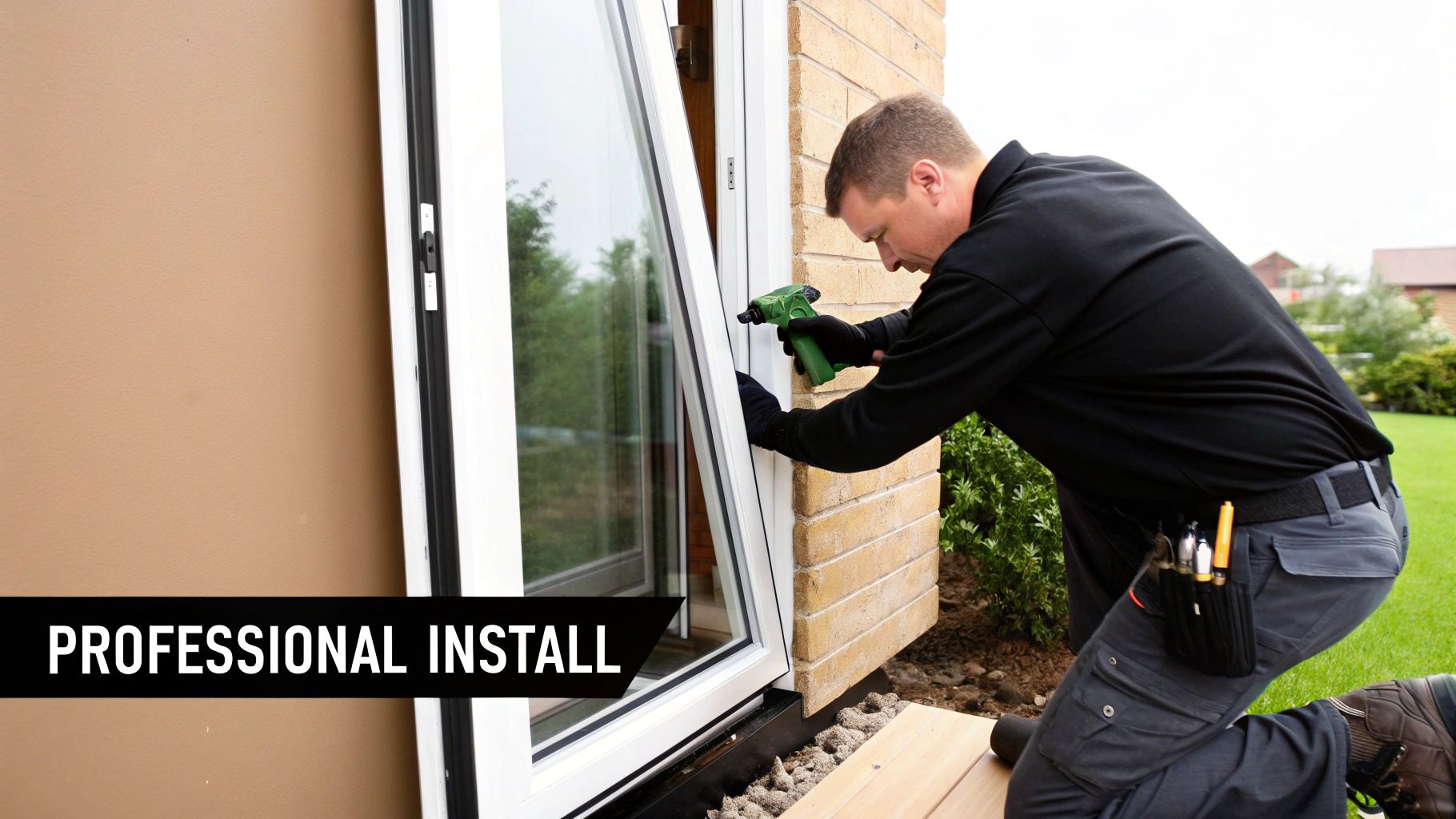
When you're figuring out the cost of a bulletproof window, the price of the glass itself is just one piece of the puzzle. You absolutely have to factor in professional installation. This isn't an optional add-on; it's what makes the entire system actually work when you need it most.
Think of it this way: you wouldn't install a bank vault door in a drywall frame and expect it to be secure. The door might be impenetrable, but a single kick could take the whole frame down. The same logic applies here. A window's ballistic rating means nothing if its frame and anchoring can't handle the same impact.
This is exactly why installing bulletproof windows is a job for experts, not a weekend DIY project. It takes trained technicians to handle the sheer weight of the glazing and properly secure it into the structure of your building.
What Goes into an Installation Quote
A professional quote is much more than just the labor to pop a window in place. If you're new to this, learning the basics of budgeting for home renovations can give you a solid framework for planning.
Here’s what you can expect to see broken down in your quote:
- Labor Costs: This covers the time and specialized skills of the certified installation team. The rates can change quite a bit depending on your location and how complex the job is.
- Specialized Framing: Your average window frame from a home improvement store won't cut it. You'll need ballistic-rated steel or heavily reinforced aluminum frames built to hold the window's weight and absorb massive energy on impact.
- Anchoring Hardware: The window system has to be bolted directly into the building's structural supports with some seriously heavy-duty hardware.
- Structural Modifications: Sometimes, the wall opening itself needs to be reinforced to bear the load of the new window and frame. This is an extra step that can add to the final cost.
Rule of Thumb: A good starting point is to assume professional installation will add another 20% to 50% on top of the material cost. Building this into your budget from day one is the best way to avoid sticker shock later on.
Putting It All Together: Real-World Cost Examples
Talking about price ranges is one thing, but let's get down to brass tacks. Seeing how these costs play out in real life is the best way to understand what you might actually spend.
We'll walk through three common situations, from a family looking for extra peace of mind to a high-risk commercial facility. Each one shows how the threat level, material choice, and installation details all come together to determine the final price tag.
Scenario 1: The Concerned Homeowner
Imagine a homeowner who wants to beef up the security on two large, easily accessible living room windows (each 4'x5'). Their main goal is to deter break-ins and protect against common handgun threats. A UL Level 1 acrylic glazing is a perfect fit here—it's effective without being overkill for a residential setting.
- Materials: Two 20 sq. ft. windows (40 sq. ft. total) at roughly $50/sq. ft. comes to $2,000.
- Installation: This is a fairly standard job, but the frames will need reinforcement. Let's budget $800.
- Total Projected Cost: You're looking at around $2,800.
For this investment, the homeowner gets a serious security boost and a powerful deterrent against the most common types of threats.
Scenario 2: The Small Business Owner
Now, think about a jewelry store owner. They need to protect their cashier's counter with a single, secure transaction window (3'x4'). The stakes are higher here, so the window needs to stop multiple shots from powerful handguns. This calls for UL Level 3 laminated glass and a built-in deal tray for passing items back and forth.
- Materials: One 12 sq. ft. window at about $90/sq. ft., plus the specialized deal tray hardware, puts this around $1,500.
- Installation: Fitting this into a countertop and integrating the hardware makes the job more complex. Expect to pay about $1,000.
- Total Projected Cost: The final bill will be approximately $2,500.
Key Insight: Notice how this smaller window costs nearly as much as the two large residential windows. The jump in protection level and the need for custom hardware really drive the price.
Scenario 3: The High-Security Facility
Let's look at a top-tier security need, like a government building's guard booth. It has two windows (each 3'x4') that absolutely must withstand high-powered rifle fire. There's no room for compromise, so they'll need a UL Level 8 glass-clad polycarbonate system.
- Materials: Two 12 sq. ft. windows (24 sq. ft. total) at a premium of $300/sq. ft. totals $7,200.
- Installation: This is a major undertaking. The sheer weight and thickness of the glazing require heavy-duty equipment and significant structural work on the booth itself, easily costing $3,500.
- Total Projected Cost: This project comes in at around $10,700.
As you can see, the question isn't just "how much do bulletproof windows cost?" The real question is, "what level of threat are you trying to stop?" Your answer directly shapes the final number.
How to Get a Real-World Quote for Your Project
Alright, let's get down to brass tacks: finding out exactly what your bulletproof window project will cost. Getting a solid, reliable price isn't just about making a phone call; it's about doing a little homework first so vendors can give you a real quote, not just a shot-in-the-dark guess.
Think of it like getting a quote for a kitchen remodel. You wouldn't just tell a contractor you have a "medium-sized kitchen." You'd give them the dimensions, tell them you want granite countertops, and show them where the sink needs to go. The same level of detail is needed here to get the numbers right.
What to Have Ready Before You Call
Having your ducks in a row before you start reaching out will make the whole process a lot less painful and ensure the quotes you get are actually comparable.
Before you pick up the phone, try to gather these key details:
- Your Measurements: Grab a tape measure and get the exact width and height of each window opening. Make sure you're measuring from the inside of the frame where the glass will actually sit.
- Your Protection Goal: What are you trying to stop? Be ready to tell them the UL protection level you've decided on, whether that’s for handgun threats or something rated for high-powered rifles.
- A Few Good Photos: Snap a couple of clear pictures of each window you want to upgrade, both from the inside and the outside. This gives the supplier a crucial look at the existing frame, wall type, and any potential installation quirks.
Taking a few minutes to provide clear photos and measurements can cut the risk of surprise costs by up to 20%. It lets installers spot potential issues, like a weak wall structure, long before they show up on site.
With this information in hand, you’re ready to have a productive conversation.
The Big Questions to Ask Every Single Vendor
You'll quickly find that not all quotes are built the same. To truly compare your options, you need to be sure you're looking at the same complete package from everyone.
Make sure you ask every potential supplier these questions to get the full story on their pricing:
- Does your price include the ballistic frame, or is that a separate line item?
- Are all the costs for installation—the labor, the hardware, everything—included in this number?
- What’s a realistic timeline for getting the materials made and having them installed?
- Can you walk me through the warranty? What does it cover for the glass and for the installation work?
Getting answers to these questions is the only way to compare your quotes apples-to-apples. It helps you find the true best value, which isn't always the lowest number on the page.
Frequently Asked Questions
https://www.youtube.com/embed/DhMl3eIcGbI
Even after you've worked out the budget, you're probably still weighing the day-to-day realities of owning bulletproof windows. Thinking about upkeep, lifespan, and what your other options are is just smart planning. Let's walk through some of the most common questions people have before they pull the trigger.
Does Bulletproof Glass Require Special Maintenance?
Yes, and this is one area where you can't cut corners. Taking proper care of your ballistic glass is what guarantees it will last. Most systems, especially those with layers of acrylic and polycarbonate, are sensitive to harsh chemicals.
You'll want to stick to a simple mix of mild soap and water with a soft microfiber cloth. Stay far away from ammonia-based cleaners like Windex—they can make the material cloudy and brittle over time. A quick visual check every now and then for any damage is also a great habit to get into.
How Long Does Bulletproof Glass Last?
You can expect a professionally installed bulletproof window to last anywhere from 10 to 20 years. The good news is that its stopping power doesn't really weaken. What can happen with older materials is a slight yellowing or haziness from years of UV exposure.
That said, modern manufacturing has gotten much better at fighting this. Today's glazing includes advanced UV inhibitors that keep the window crystal clear and performing at its peak for well over a decade.
Key Takeaway: Think of ballistic windows as a long-term investment that needs the right kind of care. Using the correct cleaning supplies and doing occasional inspections is all it takes to help them reach their full lifespan.
Is Security Film a Good Alternative?
This is a really common question, and the answer is: it depends on your goal. Security film is a fantastic and affordable way to make a window much more shatter-resistant, but it is not the same thing as bulletproof glass.
Security film is all about preventing break-ins. It holds the glass together when it's hit with a blunt object, making it incredibly difficult for an intruder to get through. It’s a delay tactic. Ballistic glass, on the other hand, is a complex, multi-layered system designed from the ground up to absorb and stop the focused energy of a bullet. Film simply can't do that.
If your main goal is to reinforce your existing glass against forced entry without the expense of a full ballistic replacement, Fortress Security Films offers advanced systems that are a powerful deterrent. You can learn more about their residential and commercial options at the Fortress Security Films website.
For a project-specific comparison of film-based and glazing options, review our ballistic security solutions.
