


Think of a glass break alarm as a security guard with superhuman hearing, trained to listen for one very specific sound: the sharp, distinct crack of shattering glass. In a nutshell, that's what these devices are—a crucial first line of defense that can alert you the moment a burglar even tries to get in through a window or glass door.
Why Glass Break Alarms Are a Critical Security Layer
Most basic home security systems use simple contact sensors on doors and windows. They work, but they only trigger an alarm after the door or window has been physically opened. That creates a massive blind spot. What if an intruder just smashes the glass and climbs right through? The contact sensor would be useless.
This is exactly where glass break alarms come in and prove their worth.
These specialized sensors aren't waiting for a door to swing open. They're actively listening, acting like a digital watchdog for the unique sound frequency of breaking glass. The second that sound is detected, the alarm goes off, notifying you and your monitoring service before an intruder even has a chance to step inside.
Proactive Detection at the Point of Entry
This ability to react instantly is a true game-changer for security. Just think about the most common ways burglars get in:
- Ground-Floor Windows: These are classic targets. A sensor here means you get an alert the moment a pane is broken.
- Sliding Glass Doors: A huge, vulnerable entry point that's often a primary target for a quick smash-and-enter.
- Storefronts and Businesses: Those big glass displays are tempting for smash-and-grab thieves. Instant detection is absolutely essential.
By catching an intruder right at the point of entry, these alarms give you a critical head start. That small window of time can be the difference between scaring someone off and dealing with a significant loss.
The real power of a glass break alarm lies in its ability to turn a reactive security system into a proactive one. It doesn't just record a break-in; it detects the very first act of aggression, buying you precious seconds to react.
A Growing Security Necessity
It's no surprise that these devices are becoming more popular in both homes and businesses. As people become more security-conscious, they're realizing that a layered defense is far more effective than relying on just one type of sensor.
The numbers back this up. The global market for glass break detectors, currently valued at around $500 million, is expected to grow substantially, possibly hitting $850 million by 2033. This trend clearly shows a shift toward smarter, faster security measures. You can find more details on the growing market for these security devices.
The Science Behind How Different Alarms Detect Break-Ins
Ever wondered how a small device on your wall can tell the difference between a window being smashed and you accidentally dropping a drinking glass? It’s not magic—it's some pretty clever engineering designed to listen for and feel the very specific clues of a forced entry. Understanding how they work is key to picking the right glass break alarms for your space.
These sensors essentially fall into two main camps, each using a distinct method to catch a break-in as it happens.
H3 Acoustic Sensors: The Sound Engineers of Security
The most common type you'll find is the acoustic sensor. Think of it as a tiny, highly-trained sound engineer that's always on duty. Its only job is to listen past the TV, the dog barking, and the traffic outside, zoning in on the one sound that matters: breaking glass.
So, how does it know? It’s listening for a very specific two-part sound signature.
- The 'Thud' (Low Frequency): First, there's the low-frequency thud of an object—a rock, a crowbar—striking the glass. This is the initial impact.
- The 'Shatter' (High Frequency): Right after that impact, it listens for the sharp, high-frequency sound of the glass actually shattering.
The alarm only triggers when it hears that exact "thud-then-shatter" sequence, in that precise order, within a fraction of a second. This dual-frequency check is brilliant for preventing false alarms. A plate shattering in the kitchen might create the high-frequency noise, but without the initial low-frequency impact on a window, the sensor knows to stay quiet.
This technology is a real cornerstone of modern security. The market for these devices is massive, projected to hit USD 348.06 billion by 2035, largely because of how effective they are. If you're interested in the business side, you can discover more about the acoustic detector market trends and see why they've become so popular.
This diagram helps visualize how these alarms fit into a complete security plan, offering proactive detection and immediate alerts.
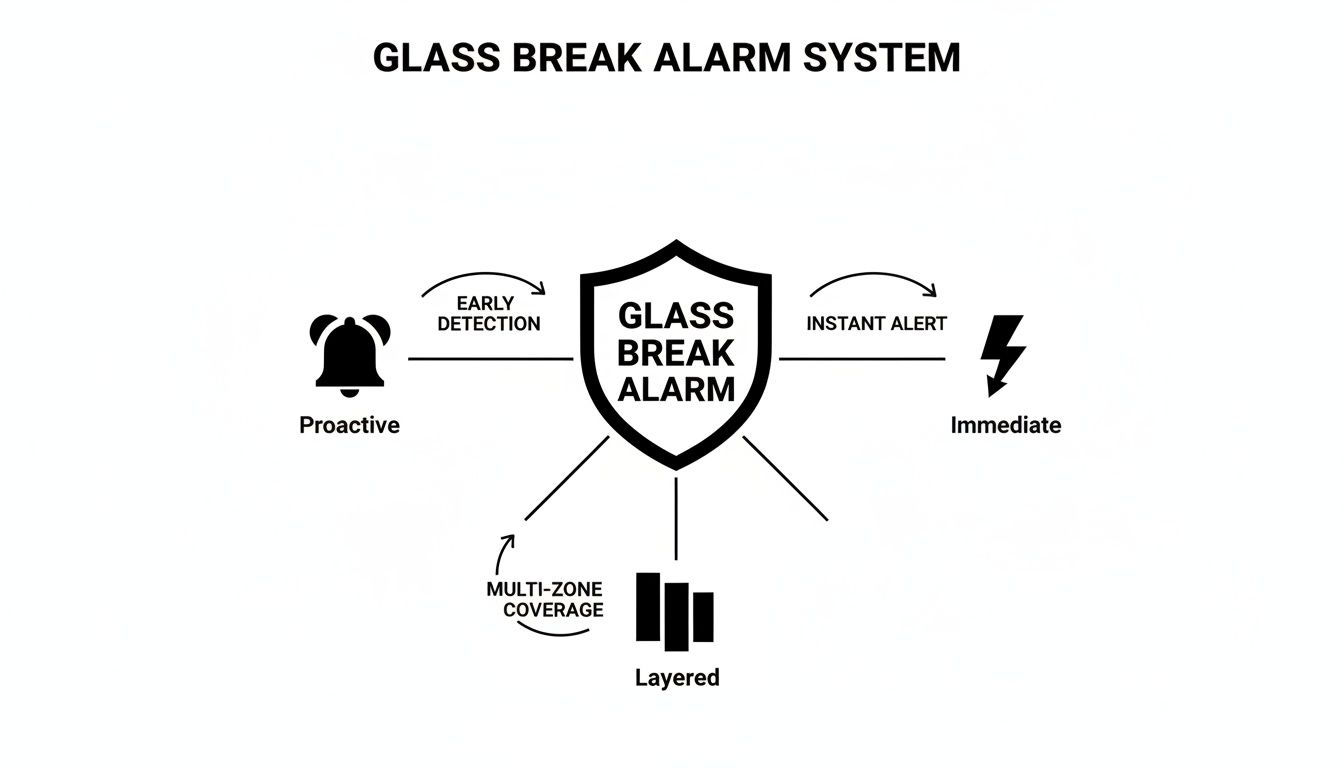
As you can see, they’re not just a reactive measure; they form a crucial layer that kicks off a security response the instant an intruder tries to get in.
H3 Shock Sensors: The Sensitive Fingertips
While acoustic sensors listen, shock sensors (or vibration sensors) feel. Imagine putting your fingertips on a window pane. If someone tapped or hit the glass, you’d feel that vibration instantly. A shock sensor does the same thing, just with much more precision.
These devices are mounted directly onto the glass or the window frame, where they wait to detect the physical shockwaves of an impact.
A shock sensor works on a simple premise: if the glass vibrates violently enough to be on the verge of breaking, the sensor will trigger an immediate alarm. It's designed to detect the raw physical force of an attack.
Because they feel the impact directly, shock sensors are completely immune to loud noises. This makes them perfect for loud environments—like a workshop, a bar, or a room with a powerful home theater system—where an acoustic sensor might get confused.
Acoustic vs. Shock Glass Break Alarms Compared
So, which one is right for you? It really boils down to your specific environment and security needs. This table lays out the key differences to help you decide.
| Feature | Acoustic Sensors | Shock (Vibration) Sensors |
|---|---|---|
| Detection Method | Listens for the two-part "thud-then-shatter" sound of breaking glass. | Feels the physical vibrations of an impact directly on the glass or frame. |
| Ideal Use Cases | Protecting multiple windows in a single room (living rooms, offices). | Securing specific, high-risk windows or in noisy environments. |
| Coverage Area | One sensor can cover a radius of up to 25 feet, protecting an entire room. | One sensor per window pane or frame is typically required. |
| Pros | Cost-effective for large areas. Fewer sensors needed. Less invasive installation. | Highly resistant to false alarms from noise. Detects impact before glass fully breaks. |
| Cons | Can be triggered by sounds that mimic the break signature. Less effective in very large or cluttered rooms. | Requires more units for full coverage, increasing cost. Must be physically mounted on each window. |
Ultimately, the choice between acoustic and shock sensors isn't about one being "better" than the other. Acoustic sensors are fantastic for covering a whole room efficiently, while shock sensors provide targeted, ultra-reliable protection for specific panes of glass. In some high-security situations, people even use both for a truly layered defense.
Installing Your Glass Break Alarms for Maximum Effectiveness
Owning a great set of glass break alarms is one thing, but knowing where to put them is what truly makes them work. The right placement strategy is the difference between an alarm that’s on high alert and one that's completely deaf to a break-in. Think of it like setting up speakers for the best sound—location is everything.
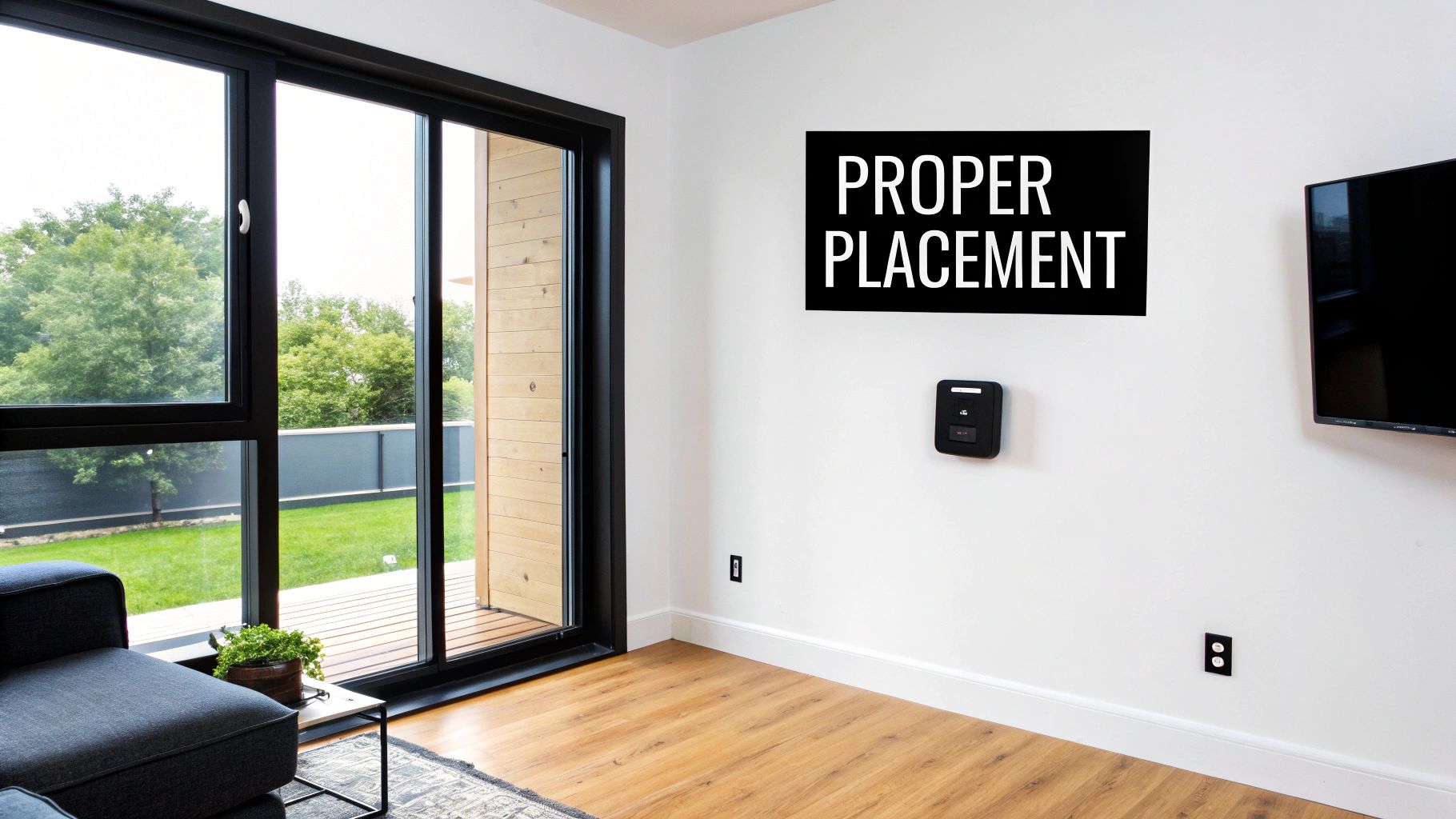
For acoustic sensors, the golden rule is a clear line of sight to the windows they’re meant to protect. Sound waves travel through the air, but they get easily muffled or blocked by physical objects. Thick curtains, heavy blinds, or a big piece of furniture can create a dangerous blind spot, rendering your sensor useless when you need it most.
Finding the Optimal Mounting Location
To get that foolproof coverage, you have to be strategic. Just sticking the sensor on the nearest wall won't cut it. The real goal is to give it an unobstructed audio path to every single pane of glass it's responsible for.
Here’s where they work best:
- Wall Mounting: The ideal spot is on the wall directly opposite the windows you're protecting. This gives the sensor the clearest possible "view" of the sound from the entire glass surface.
- Ceiling Mounting: If a wall won't work, mounting the sensor in the center of the ceiling is a fantastic alternative. It often provides a superior vantage point, looking down over potential obstructions like sofas or tables.
- Maintain Proper Distance: Most acoustic sensors have a range of about 25 feet. Always double-check the manufacturer's specs and place the unit well within this radius of the farthest window.
It's also crucial to keep your sensors away from things that make noise. Installing them near air vents, speakers, or rumbling appliances is asking for trouble and can seriously mess with their accuracy.
Proper placement isn't just a recommendation; it's the foundation of the alarm's reliability. A well-placed sensor is the difference between immediate detection and a complete security failure.
Choosing Between Wired and Wireless Systems
Your next big decision is whether to go with a wired or wireless system. Both have their pros and cons, and the right choice really boils down to your property, your budget, and how comfortable you are with the installation process.
Wired glass break alarms are hardwired directly into your home's main alarm panel. This gives them a constant, reliable power source, which means you never have to think about changing batteries. They are known for their rock-solid stability, but the installation is a much bigger job, often requiring a professional to snake wires through walls and ceilings.
On the flip side, wireless glass break alarms offer incredible flexibility. These battery-powered devices are a breeze to set up—you can mount them almost anywhere in minutes with simple adhesive strips or a couple of screws. Their sheer ease of installation and integration with smart home ecosystems has made them extremely popular.
This demand for convenience is a huge market driver. The wireless detector segment is growing fast, projected to jump from $2.26 billion in 2025 to nearly $4.5 billion by 2035. As you can see from the wireless detector market growth, people are clearly shifting toward systems that offer simpler setup and smart connectivity.
Here's a quick breakdown to help you decide:
| Feature | Wired Systems | Wireless Systems |
|---|---|---|
| Reliability | Extremely high; powered by main security panel. | Very reliable, but dependent on battery life and signal strength. |
| Installation | Complex; often requires professional installation. | Simple DIY setup in minutes; no drilling or wires. |
| Flexibility | Limited; placement is dictated by wiring access. | Highly flexible; can be placed anywhere within range. |
| Maintenance | Low; no batteries to replace. | Requires periodic battery changes (1-3 years). |
Ultimately, if you demand maximum reliability and are perhaps already doing a renovation, a wired system might be the perfect fit. But for most homeowners looking for an easy, adaptable security upgrade, wireless glass break alarms are a powerful and convenient choice.
How to Prevent False Alarms from Your Security System
There’s nothing worse than a security system that cries wolf. That jolt of adrenaline, the frantic rush to disarm it, and the potential for a hefty fine from the police can make you lose faith in your setup fast. The good news is that most false alarms from glass break alarms are entirely preventable once you know what to look for.
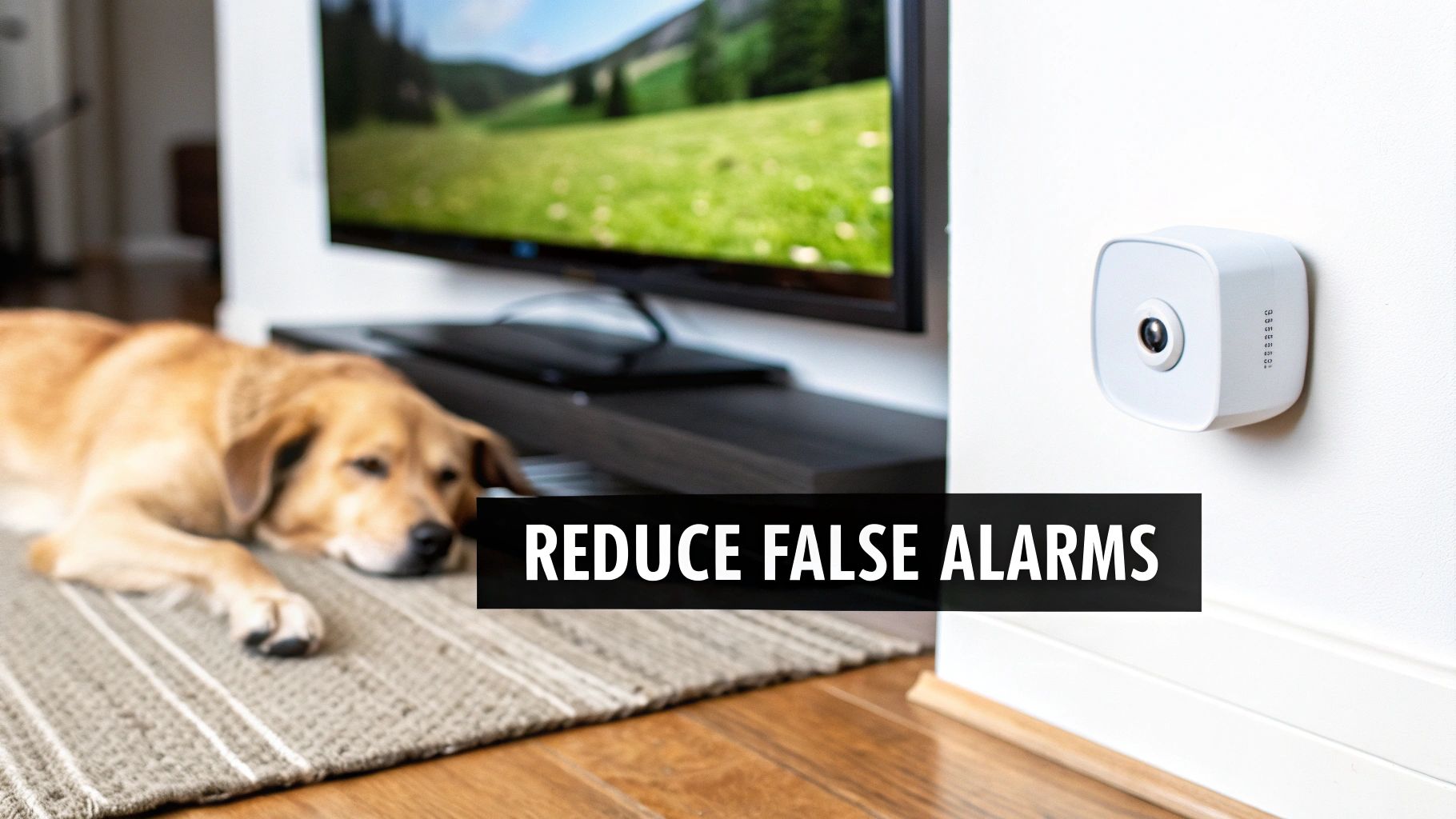
Today’s sensors are pretty sophisticated, but they can still get confused. They’re listening for a very specific two-part sound—a low-frequency "thud" followed by a high-frequency "shatter." The problem is, a lot of everyday household noises can accidentally mimic that acoustic signature. Figuring out these triggers is the first step to making your system reliable.
Identifying Common False Alarm Triggers
Your home is a symphony of sounds and vibrations. To a sensitive microphone, some of these can sound an awful lot like a break-in. Once you know the usual suspects, you can place your sensors more thoughtfully and fix any persistent issues.
Acoustic sensors can be tripped up by things like:
- Pets: A dog’s sharp, loud bark right next to a sensor can easily be mistaken for the high-frequency sound of shattering glass.
- Kitchen Noises: We’ve all done it—dropped a stack of plates or clanged some pots together. That crash can sound remarkably similar to a window breaking.
- Loud Media: Think about the sound effects in action movies or video games. Explosions and breaking glass played through a good sound system are a classic cause of false alarms.
- Everyday Sounds: Even something as simple as dropping your keys on a tile floor or a loud, sharp knock on a door can sometimes be enough to fool a sensor.
Shock sensors, on the other hand, react to physical vibrations. The culprits here are different. A heavy truck rumbling by or nearby construction can send vibrations through your house that a sensitive device might interpret as a threat.
How to Fine-Tune Your System for Reliability
Keeping your system quiet doesn't mean you have to turn it off. It just needs to be a bit smarter. With a few simple adjustments, you can drastically reduce false alarms and trust that your sensors will only go off when they’re supposed to.
First, check the sensitivity settings on your devices. Many glass break sensors let you dial the sensitivity up or down. If you live in a noisy neighborhood or have energetic pets, turning it down just a little can work wonders.
A well-calibrated sensor is your best defense against false alarms. The goal is to find the sweet spot where the system is sensitive enough to detect a real threat but not so sensitive that it reacts to everyday life.
Next, look at the tech itself. Modern dual-technology sensors are a game-changer. Many use AI and machine learning, training on huge libraries of sounds to get incredibly good at telling the difference between a real break-in and background noise. They can ignore the clinking of glasses or a movie soundtrack with far greater accuracy.
Finally, placement is everything. Don’t install sensors right next to your TV speakers or in the kitchen where loud, sharp noises are just part of life. While glass break alarms have their own specific quirks, it can also be helpful to think about understanding false alarm causes in other security systems, like smoke detectors, to get a better feel for how environmental factors can impact any sensor. Smart placement, proper calibration, and modern technology will give you a security system you can finally count on.
Integrating Alarms into Your Smart Home Security Ecosystem
A sensor that just beeps when glass shatters is one thing. But what about a sensor that can talk to every other security device in your home? Now that's a real defense.
Modern glass break alarms aren't just isolated gadgets anymore. They've become key players in a connected smart home, transforming a simple alert into a coordinated, automated response that can stop an intruder in their tracks.
Imagine someone smashes a back window. With an integrated system, the alarm doesn't just blare. It kicks off a powerful chain reaction:
- Every security camera you own instantly starts recording the event.
- Your smart lights—both inside and out—flash on, leaving nowhere for an intruder to hide.
- Smart locks automatically secure all other entry points.
- You and your professional monitoring service get a high-priority alert pinpointing the breach.
This isn’t science fiction. It’s what happens when your glass break sensor goes from being a passive detector to an active commander in your home’s defense network.
How Smart Alarms Communicate
For this kind of seamless teamwork to happen, all your devices need to speak the same language. This is where wireless communication protocols come into play, acting as the invisible threads connecting your entire security web. The two you'll run into most often are Z-Wave and Wi-Fi.
Z-Wave is a favorite in the security world. It runs on a low-frequency radio band, so it's incredibly reliable and won't get bogged down by interference from your other wireless gadgets. It also creates a "mesh network," where devices can pass signals along to each other, which is great for extending range and ensuring a rock-solid connection.
Wi-Fi is the one we all know and use daily. It connects devices right to your home router, which makes setup a breeze. The trade-off? It can be more power-hungry and has to share the airwaves with everything else, from your streaming TV to your laptop.
When you're shopping for a glass break sensor, it's absolutely critical to make sure its protocol works with your central smart home hub, whether that's Amazon Alexa, Google Home, Apple HomeKit, or the panel from your security provider.
An integrated system elevates your security from a collection of individual parts to a single, intelligent organism. When one part senses danger, the entire system responds in unison to protect your property.
Creating Powerful Security Automations
The true power of a connected system is unleashed when you start creating automations—basically, custom "if this, then that" rules for your home's security. This is where you get to build a defense strategy that’s tailored specifically to your property.
For instance, you could set up a rule that if glass breaks between 10 PM and 6 AM, the system not only triggers the siren but also broadcasts a loud "Property is under surveillance" message through all your smart speakers.
Think about these kinds of powerful automation recipes:
- "Intruder Spotlight" Routine: If a glass break is detected, turn on all interior lights to 100% brightness and blast the outdoor floodlights.
- "Evidence Capture" Protocol: If a sensor triggers, command all nearby cameras to start recording immediately and push a live video feed straight to your phone.
- "Safe Exit" Plan: In a larger home or business, a triggered alarm could automatically light up the hallways leading to designated safe rooms or emergency exits.
This kind of intelligent response flips the script, turning your home from a passive target into an actively hostile environment for any would-be burglar. By connecting your glass break alarms to the rest of your smart ecosystem, you build a layered, thinking defense that is far more effective than any single device could ever be on its own.
Combining Alarms with Security Film for Layered Protection
When it comes to securing your windows, many people get stuck on an "either/or" question: should I install glass break alarms or apply security film? But from an expert's perspective, that's the wrong way to look at it. The best strategy isn't about choosing one over the other; it’s about combining them to create a layered defense that’s far tougher to beat.

Think of it as a one-two punch against intruders. These two solutions aren't competitors. They're partners in a solid security plan, each playing a different but equally crucial role. One sounds the alarm, and the other buys you time.
The Power of "Delay and Detect"
The main job of window security film is to delay a break-in. This isn't just a simple sticker; it's an advanced material applied directly to the glass that holds it together even after it shatters. Instead of collapsing into pieces, the window becomes a stubborn, messy barrier that’s incredibly difficult and noisy to get through. For an intruder on a clock, this delay is a nightmare.
A glass break alarm, on the other hand, is all about immediate detection. Its sole purpose is to listen for the very specific sound of breaking glass and trigger an alert the instant it happens. That signal goes straight to you and your monitoring service, starting the response process before an intruder even has a foot inside.
When you put them together, you get a powerful synergy. The glass break alarm gives you the instant heads-up that an attack is happening, while the security film physically holds the intruder back, buying precious time for you and the police to react.
This combination transforms a weak point into a serious obstacle. An intruder expecting a quick smash-and-grab is suddenly faced with a window that won’t cooperate and an alarm that’s already screaming for attention. That’s often more than enough to send them running.
Comparing Your Security Layers
Once you understand the distinct roles these two tools play, it becomes obvious why they work so well as a team. Each one covers a weakness the other has. The alarm tells you there’s a problem, but it can't physically stop someone from climbing through the broken pane. The film can stop them, but it can't call for help on its own.
Deciding which to prioritize—or realizing you need both—comes down to understanding their core differences.
Security Film vs. Glass Break Alarms: Which Is Right for You?
This table breaks down how each solution contributes to your home's overall security.
| Aspect | Window Security Film | Glass Break Alarms |
|---|---|---|
| Primary Function | Delay Entry: Physically holds shattered glass in place to slow or prevent intrusion. | Instant Notification: Immediately detects the sound of breaking glass and triggers an alarm. |
| Security Benefit | Buys critical response time for homeowners and law enforcement. | Scares off intruders and ensures a rapid security response is initiated. |
| Installation | Requires professional application of the film directly onto the glass surface. | Can be a simple DIY installation for wireless models or require a professional for wired systems. |
| Cost | Higher initial investment based on window size and film thickness. | Lower initial cost per device, but multiple units may be needed for full coverage. |
In the end, relying on just one of these leaves a major hole in your defenses. By layering a robust physical barrier like Fortress Security Films with the immediate detection of glass break alarms, you’re not just protecting a window; you're building a truly comprehensive security strategy.
Your Top Questions About Glass Break Alarms Answered
Even after you get the basics down, you're bound to have some real-world questions about how these sensors fit into your home. Let's tackle some of the most common things people ask so you can be confident you're using them correctly.
One of the biggest questions is about obstructions. What if you have heavy curtains or blinds? Can they stop the sensor from working? Yes, absolutely. Thick drapes, closed blinds, and even a tall piece of furniture can absorb or deflect the specific sound waves a sensor is listening for. The key is to maintain a clear line of sight (or sound) between the sensor and the windows it's protecting.
Then there's the question of pets. Nobody wants an alarm that goes off every time the dog gets excited about the mail carrier.
Will My Pets Set Off the Alarm?
It’s a valid concern, but modern glass break alarms are built for homes with pets. While it's not impossible for a very loud, high-pitched bark right next to the sensor to cause a false alarm, most systems are smart enough to tell the difference.
The best ones use dual-technology, listening for both the low-frequency "thud" of an impact and the high-frequency "shatter" that follows. That’s a unique acoustic fingerprint your dog just can't replicate. To be extra safe, you can also:
- Tweak the Sensitivity: Most sensors let you dial back the sensitivity just a bit.
- Place it Smartly: Don't mount the sensor directly above your dog's bed or kennel.
- Buy a Quality Sensor: Reputable brands invest heavily in algorithms that are excellent at filtering out everyday household noise.
With these simple precautions, your furry friends and your alarm system can coexist peacefully.
How Far Can One Sensor Reach?
Knowing the coverage range is crucial for planning your layout. As a general rule, a standard wall- or ceiling-mounted acoustic glass break alarm can cover a radius of up to 25 feet (about 7.6 meters). This means one well-placed sensor can often protect all the windows in a typical living room or master bedroom.
Always double-check the manufacturer's specs for your specific model. Don't just assume one sensor is enough for a large, open-plan space.
If you have a bigger room or an odd layout with walls and other obstructions getting in the way, you'll need multiple sensors to avoid any gaps in coverage. And remember, shock sensors are a different story—they only protect the single pane of glass they’re stuck to, giving them a tiny, focused detection area.
At Fortress Security Films, we know that the best defense is a layered one. When you pair our tough security films with a properly installed alarm system, you create a powerful one-two punch that slows intruders down while instantly sounding the alarm. To harden your property’s weakest links, explore our home and business solutions at https://fortresssecurityfilms.com.
