


When we talk about security, we often picture alarms, cameras, and guards. But what if the design of a building or a neighborhood could prevent crime before it even happens? That’s the simple but powerful idea behind Crime Prevention Through Environmental Design, or CPTED.
CPTED is a practical approach that uses the physical environment—from how a building is lit to where a park bench is placed—to naturally discourage criminal behavior and make people feel safer. It's not about building fortresses; it's about designing smarter spaces.
The Guiding Philosophy Behind CPTED
Think of a well-designed public square. The benches face the walking paths, the lighting is bright and even, and the landscaping doesn't create hidden spots. Without a single security guard in sight, the space just feels safe. You feel seen, and that feeling is intentional. This is CPTED in action.
The concept isn't new. It was pioneered back in the early 1970s by criminologist C. Ray Jeffery and architect Oscar Newman. They argued that the physical layout of a space has a direct impact on human behavior and, by extension, crime rates. You can learn more about the history and core ideas of CPTED to see how their work reshaped modern urban planning.
Instead of reacting to crime, CPTED aims to design it out from the start by making a space feel cared for, watched over, and difficult for an offender to operate in without being noticed.
The Four Pillars of CPTED
The entire CPTED framework rests on four core principles. These aren't separate tactics but interconnected strategies that work together to create a safe, cohesive environment.
At its heart, CPTED sends a powerful, non-verbal message to anyone with ill intent: "You are being watched, this area is cared for, and you will be noticed." This psychological deterrent—the increased risk of getting caught—is often far more effective than any lock or alarm.
To give you a clearer picture, here's a quick breakdown of how these pillars function.
The Four Pillars of CPTED at a Glance
| Principle | Primary Goal | Simple Example |
|---|---|---|
| Natural Surveillance | Increase visibility so more "eyes on the street" can see and report suspicious activity. | Placing windows overlooking a parking lot or playground. |
| Natural Access Control | Guide people and vehicles through a space using defined entrances, paths, and landscaping. | Using a single, clearly marked entrance to a building lobby. |
| Territorial Reinforcement | Create a clear sense of ownership that tells outsiders this space is private and cared for. | Fences, hedges, or signs that distinguish a private yard from a public sidewalk. |
| Maintenance & Management | Ensure a space is well-kept to signal that it's actively used and monitored. | Quickly repairing broken windows, removing graffiti, and keeping landscaping trimmed. |
As you can see, each principle is about making subtle environmental changes that have a big impact on behavior.
The image below gives a great visual overview of how these foundational strategies come together.
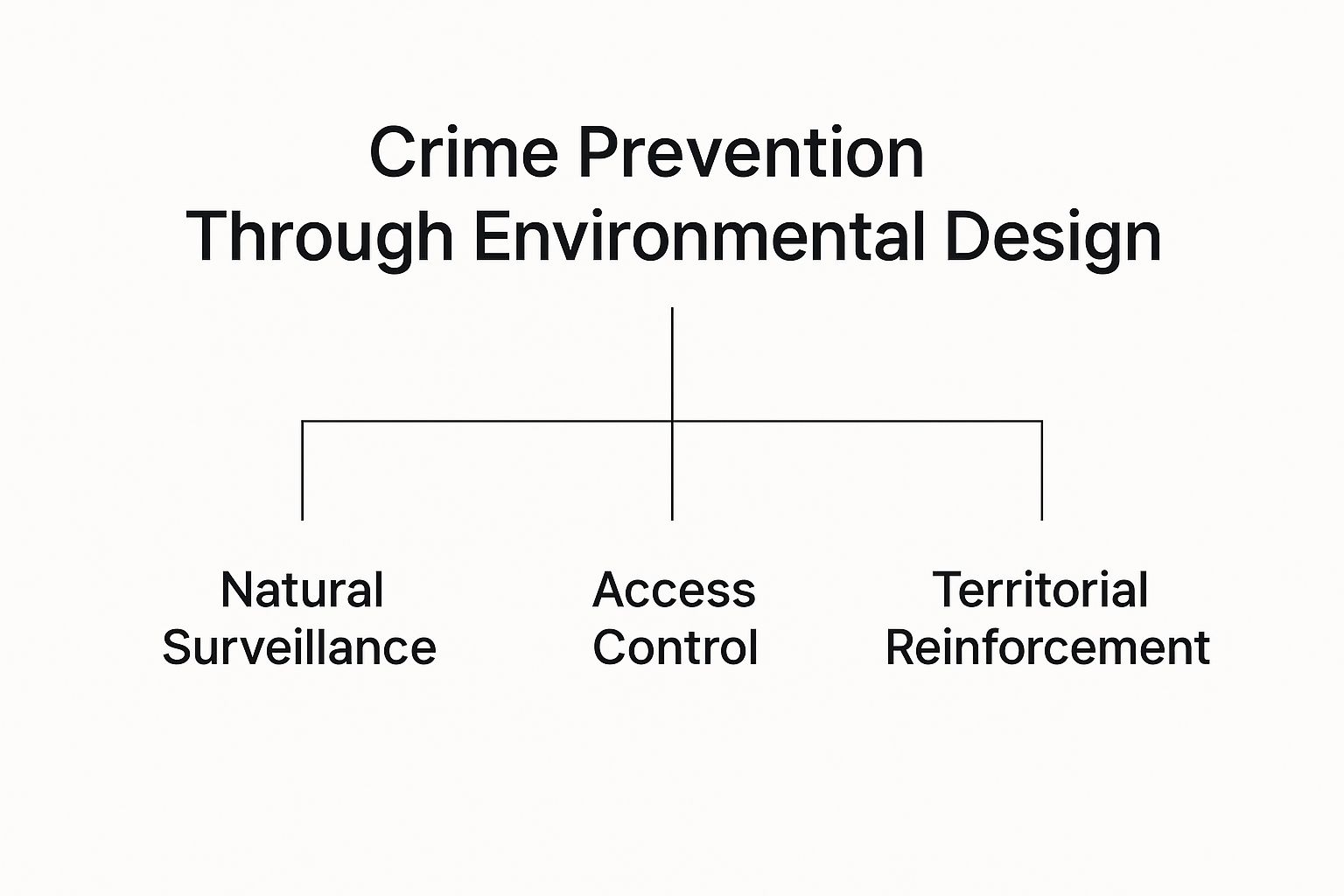
Now, let's dive deeper into the big three—natural surveillance, access control, and territorial reinforcement—and see how they work in the real world.
Putting More Eyes on the Street with Natural Surveillance
Of all the ideas in CPTED, natural surveillance is probably the most intuitive. It’s based on a simple human truth: criminals don’t like an audience. This strategy is all about designing spaces where seeing and being seen is just a normal part of the day.
Think of it as an organic, 24/7 neighborhood watch, but without the sign-up sheets or official meetings. It’s about creating an environment that naturally encourages people—residents, employees, even just passersby—to act as informal guardians of the space. By making everything more visible, we make the risk of getting caught feel much higher, turning a potential target into a much less appealing one.
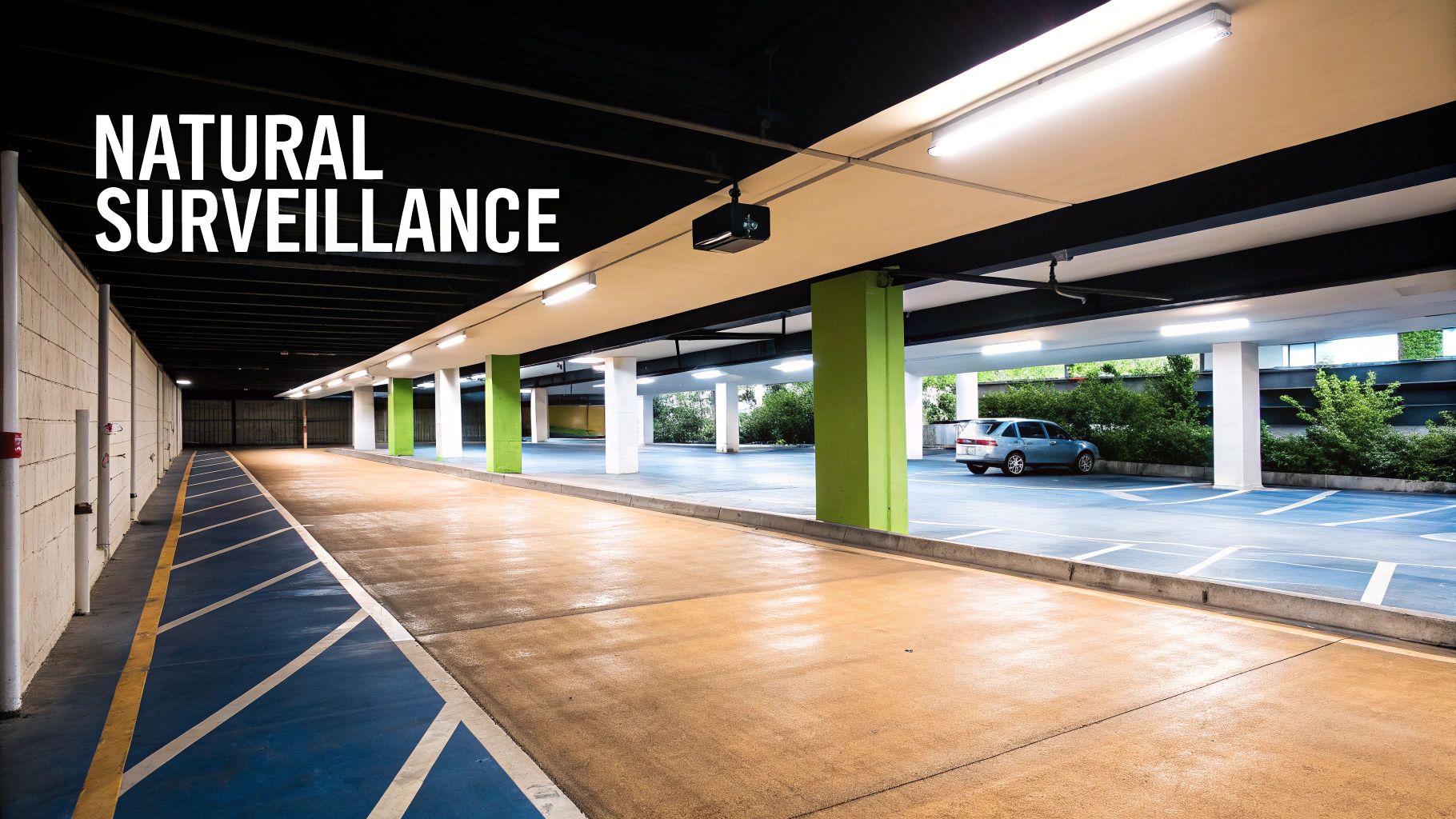
This doesn’t mean you need to install a high-tech camera on every corner. It’s actually simpler than that. The whole idea revolves around smart, often low-cost design choices that put more "eyes on the street" as a matter of course.
Strategies for Effective Natural Surveillance
The main goal here is to get rid of potential hiding spots and make it easy for the legitimate users of a space to see what’s going on around them. This usually comes down to three key areas: lighting, landscaping, and the way buildings themselves are designed.
To do it right, you have to consider how all these pieces fit together.
- Strategic Lighting: Good lighting isn't just about being bright; it's about being consistent. Well-placed fixtures should light up sidewalks, parking areas, and entrances without creating deep, dark shadows where someone could hide.
- Thoughtful Landscaping: This one is crucial. Trees should be trimmed up so their canopies start over 6 feet, and shrubs should be kept low, under 3 feet. This simple rule ensures that landscaping doesn't accidentally provide cover for someone with bad intentions.
- Architectural Placement: This is where the building itself does the work. Placing windows, porches, and balconies so they overlook public areas like streets, parks, and courtyards is a foundational CPTED concept. It puts people in a natural position to see what's happening outside.
The Critical Role of Windows and Glass
Windows are, quite literally, the eyes of a building. That makes them a cornerstone of any natural surveillance strategy. Large, clear windows on the ground floor of a business or home don't just let the people inside see out; they send a clear signal to anyone outside that the space is occupied and watched.
But here’s the trade-off. All that glass creates great visibility, but it's also a building's weakest link. This is where you need a modern security solution to bridge the gap. For instance, learning how to protect windows from break-ins with security film lets you keep that visibility without sacrificing safety.
This specialized film reinforces the glass, making it incredibly difficult for an intruder to break through. It allows for a completely clear view—perfect for natural surveillance—while creating a powerful barrier against forced entry. It essentially turns a building's biggest vulnerability into a real strength.
When you bring it all together—smart lighting, well-maintained landscaping, and transparent but secure windows—you create a space that almost polices itself. This approach empowers everyday people to become a passive, yet powerful, deterrent just by going about their day.
Guiding Behavior with Natural Access Control
If natural surveillance is all about "seeing and being seen," then natural access control is its partner in crime prevention. It’s all about guiding people through a space in a way that feels completely normal and secure. This isn't about throwing up giant walls or aggressive barriers. Think of it more like a gentle nudge, using the environment itself to direct foot traffic and make unauthorized entry feel awkward and obvious.
The whole point is to make it crystal clear where people are supposed to go—and, just as importantly, where they aren't. We do this by designing well-defined pathways and entrances that feel intuitive for visitors and employees, but incredibly conspicuous for someone with bad intentions. A building with one clear, visible main entrance is always going to be more secure than one with a dozen hidden side doors that are impossible to keep an eye on.
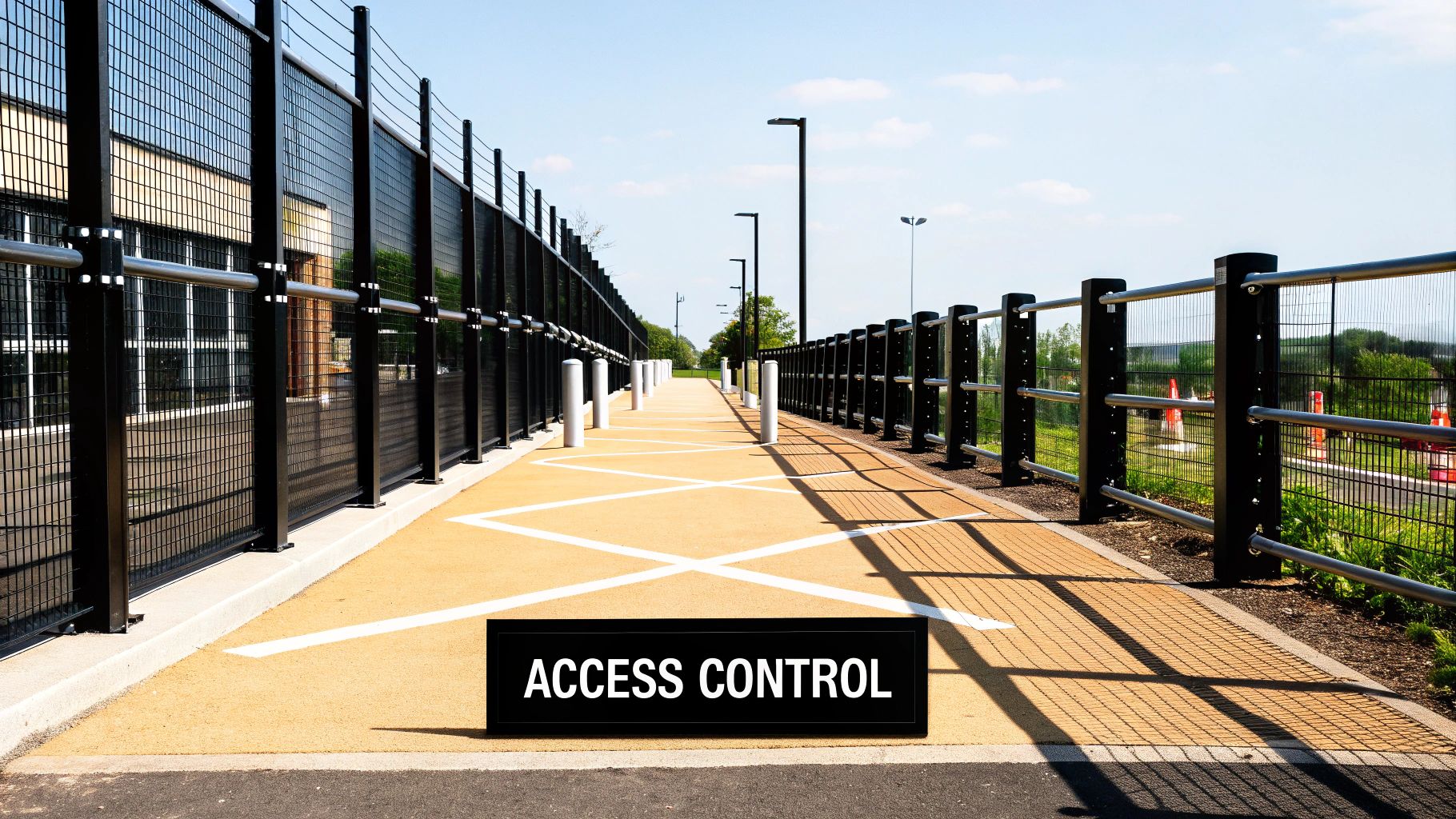
This strategy cleverly filters who comes and goes without making the property feel like a fortress. The design itself does all the heavy lifting, separating public from private spaces naturally.
Differentiating Public and Private Spaces
At its core, natural access control is about creating a clear transition from public to private areas. You're essentially sending a non-verbal cue that says, "You are now entering a controlled space." This can be done with surprisingly simple and attractive design choices.
- Pathways and Walkways: Using different paving stones, low-level lighting, or landscaping to define the main path makes people less likely to wander off and cut through private yards or restricted zones.
- Gateways and Entrances: Things like arches, porticos, or even just clearly marked doorways act as a psychological threshold. They signal a shift in environment and purpose.
- Landscaping: Thoughtfully placed hedges, flower beds, and low fences are perfect for channeling foot traffic without blocking sightlines, which reinforces the property's boundaries.
These subtle nudges make it obvious who belongs and who doesn't. A potential intruder has to consciously cross a boundary, which immediately makes them stand out.
Natural access control works by making a criminal feel like the effort and risk of getting caught are just too high. When a property has a single, clear entry point, it creates a natural chokepoint where an offender feels exposed and easily identified.
Securing Vulnerable Access Points
While directing foot traffic is a huge part of the puzzle, you can't forget about the most common targets for forced entry: your windows and glass doors. Beefing up these weak spots is a non-negotiable part of any solid access control plan. The trick is to add that extra strength without losing the open, welcoming aesthetic that CPTED is all about.
Thankfully, modern technology gives us ways to fortify these areas without anyone even noticing. For a full breakdown of your options, check out our guide on how to secure windows from break-ins.
Security window film, for instance, is a fantastic tool for natural access control. It makes glass incredibly difficult to break, which can delay an intruder long enough for help to arrive or stop them altogether. It’s a layer of protection that blends seamlessly into the CPTED philosophy, hardening a building’s perimeter while being virtually invisible.
Fostering Ownership with Territorial Reinforcement
Beyond just watching a space or guiding how people move through it, crime prevention through environmental design taps into a powerful psychological trigger: a sense of ownership. This is the core of territorial reinforcement. At its heart, the idea is simple—people protect what they feel is theirs.
Think about a homeowner who pours love into their front yard. The perfectly manicured lawn, the bright flowerbeds, and maybe a small, tasteful fence all send a clear, unspoken message. This place is cared for. This place is claimed. That feeling of pride and ownership is a surprisingly effective deterrent for would-be criminals.
Territorial reinforcement is all about creating obvious distinctions between public, semi-private, and private areas. When these lines are clear, it encourages residents to feel responsible for their patch and gives them the confidence to question unfamiliar faces. An intruder feels much more exposed and out of place stepping into a space that is obviously private than they would wandering through an ambiguous, undefined zone.
Defining Boundaries to Deter Crime
The objective here is to use environmental cues to show exactly where public space ends and private space begins. This doesn't mean you need to build a fortress. In fact, subtle design choices are often far more effective because they establish a boundary without blocking sightlines.
You can create these cues in a number of ways:
- Landscaping Borders: Think low hedges, rows of shrubs, or even just a well-defined garden bed marking the edge of a property.
- Low Fencing: A classic picket fence or a decorative railing does the job perfectly, marking a clear boundary without creating a visual barrier.
- Architectural Transitions: Simple things like a change in pavement texture, a different color of stone, or a single step up can signal the transition from a public sidewalk to a private entrance.
- Clear Signage: A well-placed sign marking a "Residents Only" patio or a community garden makes the ownership official.
When a space is clearly defined and cared for, it projects an image of an engaged and watchful community. This tells a potential criminal that the residents are not passive bystanders; they are active guardians of their environment, which significantly increases the perceived risk of being caught.
This isn't just a fringe theory; it's a strategy woven into official urban planning frameworks around the world. In places like the UK and the Netherlands, CPTED principles are a standard part of national guidelines for designing safe housing and public areas. To see how this works in practice, you can explore these CPTED review findings and see how territoriality is applied in modern city planning.
Fortifying the Boundary
Symbolic boundaries are incredibly powerful, but the physical boundary itself—especially the windows and glass doors facing public areas—can still be a weak point. This is where security window film becomes an essential part of territorial reinforcement.
By applying a high-performance security film to ground-floor windows, you can physically harden that perimeter without sacrificing the welcoming aesthetic that CPTED champions. The film makes the glass incredibly difficult to break through, reinforcing the line between public and private with a nearly invisible layer of protection. It ensures the clear boundaries you’ve worked so hard to establish are not just symbolic, but physically secure.
Why Maintenance and Management Matter
You can have the most thoughtfully designed space—perfect sightlines, clear pathways, defined boundaries—but it can all unravel without the final, crucial piece of the puzzle. This is where maintenance and management, the fourth pillar of crime prevention through environmental design, steps in. It's the ongoing commitment that keeps all the other strategies working as intended.
Think about a park with broken lights, trash cans overflowing, and graffiti scrawled on the walls. Even if it was originally designed for great visibility, the neglect sends a powerful message. It screams that no one is paying attention and that disorder is the norm, creating an atmosphere where crime feels a lot less risky.

This concept is often explained by the "broken windows theory." The theory basically says that visible signs of decay—like a single broken window left unfixed—can invite more serious crime by signaling that nobody is in control. Consistent upkeep is the direct antidote.
The Message of a Well-Kept Space
Maintenance is about so much more than just mowing the lawn or patching up a fence. It's the active, consistent care that communicates a space is valued and watched over. This ongoing effort is the glue holding the other CPTED principles together, reinforcing their effects day in and day out.
Effective maintenance boils down to a few key actions:
- Prompt Repairs: Fixing broken windows, locks, or gates right away shows the property is actively managed and secure.
- Rapid Graffiti Removal: Getting rid of graffiti as soon as it appears sends a clear message that vandalism won't be tolerated.
- Landscaping Upkeep: Keeping trees and shrubs trimmed ensures they don’t overgrow and create the very blind spots natural surveillance is meant to prevent.
- Lighting Checks: Regularly replacing burnt-out bulbs is non-negotiable for maintaining visibility and safety after dark.
A well-maintained environment projects an image of an alert and engaged community. This tells potential offenders that people are present, watchful, and likely to report anything suspicious, making the space a much less attractive target.
Ultimately, maintenance is the steady pulse that reinforces territoriality and surveillance. It ensures the physical environment consistently supports the goal of preventing crime, proving that a safe space isn't just about the initial design—it's about the long-term commitment to its care. It’s the quiet, daily work that makes a secure design truly last.
Seeing CPTED Succeed in the Real World
It’s one thing to talk about crime prevention through environmental design in theory, but it's another to see it work in the real world. When these strategies are put into action, the results aren't just academic—they're real, measurable improvements that make communities safer and genuinely better places to live. The proof is in the data from projects that show how good design can be an incredibly effective crime-fighting tool.
From quiet residential streets to bustling commercial hubs, CPTED has consistently led to significant drops in criminal activity. We're not talking about small statistical blips, either. These are major reductions in crime that have a direct, positive impact on people and businesses.
By simply making spaces more visible, controlling who comes and goes, clearly defining property lines, and keeping things well-maintained, communities have turned problem spots into secure, vibrant environments.
The Numbers Tell the Story
Hard data from case studies really brings the success of this approach into focus. For instance, a well-known study of the Five Oaks project in Ohio saw a 26% reduction in recorded crime after putting CPTED measures like better lighting and controlled access points in place.
Digging deeper, research across different cities and countries shows even more impressive outcomes. Some areas have reported crime reductions between 40% and over 60% after rolling out a full CPTED plan. You can explore more about these CPTED program outcomes to see just how powerful the impact can be.
These wins highlight a crucial point: investing in the design of your environment is a smart, proactive security measure that pays off. It proves that small, strategic tweaks can create huge improvements in public safety.
The real magic of CPTED is how subtle it is. It doesn't rely on aggressive, in-your-face security. Instead, it quietly changes the very conditions that let crime happen in the first place, making safety feel like a natural part of the environment itself.
Putting these strategies to work effectively always starts with a careful look at a property’s unique weak spots. You have to know where your vulnerabilities are before you can build a targeted CPTED plan. A great way to understand this process is to learn about professional security threat assessments, which provide a roadmap for finding and fixing risks before they turn into real problems.
Answering Your CPTED Questions
Even after grasping the core principles, people often have a few practical questions when they start thinking about crime prevention through environmental design. Let's dive into some of the most common ones to clear things up.
Does CPTED Cost a Fortune?
This is usually the first question on everyone's mind. The short answer? Not at all. While you could spend a lot on major architectural overhauls, some of the most effective CPTED strategies are surprisingly affordable.
Think about it: trimming back overgrown bushes that block sightlines, upgrading to brighter light bulbs in shadowy corners, or even just a fresh coat of paint on a tired-looking fence can make a world of difference. For new builds, baking these concepts into the design from day one often adds little to no extra cost compared to the headache of retrofitting later.
Can I Use CPTED on My Existing Property?
Absolutely. While it's certainly easiest to design a space with CPTED in mind from the ground up, it's incredibly effective for existing homes and businesses. Retrofitting is all about making smart, targeted upgrades.
This could look like:
- Installing modern, brighter LED fixtures in a dim parking garage.
- Adding low-profile fencing or manicured hedges to clearly mark where your property begins.
- Applying security window film to strengthen vulnerable glass doors and windows.
It all starts with a good, hard look at your property to see where you can get the most bang for your buck.
Will This Make My Building Look Like a Prison?
This is a big one, but the answer is a firm no. In fact, the goal is the exact opposite. CPTED is about creating environments that feel safer and more welcoming, not like a lockdown facility.
The real genius of CPTED is how subtle it is. It's not about barbed wire and bars. It's about using natural, everyday elements—thoughtful landscaping, well-lit pathways, and clear lines of sight—to boost security without sacrificing the look and feel of the space. The aim is a place that feels open and positive for its intended users, but risky and exposed for a potential criminal.
Is CPTED a 100% Guarantee Against Crime?
Let's be realistic: no single strategy can promise to eliminate 100% of crime. That's just not how the world works. But CPTED has a proven track record of significantly reducing both the frequency of crime and the fear that comes with it.
It works by tipping the scales—making criminal activity harder to pull off, easier to spot, and far less likely to succeed. That makes it one of the smartest, most proactive security investments you can make.
Ready to strengthen your property's most vulnerable points without compromising its appearance? Fortress Security Films offers advanced window security solutions that integrate seamlessly into any CPTED strategy. Discover how our invisible protection can fortify your home or business by visiting us at https://fortresssecurityfilms.com.
