


Commercial window security film is essentially an invisible shield for your building's glass. It's a high-tech polyester material that gets applied directly to your existing windows, reinforcing them to hold shattered panes together when struck.
The main goal? To deter forced entry, minimize blast hazards, and protect people from flying glass shards during a storm or an accident. It’s like adding a layer of armor to your most vulnerable spots without changing how they look.
How Window Security Film Protects Your Business
At its heart, security film transforms your standard glass into a much stronger safety barrier. Think about the windshield in your car—when a rock hits it, it spiderwebs but doesn't explode into the vehicle. Security film applies that same idea to the windows of your office, retail store, or warehouse.
The magic comes from two key elements: incredibly tough, tear-resistant layers of polyester and a super-strong adhesive that creates a permanent bond between the film and the glass.
When something hits a window treated with security film, the impact is absorbed and spread out across the entire pane. The glass will still break, but instead of shattering everywhere, the broken pieces stick firmly to the film. This simple but powerful function creates a tough obstacle with several protective benefits.
This image really drives the point home, showing the difference between a standard window and one with security film after being hit.
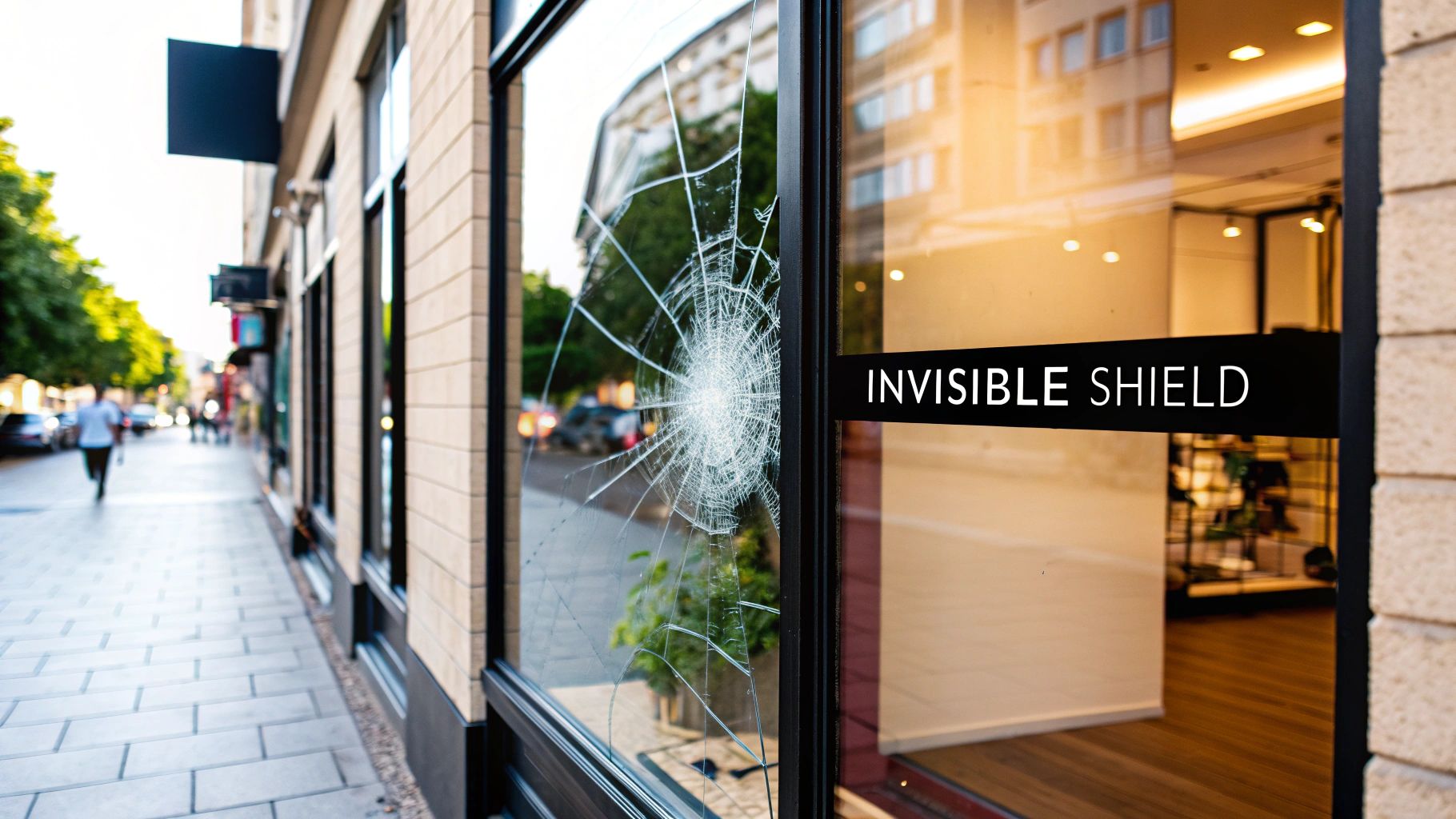
It’s a stark contrast. The untreated glass is a gaping hole, while the film holds the broken pane in the frame, keeping the barrier intact.
Delaying Intruders and Denying Access
The most obvious advantage is stopping break-ins. What would be a quick smash-and-grab on a normal window turns into a loud, difficult, and drawn-out effort. That extra time and noise are usually more than enough to convince a burglar to give up and run.
The primary goal of security film is not to make glass unbreakable, but to make breaching it so difficult and time-consuming that it thwarts the attempt. It buys critical time for alarms to sound and authorities to respond.
Mitigating Damage from Natural Disasters
Beyond thwarting criminals, this film is a huge asset when it comes to mother nature. During hurricanes, tornadoes, or even earthquakes, the biggest threat to people inside is often flying glass. The film contains these dangerous shards, protecting both your staff and your assets.
By keeping the window sealed even after it breaks, the film also plays a key role in preventing water damage for commercial properties during a major storm.
This dual-purpose protection is why the market is booming. Global spending on security films hit around $1.2 billion recently, and it's projected to nearly double to $2.3 billion by 2033. It's a clear sign that more and more property managers see this as an essential investment.
Here’s the rewritten section, designed to sound completely human-written and natural.
The Real-World Benefits of Installing Security Film
So, we've talked about what security film is, but what does it actually do for a business owner on a day-to-day basis? It's about more than just stronger glass. Installing a quality security film brings a whole host of real-world advantages that protect your people, your property, and even your bank account.
Let's dig into what this technology really means for your operations.
The most obvious win is beefed-up protection against forced entry. Your standard commercial glass is, frankly, an open invitation for a quick smash-and-grab. Security film completely changes that equation, turning a weak point into a real headache for any would-be intruder.
Picture a retail shop on a quiet street late at night. Someone tries to shatter the storefront window, expecting to be in and out in seconds. Instead of the glass exploding inward, it just spiders into a thousand cracks and holds tight in the frame. The thief is left hammering away, making a ton of noise and wasting precious time. More often than not, that's enough to make them give up and run.
Protecting People During Unexpected Events
While deterring crime is a huge part of the appeal, the film’s role in protecting people is arguably even more critical. In the chaos of an earthquake, a hurricane, or even a nearby explosion, shattered windows can turn deadly, sending shards of glass flying like shrapnel.
Even a simple accident, like a car jumping the curb and hitting a storefront, can fill a space with dangerous glass fragments in an instant.
By holding the broken glass together, commercial window security film dramatically cuts down the risk of serious cuts and injuries. It keeps your employees and customers safer when things go sideways.
This one feature can turn a potentially tragic event into a much more contained and manageable one. It’s all about protecting your most important asset: your people.
Shielding Assets from Costly UV Damage
Here’s a benefit that often flies under the radar: protection from the sun's damaging ultraviolet (UV) rays. We all know what UV does to our skin, and it’s just as ruthless to your interiors.
Think about the high-end merchandise in your window display or the beautiful furniture in your office lobby. Day after day, the sun is silently bleaching the color out of them. Without any protection, you'll start to see:
- Faded Fabrics: Your vibrant carpets, curtains, and upholstery will look dull and washed out.
- Damaged Goods: Retail products, especially things like clothing or artwork, can be ruined.
- Degraded Finishes: The sun can cause permanent harm to hardwood floors and wood furniture.
Most quality security films block up to 99% of damaging UV rays. It’s like an invisible, powerful sunscreen for everything inside your building. This simple feature preserves the look and value of your assets, saving you a fortune in replacement costs over the long run.
Unlocking Significant Energy Savings
Many of today's advanced security films pull double duty by also rejecting a significant amount of solar heat. This is a game-changer for your building's energy efficiency. By blocking a large portion of the sun's heat from ever entering through the glass, the film keeps your interior spaces cooler, especially in the summer.
What does that mean for you? Your air conditioning system doesn't have to fight nearly as hard to keep the building comfortable. Top-tier films can reduce solar heat gain by 50–80%, which can translate into a surprising 5–15% drop in your annual HVAC costs.
Considering that commercial buildings in the U.S. account for almost 40% of all energy consumption, this is a powerful way to cut down on overhead. You can dive deeper into how window films affect energy use by reviewing market insights on consumption and sustainability. Suddenly, security film isn't just an expense; it's a smart investment that can start paying for itself from the moment it's installed.
How to Choose the Right Security Film
Picking the right commercial window security film isn’t just about grabbing the thickest or most expensive option off the shelf. It’s a bit more nuanced than that. The real goal is to match the film’s specific strengths to your building’s unique weak points. Get this right, and you'll have the exact protection you need without wasting a dime.
Think of it like buying tires. You wouldn't put standard road tires on a heavy-duty truck that's about to head into rough, off-road terrain. In the same way, the film you'd choose for a small retail boutique worried about smash-and-grabs is going to be completely different from what’s needed for a government building in a high-threat area.
While it might seem complex at first, the decision really comes down to a few key factors that make all the difference.
Understanding Film Thickness and Its Role
The single most important factor you’ll look at is the film’s thickness, which is measured in mils. A mil is simply one-thousandth of an inch. It sounds tiny, but in the world of security film, the difference between a 4 mil film and a 14 mil film is massive.
A film’s thickness is directly tied to its tear strength and its ability to absorb and spread out the force of an impact. Thicker films can take a harder hit for a longer time, making them a much tougher barrier to get through.
Key Takeaway: Film thickness is the number one indicator of strength. A higher mil count means greater resistance to everything from forced entry and bomb blasts to severe storm impacts.
Nailing down the right thickness is the first and most critical step in creating a window security system that actually works.
Matching Mil Thickness to Your Security Needs
The right mil level for your business really depends on what you're trying to protect against. In the commercial world, these needs generally break down into a few clear tiers.
To make this easier, here’s a quick breakdown of how different film thicknesses line up with common business security needs.
| Film Thickness (Mil) | Primary Use Case | Ideal for |
|---|---|---|
| 4-7 mil | Basic Safety & Deterrence | Retail storefronts, offices, and restaurants needing smash-and-grab prevention and protection from accidental breakage. |
| 8-11 mil | Enhanced Security | Businesses with high-value assets, locations in higher-crime areas, or those needing a stronger barrier against forced entry. |
| 12-21+ mil | Maximum Protection | Government buildings, critical infrastructure, data centers, and facilities requiring blast mitigation or defense against determined attackers. |
This table gives you a solid starting point for a conversation with a professional installer. You can see how the protection level scales up pretty dramatically as the film gets thicker.
This decision tree infographic helps visualize how different security needs point to the value of installing a protective film.
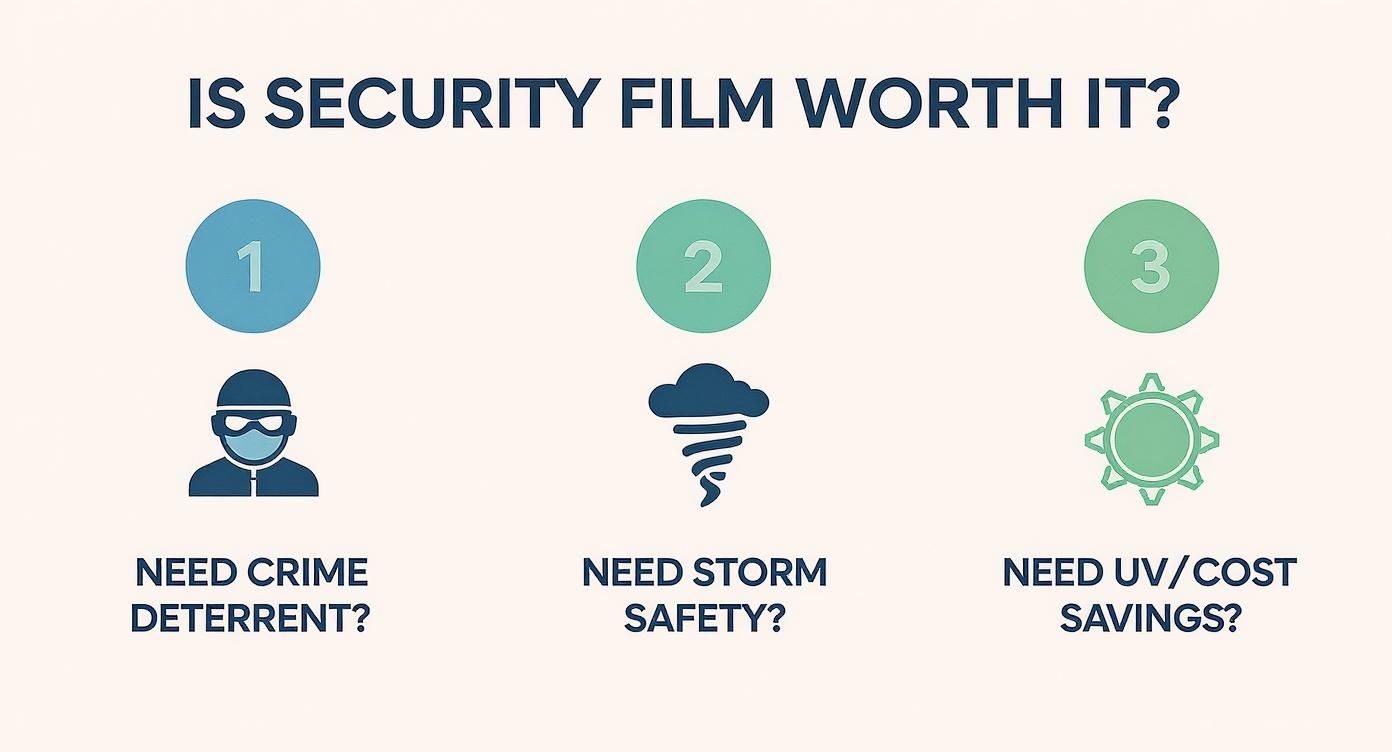
As the visual lays out, whether your main worry is crime, weather, or even just high energy bills, security film is a direct and effective solution.
The Critical Importance of Adhesives and Attachment Systems
Here’s something many people overlook: a security film is only as good as its bond to the glass and, just as importantly, to the window frame. The adhesive used is a special pressure-sensitive formula that actually gets stronger over time, creating a permanent bond that holds shattered glass together.
But for true, high-level security, you need to anchor the film to the frame itself. This is done with an attachment system.
Think of an attachment system as the final step that locks everything together. It’s a structural silicone or mechanical frame that bonds the edges of the film-coated glass directly to the window frame, creating one solid, unified barrier. Without it, a determined intruder could just push the entire sheet of broken glass out of its frame, film and all.
Exploring Specialty Film Options
Today’s films do more than just provide security. Many new options bundle security with other valuable benefits, allowing you to solve several problems with a single installation.
Here are a few popular choices:
-
Tinted and Solar Control Security Films: These films are the ultimate multi-taskers. They give you serious protection while also rejecting solar heat to lower your energy bills, cutting down on glare, and adding a layer of privacy.
-
Anti-Graffiti Films: Perfect for ground-floor windows, these are essentially sacrificial films installed on the exterior. If someone vandalizes the glass with paint or etching, you just peel off the damaged film and replace it. It's a cheap and easy fix compared to replacing an entire pane of glass.
-
Decorative Security Films: Need privacy but don't want to lose natural light? Frosted, patterned, or decorative films are a great solution. They can obscure the view into places like conference rooms or private offices while still reinforcing the glass against impact.
Choosing the right film is all about taking a clear-eyed look at your property's risks and your business goals. By getting a handle on thickness, attachment systems, and these specialty options, you can work with a professional installer like Fortress Security Films to design a solution that truly lets you rest easy.
What to Expect During Professional Installation
The best security film in the world won't do its job if it's not installed correctly. This is one area where trying to DIY can completely undermine the product's effectiveness and even void your warranty. Getting it done by a seasoned professional is the only way to guarantee the film performs as promised.
Let's walk through what a proper, professional installation looks like so you know exactly what to expect.
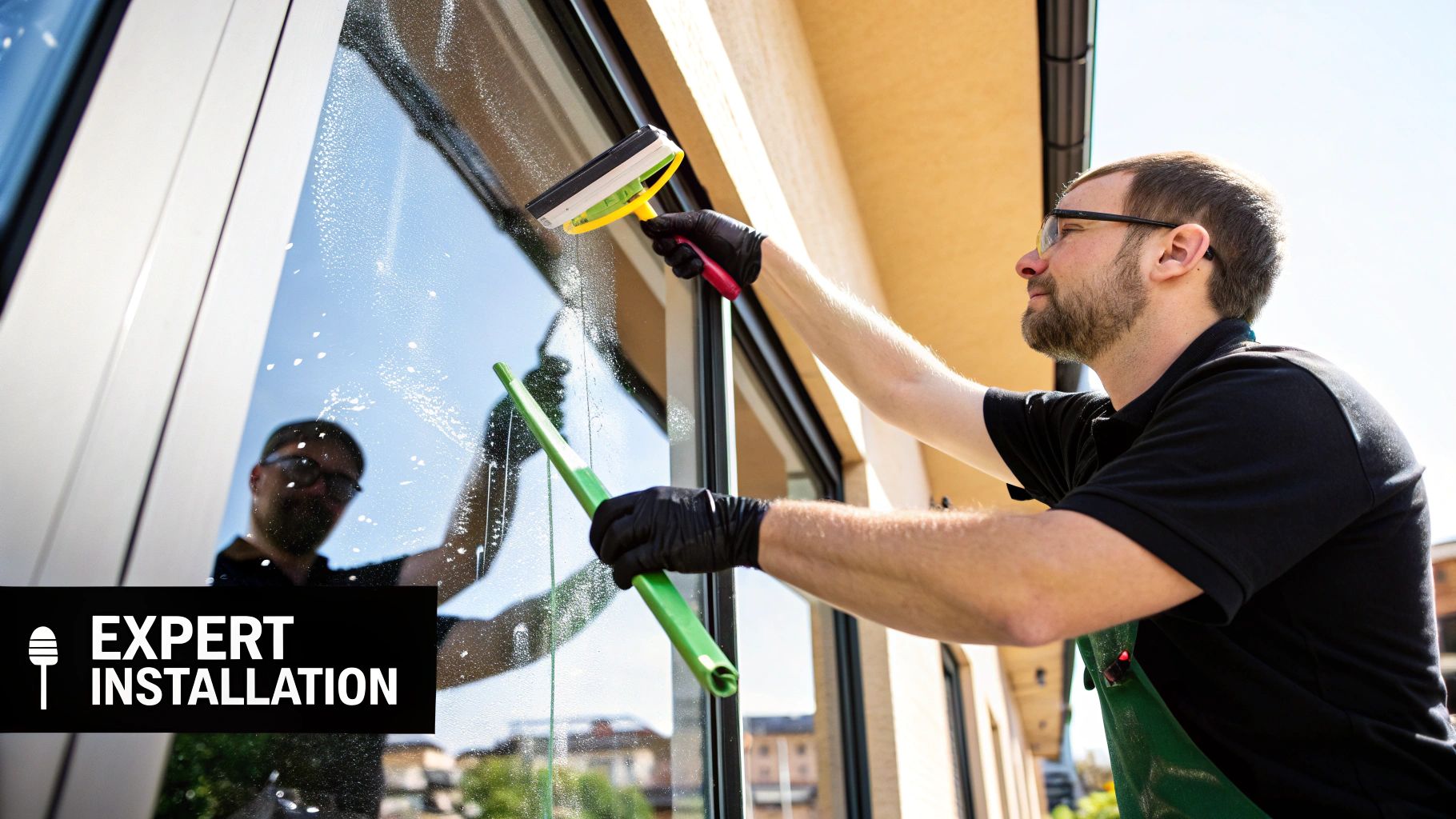
The entire process is designed to be as clean and non-disruptive as possible. From the first measurement to the final inspection, every step is deliberate and calculated to create that powerful, invisible shield on your glass.
The Initial Consultation and Preparation
It all starts with a conversation. Before a single roll of film is touched, a technician will come to your property to get a handle on your security goals. They'll assess your windows and, most importantly, take meticulous measurements.
There's no room for error here. A film cut just a fraction too small can leave a vulnerable gap, while one that's too large won't seal properly at the edges. Once the measurements are locked in, your installation is scheduled. On the day, the team arrives with the pre-cut film and gets right to work on the most crucial prep step: cleaning the glass.
This isn't your average spray-and-wipe job. Installers use specialized solutions and tools to strip away every bit of residue, grime, and microscopic dust from the interior surface of the glass.
A perfectly clean surface is the foundation of a successful installation. Even a single speck of dust can create a bubble or imperfection, which is not just an aesthetic issue but a potential weak point in the security barrier.
The Application Process
With the glass prepped to perfection, the real skill comes into play. The installer peels the protective liner from the film, spritzing both the sticky side of the film and the window pane with a special slip solution. This soapy water mixture is the secret sauce that allows them to slide the large sheet of film around and float it into the perfect position.
Once it's aligned, the squeegee comes out. Using firm, methodical, overlapping strokes, the installer works from the center out, pushing the slip solution to the edges. This does two critical things at once:
- It activates the adhesive: Forcing the water out creates the pressure-sensitive bond that anchors the film to the glass.
- It ensures clarity: This step meticulously removes any air bubbles or water pockets for a completely smooth, distortion-free view.
Finally, the installer uses a razor-sharp trimming tool to finish the edges, leaving a clean, almost invisible line that fits the frame perfectly.
The Final Curing Period
Even after the installers pack up and leave, the job isn't quite finished. The commercial window security film now needs to "cure." This is simply the time it takes for the last bits of microscopic moisture trapped between the film and the glass to evaporate.
As this happens, the adhesive bond gets stronger and stronger until it reaches its maximum strength. This curing period can take anywhere from a few days to a few weeks, depending on the film's thickness, the amount of sunlight the window gets, and the humidity in your building.
You might see a little haziness or a few small water pockets during this time—don't panic, that's completely normal. The key is to leave the windows alone. No cleaning, no touching. Once fully cured, the film will be crystal clear and permanently bonded, ready to do its job.
Understanding the Cost and Return on Investment
When it comes to any upgrade for your business, the bottom line is always front and center. I get it. But it's important to see commercial window security film as a strategic investment in your property's resilience, not just another line-item expense. Getting a handle on the costs involved and the real-world returns you can expect is the key to making a confident decision.
The price isn't a simple, off-the-shelf number. It’s calculated based on a few key variables that define the scope and complexity of your specific project. Once you understand these factors, you can budget effectively and see the genuine long-term value this solution provides.
Breaking Down the Primary Cost Factors
The final quote you receive from a professional installer will hinge on several key elements. Each one plays a part in the total investment required to fortify your building's glass.
Here's what goes into the calculation:
- Total Square Footage: This is the most obvious factor. The more glass you need to cover, the more film and labor time will be needed. Simple as that.
- Film Thickness (Mil): As we covered earlier, thicker films offer much greater protection, but they also cost more. That’s because the materials and manufacturing are more advanced. A standard 4 mil film will be less per square foot than a heavy-duty 14 mil film designed for maximum impact resistance.
- Window Complexity: A big, flat, rectangular window is a straightforward job. But what about windows with odd shapes, lots of small panes like you see in French doors, or hard-to-reach skylights? These increase the labor time, which in turn bumps up the cost.
- Attachment Systems: If you decide to add a mechanical or wet-glaze attachment system to anchor the film to the window frame, that will add to the final price. For high-risk areas, though, this extra security is an essential and incredibly valuable upgrade.
As a general ballpark, you can expect the cost for a professional installation to run anywhere from $8 to $20 per square foot. Where your project lands in that range will depend entirely on the specific combination of the factors above.
Analyzing the Long-Term Return on Investment
If you only look at security film as an upfront cost, you're missing the bigger picture. Think about it: a single thwarted break-in can save you thousands—or even tens of thousands—of dollars in stolen goods, property damage, and business downtime. That one event could pay for the entire installation many times over.
The true value of security film is measured not just by its upfront cost, but by the losses it prevents. It's a proactive investment in business continuity and peace of mind.
And the financial benefits don't stop at crime prevention. Many business owners I’ve worked with are pleasantly surprised to find multiple ways the film pays them back, making the initial investment even smarter.
For instance, many insurance companies see security film as a serious risk-mitigation measure. You may actually qualify for a discount on your commercial property insurance premiums after the installation, creating a direct and ongoing financial return.
Better yet, if you opt for a film that also has solar control properties, you unlock another powerful benefit. By blocking a significant amount of solar heat, these films can dramatically lower your air conditioning costs in the warmer months. This drop in your energy bills provides a steady, measurable return year after year, helping the system pay for itself over time—all while making your workspace more comfortable for everyone.
When you add up the savings from prevented theft, potential insurance discounts, and lower energy bills, the financial case for commercial window security film becomes incredibly compelling.
Keeping Your Security Film in Top Shape
Once your commercial window security film is installed and fully cured, you might be surprised by how easy it is to maintain. This isn't some delicate piece of technology requiring special handling. A little common-sense care is all it takes to keep it looking and performing its best for years.
The most important part of upkeep is simply cleaning it correctly. You just want to get the smudges and dust off without accidentally scratching the film’s tough outer layer. That means staying away from abrasive tools and harsh chemicals.
The Right Way to Clean Security Film
You don’t need a cabinet full of specialty products. The best approach is usually the simplest one—a gentle cleaning solution and the right kind of cloth will do the job perfectly without putting your film at risk.
Here’s what to do (and what to avoid):
- DO use a simple mix of mild dish soap and water. A few drops in a spray bottle is perfect.
- DO use soft tools. Think microfiber cloths, new synthetic sponges, or a good-quality rubber squeegee.
- DO dry the surface gently with a fresh microfiber cloth to avoid water spots.
- DON'T ever use ammonia-based cleaners (Windex is a common one). Ammonia can slowly eat away at the film's adhesive.
- DON'T use anything abrasive. Scouring pads, gritty powders, or rough paper towels can easily create permanent scratches.
For businesses that want to ensure their windows are always spotless, it’s a good idea to bring in the pros. If you're looking for help, you might consider commercial window cleaning services in Phoenix Arizona.
How Long Does It Last and When to Replace It
High-quality security film is incredibly durable. When it's installed by a professional and you take basic care of it, you can expect the film to last anywhere from 10 to 20 years. In some cases, it can last even longer, depending on the film type and how much direct sun it gets.
Over its life, the film will be working 24/7 to protect your property. But just like any other part of a building, it will eventually wear out and need to be replaced.
Keep an eye out for a few tell-tale signs. If you start to see bubbling, the edges peeling back, or the film taking on a cloudy or purplish tint, it’s a clear signal that its time is up. Those are signs that the adhesive and layers are breaking down, and it's time to call a professional for removal and replacement to keep your security intact.
Frequently Asked Questions About Commercial Security Film
It's completely normal to have a few lingering questions, even after getting a good sense of the benefits and the installation process. I've heard them all over the years. This FAQ section is here to give you straightforward answers to the most common things business owners ask, so you can feel confident you're making the right choice.
Let's clear up some of the most common points of confusion, from how the film looks to how it performs in a real-world scenario.
Will Security Film Make My Windows Dark or Reflective?
This is probably the number one myth out there. Most high-quality security films are optically clear, which means that once they're properly installed, you won't even know they're there. The goal is to strengthen your glass without changing the look of your building, keeping your storefront bright and welcoming.
Now, if you want to add privacy or cut down on glare and heat, you absolutely can. Many businesses opt for combination films that blend security features with solar control. You can get tinted or even reflective versions, but that's a choice, not a requirement. A standard security film installation is completely invisible.
Key Takeaway: You're in the driver's seat on this one. You can go for crystal-clear film for pure, invisible protection, or you can choose a tinted version to add privacy and energy savings to the mix.
This flexibility means you never have to sacrifice your brand's aesthetic for peace of mind.
Is Commercial Window Security Film Bulletproof?
Let's be very clear on this one: standard commercial window security film is not bulletproof. It's designed to be shatter-resistant, and that's a huge difference. Its main job is to keep the glass intact when it's hit with a blunt object, rocked by a storm, or impacted by a blast.
It makes breaking through a window incredibly difficult for a smash-and-grab thief, but it won't stop a bullet. True ballistic protection requires much thicker, multi-layered films combined with specialized glass systems. That's a whole different category of product—and price point—typically reserved for places like government facilities or high-risk financial centers.
For the vast majority of businesses, the goal is to stop forced entry and protect people from flying glass, and that's exactly what standard security film is built to do.
How Long Does Installation Take for a Typical Storefront?
You’d be surprised at how fast a professional team can work. A skilled installation is designed to cause as little disruption to your day as possible. Of course, the exact time depends on the size and number of your windows, but a typical ground-floor storefront can often be done in just a few hours.
The installers show up with the film already cut to size and usually work from inside your building, so it’s a clean and efficient process. A good crew can handle anywhere from 500 to 1,000 square feet of flat glass per day. For most small or medium-sized businesses, this means the whole job is done in less than a business day. You get the protection you need with virtually no downtime.
Can the Film Be Removed in the Future?
Yes, it can. While the adhesive creates an incredibly strong bond to keep the glass together, it's not a permanent alteration. If you need to remove the film down the road—maybe you're moving, your lease is up, or you want to upgrade—a professional can take it off without damaging the window.
They use special steamers and solutions that soften the adhesive, letting them peel the film away cleanly. This is a great benefit, as it gives you a powerful security upgrade that isn't a forever commitment. It's a solution that can adapt as your business needs change.
Ready to add a powerful, invisible layer of protection to your business? The experts at Fortress Security Films can provide a comprehensive assessment and a custom solution that fits your exact needs. Secure your property today by visiting Fortress Security Films.
