


Think of commercial window film as more than just a roll of tint. It's a high-performance upgrade that turns your existing glass into a smart, efficient barrier. We’re talking about applying a specialized polyester layer that can dramatically slash energy bills, cut down on frustrating glare, and even protect your property from break-ins.
What Commercial Window Film Can Really Do for Your Building
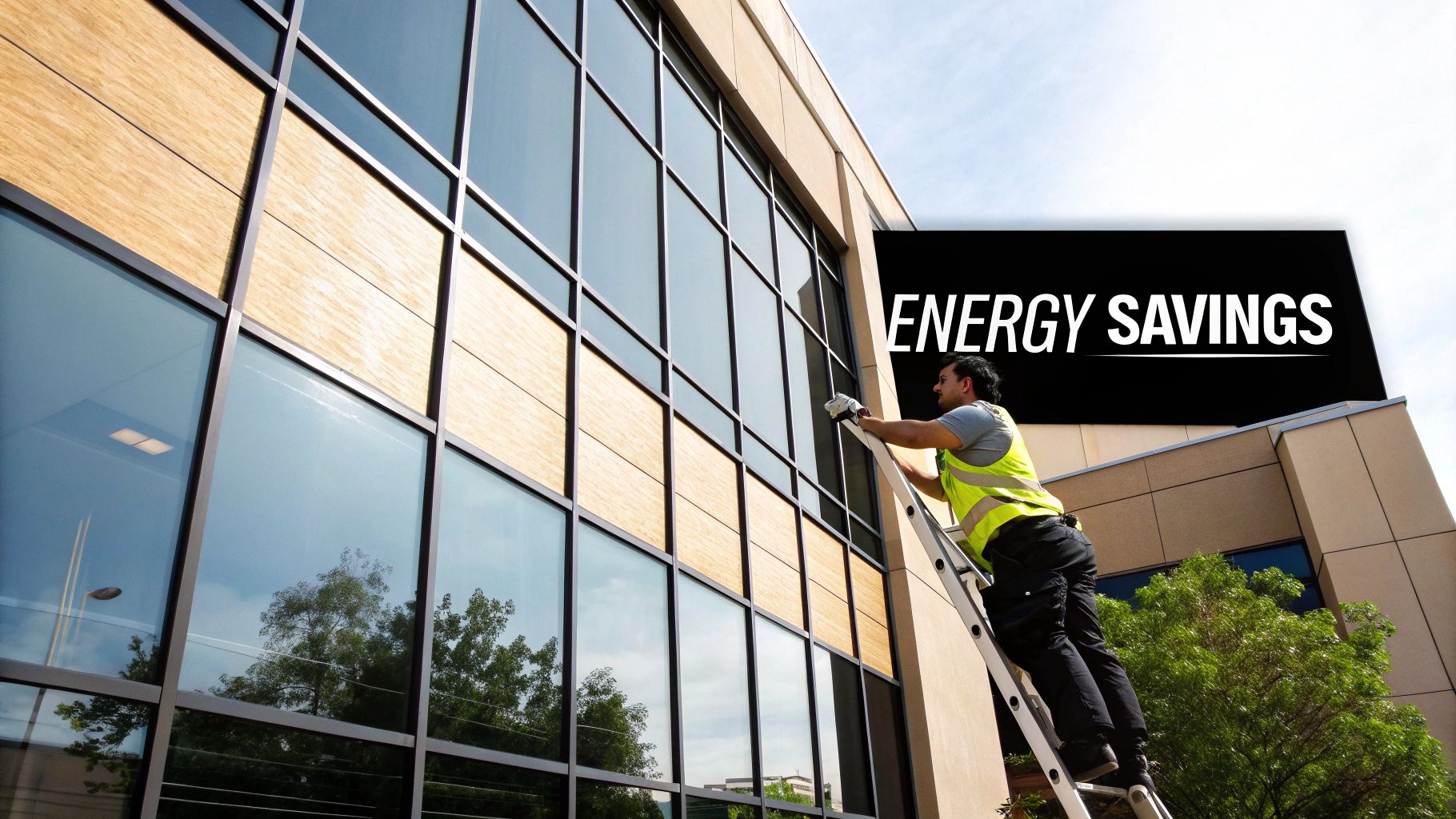
This guide is built on years of hands-on experience, not just technical specs. We're skipping the jargon to focus on what matters most: the real-world results you can expect. Let’s get into how these modern films can completely change your building's performance and give you a solid return on investment.
Many property managers I talk to initially see window film as a cosmetic touch. But its real value is in what it does. It's a functional upgrade that quietly works for you every single day, eventually paying for itself.
Far More Than Just Darkening Windows
The technology behind commercial window film has come a long way. Forget the bubbly, purple tint you see on old cars. Today's films are advanced materials designed to solve multiple building management problems at once. A professional commercial window film installation tackles several key issues:
- Slash Energy Costs: The right film can block up to 80% of solar heat, giving your HVAC system a much-needed break in the summer. It also helps lock in heat during the winter, trimming your utility bills year-round.
- Keep People Comfortable: Glare on computer screens and uncomfortable "hot spots" near windows can kill productivity. Film evens out the temperature, creating a more pleasant and effective workspace for everyone.
- Protect Your Assets: UV rays are brutal on interiors. These films block 99.9% of damaging UV light, preventing your expensive flooring, furniture, and retail merchandise from fading.
- Boost Safety and Security: Thicker security films are a game-changer. They're designed to hold shattered glass in place, which is a powerful deterrent against smash-and-grab burglaries and a crucial safety feature during storms or accidents.
This isn't just about shade. It's about adding an invisible, high-performance layer to your building that works 24/7 to boost efficiency and security without changing the look of your property.
A Smart Business Investment
At the end of the day, installing commercial window film is less of a renovation project and more of an operational upgrade. It’s a practical step toward making your building run smarter, safer, and more economically. Seeing how different films are applied to commercial and retail properties shows just how tailored the solutions can be.
This guide will walk you through the whole process, from picking the perfect film for your needs to understanding the long-term financial benefits. With the right information, you can make a decision you'll feel good about for years to come.
Choosing the Right Film for Your Building

Picking the right commercial window film is, without a doubt, the most critical decision you'll make. It’s easy to get bogged down in technical jargon like VLT (Visible Light Transmission) or TSER (Total Solar Energy Rejected). My advice? Forget the specs for a moment and focus on the problem you're actually trying to solve. Your goal is what truly dictates the best film for the job.
This isn't just about tinting your windows. It’s a strategic upgrade to your building's performance. Are you fighting a losing battle with afternoon heat? Concerned about smash-and-grab threats at your storefront? Or do you just need to add a bit of privacy to a ground-floor conference room? Each of these scenarios points to a completely different type of film.
Assess Your Building’s Primary Needs
Before you even think about calling an installer, do a walk-through of your property. Put on your detective hat. Watch how the sun hits different parts of the building throughout the day and make a list of the pain points. This little bit of homework will arm you with the right questions and ensure your commercial window film installation delivers real value.
A west-facing office with floor-to-ceiling glass, for instance, is going to get blasted with heat and glare every afternoon, sending HVAC costs through the roof. On the other hand, a street-level retail shop might be more concerned with protecting its merchandise from UV fading and deterring break-ins. The needs are worlds apart, and so are the solutions.
Here’s what I tell my clients to look for:
- Energy Efficiency: Where are your building's "hot spots"? Are tenants constantly complaining that certain rooms are unbearable? Your energy bills can tell you a lot about where your HVAC system is working overtime.
- Occupant Comfort: Is glare making it impossible for employees to see their screens? Reducing eye strain and keeping temperatures stable does wonders for productivity.
- Security Vulnerabilities: Which windows are easy targets? Ground-floor glass, back entrances, and isolated windows are the first places a thief will look.
- Aesthetics and Privacy: Do you need to block the view into sensitive areas like meeting rooms or HR offices? Or maybe you want to add some branding to your interior glass partitions.
To make this easier, I've put together a quick comparison of the main film types you'll encounter. Think of this as a starting point for your conversation with an installer.
Commercial Window Film Comparison
| Film Type | Primary Benefit | Best For |
|---|---|---|
| Solar Control | Heat rejection & glare reduction | Offices with high sun exposure, reducing energy costs |
| Safety & Security | Shatter resistance & intrusion delay | Retail storefronts, ground-floor windows, high-risk areas |
| Decorative | Privacy, branding & aesthetics | Conference rooms, glass partitions, building entrances |
Each of these films serves a distinct purpose, so matching the right one to your specific problem is key to a successful project.
Solar Control Films for Energy Savings
Solar control films are the workhorses of our industry. They are specifically engineered to manage heat and light, using microscopic layers of metal or ceramic to reflect solar energy before it ever heats up your space. The payoff is immediate: a cooler interior and a noticeable drop in your energy bills.
A good solar film can block up to 80% of the sun's heat, which is a massive win for buildings with a lot of glass. We're not just talking about making people more comfortable; this translates directly to lower operational costs. It's no surprise that the sun control segment is the market leader, pulling in nearly 46% of all commercial window film revenue.
The global push for greener buildings has made window film a go-to solution. The market itself was valued at USD 11.56 billion in 2023 and is expected to hit USD 16.56 billion by 2030. That growth says it all—property managers everywhere are recognizing film as a smart investment in sustainability. You can dive deeper into these trends in the full Grand View Research report.
Safety and Security Films for Protection
When protecting people and property is your top priority, you need a safety and security film. These films are significantly thicker than solar films and use an incredibly aggressive adhesive to bond with the glass. Their primary job is simple but effective: to hold shattered glass together upon impact.
By keeping the glass pane intact, security film creates a tough barrier that slows down intruders, minimizes damage from storms, and prevents injuries from flying glass shards during an accident.
That delay is often all it takes to make a burglar give up and move on. For a storefront, those extra few seconds of resistance can be the difference between a broken window and a catastrophic loss.
Decorative Films for Privacy and Branding
Finally, don't overlook decorative films. They're a fantastic tool for boosting privacy and adding aesthetic flair without sacrificing natural light. The options are practically endless:
- Frosted Films: These give you that elegant sandblasted or etched-glass look. They’re perfect for conference rooms, private offices, or any space where you need to obscure the view.
- Patterned Films: From subtle stripes to complex geometric designs, patterns can turn a plain glass partition into a statement piece.
- Branded Films: We can custom-cut company logos and text to apply to glass entrances or office walls, reinforcing your brand in a sleek, professional way.
Decorative films are an incredibly cost-effective way to refresh a space without the headache and expense of a full renovation. They can make a simple pane of glass look like a high-end architectural feature.
What to Expect on Installation Day
Thinking about getting commercial window film installed? It’s natural to wonder what the process actually looks like. It’s a lot more involved than just sticking something on the glass—it’s a precise, skilled trade that, when done right, leaves a finish so clean it looks like it came from the factory.
From the minute a professional crew walks through your door, their first priority is creating a clean, controlled workspace. They know from experience that even a single speck of dust can ruin an entire window application. You'll see them lay down drop cloths and carefully mask off any sensitive areas to protect your floors, desks, and equipment.
The Foundation of a Flawless Finish: Surface Prep
Before any film gets near the glass, the window surface has to be absolutely spotless. This isn't your average Windex and paper towel job. Installers use specialized scrapers and cleaning solutions to get rid of every last trace of grime, paint overspray, or old silicone. It has to be perfect.
Honestly, this prep work is probably the most critical part of the entire installation and takes up a good chunk of the time. Rushing this step is the number one reason for imperfections like bubbles or trapped debris. A pristinely clean window is the foundation for everything that follows.
This infographic breaks down the core stages of the on-site application.
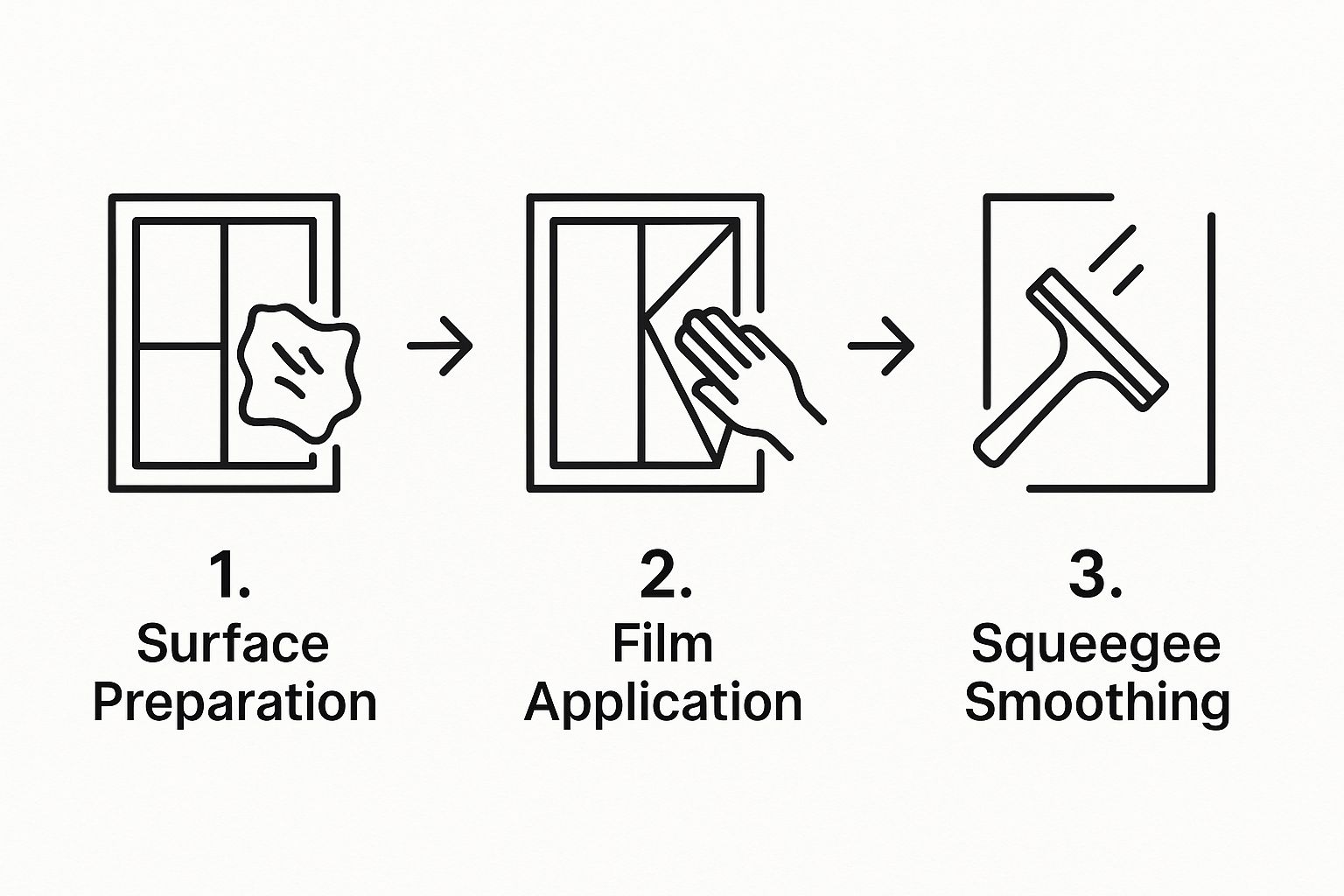
As you can see, each step logically flows into the next, all building towards that perfect, seamless bond between film and glass.
Applying and Positioning the Film
Once the glass is prepped and ready, the real action begins. The installer will generously spray both the window and the film’s adhesive side with a special slip solution. It's usually just a simple mix of water and a specific type of soap, but it's the key to the whole process.
This solution creates a slick, forgiving surface that stops the film's powerful adhesive from grabbing the glass too early. It gives the installer a crucial window of opportunity to slide the film around and nudge it into the perfect position, making sure the alignment with the window frame is dead-on.
One of the biggest myths is that the film is applied dry. In reality, that slip solution is the secret sauce. Without it, getting a precise, bubble-free fit would be next to impossible.
With the film in place, the installer moves on to what's arguably the most satisfying part to watch: squeegeeing. They use a set of professional-grade squeegees, working methodically from the center out to the edges. This does two things at once:
- It forces all the water and slip solution out from between the film and the glass.
- It activates the film's pressure-sensitive adhesive, creating a strong, lasting bond with the window.
There's a real art to this. It requires just the right pressure and overlapping strokes to push every last drop of water out. Any trapped moisture or air will show up later as an ugly bubble or a hazy spot.
Working Around Your Business Operations
We get it—the last thing you need is a major disruption to your business. A seasoned installation team is a master of working quietly and efficiently to stay out of your way. They’re used to scheduling jobs during off-peak hours, like early mornings or weekends, or tackling the project in phases.
Clear communication is everything. Before work begins, the project manager should sit down with you to map out a schedule that minimizes the impact on your staff and customers.
For instance, if you run a retail store, a crew can get the storefront windows done before you even open for the day. In an office building, they might work on one floor at a time to keep common areas free. This kind of flexibility is a sign you’re working with real pros. If you need to find a team that understands these logistics, searching for a certified security film installation near me is a great way to connect with local experts.
A Little Prep on Your End Goes a Long Way
While the installers will handle all the heavy lifting, there are a few simple things you can do to help the day go even faster and smoother.
- Clear the Way: Try to move any furniture, plants, or merchandise at least two to three feet back from the windows. This gives the crew the space they need to work safely and efficiently.
- A Quick Wipe-Down: A quick dusting of the window sills and frames before the team arrives can make a big difference. It helps keep airborne dust to a minimum once they start working.
- Give a Heads-Up: Just let your employees or tenants know what’s happening and when. A quick email can prevent any confusion and gives people a chance to prep their own workspaces if needed.
Taking these small steps helps set the stage for a perfect installation. The final part of the process is always a meticulous final inspection, where the lead installer will check every single window to make sure the quality is up to their standards before calling the job done.
Protecting Your Investment with Proper Film Care
Once our installation crew packs up and leaves, your role in the process begins. A professional commercial window film installation is a significant upgrade, and taking care of it properly is the key to getting the full lifespan and performance you paid for. The first stage is all about patience: the curing process.
You'll almost certainly see some minor imperfections in the first few days or even weeks. It's completely normal to notice a slight haziness, some small water pockets, or a generally cloudy look. This is just the film's adhesive bonding with the glass as the last bit of application moisture evaporates. Whatever you do, resist the urge to poke or press on these spots—they will disappear on their own as the film fully cures.
The Curing Process Explained
How long does it take for window film to fully cure? Well, it depends. Factors like the type of film we installed, how much direct sun hits the windows, and even the time of year all play a part. Generally speaking, you should expect the full curing process to take anywhere from 30 to 60 days.
The most important thing you can do during this time is simple: leave the windows alone. Don't even think about cleaning them. Any pressure on the film before it has fully bonded can mess with the adhesive and leave permanent blemishes.
Think of it like letting paint dry. It might feel dry to the touch pretty quickly, but it needs time to fully harden and become durable. Rushing it will only compromise the final result.
Long-Term Film Maintenance and Cleaning
After that initial curing period is over, keeping your window film in top shape is incredibly simple. The whole secret is using the right tools and cleaners to avoid scratching the film or damaging its protective layers. Aggressive cleaning is the fastest way to ruin a film and potentially void your warranty.
Here’s a quick guide to keep your film looking pristine for years:
- Safe Cleaning Solutions: A mild solution of dish soap and water is all you'll ever need. Just fill a spray bottle with water and add a few drops of a gentle, non-abrasive soap.
- Approved Tools: Stick to soft materials. A clean, soft cloth, a microfiber towel, or a good rubber squeegee are your best friends here.
- Gentle Technique: Lightly spray the window with your soap solution and wipe gently. If you're using a squeegee, make sure your strokes overlap to prevent streaks.
Common Mistakes That Can Ruin Your Film
Knowing what not to do is just as important as knowing how to clean the film properly. So many common household cleaners contain chemicals that are absolute poison for window film.
Avoid these at all costs:
- Ammonia-Based Cleaners: Products like Windex will literally break down the film’s adhesive, which can cause it to bubble or peel over time.
- Abrasive Materials: Never, ever use scrub brushes, scouring pads, or even rough paper towels. They will cover the film’s surface in fine scratches.
- Sharp Objects: It goes without saying, but be careful with razor blades or other sharp tools near the window. They can easily slice or lift the film right off the glass.
This push to protect building assets with high-performance films isn't just happening here; it's a global movement. The Asia-Pacific region, for instance, has become a massive hub for commercial window film, holding a whopping 41.25% of the market share in 2024. This growth is fueled by booming construction and a huge focus on energy efficiency in countries like China and India. We're seeing similar trends here in North America, where the U.S. market is projected to hit USD 1.04 billion by 2032. You can find more insights on the global window film market on thebusinessresearchcompany.com.
By following these simple care guidelines, you'll make sure your film continues to deliver the energy savings, security, and comfort you invested in from day one.
Getting a Handle on Window Film Costs and ROI
When you're thinking about adding window film to a commercial property, it's easy to get fixated on the initial price. But I always tell clients to look at it as a smart business investment, not just another line-item expense. The real story isn't in the quote; it's in the long-term financial payoff.
Once you understand both the upfront cost and the return on that investment (ROI), the value of the project really clicks into place.
What Goes Into a Window Film Quote?
Asking for a simple per-square-foot price can be a bit misleading. The cost is never a one-size-fits-all number because every job is different. A straightforward installation on a single-story office is a world away from a complex project on a high-rise with hard-to-reach glass.
Here are the main things that will shape your final quote:
- The Film Itself: This is the biggest factor. A standard tinted film is going to be much more affordable than a high-performance solar control film with ceramic technology. And if you're looking at thick, multi-layered security films for forced entry protection, you're talking about a more significant investment due to the advanced materials involved.
- Job Complexity: Are the windows easy for my crew to get to, or will we need lifts and specialized equipment? Oddly shaped windows or glass that requires a ton of prep work also adds to the labor hours, which naturally affects the cost.
- Total Square Footage: Of course, the sheer amount of glass we're covering plays a role. The good news is that larger projects often get a better per-unit price on both materials and labor.
Getting a feel for these variables is the first step toward setting a realistic budget. If you want to dive deeper, our guide on security window film cost breaks it all down even further.
Finding Your Return on Investment
Now for the exciting part. That initial cost is just one side of the coin. The ROI is what makes window film such a no-brainer for most property managers, and the payback period is often much shorter than people realize.
The most immediate and significant return comes straight from your energy bills. By rejecting up to 80% of solar heat, high-quality window film gives your HVAC system a much-needed break, especially in the sweltering summer months. This directly translates into lower utility costs, often slashing cooling expenses by 30% or more.
Your investment in window film starts paying you back from the very first energy bill. For many commercial buildings, the total energy savings can lead to a full payback on the installation cost in as little as two to five years.
The Full Financial Picture
The financial benefits don't stop with your electric bill. There are other, less obvious returns that really add up over time.
- Protecting Your Assets: The film blocks 99.9% of damaging UV rays. Think about what that means for your expensive flooring, office furniture, or retail merchandise. It prevents fading, extends the life of your assets, and saves a fortune in replacement costs down the road.
- Tapping into Utility Rebates: It's always worth checking with your local utility company. Many offer rebates for energy-efficient upgrades, and window film often qualifies. This can take a nice chunk out of your initial outlay.
- Happy Tenants and Employees: This one is harder to put a number on, but it's incredibly valuable. A more comfortable building with less glare and fewer hot spots means happier, more productive people. For commercial landlords, that can mean lower tenant turnover.
The industry's growth really tells the story. The global commercial window film market was valued at over USD 12.6 billion in 2025 and is projected to nearly double to USD 23.93 billion by 2037. This boom is being driven by a global push for energy efficiency and green building codes. You can see more on these window film market trends and projections on researchnester.com.
When you frame the project in terms of its payback period and all-in ROI, it becomes clear that this is a financially sound decision for your property.
Common Questions About Commercial Window Film
Even after seeing all the benefits, it's natural for property managers to have a few lingering questions before pulling the trigger. Getting these concerns addressed upfront is key to feeling confident about the project. Here, we’ll tackle some of the most common questions we get from clients every day.
Think of this as your quick-reference guide for those "what if" scenarios. We'll give you straight, no-nonsense answers based on years of experience in the field.
How Long Does Commercial Window Film Last?
This is usually the first thing people ask, and for good reason. A professional commercial window film installation is a real investment, not some temporary fix. The good news is that high-quality films are engineered to go the distance without peeling, bubbling, or turning a weird shade of purple.
For most films installed on the inside of your windows, you can realistically expect them to last 15 to 20 years, sometimes even longer if they're well-maintained. Films applied to the exterior have a tougher life battling the elements, so their lifespan is typically shorter, around five to ten years.
Beyond just the lifespan, the warranty is what really gives you peace of mind.
A solid manufacturer's warranty for commercial film usually covers defects like bubbling, peeling, cracking, and delamination for 10 to 15 years. It's your assurance that the product will perform exactly as promised.
But there's a catch: that warranty is almost always tied to a professional installation. If you try to DIY it or hire an uncertified installer, you can pretty much kiss that protection goodbye. Always ask to see the specific warranty details for your chosen film before work begins.
Can Window Film Cause Thermal Stress Cracks?
This is a great question and a totally valid concern. The idea of a film absorbing heat and cracking the glass sounds scary, but it's incredibly rare when the job is done right. A thermal stress fracture happens when one part of the glass gets hot and expands much faster than a cooler part, creating tension the glass can't handle.
Any reputable installer worth their salt will perform a "film-to-glass" compatibility check before they even think about recommending a product. This involves looking at several factors:
- Glass Type: Is it standard annealed glass, or is it tempered or laminated?
- Glass Thickness: Thicker glass responds to heat differently.
- Window Size: A huge pane of glass has more stress potential than a small one.
- Existing Damage: Even tiny, invisible nicks along the edge of the glass can be weak points.
- Shading: An overhang that casts a shadow across half the window all day creates a perfect storm for uneven heating.
By analyzing these variables, a pro can select a film with the right solar absorption rate that's perfectly safe for your windows. The myth about film cracking glass almost always comes from someone putting the wrong, high-absorption film on a sensitive type of glass—a mistake an expert would never make.
Is It Possible to Install Film on Any Glass?
Window film is incredibly versatile, but it can't go on absolutely everything. The vast majority of films are made for smooth, flat glass surfaces.
For instance, trying to apply film to heavily textured or frosted glass is a no-go. The adhesive just can't get a solid, even grip, which looks terrible and is guaranteed to fail. Certain plastics like polycarbonate or acrylic (Plexiglas) are also tricky; standard films can react with the plastic and cause "outgassing," which creates a ton of little bubbles under the film.
Specialized films exist for some of these surfaces, but you'll never know for sure without a professional assessment. An experienced technician can spot problem glass in a second and recommend the right film—or tell you honestly if it's not a good idea.
Ready to enhance your property's security, efficiency, and comfort? The expert technicians at Fortress Security Films provide tailored solutions that deliver lasting value. Explore our advanced window film options and schedule your consultation today.
Learn more about our commercial services at fortresssecurityfilms.com
