


Your commercial storefront windows are so much more than panes of glass. They're your silent salesperson, your first impression, and a critical layer of security all rolled into one. Think of them as both a protective barrier against the outside world and a powerful marketing tool to welcome people inside. Getting your window strategy right is a direct investment in your business's safety, curb appeal, and ultimately, your bottom line.
Your First Line of Defense and First Impression
Long before a customer ever speaks to a staff member, your storefront has already introduced your brand. It’s the face of your business, working 24/7 to tell your story. Clean, clear, well-maintained windows send a powerful message of professionalism and care, creating an inviting atmosphere that naturally draws people in.
But here’s the flip side: this vital asset is also one of your biggest weaknesses. Standard glass is notoriously easy to break, making it a prime target for everything from smash-and-grab burglaries and vandalism to simple accidental damage. A shattered window doesn't just mean stolen inventory; it means downtime, emergency repair costs, and a risk to your staff's safety.
More Than Just Glass
It’s time to stop thinking of your windows as just a construction material and start seeing them as a strategic part of your business operations. This guide is for property owners who understand that. We’ll dig into how modern window solutions can have a real, measurable impact on your success by:
- Strengthening Security: Fortifying your property against common threats like forced entry.
- Boosting Aesthetics: Elevating your building’s curb appeal to create a more welcoming space.
- Increasing Energy Efficiency: Slashing high cooling costs by reducing solar heat gain—a huge factor here in Southern California.
- Protecting Merchandise: Blocking up to 99% of damaging UV rays that cause expensive inventory to fade.
A Growing Market Driven by Need
This focus on stronger, smarter building solutions isn't just a local trend. The commercial storefront window market was valued at a staggering $3.5 billion in 2023 and is expected to hit nearly $6.0 billion by 2032. What's driving this? A massive demand for better security and improved energy efficiency.
Your storefront is your greatest marketing tool. It’s a 3D billboard that can stop people in their tracks, tell a story, and entice them to come inside.
At the end of the day, the goal is to find that perfect balance between security, aesthetics, and budget. For some creative ways to make your storefront a true showstopper, check out these captivating window display ideas. Now, let’s break down complex options like laminated glass and security films into practical solutions that protect your property, your people, and your profits.
The Real-World Threats to Your Storefront
Let's be blunt: your standard storefront glass is the weakest link in your entire building's security. To a would-be thief, that big, beautiful window is an open invitation—the path of least resistance to everything you've worked to build. This isn’t just theory; it's a daily reality where the seconds it takes to break glass can mean the difference between a normal day and a devastating loss.
The threats businesses face today are fast, brazen, and completely unpredictable. Old-school security like an alarm system is reactive. It only goes off after someone is already inside. By then, the damage is done and they're gone.
The Anatomy of a Smash-and-Grab
The classic smash-and-grab is a crime of speed. It’s all about brute force and getting out fast. Someone uses a rock, a crowbar, or whatever they can find to shatter your window. From the first crash to them running off with your merchandise, the whole thing can be over in less than 30 seconds.
Think of your standard tempered glass like a frozen lake. One hard hit, and the whole thing crumbles into a million tiny, pebble-like pieces. This is actually a safety feature meant to prevent injuries, but for security, it’s a total failure. Once it's gone, there's nothing left but a gaping hole for someone to walk right through.
An alarm tells you someone has broken in. A properly reinforced window stops them from breaking in at all. That’s the critical shift from reactive to proactive security.
Criminals are banking on this speed. They know they’ll be long gone with your inventory before an alarm company even finishes the phone call, let alone before law enforcement arrives. To truly secure your business, you need a plan that stops them at the glass. For a closer look at building a layered defense, you can learn more about how to prevent retail theft in our in-depth guide.
Beyond Burglary: Vandalism and Civil Unrest
Theft is a huge concern, but it’s not the only one. Vandalism, whether it’s ugly graffiti or someone taking a hammer to your glass out of spite, is just as disruptive. A single broken window can force you to close for repairs, scare away customers, and send the message that the area isn't safe.
We've also seen how quickly civil unrest can flare up, especially in major urban centers. In these chaotic situations, storefronts become easy targets. A large, agitated crowd can do an incredible amount of damage in minutes, and standard glass offers zero defense. One broken window often leads to another, triggering widespread looting and destruction that can far exceed what your insurance policy will cover.
The ripple effects from any of these events are serious and costly:
- Inventory Loss: The immediate cost of what was stolen.
- Property Damage: The bill for emergency board-ups and glass replacement.
- Business Interruption: Lost sales for every hour you're closed for cleanup.
- Rising Insurance Premiums: Filing a claim almost always means your rates will go up.
- Damage to Your Reputation: A boarded-up storefront makes everyone, including your best customers, feel uneasy.
Relying on unreinforced glass is fundamentally a reactive strategy. It's a plan that starts after the worst has already happened. A modern approach to security is about being proactive. It's about making your storefront so tough to breach that criminals decide to just move on. You harden the target before it ever gets hit.
Choosing the Right Commercial Window Technology
Picking the right material for your storefront windows is one of those foundational decisions that echoes through your business for years. It affects everything from your day-to-day security posture to your monthly energy bills. This isn't just about filling a hole in the wall; it's a strategic choice about the right tool for the job.
The days of one-size-fits-all glass are long gone. We're seeing huge advancements in glazing solutions, and the market reflects that. The global storefront glass market was valued at $5.6 billion back in 2020 and is on track to hit $13.3 billion by 2032. That explosive growth is all about demand for windows that do more—better security, smarter energy use, and sharper aesthetics. You can actually read the full research on the storefront glass market to see the data driving this shift.
Tempered Glass: The Baseline Standard
Most storefronts you see are fitted with tempered glass. You can think of it as "safety glass." Through a process of intense heating and rapid cooling, the glass becomes about four times stronger than normal. Its real claim to fame is how it breaks—it shatters into thousands of tiny, dull-edged pebbles instead of large, lethal shards.
But here’s the catch: that safety feature is also its biggest security flaw. While it can take a beating, a single, well-placed, powerful blow will cause the entire pane to disintegrate. For a smash-and-grab thief, that means instant access.
Laminated Glass: The Security Specialist
If you're serious about preventing break-ins, laminated glass is where you start. Picture a tough, transparent vinyl layer (known as PVB) sandwiched between two sheets of glass. It’s like a permanent, invisible safety net baked right into the window.
When laminated glass takes a hit hard enough to crack, that inner layer does its job, holding all the broken pieces firmly in place. Instead of collapsing, the window just spiders, remaining a solid barrier in the frame. This buys precious time and makes forced entry a loud, difficult, and frustrating process—often enough to make a would-be intruder give up and move on.
As this infographic shows, the threats to your storefront are more varied than just a simple break-in.
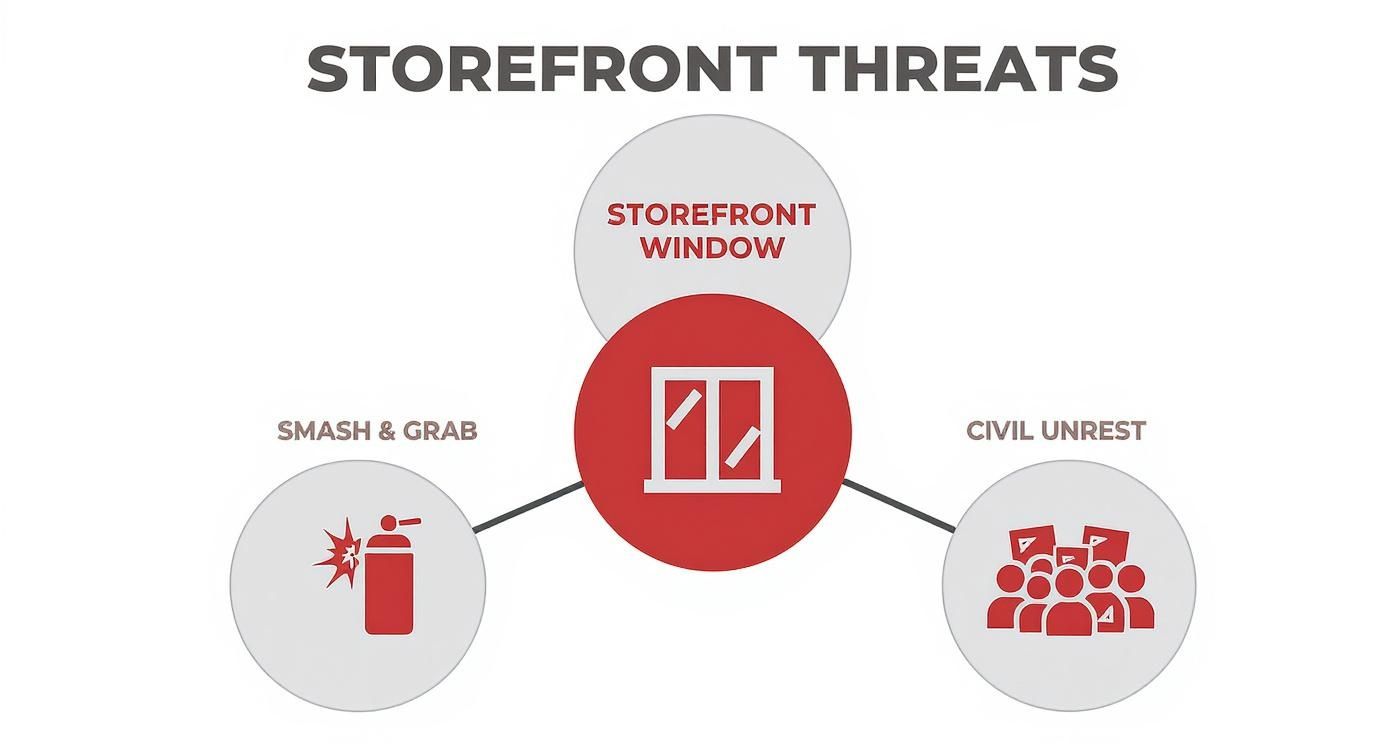
From vandalism to civil unrest, you need a solution that can stand up to a range of real-world risks, not just one.
To help you weigh the pros and cons, here's a quick breakdown of the most common materials.
Commercial Window Material Comparison
| Material Type | Key Security Feature | Energy Efficiency | Typical Cost | Ideal For |
|---|---|---|---|---|
| Tempered Glass | Shatters into small, "safe" pebbles | Low | $$ | Standard retail where basic safety codes are the main concern. |
| Laminated Glass | Interlayer holds glass together when shattered | Moderate | $$$ | High-traffic retail, jewelry stores, urban areas needing smash-and-grab deterrence. |
| Polycarbonate | Virtually unbreakable, 250x stronger than glass | Low to Moderate | $$$$ | High-risk locations, facilities with extremely valuable assets, government buildings. |
| Insulated Glass Unit (IGU) | Air/gas gap between panes | High | $$$ | Businesses in hot or cold climates focused on reducing HVAC costs. Security is a secondary feature. |
As you can see, the "best" choice really depends on your specific location, business type, and budget.
Polycarbonate: The Impact Champion
When you need the absolute highest level of impact resistance, you look to polycarbonate. Let's be clear: this isn't glass at all. It's an incredibly tough thermoplastic—the same stuff used to make bullet-resistant barriers and police riot shields. It's an astonishing 250 times stronger than standard glass.
So, what's the downside? Polycarbonate is pricier and can scratch more easily than glass if it doesn't have a protective coating. It also used to have a reputation for yellowing under heavy UV exposure, though modern formulations have dramatically improved that. It’s the go-to for businesses in very high-risk areas or those protecting priceless inventory. Thinking about this kind of upgrade is a natural part of keeping up with the broader commercial real estate tech trends shaping property management today.
Insulated Glass Units: The Energy Saver
Insulated Glass Units, or IGUs, are all about thermal performance. Their main job isn't security, it's saving you money on energy. An IGU is made of two or three panes of glass separated by a sealed space filled with an inert gas like argon. This whole setup works like a thermal blanket for your building.
Think of an IGU like a high-tech travel mug. The air gap prevents heat from easily passing through, keeping the cold out in the winter and the heat out in the summer.
In a place like Southern California, that can lead to a serious reduction in your HVAC costs. The great thing is, you don't have to choose between energy efficiency and security. You can get the best of both worlds by commissioning an IGU made with a laminated exterior pane. It's a powerful hybrid approach that tackles your two biggest window-related headaches at once.
Retrofitting Your Windows with Security Film
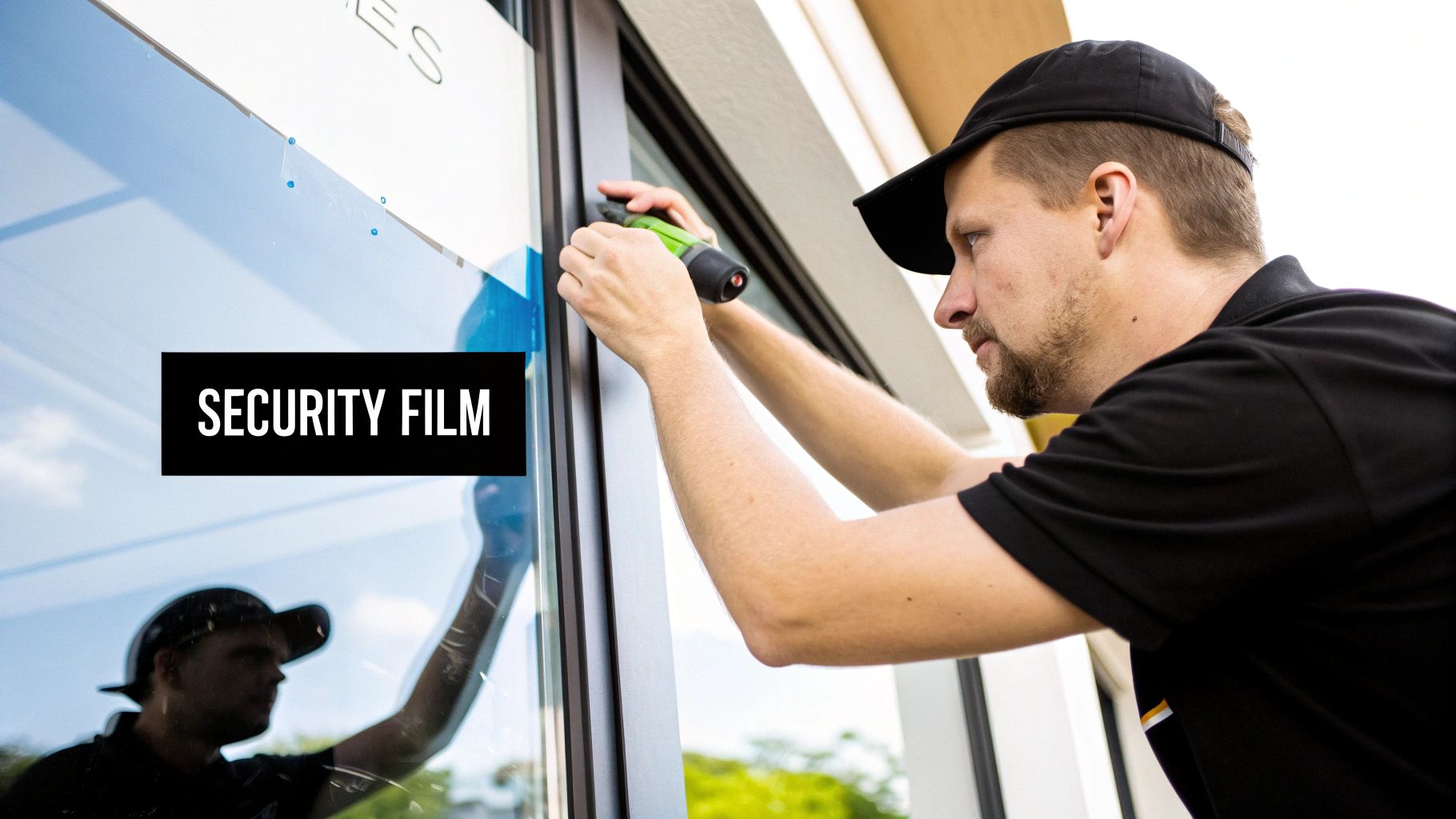
What if you could seriously upgrade the security of your existing storefront windows without the massive cost and headache of a full replacement? That’s exactly what security window film brings to the table. It's a powerful retrofit solution that turns your most vulnerable entry point—your glass—into a tough, resilient barrier.
Think of it as an invisible shield. It's a high-tech layer of polyester that's bonded directly to the inside surface of your windows. This one simple addition completely changes how your glass behaves under attack.
When a thief strikes an untreated window, the glass shatters and falls away, creating an instant opening. But security film absorbs that impact and, thanks to an incredibly strong adhesive, holds all those broken shards together in the frame.
A window treated with security film might crack and spiderweb, but it won't give way. This creates a loud, frustrating, and time-consuming obstacle for any would-be intruder, often convincing them to just give up and flee.
This delay is everything. Instead of an easy smash-and-grab, a criminal is forced to make a racket and waste precious time trying to get through. That’s more than enough time for your alarm to do its job and alert the authorities.
Decoding Film Thickness: The Mil Rating
Not all security films are the same. Their strength is measured in "mils"—one mil is a thousandth of an inch. While that sounds tiny, the real-world difference between a 4-mil and a 14-mil film is huge.
Picking the right thickness comes down to what you’re trying to protect against.
- 4-7 Mil Films (Safety & Light Security): These are often called "safety films." They're great for preventing injuries from accidental glass breakage and can deter a single, half-hearted smash-and-grab attempt.
- 8-14 Mil Films (Anti-Intrusion): For most retail and commercial storefronts, this is the sweet spot. An 8-mil film is often the minimum recommended thickness for real anti-intrusion security. It can stand up to repeated hits from bricks, bats, or crowbars, buying you that critical delay.
- 15+ Mil Films (Heavy-Duty Protection): These super-thick films are built for high-risk locations. They offer enhanced protection against more extreme threats, like bomb blasts or very determined, sustained attacks.
For the majority of Southern California businesses worried about break-ins and vandalism, a film in the 8 to 12-mil range provides the perfect balance of effective protection and cost.
More Than Just a Security Upgrade
While its main job is to reinforce your glass, modern security film is a multi-tasking workhorse that delivers other valuable benefits for your business. It's an investment that pays you back in ways you might not have considered.
One of the biggest perks is its ability to block destructive ultraviolet (UV) radiation. A quality film can reject over 99% of UV rays, which are the main cause of fading and sun damage. This keeps the merchandise in your window displays—whether it's clothing, furniture, or art—from being ruined, saving you from having to write off expensive inventory.
On top of that, many security films have built-in solar control properties. They can dramatically reduce the amount of heat pouring through your windows, which is a game-changer in our sunny climate.
- Lower Cooling Costs: By blocking infrared heat, the film helps keep your store at a more comfortable temperature. This means your HVAC system doesn't have to work as hard, which shows up as savings on your monthly energy bill.
- Reduced Glare: It also cuts down on that annoying glare, making things more pleasant for both your customers and your staff.
- Enhanced Privacy: While most films are optically clear, you can also get tinted or reflective versions to increase daytime privacy without blocking the view from inside.
When you retrofit your commercial storefront windows with security film, you're not just installing a single product. You’re getting a complete solution that protects your property from break-ins, your merchandise from sun damage, and your budget from high energy costs. It’s one of the smartest, most cost-effective upgrades a business owner can make.
Calculating the ROI of Your Window Investment
It's easy to look at upgrading your commercial storefront windows and see only an expense. That's a common mistake. A security enhancement is really a strategic investment, and just like any smart business decision, you need to measure its value. When you look past the initial price tag, you start to see the full financial picture—a powerful return on investment (ROI) that protects your bottom line for years to come.
Calculating this ROI isn’t just about the upfront cost. It’s a mix of direct, tangible savings and some incredibly valuable, if less obvious, benefits. This framework turns a capital expenditure into a smart, calculated move. It's no surprise the global storefront glass market is projected to hit $25.4 billion by 2031. Property owners are clearly catching on to the financial and operational importance of high-performance glass. You can discover more insights about the storefront glass market's growth to see the economic trends for yourself.
The Tangible Returns You Can Measure
These are the hard numbers you can plug right into a spreadsheet. The most obvious return comes from stopping a single incident before it happens.
- Avoided Loss from Theft: A smash-and-grab can cost you thousands in stolen merchandise and property damage in less than a minute. Preventing just one of those events can easily pay for the entire window upgrade.
- Lower Energy Bills: Here in Southern California, solar heat gain sends cooling costs through the roof. Security film or new insulated glass units can dramatically cut down on that heat, leading to real, immediate savings on your monthly utility bills.
- Reduced Insurance Premiums: Many insurance providers offer discounts to businesses that take proactive security measures. When you show them you've hardened your storefront, you might just qualify for lower annual premiums—a return that pays you back year after year.
- Elimination of Repair Costs: The bill for an emergency board-up and a rush glass replacement is never cheap. A window that stands up to an attack saves you from that expensive, disruptive cycle of repairs.
Think of your window investment as an insurance policy that actually works to prevent a claim in the first place. It actively stops the losses that traditional insurance only reimburses after the fact, and it pays you dividends in energy savings every single month.
The Intangible Value That Drives Growth
Not every benefit shows up on an accounting ledger, but their impact on your business is just as real. These intangible returns are what build a healthier, more resilient operation over the long haul.
- Enhanced Customer Confidence: A secure, well-kept storefront just feels better. Customers subconsciously feel safer, which can encourage them to stay longer and spend more.
- Improved Employee Safety and Morale: Your team is your most valuable asset. When they know their workplace is protected from a violent entry or vandalism, it builds a sense of security that directly boosts morale and can even reduce turnover.
- Uninterrupted Business Operations: A break-in means shutting down for cleanup and repairs. That’s lost revenue and frustrated customers. A window that foils an attack keeps your doors open.
- Peace of Mind: Honestly, you can't put a price on knowing your business is protected 24/7. It frees you up to focus on growing your business instead of constantly worrying about your property’s biggest vulnerability.
When you add up both the tangible and intangible factors, the payback period for your investment becomes surprisingly short. For a detailed breakdown of what one of the most effective retrofit solutions costs, take a look at our complete guide on the cost of security window film.
In the end, a secure storefront isn't just about stopping bad things from happening. It's about creating an environment where good things—like customer loyalty and consistent growth—can flourish.
What to Expect During the Installation Process
Upgrading your commercial storefront windows shouldn't mean shutting down your business. Whether you’re looking at a full window replacement or a security film retrofit, any professional crew worth their salt knows the goal is simple: get in, get the job done right, and get out with as little disruption as possible.
It's all about fortifying your property while keeping your doors open and customers flowing. While both replacing windows and adding film will boost your security, the way they're installed—and the impact on your business—are worlds apart in time, noise, and general mess.
The Phased Approach to Installation
A professional window or film project isn’t a chaotic free-for-all. It follows a clear, predictable path to make sure everything is done precisely and meets your exact needs.
Think of it in a few key stages:
- Initial Consultation and Measurement: First, a technician comes to you. They'll check out your current windows, talk through what you're trying to achieve (better security, energy savings, etc.), and take careful, precise measurements. This step is the blueprint for a perfect fit.
- Project Scheduling: This is where we work together. A good installation team will schedule the job around your business hours. We can often work during your off-peak times, or even overnight, so your daily operations aren’t affected.
- Site Preparation: Before the work starts, the crew preps the area. This means protecting floors, carefully moving any nearby merchandise or furniture, and creating a clean, safe zone to work in.
- Installation and Cleanup: This is the main event, where the new glass or film is installed. Afterward, a thorough cleanup ensures the space is left exactly as it was found—only now, your windows are secure.
The real mark of a professional installation isn’t just the quality of the final product. It’s the respect shown for your business. The best crews are practically invisible, letting you run your shop without a hitch.
Full Replacement vs. Security Film Timelines
This is where the two options really split. A full window replacement is basically a small construction project. It involves tearing out old frames, which is loud, dusty, and can leave your storefront exposed for a while. A job like this can easily stretch over several days, depending on how many windows you have.
On the other hand, applying security film is a much quicker, cleaner affair. Because the film is applied directly to your existing glass, there's no demolition, no dust, and no gaping holes in your building. A typical storefront can usually be done in a single day, with minimal noise and no structural changes. This speed makes it a fantastic choice for any business that needs to get secure without suffering any downtime.
If you want to get into the nitty-gritty, you can learn more about the security window film installation process and see just how efficient it is.
Your Top Questions About Storefront Security
When it comes to protecting your commercial storefront windows, you're bound to have some questions. It's a big decision, and getting straight answers is the only way to feel confident you're making the right investment.
Let's tackle the big one first: just how much stronger does security film make the glass? People often wonder if it makes the glass "unbreakable." The short answer is no, but that's not really its job. A professionally installed film, typically at least 8 mil thick, is designed to absorb and distribute the force from repeated blows from a bat, brick, or other heavy object.
Instead of the glass exploding inward, the film holds all the shattered pieces together. This creates an incredibly tough, flexible barrier that can frustrate a potential intruder for several minutes. In the real world of smash-and-grab crime, that delay is everything. More often than not, it's enough to make them give up and run.
Insurance, Compatibility, and the Fine Print
Property managers and owners often ask us how these upgrades sit with their insurance carriers. The good news is, insurers love proactive security measures. Many carriers recognize high-quality security film or laminated glass as a serious step toward reducing risk.
Hardening your storefront with a proven solution is something your insurance provider wants to see. It’s always worth a call to your agent beforehand, as you might find yourself eligible for lower annual premiums on your commercial property policy.
Finally, what about compatibility? Can this be added to your specific windows? Security film is remarkably versatile. It can be applied to almost any type of flat commercial glass, whether it's the common tempered glass in your doors or the annealed glass in your large display windows.
A professional installer's first step is always to check the condition of your glass and, just as importantly, your window frames. They need to ensure the entire system can handle the added stress. The film is always applied to the interior surface of the glass, which shields it from weather and external tampering, guaranteeing it will perform for years to come. It’s a simple retrofit that adds a formidable layer of defense without changing the look of your business.
Ready to secure your property with a solution trusted by businesses across Southern California? Contact Fortress Security Films for a professional consultation and discover how our advanced security films can protect your assets. Learn more at https://fortresssecurityfilms.com.
