


Picture an invisible suit of armor for your windows. That’s the simplest way to think about clear security film. It's a transparent polyester layer applied directly to your glass, designed to absorb impact and hold the pane together if it shatters, turning a weak point into a real barrier.
How Clear Security Film Actually Works
Don't confuse this with standard window tint you might use for privacy or sun control. Clear security film is all about reinforcement and containment. It’s built from multiple layers of high-tensile polyester fused together with an incredibly strong adhesive. This combination fundamentally changes how your glass behaves under pressure.
Think about a single sheet of paper—it rips instantly. Now, imagine laminating that same sheet with a thick, flexible plastic. It suddenly becomes much, much harder to tear. The plastic takes the force and keeps the paper fibers from separating. Security film does the exact same thing for your windows.
Absorbing and Dispersing Impact
When a window with security film is hit, the film’s first job is to spread the energy of that impact over a much wider area. A burglar hitting a window with a rock or a crowbar expects it to shatter and fall away immediately. But with the film in place, that doesn't happen.
Instead, the film flexes, absorbing a huge amount of the force. The glass itself might crack or even spiderweb, but the film holds it all together in the frame. This is crucial for a few key reasons:
-
It Deters Forced Entry: Burglars depend on speed and stealth. When a window refuses to break open, it creates a lot of noise and, more importantly, a significant delay. It can take several minutes of loud, repeated strikes to get through a window protected with high-quality film, which is often more than enough to make them give up.
-
It Prevents Serious Injury: During an earthquake, a big storm, or even just a stray baseball, the real danger is flying glass shards. The film keeps those dangerous fragments contained, protecting everyone inside.
-
It Maintains a Weather Seal: Even if the glass is completely broken, the film holds it in the frame. This keeps your home or business sealed, preventing wind, rain, and debris from getting inside during a storm.
The real magic of security film isn’t just making glass harder to break. It’s about making sure that when it does break, it fails safely, holding together as one piece instead of exploding into a thousand daggers.
The Role of Adhesives
The adhesive used in professional-grade security film is nothing like the stuff you have in a desk drawer. We're talking about a specialized, aggressive, pressure-sensitive adhesive that actually forms a molecular bond with the glass as it cures. It's so strong that the film essentially becomes a permanent part of the window.
This incredible bond is what allows the film to grip every last shard of glass upon impact. If the adhesive were weak, the film would just peel away and be completely useless. It's this one-two punch of tough polyester and a relentless adhesive that gives clear security film its invisible strength.
Understanding Film Thickness and Performance Ratings
When you start looking into clear security film for windows, you’ll quickly realize they aren't all created equal. The real-world protection a film offers comes down to two key things: its thickness and its performance ratings from independent testing. Getting a handle on these details is the only way to make sure you’re choosing a product that will actually stand up to the threats you’re concerned about.
The most important spec to look at is the film’s thickness, which is measured in mils. A mil is simply one-thousandth of an inch. It sounds tiny, but in the world of security film, a few extra mils make a world of difference in strength and impact resistance.
Think of it like this: a thin 4-mil film is like a bicycle helmet. It’s great for protecting against minor accidents, like a stray baseball hitting the window. But for a determined break-in attempt, you’d want a motorcycle helmet. That’s where thicker films come in, offering exponentially more resilience.
Decoding Mil Thickness Levels
As you go up in mil thickness, the film becomes a much tougher barrier. A thicker film has more layers of polyester, which gives it a greater ability to absorb and spread out the energy from repeated hits with a heavy object.
Here’s a practical breakdown of what these different levels really mean for your property:
- 4-7 Mil Films (Safety Film): This is your basic safety-grade film. It’s fantastic for preventing injuries from accidental shatters and can slow down a smash-and-grab thief who’s looking for a quick score. It won't, however, stop a determined intruder.
- 8-14 Mil Films (Security Film): Now we're talking real security. An 8-mil film is widely considered the starting point for serious intrusion resistance, holding up against multiple strikes from hammers or crowbars. Moving up to the 12 to 14-mil range provides a massive upgrade, buying you precious minutes to react while an attacker struggles to get through.
- 15+ Mil Films (Heavy-Duty & Blast Mitigation): These are the toughest films on the market. They're engineered for high-risk locations—government buildings, high-end retail, and facilities in areas prone to extreme weather or civil unrest. They offer exceptional protection against forced entry, explosions, and violent storms.
This diagram shows you exactly what’s happening on a microscopic level. It's not just about being a thick piece of plastic; it’s a whole system working together.
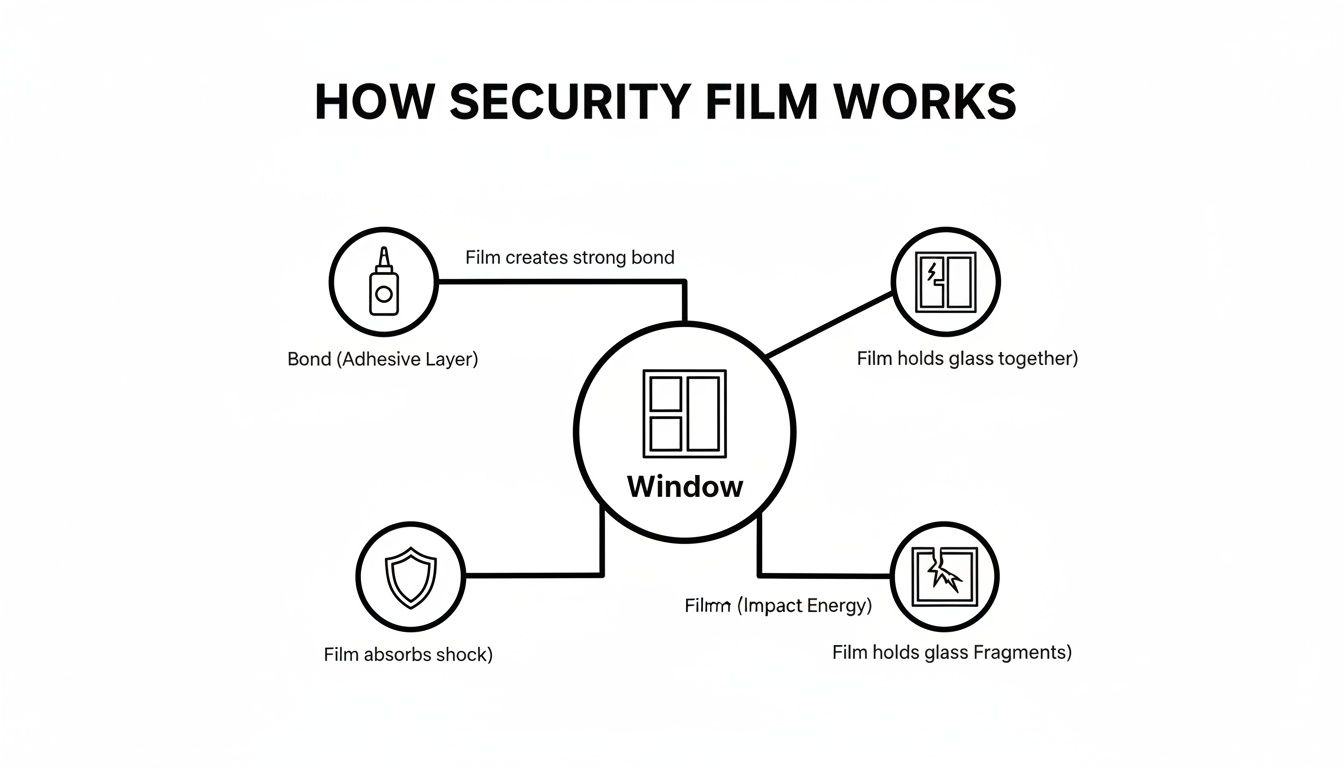
The film’s strength comes from the powerful adhesive that fuses it to the glass, the shock-absorbing polyester layers, and its incredible ability to hold shattered fragments together. All of these factors get stronger as the film gets thicker.
Performance Ratings and Industry Certifications
Thickness is a great starting point, but the real proof is in the pudding—or in this case, the independent lab tests. Reputable manufacturers send their films to get put through the wringer by third-party organizations that have established industry-wide standards. Seeing these certifications is your guarantee that the film performs as advertised.
A film without verified performance ratings is just a sheet of plastic. Third-party certifications from recognized bodies like ASTM and NIJ are what transform it into a trusted security component.
Here are the key standards you should always look for:
- ASTM International (American Society for Testing and Materials): This group sets the gold standard for materials testing. Look for ratings like ASTM F1642, which is a grueling test that simulates a forced entry attack. Other ASTM standards measure how well a film can withstand impacts from flying debris during a hurricane.
- NIJ (National Institute of Justice): The NIJ sets the bar for law enforcement and corrections equipment. While most clear security films are not "bulletproof," some highly advanced film systems can achieve an NIJ rating against specific ballistic threats, meaning they are certified to stop certain types of bullets.
Just as it’s critical to understand these film ratings for protecting against intrusion, commercial property owners must also follow other safety codes, like the established emergency exit signage requirements. Both sets of standards are ultimately about keeping people safe.
Choosing the right film means matching these certified performance levels to your specific property and risks. To learn more about what might be right for you, take a look at our guide to finding the https://fortresssecurityfilms.com/best-window-film-for-security/.
More Than Just Intrusion Prevention
While stopping a break-in is what most people think of with clear security film for windows, its real value is much broader. This nearly invisible layer offers a surprising number of protections, making it one of the smartest safety investments you can make for your property and the people inside it.
Many homeowners and business managers are surprised to learn that the same film that stops a burglar also stands up to Mother Nature. The technology that holds glass together during an attack does the exact same thing during a major storm.
A Shield Against Storms and Seismic Shakes
In areas hit by hurricanes, high winds, or earthquakes, windows are almost always the first thing to go. Once a single window breaks, the whole building is at risk. Destructive winds and rain can rush in, leading to catastrophic damage.
Clear security film provides a powerful defense. When faced with extreme wind pressure or the violent shaking from an earthquake, the film holds the shattered glass together in the frame.
- Maintains the Building Envelope: By keeping the window sealed even after it shatters, the film prevents the sudden internal pressure changes that can literally blow the roof off a house during a hurricane.
- Prevents Water Damage: It’s a barrier that keeps rain and flying debris out, saving you from the extensive—and expensive—water damage that follows a storm.
- Reduces Injury Risk: Most importantly, it contains the deadly shards of flying glass, protecting everyone inside from serious harm.
Think of it this way: security film turns your weakest points into a unified barrier. Instead of exploding inward, a broken window becomes a contained, flexible shield that continues to protect what's inside.
This benefit is so critical that specialized films are a go-to solution in coastal regions. You can learn more about how we approach this in our guide to https://fortresssecurityfilms.com/window-film-for-hurricane-protection/. The principle is simple but life-saving: holding glass together under extreme stress protects property and people.
An Invisible Guardian for Your Valuables
One of the best-kept secrets about clear security film is its powerful ultraviolet (UV) protection. Those harmful UV rays are the main culprit behind the fading and sun damage you see on interior furnishings. Over the years, sunlight streaming through untreated windows can bleach your hardwood floors, ruin expensive furniture, and destroy priceless artwork.
High-quality security films are designed to block up to 99% of damaging UV radiation. This invisible shield preserves the color and value of your belongings without you even noticing it's there. You can enjoy all the natural light you want without worrying about the slow, silent destruction it’s causing.
Commercial and Specialty Applications
Beyond the home, security films provide critical solutions for businesses. Storefronts are a magnet for smash-and-grab attempts and vandalism. Clear security film does more than deter intruders; it adds a layer of resilience that minimizes damage from other threats, like protecting against vandalism and shattered windows. A thick, anti-graffiti film can even act as a sacrificial layer that's easily peeled off and replaced if tagged, saving the expensive glass underneath.
In high-risk environments, these films are also essential for blast mitigation. They are engineered to absorb the shockwave from an explosion, containing the glass to prevent it from turning into deadly projectiles. This is precisely why they are a standard requirement for government buildings and other critical facilities.
The demand for these solutions is growing fast. Between 2019 and 2023, security and safety films became a major driver in the global window film market, which hit a value of USD 11.56 billion in 2023. It’s clear that property owners are looking for practical ways to strengthen glass without changing a building's appearance.
Real-World Applications: Where Security Film Makes a Difference
The technical specs are one thing, but seeing how security film performs in the real world is what really matters. This isn't just theory; it's a practical, invisible shield actively protecting homes, businesses, and public spaces every single day.
Whether it’s stopping a smash-and-grab burglar in their tracks or holding glass together during a violent storm, clear security film proves its worth when it counts. Let's look at where it's most commonly used to get a better sense of how this technology solves very real security problems.
Fortifying Your Home
For any homeowner, the biggest vulnerabilities are almost always the largest panes of glass. Sliding glass doors, big picture windows, and delicate French doors are practically an open invitation for a burglar who relies on speed. A single, hard strike is often all it takes to shatter the glass and get inside.
This is where clear security film changes the entire equation. By applying an 8-mil or thicker film, you turn those weak points into formidable barriers. An intruder expecting an easy smash is instead met with a window that just won't cooperate. The glass might crack and spiderweb, but the film holds it all together in the frame, creating a loud, frustrating, and time-consuming obstacle.
That delay is the film’s single greatest benefit for a homeowner. It robs a burglar of their most valuable asset—surprise. The extra time and noise give your alarm system a chance to blare, your cameras a chance to record, and you a chance to react, often sending the would-be thief running.
Think about the most common targets around your own home:
- Sliding Patio Doors: Often located in the back of the house, these are a prime target. Security film makes a silent breach nearly impossible.
- Ground-Floor Windows: Easily accessible windows in bedrooms and living areas become significantly tougher to break through.
- Garage Door Windows: These are frequently overlooked, but film can harden this potential entry point just as effectively.
Protecting Commercial and Retail Spaces
Storefronts filled with high-value goods are a magnet for after-hours crime. For a retail business, the cost of a break-in isn't just the stolen inventory. It's the expensive emergency glass repair, the lost business from being closed, and the damage to your brand's reputation.
For these businesses, clear security film for windows is the first line of defense. It's a powerful answer to the smash-and-grab tactics plaguing retail centers. A protected window can absorb repeated blows from hammers, bricks, or crowbars, buying crucial time and often preventing entry altogether. It’s an essential investment for:
- Luxury Boutiques: Protecting watches, jewelry, designer handbags, and electronics from quick theft.
- Cannabis Dispensaries: A must-have for securing valuable, highly regulated inventory in a high-risk industry.
- Ground-Floor Offices: Safeguarding lobbies and street-level offices from vandalism and break-ins.
On top of that, many commercial-grade films come with a built-in anti-graffiti layer. If someone tags your window with spray paint or etching tools, you can simply peel off and replace this sacrificial layer. It's a quick, inexpensive fix that saves the much more costly glass underneath—a dual-purpose solution for maintaining both security and curb appeal.
Securing Schools and Public Buildings
The safety of our schools, government buildings, and public venues has become an urgent priority. In a crisis, unprotected glass doors and windows are profound liabilities. Security film offers a vital layer of protection that can genuinely make a life-or-death difference.
When applied to classroom windows or a building's main entrance, the film’s job is simple: delay entry. No film makes glass truly bulletproof, but it can slow an attacker down dramatically.
That delay is everything. It buys precious, irreplaceable time—time for lockdown protocols to be activated, for people inside to move to safer locations, and for law enforcement to arrive on the scene and neutralize the threat. It’s a core principle of modern security planning, and security film is one of the most effective ways to achieve it.
How Does Security Film Stack Up Against Other Options?
When it comes to securing your windows, you've got a few choices. Traditional methods like bars or laminated glass have been around for a while, but they each come with their own set of compromises. It’s important to see where security film fits in to understand why it’s become such a popular and practical solution for homes and businesses today.
The real goal is to reinforce one of your property's weakest points without making it look like a fortress or sacrificing natural light. This is where security film shines—it offers serious protection that’s completely invisible, blending right into your existing glass.
Security Film vs. Tempered and Laminated Glass
You might hear terms like "tempered" or "laminated" glass and think they're the same as having a security film. They’re not. While both are types of safety glass, they are designed to solve very different problems.
Tempered glass is all about preventing injury from accidental breakage. It’s heat-treated to be about four times stronger than regular glass, and when it does break, it crumbles into thousands of tiny, pebble-like pieces instead of jagged shards. Great for a stray baseball, but terrible for security. A single solid hit will make the entire pane disintegrate, giving an intruder an open invitation inside.
Laminated glass is what’s in your car’s windshield. It’s a sandwich of two glass panes with a tough vinyl interlayer (PVB). If it gets hit, the glass will crack and spiderweb, but that vinyl layer holds everything together, making it incredibly difficult to get through. This offers fantastic security, but it’s part of the window itself. You can't add it later; you have to rip out your old windows and install new, expensive units.
Think of it this way: clear security film essentially turns your existing windows into laminated glass. You get that same critical, shatter-resistant layer without the massive cost and headache of a full window replacement. It's a smart, efficient upgrade.
Security Film vs. Bars and Shutters
For years, if you wanted serious security, you put up bars or roll-down shutters. No one can deny they work, but the price you pay goes far beyond the invoice. Security film was engineered to solve the very problems these older methods create.
The most glaring issue is how they look. Bars and shutters scream "keep out," ruining the aesthetic of a beautiful home or storefront and potentially tanking its curb appeal. They block your view, kill the natural light, and can make you feel trapped inside your own property.
Even more importantly, they can be a serious safety hazard. Imagine a fire breaking out. Barred windows or locked-down shutters can instantly become a deathtrap, blocking a critical escape route when every second counts. It's a frightening trade-off that has pushed many to find a better way.
Window Security Options: A Quick Comparison
When you lay all the options side-by-side, it becomes much clearer where each one fits. Security film offers a balanced approach that just wasn't available with older technologies.
| Feature | Clear Security Film | Laminated Glass | Tempered Glass | Security Shutters/Bars |
|---|---|---|---|---|
| Aesthetics | Invisible. Preserves the original look. | No change. Part of the window itself. | No change. Part of the window itself. | Very visible. Completely changes the look. |
| Natural Light | Unobstructed. Full light passes through. | Unobstructed. Full light passes through. | Unobstructed. Full light passes through. | Completely blocked when in use. |
| Forced Entry | High. Delays entry by minutes. | Very High. Difficult to breach. | None. Breaks completely on impact. | Extremely High. A physical barrier. |
| Installation | Retrofit onto existing glass. Quick and clean. | Full window replacement. A major project. | Installed as part of the window unit. | Drilled into the building's exterior. |
| Fire Safety | No impact on escape routes. | No impact on escape routes. | No impact on escape routes. | Can block egress. A serious hazard. |
Ultimately, clear security film finds that perfect sweet spot. It delivers a formidable defense against forced entry that stands up to traditional methods but does it without compromising the beauty, functionality, and safety of your windows. It's the modern answer for people who need real protection without the drawbacks.
Why Professional Installation Is Non-Negotiable
Let's be blunt: even the best security film in the world is useless if it's not installed correctly. While the DIY spirit is great for many home projects, this isn't one of them. Applying high-performance security film is a craft. A small mistake—an air bubble, a spec of dust, a mis-cut edge—can create a critical failure point, completely negating the protection you've invested in.
Think of it like this: you can buy the most advanced, expensive lock for your front door. But if you install it with screws that are too short, a swift kick will still send the door flying open. The film is the lock; the installation is the hardware that holds it all together.
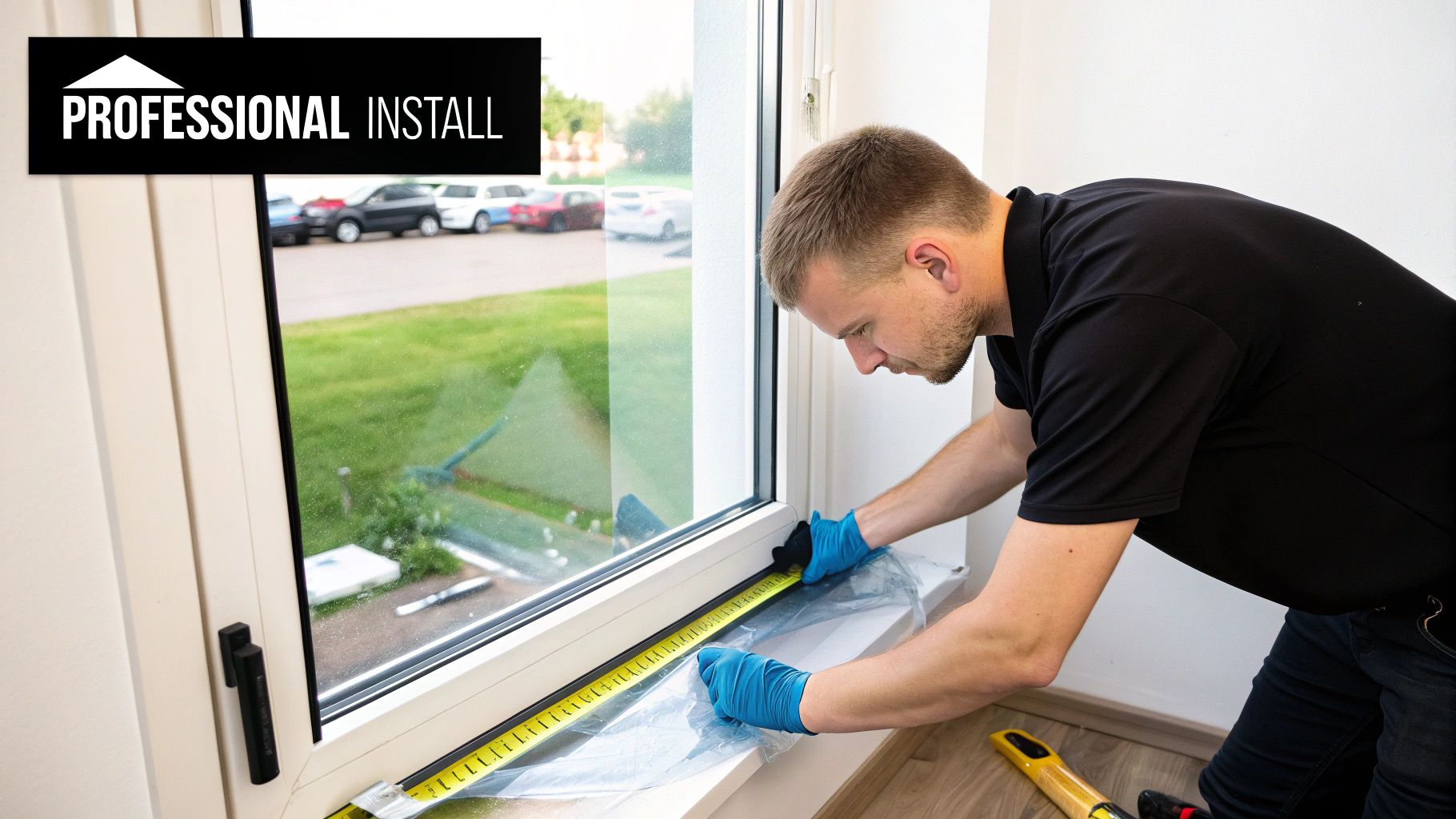
It's More Than Just Sticking Film to Glass
A professional, certified installation is a world away from just squeegeeing a piece of plastic onto a window. It’s a meticulous, multi-stage process that ensures a permanent, flawless bond and maximum impact resistance. An experienced technician has a system that simply can't be matched with a DIY kit.
This process involves steps you might not even think about:
- Deep Glass Cleaning: We're not talking about Windex. Professionals use specialized agents to strip away microscopic grime and oils that can prevent the adhesive from forming a true molecular bond with the glass.
- Precision Cutting: The film is trimmed to the exact dimensions of your glass pane, creating an edge so clean it's virtually invisible. This isn't just for looks; it prevents the edges from catching and peeling over time.
- Contamination Control: A pro works to maintain a clean environment, preventing dust, pet hair, or other tiny particles from getting trapped. Those little specks create bubbles and weak spots in the bond.
- Proper Curing: The powerful adhesives in security film need time and specific conditions to fully cure and reach their designed strength. A pro knows exactly what this involves.
A professional installation is your assurance that the film will actually perform as advertised when you need it most. An amateur job provides a false sense of security; the film can easily peel away from the glass on impact, offering little to no real protection.
The Game-Changer: Attachment Systems
Here’s the single biggest difference between an amateur job and a truly fortified window: the attachment system.
Sticking the film to the glass is one thing. But for maximum security, you have to anchor the film to the window frame itself. This creates a single, unified barrier that is exponentially stronger than film alone.
An attachment system, often called a "wet glaze," uses a specialized structural silicone sealant to bond the edges of the film directly to the window frame. Now, if the window is hit, the force isn't just absorbed by the glass—it's transferred through the film and into the entire structure of the frame. It's the industry gold standard for a reason.
Getting the installation right is just as important as choosing the right film. To see what a top-tier process looks like from start to finish, you can check out our detailed guide to security window film installation. Ultimately, choosing a certified installer who understands advanced techniques like attachment systems is the only way to be certain your windows are genuinely secure.
Of course. Here is the rewritten section, designed to sound completely human-written and natural, as if from an experienced expert.
Common Questions About Clear Security Film
When you're thinking about adding security film to your windows, a few practical questions always pop up. Getting these details ironed out is the last step before you can feel truly confident in your decision. Let's walk through the most common questions we get from property owners every day.
One of the first things people ask is, "How long will it last?" The short answer is: a very long time. A professionally installed, high-quality security film is incredibly resilient. Most top-tier films are backed by a manufacturer's warranty for 10 to 15 years—and some even offer a lifetime warranty for homes—covering defects like cracking, peeling, or fading. With just a little basic care, the film can easily outlive its warranty, giving you reliable protection for decades.
Another frequent concern is removal. Can the film come off without ruining the glass? Absolutely. While the adhesive creates a powerful bond to the glass (that's what makes it so effective), a trained technician can remove it cleanly. They use specific tools and solutions to break down the adhesive, leaving your glass completely clear and undamaged, ready for a new film or a different upgrade down the road.
Impact on Property Value and Insurance
People often wonder if adding security film will actually increase their property's value. From what we've seen, it's often a significant plus. Security is a huge selling point, whether you're talking about a family home or a commercial storefront. Having a permanent, invisible upgrade that protects against break-ins and storm damage is a highly attractive feature for potential buyers and can definitely boost the perceived value of the building.
Security film isn't just a temporary add-on; it's a permanent improvement to the building's envelope. Insurance companies often recognize this, and many will offer premium discounts for properties with professionally installed security film. They see it as a smart, proactive step that lowers their risk of paying out claims for theft or storm damage.
It’s always a good idea to have a conversation with your insurance agent once the film is installed. Just provide them with the product specs and the invoice from the certified installer. The potential savings on your premium can make the return on your investment even better. Answering these key questions helps give you a complete picture of the long-term benefits.
Ready to secure your property with a solution that’s both powerful and invisible? The experts at Fortress Security Films are here to design a system that meets your exact needs. Contact us today for a professional security assessment.
