


Car window security film is a specialized polyester layer that gets applied directly to your car's glass. Its main job? To reinforce your windows against forced entry and impact. This isn't your standard window tint; it's a heavy-duty, nearly invisible barrier designed to hold shattered glass together, which can make all the difference during a break-in attempt.
The Invisible Shield Protecting Your Car
We've all heard that awful sound of glass shattering. For car owners, it’s a constant worry. A typical smash-and-grab takes just a few seconds because standard tempered glass, while strong, gives way instantly. This is precisely where security film steps in, turning your car's most vulnerable points into a real line of defense. It's not just an accessory; it's a fundamental security upgrade.
The film is a transparent or tinted polyester sheet that bonds tightly to the inside of your windows. When a thief tries to smash the glass, it won't explode into a million pieces. Instead, the film's powerful adhesive holds the fractured glass together, creating a tough, spiderweb-like barrier that is incredibly frustrating and time-consuming to get through.
Beyond Basic Theft Prevention
While stopping criminals is its most famous feature, the advantages of security film go much further. The protection it offers covers a range of everyday situations, making it a smart investment for anyone who cares about safety.
Here’s what else it brings to the table:
- Accident Protection: During a car crash, shattered glass can become a spray of dangerous projectiles. Security film holds the shards in place, protecting you and your passengers from serious cuts and injuries.
- UV Ray Blockage: The film acts like a powerful sunscreen for your car, blocking up to 99% of damaging UV rays. This keeps your dashboard, seats, and other interior surfaces from fading and cracking over time, and it protects your skin, too.
- Enhanced Privacy: Opting for a tinted version keeps prying eyes from seeing valuables inside, making your car a less attractive target to begin with.
This technology offers a robust defense by not just delaying intruders but by providing a comprehensive safety solution for everyday driving. It’s an investment in peace of mind.
It's no surprise that more and more people are catching on. The global market for security window film was recently valued at around USD 1.5 billion and is expected to nearly double by 2033, all thanks to a growing demand for better safety solutions.
Ultimately, this film is a single investment that protects you from theft, accidents, and sun damage, turning fragile glass into a resilient shield. For more expert insights on securing your property, feel free to explore other articles on our Fortress Security Films blog.
How This Film Reinforces Your Windows
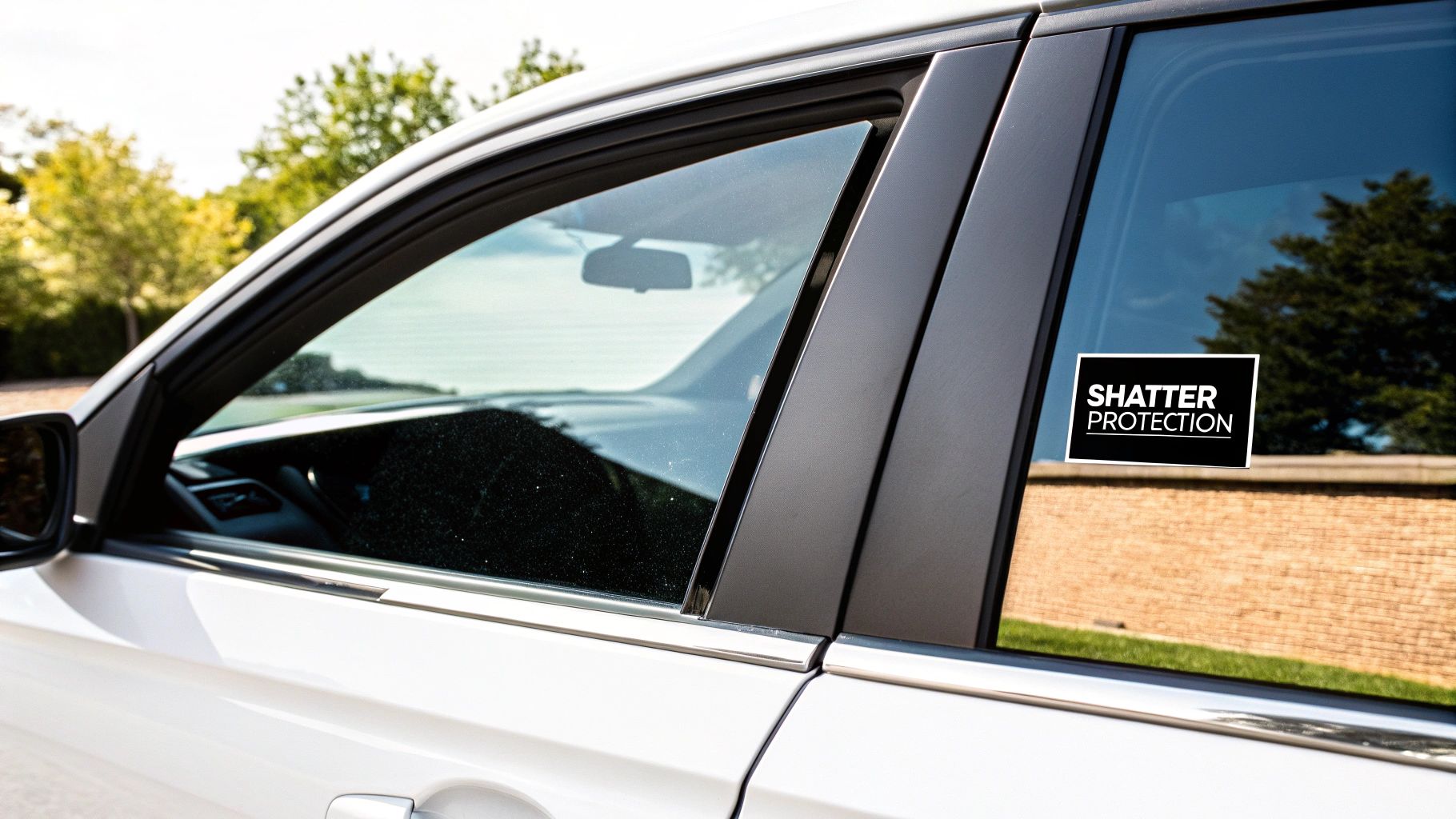
It’s a fair question: how can a thin, clear sheet of film possibly stop a car window from being smashed? The magic is in the engineering and the way it handles force. Think of car window security film as an invisible, high-strength safety net that’s been bonded directly to your glass. It fundamentally changes the glass from a brittle surface into a resilient one.
This isn't your average window tint. We're talking about a sophisticated material made from multiple micro-layers of high-tensile polyester, which is known for being incredibly strong yet flexible. These layers are fused together and then applied with a special, aggressive adhesive that forms a powerful, lasting bond with the window.
When a thief strikes an untreated window, all that impact energy focuses on one tiny spot. The glass instantly fractures and explodes inward. But with security film installed, that same force is absorbed and spread out across the entire surface of the window.
The Science of Strength
What makes one film tougher than another really boils down to two things: its thickness and its tensile strength. Once you understand these, you'll know exactly what you're looking for.
- Film Thickness (Mils): We measure thickness in mils—one mil is simply one-thousandth of an inch. For context, a typical solar tint is under 2 mils thick. Real security films start at 4 mils and can go all the way up to 14 mils or even more. The thicker the film, the bigger the punch it can absorb.
- Tensile Strength: This is the key. It measures how much the film can be stretched before it finally tears. Top-tier security films have an incredibly high tensile strength. This is what allows the film to hold strong, containing all the shattered glass in a spiderweb pattern even after the window behind it is completely broken.
Instead of the glass simply falling out of the frame, the film grips every last piece. This creates a tough, flexible barrier that’s surprisingly difficult to get through. For a criminal who relies on speed, that delay is everything.
A smash-and-grab thief counts on the glass disappearing in a split second. When it holds together instead, their plan falls apart. Every extra moment they spend fighting the window dramatically increases their chances of being seen and caught.
From Brittle to Barrier
This is how the film turns a fragile pane of glass into a genuine security barrier. It completely changes how the glass fails.
Think about it. Unprotected tempered glass is designed to crumble into thousands of tiny, relatively harmless cubes on impact. That’s a great safety feature in a car accident, as it prevents large, dangerous shards. But for theft, it’s an open invitation.
Security film takes advantage of this. It lets the glass break just as it was designed to, but it refuses to let those thousands of pieces go anywhere. What you're left with is a durable, contained sheet of broken glass that stays locked in the window frame, blocking entry.
This doesn't just stop thieves. It’s also a huge safety upgrade in an accident, protecting you and your passengers from flying glass. The film becomes an invisible shield, constantly on guard against everything from a stray rock on the highway to a crowbar in a dark parking lot.
More Than Just Smash and Grab Prevention
When people think of car window security film, smash-and-grab theft is usually the first thing that comes to mind. But honestly, that’s just scratching the surface. Treating this film as just a theft deterrent misses the bigger picture. It’s really a comprehensive upgrade for your vehicle, adding layers of safety, comfort, and preservation that you'll benefit from every single day.
One of the most vital, yet underappreciated, benefits kicks in during a car accident. In a serious collision, side windows don't just break—they explode. This sends a spray of sharp, dangerous glass shards flying through the cabin at incredible speeds, posing a huge risk of severe cuts and eye injuries to everyone inside.
Security film is designed to contain that chaos. It has a powerful adhesive that bonds to the glass, so even when the window shatters, the film holds all the pieces together. Instead of a shower of projectiles, you get a contained, flexible sheet of broken glass. This single feature can drastically reduce injuries, which is the same reason you see an increasing interest in security window film for schools.
Shielding Your Interior from Sun Damage
Beyond holding glass together, high-quality security film is also an amazing shield against the sun. We’ve all seen what happens to a car’s interior after years of sun exposure—it's not pretty. The constant barrage of ultraviolet (UV) radiation is what causes dashboards to crack, upholstery to fade, and plastic trim to become brittle.
Car window security film acts as a powerful barrier, blocking up to 99% of those harmful UV rays. Think of it as a permanent, high-SPF sunscreen for your car's interior. It keeps your dashboard, seats, and trim looking vibrant and new for years, helping to preserve your vehicle’s value.
This protective quality is a big reason the market is growing so fast. The automotive window film industry, currently valued around USD 3.1 billion, is expected to hit nearly USD 4.9 billion by 2032. More and more car owners are recognizing the long-term benefits of protecting their investment from UV damage while also boosting security and privacy.
Creating a Private and Secure Space
Let's talk about privacy. A car with clear windows is like a storefront display for thieves. A laptop bag on the passenger seat, a phone in the center console, or shopping bags in the back are all easy targets.
Tinted security film makes it much harder for prying eyes to see what's inside. It's a simple concept, but it works. Most opportunistic criminals are looking for a quick and easy score. If they can’t immediately spot something valuable, they’re far more likely to just move on to the next car.
This screenshot from LLumar, a top film manufacturer, shows exactly what happens when a window with security film is struck.
You can see the classic spiderweb pattern of the shattered glass, but it’s all held tightly in one piece by the film. It creates a tough barrier, not an open invitation.
By combining accident safety, UV protection, and enhanced privacy, car window security film delivers a comprehensive solution. It’s not just about stopping a break-in; it’s about creating a safer, more comfortable, and longer-lasting vehicle environment.
When you add it all up, you get a complete safety package. You get the peace of mind that you and your passengers are better protected in a crash, your car's interior won't get baked by the sun, and your belongings are out of sight. It's one of those smart investments that pays you back in safety and security every time you drive.
How to Choose the Right Security Film
Picking the right security film for your car can seem daunting with all the technical jargon out there. But it doesn't have to be. Once you get a handle on a few key factors, the right choice becomes much clearer. Really, it all comes down to one question: what are you trying to achieve?
Are you looking for maximum, no-compromise protection against a smash-and-grab? Or do you want a good balance of security, privacy, and heat-blocking power? Your answer is the starting point that will guide all your other decisions.
Film Thickness: Your First Line of Defense
When it comes to pure security, the single most important spec to look at is the film's thickness. We measure this in mils, where one mil is one-thousandth of an inch.
Think of it this way: a thicker film acts like a stronger, more flexible net that’s bonded directly to your glass. It’s what keeps the window from shattering into a million pieces. While a standard solar tint might be less than 2 mils thick, a true security film starts at double that.
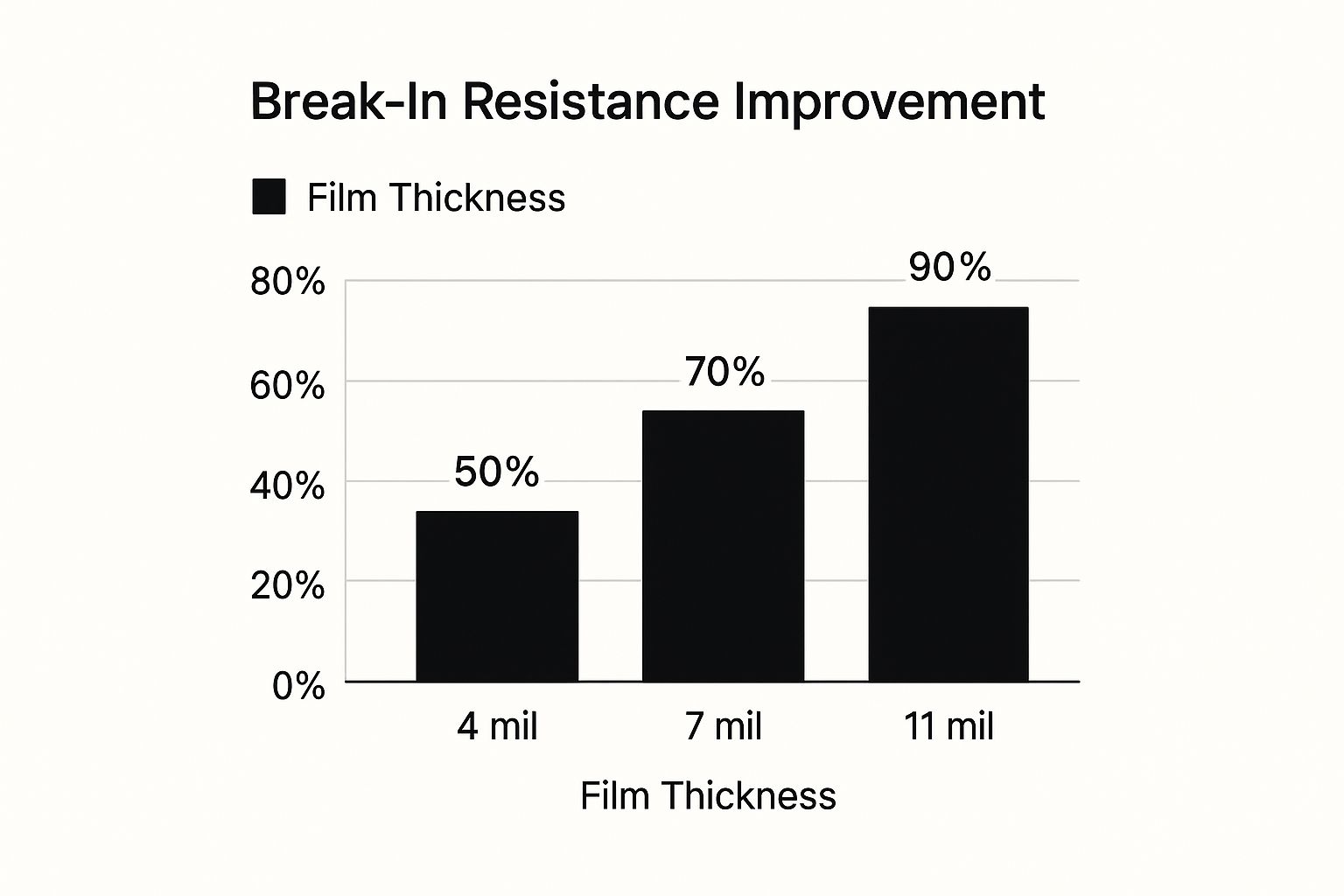
As you can see, jumping from a basic 4-mil film to a heavy-duty 11-mil version nearly doubles its strength. This dramatically increases the time and force a thief needs to actually get through the window.
A thicker film is simply better at absorbing impacts and has greater tensile strength, making it exponentially harder for someone to break in. If you live in a high-risk area or just want the ultimate peace of mind, investing in a film that is 8 mils or thicker is the way to go.
Choosing the right thickness is a balancing act between your budget and your security needs. This table breaks down the common options to help you decide.
Car Window Security Film Thickness Comparison
| Film Thickness (mils) | Primary Protection Level | Best For | Typical Use Case |
|---|---|---|---|
| 4 – 7 mil | Basic to Moderate | Deterring opportunistic smash-and-grab thieves. | Adding a solid layer of protection to deter quick, unplanned break-ins in low-risk areas. |
| 8 – 11 mil | High | Resisting more determined attacks and requiring significant force to breach. | Vehicles in urban or high-crime areas, or for drivers wanting superior security. |
| 12+ mil | Maximum | Withstanding repeated, heavy impacts for an extended time. | High-value vehicles, personal protection, or anyone seeking the highest level of defense. |
Ultimately, even a 4-mil film is a huge upgrade over unprotected glass, but for serious security, thicker is always better.
What's the Film Made Of? Choosing Your Technology
Beyond just thickness, the material science behind the film makes a huge difference, especially when you want benefits like heat rejection and UV protection. The automotive film market is constantly innovating.
Here’s a quick rundown of what you’ll find:
- Standard Polyester Films: This is your entry-level security film. It's strong, clear, and does a great job holding shattered glass together, but it won’t do much to block the sun’s heat.
- Carbon Films: A nice step up. These films are infused with carbon particles that are fantastic at blocking heat. A big plus is that they don’t interfere with your phone, GPS, or radio signals. They also have a great-looking matte finish.
- Nano-Ceramic Films: This is the best of the best. These films use advanced ceramic nanoparticles that are absolute powerhouses at blocking infrared heat—the kind you can feel—without having to be super dark. You get top-tier security, incredible heat rejection, and perfectly clear views.
The global market for automotive films, which was valued at around USD 3.9 billion, is a testament to how popular these advanced technologies have become. For premium nano-ceramic films, you can expect to see prices from $15 to $25 per square foot, reflecting their superior performance. You can dig into the numbers and trends yourself in this detailed industry report.
Don’t Forget About Tint Level (VLT) and Local Laws
Finally, you have to think about the tint level, which we call Visible Light Transmission or VLT. It’s simply the percentage of visible light that can pass through the window. The lower the VLT number, the darker the tint. A 5% VLT is that "limo tint" look, while a 70% VLT is nearly transparent.
A darker tint is great for privacy—it keeps prying eyes from seeing what's inside your car. However, you absolutely must follow your local laws.
Critical Reminder: Every state has its own strict and often confusing laws about window tint. They usually have different VLT rules for your front windows, rear windows, and back windshield.
Before you buy anything, look up the regulations for your specific state. Any reputable installer will know these laws inside and out and can help you make a compliant choice. Installing a film that's darker than what’s legal can lead to big fines and an order to have it all removed. Making a legal choice from the start ensures your car window security film is both effective and hassle-free.
Why Professional Installation Is Essential
So, you’ve picked out the perfect car window security film for your vehicle. You might think the heavy lifting is done, but the most important step is actually next. The truth is, how well your film performs—whether it can actually stop an impact, keep the glass intact, and last for years—is almost entirely dependent on the quality of its installation.
I like to use a simple analogy: think of it like building a strong brick wall. You can have the best, most expensive bricks on the market, but if the mortar is mixed poorly or applied with sloppy technique, the wall will be weak. It’s the same with security film; the installation is the "mortar" that creates a flawless bond and gives the film its strength.
A certified installer doesn't just slap the film onto your window. It's a precise, multi-stage craft that requires a meticulously clean space, specialized equipment, and years of hands-on experience. Cutting corners or making a small mistake can make that expensive film you bought practically useless.
The Professional Process Unpacked
Any installer worth their salt follows a strict protocol to get that perfect, invisible application. The work has to be done in a controlled, dust-free environment because contamination is the absolute arch-nemesis of a clean install.
Here’s what that process looks like in a professional shop:
- Thorough Decontamination: We're not talking about a quick wipe with Windex. A pro uses special clay bars and cleaning solutions to lift every microscopic speck of dust, oil, and road grime off the glass. This step is non-negotiable for getting the adhesive to bond directly and powerfully to the window surface.
- Precision Computer Cutting: Forget about a guy with a razor blade trying to freehand the cut. The best shops use computer software loaded with the exact templates for your car’s make and model. A plotter then cuts the film to perfectly match your glass, ensuring a clean, edge-to-edge fit with zero gaps.
- Expert Application: Using a proprietary "slip solution," the installer carefully floats the film into place. Then, using a series of specialized squeegees, they methodically push out every drop of water and every last air bubble. There's a real art to this, and it’s what creates that smooth, distortion-free finish.
This level of precision is exactly why you need to find a qualified expert. If you're looking to get this done, it pays to know what to expect from a top-tier shop. You can get a deeper dive into what a professional window security film installation involves to help you vet potential installers.
The Pitfalls of a DIY Attempt
I get it. The temptation to save a few bucks with a DIY kit is strong, but this is one of those jobs where it almost always ends in frustration and wasted money. The adhesive on security film is much more aggressive than what’s on standard tint, leaving absolutely no room for error.
Common DIY mistakes I've seen that ruin the film's integrity include:
- Trapped Contaminants: Even a single speck of dust or a piece of lint trapped underneath creates a permanent air bubble. It not only looks terrible but also creates a critical weak spot in the film's bond.
- Air Bubbles and Creases: Without the right squeegee technique and tools, it's next to impossible to get all the mounting solution out. This leaves you with ugly bubbles and creases that compromise the film's structure.
- Peeling Edges: If the edges aren't prepped perfectly or trimmed with precision, they will eventually start to lift and peel. Once an edge is compromised, the whole sheet of film can be pulled away with little effort.
A poorly installed security film provides a false sense of security. It might look okay from a few feet away, but it will fail the moment it’s tested, offering little to no real protection when you need it most.
Understanding the Curing Process
After the pros are done, there’s one last, critical phase: the cure. For a few days, or maybe up to a couple of weeks, you might see that your windows look a little hazy, cloudy, or have tiny water pockets. This is completely normal.
Don’t panic! That haziness is just the leftover moisture from the slip solution evaporating through the film's microscopic pores. It’s a visual sign that the powerful adhesive is forming its permanent bond with the glass. It’s crucial that you don’t roll your windows down or try to clean them during this time, as you could disrupt the cure and mess up the installation.
Once it's fully cured, the film will become crystal clear, and your invisible shield will be at maximum strength.
Answering Your Top Security Film Questions
When you're looking at a serious upgrade like car window security film, it's only natural to have a few questions. This isn't just a standard tint; it's a specialized product, and getting into the details is the best way to feel confident about your choice.
To make sure you have all the facts, we’ve pulled together the most common questions we hear from car owners just like you. Think of this as a quick-reference guide to address any lingering concerns and give you the clarity you need to move forward.
Is Car Window Security Film Bulletproof?
This is easily the most frequent—and most important—question we get. The answer is a firm no. It's crucial to understand that standard car window security film is bullet-resistant, not bulletproof. Those two terms mean very different things.
Security film is engineered to handle blunt force impacts. Think hammers, rocks, or a "spark plug ninja" attack. Its main job is to hold shattered glass together in one piece, which drastically slows down an intruder and keeps the broken glass from turning into dangerous projectiles. It creates a barrier that’s incredibly tough to break through quickly.
Bulletproof glass is a completely different animal. It’s a thick, multi-layered composite of glass and polycarbonate, sometimes several inches thick. Bullet-resistant film, while incredibly tough, is designed to absorb and spread out the energy from lower-velocity impacts, not stop a high-velocity bullet from a gun.
While highly specialized, ultra-thick ballistic films do exist for government vehicles or armored commercial trucks, they are not the same products sold for consumer cars. Those systems require special window frames and are part of a much larger, more complex armoring package. For everyday drivers, the goal of security film is to deter smash-and-grab theft and protect you from flying glass.
How Much Does Car Security Film Cost?
The cost of installing car security film can swing quite a bit, so it helps to know what goes into the final price tag. There's no single flat rate because the investment really depends on a few key factors.
Here’s what will shape the quote you receive:
- Film Quality and Type: A standard 4-mil polyester film is going to be your most budget-friendly option. If you step up to a premium 8-mil (or thicker) nano-ceramic film—which adds fantastic heat rejection to its security features—the price will naturally go up.
- Vehicle Size and Complexity: It costs less to cover the windows of a small, two-door coupe than it does a large SUV with more glass and more challenging curves.
- Local Labor Rates: The price for a skilled, certified installer will vary depending on where you live.
For a professional job on a typical sedan, you can generally expect the cost to land somewhere between $400 and $1,200. The lower end of that range usually covers a solid, basic security film. The higher end reflects the thicker, top-tier films that give you the best of both worlds: maximum protection and comfort. It's always smart to get a few quotes from reputable installers to see how they compare.
Can I Remove Security Film Later On?
Yes, you can remove car window security film, but this is one of those jobs you absolutely want to leave to a professional. The adhesive used to bond the film to your glass is incredibly strong—that's what allows it to hold shattered glass together so effectively.
Trying to pull it off yourself without the right tools and chemicals can create a nightmare of a sticky mess. You'll likely leave behind a stubborn, gluey residue that’s almost impossible to clean off. Worse yet, you could easily scratch your glass for good or damage the delicate defroster lines on your rear windshield.
Professionals use commercial-grade steamers to gently heat the film, which softens that aggressive adhesive. From there, they use specific solvents and techniques to peel the film away cleanly, leaving your window looking like it was never there. The small cost for professional removal is well worth it to avoid damaging your car.
Will Security Film Interfere With Electronics?
This is a totally valid concern, especially since our cars are packed with technology. The great news is that modern, high-quality car window security film is specifically designed to be 100% signal-friendly.
The old stories about signal interference came from outdated, metallic-based window tints. The metal particles in those films could actually block or reflect radio waves, causing spotty cell reception, glitchy GPS navigation, and fuzzy satellite radio.
Thankfully, today's advanced films have completely solved this problem.
- Carbon Films: These use non-conductive carbon particles that don't mess with electronic signals.
- Nano-Ceramic Films: These are the top of the line, using microscopic ceramic particles that are also non-metallic and signal-friendly. They deliver elite performance with zero electronic drawbacks.
When you choose a quality carbon or ceramic security film, you can rest assured it will not interfere with your GPS, cell signal, keyless entry, or satellite radio. Once the film has fully cured, it's also so thin and stable that it won't affect the normal up-and-down operation of your power windows. It’s one of the biggest benefits of investing in modern film technology.
Ready to transform your vehicle's glass into a powerful protective barrier? Fortress Security Films offers expert installation of premium security films designed to give you ultimate peace of mind. Contact us today for a free consultation and learn how we can safeguard your car.
