


When you hear “bulletproof glass,” what comes to mind? Probably a bank teller’s window or the armored car for a head of state. It's not something you typically picture in a quiet suburban home.
But the industry term is actually bullet-resistant glass, and it’s an advanced security feature that's quietly making its way into residential properties. The name says it all—it's designed to resist penetration by absorbing a bullet's energy, not to be completely "proof" against every possible threat.
Securing Your Sanctuary with Bullet Resistant Glass
Bringing commercial-grade security into your living room might feel a little intense, but it speaks to a very basic human need: peace of mind. Let’s face it, standard residential windows are the weakest link in a home's defense. A single pane of glass takes only seconds to shatter, giving an intruder an open invitation inside.
Bullet-resistant glass completely flips that script.
Instead of a fragile barrier, it’s a serious deterrent. Think of it like a catcher's mitt stopping a 100-mph fastball. The inner layers, usually made from a flexible material like polycarbonate or polyvinyl butyral (PVB), are there to absorb the incredible kinetic energy of a projectile. Meanwhile, the tough outer layers of glass flatten the bullet on impact. It’s this layered teamwork that stops the threat cold.
Why Homeowners Are Making the Switch
This isn't just a niche trend anymore; it's a direct response to very real safety concerns. The numbers tell the story. The global market for this technology was valued at around USD 8.48 billion in 2024 and is expected to surge to USD 20.20 billion by 2033. A big part of that growth is coming from homeowners, especially in high-net-worth neighborhoods, who now see it as a practical layer of defense.
But the protection goes far beyond stopping bullets.
- Forced Entry Deterrence: The same layered strength that stops a bullet makes it incredibly difficult for an intruder to smash through with a crowbar, hammer, or rock.
- Storm Protection: If you live in an area prone to hurricanes or tornadoes, this glass can handle flying debris that would shatter a normal window in an instant.
- Sound Reduction: The dense, multi-layer construction is a fantastic sound insulator, making your home significantly quieter.
A common worry is that installing bullet-resistant glass will make a home look like a bunker. Thankfully, modern manufacturing delivers amazing optical clarity. These windows look just like any other high-end window, blending right in with your home’s design without sacrificing natural light.
While reinforcing your windows offers powerful protection, a truly secure home relies on comprehensive strategies on how to increase home security and protect your home, from the driveway to the back door. Think of bullet-resistant glass as one crucial piece of a much larger puzzle designed to keep your family safe.
Decoding Ballistic Protection Levels for Your Home
When it comes to protecting your home with ballistic glass, it's not about buying the thickest, toughest panel you can find. It’s about making a smart, calculated decision based on a real-world assessment of your security needs. The gold standard for measuring this strength is the National Institute of Justice (NIJ) rating system, which clearly defines what kind of threat a specific product is built to stop.
Think of NIJ ratings like weight classes in boxing. A heavyweight is prepared for a much different level of impact than a lightweight. In the same way, ballistic glass is engineered for specific threats, and matching the rating to your potential risk is the key to a sound investment.
Understanding the NIJ Standard
At its core, the NIJ standard is pretty straightforward. Each level corresponds to the caliber and velocity of ammunition it's certified to defeat. The scale starts at Level 1, which stops rounds from smaller handguns, and goes all the way up to Level 8, designed to stop high-powered, armor-piercing rifle rounds.
For homes, we're almost always focused on the lower to mid-range levels. The higher ratings you see in military bases or armored trucks are complete overkill for a residential setting—both in cost and in the heavy-duty construction needed to support them.
This diagram shows where true bullet-resistant glass fits in with other security options.
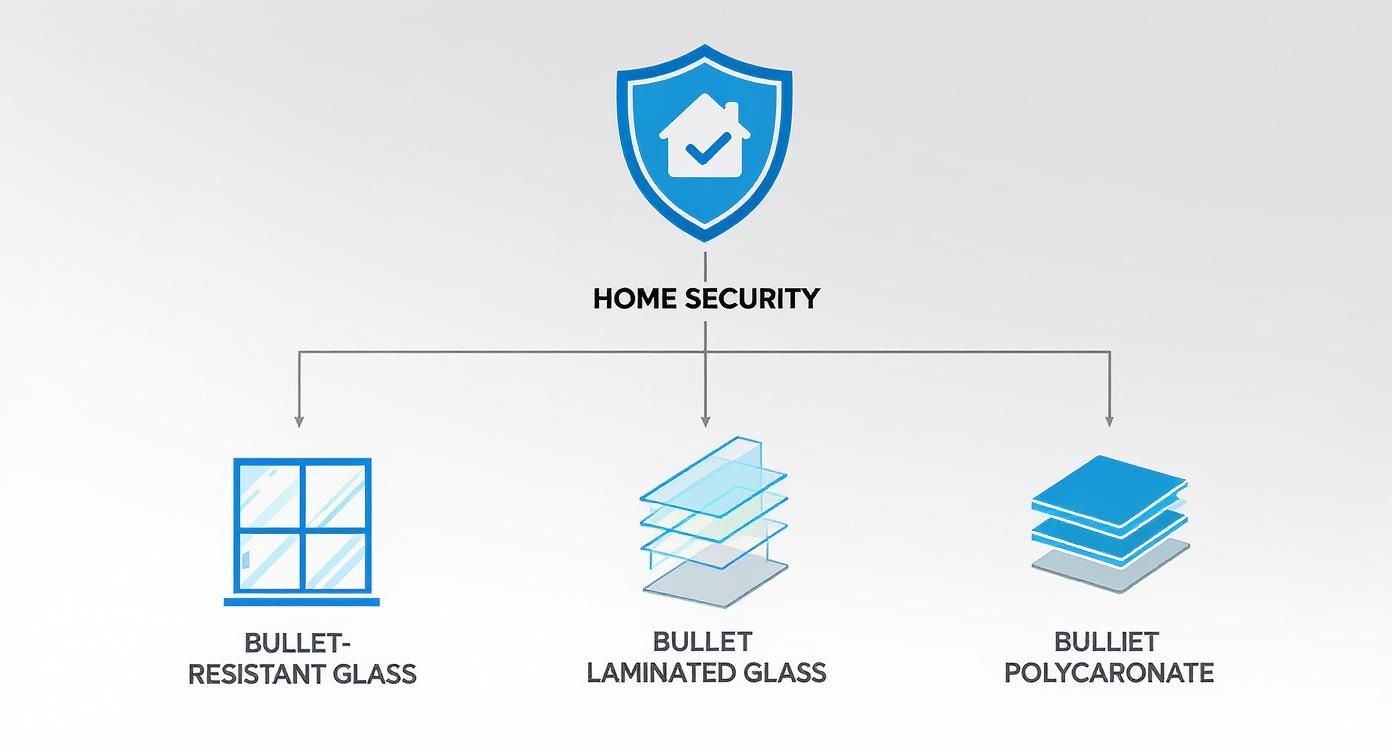
As you can see, it's a specialized product that offers a far higher degree of protection than standard laminated safety glass or polycarbonate sheets alone.
Finding the Right Protection Level for Your Home
For most homeowners, the ratings that matter are NIJ Levels 1 through 3. These options provide serious protection against the firearms most commonly used in residential crimes, and they're practical to install in a typical home.
-
NIJ Level 1: This is your entry-level ballistic protection. It’s designed to stop at least three shots from a 9mm full metal jacket round, one of the most common handgun calibers. It gives you a solid baseline of defense against random, opportunistic threats.
-
NIJ Level 2: Taking a step up, Level 2 glass can withstand rounds from a more powerful .357 Magnum handgun. This is a popular choice for homes in higher-risk urban or suburban neighborhoods where the potential for more determined threats is a concern.
-
NIJ Level 3: This is one of the most common and effective choices for high-security homes. Level 3 is rated to stop multiple rounds from a .44 Magnum, a very powerful handgun. It defends against a wide range of handgun threats without the extreme weight and cost of rifle-rated glass.
Anything above Level 3 is usually engineered to stop rifle fire, like rounds from an AR-15 or AK-47. While you can get this for a home, it's rarely necessary and requires heavily reinforced, specialized framing to handle the immense weight and impact energy.
The table below breaks down these common levels in a practical way.
Common NIJ Ratings for Residential Bullet Resistant Glass
| NIJ Level | Protects Against (Common Handguns) | Protects Against (Rifles) | Typical Residential Application |
|---|---|---|---|
| Level 1 | 9mm, .38 Special | No | Provides a solid baseline defense against common handguns for general home security. |
| Level 2 | .357 Magnum, 9mm | No | A good upgrade for homes in higher-risk areas or for those seeking enhanced protection. |
| Level 3 | .44 Magnum | No | The most common high-security choice, offering robust protection against powerful handguns. |
Ultimately, choosing the right level is about creating a barrier that deters intruders and buys you critical time to react and call for help.
For the vast majority of homes, Level 1 to Level 3 glazing achieves this perfectly. It provides a powerful deterrent and a life-saving delay without turning your home into a fortress.
Conducting Your Personal Threat Assessment
So, how do you pick the right level? It all starts with an honest look at your personal situation. You don't need to be a security consultant—just think through a few key factors to figure out what makes sense for your property and family.
Ask yourself these questions:
- What’s my main concern? Are you trying to deter a quick smash-and-grab burglary, or are you worried about a more targeted, determined threat? Your answer helps define the strength you need.
- Where are my home’s weak spots? Ground-floor windows, large glass patio doors, and front doors with glass sidelites are the most common targets. You might decide to put a higher level of protection in these specific areas.
- What’s the security climate in my neighborhood? A secluded estate in a high-net-worth area like Palos Verdes might face different risks than a home in a densely populated urban center.
Thinking through these questions will point you toward a protection level that truly fits your needs. Choosing the right ballistic glass means investing in peace of mind that’s matched to your life—keeping your sanctuary secure without any unnecessary cost or complexity.
Laminated Glass vs. Polycarbonate: What's the Difference?
When you start looking into bullet-resistant glass for your home, you'll quickly realize it's not just about how thick the panel is. The actual materials used are what really define the performance, look, and cost. The two main players in this space are laminated glass and polycarbonate, and they take very different approaches to stopping a bullet.
Think of it this way: one is like a medieval knight's rigid, heavy plate armor, while the other is more like modern, flexible Kevlar. Both get the job done, but their design philosophy is completely different. That same principle applies here.
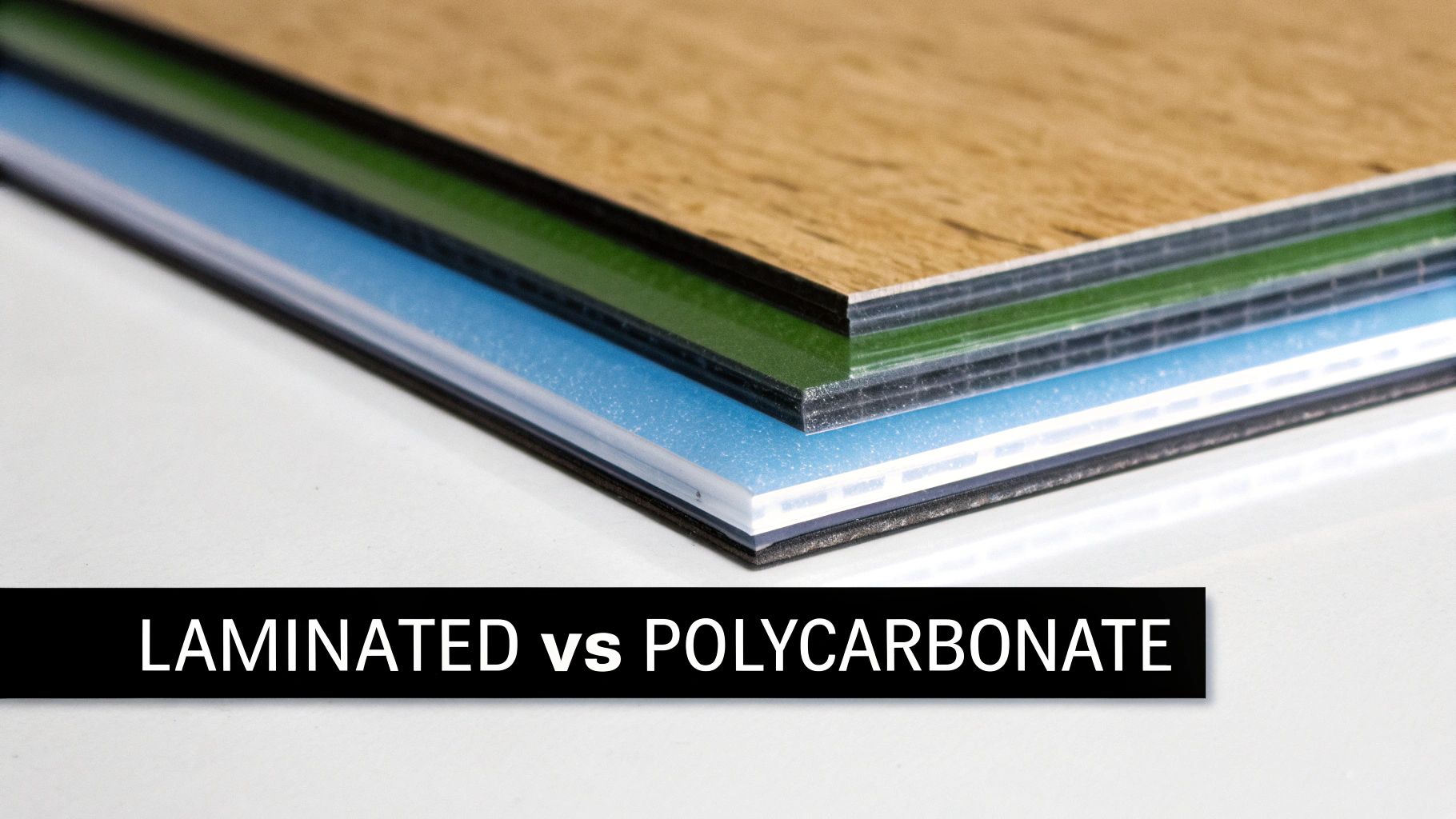
Laminated Glass: The Classic "Glass Sandwich"
Laminated glass is what most people picture. It’s essentially a high-tech sandwich made by layering a flexible plastic, usually polyvinyl butyral (PVB), between multiple sheets of glass.
When a bullet hits, the outer glass layer shatters, but that sticky, tough PVB interlayer grabs the energy of the impact and holds all the glass fragments in place. This is what stops the bullet from passing through. The more layers you add, the more protection you get.
The big win for an all-glass laminate is its flawless optical clarity and scratch resistance. It looks and feels just like a premium window, which is a huge deal for homeowners who want top-tier security without making their house look like a fortress.
But there's a catch: this stuff is heavy. Really heavy. A high-rated panel can weigh a ton, which often means you'll need to reinforce the window frames. That specialized installation adds a chunk to the overall cost.
Polycarbonate: The Lightweight Heavy-Hitter
Polycarbonate is in a totally different league. It's not actually glass; it's a remarkably strong, clear thermoplastic. On its own, polycarbonate is an incredible 250 times more impact-resistant than glass but weighs a whole lot less.
For ballistic-rated windows, you'll typically find it in a composite form called glass-clad polycarbonate (GCP). Here, the outer layers are thin sheets of glass for scratch resistance, but the real muscle is in the thick inner layers of polycarbonate that absorb the impact. This combination gives you amazing protection at a fraction of the weight of an all-glass panel.
Because it's so much lighter, GCP is often a go-to choice for retrofitting existing homes where you can't—or don't want to—do major structural work on the window frames.
The trade-off? Polycarbonate is softer than glass. While modern versions have a protective hard coat, they can still scratch more easily. They can also be prone to yellowing after years of direct UV exposure if not made with high-quality UV inhibitors.
A Head-to-Head Comparison
So, which one is right for your home? It really boils down to balancing weight, clarity, and your budget. Here's a quick breakdown to help you compare.
| Feature | Laminated Glass | Polycarbonate (and GCP) |
|---|---|---|
| Impact Resistance | Good to excellent, depending on thickness | Excellent to superior; significantly stronger than glass. |
| Weight | Heavy. Requires strong, often reinforced frames. | Lightweight. Often suitable for standard frames. |
| Optical Clarity | Excellent. Maintains pristine, clear views. | Very good, but can have minor distortions. |
| Scratch Resistance | Superior. Resists scratches like normal glass. | Lower. Prone to scratching without a protective coating. |
| Cost | Generally more affordable at lower protection levels. | Often more expensive, especially at higher NIJ ratings. |
Recent innovations are what have really brought these high-level security materials into the residential world. The global market for bulletproof glass was valued at USD 8.25 billion in 2024 and is projected to jump to USD 22.60 billion by 2035. Much of that growth is being fueled by new technologies making these solutions more practical and effective for homeowners, especially here in North America where security is a growing concern. If you're interested in the market trends, you can learn more about market findings and their projections.
Calculating the Cost of Bullet Resistant Windows
https://www.youtube.com/embed/rEs3eZVTd68
Alright, let's talk numbers. What does this level of security actually cost? When you're looking at bulletproof glass for a house, there's no single price tag. It's more of a spectrum, and your final investment will come down to your specific security goals, the materials you choose, and how complex the installation is.
The price range is pretty wide. You can start around $25 per square foot for top-notch security films that do a great job deterring break-ins, and climb to over $100 per square foot for serious, multi-layered ballistic panels. What you end up paying depends entirely on a few key variables.
Key Factors Driving the Final Price
When you're budgeting for ballistic glass, a few critical things will shape the total cost. Each one affects how the product performs and the labor needed to get it installed right. As homeowners dive into security upgrades, they often weigh them against other major construction costs, sometimes by understanding the cost of steel building homes.
Here are the main components that move the needle on price:
-
NIJ Protection Level: This is the big one. A Level 1 rated window, built to stop common handgun rounds like a 9mm, is going to be far more affordable than a Level 3 window designed to stop a high-powered .44 Magnum. Higher ratings mean more layers and more sophisticated manufacturing, which naturally drives up the price.
-
Material Composition: As we've covered, different materials come with different costs. All-laminated glass is often the more budget-friendly option at lower protection levels. In contrast, the advanced, lightweight polycarbonate tends to get pricier as you move up the NIJ rating scale.
-
Window Size and Shape: Standard rectangular windows are always the most economical. If you need custom sizes, arched tops, or other unique shapes, expect the cost to increase. Bigger windows also need thicker, heavier glazing to do their job, adding to both material and shipping expenses.
Here's the most important thing to remember: the glass itself is only half the battle. A perfectly rated ballistic panel won't do you any good if it's sitting in a standard residential frame that can be kicked in or pried open in seconds.
The Non-Negotiable Cost of Professional Installation
This leads to a point that can't be overstated—professional installation isn't just a good idea, it's a mandatory part of the system. Bullet-resistant glass is incredibly heavy and needs specialized handling and mounting to perform the way it was designed and tested.
Here's why you can't cut corners on installation:
-
Frame Reinforcement: The window frame has to be tough enough to handle the massive energy transfer when a bullet hits. Pros often use reinforced steel or aluminum frames built specifically to work with ballistic glass.
-
Secure Anchoring: The whole unit—glass and frame together—has to be securely anchored directly to your home's structural supports. If it's not anchored properly, the entire window could be knocked out with enough force, making the expensive glass useless.
-
Preserving Warranties: If you try to install it yourself or hire a general contractor who isn't certified, you can bet you'll void the manufacturer's warranty. That leaves you with zero protection if the product fails.
Ultimately, the cost of bulletproof glass for your home is a direct investment in your family's safety. By carefully weighing the NIJ rating, material choices, and professional installation, you can build a protective shield that fits your home's unique needs and your budget—and the peace of mind that comes with it is priceless.
A Practical Checklist for Homeowners
Deciding to install bullet-resistant glass in your home is a major step. It’s an investment in your family's safety, and you want to get it right. To make a confident choice, it helps to think through the process methodically, from assessing your actual needs to finding the right team for the job.
Thinking this way is becoming much more common. In fact, the market for bulletproof glass in construction is expected to expand at an annual rate of 16.2% between 2023 and 2033. This isn't just a statistic; it shows a real shift as more homeowners take proactive steps to secure their properties. If you're curious about the numbers, you can read the full research about the global bulletproof glass market.
Here’s a simple framework to guide your decision-making.
Start with a Realistic Threat Assessment
Before you look at a single product, you need to understand the problem you're trying to solve. A personal threat assessment isn’t about being paranoid; it's about being practical. Just ask yourself a few honest questions.
- What am I really worried about? Is your main goal to stop a fast smash-and-grab burglary? Or are you concerned about a more determined, targeted threat? The answer will point you toward the right NIJ protection level.
- What’s my neighborhood like? Take local crime rates and the general feel of your area into account. A secluded estate in Palos Verdes faces different potential risks than a home in a bustling city neighborhood.
- Where is my property most vulnerable? Take a walk around the outside of your house. Look for poorly lit corners, easy access points, or dense landscaping that could give an intruder cover.
Answering these questions helps you move from a general feeling of unease to a clear set of security goals.
Pinpoint and Prioritize Your Weak Spots
Not all windows and doors are created equal when it comes to risk. Intruders almost always go for the path of least resistance. Figuring out where those weak points are lets you put your budget where it will do the most good.
Concentrate on these high-priority zones:
- Ground-Floor Windows and Doors: These are the most obvious targets. Pay close attention to large sliding glass doors, kitchen windows, and any glass right next to a door lock.
- Hidden Entry Points: Do you have windows on the side or back of the house that can't be seen from the street? Those are prime targets for someone trying to stay hidden.
- Doors with Sidelites: Those narrow glass panels flanking a front door are a classic weak spot. An intruder can break one, reach inside, and unlock your door in seconds.
By prioritizing these areas, you get the biggest security upgrade for your investment.
Vet Your Installer and Understand Local Codes
The best bullet-resistant glass in the world is useless if it's installed improperly. If the frame gives way, the glass rating doesn't matter. This means choosing the right installer is just as critical as choosing the right product.
A ballistic system is only as strong as its weakest link. Professional installation ensures the glass, frame, and anchoring all work together as a certified unit to stop a threat.
When you're interviewing potential installers, be sure to ask:
- About their certifications and experience: Can they show you proof they're certified to install ballistic systems? Ask to see photos of past residential projects like yours.
- If they know local codes: Building codes in Southern California can get complicated. Your installer needs to know all the local rules, including any specific requirements for security installations.
- For a long-term maintenance plan: Find out how to care for the windows, especially if you choose a product with polycarbonate layers. A good company will give you clear instructions to keep the system working properly and looking its best.
Following this checklist will help you navigate the process confidently, ensuring you make a smart decision that brings you real peace of mind.
Common Questions About Residential Bulletproof Glass
Even after digging into the materials, costs, and protection levels, it’s completely normal to have some practical questions about what it's really like to live with bulletproof glass in your home. This is a big decision, and understanding the day-to-day realities is key to feeling confident about it. Let's tackle some of the most frequent concerns we hear from homeowners.
Will Bulletproof Glass Change the Look of My Home?
This is probably the number one worry we address. Homeowners are concerned that adding ballistic protection will make their house look like a fortress or some high-security government building. It’s a perfectly valid concern. You want your home to be a sanctuary, not an imposing compound.
Thankfully, modern manufacturing has completely solved this problem.
Today’s top-tier bullet-resistant glass is engineered for exceptional optical clarity. Forget the thick, greenish-tinted panels you might picture at a bank teller's window. Residential-grade products are designed to be virtually indistinguishable from standard high-end windows, letting in maximum natural light without distorting your view. The goal is seamless integration—providing incredible security that remains completely invisible.
How Much Does This Stuff Actually Weigh?
The weight of bullet-resistant glass is a huge factor and directly impacts how it gets installed. This isn't your average window pane. It's a heavy, dense composite, and the weight changes dramatically depending on the materials used and its NIJ protection level.
An old-school, all-laminated glass panel rated for NIJ Level 3, for instance, can be incredibly heavy. We're talking about needing custom-built, reinforced steel or aluminum frames just to support its mass. This is a major structural consideration that has to be planned from the start.
On the other hand, glass-clad polycarbonate (GCP) is a much lighter alternative. By using strong but lightweight polycarbonate for the inner layers, these panels offer the same (or even better) protection at a fraction of the weight. This often makes GCP the go-to solution for retrofitting existing homes where you can’t exactly rebuild the walls.
No matter which material you're considering, a professional assessment is non-negotiable. An expert installer has to evaluate your home's structure to make sure the window frames can safely handle the load. The entire system has to work together to be effective.
Does Bullet-Resistant Glass Need Special Maintenance?
You’ll be happy to hear that maintaining your bullet-resistant windows is surprisingly simple. It’s not much different from caring for regular glass, but there are a few golden rules to follow to ensure they last and stay perfectly clear.
Simple Care Tips for Longevity:
- Use the Right Cleaner: All you need is a simple mix of mild soap and water or a standard non-ammoniated glass cleaner. Just use a soft, lint-free microfiber cloth.
- Avoid Abrasives at All Costs: Never, ever use abrasive scrubbers, squeegees with sharp metal edges, or harsh chemicals like ammonia or bleach. They can eat away at the protective coatings and scratch the surface.
- Be Gentle with Polycarbonate: If your windows have polycarbonate layers, they need a little extra care. This material is softer than glass and can scratch more easily. Always stick to a very soft cloth and avoid any cleaners with alcohol or solvents.
Follow these simple steps, and you'll preserve the window's optical clarity and protective integrity for decades.
Can't I Just Add a Security Film to My Existing Windows?
This is a great question, and it’s important to get the distinction right. High-quality security films are an excellent and affordable way to dramatically strengthen your existing windows. They make the glass shatter-resistant, holding all the shards together on impact. This works wonders for deterring smash-and-grab burglaries and protecting against storm debris.
However, standard security films are not bullet-resistant. They are built to delay forced entry, not stop a bullet.
Now, there is a specialized category of NIJ-certified ballistic films that can offer some ballistic protection when applied in multiple layers to very thick glass. While these advanced films might stop rounds from smaller handguns, they generally provide a lower level of protection than a purpose-built bullet-resistant glass panel. A full replacement window is an engineered system—the glass and frame are designed and tested together to defeat specific threats, giving you the highest level of certified security.
Ready to see how advanced security solutions can discreetly protect your home without compromising its beauty? At Fortress Security Films, we specialize in providing nearly invisible protection tailored to your property’s unique needs.
Discover our advanced residential security film solutions today.
