


When most people hear "bulletproof glass," they probably think of those thick, murky panels you see at a bank or a ticket booth. But for home security, that image is completely outdated. The technology has come a long way, and today's solutions are surprisingly sophisticated and almost invisible.
First things first, the industry term isn't "bulletproof"—it's bullet-resistant glass. And it’s designed to blend seamlessly into your home’s architecture, offering crystal-clear views without a hint of the protection it provides.
Securing Your Home with Modern Ballistic Glass
For homeowners across Southern California, especially in more affluent communities, peace of mind is invaluable. When we think about securing a property, our minds often jump to things like iron bars, heavy shutters, or complex alarm systems. Bullet-resistant glass offers a much cleaner, more elegant solution—an invisible shield that hardens your home's weakest points without sacrificing its beauty.
This guide will pull back the curtain on residential ballistic protection. We’re going to look past the old, industrial stereotype and show you how modern security glazing is a practical and refined upgrade. It’s not about one-size-fits-all; it’s a spectrum of solutions that can be tailored to the specific threats you’re concerned about.
What’s Really Happening at Impact?
At its core, bullet-resistant glass isn’t designed to be simply "unbreakable." It's all about absorbing and dispersing energy.
Think of it like a professional catcher’s mitt stopping a 90 mph fastball. The mitt isn't a rigid wall; it flexes and "gives," safely absorbing the ball's kinetic energy. Ballistic glass does the same thing on a much more extreme scale, using multiple layers of different materials to "catch" a bullet and stop it cold.
The secret is in the layering. Most high-performance ballistic glazing consists of alternating sheets of glass and a specialized polymer, like polycarbonate. This sandwich-like construction gives the window both hardness and flexibility, which is the key to neutralizing the force of an impact.
The real objective here is to turn a fragile entry point into a formidable barrier. It’s about buying you precious time—time for your family to get to safety and for law enforcement to arrive during a worst-case scenario.
Of course, these windows are just one part of a comprehensive security plan. It's always a good idea to integrate them with general security best practices for homes to create a truly layered defense.
Tailoring the Solution to Your Home
The good news is that you don't have to live in a fortress to get this level of protection. Modern technology gives us a few different paths to achieve it, making it adaptable for nearly any home style or budget.
Here are the main options you’ll come across:
- Multi-Layered Glazing: This is the top-tier solution, where your existing window panes are replaced with fully-engineered, factory-laminated units made of glass and polycarbonate. It offers the highest protection levels and is perfect for new builds or extensive remodels.
- Ballistic Security Films: A fantastic retrofit option. These are incredibly thick, multi-layered films applied directly to your existing glass by certified technicians. When paired with a structural anchoring system that bonds the film to the window frame, they can achieve legitimate ballistic ratings.
- Polycarbonate Sheets: While more common in high-risk commercial buildings, solid polycarbonate glazing can be used in homes where maximum protection is the absolute priority. It's incredibly tough, though its optical clarity and scratch resistance can differ from laminated glass.
We’ll explore each of these in more detail, giving you the clarity you need to decide which approach is the right fit for your home and family.
How Bullet Resistant Glass Actually Works
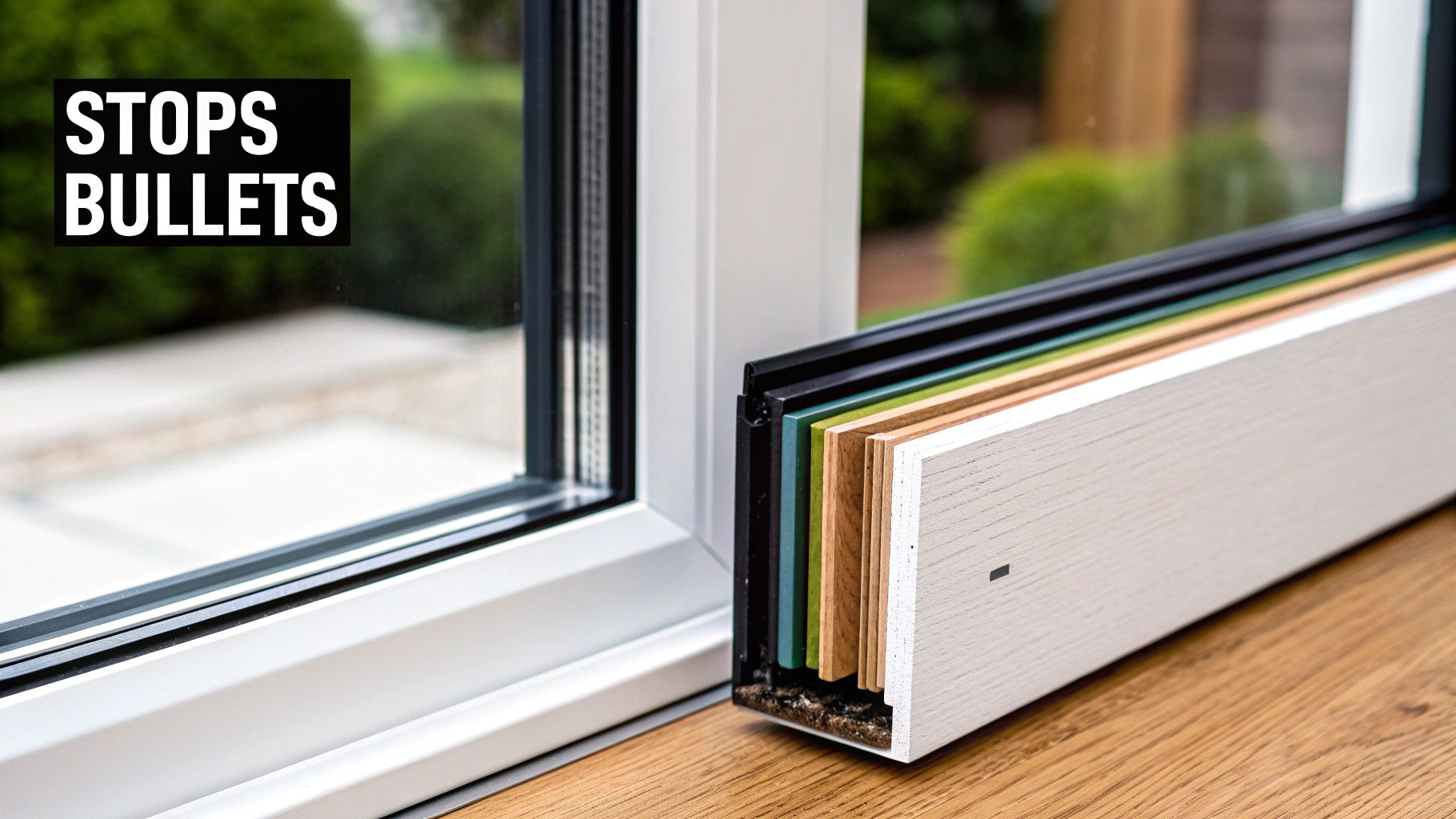
Ever wondered how a piece of what looks like normal glass can stop a bullet cold? It's not about being an impenetrable wall of force. The real secret is in clever, layered engineering that acts more like a highly advanced catcher's mitt—absorbing and dispersing a projectile's staggering amount of energy.
This turns your window from a weak point into a serious line of defense. The technology behind bulletproof glass for homes is all about a sandwich-like construction, where multiple layers of different materials work together the instant an impact occurs.
When a bullet hits, the outermost layer of hardened glass does its job first. It’s designed to shatter, which might seem strange, but this is a critical first step. The shattering actually deforms the bullet, flattening its tip and scrubbing off a significant amount of speed.
By blunting the projectile, this outer layer dramatically increases the bullet's surface area. That means the force is spread out over a much wider section of the window instead of being focused on one tiny, destructive point that would punch right through ordinary glass.
The Science of Absorption
Once that outer glass layer shatters, the flexible inner layers spring into action. This is where the real work of stopping the bullet happens. These layers are typically made from tough, elastic materials like polycarbonate or a specialized polymer called polyvinyl butyral (PVB).
Think of these inner layers as a safety net. The outer glass is hard and brittle, but the inner layers are pliable and incredibly strong. They flex and stretch when the deformed bullet hits them, soaking up the rest of its kinetic energy and trapping it within the panel. It literally "catches" the threat.
This marriage of a hard outer layer that breaks apart the bullet and a soft inner core that absorbs its energy is the entire principle behind ballistic resistance. Each layer has a specific job to do, and they perform it in a fraction of a second.
The number of these alternating layers, and how thick they are, dictates the window’s strength and what kind of threat it can stop. A window rated to stop a handgun round will have a much different makeup than one built to withstand a high-powered rifle. This is how manufacturers engineer products to meet specific NIJ (National Institute of Justice) protection levels.
Two Paths to a Safer Home
For homeowners in Southern California, this security technology is available in two main forms. The right choice really depends on your property, budget, and overall security plan.
- Laminated Ballistic Glazing: This is a full replacement solution. Your old windows are removed, and new, factory-built units are installed. These are engineered from scratch with the glass and polycarbonate layers permanently bonded together, offering the highest level of seamless protection.
- Ballistic Security Films: This is a powerful retrofit option. Here, an incredibly thick, multi-layered polymer film is applied directly to your existing window glass. A critical component of a professional installation is the anchoring system that mechanically fastens the film to the window frame, preventing the entire pane from being knocked out after an attack.
Both methods rely on the same core principle of energy dispersion. Whether you're installing brand-new ballistic windows or retrofitting with an anchored film system, the objective is the same: to transform your home's most vulnerable entry points into a protective shield that gives you critical time when you need it most.
Decoding NIJ Ratings for Residential Security
When you start looking into bullet-resistant glass, the terminology can feel a little intimidating. But it’s not as complicated as it seems. Just like a firefighter needs different gear for different situations, ballistic protection isn’t a one-size-fits-all product. The trick is to understand the language professionals use to measure performance.
The gold standard for this is the National Institute of Justice (NIJ). Think of NIJ ratings as a straightforward way to classify protection levels. Each level is tested to stop specific types of ammunition, so you can match the solution directly to your security needs without any of the guesswork.
Let's put this in real-world terms. For most homeowners, the concern isn't about stopping military-grade weapons; it’s about protecting against common handguns that might be used in a burglary or home invasion. That's where the lower-to-mid-range NIJ levels offer practical, powerful defense.
Matching the Protection to the Threat
Understanding these levels is the key to making a smart investment. You wouldn't use a sledgehammer to hang a picture, and you don't always need the absolute highest level of ballistic protection for your home. It’s all about finding the right tool for the job.
For many homes in Southern California, an NIJ Level 1 or Level 2 system is the perfect starting point. These ratings are specifically designed to stop rounds from the most common handguns, like a 9mm or a .357 Magnum. This level of security is incredibly effective at defeating a forced entry attempt and giving you a solid barrier against an opportunistic criminal.
Stepping up to an NIJ Level 3 rating brings a serious jump in protection. This level can stop much higher-velocity rifle rounds, such as those from a .44 Magnum. It’s a more specialized solution, typically reserved for high-net-worth estates or homes that face specific, known threats.
The goal is to find that sweet spot where your peace of mind aligns with a practical level of defense. For most residential applications, the focus is on defeating common handgun threats, which NIJ Levels 1-3 cover exceptionally well.
It's also important to know that you don't always need to rip out your windows to get this level of protection. While a full, multi-layered window replacement offers the highest certifications, advanced retrofit solutions are also a fantastic option. For instance, a professionally installed and anchored ballistic window film system can achieve certified NIJ ratings and provide a powerful upgrade to your existing glass.
NIJ Ballistic Resistance Levels Explained for Homeowners
To make this even clearer, I've put together a simple table that breaks down the NIJ levels most relevant for home security. This should help you visualize what each rating actually means in terms of protection and where it fits.
| NIJ Level | Protects Against (Common Examples) | Typical Application for Homes | Solution Type |
|---|---|---|---|
| Level 1 | 9mm, .38 Special | A great baseline for suburban homes. Deters common break-ins and opportunistic threats. | Retrofit Film or Glazing |
| Level 2 | .357 Magnum, high-velocity 9mm | A robust choice for urban homes or properties where crime rates are a greater concern. | Retrofit Film or Glazing |
| Level 3 | .44 Magnum, some rifle rounds | Best for high-profile estates or homes with specific, identified threats. Offers fortress-like security. | Laminated Glass / Polycarbonate |
Using this table as a quick reference, you can have a much more productive conversation with a security consultant. You'll be able to explain your concerns clearly and have a solid foundation for choosing a system that balances safety, aesthetics, and your budget. This clarity makes sure your investment is targeted right where you need it most.
More Than Just Protection: The Unexpected Perks
Of course, the main reason you’re looking into ballistic glass is for protection. That’s a given. But what most homeowners don't realize until after installation is just how many other day-to-day benefits come along for the ride. Think of it less as a single-purpose security feature and more as a complete upgrade to your home's comfort and resilience.
Right off the bat, you get a massive boost in forced-entry resistance. Your home's weakest link, by far, is standard glass. A burglar can smash through it in seconds. Bullet-resistant glass completely flips that script. Its tough, laminated structure can take a serious beating from hammers, crowbars, or bricks, refusing to give way.
That delay is a game-changer. Criminals want easy targets, and a window that cracks but doesn't break is anything but easy. Instead of shattering, the glass will spiderweb but stay firmly in its frame, creating a physical wall. That buys you critical time for your alarm to sound and for help to arrive.
Beyond Burglars: Everyday Upgrades
The benefits don't stop with security. The same multi-layered design that stops a bullet is also fantastic at dealing with other, more common threats. Your investment pays dividends every single day, not just in a worst-case scenario.
- Natural Disaster Defense: Living in Southern California means thinking about earthquakes. In a quake or even during severe windstorms, this glass holds together. It prevents deadly shards of glass from flying through your home, protecting your family and your property.
- A Sunscreen for Your Home: The polymer layers inside ballistic glass block up to 99% of damaging UV rays. This is a huge deal for preserving the life of your expensive furniture, hardwood floors, and artwork, preventing them from fading and deteriorating in the sun.
- Incredible Soundproofing: The dense layers of glass and polymer act as a powerful sound barrier. That noisy street outside? It fades into the background. This acoustic insulation creates a much more peaceful and quiet sanctuary for your family to enjoy.
Why More Homeowners Are Making the Switch
We're seeing a clear trend: proactive security is no longer a niche concern. North America is leading the charge, accounting for a 35.8% share of the global market. With FBI data reporting over 1.2 million violent crimes in 2022, homeowners are rightly looking for real, physical solutions.
In fact, manufacturers have noted a 20-30% jump in residential inquiries since 2020. This lines up with a troubling rise in home invasions targeting affluent neighborhoods. People are realizing that this invisible layer of armor is one of the most effective ways to buy themselves time when it matters most. You can dive deeper into the market drivers over at Data Bridge Market Research.
This diagram gives you a great visual of the NIJ rating system, showing how protection levels scale from common handguns up to high-powered rifles.
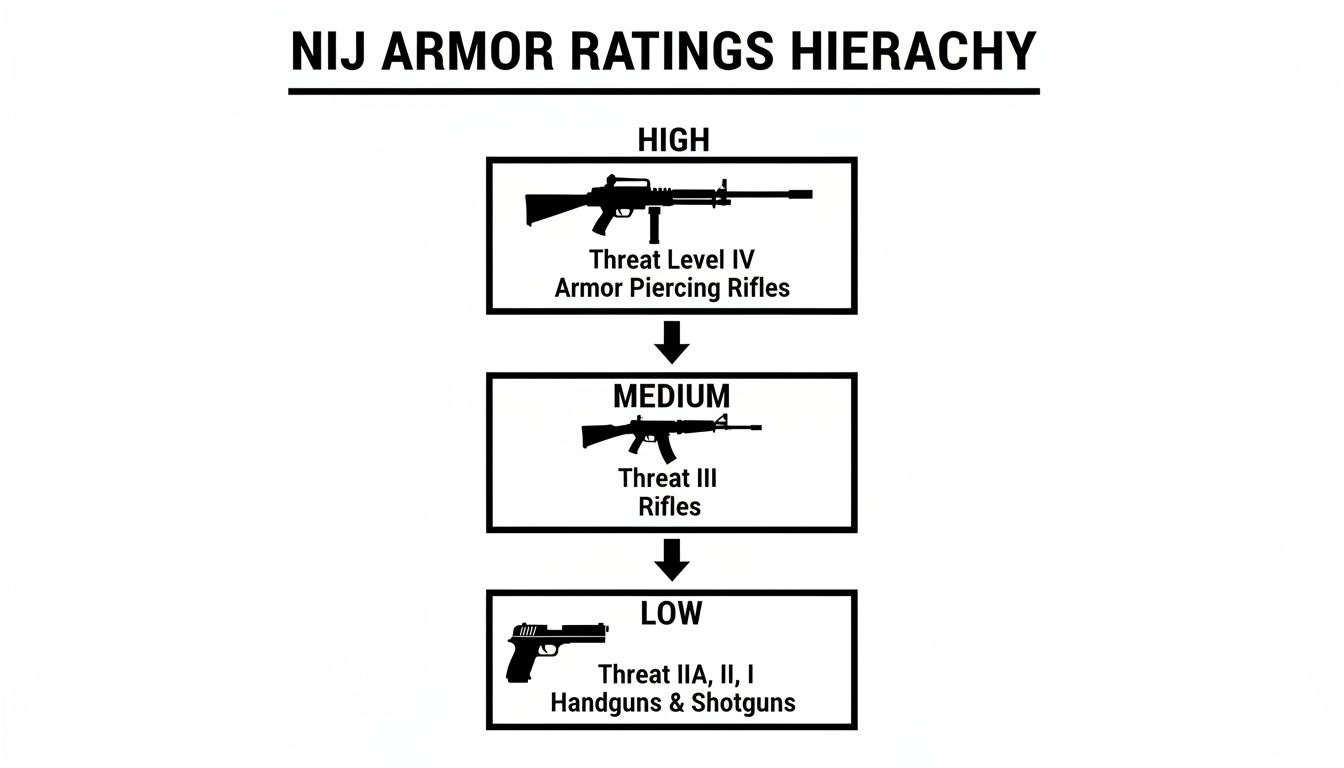
As you can see, it's not a one-size-fits-all solution. You can choose the level of protection that directly addresses your specific concerns.
Ultimately, opting for bullet-resistant glass is an investment in your home’s total environment. It brings a profound sense of security while actively making your home more comfortable and preserving its value—benefits you’ll appreciate every single day.
Choosing the Right Security Glass Installer
Having the best bulletproof glass for homes is only half the battle. The other half—the part that truly determines how well it works—is the installation itself. Get it right, and your investment performs exactly as intended. A poor installation, however, can create weak spots that render the entire system useless.
You’re not just looking for someone to fit a pane of glass. You need to partner with a security specialist who genuinely understands the physics and nuances of ballistic protection. They should act more like a consultant, guiding you to the right solution for your home, not just the priciest one on their truck.
A true professional starts with a conversation. They'll want to know about your specific concerns, the layout of your property, and even your family's daily routines. This consultative approach is the hallmark of someone who cares about your security, not just making a quick sale.
Vetting Your Installation Professional
So, how do you spot a true expert? Think of it like a hiring process—you need a checklist to make sure they're qualified. Just as there are best practices for how to choose an architect for your project, there are non-negotiables when vetting a security installer.
Here’s what you should absolutely demand:
- Proof of Certifications: Don't just take their word for it. Ask to see the paperwork showing their products meet NIJ standards. A pro will be proud to share this.
- Residential Experience: Installing ballistic glass in a luxury home is a world away from a simple commercial job. Ask for a portfolio of their residential work and look closely at the finish and aesthetics.
- Proper Licensing and Insurance: This is table stakes. Ensure they are fully licensed, bonded, and insured. It's your protection against anything going wrong on your property.
The Importance of Local Expertise
A local company brings an invaluable advantage. A specialist who understands Southern California architecture, for example, will already know how to approach the large glass doors, custom window frames, and indoor-outdoor designs common in the region.
A great installer does more than just fit the glass; they analyze your home’s unique vulnerabilities and recommend a tailored solution. They understand that a professional installation, especially of retrofit systems, is a detailed process that can make or break the effectiveness of the security film.
It's no surprise that the demand for these solutions is climbing. The global bulletproof glass market was valued at $9.3 billion in 2023 and is on track to hit an incredible $29.5 billion by 2033. This boom is fueled by homeowners looking for real, reliable ways to protect their families.
At the end of the day, this decision comes down to trust. You're entrusting this person with your family's safety. Take your time, ask the tough questions, and choose a partner who shows a deep commitment to delivering flawless protection. For a closer look at what a top-tier installation involves, see our guide on the professional security window film installation process.
Common Questions About Residential Ballistic Glass
Even after getting familiar with the technology, it's totally normal to have some practical questions. Making the jump to ballistic protection is a big decision, and you want to know what it’s really like to live with day-to-day.
Let's dive into the most common questions we hear from our clients right here in Southern California. We’ll give you clear, straight answers to help you feel confident about securing your home.
How Much Does Bulletproof Glass for a Home Cost?
This is usually the first thing people ask, and the truth is, it really depends on what you need. The final price tag is shaped by the NIJ protection level you’re aiming for, the size of your windows, and whether you’re doing a full window replacement or a retrofit with a film system.
For a ballpark figure, retrofitting your current windows with a professionally installed, NIJ-rated ballistic film system usually lands somewhere between $100 to $250+ per square foot.
If you're looking at a full replacement with laminated ballistic glass, that’s a more significant investment. Those projects often start around $250 per square foot and go up from there for higher threat levels. The only way to get a firm number is to have a professional security assessment of your home. For a deeper dive into the numbers, you can review our detailed breakdown of security window film costs.
Will Ballistic Glass Distort My Windows or Views?
Not at all. That’s a common misconception, usually based on old, clunky technology from decades ago. Today’s residential ballistic glass and films are engineered for incredible optical clarity.
High-quality systems are virtually invisible once they're installed. They’re specifically designed to protect your home's aesthetic and keep your views pristine, letting all that beautiful natural light in without any distortion, haze, or the yellow tint you might have seen in old bank teller windows.
Can I Install Bullet Resistant Film Myself?
This one is a hard no. Installing ballistic film is absolutely a job for certified professionals. The entire system's ability to achieve and maintain its NIJ rating hinges on a flawless installation.
The process involves meticulous glass prep and, crucially, a structural anchoring system that bonds the film directly to the window frame. It’s this attachment that stops the entire pane of glass from being blown out of the frame during an attack. A DIY job would not only be uncertified, but it would flat-out fail when you need it most.
Is It Legal to Install Bulletproof Glass in My Home?
Yes, it is 100% legal for a private citizen in the United States to install bulletproof glass for homes. No federal laws stop homeowners from fortifying their private property for their own safety.
Of course, it's always a good idea to check with your local building codes or Homeowners Association (HOA) for any specific rules they might have about window appearance or thermal ratings. But these regulations almost never prohibit professionally installed security upgrades like ballistic glass or film. Your right to protect your family is well-established.
At Fortress Security Films, our expertise lies in creating high-performance security solutions that blend in seamlessly with your home's unique design. To talk about your specific needs and get a personalized assessment, contact us today.
