


Is installing bulletproof glass for home windows actually a practical move for a homeowner? For those who put a premium on safety, the answer is a resounding yes. This isn't just about replacing a pane of glass; it's about integrating a powerful layer of defense against forced entry, gunfire, and even the worst of Mother Nature right into the structure of your home.
Think of it less like a window and more like a transparent shield.
A Practical Look at Home Security Glazing
When we talk about bulletproof glass, it's important to get the language right. In the security industry, the professional term is "bullet-resistant," because no material is truly impenetrable against every possible threat. These advanced windows are engineered to stop specific types of ammunition, giving you precious time to react if the unthinkable happens.
This kind of glazing is a proactive security measure, just like a high-end alarm system or a fire sprinkler network. It's designed to stop a threat at your home's most vulnerable point—the glass—before an intruder ever sets foot inside. As security becomes a greater concern for many, homeowners are starting to see this technology not as an extreme measure, but as the next logical step in protecting their property and family.
Why Are More Homeowners Choosing Ballistic Protection?
What's behind this shift? It's a mix of growing security awareness and huge leaps in technology that have made these solutions more accessible and visually seamless than ever before. Rising personal security concerns are fueling massive growth in the global bulletproof glass market. In 2025, the market is estimated at USD 11.56 billion and is projected to hit USD 30.38 billion by 2032, with homes representing a major part of that expansion. You can explore more on this trend over at Coherent Market Insights.
But it's not just about stopping bullets. The same multi-layered construction that makes this glass so tough provides incredible defense against far more common threats:
- Forced Entry: A crowbar, hammer, or brick simply bounces off. The robust layers of glass and polycarbonate defeat the most common break-in tools.
- Severe Weather: During a hurricane or tornado, this glass offers unmatched protection against flying debris that would shatter a standard window.
- Sound Insulation: The dense, multi-layer design creates a noticeably quieter and more peaceful home environment.
The real value of bullet-resistant glass is time. By stopping an intruder from getting in immediately, it buys your family critical seconds—or even minutes—to find safety and for law enforcement to respond.
Before you decide if this investment is right for you, it’s crucial to weigh all the factors. This guide will walk you through everything from ballistic ratings and costs to aesthetics and more affordable alternatives like security films.
The table below gives a quick snapshot of what to keep in mind.
Quick Guide to Home Window Ballistic Protection
Here’s a summary of the key decision-making factors for homeowners considering bullet-resistant windows.
| Consideration | Key Details | Typical Range |
|---|---|---|
| Protection Level | From handgun rounds (NIJ Level 1-3) to high-powered rifle rounds (NIJ Level 4+). Higher levels mean thicker, heavier glass. | Level 1-3 is common for residential settings. |
| Material Type | Laminated Polycarbonate, Acrylic, or Glass-Clad Polycarbonate. Each offers different clarity, weight, and cost. | Glass-Clad Polycarbonate is a popular high-end choice. |
| Overall Cost | Includes materials, custom fabrication, and specialized installation. Can be a significant home investment. | $100 to $500+ per square foot. |
| Aesthetics | Modern options are crystal clear and can be integrated seamlessly. Custom frames may be required. | Virtually indistinguishable from standard high-end windows. |
| Installation | Requires professional installation due to weight and the need for reinforced framing to be effective. | Professional installation is non-negotiable for safety. |
| Alternatives | Ballistic security films offer a lower-cost retrofit option for intruder and blast resistance, but not true "bullet resistance." | Films provide significant shatter and entry resistance. |
Ultimately, choosing the right solution comes down to balancing your specific security goals with your budget and the unique needs of your home.
How Bullet Resistant Glass Actually Works
The real secret behind bullet-resistant glass isn't a single, magical material. It's actually a clever sandwich of different materials layered together, all designed to absorb and spread out the massive energy of a projectile.
Think about catching a fastball. A catcher’s mitt isn't a hard, rigid wall; it's soft and gives a little to absorb the ball's force. Ballistic glass works on a similar principle: it’s not about being unbreakable, but about yielding in a very controlled, strategic way.
A regular pane of window glass shatters because it’s just one brittle layer. When a bullet hits it, that force has nowhere to go, so the whole thing explodes. Bullet-resistant glass completely changes the game by laminating multiple layers of hard and soft materials together. This "sandwich" is what gives it its stopping power.
Each layer has a specific job to do when an impact happens, working as a team to stop a threat that a single material never could.
The Anatomy of a Ballistic Sandwich
At its heart, bullet-resistant glass is a composite material, typically alternating layers of hard glass with a softer, more flexible polymer. While the specific recipe changes depending on the level of protection you need, the basic idea is always the same.
The outer layers are almost always glass, and the inner layers are a tough, resilient plastic. This setup is engineered to stop a bullet in a one-two punch: first shattering it, then catching it.
- The Hard Outer Layer (Glass): The first layer's job is to break on impact. That sounds wrong, but it's crucial. As the glass shatters, it flattens the tip of the bullet, which drastically slows it down and absorbs that first brutal shock of energy.
- The Soft Inner Layers (Polycarbonate/PVB): This is where the magic really happens. These flexible inner layers, made from materials like polycarbonate or polyvinyl butyral (PVB), act like a high-tech net. They catch the now-flattened, slower-moving bullet and spread the rest of its energy safely across the entire panel.
So, while the outside layer of glass might crack or even shatter, the tough inner layers hold everything together and, most importantly, stop the bullet from getting through. The number and thickness of these layers are what determine the window’s official ballistic rating.
The core concept is delamination and energy absorption. The layers are designed to separate slightly upon impact, creating space for the energy to disperse safely without compromising the structural integrity of the entire pane.
Innovations in Clarity and Strength
Gone are the days when getting bulletproof glass for home windows meant living behind thick, heavy, green-tinted panels that made your house look like a fortress. Modern manufacturing has come a long way, producing ballistic glass that is remarkably thinner, lighter, and clearer than ever before.
Thanks to advanced polymers and bonding techniques, manufacturers can now achieve high levels of protection with fewer, more efficient layers. This means you can get a window that can stop a powerful handgun round but looks nearly identical to a standard, high-quality residential window.
Better yet, these modern security glazing systems don't force you to compromise on other features. They can easily incorporate:
- Low-E Coatings: To keep your home energy-efficient.
- UV Filtering: To protect your furniture, floors, and artwork from fading.
- Tints: For added privacy or to match your home's aesthetic.
What this all means is that homeowners no longer have to pick between serious security and the beauty of their home. Modern bullet-resistant glass offers powerful protection that blends in seamlessly, giving you true peace of mind without turning your home into a bunker.
Decoding Ballistic Ratings for Your Home
When you first look into bulletproof glass for home windows, you’ll quickly find yourself swimming in a sea of acronyms and technical specs. Terms like NIJ and UL might seem intimidating, but they’re just standardized "report cards" that tell you exactly how much protection a window offers. Getting a handle on these ratings is the single most important step in matching the right product to your family’s security needs.
Think of it like buying tires. You wouldn't put racing slicks on a pickup truck meant for rough terrain. In the same way, the ballistic rating you choose has to align with the real-world threats you’re looking to prevent. The two gold standards in the United States come from the National Institute of Justice (NIJ) and Underwriters Laboratories (UL).
These organizations are the trusted, independent third parties that test and certify ballistic-resistant materials. For homeowners, the most practical ratings are usually in the lower-to-mid range, which are engineered to stop ammunition from common handguns and certain rifles.
Translating NIJ and UL Ratings Into Real-World Scenarios
Instead of getting bogged down in the physics, it’s far more useful to think about what these ratings mean for your actual home. Each level up the scale represents a significant jump in stopping power, designed to defeat a more powerful and dangerous threat.
For example, a lower rating like UL 752 Level 1 or NIJ Level IIA is built to stop rounds from smaller-caliber handguns. This is often a smart and practical choice for homes in suburban areas, where the main goal is to harden your home against a break-in attempt or random act of violence. It beefs up your home's weakest points without demanding huge structural changes.
Stepping up to a higher rating like UL 752 Level 3 or NIJ Level IIIA, on the other hand, delivers a much more formidable defense. This level is designed to stop powerful handgun rounds, including a .44 Magnum. It’s a popular choice for high-profile individuals or homeowners who want a serious security upgrade and the peace of mind that comes with it.
This is how the layers inside the glass work together to defeat a threat.
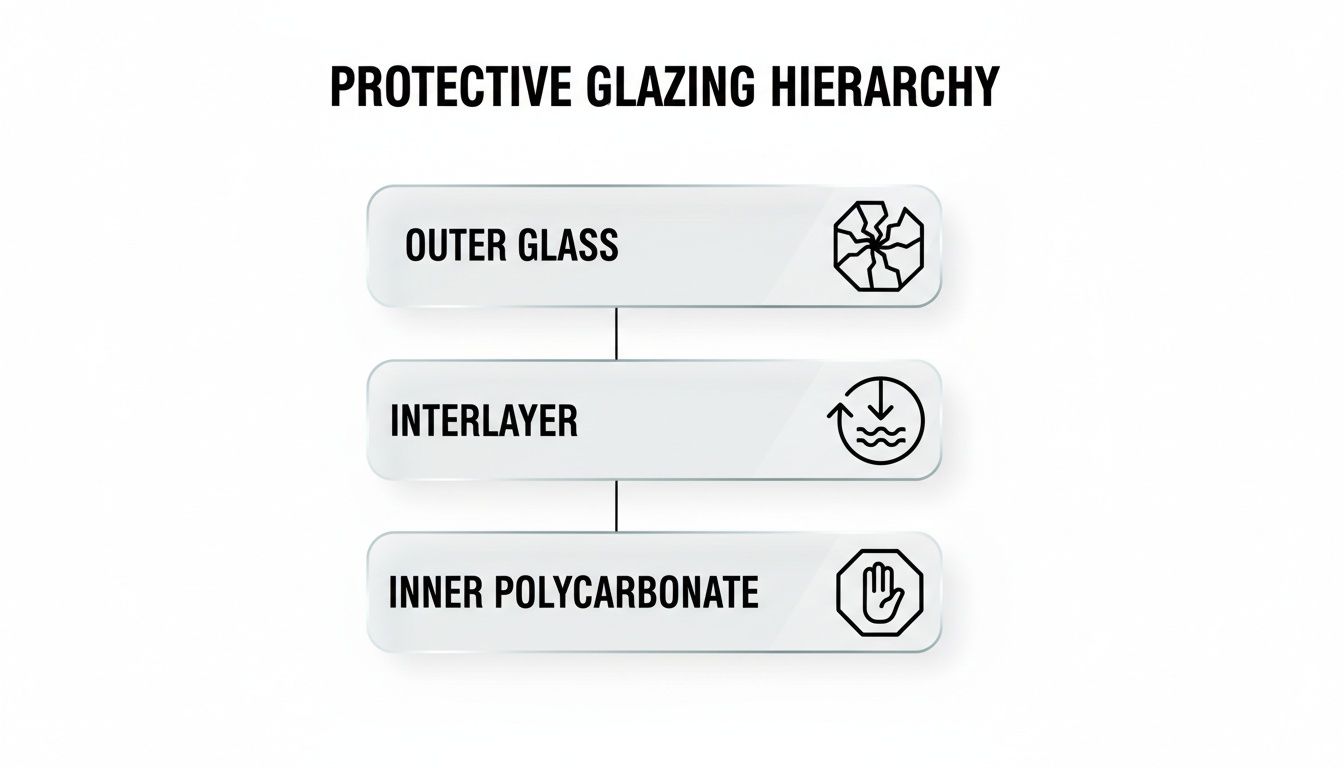
As you can see, the outer glass layer shatters to absorb the initial impact and flatten the bullet. The flexible interlayer then soaks up the shockwave of energy, and the final polycarbonate layer acts as the backstop, catching the projectile completely.
Choosing the Right Level for Your Home
It’s amazing how far the technology has come. Modern UL 752 Level 3 glass can now stop those powerful .44 Magnum rounds while weighing 40% less than older products. This innovation has made it incredibly popular, with an estimated 70% of new luxury homes in Texas choosing this level of protection.
When you see that a recent FBI report documented 1.2 million burglaries in the U.S., the value of this investment becomes crystal clear. Ballistic windows can reduce a projectile's ability to penetrate by an incredible 95%.
Key Takeaway: The idea isn't to prepare for a Hollywood-style siege. It's about choosing a protection level that makes sense for your environment and concerns. Over-engineering your solution just leads to unnecessary costs and installation headaches.
To help simplify your decision, we've put together a table comparing the most common ballistic ratings for residential use. It breaks down what each level stops, where it’s typically used, and how it compares in cost.
Ballistic Protection Levels for Residential Windows (NIJ & UL 752)
This table compares common ballistic ratings, the threats they are designed to stop, and their general suitability and cost for home applications.
| Protection Level | Stops Ammunition From | Typical Application | Relative Cost |
|---|---|---|---|
| UL 752 Level 1 | 9mm Handgun | Suburban homes, deterring common street crime, standard security upgrades. | $$ |
| UL 752 Level 2 | .357 Magnum Handgun | Urban homes, properties in higher-risk areas, increased protection against common threats. | $$$ |
| UL 752 Level 3 | .44 Magnum Handgun | Luxury homes, high-net-worth individuals, homes with specific or elevated threat profiles. | $$$$ |
| UL 752 Level 4 | .30 Caliber Rifle | High-security applications, homes requiring protection against high-powered rifles. | $$$$$ |
While full replacement windows offer certified ballistic stopping power, it’s important to know they aren't your only option. Advanced security films can provide incredible resistance against forced entry and impact at a more accessible price point.
For homeowners looking for a powerful security retrofit, learning more about ballistic film for windows is a great next step. In the end, a solid understanding of these ratings empowers you to make a smart decision, ensuring your investment truly protects your family.
More Than Just Bulletproofing: The Unexpected Perks of Ballistic Glass
When you think about installing bulletproof glass for your home's windows, the first thing that comes to mind is obvious: stopping a bullet. And while that’s its primary job, it's really just the beginning of the story. The very things that make this glass so tough—its multiple, bonded layers—also deliver a whole host of other benefits that can seriously upgrade your home.
Let's start with the most common threat: break-ins. Your standard window is a burglar's best friend. A well-aimed rock or a quick pry with a crowbar, and they're in. Ballistic glass completely flips that script. Its layered construction of glass and tough polycarbonate is designed to absorb and spread out immense force, making it a nightmare for anyone trying to smash their way through.
A Shield Against Intruders and Storms
That incredible strength does more than just stop criminals. It also provides a formidable defense against Mother Nature at her worst. If you live in an area where hurricanes or tornadoes are a real threat, you know that flying debris is one of the biggest dangers.
Bullet-resistant glass can take a hit from high-velocity impacts, keeping punishing wind, driving rain, and dangerous projectiles outside. It protects your property and, more importantly, keeps your family safe inside when a storm is raging. It’s this dual-purpose resilience that makes it such a smart investment for total home protection.
Think about it this way: if a window is engineered to stop a speeding bullet, it's not going to have much trouble with a piece of flying debris or a brick. This is one of the most practical—and often overlooked—advantages you get with ballistic-grade security.
This comprehensive approach to safety isn't just theory; it's proving its worth in the real world. Recent surveys show a 90% satisfaction rate among homeowners, who credit the glass with thwarting 85% of smash-and-grab attempts. It's no wonder installations are climbing by 20% annually in major markets. Homeowners are catching on that this is an investment in genuine peace of mind. You can explore the growing bulletproof glass market to see the trends for yourself.
Improving Your Day-to-Day Life
Beyond active threats, the benefits of ballistic glass weave themselves into the fabric of your daily life. That dense, multi-layered design is an incredible sound barrier, effectively muffling the world outside.
It’s like turning down the volume on your neighborhood. This is a game-changer if you live near a busy road, an airport, or just have noisy neighbors. The peace and quiet it brings to your home is something you'll appreciate every single day.
Finally, these windows act as a powerful guardian for everything inside your home. The same plastic interlayers that stop impacts are also fantastic at blocking the sun's damaging ultraviolet (UV) rays. This has two major benefits:
- It Protects Your Furnishings: Sunlight is the primary culprit behind faded hardwood floors, expensive furniture, rugs, and artwork. Ballistic glass helps preserve their color and value.
- It Shields Your Family: You can enjoy all the bright, natural light without worrying about the harmful effects of constant UV exposure.
So, when you choose bullet-resistant glass, you're not just preparing for an unlikely worst-case scenario. You're investing in a home that's stronger, significantly quieter, and better protected from the elements—delivering real, tangible benefits from the moment it's installed.
Budgeting for Bulletproof Window Installation
When you start to budget for bulletproof glass for home windows, it's easy to focus on the glass itself. But that’s just one piece of the puzzle. The total cost involves a lot more, from beefing up the window frames to the specialized labor required for a proper install. Getting a handle on all these moving parts is key to setting a realistic budget.
The biggest factor driving the price is, without a doubt, the ballistic rating. It's simple, really: the more powerful the threat you want to stop, the thicker, heavier, and more complex the glass needs to be. A Level 1 window, designed for common handgun rounds like a 9mm, will be a lot easier on the wallet than a Level 3 window built to stop a .44 Magnum.
Breaking Down the Core Costs
Pricing for bullet-resistant glass is usually quoted per square foot, and the numbers can vary quite a bit. The good news is that manufacturing has come a long way, making this level of security more accessible than ever. In fact, average costs have dropped by about 25% since 2019, landing somewhere between USD 50 to 100 per square foot for lower-level ratings.
This drop in price has led to a major uptick in residential projects. In just the last year, installations hit 50,000 homes across the U.S.—an 18% jump from the year before. You can dive deeper into these trends in this comprehensive market report.
But remember, the glass isn't the only line item. You also need to account for:
- Window Frames: Ballistic glass is heavy—far heavier than standard glass. Your existing frames likely won't cut it. They’ll probably need to be replaced with reinforced steel or aluminum models that can handle the weight and the force of an impact.
- Professional Installation: This is absolutely not a DIY job. You need certified pros who know how to install the entire system—glass, frame, and seals—so that it performs exactly as it’s designed to. Labor costs will depend on how complex your project is.
- Project Type: Retrofitting new ballistic windows into an existing home is often more complicated, and therefore more expensive, than designing them into a new construction build from the very beginning.
The Return on Your Security Investment
The upfront cost is certainly a consideration, but think of it as a permanent upgrade to your home. Installing bullet-resistant windows adds real value to your property and can even lead to some nice financial perks down the road.
One of the quickest returns you'll see is on your homeowner's insurance. Insurers see this upgrade as a serious deterrent to break-ins and damage, and they often reward it with significant discounts.
How significant? Insurance industry data shows that homeowners with certified ballistic protection can slash their premiums by up to 22%. Over time, those savings can really add up, offsetting a good chunk of your initial investment.
Budget-Friendly Alternatives to Full Replacement
If a full window replacement project just isn't in the cards right now, don't worry. High-performance ballistic security films are a fantastic, more affordable alternative. These tough, multi-layered films are applied directly to your existing window panes, dramatically reinforcing them against impact.
While they won't offer the same certified bullet-stopping power as a purpose-built ballistic window, they make your glass incredibly difficult to shatter. This creates a powerful barrier against forced entry and smash-and-grab attempts. To see how the numbers stack up, take a look at our guide on the cost of security window films. It's a way to get a major security upgrade for a fraction of the cost.
Installation, Aesthetics, and Navigating the Rules
So you've chosen the right ballistic rating. That’s a huge step, but the job isn't done yet. Even the most advanced bulletproof glass for home windows is only as good as the team that installs it. The entire system—the glass, the frame, and how it’s anchored into your wall—has to work together as a single, unyielding unit.
This is why a professional installation isn't just a good idea; it's essential. Think of your window as a chain. The ballistic glass is a powerful link, but if the frame is weak or it's not secured properly, the whole system will fail when it matters most. Certified installers bring the specialized expertise needed to make sure every single component is up to the task.
Getting the installation right is everything. It underscores the need for reputable professionals, much like finding a certified access control installer for other layers of your home’s security. These experts know the unique physics and structural demands that come with heavy security glazing.
Seamless Security That Doesn't Look Like a Fortress
One of the biggest concerns we hear from homeowners is the fear of their house ending up looking like a concrete bunker. Let's put that worry to rest. Modern security glazing is engineered to be practically invisible. The days of thick, clunky, green-tinted bulletproof glass are a thing of the past.
Today’s bullet-resistant windows offer stunning optical clarity. They can be custom-built to complement any architectural style you can imagine, from a historic colonial to an ultra-modern design. You simply don't have to sacrifice your home's beauty for world-class protection.
These advanced systems can be tailored to meet your exact needs:
- Custom Shapes and Sizes designed to fit arches, circles, or any other unique window opening.
- Decorative Tints and Films that provide both privacy and a touch of personal style.
- Energy-Efficient Coatings, like Low-E, which help lower your heating and cooling bills.
This kind of versatility ensures your security upgrade blends right in, preserving your home’s character, curb appeal, and overall value.
A professional installation means your home is fiercely protected, but no one has to know it. The goal is discreet security that brings peace of mind without changing how you live or how your home looks.
The demand for these invisible solutions is growing fast. Driven by rising security concerns, the U.S. market for bulletproof glass hit USD 2.61 billion and is projected to climb to USD 5.86 billion by 2032. This trend directly reflects the unfortunate reality of over 43,000 gun-related deaths in the U.S. in a single recent year, which has fueled a 60.62% growth in North American demand.
Navigating Local Codes and Regulations
The final piece of this puzzle is making sure your project is fully compliant with local laws and regulations. Before any work begins, it's critical to check in with your city or county building department. Some areas have specific codes governing security modifications, especially if you live in a historic district or a neighborhood with strict architectural rules.
And don't forget the HOA. If you're part of a Homeowners Association, you'll need to review their bylaws carefully. Many have rules about window appearance, and getting their blessing beforehand can save you from major headaches and potential fines. A good professional installer can often help you navigate this paperwork. You can learn more about ensuring a smooth process with our guide on security window film installation.
Your Top Questions About Bullet-Resistant Glass Answered
It's natural to have a few questions as you think about bringing this level of security to your home. Let's walk through some of the most common things homeowners ask, clearing up any confusion so you can make a smart, informed choice about bulletproof glass for home windows.
We'll tackle the real-world concerns, from aesthetics to cost-effectiveness, giving you the practical insights you need.
Will This Make My Home Look Like a Bunker?
Absolutely not. That’s probably the biggest myth out there. Forget the thick, greenish panels you see in movies—today’s bullet-resistant glass is designed to be visually identical to high-end architectural windows.
Modern materials have made it possible to create thinner, lighter glazing that still provides incredible protection. You can get custom shapes and sizes, add low-E coatings for energy savings, and match your home's style perfectly. No one will know the difference.
Can I Just Use Security Film Instead of Replacing the Whole Window?
Yes, and for many people, this is a fantastic and much more budget-friendly approach. Security films are tough, multi-layered sheets that get professionally bonded to your existing windows, basically holding the glass together if it's hit.
While a film won't give you a formal ballistic rating like a full window replacement, it dramatically boosts your defense against forced entry. It’s an incredibly effective deterrent against smash-and-grab burglars and other would-be intruders, all at a fraction of the cost.
The real magic of security film is reinforcement. It turns your weakest entry point—the glass—into a serious obstacle, buying you precious time in an emergency without the expense of a full tear-out and replacement.
How Do I Clean and Care for Bulletproof Windows?
Good news: it's surprisingly easy. The cleaning method just depends on the outer surface of your window. If it's glass, you can clean it exactly like you do now with your favorite glass cleaner.
If your windows have a polycarbonate outer layer (often used for scratch resistance), just skip harsh chemicals like ammonia. A soft microfiber cloth with a simple mix of mild soap and water is all it takes to keep them perfectly clear. Your installer will give you the exact rundown for your specific product.
Will Installing Bulletproof Glass Lower My Home Insurance Premiums?
There’s a very good chance it will. When you install certified ballistic windows, you're making a massive upgrade to your home's security profile, drastically cutting the risk of break-ins and damage.
Insurance companies love to see this kind of proactive protection and often reward it with significant discounts on your homeowner's policy—sometimes in the 15-25% range. Just make sure to give your agent the official certification and specs for your new windows to lock in the savings. It's an investment that protects you and pays you back.
Ready to enhance your home’s security without sacrificing its beauty? Fortress Security Films offers advanced, nearly invisible window protection solutions tailored to your needs.
Discover how our expert team can safeguard your home with cutting-edge security films.
