


When people hear the term "bulletproof glass for homes", they often picture an impenetrable fortress, maybe something out of a spy movie. The reality is far more practical and, frankly, more accessible. True security for a home isn't about making it indestructible; it's about bullet-resistant solutions engineered to delay, deter, and ultimately deny intruders.
These systems fortify your home without sacrificing its style, giving you peace of mind that’s both powerful and practically invisible.
Securing Your Home With Ballistic Protection
For most homeowners, especially those in upscale Southern California communities, the goal isn't to stop a tank. It's to turn your home's weakest points—its beautiful, expansive windows—into a formidable line of defense. The entire strategy revolves around buying time. It's about turning a smash-and-grab that takes seconds into a loud, difficult, multi-minute ordeal that sends intruders running and gives authorities time to arrive.
Thinking "bullet-resistant" instead of "bulletproof" is the key. This subtle but critical shift in mindset opens up a whole world of effective solutions that blend right into your home's design. You don't have to give up your ocean views or natural light to feel safe.
Two Paths to Enhanced Window Security
When it comes to upgrading your windows, there are generally two ways to go about it. Each has its place, depending on your home, budget, and security goals.
- Retrofitting with Ballistic Films: This is where an advanced, multi-layered security film is applied directly onto your existing window panes. It's a much less disruptive process that strengthens the glass and, most importantly, holds it together if it’s shattered. It's often the most straightforward and cost-effective option.
- Full Replacement with Laminated Glass: This is the more comprehensive approach. We’re talking about removing your old windows entirely and installing new units built with laminated ballistic glazing from the factory. This path can deliver higher, certified levels of protection.
The real goal of residential ballistic protection is strategic delay. By reinforcing your windows, you take away the easiest and quietest way in. You force a potential intruder to make a ton of noise and waste precious time trying to get through, which is usually the best deterrent there is.
It's no surprise that demand for these systems is climbing. The global market for bulletproof glass is expected to skyrocket from $9.3 billion in 2023 to $29.5 billion by 2033. That’s a huge jump, and it shows just how seriously homeowners are taking security these days.
To help you get a quick overview, here's a simple breakdown of the main options.
Quick Guide to Residential Window Protection
| Solution Type | Primary Benefit | Best For | Aesthetic Impact |
|---|---|---|---|
| Security Film | Shatter resistance, delay | Deterring forced entry, smash-and-grabs | Virtually invisible on existing glass |
| Laminated Glass | Higher impact/ballistic ratings | Certified protection, high-risk areas | Minimal; integrated into new window unit |
| Security Screens | Physical barrier, ventilation | Visible deterrence, preventing entry even if glass breaks | Varies by design, can be a visible layer |
This table is just a starting point. While ballistic glass provides incredible protection, remember there are other great ways to fortify your home, like installing high-quality security screens for windows.
Ultimately, understanding what's available is the first and most important step. This guide will walk you through everything you need to know to create a home that is both beautiful and secure.
How Bullet-Resistant Glass Actually Works
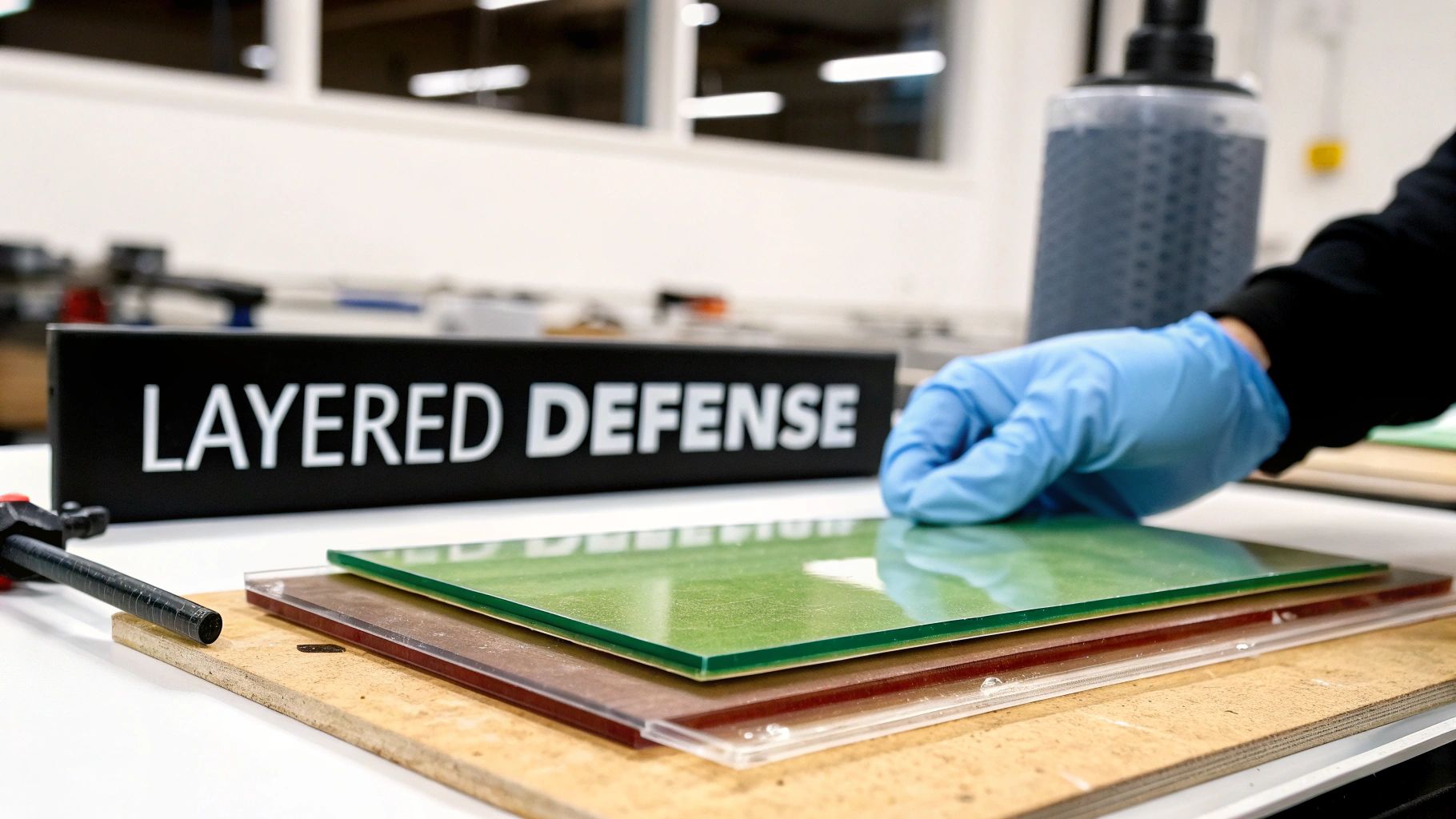
The magic behind bullet-proof glass for homes isn't about creating an indestructible, diamond-hard barrier. It’s far more clever than that. The real secret is in energy absorption and controlled failure—a system designed to stop a projectile in its tracks and keep the occupants safe. There are two main ways to achieve this, each with its own science.
The classic approach is what’s known as laminated ballistic glazing. Think of it less like a single pane of glass and more like a high-tech club sandwich. It’s not one super-strong sheet, but a precisely engineered stack of multiple layers fused together with intense heat and pressure.
This "sandwich" alternates between rigid glass and flexible polymer materials. The outermost layer of hardened glass serves as the first line of defense. Its job is to shatter on impact, which immediately blunts the bullet, flattens its tip, and scrubs off a huge amount of its initial speed.
The Science of Absorption
Once the bullet is deformed and slowed, the inner layers go to work. These are usually made from materials like polycarbonate or polyvinyl butyral (PVB), which is a remarkably tough and elastic polymer. This softer, flexible core is the system's "catcher's mitt."
It absorbs the bullet's remaining kinetic energy, allowing the force to ripple through the layers. The core flexes and stretches without breaking, spreading the impact over a much wider surface area. This distribution of force is what stops the bullet from punching through.
The core principle is simple but brilliant: a combination of hard and soft materials is exponentially stronger than one thick pane. The glass shatters to slow the bullet down, and the polymer core catches it, preventing penetration while also stopping deadly glass shards from flying into the room.
This layered defense is precisely what makes bullet-proof glass for homes so effective. The system is designed to sacrifice its outer layers to completely neutralize the threat.
High-Tech Armor for Your Existing Windows
The second method involves retrofitting your existing windows with advanced security films. This is like giving your current glass a flexible, micro-thin suit of armor. We're not talking about a simple sticker; this is a sophisticated polymer sheet, many times thicker than standard solar film, that is professionally bonded to the interior face of your window.
While a single layer of film on its own won't stop a bullet, certified ballistic film systems absolutely can. These systems use a similar principle of energy absorption but add a critical component: a structural anchoring system.
The installation involves more than just applying the film. It's bonded directly to the window frame itself, usually with a powerful structural silicone or a mechanical attachment. This turns the separate components—film, glass, and frame—into a single, unified shield.
When a window treated with an anchored film system is struck:
- The glass will likely shatter, but the incredibly strong film holds all the dangerous fragments tightly together within the frame.
- A protective barrier remains, preventing an intruder (or a projectile) from getting through immediately.
- The anchored film flexes like a trampoline, absorbing and dissipating the impact energy across the entire window unit.
This technology transforms a standard piece of glass into a surprisingly resilient barrier. It lets you maintain the look of your home while adding a powerful, invisible layer of protection that buys you critical time to react. The real strength comes from the synergy between the tough film and its secure bond to the frame, which allows the entire system to stand up to incredible force.
Choosing Your Path: Security Film or Full Glass Replacement?
When you decide to secure your home’s most vulnerable points—its windows—you’ll quickly find yourself at a fork in the road. Do you retrofit your existing glass with advanced security film, or do you go for a full replacement with factory-made ballistic glass? There’s no single right answer. The best path for you comes down to your specific security goals, your budget, the look you want for your home, and how quickly you need it done.
This isn't just a niche concern anymore. Homeowners are taking this seriously. North America now accounts for 35.8% of the entire global market for bullet-resistant glass, a market valued at $5.7 billion back in 2022. That number is climbing by a staggering 17.5% every year, largely driven by people like you looking to protect their homes and families. Data Bridge Market Research has some fascinating insights on this trend if you're curious.
Let's walk through the pros and cons of each approach so you can make a choice that gives you real peace of mind.
The Case for an Advanced Security Film Retrofit
For many Southern California homeowners, retrofitting with a high-performance security film system is the most sensible and effective option. Think of it as adding an invisible, high-tech shield to the beautiful windows you already have. It’s a powerful security upgrade without the headache of a major construction project.
The advantages here are pretty clear:
- It’s Far More Affordable: This is the big one. Retrofitting is significantly less expensive than tearing out and replacing entire window units. You're enhancing what's already there, so you save a bundle on both materials and labor.
- Life Goes On During Installation: The process is clean, quiet, and surprisingly fast. Certified pros work from inside your home, and most residential projects are wrapped up in just a few days. There’s almost never a need for structural changes. Our guide on the security window film installation process breaks down just how smooth it is.
- Your Home's Character Stays Intact: Live in a home with custom, historic, or architecturally unique windows? Film is your answer. It's optically clear and basically disappears once applied, so your home’s original charm and design are perfectly preserved.
Security film gives you a formidable defense by transforming your existing glass into a tough, resilient barrier. It’s designed to absorb shock and hold shattered glass in a single sheet, buying precious time during a break-in attempt—all without changing how your windows look.
This approach is perfect if you’re looking for a major security boost that’s discreet and doesn't break the bank. It's a fantastic deterrent against smash-and-grab burglaries, offers blast mitigation, and reinforces glass against brute force.
When a Full Ballistic Glass Replacement Makes Sense
While security film is an amazing solution for most, there are definitely times when a full replacement with laminated ballistic glass is the right call. This is the more intensive option, where your current windows are completely removed and replaced with new, pre-fabricated units that have ballistic-rated glazing built right into the frame.
This is the path for homeowners who need the absolute highest level of certified protection.
- You Need NIJ-Rated Protection: If you need certified defense against high-powered rifle rounds, full replacement is the only way to get it. These factory-sealed, integrated systems are engineered and tested to meet strict NIJ (National Institute of Justice) standards.
- You're Building or Doing a Major Renovation: Tearing out walls anyway? Building a new custom home? This is the perfect time to incorporate ballistic glass from the ground up. It lets you seamlessly build ultimate security right into the structure of your home.
- Your Windows Are Old and Inefficient: If your current windows are drafty, failing, or just plain old, a full replacement kills two birds with one stone. You get a top-tier security upgrade and all the benefits of modern, energy-efficient windows.
Opting for a full replacement is a serious investment in your home's long-term security and value. It delivers the kind of confidence that comes from knowing your windows meet lab-tested standards for ballistic resistance, making it the clear choice for those with the most demanding security needs.
Comparing Security Film Retrofit and Ballistic Glass Replacement
To make the decision clearer, let's put the two options side-by-side. The right choice often becomes obvious when you see how each one stacks up against your priorities.
| Factor | Advanced Security Film (Retrofit) | Laminated Ballistic Glass (Replacement) |
|---|---|---|
| Primary Goal | Forced entry delay, smash-and-grab prevention, blast mitigation. | Certified ballistic stopping power (NIJ-rated). |
| Cost | Significantly lower. Enhances existing glass. | Substantially higher. Full window and frame replacement. |
| Installation | Fast and non-disruptive (typically 1-3 days). No structural changes. | Slower and more disruptive (weeks). Requires structural work. |
| Aesthetics | Invisible. Preserves the home's original look and windows. | Requires new window units, which may alter the home's appearance. |
| Best For | Upgrading security on existing, high-quality windows. | New construction, major renovations, or when NIJ certification is required. |
| Protection Level | Excellent against blunt force, intruders, and blasts. | Certified protection against specific ammunition threats. |
Ultimately, whether you choose a film retrofit or a full glass replacement, you're taking a critical step toward fortifying your home. The key is to align your choice with your specific threat model, budget, and the unique characteristics of your property.
Decoding Ballistic Ratings for Your Home
When you start looking into bullet proof glass for homes, you’ll quickly run into a bunch of industry jargon: NIJ, UL 752, Levels I, II, IIIA. It can feel like you’re trying to learn a new language. But don't worry, it's actually pretty straightforward once you get the hang of it.
At its core, a ballistic rating is simply a grade that tells you what kind of firearm ammunition a window system can stop. The most common standard you’ll see is from the National Institute of Justice (NIJ). Think of it as a clear-cut scale for security. For a home, you’re not trying to stop high-powered rifle rounds; the real focus is on protection from common handguns.
NIJ Ratings That Matter for Homeowners
Let’s be realistic. The overwhelming majority of armed home invasions involve handguns. This is exactly why the lower-to-mid-range NIJ ratings are the sweet spot for residential security. They offer a powerful defense against the most likely threats without the massive cost, weight, and installation complexity of higher-level, military-grade systems.
Here’s how the key levels break down for home applications:
- NIJ Level I: This is your entry point. It's engineered to stop lower-velocity rounds from smaller handguns like a .38 Special or a .22 Long Rifle. While it provides a basic layer of protection, most of our clients choose to step up from here.
- NIJ Level II: This is a significant upgrade. Level II is designed to defeat more powerful 9mm rounds and higher-velocity .357 Magnum ammunition, which covers a much wider spectrum of common street weapons.
- NIJ Level IIIA: For most homeowners, this is the gold standard. It’s tested to stop nearly all common handgun rounds, including high-velocity 9mm and powerful .44 Magnum bullets.
For the vast majority of homeowners in Southern California, an NIJ Level II or IIIA system provides an exceptional balance of security, clarity, and cost. It effectively hardens your home against the most common criminal threats, turning a potential tragedy into a non-event.
The goal here is practical, intelligent security. You're creating a safe, resilient home, not an impenetrable fortress. Overspending on rifle-rated glass for a residential project is often an unnecessary expense. By focusing on handgun-rated solutions, you’re addressing the most realistic risks head-on.
This decision tree can help you visualize how your main priority—whether that’s budget or absolute security—guides you toward the best window protection solution for your needs.
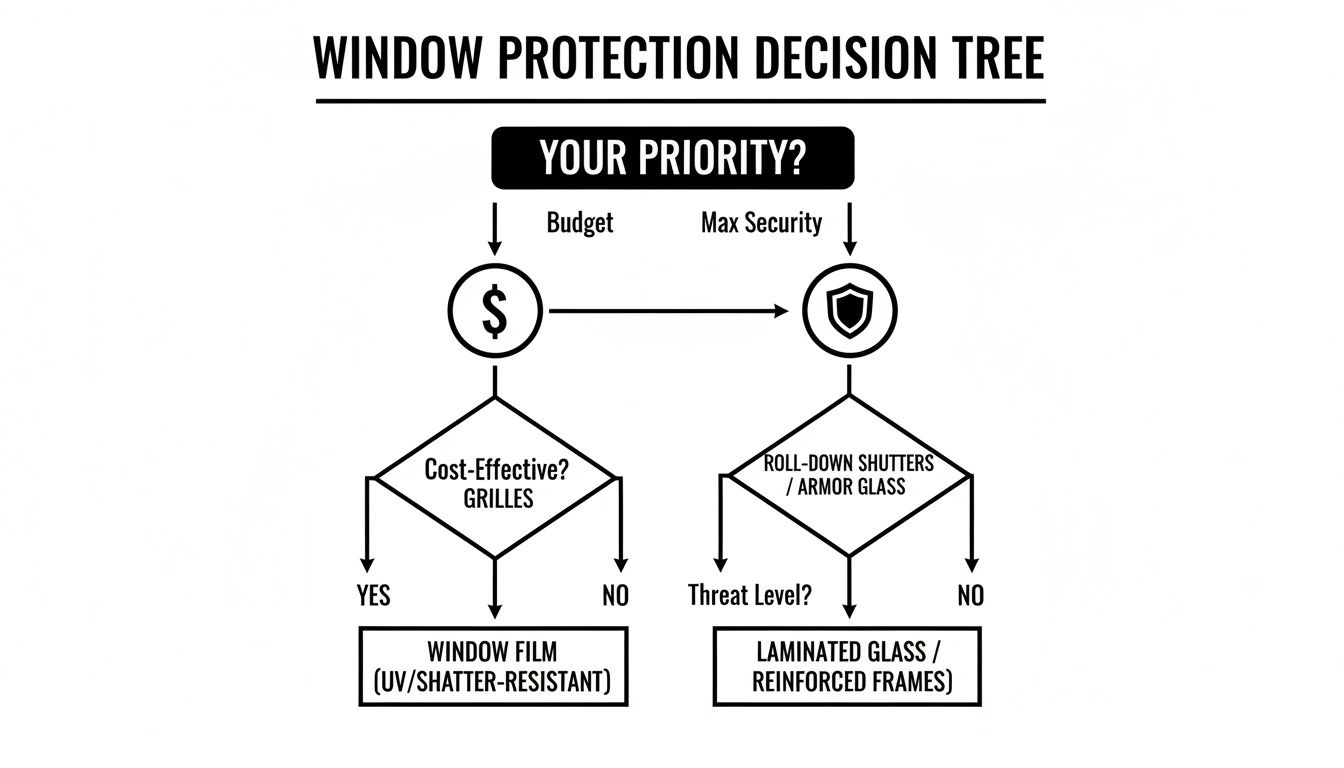
As you can see, both paths lead to a massive upgrade in your home's security. It’s all about picking the solution that best fits your family's safety goals and your budget.
It's All About the System, Not Just the Film
Here's something that’s absolutely critical to understand: a ballistic rating applies to the entire installed system, not just a sheet of film or a pane of glass by itself. A true, NIJ-certified solution is a team of three components working in perfect sync: the glazing material (laminated glass or film), your existing window frame, and the specialized anchoring mechanism that bonds the glazing to the frame.
If you just slap a thick film on glass without anchoring it to the frame, it will fail. A professional installation that securely bonds the film to the frame is what allows the entire window unit to absorb and safely dissipate the incredible energy of a bullet’s impact.
This is exactly why a professionally installed ballistic window film system is so effective. The multi-layered film itself provides the stopping power, but it's the structural anchoring that ensures the whole window stands its ground. It’s a complete defense mechanism that transforms your standard glass into a certified protective barrier.
Choosing the right level is the most important decision you'll make. By understanding what these NIJ ratings really mean, you can confidently select a solution that offers real-world protection and gives you true peace of mind.
Breaking Down the Costs and Installation
Upgrading your home's windows for ballistic protection is a serious investment in your family's peace of mind. As you might expect, the cost isn't a simple off-the-shelf price. It really depends on which path you take, the unique features of your home, and the specific level of security you're aiming for.
You're essentially looking at two very different routes: retrofitting with security film or a full replacement with ballistic glass. The price points reflect that. A security film retrofit is the more approachable option, generally running between $25 to $50 per square foot, fully installed. On the other hand, a full replacement with laminated ballistic glass is a much heavier lift financially, typically starting at $150 per square foot and easily going up from there.
So, what moves that needle? Several key factors come into play.
- Your Chosen Protection Level: A system rated for NIJ Level IIIA, capable of stopping high-caliber handgun rounds, is naturally going to cost more than a Level I system. The materials and engineering are simply more advanced.
- The Windows Themselves: Think about your home. Are the windows large, custom-shaped, or in hard-to-reach places? Any of these complexities will add to the labor and push the final price up.
- Frame Health: If you're going for a full replacement, the condition of your existing window frames is a big deal. If they need repair or reinforcement, that will factor into the overall project cost.
This isn't a niche concern anymore. The global market for bullet-resistant glass was valued at a massive $7.8 billion in 2023 and is projected to rocket to $28.4 billion by 2033. This surge is largely driven by homeowners and businesses looking for sophisticated, impact-resistant solutions.
The Installation Experience: Security Films
One of the best things about choosing a security film retrofit is how little it disrupts your life. There's no demolition, no major construction—just a clean, precise process handled by skilled technicians. It’s a smooth and surprisingly efficient upgrade.
Here’s a quick look at how it unfolds:
- Deep Cleaning: The technicians start by meticulously cleaning the inside surface of your glass. This is crucial for creating a perfect, debris-free bond.
- Applying the Film: Next, they carefully apply the security film, using special tools to squeegee out every drop of moisture. The result is an optically clear finish with no bubbles or distortions.
- Anchoring to the Frame: This is the most important step. A specialized structural sealant or a mechanical attachment system is used to fuse the film directly to the window frame. This is what creates a single, unified barrier that can withstand incredible force.
The entire installation happens from inside your home and, depending on how many windows you have, can often be wrapped up in just a couple of days. You can get a more detailed breakdown of what to expect by reviewing our guide on security window film cost.
The Process: Full Glass Replacement
Opting for a full replacement with laminated ballistic glass is a much bigger project, more akin to a standard window replacement, but on a whole other level. It's a true structural upgrade. The old window units come out completely, and new, factory-built units with the ballistic glazing already integrated are installed in their place.
While it's certainly more involved, a full replacement is the only way to achieve the highest certified NIJ protection levels. You are building ultimate security directly into the bones of your home.
This route makes the most sense during new construction or a major remodel when walls and frames might already be open. To get a realistic budget, it's smart to look at the factors that influence general window replacement costs. This gives you a complete financial picture, helping you plan accurately for a full-scale security upgrade.
Beyond Ballistics: More Benefits of Security Window Film
While the idea of bullet proof glass for homes grabs your attention for its ability to stop extreme threats, the day-to-day value you get from a professional security film system goes so much further. These films are more than just a security measure; they’re a quiet upgrade that enhances your home’s safety, comfort, and value in ways you might not have considered.
Think of it as adding an invisible, multi-talented shield to your windows that works for you around the clock. One of its most practical advantages is how it handles forced entry attempts. Standard glass is shockingly easy for a burglar to break, giving them a fast, quiet way inside.
Security film completely changes that equation. When struck, the glass will shatter, but the film holds all those dangerous pieces tightly together. This creates a tough, flexible barrier that can withstand repeated blows from a hammer, brick, or crowbar, buying you precious time and often convincing an intruder to simply give up.
A Shield Against More Than Intruders
The very same characteristic that frustrates burglars also makes security film an incredible asset during a natural disaster. Here in Southern California, we live with the reality of earthquakes. When a tremor hits, unprotected windows can explode into a spray of deadly glass shards.
A good security film system keeps those fragments locked in place, dramatically lowering the risk of serious injury. The same principle applies to severe weather, protecting your home's interior from wind, rain, and debris if a window breaks. It’s an investment that pays off in both security and basic disaster readiness.
You might install security film for an unlikely, high-stakes event, but you end up benefiting every single day from its other protective qualities. It’s a silent guardian for your home and everything in it.
Nowhere is this daily protection more obvious than in its impressive UV-blocking power. The beautiful Southern California sun that lights up our homes also carries damaging ultraviolet rays, which silently destroy your valuable interiors over time.
Preserving Your Home’s Interior Beauty
High-quality security films are engineered to block up to 99% of harmful UV radiation—all without changing the look of your glass. This invisible shield is constantly at work protecting your most cherished belongings from sun damage:
- Artwork and Photographs: Keeps your collection vibrant by preventing fading and discoloration.
- Hardwood Floors and Rugs: Stops the sun from bleaching and ruining expensive flooring, especially in rooms that get a lot of light.
- Fine Furniture: Protects delicate wood finishes from drying out and upholstery from fading and becoming brittle.
In the end, security window film is a truly comprehensive upgrade. It delivers robust forced-entry deterrence, vital disaster mitigation, and constant protection from sun damage. It’s one of the smartest ways to safeguard your family, preserve the value of your property, and gain a real sense of peace of mind.
Answering Your Questions About Ballistic Glass & Security Film
When you start looking into something as serious as bullet-resistant glass for your home, you're bound to have questions. It’s a major investment in your family's peace of mind, and you need clear, honest answers. We've compiled the most common questions we hear from homeowners to help you understand what this technology is really all about.
The idea here is to cut through the noise and give you the confidence to decide what's right for your home and family.
Will Ballistic Film Make My Windows Look Dark or Distorted?
Not at all. This is probably the biggest myth we have to bust. High-quality security films are designed to be optically clear—once a professional installs them, they are completely invisible. The whole point is to add a formidable layer of protection without changing your home's natural light, ruining your views, or clashing with the architecture.
You won't see any bubbling, haziness, or weird distortion. Your windows will look exactly the same as they do right now, just with an invisible shield working 24/7 to keep you safe.
How Much Time Does Security Film Really Add During a Break-In?
It adds a critical amount of time—often, enough to change the entire outcome. An intruder can smash a standard pane of glass in seconds. But with a professionally installed security film system, especially one with an anchoring mechanism, you're now talking about several minutes of loud, difficult work to get through.
That delay is everything. It's more than enough time for your alarm to trip, for the police to be dispatched, and for your family to get to a safe room.
Honestly, most of the time, the intruder gives up. They're looking for a quick, quiet entry. The moment they realize how much noise and effort it's taking to get through the glass, they're likely to move on to an easier target.
Security film turns your weakest point of entry into one of your strongest.
Can I Just Install This Film Myself?
For this kind of system to work as advertised, professional installation is absolutely essential. I know it might look like a simple peel-and-stick application on the surface, but getting that perfect, edge-to-edge bond without a single bubble or piece of dust takes a lot of skill and specialized tools. Even more importantly, real forced-entry and ballistic protection comes from the anchoring system that physically bonds the film to your window frame.
This is the step that turns the glass, film, and frame into one solid unit that can withstand incredible force. It's not a DIY weekend project. You need a certified technician to ensure the system will hold up under a real attack; trying to do it yourself will void the warranty and, frankly, it won't work.
How Does Security Glass Affect My Homeowners Insurance?
It can actually have a really positive effect. Many insurance companies see professionally installed ballistic glass or certified security film as a serious security upgrade and will offer you a discount on your premiums.
When you think about it from their perspective, you're actively reducing their risk in several ways:
- Forced Entry: This is the big one. It drastically lowers the chances of a successful burglary.
- Storm Damage: The film holds shattered glass in place, preventing wind, rain, and debris from destroying the inside of your home.
- Personal Injury: By containing the glass shards, it also reduces the risk of someone getting hurt during a break-in or storm.
My advice is to call your insurance agent before you even start. Let them know what you're considering and provide the product specs and certifications. You might find that the investment in your security pays for itself over time.
Ready to turn your home's most vulnerable points into a source of strength? The experts at Fortress Security Films can provide a comprehensive security assessment and show you how our invisible film systems deliver powerful protection without changing the look of your home.
